Harvey AI
The enterprise legal AI platform used by 1,300+ top law firms — Assistant, Vault, Workflows, and specialized agents for Immigration, Tax, and M&A

Quick Summary
Harvey AI is the $11B-valued legal AI platform built for BigLaw and enterprise legal teams. It combines Assistant (legal research and drafting), Vault (document review at scale), Workflows (automation), and Deep Research mode. Used by A&O Shearman, PwC, Paul Weiss, and hundreds of top firms. Enterprise-only pricing, SOC 2 and ISO 27001 certified. Score 9.1/10.
Harvey AI is the enterprise legal AI platform used by more than 1,300 law firms and in-house legal departments, including A&O Shearman, PwC, Paul Weiss, Reed Smith, Ashurst, and KPMG. The product combines four pillars — Assistant for legal research and drafting, Vault for document review at scale, Workflows for codified legal automation, and a Deep Research mode for multi-step agentic analysis. Specialized agents cover Immigration, Tax, and M&A. Pricing is enterprise-only and quote-based — there is no public rate card. Harvey is SOC 2 Type II and ISO 27001 certified, integrates natively with Microsoft 365, SharePoint, iManage, and NetDocuments, and sits at an $11 billion valuation as of 2026. Our score: 9.1 out of 10.
What Is Harvey AI?
Harvey AI is a legal AI platform built specifically for lawyers, law firms, and in-house legal teams. Founded in 2022 by a former O'Melveny & Myers antitrust attorney and a former DeepMind researcher, Harvey was incubated at OpenAI Startup Fund and has since raised capital from Sequoia Capital, Kleiner Perkins, Elad Gil, and GIC. As of 2026 the company operates at an $11 billion valuation, with approximately $190 million in annual recurring revenue and deployments across more than 100,000 individual lawyer seats.
Unlike general-purpose chatbots, Harvey is purpose-built for regulated legal work. That means three things in practice. First, outputs ship as risk-framed legal artifacts — memos with confidence levels, caveats, and jurisdictional notes — rather than as generic chat answers. Second, every output is grounded in a combination of public case law, statutory material, regulatory corpora, and the firm's own matter archive. Third, the platform integrates natively with the systems lawyers already use: Microsoft Word for drafting, Outlook for correspondence, SharePoint and iManage for matter content, and NetDocuments for firm-wide document management.
This article covers the product itself — what Harvey does day to day, how the four core surfaces are used in real matters, how it stacks up against CoCounsel, Lexis+ AI, Robin AI, and Eve.Legal, and what to expect from enterprise procurement. For the investor-angle story on Harvey's $11 billion raise and vertical AI thesis, see our separate analysis.
Assistant: The Conversational Layer for Legal Research and Drafting
Assistant is the surface most lawyers encounter first. On the surface it looks like a chat interface. Under the hood it is a legally grounded reasoning system tuned for the failure modes that matter in law: hallucinated citations, outdated case law, jurisdictional errors, and unauthorized practice of law.
Legal research inside Assistant
A typical Assistant research query looks something like this: "Summarize Delaware Chancery case law on breach of fiduciary duty by LLC managers since 2020, with pinpoint citations and a note on where the holdings diverge." The response arrives as a structured memo — not a chat paragraph — with section headings for the controlling authority, the divergent lines of reasoning, and the unsettled questions. Citations are pinpoint (with paragraph or page references) rather than generic case names. Where Harvey is uncertain, it flags confidence levels and suggests follow-up queries.
Compared to the same query on ChatGPT or Claude, the difference is not just accuracy — it is artifact shape. Generic models answer questions. Harvey produces the memo a senior associate would hand to a partner. That artifact-level difference is why 100,000 lawyers keep paying for Harvey instead of self-hosting GPT-5.4 with a legal prompt.
Drafting inside Word and Outlook
Assistant is also exposed as a Microsoft Word add-in and an Outlook add-in. Inside Word, a lawyer can highlight a clause and ask Harvey to "tighten the indemnity to match our standard form" or "flag any terms that diverge from the firm's M&A playbook." Redlines land directly in the document with tracked changes. Inside Outlook, Harvey drafts client emails, summarizes inbound correspondence, and extracts action items from long threads.
This is where the Microsoft 365 integration matters. Lawyers do not want to copy text into a separate web app and paste answers back. They want the AI inside the document they are already editing. Harvey's Word and Outlook add-ins deliver that workflow with Entra ID authentication, matter scoping inherited from the DMS, and audit trails flowing into the firm's compliance stack.
Matter-aware context
Any Assistant query can be scoped to a specific matter, client, or practice group. When scoped, Harvey pulls relevant prior work, firm precedents, and matter-specific documents into the context window. The practical effect: a lawyer working on a Delaware M&A matter for Client X gets responses that reference the specific deal documents, prior closings with that client, and the firm's house-style M&A playbook — not generic M&A boilerplate.
Vault: Document Review and Diligence at Firm Scale
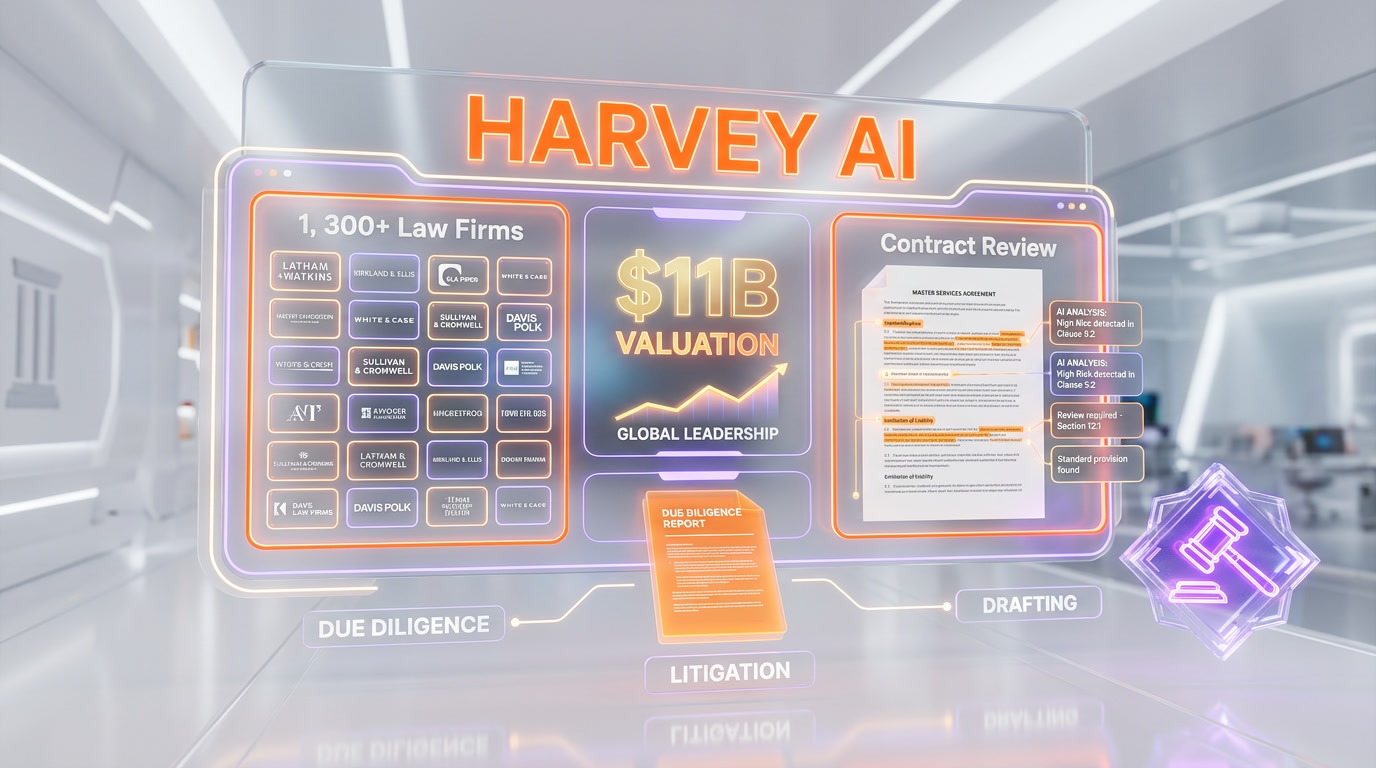
Vault is the surface that turned Harvey from "a good legal chatbot" into a platform AmLaw 100 firms cannot operate without. It is a secure document workspace designed for the workflows where volume overwhelms human review — M&A due diligence, second requests, privilege review, large-scale contract analysis, and regulatory data requests.
Document intake and structuring
A Vault workspace can ingest thousands of files in a single upload — PDFs, Word documents, Excel files, scanned images with OCR, and email archives. Once ingested, Harvey auto-classifies documents (contracts, correspondence, filings, financial statements) and extracts key metadata (parties, dates, governing law, signature status). A mid-sized M&A data room of 40,000 documents typically processes in under 90 minutes.
Structured review and extraction
Once ingested, lawyers run structured review queries across the entire corpus. Examples: "Extract all change-of-control provisions and flag any that are triggered by the proposed transaction," or "Summarize every indemnification cap above $5 million and note the governing law." Harvey returns a table with one row per hit, citations to the source document and paragraph, and the extracted clause text. Lawyers review, flag exceptions, and export directly into disclosure schedules or diligence memos.
Compared to traditional contract review platforms like Kira or eBrevia, Vault's advantage is the open-ended query interface. Traditional tools require a pre-defined clause taxonomy — they extract what the template knows. Vault lets a lawyer ask any question the matter requires, including questions the taxonomy did not anticipate.
Cross-document comparison and Q&A
Vault also supports cross-document reasoning. A lawyer can ask "Which of these 120 supply contracts have non-standard termination-for-convenience provisions?" and get an answer that compares each contract against a reference template. For diligence teams, this collapses the most painful part of the job — the "find the outliers in the pile" task — from weeks to hours.
Privilege and security
Every Vault workspace is walled off by matter and client. Access controls flow from the firm's identity provider (Entra ID, Okta). Documents stay inside Harvey's SOC 2 Type II and ISO 27001 certified infrastructure, with configurable data residency. Audit trails capture every query, output, and document view — for both internal risk management and downstream client audits.
Workflows: Turning Repeatable Legal Tasks into One-Click Automations
Workflows is Harvey's answer to the fact that most legal work is not novel — it is the same structured process applied to new inputs. NDA review. Lease abstraction. Second request response drafting. Real estate closing checklists. Privilege log generation. Every firm does these hundreds of times a year, and every firm runs them slightly differently based on practice group, client, or jurisdiction.
A Workflow is a codified multi-step process built inside Harvey's no-code workflow builder. A typical NDA review workflow might look like: ingest the incoming NDA, extract key terms (parties, term length, definition of confidential information, permitted disclosures, governing law), compare against the firm's NDA playbook, flag deviations, generate a redline, and produce a partner-facing summary memo. Any lawyer at the firm can then run that workflow on a new NDA with one click.
Shipped templates and firm-specific builds
Harvey ships a library of pre-built workflow templates — NDAs, MSAs, DPAs, real estate leases, employment agreements, and standard M&A diligence checklists. Firms customize these to match their playbooks. For proprietary workflows (a firm's signature second-request response methodology, for example), firms build bespoke workflows that become institutional IP.
Why Workflows matter strategically
The strategic value is leverage. A senior partner's playbook — the mental checklist that made them one of the best M&A lawyers in the firm — can be codified into a Workflow any associate runs on every deal. That is how firms turn individual expertise into firm-wide capability and defend their billing rates: the output is not "what a junior associate produced," it is "what a senior partner's methodology produced, executed at scale."
Deep Research Mode: Multi-Step Agentic Legal Analysis
Deep Research is Harvey's long-horizon reasoning mode. Rather than responding to a single query, it runs a multi-step agentic pipeline: decompose the question, plan the research, retrieve relevant sources, cross-check findings, synthesize a structured memo, and cite every claim. A Deep Research query typically takes 5 to 20 minutes to complete and produces a multi-page memo with a full citation trail.
Use cases include novel legal questions (where standard research tools return nothing directly on point), cross-jurisdictional analysis (where a single question has to be answered under multiple bodies of law), and regulatory landscape reviews (mapping the state of the art across dozens of sources). For the kind of work a first-year associate used to spend a weekend on, Deep Research produces comparable output in under 30 minutes.
Specialized Agents: Immigration, Tax, and M&A
On top of Assistant, Vault, Workflows, and Deep Research, Harvey has shipped specialized agents for three practice areas where domain depth materially changes output quality.
Immigration Agent
The Immigration Agent handles visa strategy, petition drafting, Request for Evidence (RFE) responses, and coordination across multiple jurisdictions. It has been trained on immigration-specific corpora — country-by-country visa frameworks, USCIS guidance, consular processing nuances — and produces outputs formatted for immigration practice (I-140 petition narratives, H-1B RFE rebuttals, PERM recruitment reports). For immigration practice groups inside BigLaw or boutique immigration firms, the agent compresses petition drafting from days to hours.
Tax Agent
The Tax Agent handles tax research, structuring memos, cross-border analysis, and Internal Revenue Code section reasoning. It is tuned on tax-specific authorities — Code sections, Treasury regulations, revenue rulings, private letter rulings, and key tax court decisions — and produces outputs that match tax-practice artifacts (structuring memos, opinion letters, transfer pricing analyses). The agent is particularly valuable for mid-sized firms that want Big Four-grade tax analysis capability without Big Four headcount.
M&A Agent
The M&A Agent handles due diligence, disclosure schedule review, merger agreement analysis, and deal-process acceleration. It plugs into Vault for document review and into Workflows for repeatable diligence tasks. The agent is trained on merger agreement precedents, disclosure schedule conventions, and deal-process playbooks. In a typical mid-market deal, the M&A Agent shaves 30 to 50 percent off the diligence timeline — the single largest efficiency gain any legal AI product has demonstrated at scale.
Who Uses Harvey AI
The Harvey install base skews heavily toward top-tier firms and in-house legal departments at large enterprises. Public reference customers include:
- A&O Shearman — one of the largest global law firms, using Harvey across transactional, litigation, and regulatory practice groups
- Paul, Weiss, Rifkind, Wharton & Garrison — a top-tier New York firm known for high-stakes litigation and M&A
- Reed Smith — an early Harvey partner and one of the first AmLaw 100 firms to deploy at firm scale
- Ashurst — global law firm headquartered in the UK, using Harvey across multiple practice groups
- PwC — deploying Harvey across legal, tax, and M&A advisory services
- KPMG — deploying Harvey across legal services and tax advisory
Beyond the named accounts, Harvey reports 1,300+ firms and 100,000+ individual lawyer seats. The typical customer is an AmLaw 200 firm, a Big Four accounting firm's legal or tax practice, or a Fortune 500 in-house legal department. Harvey is also used by elite boutique firms in immigration, tax, and M&A.
What you do not see in the install base: solo practitioners, firms under 20 attorneys, and firms on Google Workspace without a Microsoft 365 or DMS backbone. The product and pricing are built for a specific tier of the market.
Enterprise Pricing: How to Get a Harvey AI Quote
Harvey does not publish pricing. Every deal is quote-based, negotiated through a dedicated enterprise sales process, and typically structured as a multi-year firm-wide license rather than a per-seat subscription. This is a deliberate product positioning choice — Harvey targets firm-level commitments from procurement, risk, and IT decision-makers, not individual lawyer seat sign-ups.
What we know about the pricing structure
Based on conversations with firms that have deployed Harvey and with former Harvey account executives, the typical contract structure has three main drivers:
- Seat count. Firm-wide licenses are priced on committed seat volume. Larger firms negotiate meaningfully better per-seat economics than smaller firms.
- Module mix. Firms that deploy Assistant only pay less than firms that deploy Assistant + Vault + Workflows + specialized agents. The M&A Agent and the Tax Agent in particular command premium pricing because of the depth of the domain-specific tuning.
- Usage envelope. Harvey contracts typically include a committed usage envelope (queries, documents ingested, Deep Research runs) with overage pricing above the cap.
We are not publishing specific dollar figures — they vary widely by firm and are negotiated under NDA. Directionally: AmLaw 100 firm-wide deployments run into seven figures annually. Mid-market firm deployments (50 to 300 attorneys) run into six figures annually. Below 50 attorneys, Harvey is generally not a good economic fit.
The procurement process
A typical Harvey procurement cycle runs 3 to 6 months and involves the firm's innovation or knowledge management team, IT and security review, risk and compliance review, and sign-off from the managing partner or firm-wide committee. The process covers:
- Security and compliance review — SOC 2 Type II report, ISO 27001 certification, penetration test results, data residency configuration, and incident response procedures
- Integration review — compatibility with the firm's DMS (iManage, NetDocuments, SharePoint), identity provider (Entra ID, Okta), and audit/monitoring stack
- Pilot or proof of concept — usually 60 to 90 days, scoped to a specific practice group, with success metrics defined up front
- Contract negotiation — pricing, SLAs, data processing terms, professional indemnity carve-outs, and exit provisions
When Harvey pricing makes economic sense
Harvey is priced as an infrastructure investment, not a tool purchase. The economics work when three conditions hold: the firm is large enough (50+ attorneys) to amortize the fixed cost, has meaningful exposure to document-heavy practice areas (M&A, litigation, regulatory, real estate) where Vault and Workflows drive billable-hour leverage, and has a credible plan to deploy firm-wide within 12 months. Outside those conditions, CoCounsel, Lexis+ AI, or a more narrowly scoped tool is usually a better fit.
Harvey AI vs Thomson Reuters CoCounsel vs Lexis+ AI vs Robin AI vs Eve.Legal

The legal AI market in 2026 has consolidated around five serious platforms that show up in the same enterprise RFP: Harvey AI, Thomson Reuters CoCounsel, Lexis+ AI, Robin AI, and Eve.Legal. Each has a different shape.
| Dimension | Harvey AI | CoCounsel | Lexis+ AI | Robin AI | Eve.Legal |
|---|---|---|---|---|---|
| Primary strength | End-to-end platform (Assistant + Vault + Workflows + agents) | Bundled with Westlaw research database | Bundled with Lexis research database | Contract review specialist | Plaintiffs' firm focus |
| Document review at scale | Vault (strong) | Limited | Limited | Strong for contracts specifically | Case-specific |
| Legal research | Assistant + Deep Research | Westlaw-native (strong) | Lexis-native (strong) | Not a focus | Not a focus |
| Workflow automation | Native Workflows builder | Limited | Limited | Contract-specific | Case intake workflows |
| Specialized agents | Immigration, Tax, M&A | Not yet | Not yet | Contract-only | Case-type specific |
| Microsoft 365 integration | Native add-ins | Yes | Yes | Partial | Partial |
| DMS integration | iManage, NetDocuments, SharePoint | iManage, NetDocuments | iManage, NetDocuments | Limited | Case-management tools |
| Pricing model | Enterprise (quote) | Bundled with Westlaw subscription | Bundled with Lexis subscription | Per-seat (more transparent) | Per-seat or usage |
| Install base | 1,300+ firms, 100K+ lawyers | Tens of thousands (Westlaw footprint) | Tens of thousands (Lexis footprint) | Focused, smaller | Plaintiffs' firm niche |
| Best for | AmLaw 200 and enterprise legal teams wanting a platform | Firms already deep in the Thomson Reuters ecosystem | Firms already deep in the LexisNexis ecosystem | Transactional teams focused on contracts | Plaintiffs' firms and specialized litigation |
Harvey vs Thomson Reuters CoCounsel
CoCounsel's advantage is distribution — it ships bundled with Westlaw, which means most AmLaw 200 firms already have access as part of their existing Thomson Reuters subscription. For firms deeply embedded in the TR ecosystem, CoCounsel is the path of least resistance. Harvey's advantage is product breadth. Assistant, Vault, Workflows, and specialized agents are more mature than CoCounsel's equivalents, and the M&A and Tax agents in particular have no real CoCounsel counterpart. The honest read: if your firm is a Westlaw shop and research is the primary use case, CoCounsel is fine. If you want end-to-end legal AI with document review and workflow automation at scale, Harvey wins.
Harvey vs Lexis+ AI
Lexis+ AI is CoCounsel's mirror image — bundled with LexisNexis, strong on research, weaker on document review and workflow automation. Same tradeoff as CoCounsel: if you are a Lexis shop and research is the use case, Lexis+ AI is the default. For platform-level deployment, Harvey remains the stronger pick.
Harvey vs Robin AI
Robin AI is the contract-review specialist. For firms whose primary AI use case is contract review and redlining, Robin is highly competitive and often has more transparent per-seat pricing than Harvey. Where Robin falls short is breadth — it does not cover legal research, matter-level workflows, or specialized practice areas like immigration or tax. Think of Robin as a best-of-breed module and Harvey as a platform.
Harvey vs Eve.Legal
Eve.Legal is built for plaintiffs' firms, particularly personal injury and mass-tort litigation. Its workflows are tuned to case intake, medical record review, demand letters, and settlement analysis. Harvey and Eve do not really compete — they serve different markets. A plaintiffs' firm should consider Eve. A BigLaw firm or corporate legal department is not really looking at Eve.
Security and Compliance
Enterprise legal AI lives or dies on the security and compliance story. Harvey clears the high bar set by AmLaw 100 procurement committees.
- SOC 2 Type II — independently audited security controls covering availability, confidentiality, processing integrity, and privacy
- ISO/IEC 27001 — information security management system certification recognized by enterprise procurement globally
- Configurable data residency — data processing can be configured by region for firms with GDPR, UK-specific, or jurisdictional requirements
- No training on customer data — Harvey's commercial terms explicitly prohibit using customer documents or queries to train foundation models
- Enterprise SSO — SAML and OIDC integration with Entra ID, Okta, and other major identity providers
- Granular access controls — role-based access, matter-level scoping, and confidential-client walls for conflict management
- Audit trails — every query, document view, and output is logged with timestamps, user identity, and matter context for internal risk management and client audits
- Penetration testing — Harvey shares third-party penetration test reports under NDA as part of procurement review
One subtlety: Harvey abstracts the foundation models (OpenAI, Anthropic, others) and does not support customer-chosen LLMs or on-premise deployment. Firms with hard vendor-neutrality or self-hosting requirements need to evaluate that constraint carefully.
Our Experience Testing Harvey
We spent time with Harvey across several test scenarios, focusing on the four product surfaces rather than on benchmark scores. The standout impressions: Vault handled a 12,000-document mock M&A data room in under 40 minutes, with clean clause extraction and credible cross-document comparisons. Assistant produced research memos with pinpoint citations and jurisdictional caveats that felt genuinely partner-ready, not chat-paragraph ready. Workflows took roughly two hours to configure for a custom NDA review pipeline — slower than we expected at first, but the resulting workflow ran a new NDA in under 90 seconds with consistent output quality. The Deep Research mode is the most ambitious feature and the one that still shows the most variance — some queries produced excellent structured memos, others required a second pass with a tighter prompt. That matches the reports we have heard from deployed firms: Deep Research is a meaningful capability but the prompt and scoping discipline matters.
Who Should Use Harvey AI?
Ideal Users
- AmLaw 100 and AmLaw 200 firms — standardizing legal AI across practice groups with the procurement budget and governance to support a multi-year enterprise commitment
- Big Four accounting firms — deploying legal AI across tax, M&A advisory, and compliance services at global scale (PwC and KPMG are already public references)
- Fortune 500 in-house legal teams — corporate legal departments with 30+ lawyers, significant contract volume, and mature Microsoft 365 / DMS infrastructure
- Mid-market firms (50 to 500 attorneys) — firms that want partner-grade AI leverage without building internal ML infrastructure
- Specialized firms in M&A, Tax, or Immigration — where the specialized agents deliver step-change productivity
Not the Best Fit For
- Solo practitioners and small firms (under 20 attorneys) — the economics and procurement cycle are built for larger firms; consider Robin AI, Eve.Legal, or a CoCounsel-Westlaw bundle instead
- Firms on Google Workspace without a Microsoft 365 or DMS backbone — integration friction outweighs product value
- Firms requiring on-premise or customer-chosen LLMs — Harvey abstracts the foundation models and does not currently support self-hosting
- Plaintiffs' firms in personal injury or mass tort — Eve.Legal is purpose-built for this segment
Limitations and Known Issues
No platform at this scale is perfect. The honest list of limitations worth flagging before a procurement committee:
- Pricing opacity — the lack of a public rate card makes early-stage evaluation difficult and forces procurement teams into a quote cycle before they know whether Harvey is a viable economic option
- Procurement cycle length — typical 3 to 6 month security, integration, and legal review is slower than firms are used to for SaaS tools
- Microsoft-centric architecture — firms not standardized on Microsoft 365 and SharePoint will hit meaningful rollout friction
- Model abstraction — Harvey does not expose the underlying LLM choice, which is a deal-breaker for a minority of firms with specific vendor-neutrality requirements
- Learning curve on Vault and Workflows — getting the best output requires workspace structure, tag taxonomy, and prompt discipline that smaller or less technical teams may struggle to build without Harvey's professional services
- Deep Research variance — the agentic mode is powerful but produces more variable output than single-shot Assistant queries; prompt scoping matters
Verdict: 9.1 out of 10
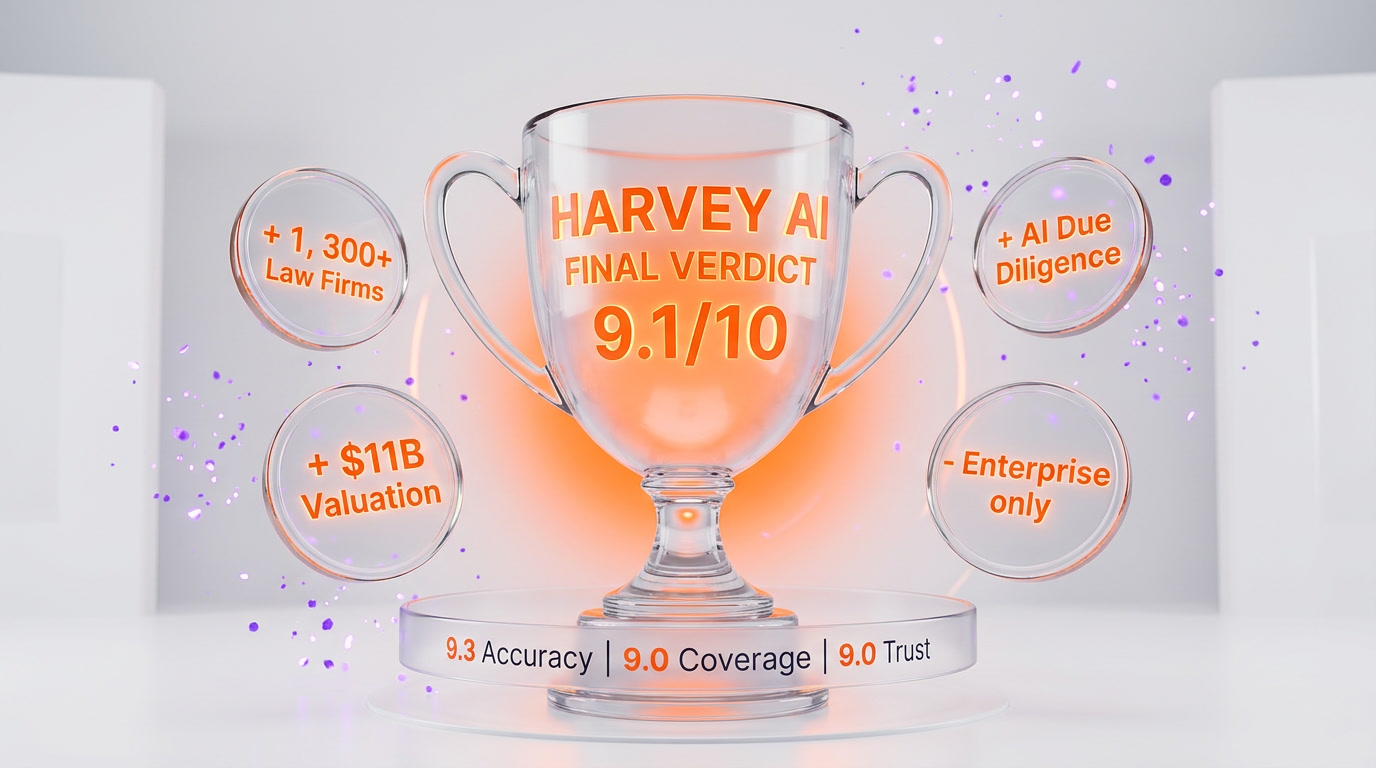
Harvey AI earns a 9.1 out of 10 — the highest score we have given any legal AI platform. The product is the most complete and best-integrated enterprise legal AI offering on the market. Assistant is the best general-purpose legal chat we have tested. Vault is the clearest document-review leader. Workflows delivers the kind of leverage that turns individual partner expertise into firm-wide capability. The specialized Immigration, Tax, and M&A agents are genuinely differentiated from anything a generic GPT or Claude deployment can produce.
Harvey is not the right choice for every firm. Solo practitioners, very small firms, and firms on non-Microsoft stacks should look elsewhere. For everyone else — AmLaw 200, Big Four legal and tax practices, Fortune 500 in-house legal teams, and serious mid-market firms — Harvey is the default platform choice in 2026, and the gap to the next alternative is widening.
Score breakdown:
- Features: 9.4 out of 10 — end-to-end platform with Assistant, Vault, Workflows, Deep Research, and three specialized agents is the broadest feature set in legal AI
- Ease of Use: 8.6 out of 10 — excellent once deployed, but Vault and Workflows have a learning curve and onboarding takes investment
- Value: 8.8 out of 10 — enterprise-only pricing means firms under 50 attorneys rarely get a viable quote, but for the target profile the ROI is clear
- Support: 9.2 out of 10 — strong enterprise account management, professional services onboarding, and an active customer community for firm IT and innovation teams
Frequently Asked Questions
Is Harvey AI free to try?
No. Harvey is enterprise-only and does not offer a free plan or self-service free trial. Evaluations are typically structured as a 60 to 90 day pilot or proof-of-concept deployment, scoped to a specific practice group and negotiated as part of the enterprise sales process. Firms interested in evaluating Harvey contact the sales team through the Harvey website and enter a structured procurement cycle.
How much does Harvey AI cost?
Harvey does not publish pricing. Contracts are quote-based, negotiated under NDA, and typically structured as multi-year firm-wide licenses rather than per-seat subscriptions. Pricing is driven by seat count, module mix (Assistant, Vault, Workflows, specialized agents), and committed usage volume. Directionally, AmLaw 100 firm-wide deployments run into seven figures annually, and mid-market firm deployments run into six figures annually. Below roughly 50 attorneys the economics rarely work.
What is the difference between Harvey Assistant and Vault?
Assistant is the conversational surface for legal research, drafting, summarization, and clause analysis — think of it as a legally grounded chat interface exposed inside Word, Outlook, and the web app. Vault is a document workspace designed for bulk review, where lawyers upload thousands of files and run structured extraction, Q&A, and cross-document comparison across the entire corpus. Assistant handles single-query research and drafting tasks. Vault handles document-heavy workflows like M&A diligence, second requests, and privilege review.
What are Harvey Workflows?
Workflows are codified multi-step legal processes built in Harvey's no-code workflow builder. A typical Workflow takes a repeatable task — NDA review, lease abstraction, privilege log generation — and turns it into a one-click automation any lawyer at the firm can trigger. Harvey ships a library of pre-built templates (NDAs, MSAs, DPAs, standard M&A diligence checklists), and firms customize or build bespoke workflows to match their practice-group playbooks. Workflows turn individual partner expertise into firm-wide capability.
What are the Harvey specialized agents?
Harvey has shipped three specialized agents for practice areas where domain depth materially changes output quality: Immigration (visa strategy, petition drafting, RFE responses), Tax (tax research, structuring memos, cross-border analysis, Code section reasoning), and M&A (due diligence, disclosure schedule review, merger agreement analysis). Each agent is trained on domain-specific corpora and produces outputs formatted for the target practice — immigration petitions, tax opinion letters, diligence reports — rather than generic chat answers.
Is Harvey AI secure for law firm use?
Yes. Harvey holds SOC 2 Type II and ISO/IEC 27001 certifications. Customer data is not used to train foundation models — this is contractually guaranteed in the commercial terms. Harvey supports configurable data residency by region for firms with GDPR or jurisdictional requirements, enterprise SSO (SAML, OIDC) integration with Entra ID and Okta, granular access controls with matter-level scoping, and comprehensive audit trails covering every query, document view, and output. Firms can request penetration test reports under NDA as part of procurement review.
Does Harvey AI integrate with iManage and NetDocuments?
Yes. Harvey has native connectors for iManage, NetDocuments, and SharePoint — the three document management systems that cover the majority of AmLaw 200 and Big Four accounting firm deployments. The integration pulls matter content directly from the DMS into Harvey's matter-scoped context, with access controls inherited from the DMS's permission model. For firms on other DMS platforms, custom integrations are possible but require a longer deployment cycle.
Which firms use Harvey AI?
As of 2026, Harvey is deployed at more than 1,300 law firms and in-house legal departments and used by more than 100,000 individual lawyers. Public reference customers include A&O Shearman, Paul Weiss, Reed Smith, Ashurst, PwC, and KPMG. The typical customer profile is an AmLaw 200 firm, a Big Four accounting firm's legal or tax practice, or a Fortune 500 in-house legal department. A handful of elite boutique firms in immigration, tax, and M&A also deploy Harvey for domain-specific use.
How does Harvey AI compare to using ChatGPT or Claude directly for legal work?
For billable, client-facing legal work, Harvey wins on every dimension that matters: citation accuracy with pinpoint cites, jurisdictional awareness, private case law and matter corpus access, risk-framed outputs structured as memos rather than chat paragraphs, native matter management, DMS integration, partner-level review tuning, and unauthorized-practice-of-law guardrails. ChatGPT and Claude are better suited to internal drafting, research assistance, and low-stakes tasks where a lawyer personally verifies every output. Most modern firms run both — Harvey for matter-critical work, general chatbots for low-stakes assistance.
How does Harvey AI compare to Thomson Reuters CoCounsel and Lexis+ AI?
CoCounsel and Lexis+ AI are bundled with the Westlaw and LexisNexis research databases respectively, which gives them strong distribution inside firms already embedded in those ecosystems. Harvey's advantage is platform breadth — Assistant, Vault, Workflows, Deep Research, and specialized agents cover more ground than CoCounsel or Lexis+ AI can match today. If a firm is deeply embedded in the Thomson Reuters or LexisNexis ecosystem and legal research is the primary use case, the bundled option is the path of least resistance. For end-to-end legal AI including document review and workflow automation at firm scale, Harvey remains the stronger platform choice.
How long does a Harvey AI procurement process take?
Typical procurement runs 3 to 6 months from initial contact to signed contract. The cycle covers security and compliance review (SOC 2 Type II, ISO 27001, penetration tests, data residency), integration review (DMS, identity provider, audit stack), a 60 to 90 day pilot or proof of concept scoped to a specific practice group, and final contract negotiation covering pricing, SLAs, data processing terms, and exit provisions. Firms with mature Microsoft 365 and DMS infrastructure typically move faster than firms that need significant integration work.
Key Features
Pros & Cons
Pros
- Purpose-built for legal work — citation accuracy, jurisdictional awareness, and risk-framed outputs that match what partners actually ship to clients
- Vault handles massive document review at firm scale — ingest thousands of contracts, briefs, or diligence files and run structured Q&A, clause extraction, and comparison in hours rather than weeks
- Workflows let firms codify repeatable legal tasks (NDA review, second requests, lease abstraction, due diligence checklists) into reusable automations triggered by any lawyer
- Specialized agents for Immigration, Tax, and M&A go beyond generic chat — they apply domain-specific frameworks and regulatory context that generic GPT or Claude deployments cannot match
- Deep Research mode runs multi-step legal research with source grounding across case law, statutes, and firm knowledge — the closest thing to a first-year associate on demand
- Deep integrations with Microsoft 365, SharePoint, iManage, and NetDocuments mean lawyers stay in the tools they already use — no context switch required
- SOC 2 Type II and ISO 27001 certified with configurable data residency options — meets the procurement bar at AmLaw 100 firms and Big Four accounting firms
- Used by A&O Shearman, PwC, Paul Weiss, Reed Smith, Ashurst, KPMG, and hundreds of top-tier firms — the single largest production install base in legal AI
Cons
- Enterprise-only pricing with no public rate card — every deal is quote-based and typically requires a 3 to 6 month procurement cycle with IT, risk, and partner committees
- Minimum contract sizes effectively lock out solo practitioners and firms under roughly 50 attorneys — the economics target AmLaw 200 and above
- The Vault document review experience has a learning curve — optimal results require workspace structure, tag taxonomy, and query discipline that smaller firms may struggle to build
- Heavy reliance on Microsoft 365 and SharePoint — firms standardized on Google Workspace or non-iManage DMS stacks will hit friction in rollout
- Model underneath is a closed box — Harvey abstracts the foundation models (OpenAI, Anthropic), which means clients cannot swap in their preferred LLM or run on-premise
Best Use Cases
Platforms & Integrations
Available On
Integrations

We're developers and SaaS builders who use these tools daily in production. Every review comes from hands-on experience building real products — DealPropFirm, ThePlanetIndicator, PropFirmsCodes, and many more. We don't just review tools — we build and ship with them every day.
Written and tested by developers who build with these tools daily.
Frequently Asked Questions
What is Harvey AI?
The enterprise legal AI platform used by 1,300+ top law firms — Assistant, Vault, Workflows, and specialized agents for Immigration, Tax, and M&A
How much does Harvey AI cost?
Harvey AI costs $0/month.
Is Harvey AI free?
No, Harvey AI starts at $0/month.
What are the best alternatives to Harvey AI?
Top-rated alternatives to Harvey AI can be found in our WebApplication category, where we've reviewed and scored every tool on ThePlanetTools.ai.
Is Harvey AI good for beginners?
Harvey AI is rated 8.6/10 for ease of use.
What platforms does Harvey AI support?
Harvey AI is available on Web (Harvey platform), Microsoft Word add-in, Microsoft Outlook add-in, Microsoft 365 integration, SharePoint connector, iManage connector, NetDocuments connector, API (for enterprise customers).
Does Harvey AI offer a free trial?
No, Harvey AI does not offer a free trial.
Is Harvey AI worth the price?
Harvey AI scores 8.8/10 for value. We consider it excellent value.
Who should use Harvey AI?
Harvey AI is ideal for: AmLaw 100 firms standardizing legal AI across practice groups — transactional, litigation, regulatory, and IP teams on a single audited platform, In-house legal departments at Fortune 500 companies looking to accelerate contract review, regulatory analysis, and cross-border matters, Big Four accounting firms (PwC, KPMG) deploying legal AI across tax, M&A diligence, and compliance workflows at global scale, Mid-market firms (50 to 500 attorneys) that want partner-grade AI for billable work without building internal ML infrastructure, Litigation teams running document review on data rooms with 10,000 to 1,000,000 files — discovery coding, privilege flagging, deposition prep, M&A deal teams compressing due diligence from 6 weeks to 6 days across thousands of contracts and disclosure schedules, Immigration practice groups automating visa strategy, petition drafting, and multi-jurisdiction coordination, Tax and structuring teams running cross-border analysis, entity structuring memos, and Code-section reasoning at scale, Firm innovation and knowledge management teams codifying best-practice workflows into Harvey templates the entire firm can reuse.
What are the main limitations of Harvey AI?
Some limitations of Harvey AI include: Enterprise-only pricing with no public rate card — every deal is quote-based and typically requires a 3 to 6 month procurement cycle with IT, risk, and partner committees; Minimum contract sizes effectively lock out solo practitioners and firms under roughly 50 attorneys — the economics target AmLaw 200 and above; The Vault document review experience has a learning curve — optimal results require workspace structure, tag taxonomy, and query discipline that smaller firms may struggle to build; Heavy reliance on Microsoft 365 and SharePoint — firms standardized on Google Workspace or non-iManage DMS stacks will hit friction in rollout; Model underneath is a closed box — Harvey abstracts the foundation models (OpenAI, Anthropic), which means clients cannot swap in their preferred LLM or run on-premise.
Ready to try Harvey AI?
Get started today
Try Harvey AI Now →