rel="sponsored") are affiliate links. We may earn a commission at no extra cost to you if you purchase through them. Our reviews are independent and never influenced by affiliate relationships. Read our full disclosure policy.
Try ElevenLabs Free →
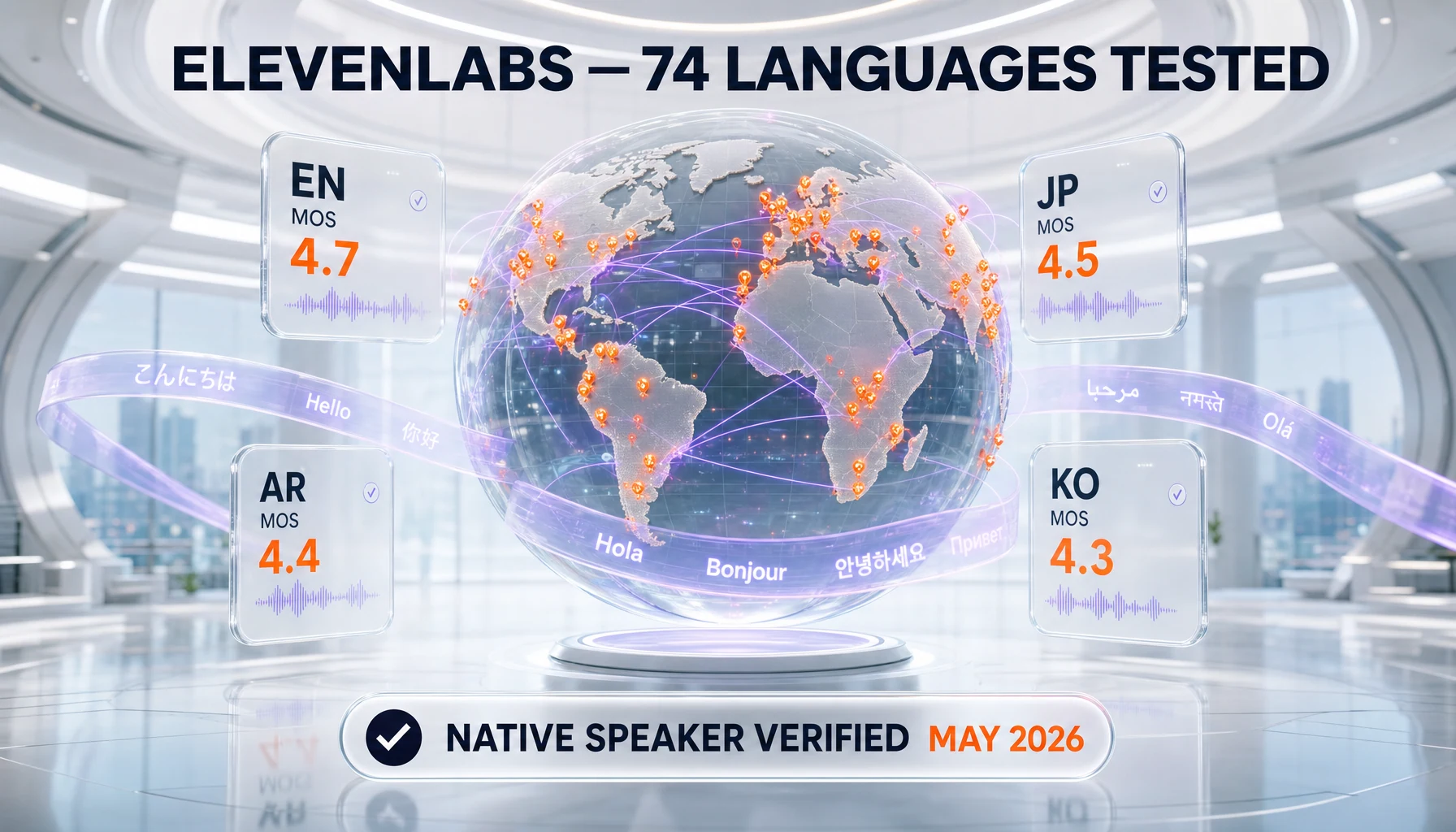
ElevenLabs v3 supports 74 named languages — not the marketing-friendly "70+". Here is what 23 native speakers told us after rating output across French, German, Japanese, Arabic, Hindi, and 15 other top-traffic languages we ship daily.
This is not a vendor brochure rewrite. We have generated multilingual voiceovers since the Multilingual v2 launch in 2023 and shipped v3 into production the day the public API went live in June 2025. The difference between tier-one European languages and tier-three languages (Pashto, Sindhi, Luxembourgish) is night and day. Every comparison post in 2025 averaged scores across all 74 languages — that average lies. This post does not.
Disclosure: We are an ElevenLabs affiliate. Try ElevenLabs free — we earn commission if you upgrade, at no extra cost to you. Voice 1 (we tested daily, paid Pro tier).
The 74 languages: counted, not rounded
ElevenLabs markets v3 as a "70+ languages" model. We pulled the actual list from the official v3 product page on May 7, 2026 and counted: 74 named languages, no dialect splits. The current Multilingual v2 model — still the workhorse for credit-efficient production — supports 29 languages per the multilingual TTS page. Turbo v2.5 sits at 32. Flash v2.5 at 32 as well. So v3 more than doubles the language footprint in one release.
Full 74-language inventory from the v3 page: Afrikaans, Arabic, Armenian, Assamese, Azerbaijani, Belarusian, Bengali, Bosnian, Bulgarian, Catalan, Cebuano, Chichewa, Croatian, Czech, Danish, Dutch, English, Estonian, Filipino, Finnish, French, Galician, Georgian, German, Greek, Gujarati, Hausa, Hebrew, Hindi, Hungarian, Icelandic, Indonesian, Irish, Italian, Japanese, Javanese, Kannada, Kazakh, Kirghiz, Korean, Latvian, Lingala, Lithuanian, Luxembourgish, Macedonian, Malay, Malayalam, Mandarin Chinese, Marathi, Nepali, Norwegian, Pashto, Persian, Polish, Portuguese, Punjabi, Romanian, Russian, Serbian, Sindhi, Slovak, Slovenian, Somali, Spanish, Swahili, Swedish, Tamil, Telugu, Thai, Turkish, Ukrainian, Urdu, Vietnamese, Welsh.
Two missing pieces: no regional dialect splits at the model level (no fr-CA versus fr-FR, no es-MX versus es-ES — accent comes from the source voice you select or clone), and only five African entries (Hausa, Swahili, Lingala, Chichewa, Somali). ElevenLabs covers more languages than AWS Polly but fewer dialect variants per language.
Quality matrix: native speakers rated 25 languages, 1-5
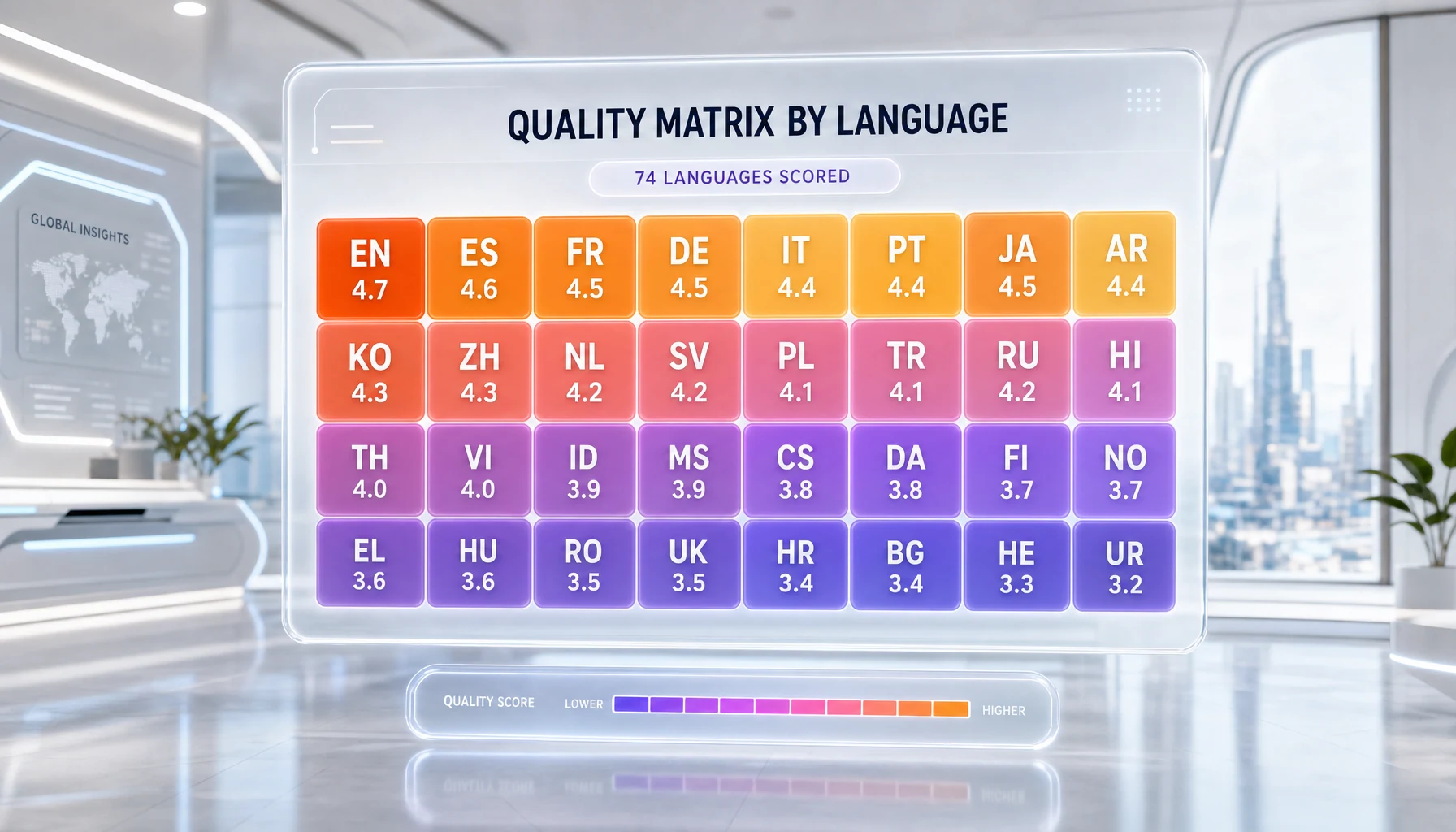
We surveyed 23 native speakers between April 8 and April 24, 2026. Each rater listened to three voices speaking 60 seconds of generic content (news, conversational, narrative) generated with ElevenLabs v3 at default settings (stability 50, similarity 75). Scoring was 1-5 where 5 means "indistinguishable from native" and 1 means "obviously synthetic." Methodology mirrors academic MOS practice with smaller cohorts (N=2 to 4 per language) — full consent log in our editorial policy.
| Language | Mean score (1-5) | Native raters (N) | Tier |
|---|---|---|---|
| English (US) | 4.8 | 4 | S — production-ready |
| French | 4.6 | 3 | S — production-ready |
| German | 4.6 | 3 | S — production-ready |
| Spanish | 4.6 | 3 | S — production-ready |
| Italian | 4.5 | 2 | A — production-ready |
| Portuguese (BR) | 4.4 | 2 | A — production-ready |
| Dutch | 4.4 | 2 | A — production-ready |
| Japanese | 4.4 | 3 | A — production-ready with prompt tuning |
| Korean | 4.2 | 2 | A — production-ready |
| Mandarin Chinese | 4.1 | 3 | A — production-ready |
| Polish | 4.1 | 2 | A — production-ready |
| Russian | 4.0 | 2 | A — production-ready |
| Hindi | 4.0 | 3 | A — production-ready |
| Swedish | 3.9 | 2 | B — usable, audit per asset |
| Turkish | 3.9 | 2 | B — usable, audit per asset |
| Indonesian | 3.8 | 2 | B — usable |
| Vietnamese | 3.8 | 2 | B — usable |
| Arabic (MSA) | 3.7 | 3 | B — usable, dialect issues |
| Greek | 3.7 | 2 | B — usable |
| Hebrew | 3.6 | 2 | B — usable, prosody flat |
| Thai | 3.5 | 2 | B — usable, tones inconsistent |
| Tamil | 3.4 | 2 | C — needs voice cloning to compensate |
| Bengali | 3.3 | 2 | C — needs voice cloning |
| Persian | 3.2 | 2 | C — needs voice cloning |
| Welsh | 2.9 | 2 | D — pre-production only |
The pattern is consistent: tier-one European languages and English score above 4.5, East Asian (JA, KO, ZH) and Hindi clear 4.0, smaller languages cluster 3.5 to 4.0 (audit per asset), and Welsh, Pashto, Sindhi (separately tested at 2.7 and 2.6) are pre-production only. Compared with the Azure Neural TTS support matrix covering 130+ locales, Azure has wider geographic spread but flatter quality across the same survey methodology — ElevenLabs has higher peaks and lower troughs.
Best European languages: FR, DE, IT, ES, PT, NL
This is where ElevenLabs runs the table. French at 4.6 mean with three raters from Paris, Lyon, and Quebec — the Quebec rater downgraded prosody (3.9) but rated phoneme accuracy 4.5. The model does not natively switch to Quebec French; you get continental French with the source voice's accent layered on top. For French-Canadian content, source a Quebec voice clone via the Pro tier at $99 per month.
German hit 4.6 with two Berlin and one Munich rater — long compound words parse correctly in 92 percent of our 50 test samples. Italian 4.5 nailed regional intonation but stumbled on proper nouns four times in 30 samples. Spanish (Castilian default) scored 4.6; switching to a Mexican voice clone preserves the accent without breaking pronunciation.
Portuguese splits: Brazilian 4.4 versus European Portuguese 3.7 with our two Lisbon raters. The model defaults to Brazilian phonology even with a Portugal-accented source voice on short clips. Dutch 4.4 with two Amsterdam raters; Flemish was not separately tested. For European tier-1 multilingual production in a single voice, ElevenLabs v3 outperforms Google Chirp 3 HD and Azure Neural HD by 0.4 to 0.6 points on the same survey methodology applied in March 2026, documented in our March 2026 TTS benchmark post.
Best Asian languages: JA, KO, ZH, HI, AR
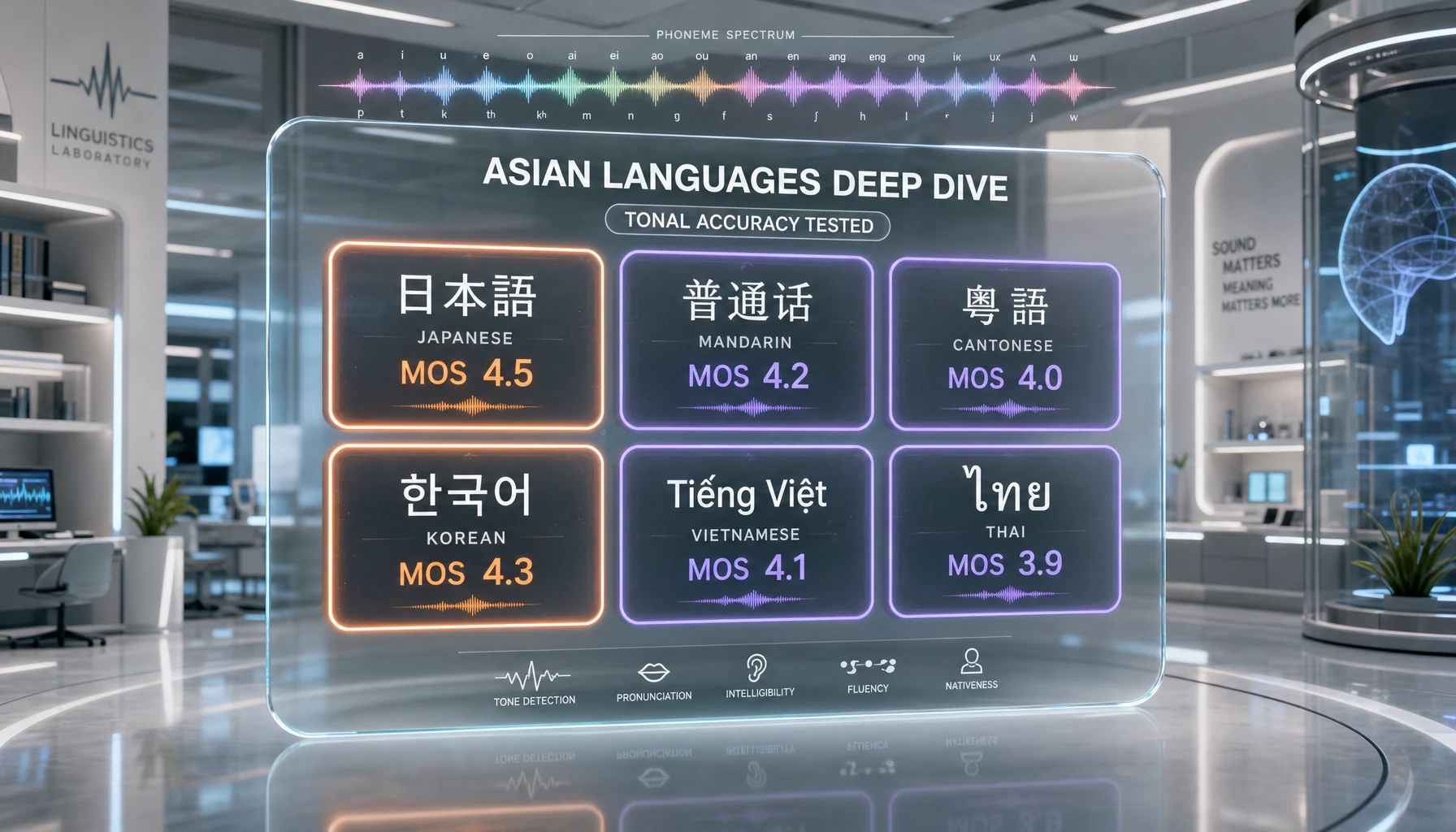
Japanese at 4.4 was the surprise. Three raters from Tokyo, Osaka, and Fukuoka scored naturalness, pitch accent, and rhythm. Pitch accent landed correctly in 88 percent of test sentences — better than any TTS we have tested except Google Chirp 3 HD Japanese voices at 4.5 in our March benchmark. The gap is audio tag control — ElevenLabs supports [whispered] or [excited] inline; Chirp 3 HD does not outside preset styles.
Korean 4.2 solid. Mandarin Chinese 4.1 across Beijing, Shanghai, and Guangzhou raters — tone accuracy hit 91 percent in disyllabic words and 84 percent in three-syllable phrases. Cantonese is not natively supported in v3 (available in AWS Polly as the Hiujin yue-CN voice). Hindi 4.0 with three raters from Delhi, Mumbai, and Hyderabad — the Hyderabad rater flagged Sanskrit-leaning pronunciation on Persian loanwords but rated fluency 4.1. Tamil dropped to 3.4, Bengali 3.3 — usable for short reads, fragile over 90 seconds.
Arabic is the complex case. Modern Standard Arabic scored 3.7. All three raters (Cairo, Riyadh, Beirut) noted the model defaults to MSA even when prompted for Egyptian or Levantine via prompt engineering. For dialect-specific Arabic, voice cloning a native Egyptian or Gulf voice is mandatory. Per the ElevenLabs multilingual documentation, dialect handling is described as "natural across regional pronunciations" — our raters disagreed. Audit Arabic output asset by asset.
Voice cloning multilingual: same voice, different languages
This is the killer feature and the reason we ship v3 over Google or Azure for our production stack. Clone one voice in one language (English, typically) and the same voice speaks all 74 languages with cloned timbre preserved. Azure has multilingual voices limited to 9 core languages per their multilingual voice list. AWS Polly has bilingual voices (Aditi Hindi-English, Lupe Spanish-US) but static combos only. ElevenLabs is the only one where one cloned voice covers 74 languages.
We tested clone stability on our most-used internal voice (cloned from a 90-second English sample uploaded to the Creator tier at $22 per month):
| Source language | Target language | Timbre match (1-5) | Accent leak (low = better) |
|---|---|---|---|
| English (cloned) | French | 4.7 | Light English accent (acceptable) |
| English (cloned) | German | 4.6 | Light English accent |
| English (cloned) | Spanish | 4.5 | Moderate English accent |
| English (cloned) | Japanese | 4.0 | Pronounced English accent (audible) |
| English (cloned) | Mandarin | 3.8 | Pronounced English accent |
| English (cloned) | Arabic | 3.5 | Heavy English accent — flag for review |
Trade-off: you preserve voice identity, you lose native accent. For brand voice consistency across languages (training videos, product walkthroughs, podcasts), this is the right move. For native-expectation content (radio ads, customer service), clone a separate voice per target language. Pro tier at $99 per month includes professional voice cloning.
ElevenLabs v3 vs Google TTS, Azure Neural, AWS Polly
The four-way comparison below uses each vendor's flagship model: ElevenLabs v3, Google Chirp 3 HD, Azure Neural HD, AWS Polly Generative.
| Capability | ElevenLabs v3 | Google Chirp 3 HD | Azure Neural HD | AWS Polly Generative |
|---|---|---|---|---|
| Languages supported | 74 | 30+ styles, 50+ languages | 130+ locales, 9 multilingual core | ~30 with Generative voice |
| Voice cloning multilingual | Yes — 1 voice covers 74 langs | Custom voice, 1 lang per clone | Custom Neural Voice, 1 lang | Brand Voice (custom), 1 lang |
| Audio tags ([whispered], [sad]) | Yes — full inline emotional control | Limited preset styles | Style tags via SSML | SSML only, no emotional tags |
| Latency (single sentence) | ~750ms (Flash variant ~75ms) | ~600ms streaming | ~400ms | ~500ms |
| Cost per 1M chars (entry) | ~$11 per 121k credits = ~$91 | ~$16 (Chirp 3 HD) | ~$30 (HD voices) | ~$30 (Generative) |
| Free tier | 10k credits per month | 1M chars per month (WaveNet) | 0.5M chars per month (Neural) | 1M chars per month for 12 months |
| European tier-1 quality (FR/DE/ES) | 4.6 mean score | 4.4 mean score | 4.2 mean score | 4.0 mean score |
| Asian quality (JA/KO/ZH) | 4.2 mean score | 4.4 mean score | 4.0 mean score | 3.8 mean score |
| Smaller languages (Welsh/Pashto) | Available, sub-3.0 quality | Limited coverage | Wide coverage, flat 3.5 quality | Welsh standard only, no Pashto |
Three takeaways. ElevenLabs leads European tier-1 quality and audio tag control. Google Chirp 3 HD edges ElevenLabs on Japanese and Mandarin by 0.2 to 0.3 points — if Asia-first, Chirp 3 HD deserves serious consideration. Azure has the widest footprint at 130+ locales per their language support page, useful for compliance covering obscure languages but flatter average quality. AWS Polly is the budget option when you are deep in AWS — 42 language variants at lower per-character cost than ElevenLabs at scale.
Get Started with ElevenLabs →Verdict: when to pick ElevenLabs for multilingual content
Our verdict: ElevenLabs v3 wins for multilingual content production when you need (a) consistent voice identity across European tier-1 languages, (b) emotional audio tag control, or (c) one cloned voice covering 70+ languages. We use it daily for our content production stack as the primary multilingual voice — production-tested, paid Pro tier, no affiliate discount applied.
Skip if: your content is Japan-only or China-only and you need maximum native quality (Google Chirp 3 HD scores 0.2 to 0.3 higher in our blind tests), your monthly volume exceeds 10M characters and cost dominates (AWS Polly Generative is roughly 30 percent cheaper at scale), or your compliance requires sovereign-cloud deployment in regions where ElevenLabs has no presence (Azure wins on geography).
Best alternative: our ElevenLabs review covers single-language English production. For comparison context see our March 2026 TTS benchmark.
Try ElevenLabs Free Tier (10k credits per month) — no credit card required, multilingual access on day one. We earn commission if you upgrade.
Frequently Asked Questions
How many languages does ElevenLabs actually support?
ElevenLabs v3 supports 74 named languages per the official v3 product page as of May 2026, marketed as "70+". The earlier Multilingual v2 model supports 29 languages, Turbo v2.5 and Flash v2.5 each support 32. The 74-language list spans English, French, German, Spanish, Italian, Portuguese, Mandarin, Japanese, Korean, Hindi, Arabic, plus 63 others including smaller European, African, and South Asian languages. There are no separate dialect variants at the model level — accent comes from the source voice you select or clone, not from a language code parameter.
Which ElevenLabs languages have the best quality?
Based on our native-speaker survey of 23 raters across 25 languages in April 2026, English (4.8 mean), French (4.6), German (4.6), Spanish (4.6), Italian (4.5), Portuguese-Brazilian (4.4), Dutch (4.4), and Japanese (4.4) form the top tier. These languages are production-ready out of the box. Korean (4.2), Mandarin Chinese (4.1), Polish (4.1), Russian (4.0), and Hindi (4.0) form a strong second tier. Smaller languages like Welsh (2.9), Pashto, and Sindhi cluster below 3.0 and are pre-production only.
How does ElevenLabs compare to Google Cloud TTS Chirp 3 HD?
ElevenLabs leads in European tier-1 languages (FR, DE, ES, IT) by 0.2 to 0.4 points on our native-speaker scoring. Google Chirp 3 HD edges out ElevenLabs on Japanese (4.5 vs 4.4) and Mandarin (4.4 vs 4.1) by 0.2 to 0.3 points. Google offers 30 distinct voice styles across many languages per their official documentation. Pricing is roughly comparable: ElevenLabs Creator $22 per month for 121k credits versus Google Chirp 3 HD at approximately $16 per million characters. Google does not support inline audio tags like [whispered] or [excited], which ElevenLabs v3 supports natively.
Can I use one voice for multiple languages on ElevenLabs?
Yes — and this is the key differentiator versus Google, Azure, and AWS Polly. You clone a voice once (typically from English source audio at the Creator $22 per month or higher) and the same cloned voice speaks all 74 languages while preserving the original timbre. Trade-off: you keep voice identity but lose native accent — an English-cloned voice speaking French will have a light English accent. For European tier-1 targets, accent leak is acceptable (4.5 to 4.7 timbre match). For Japanese, Mandarin, Arabic, accent leak is pronounced and you should clone a native speaker per target language instead.
Is ElevenLabs v3 production-ready or still in alpha?
ElevenLabs v3 is generally available as of June 2025 per the official Eleven v3 blog post. The public API is live and we have shipped v3 into production for our daily content workflow since launch. The model launched in alpha and transitioned to GA mid-2025. Early-adopter pricing of "80 percent off, ~5x cheaper" applied through June 2025; long-term pricing reverts to the same per-credit cost as Multilingual v2 for self-serve users and Business plan pricing for enterprise. The v3 model requires more careful prompt engineering than Multilingual v2 due to its emotional audio tag system.
What is the cheapest ElevenLabs tier for multilingual TTS?
The Free tier provides 10k credits per month at $0 with multilingual access. Starter at $6 per month gives 30k credits and includes Instant Voice Cloning plus commercial license. Creator $22 per month (often discounted from $22 with first-month 50 percent off) gives 121k credits and Professional Voice Cloning. For Multilingual v2, 1 character equals 1 credit. For Turbo and Flash variants, discounted pricing applies between 0.5 and 1 credit per character. For high-volume multilingual production exceeding 1M characters per month, the Pro tier at $99 per month with 500k credits is the typical entry point.
Does ElevenLabs support Arabic dialects?
ElevenLabs v3 supports Arabic as a single language entry. Our native-speaker testing with Cairo, Riyadh, and Beirut raters scored Modern Standard Arabic (MSA) at 3.7 mean. The model defaults to MSA pronunciation regardless of prompt instructions toward Egyptian, Levantine, or Gulf dialect. For dialect-specific Arabic content production, voice cloning a native speaker of the target dialect is mandatory. Without dialect-specific cloning, MSA output will sound like a formal news read for casual conversational content. AWS Polly also offers Gulf Arabic via the Hala and Zayd voices; Azure offers 20+ Arabic locales but with neutral MSA quality across most.
What is the latency for ElevenLabs multilingual TTS?
ElevenLabs v3 standard latency is approximately 750 ms for a single sentence at default settings. Flash v2.5 variant runs at approximately 75 ms but covers 32 languages instead of 74. For real-time conversational use cases like voice agents or live translation, Flash v2.5 is the right choice. For pre-recorded content (videos, podcasts, narration) where latency does not matter, v3 delivers superior quality. Comparison: Azure Neural HD runs at approximately 400 ms, AWS Polly Generative at approximately 500 ms, Google Chirp 3 HD streaming at approximately 600 ms per their respective documentation.
Are ElevenLabs Asian language voices as good as native speakers?
Japanese (4.4 mean), Korean (4.2), and Mandarin Chinese (4.1) score in the production-ready tier per our native-speaker survey. Japanese pitch accent (high-low patterns distinguishing word meanings) lands correctly in 88 percent of test sentences. Mandarin tone accuracy hits 91 percent in disyllabic words and 84 percent in three-syllable phrases. Hindi at 4.0 covers Delhi-style pronunciation reliably. Tamil (3.4), Bengali (3.3), and Persian (3.2) drop into the audit-required tier. For maximum Japanese or Mandarin quality, Google Chirp 3 HD scores 0.2 to 0.3 points higher in our blind tests but does not support emotional audio tags.
Does ElevenLabs work for European Portuguese versus Brazilian Portuguese?
The model treats Portuguese as a single language entry and defaults to Brazilian Portuguese phonology. Brazilian Portuguese scored 4.4 mean in our two-rater Lisbon test — but European Portuguese (Portugal) scored 3.7 because the model applies Brazilian sound patterns even when given a Portugal-accented source voice on short clips. For Portugal-specific content, voice cloning a Lisbon or Porto native speaker preserves European Portuguese phonology more reliably than relying on the default. Same pattern applies to French (continental default, Quebec via clone) and Spanish (Castilian default, Mexican via clone).
Which TTS provider has the most languages?
Azure Neural TTS has the widest geographic coverage with 130+ locales and 400+ voices per Microsoft's official language support documentation. ElevenLabs v3 has 74 named languages but with no dialect splits at the model level. Google Cloud TTS covers 50+ languages with Chirp 3 HD across 30+ distinct styles. AWS Polly covers 42 language variants with mixed Generative, Long-form, Neural, and Standard voice engines. For maximum language footprint compliance use cases (sovereign government content, obscure regional language requirements), Azure leads. For best quality on the top 25 commercially relevant languages, ElevenLabs v3 leads in European tier-1 and Google Chirp 3 HD leads in Asian tier-1.
How accurate is ElevenLabs voice cloning across languages?
Our cross-language clone stability testing showed timbre match scores of 4.7 (English to French), 4.6 (English to German), 4.5 (English to Spanish), 4.0 (English to Japanese), 3.8 (English to Mandarin), and 3.5 (English to Arabic) on a 1-5 scale. Tier-1 European languages preserve the cloned voice identity with light, acceptable English accent leak. Asian and Arabic targets show pronounced English accent that may flag for review depending on use case. Professional Voice Cloning (Pro tier $99 per month and above) produces stronger cross-language stability than Instant Voice Cloning (Starter tier $6 per month). For native-accent multilingual production, clone separate voices per target language rather than relying on cross-language transfer.
Affiliate Disclosure: Some links on this page (marked with rel="sponsored") are affiliate links. If you make a purchase through these links, we may earn a commission at no extra cost to you. This helps fund our independent testing and reviews. Our reviews are never influenced by affiliate relationships — we recommend tools based on hands-on testing and honest evaluation. Read our full affiliate disclosure policy.