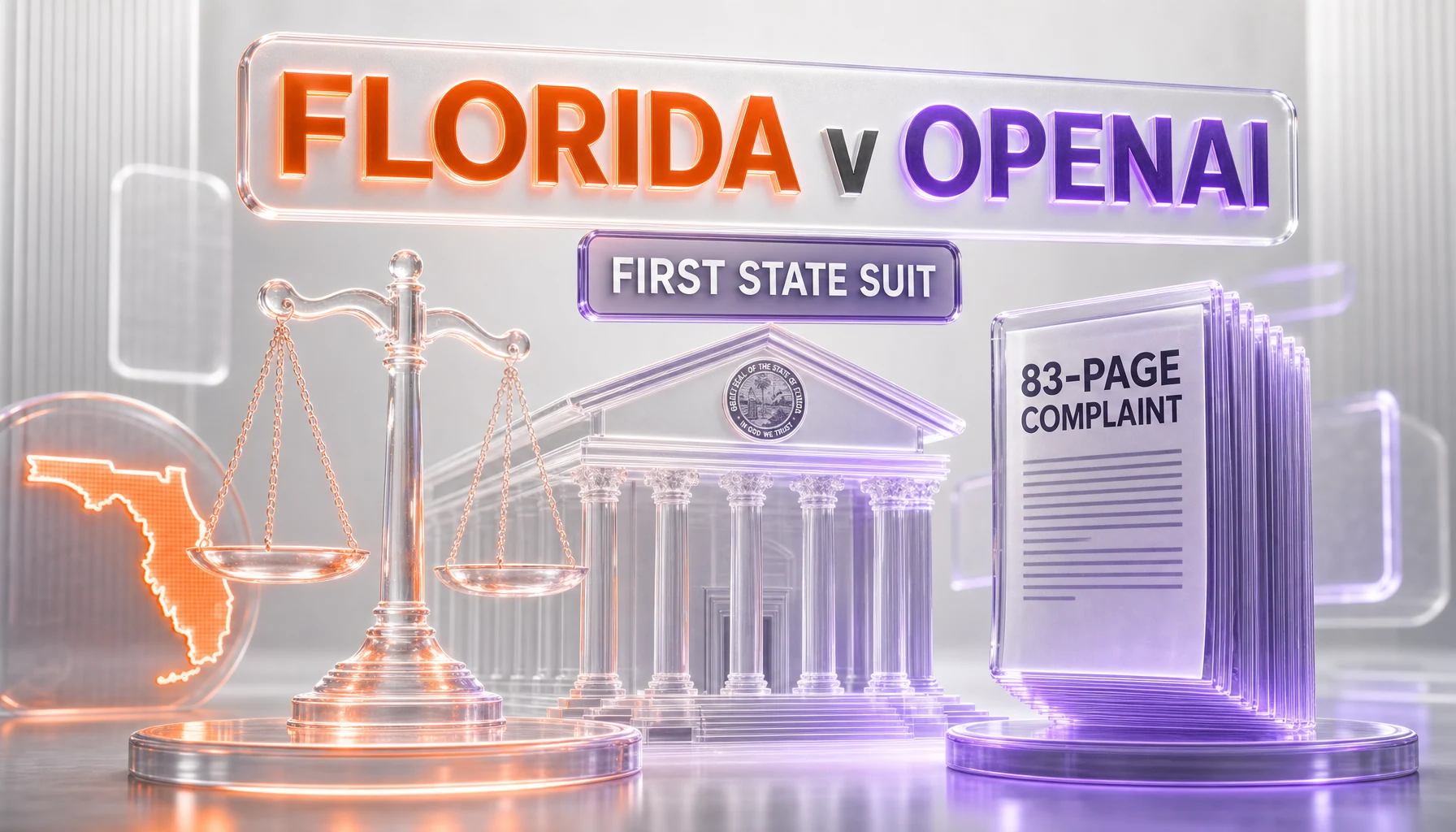
Florida has become the first US state to sue OpenAI and its chief executive Sam Altman, in an 83-page consumer-protection and product-liability complaint filed on June 1, 2026. The suit, brought by Florida Attorney General James Uthmeier in the Tenth Judicial Circuit of Florida, alleges that OpenAI marketed ChatGPT as safe and reliable — including for children — while allegedly concealing risks it is said to have known about. It is not a wrongful-death case, and every count in it is an unproven allegation that OpenAI is entitled to contest in court.
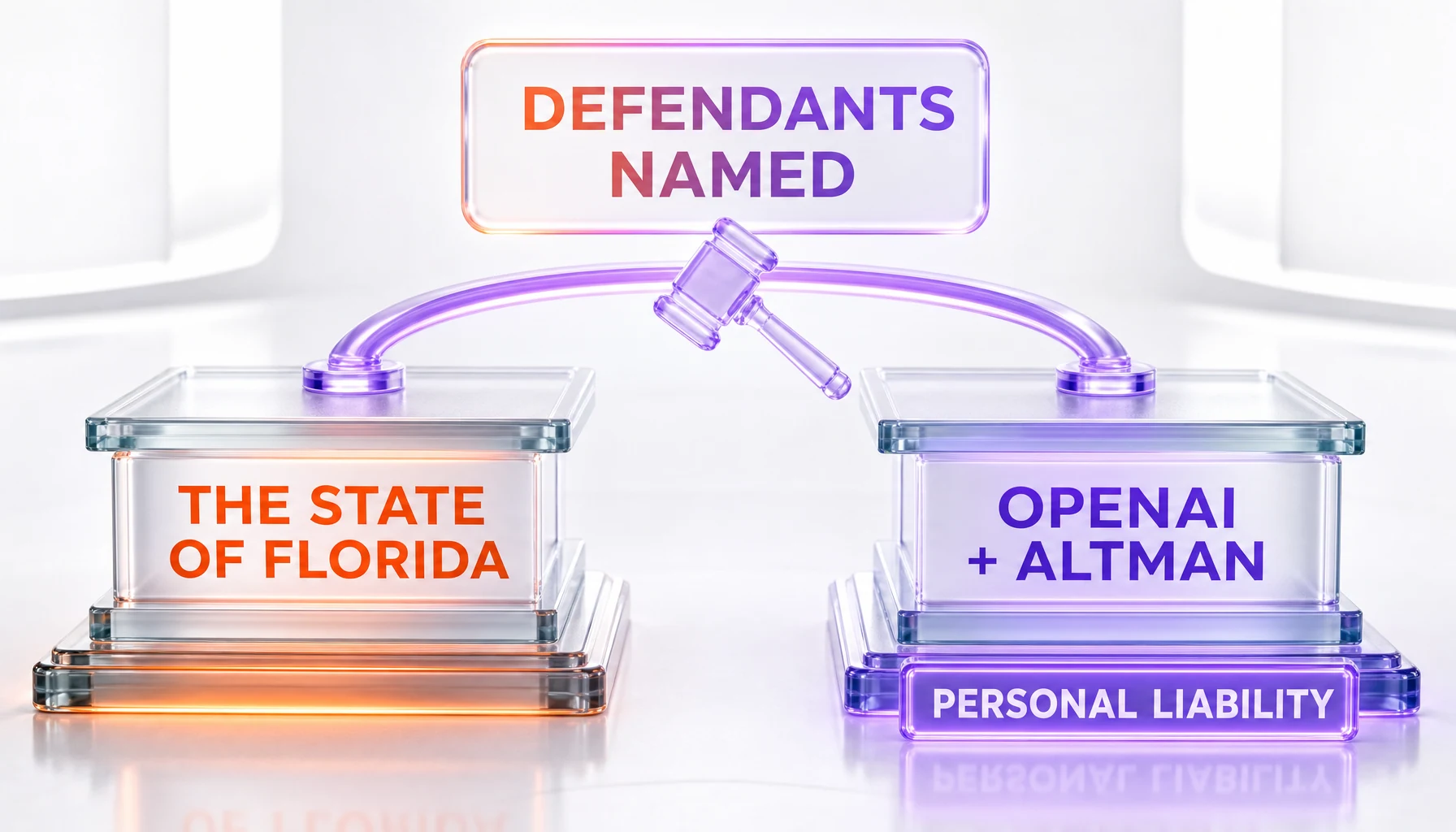
This is, by the state's own framing, a first: no other US state attorney general has previously filed suit against OpenAI. The complaint is also notable for naming Altman as a defendant in his personal capacity, alongside the company. According to reporting by TechCrunch, CNBC, NPR, Fortune and CBS News, the attorney general has signaled an intent to seek to hold Altman personally liable for potentially substantial damages. None of that has been tested, let alone proven, in court.
Because the subject matter is heavy — the complaint references a 2025 campus shooting as one factual example, and the broader litigation landscape involves families who say a relative was harmed — this article keeps to what is documented in the public filing and reputable reporting. Where something is an allegation, it is labeled as an allegation. Where OpenAI has responded, that response is included. Nothing here asserts that ChatGPT caused any act of violence; that question is contested and unresolved.
What Florida actually filed
On June 1, 2026, the Office of the Florida Attorney General announced that James Uthmeier had filed what it describes as the first nation-state-led lawsuit against OpenAI and its chief executive. The case was filed in the Tenth Judicial Circuit of Florida — a state court, not a federal one. The complaint runs to 83 pages. Its two defendants are OpenAI, the company, and Sam Altman, named individually.
The framing matters. This is a consumer-protection and product-liability action. The core allegation, as the attorney general's office describes it, is that OpenAI marketed ChatGPT to the public — and specifically to families and children — as a safe and trustworthy product, while allegedly downplaying or concealing risks the state says the company knew about internally. In the attorney general's telling, that gap between marketing and the alleged internal reality is what makes the conduct a deceptive trade practice. Again: this is the state's allegation. OpenAI disputes the characterization.
In his statement announcing the filing, Uthmeier said: "Sam Altman and ChatGPT have chosen the AI race over the safety and security of our kids. They have chosen profit over public safety." He also said, per the announcement, that "OpenAI and Altman ignored internal and external safety warnings, put children at great risk." These are the attorney general's words and the attorney general's allegations. They describe the state's theory of the case; they are not findings by any court.
Why naming Altman personally is unusual
Most consumer-protection suits target the corporate entity. Florida's decision to name Altman as an individual defendant is the detail that drew the most attention from legal observers, because individual liability is harder to establish than corporate liability and exposes a named executive to personal financial risk. The attorney general's office has indicated it will argue Altman bears personal responsibility, with reporting suggesting the state may seek damages that, in aggregate, could run into the billions. Whether a court accepts that theory — or whether Altman is dismissed from the case early — is one of the central open questions. It has not been decided.
For readers who followed the earlier OpenAI litigation, the contrast is instructive. In the Musk v. Altman case, where a federal advisory jury dismissed all claims as time-barred, the dispute was about corporate governance and OpenAI's nonprofit-to-for-profit conversion. Florida's suit is a different animal entirely: it is grounded in consumer-protection statutes and product-liability doctrine, and its subject is alleged harm to consumers rather than a shareholder-style governance grievance.
The legal theory, count by count
According to a breakdown reported by CNN, the 83-page complaint is built from several distinct legal counts. Understanding them matters, because the label people may reach for — "the ChatGPT shooting lawsuit" — does not describe what was filed. What was filed is a layered consumer-protection and product-liability action.

As reported, the counts include:
- Four counts of deceptive and unfair trade practices under Florida's Deceptive and Unfair Trade Practices Act (FDUTPA). This is the statutory backbone of the case — the claim that OpenAI's marketing of ChatGPT was misleading in ways that injured consumers.
- Two counts of negligence. The allegation here is that OpenAI failed to exercise reasonable care in how it built, tested, and released the product.
- Two counts of product liability. This treats ChatGPT as a product that, the state alleges, was defective or unreasonably dangerous as marketed.
- One count of fraudulent misrepresentation. A heightened claim that the company made false representations about the product's safety.
- One count of public nuisance. A claim that the product's alleged effects constitute a broad harm to the public.
What is conspicuously absent is a wrongful-death count. That is the single most important thing to understand about the legal structure of this filing. Florida did not sue OpenAI for causing a death. It sued OpenAI under consumer-protection and product-liability theories, alleging that the company misrepresented the safety of a product. The distinction is not a technicality; it shapes what the state must prove and what it does not.
What FDUTPA requires the state to show
FDUTPA is a broad statute, and state attorneys general have used it against many kinds of consumer-facing businesses. In general terms, a FDUTPA claim turns on whether a practice was deceptive or unfair and whether it caused consumer injury. Critically, the state does not need to prove that ChatGPT caused a specific violent act in order to advance a deceptive-marketing theory. It needs to persuade a court that the marketing was misleading and that consumers were harmed by relying on it. That is a meaningfully different burden — and it is part of why the case is framed the way it is.
The FSU reference: a factual example, not the cause of action
This is the part of the story that requires the most care, because it is the part most likely to be misread.
The complaint reportedly references the April 17, 2025 shooting at Florida State University as one factual example among several. According to reporting, prosecutors examined chat logs that they say suggest the person accused in that case had consulted ChatGPT. That is the extent of what is documented: an example cited in a filing, and an assertion that logs were reviewed.
Several things must be stated plainly. First, the person accused in the FSU case is entitled to the presumption of innocence; the criminal matter is separate and proceeds on its own track. Second — and this is the central caution of this entire article — no court has found, and this civil complaint does not establish, that ChatGPT or OpenAI caused that shooting or any act of violence. The proposition that an AI system caused or contributed to violence is an allegation, and a contested one. It should not be read, repeated, or summarized as a fact.
There is also a distinct, separate process to keep in mind. A criminal investigation opened in April 2026 into OpenAI's possible responsibility is reportedly underway, and it is not the same thing as this civil consumer-protection lawsuit. The two are easy to conflate and important to keep apart: one is a civil action by a state attorney general about alleged deceptive marketing; the other is a criminal inquiry that has reached no conclusion. Neither has produced a finding against OpenAI.
The reason the FSU reference appears in the complaint at all, as the state frames it, is to illustrate the kind of real-world risk it alleges the marketing concealed — not to litigate a homicide. Treating it as the latter misunderstands the document.
OpenAI's response
OpenAI has responded to the filing. In a statement reported by CBS News, the company said it is "committed to getting this right," and pointed to safety measures it has rolled out, including age-prediction and age-verification tools and parental controls intended to limit how minors interact with the product.
That response is part of the record and belongs in any fair account of the case. A complaint is one side's argument; it has not been answered in court, and the defendants have not yet had the opportunity to file their formal response, conduct discovery, or test the state's evidence. OpenAI's public position is that it disputes the framing and that it has been actively building safeguards — particularly around minors. Whether those safeguards are adequate, and whether they existed at the times the complaint focuses on, are exactly the kinds of factual questions a court would have to work through.
OpenAI's emphasis on age and parental controls is consistent with a broader trajectory at the company. It previously walked back a planned adult-content feature; we covered the reversal in our analysis of how OpenAI abandoned its planned ChatGPT adult mode. That earlier episode and this lawsuit both sit inside the same pressure — sustained scrutiny over how a general-purpose chatbot behaves with younger or vulnerable users.
Why this is a first, and why that matters
Florida is, by its own account and by the reporting around the filing, the first US state to sue OpenAI. That "first" carries weight beyond Florida's borders, for a few reasons.
State attorneys general tend to move in coordination or in waves. When one state files a novel consumer-protection theory against a large company and it survives early motions, others frequently follow with their own suits or investigations. We have already watched a version of this dynamic play out in a different corner of the AI industry: in the Grok deepfake litigation, where dozens of state attorneys general moved against xAI. The mechanics are not identical — that matter involves different alleged harms — but the pattern of state AGs treating AI products as a consumer-protection frontier is the same.
There is also a legislative backdrop. States have been the most active layer of government on AI-and-minors questions. We mapped that in our piece on the wave of state laws targeting AI companion chatbots, where multiple states passed legislation in a matter of months. Florida's lawsuit can be read as the litigation counterpart to that legislative momentum: where statutes set rules going forward, an enforcement suit tests conduct that has already happened, under laws already on the books.
The personal-liability question as a signal
The choice to name Altman personally is, separate from its legal merits, a strategic signal. Naming an individual chief executive raises the stakes of the dispute and changes the negotiating dynamics around any eventual settlement. It is also the element most likely to be challenged early, because personal liability for the acts of a corporation is a high bar in most circumstances. If that part of the case is narrowed or dismissed, the headline framing will shift even if the corporate claims proceed. This is worth watching precisely because it is uncertain.
The wider litigation landscape
Florida's suit does not exist in isolation. By the count cited in reporting around the filing, OpenAI now faces on the order of 20 lawsuits, including actions brought by families. Those cases vary widely in their legal theories and factual claims, and they are at different stages. Lumping them together would be a mistake; they are distinct proceedings with distinct allegations, none of which has produced a final judgment against the company on the questions at issue here.
What Florida adds to that landscape is a sovereign plaintiff — a state, with the investigative and enforcement powers of an attorney general's office, and with the ability to pursue statutory remedies under FDUTPA that a private plaintiff cannot. That changes the character of the threat to OpenAI. A private suit seeks compensation for an alleged injury; a state consumer-protection suit can seek penalties, injunctive relief that reshapes how a product is marketed or operated, and broad findings about a company's practices.
The backlash context, kept in proportion
It is also fair to note, without overstating it, that this lawsuit lands amid a period of intense and sometimes hostile public sentiment toward AI leaders. We documented one alarming edge of that in our reporting on physical attacks reported at Sam Altman's residence amid AI backlash. The point in raising it is narrow: the environment around these companies is charged, which makes careful, allegation-aware reporting more important, not less. It is not a comment on the merits of Florida's case, and it does not excuse or implicate any party in anything.
What this means for the AI industry
Step back from the courtroom mechanics and the strategic picture is this: a sovereign US plaintiff has now treated a frontier AI chatbot as a regulated consumer product, using statutes written long before generative AI existed. That is the part with consequences beyond OpenAI. If consumer-protection and product-liability doctrine can be stretched to cover how a chatbot is marketed and how it behaves with vulnerable users, every major AI company — not only OpenAI — inherits the same exposure for the same product category.
For the companies, the practical takeaway is that marketing language about safety is now legal surface area. Claims that a product is "safe for kids," or trustworthy, are the kind of statements a consumer-protection theory tests. Expect more conservative public messaging, more visible age and parental controls, and more documented internal safety processes — not because any court has ruled, but because the cost of an allegation like Florida's is now concrete. For users, none of this changes how the product works today; it changes the legal weather around the companies that build it.
What happens next, and what to watch
A complaint is the opening move. The realistic near-term sequence in a case like this is procedural: the defendants will likely move to dismiss some or all counts, the parties will fight over which claims survive, and — if any do — the case moves into discovery, where the state's allegations about what OpenAI "knew" would actually be tested against documents and testimony.
Specific things worth tracking, none of which is a prediction of outcome:
- The motion to dismiss. How much of the 83-page complaint survives the first round will tell you how seriously a court takes the consumer-protection and product-liability theories as applied to a chatbot.
- The Altman personal-liability question. Whether he stays in the case as an individual defendant, or is dismissed, will reshape the story regardless of what happens to the corporate claims.
- Whether other states follow. A second or third state AG filing would convert this from a Florida story into a national one.
- The separate criminal inquiry. The April 2026 criminal investigation into OpenAI's possible responsibility is distinct from this civil suit and would have its own, independent significance.
- OpenAI's formal answer. The company's response in court — as opposed to its press statement — will lay out its actual defenses for the first time.
The bottom line
Florida is the first US state to sue OpenAI, and it has named Sam Altman personally in an 83-page consumer-protection and product-liability complaint. The state's central allegation is that OpenAI marketed ChatGPT as safe — including for children — while allegedly concealing known risks. The complaint references the 2025 FSU shooting as a factual example, and a separate criminal inquiry is reportedly underway, but this is not a wrongful-death case, and nothing has been proven. OpenAI says it is "committed to getting this right" and points to age and parental controls it has built.
The single most important thing to carry away is also the simplest: this is a set of allegations, not a verdict. The case will be decided, if it is decided at all, in a courtroom over a period of months or years — not in a headline. We will update this article as the procedural posture changes.
Frequently Asked Questions
Did Florida prove that ChatGPT caused a shooting or any deaths?
No. Nothing has been proven. Florida's filing is a civil complaint — one side's allegations — and no court has made any finding against OpenAI. The complaint references the April 2025 Florida State University shooting as a factual example, and a separate criminal inquiry into OpenAI's possible responsibility is reportedly underway, but the proposition that ChatGPT caused or contributed to any act of violence is an unproven, contested allegation. It should not be treated as a fact.
Who is James Uthmeier and what court was the case filed in?
James Uthmeier is the Attorney General of Florida. He filed the lawsuit on June 1, 2026 in the Tenth Judicial Circuit of Florida, which is a state court rather than a federal court. His office described it as the first nation-state-led lawsuit against OpenAI and its chief executive.
Why is Sam Altman named personally in the lawsuit?
Florida named Sam Altman as an individual defendant alongside OpenAI, and the attorney general's office has signaled it will argue he bears personal responsibility, with reporting suggesting potential damages that could aggregate into the billions. Naming an executive individually is unusual and is a high legal bar to establish. Whether Altman remains in the case as a personal defendant, or is dismissed, is one of the central open questions and has not been decided.
Is this a wrongful-death lawsuit?
No. The 83-page complaint does not include a wrongful-death count. According to reporting, it is built from consumer-protection and product-liability claims: four counts of deceptive and unfair trade practices under FDUTPA, two counts of negligence, two counts of product liability, one count of fraudulent misrepresentation, and one count of public nuisance. The case is about alleged deceptive marketing of a product, not a claim that OpenAI caused a death.
What is FDUTPA and why does it matter here?
FDUTPA is the Florida Deceptive and Unfair Trade Practices Act, the statutory backbone of the case. A FDUTPA claim generally turns on whether a business practice was deceptive or unfair and whether it injured consumers. Importantly, the state would not need to prove that ChatGPT caused a specific violent act to advance a deceptive-marketing theory — it would need to persuade a court that the marketing was misleading and that consumers were harmed by relying on it.
What did OpenAI say in response?
OpenAI responded, per CBS News, that it is "committed to getting this right," and pointed to safety measures it has introduced, including age-prediction and age-verification tools and parental controls aimed at limiting how minors use the product. The company has not yet filed its formal court response, conducted discovery, or had the chance to test the state's evidence. Its public position is that it disputes the framing of the complaint.
Why is it significant that Florida is the first state to sue OpenAI?
No US state attorney general had previously sued OpenAI, so Florida's filing sets a precedent. State attorneys general often move in waves: if a novel consumer-protection theory against a large company survives early motions, other states frequently follow with their own suits or investigations. A second or third state filing would turn this from a Florida story into a national one.
How is this different from the Musk v. Altman case?
They are unrelated in subject matter. The Musk v. Altman case concerned OpenAI's corporate governance and its nonprofit-to-for-profit conversion, and a federal advisory jury dismissed all claims as time-barred. Florida's suit is a state consumer-protection and product-liability action about alleged deceptive marketing of ChatGPT, including to children. The legal theories, the courts, and the underlying disputes are entirely distinct.
Is the criminal investigation the same as this lawsuit?
No. They are separate. The civil action by the Florida attorney general concerns alleged deceptive marketing and product liability. A distinct criminal investigation, reportedly opened in April 2026, into OpenAI's possible responsibility is a different process on its own track. Neither has produced a finding against OpenAI, and the two should not be conflated.
How many lawsuits does OpenAI currently face?
By the count cited in reporting around the Florida filing, OpenAI faces on the order of 20 lawsuits in total, including actions brought by families. These cases involve different legal theories and factual claims and are at different stages. They are distinct proceedings, and none has produced a final judgment against the company on the questions raised in the Florida complaint.
What happens next in the case?
A complaint is the opening move. The defendants are expected to move to dismiss some or all counts, the parties will fight over which claims survive, and any surviving claims would move into discovery, where the state's allegations about what OpenAI knew would be tested against documents and testimony. Key things to watch include the motion to dismiss, whether Altman stays in as a personal defendant, whether other states follow, and OpenAI's formal answer in court.
Should I treat the allegations in the complaint as established facts?
No. Every count in the complaint is an allegation that OpenAI has the right to contest. A complaint sets out one party's claims; it is not a court ruling. Until a court decides the case — which could take months or years, if it is decided at all rather than settled or dismissed — the appropriate framing is that Florida alleges these things, not that they have been proven.