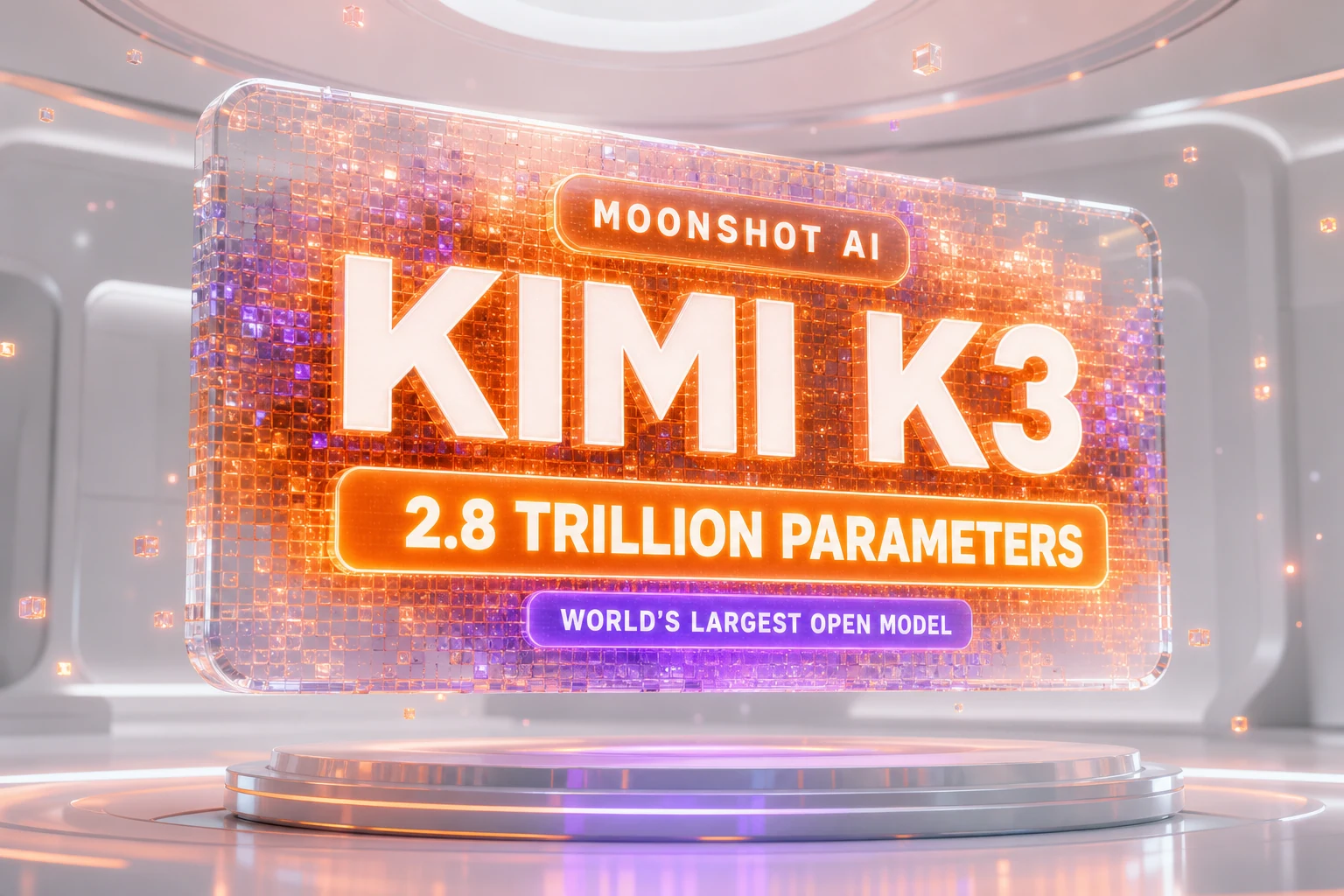
Kimi K3 is the flagship model Moonshot AI announced on July 16, 2026, and it is the largest open-weight model the industry has ever seen: a Mixture-of-Experts design with roughly 2.8 trillion total parameters, about 50 billion active per token, a 1-million-token context window, and native vision. On the independent Artificial Analysis Intelligence Index version 4.1 it scores 57 — third to fourth in the world, ahead of Claude Opus 4.8 at 56 and behind Claude Fable 5 at 60 and GPT-5.6 Sol at 59. But two facts complicate the "open" headline. First, at launch the weights had not actually been published; Moonshot promises them by July 27, 2026 under a Modified MIT license. Second, Kimi K3 is priced like a US frontier model at $3.00 per million input tokens and $15.00 per million output tokens — the most expensive model a Chinese lab has ever shipped.
Key Takeaways
- The biggest open model ever — on paper. At roughly 2.8 trillion total parameters (about 50 billion active, 16 of 896 experts firing), Kimi K3 is more than twice the size of Moonshot's earlier trillion-parameter Kimi K2 line.
- Third-to-fourth in the world, independently. Its Artificial Analysis Intelligence Index version 4.1 score of 57 sits above Claude Opus 4.8 (56) and behind GPT-5.6 Sol (59) and Claude Fable 5 (60) — the same index version for all four, so the ranking is legitimate.
- The end of ultra-cheap Chinese AI. At $3.00 input and $15.00 output per million tokens, Kimi K3 costs more than Claude Sonnet 5, which lists at $2.00 input and $10.00 output. Its predecessor charged roughly $0.95 and $4.00. The discount that defined Chinese frontier models just evaporated at the top of the lineup.
- Open with an asterisk. The weights were promised, not published. Moonshot targets a Modified MIT weight drop by July 27, 2026 — so on launch day the "world's largest open model" was, strictly, closed.
- Two number systems, kept apart. The independent index (57) and Moonshot's own benchmark sheet are different kinds of evidence. The vendor figures are self-reported and were not independently reproduced at launch.
What Kimi K3 Actually Is
Kimi K3 is Moonshot AI's new frontier model, unveiled on July 16, 2026 after a promotional page briefly leaked on the Kimi Open Platform the day before. It is a sparse Mixture-of-Experts (MoE) system: of its roughly 2.8 trillion total parameters, only about 50 billion are active on any given token, because just 16 of its 896 experts fire per forward pass. That sparsity is the whole trick — it is how a model this large can be served at a price anyone would pay, rather than sitting in a lab as a research curiosity.
The architecture introduces two named building blocks. Kimi Delta Attention (KDA) is an attention scheme tuned for very long contexts, and Attention Residuals (AttnRes) is a training-efficiency change; a third component, Stable LatentMoE, targets the stability of routing tokens to experts at this scale. The model carries a 1-million-token context window and native vision, and Moonshot ships it in more than one flavor: a K3 Max variant aimed at chat and agent use, and a K3 Swarm Max variant oriented toward running many instances in parallel. The framing throughout is agentic — this is pitched as a model for long-horizon coding and autonomous task-running, not just a chatbot.
Where Kimi K3 Ranks: The Independent Number
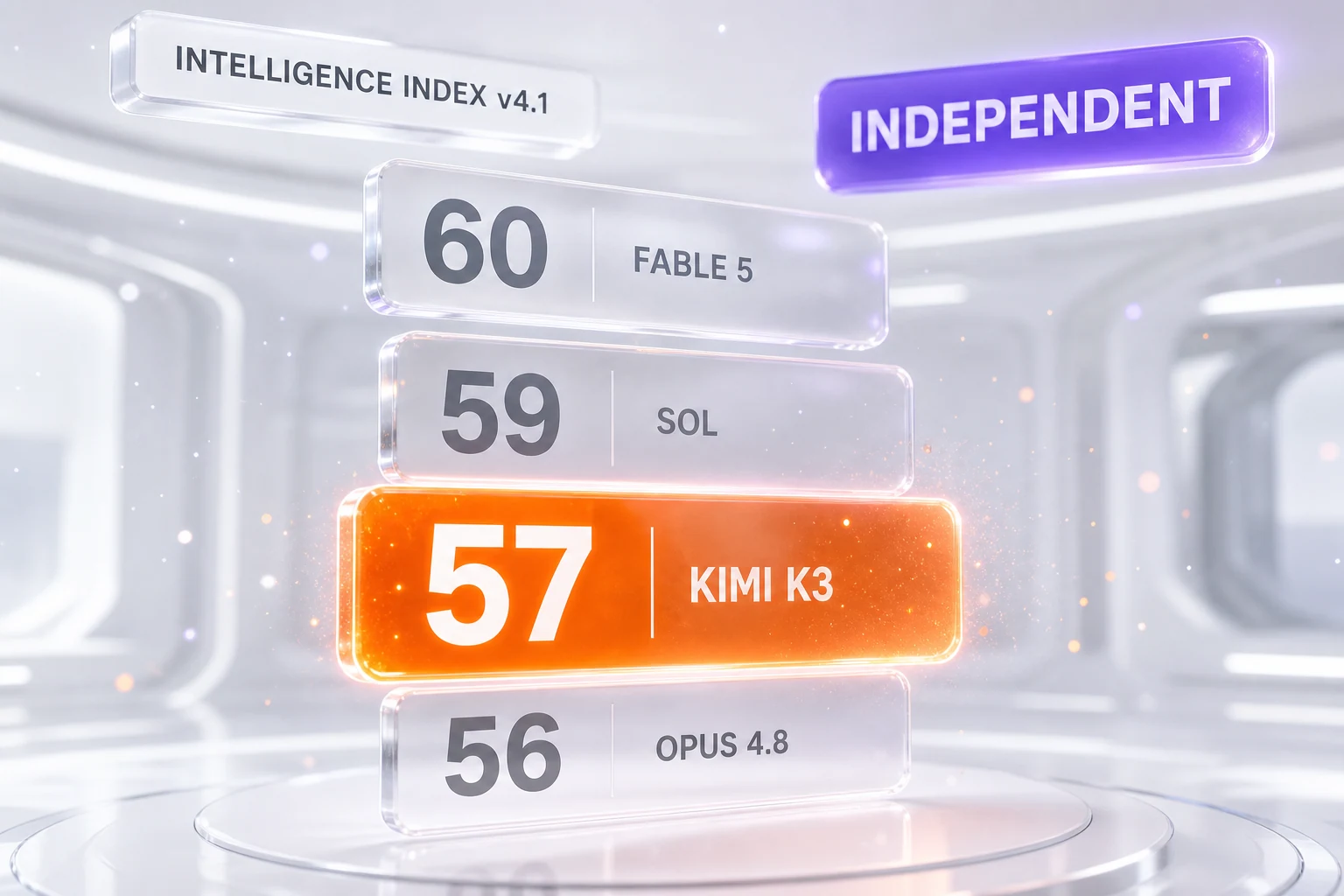
The number that matters most is the one Moonshot did not produce. On the Artificial Analysis Intelligence Index — an independent aggregate that, in its version 4.1, combines nine separate evaluations — Kimi K3 scores 57. That is enough to place it third to fourth among all models in the world. It edges past Claude Opus 4.8 (56) and trails only GPT-5.6 Sol (59) and Claude Fable 5 (60). Because every one of those scores is drawn from the same version 4.1 of the index, the comparison is clean rather than a cross-version mirage.
A 57 is the highest independent intelligence score any Chinese lab has posted. To put the ascent in perspective, Moonshot's own Kimi K2.6 and Kimi K2.7 Code sat lower on the same index, at 44 and 42, alongside open-weight peers like MiniMax M3. K3 is not an incremental bump on that line; it is a leap into the neighborhood of the closed US frontier.
The Independent Leaderboard, Version 4.1
| Model | Maker | Intelligence Index v4.1 | Weights |
|---|---|---|---|
| Claude Fable 5 | Anthropic | 60 | Closed |
| GPT-5.6 Sol | OpenAI | 59 | Closed |
| Kimi K3 | Moonshot AI | 57 | Open (promised) |
| Claude Opus 4.8 | Anthropic | 56 | Closed |
A second independent signal points the same way. On Artificial Analysis's GDPval-AA version 2 — a test of real-world tasks spanning dozens of occupations — Kimi K3 scored 1,687, placing third overall behind Claude Fable 5 Max (1,815) and GPT-5.6 Sol Max (1,747.8), and ahead of Claude Opus 4.8 (1,600). Two different third-party lenses, one consistent verdict: Kimi K3 belongs in the frontier conversation.
The Price Shock: The End of Cheap Chinese AI
For two years, the pitch for Chinese frontier models was simple — nearly the same capability for a fraction of the price. Kimi K3 tears that pitch up. It costs $0.30 per million cache-hit input tokens, $3.00 per million standard input tokens, and $15.00 per million output tokens. Strip away the cache tier and that is above the standard list price of Claude Sonnet 5, a US frontier-tier model that lists at $2.00 input and $10.00 output. Simon Willison, testing the model on launch day, called it "the most expensive model released by a Chinese AI lab to date."
The jump is stark against Moonshot's own back catalog. Kimi K2.6 charged roughly $0.95 per million input tokens and $4.00 per million output. Moving to K3 roughly triples the input rate and nearly quadruples the output rate. This is not a rounding error; it is a strategy change. Moonshot has decided that a top-three independent score is worth frontier money, and that customers will pay it rather than treat Chinese AI as the budget option by reflex. If that bet pays off, the mental model of "Chinese equals cheap" stops being automatic — at least for the flagship tier.
Open, With an Asterisk
Here is the tension at the center of the launch. Moonshot calls Kimi K3 the world's first open model in the 3-trillion-parameter class, and the Kimi K2 family's Modified MIT releases give that claim real history. Yet on July 16, 2026, the weights were not available to download. What shipped on launch day was an API you pay to call and a promise that the weights would follow.
The stated target is a full weight release by July 27, 2026, under the same Modified MIT license. That distinction is worth stating plainly because it changes what "open" buys you today: right now you cannot self-host Kimi K3, fine-tune it on your own hardware, or audit it end to end. You can only rent it. Release dates for weight drops have slipped before across the industry, so the accurate description as of this writing is open-weight-in-waiting — the intent is documented, the artifact is not yet in hand. If Moonshot hits its date, K3 becomes the most capable openly licensed model on earth; if it slips, the headline quietly outruns the reality for a while.
What Moonshot Says It Can Do
Independent scores are one lens. A vendor's own benchmark sheet is another, and Moonshot's is glossy. Alongside the launch, the company published a run of results on agentic, coding, reasoning, and multimodal tests. These are Moonshot-reported figures — self-selected, self-run, and not independently reproduced at launch — so they belong in their own box, well away from the third-party index.
| Benchmark (Moonshot-reported) | Score |
|---|---|
| Terminal-Bench 2.1 | 88.3 |
| BrowseComp | 91.2 |
| GPQA-Diamond | 93.5 |
| Program Bench | 77.8 |
| SWE Marathon | 42.0 |
| MMMU-Pro (vision) | 81.6 |
| OmniDocBench | 91.1 |
Every figure in that table comes from Moonshot, and none had been independently confirmed when the model launched. The right way to read a vendor sheet is as a claim, not a result: useful for the story a company wants to tell about its own model, and worth exactly nothing until an outside lab reproduces it. For a neutral read, the third-party Intelligence Index discussed earlier is the number to trust; for a definitive one, wait for reproductions.
Kimi Delta Attention and the 6.3x Long-Context Trick
A model with 2.8 trillion parameters and a million-token window would be prohibitively slow with conventional attention, and that is the problem Kimi Delta Attention is built to solve. Moonshot reports that KDA delivers up to a 6.3-times acceleration in decoding within a 1-million-token context — the difference between a long-context feature that exists on a spec sheet and one that is actually usable interactively. The companion technique, Attention Residuals, is reported to lift training efficiency by roughly 25 percent while adding under 2 percent to cost, which is how a lab makes a run this large economically feasible in the first place.
These claims, like the benchmark sheet, are Moonshot's own, and the real test will come when the weights are public and independent researchers can profile the architecture directly. But the design intent is clear and coherent: every headline component — sparse expert routing, delta attention, attention residuals, a stable MoE router — is aimed at the same goal of making an enormous, long-context, agent-focused model cheap enough to run and stable enough to train.
An Independent First Look: The Pelican Test
The most useful outside signal on launch day came from developer Simon Willison, whose running habit is to ask each new model to draw an SVG of a pelican riding a bicycle. His first look at Kimi K3 is worth reading for the texture it adds to the numbers. The pelican generation cost about 25 cents and burned roughly 16,658 output tokens, of which about 13,241 were reasoning tokens — a reminder that a frontier-priced model with a single "max" reasoning level can run up a bill quickly. Willison flagged the model's one reasoning setting as expensive, and noticed a tokenization quirk: a trivial prompt counted as 95 input tokens where rival systems counted around 10, hinting at a hidden system prompt of roughly 85 tokens baked in.
On the upside, he found the native vision genuinely strong, producing high-quality alt text when asked to describe the rendered image. None of this is a full evaluation — it is one experienced developer's first afternoon with the API — but it corroborates the shape of the launch: capable, multimodal, and, by Chinese-lab standards, unusually expensive to run.
What It Means for the Open-Weight Race
Kimi K3 reframes two debates at once. The first is about capability: an open-licensed model reaching the third-to-fourth rung of an independent leaderboard closes much of the remaining gap between open weights and the closed US frontier, and it does so from a Chinese lab, which sharpens the geopolitical edge of the story. If the weights land on schedule, teams that need to self-host a near-frontier model — for data residency, cost control at scale, or auditability — will have their strongest option yet.
The second debate is about price, and here Kimi K3 is almost a provocation. By charging like GPT-5.6 Sol and Claude Opus 4.8 rather than undercutting them, Moonshot is testing whether "Chinese AI" can shed its budget label and compete on prestige and capability instead. For anyone weighing options across our roundup of the best AI coding tools of 2026, the calculus shifts: the reflexive move of reaching for a Chinese model to save money no longer holds at the flagship tier, and the real question becomes whether an eventual self-hostable, near-frontier open model is worth building around. That answer depends on a date — July 27 — and on whether Moonshot keeps it.
Frequently Asked Questions
What is Kimi K3?
Kimi K3 is the flagship large language model that Moonshot AI announced on July 16, 2026. It is a sparse Mixture-of-Experts model with roughly 2.8 trillion total parameters, a 1-million-token context window, and native vision, which Moonshot describes as the world's first open model in the 3-trillion-parameter class. On independent testing it ranks among the top few models in the world, but its open weights had not yet been published at launch and it is priced like a US frontier model rather than a cheap Chinese alternative.
How many parameters does Kimi K3 have?
Kimi K3 has roughly 2.8 trillion total parameters, making it the largest open-weight model announced to date — more than twice the size of Moonshot's earlier trillion-parameter Kimi K2 line. It is a Mixture-of-Experts design, so only about 50 billion parameters are active per token, with 16 of its 896 experts firing on any given forward pass. That sparse activation is what lets a model this large run at a workable cost.
Where does Kimi K3 rank on the Artificial Analysis Intelligence Index?
Kimi K3 scores 57 on the Artificial Analysis Intelligence Index version 4.1, an independent aggregate of nine evaluations. That places it roughly third to fourth in the world: above Claude Opus 4.8 at 56, and behind Claude Fable 5 at 60 and GPT-5.6 Sol at 59. All four of those figures come from the same version 4.1 of the index, so the comparison is apples to apples. It is the highest independent score any Chinese lab has posted.
How much does Kimi K3 cost?
Kimi K3 is priced at $0.30 per million cache-hit input tokens, $3.00 per million standard input tokens, and $15.00 per million output tokens on the Kimi Open Platform. That input-and-output rate sits above Claude Sonnet 5's $2.00 input and $10.00 output list price, and it makes Kimi K3 the most expensive model a Chinese AI lab has released so far.
Why is Kimi K3's pricing a big deal?
Because Chinese labs built their reputation on undercutting US frontier models by an order of magnitude, and Kimi K3 walks away from that playbook. Its predecessor Kimi K2.6 charged about $0.95 per million input tokens and $4.00 per million output; K3 jumps to $3.00 and $15.00. Moonshot is betting that a top-three independent score is worth frontier pricing — a signal that the era of ultra-cheap Chinese AI as a default may be ending, at least at the top of the lineup.
Are Kimi K3's weights open source?
They are promised as open, but at launch they were not yet published. Moonshot has released its Kimi K2 family under a Modified MIT license and says K3 will follow the same open-weight pattern. So on July 16, 2026, Kimi K3 was open in intent and closed in practice — you could pay to use the API, but you could not yet download the model. That is an important asterisk on the "world's largest open model" headline.
When will Kimi K3's open weights be released?
Moonshot has said the full model weights are scheduled to be published by July 27, 2026, according to researchers who reviewed the company's technical documentation. Until that release actually lands, the "open" label describes a commitment rather than something you can act on. Timelines like this can slip, so the honest description today is that Kimi K3 is open-weight-in-waiting, with a target date late in July 2026.
What is Kimi Delta Attention (KDA)?
Kimi Delta Attention is one of two headline architecture changes in Kimi K3. It is an attention mechanism tuned for very long contexts, and Moonshot reports it delivers up to a 6.3-times speedup in decoding inside a 1-million-token window. The second change, Attention Residuals (AttnRes), is reported to improve training efficiency by about 25 percent for less than 2 percent added cost. Together they are how Moonshot claims to make a 2.8-trillion-parameter, million-token model practical to serve.
What is the context window of Kimi K3?
Kimi K3 has a 1-million-token context window, which is on par with the largest windows offered by frontier US models such as Claude Opus 4.8, Claude Fable 5, and GPT-5.6 Sol. Combined with Kimi Delta Attention, the long window is aimed squarely at long-horizon coding and agent workloads, where a model needs to hold an entire codebase or a lengthy task history in view at once.
How does Kimi K3 compare to Claude Opus 4.8 and GPT-5.6 Sol?
On the independent Artificial Analysis Intelligence Index version 4.1, Kimi K3 scores 57, which is one point above Claude Opus 4.8 at 56 and two points below GPT-5.6 Sol at 59. In practice that means Kimi K3 is competitive with the US frontier on raw intelligence, and it now charges frontier-level prices to match. The remaining differences come down to ecosystem, tooling, reliability, and — once the weights ship — the option to self-host, which the closed US models do not offer.
What are the Kimi K3 Max and K3 Swarm Max variants?
Moonshot ships Kimi K3 in more than one configuration. K3 Max is the chat and agent variant most users will call through the API, while K3 Swarm Max is oriented toward parallelism — running many model instances or sub-agents at once for heavier, distributed workloads. The split reflects Moonshot's framing of K3 as an agentic and coding model rather than a single monolithic chatbot.
Are Kimi K3's benchmark scores independently verified?
Two different kinds of numbers are circulating, and they should not be mixed. The independent one is the Artificial Analysis Intelligence Index score of 57, produced by a third party. Separately, Moonshot publishes its own benchmark sheet — figures on tests like Terminal-Bench, BrowseComp, and GPQA-Diamond — which are vendor-reported and had not been independently reproduced at launch. Treat Moonshot's self-reported results as marketing until outside labs confirm them, and lean on the third-party index for a neutral read.
Sources
- Artificial Analysis — Kimi K3 model page (Intelligence Index v4.1, pricing)
- Simon Willison — Kimi K3 first look (pelican SVG test, cost, tokenization)
- MarkTechPost — Moonshot AI releases Kimi K3 (architecture, KDA, experts)
- VentureBeat — China's Moonshot AI releases Kimi K3, the largest open-source model ever
- Axios — China's open-weight Kimi model stuns AI world with frontier-level results