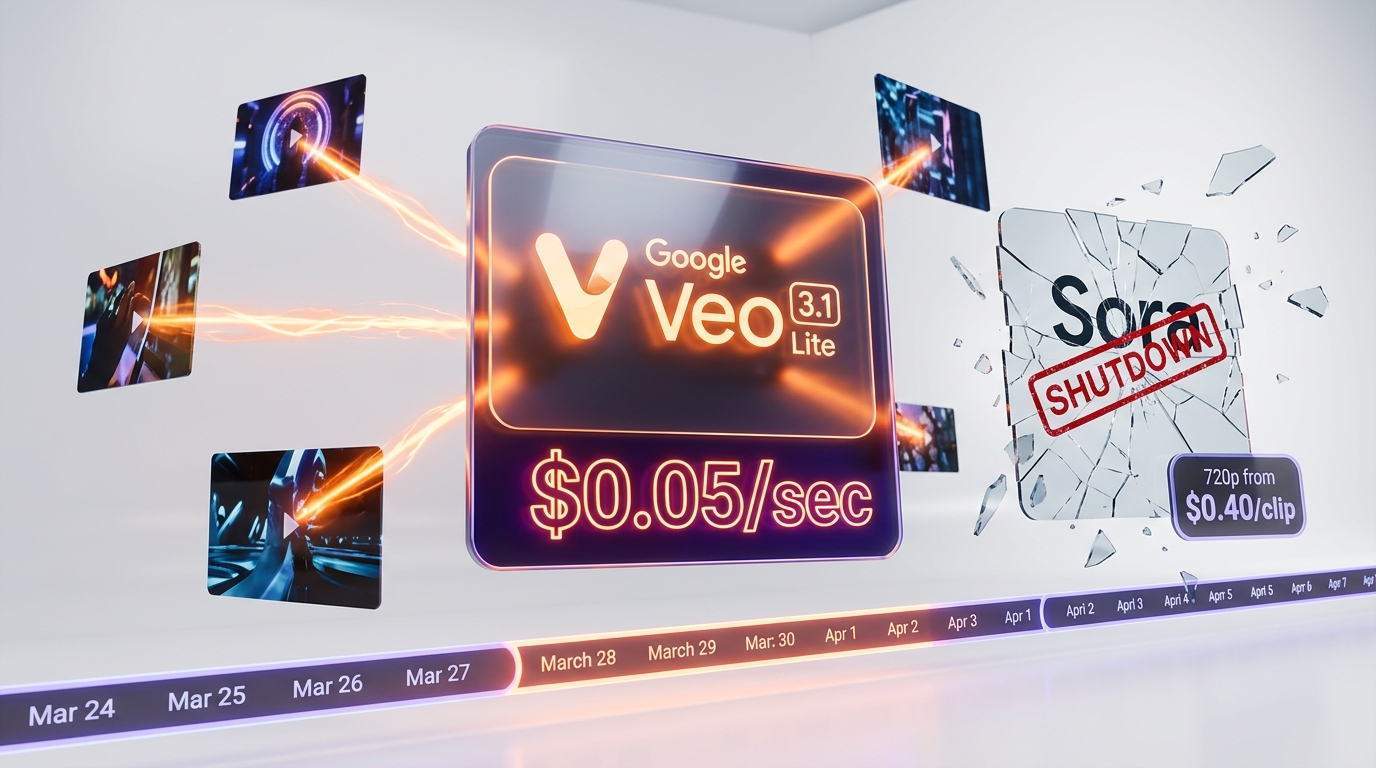
Google launched Veo 3.1 Lite on March 31, 2026 at $0.05 per second for 720p video via the Gemini API, making it the cheapest production-grade AI video model on the market. One week earlier, on March 24, OpenAI announced the shutdown of Sora after a $15 million per day burn rate against just $2.1 million in total lifetime revenue. Veo 3.1 Fast received a 14-33% price cut on April 7. Google now offers three API tiers — Lite, Fast, and Full — while its only serious competitor just exited the market.
The Numbers That Killed Sora
OpenAI pulled the plug on Sora on March 24, 2026. The economics were catastrophic. At its peak, Sora was burning through an estimated $15 million per day in inference costs. Its entire lifetime revenue from in-app purchases totaled $2.1 million — meaning daily costs exceeded total lifetime revenue by more than 7,000x.
Downloads peaked at 3.33 million in November 2025 and fell 66% to 1.13 million by February 2026. The product was already in freefall before the announcement. The $1 billion Disney licensing and investment deal collapsed alongside it — Disney executives were reportedly informed less than an hour before the public announcement on March 23.
| Sora Metric | Value |
|---|---|
| Shutdown Date | March 24, 2026 |
| Daily Burn Rate (Peak) | $15M/day |
| Total Lifetime Revenue | $2.1M |
| Cost-to-Revenue Ratio | 7,000:1 (daily) |
| Peak Downloads (Nov 2025) | 3.33M |
| Final Downloads (Feb 2026) | 1.13M (-66%) |
| Disney Deal Status | Dead — $1B collapsed |
| App Shutdown | April 26, 2026 |
| API Shutdown | September 24, 2026 |
The Sora team will continue as a research unit focused on world simulation and robotics under a new model codenamed "Spud." By shifting computing resources away from Sora, OpenAI can reallocate chips to more profitable coding, reasoning, and text-generation tasks. The shutdown is partly strategic: OpenAI's planned IPO makes a product burning $15 million per day with minimal revenue a serious liability for institutional investors.
Veo 3.1 Lite: Google's $0.05 per sec Answer
Seven days after Sora's death announcement, Google launched Veo 3.1 Lite on March 31, 2026 through the Gemini API and Google AI Studio. At $0.05 per second for 720p and $0.08 per second for 1080p, it is the cheapest production-grade AI video generation model currently available via API.
Veo 3.1 Lite Specifications
| Feature | Veo 3.1 Lite |
|---|---|
| Release Date | March 31, 2026 |
| Model ID | veo-3.1-lite-generate-preview |
| Resolutions | 720p, 1080p |
| Aspect Ratios | 16:9, 9:16 |
| Duration Options | 4s, 6s, 8s |
| Input Modes | Text-to-Video, Image-to-Video |
| Audio | Ambient sound (generate_audio parameter) |
| 720p Price | $0.05 per sec |
| 1080p Price | $0.08 per sec |
| 8s Video Cost (720p) | $0.40 |
| API Access | Gemini API + Google AI Studio |
Lite delivers the same generation speed as Veo 3.1 Fast but at less than 50% of the cost. It supports both text-to-video and image-to-video pipelines, flexible framing for landscape (16:9) and portrait (9:16), and durations of 4, 6, or 8 seconds. The generate_audio parameter adds ambient sound to clips — a genuine differentiator for social content that auto-plays with sound.
The timing is surgical. Google watched Sora implode, waited one week, and dropped a model priced specifically to absorb every developer Sora left behind. At $0.40 for an 8-second 720p clip, Veo 3.1 Lite makes high-volume video generation economically viable for the first time.
Veo 3.1 Fast Gets a Price Cut on April 7
Google did not stop at launching Lite. On April 7, 2026 — one week after Lite's release — Veo 3.1 Fast received a 14-33% price reduction across all resolutions. The new pricing:
| Resolution | Old Price/sec | New Price/sec (April 7) | Reduction |
|---|---|---|---|
| 720p | ~$0.12 | $0.10 | ~17% |
| 1080p | ~$0.15 | $0.12 | ~20% |
| 4K | ~$0.45 | $0.30 | ~33% |
After the price drop, Fast's 720p tier costs only twice what Lite charges, but includes 4K output capability, reference image support, and video extension features. This is classic Google pricing strategy: anchor with an ultra-cheap Lite model, then make the mid-tier irresistible by comparison.
The Complete Veo 3.1 Pricing Architecture
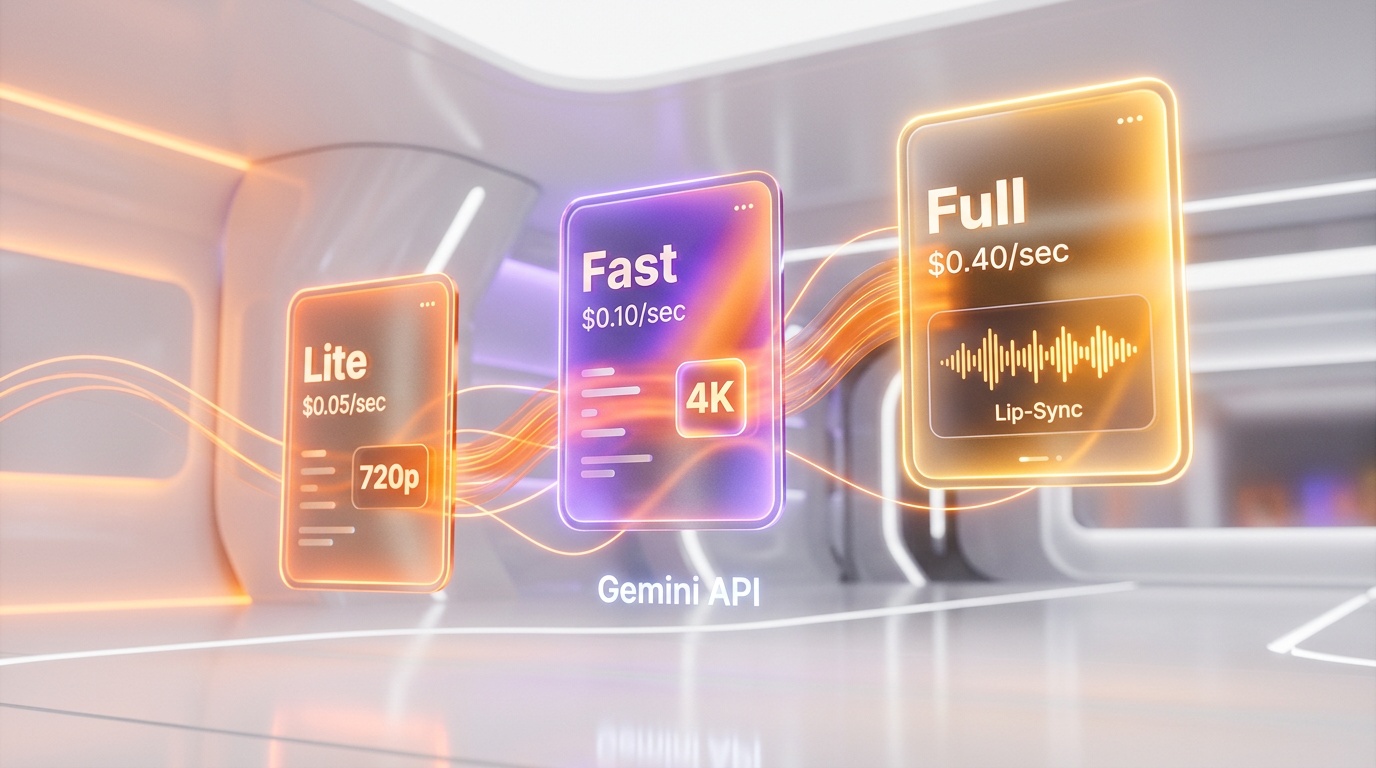
Google now offers a three-tier Veo 3.1 API pricing system that covers every use case from bulk social media content to cinematic production:
| Model | 720p/sec | 1080p/sec | 4K/sec | Best For |
|---|---|---|---|---|
| Veo 3.1 Lite | $0.05 | $0.08 | N/A | High-volume apps, social content, MVPs |
| Veo 3.1 Fast | $0.10 | $0.12 | $0.30 | Production apps, 4K output, ref images |
| Veo 3.1 Full | $0.40 | $0.40 | $0.60 | Cinematic production, native lip-sync audio |
That is a 12x price range from Lite 720p ($0.05) to Full 4K ($0.60). Google is telling the market: whatever your budget, we have a tier for you. No other provider offers this kind of graduated pricing across a single model family.
Veo 3.1 Full: The Only Model With Native Audio Lip-Sync
While Lite and Fast are about accessibility and volume, Veo 3.1 Full remains the flagship — and it has a feature no competitor can match: native audio lip-sync generation.
Veo 3.1 Full generates three types of audio simultaneously in a single render pass: dialogue and speech synced to character lip movements, sound effects matched to on-screen action, and ambient environmental soundscapes. The audio quality hits 48kHz with lip-sync accuracy within 120 milliseconds. This is not post-processing — the model uses a joint diffusion process where audio and video are generated together as a unified output.
No other publicly available AI video model does this. Runway Gen-4 requires separate audio workflows. Kling 3.0 generates silent video by default. Pika focuses on short-form creative effects. Only Veo 3.1 Full produces ready-to-publish video with synchronized speech, sound effects, and ambient audio from a single text prompt.
MovieBench: 72% Human Preference Over Sora
The quality gap was already established before Sora shut down. In Google's internal MovieBench evaluation, Veo 3 achieved a 72% preference rate among human evaluators for overall prompt fulfillment, compared to 23% for OpenAI's Sora. Veo 3 also scored higher in physics simulation realism and lip-sync accuracy.
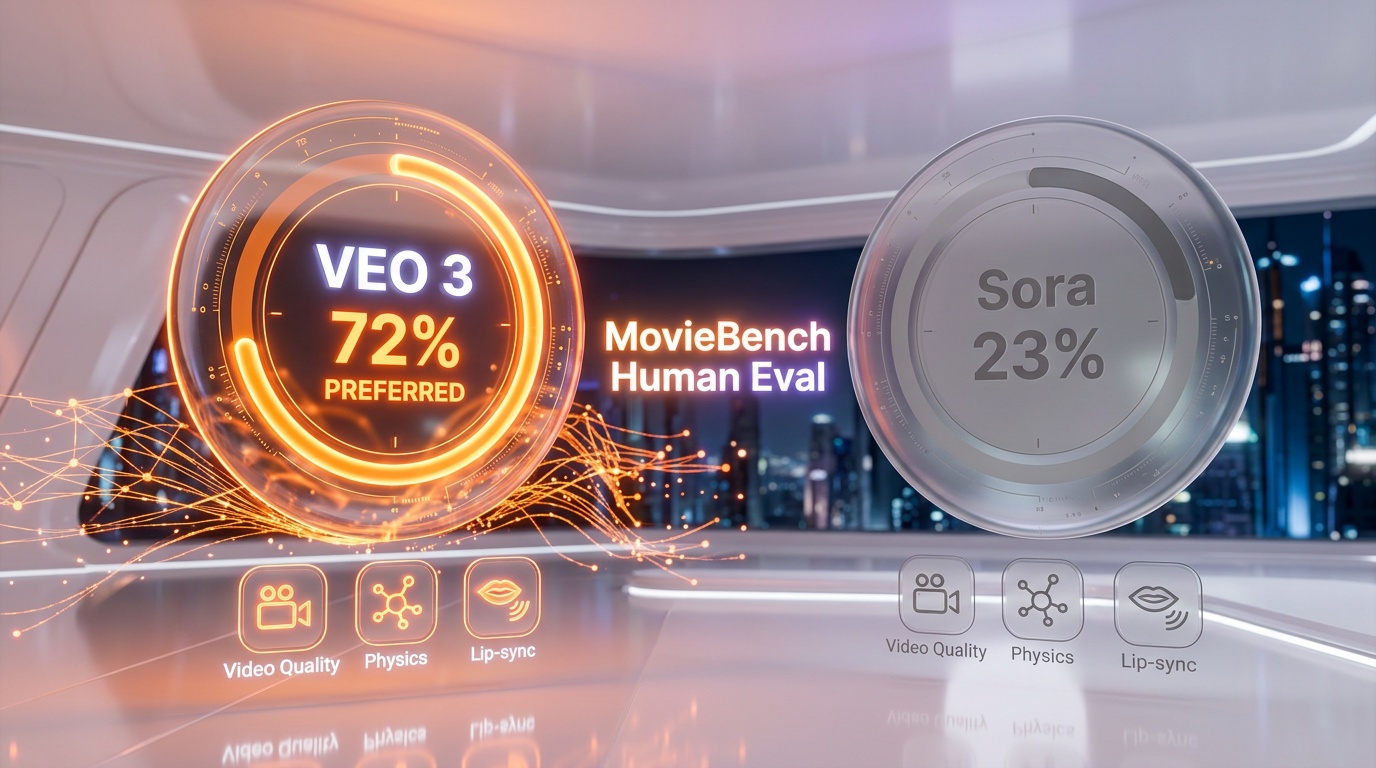
For the newer Veo 3.1, MovieGenBench testing showed it consistently outperforming Sora 2, Runway Gen 4, and other competitors in accurately following complex multi-element prompts. Veo 3.1 ranked highest in overall preference, prompt adherence, and visual quality among all competing models.
These are not marginal differences. A 72% vs 23% preference rate is a category-defining quality gap — the kind of gap that makes enterprise customers stop evaluating alternatives.
Google Flow: The Unified Creative Platform
Veo 3.1 is not just an API. Google is building an entire creative ecosystem around it through Flow, its unified AI filmmaking platform.
In February 2026, Google shipped a major redesign of Flow. The best capabilities from Whisk (collage generation), ImageFX (still image generation), and Nano Banana (high-fidelity image creation) were merged into a single workspace. Since March 2026, users can generate, edit, and animate images and videos without ever leaving Flow.
Flow Key Capabilities
- Unified workspace — Whisk collages, ImageFX stills, and raw prompts in a single interface for generation, editing, and animation
- Lasso tool — Precisely select areas of an image and modify them with natural language ("remove the man," "add koi fish in the water")
- Video editing — Extend clip length, add/remove objects in video, orchestrate camera motion
- Image-to-video pipeline — Create high-fidelity images and instantly use them as frames for Veo video generations
- Gemini-powered prompting — Coming soon, with direct-to-YouTube publishing expected before end of 2026
Flow represents Google's vertical integration play. While competitors sell video generation as a standalone API, Google is building the complete creation-to-distribution pipeline. When YouTube integration lands, creators will be able to go from text prompt to published video without touching a third-party tool.
Impact on Competitors: Runway, Kling, Pika
Sora's exit and Veo 3.1 Lite's launch fundamentally reshape the AI video market. We are tracking three competitors who now face very different strategic challenges.
Runway Gen-4 Turbo
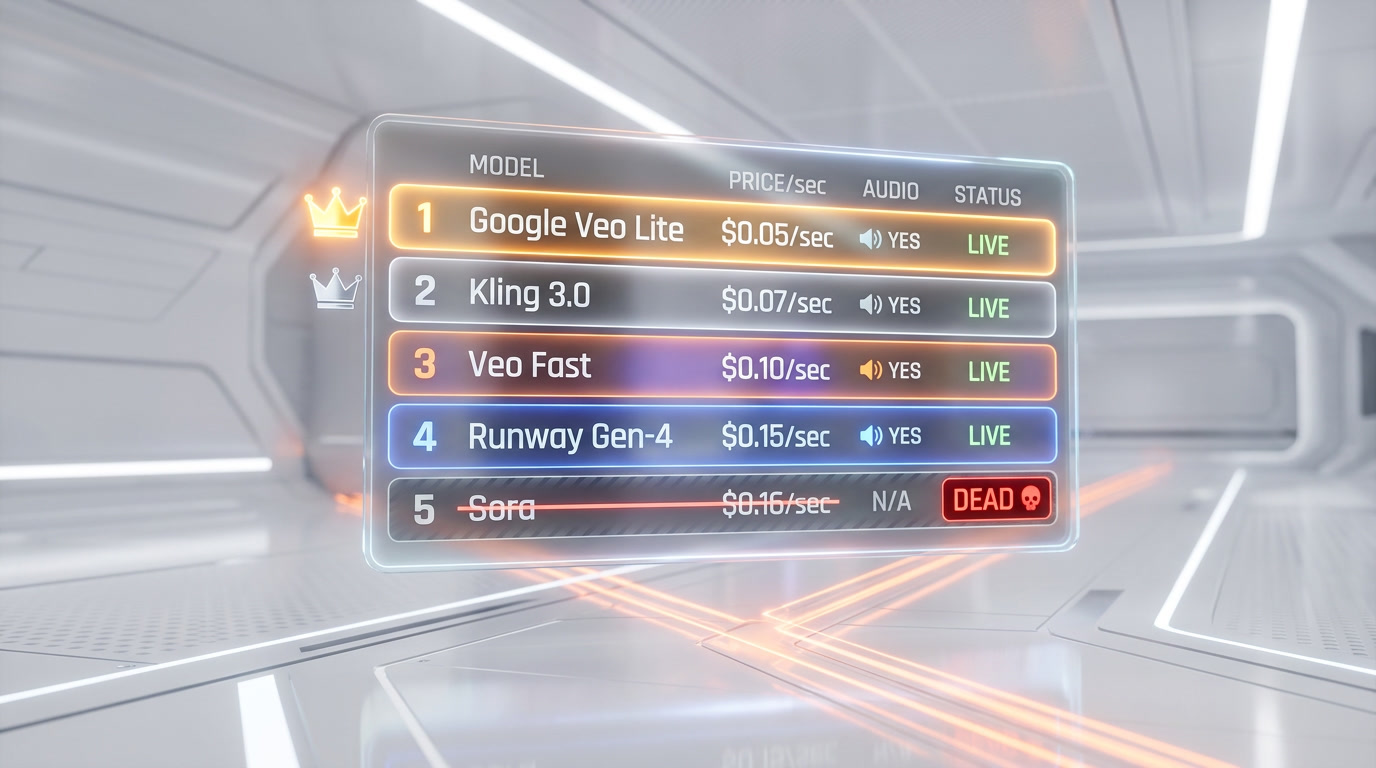
Runway remains the strongest competitor in terms of temporal consistency and character persistence for professional production workflows. Gen-4 Turbo is the top choice for advertising and narrative content. However, at roughly $0.15-0.20 per second, Runway is now 3-4x more expensive than Veo 3.1 Lite for basic generation. Runway's advantage narrows to professional-grade motion control and enterprise relationships.
Kling 3.0
Kuaishou's Kling 3.0 was the price leader at $0.07 per second — until Veo 3.1 Lite undercut it at $0.05. Kling's production quality at 65% less than Sora and 44% less than Runway made it dominant for high-volume social media production. But Veo 3.1 Lite now beats Kling's $0.07 pricing by 29%, and Google's brand and API ecosystem (Gemini) make it a more natural choice for developers already in the Google Cloud stack.
Pika
Pika has carved a niche in creative expression and viral short-form content rather than competing on photorealism. As the market consolidates around price and production quality, Pika's differentiation becomes both its strength and its limitation — it is insulated from the price war but also excluded from the enterprise market Google and Runway are fighting over.
Pricing War: Cost Per 8-Second Video Across All Players
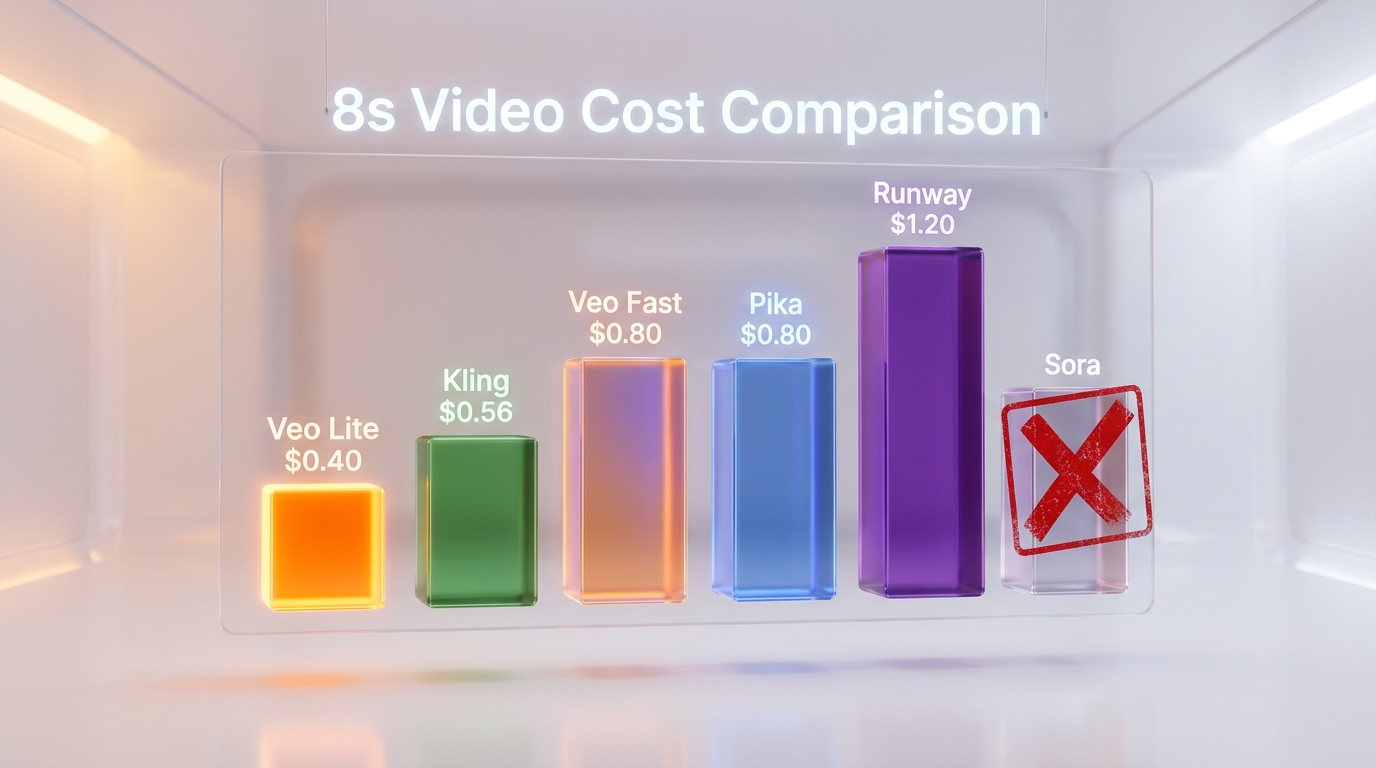
Here is what an 8-second video actually costs across every major provider as of April 2026:
| Model | 8s Video (720p) | 8s Video (1080p) | Audio Included | Status |
|---|---|---|---|---|
| Google Veo 3.1 Lite | $0.40 | $0.64 | Ambient (optional) | Live |
| Google Veo 3.1 Fast | $0.80 | $0.96 | Full audio | Live (new price) |
| Google Veo 3.1 Full | $3.20 | $3.20 | Native lip-sync | Live |
| Kling 3.0 | $0.56 | ~$0.80 | No | Live |
| Runway Gen-4 Turbo | ~$1.20 | ~$1.60 | No | Live |
| Pika | ~$0.80 | N/A | No | Live |
| Sora | N/A | N/A | N/A | Shutdown (March 24) |
Veo 3.1 Lite is the cheapest option at $0.40 for an 8-second 720p clip. Veo 3.1 Full is the most expensive at $3.20+ but is also the only model producing synchronized audio with lip-sync. The market is stratifying: cheap generation for volume (Lite/Kling), production quality for professionals (Runway/Fast), and cinematic output for premium content (Full).
What This Means for Developers
If you are building a product that uses AI video generation, the landscape just simplified dramatically:
For High-Volume Applications
Veo 3.1 Lite at $0.05 per sec through the Gemini API is the clear choice. You get text-to-video and image-to-video, 720p/1080p output, flexible durations, and optional ambient audio. At $0.40 per 8-second clip, you can generate 2,500 videos for $1,000. Kling 3.0 is the only real alternative at $0.07 per sec, but Google's API ecosystem and documentation make Lite easier to integrate.
For Production Applications
Veo 3.1 Fast at the new April 7 pricing ($0.10 per sec for 720p, $0.30 per sec for 4K) offers the best balance of quality, features, and price. You get 4K output, reference image support, and video extension. Runway Gen-4 Turbo remains competitive for workflows requiring fine-grained motion control, but at a significant price premium.
For Premium Content
If you need video with native audio, dialogue, and lip-sync, Veo 3.1 Full is the only option. Period. No other model generates synchronized speech from a text prompt. At $0.40-0.60/sec, it is expensive — but the alternative is running separate audio generation, lip-sync, and compositing pipelines, which costs more in engineering time.
The Sora Lesson: Why Compute Economics Win
Sora's failure is a case study in what happens when you ship a product without solving the economics. The technology was impressive — Sora could generate compelling video. But at $15 million per day in compute costs and a consumer-facing app that generated just $2.1 million total, the math was never going to work.
Google solved this problem differently. Instead of building a standalone consumer app and hoping for revenue, Google built a multi-tier API that lets the market self-select by willingness to pay. Developers who need cheap generation use Lite. Those who need quality use Fast. Those who need the full cinematic experience use Full. Every tier is priced to be profitable.
This is the same playbook Google used with Cloud TPUs, BigQuery, and Gemini API pricing. Offer a free or ultra-cheap entry point, make the mid-tier the obvious choice for most users, and charge a premium for the flagship. It is not revolutionary strategy — it is just good business applied to a market where the previous leader forgot that burning $15 million per day needs a revenue model.
Timeline: How Google Won AI Video in 12 Days
| Date | Event |
|---|---|
| March 24, 2026 | OpenAI announces Sora shutdown ($15M/day burn rate) |
| March 24, 2026 | Disney $1B deal collapses (informed hours before announcement) |
| March 31, 2026 | Google launches Veo 3.1 Lite at $0.05 per sec via Gemini API |
| April 7, 2026 | Google cuts Veo 3.1 Fast pricing 14-33% across all resolutions |
| April 26, 2026 | Sora app officially shuts down |
| September 24, 2026 | Sora API officially shuts down |
In 12 days — from Sora's shutdown announcement (March 24) to Fast's price cut (April 7) — Google repositioned its entire Veo lineup to absorb the AI video market. Whether this timing was opportunistic or pre-planned, the execution was precise.
What Happens Next
We expect four developments in the coming months:
- Sora app shuts down April 26. The remaining Sora users will need to migrate. Google and Kling will compete for them on price. Runway will compete on quality and enterprise features.
- Sora API shuts down September 24. This is the bigger disruption. Any production application built on Sora's API has a six-month migration window. Veo 3.1 Lite is the closest drop-in replacement for price-sensitive applications.
- Google Flow adds YouTube integration. When this ships (expected H2 2026), Google will offer the only end-to-end pipeline from text prompt to published YouTube video. This is a competitive moat no other player can replicate.
- Kling 3.0 will likely cut prices. Kuaishou cannot afford to be the second-cheapest option when Google's brand and API ecosystem make Lite the default choice for developers. Expect Kling to match or beat $0.05 per sec within Q2 2026.
Our Take: The Market Just Consolidated
Sora's shutdown is not just the end of one product — it is the end of the "hype-funded" era of AI video. The lesson is brutal: you can have the most impressive demo reel in AI, but if you cannot make the unit economics work, you are dead.
Google did not win this market by building better technology (though Veo 3.1 is excellent). Google won by solving the business model first. Three tiers, graduated pricing, Gemini API integration, Flow as the creative frontend, YouTube as the distribution backend. This is infrastructure, not a demo.
For developers evaluating AI video APIs right now: start with Veo 3.1 Lite for prototyping and volume, upgrade to Fast when you need 4K or reference images, and use Full only when native audio is a hard requirement. Build on the Gemini API. Google is not going to shut this down in six months.
For creators using Flow: this is the most capable AI filmmaking tool available today. The unified workspace, Veo integration, and upcoming YouTube publishing make it the default choice. Runway's standalone tools are more polished for professional VFX workflows, but for most creators, Flow does the job.
The AI video market just went from fragmented to consolidated. Google has the technology, the pricing, the platform, and the distribution. Everyone else is fighting for second place.
Frequently Asked Questions
Is Google Veo 3.1 Lite cheaper than Runway Gen-4 and Kling 3.0?
Yes. Veo 3.1 Lite costs $0.05 per sec for 720p and $0.08 per sec for 1080p via the Gemini API, making it the cheapest production-grade AI video model available. An 8-second 720p clip costs just $0.40. Runway Gen-4 requires separate audio workflows, and Kling 3.0 generates silent video by default — neither matches Veo's price-to-feature ratio.
Why did OpenAI shut down Sora?
OpenAI killed Sora on March 24, 2026 due to catastrophic economics: $15 million/day burn rate against just $2.1 million in total lifetime revenue — a 7,000:1 daily cost-to-revenue ratio. Downloads dropped 66% from 3.33M (Nov 2025) to 1.13M (Feb 2026). The $1B Disney licensing deal collapsed, and with OpenAI's planned IPO, the product was a liability.
What is the difference between Veo 3.1 Lite, Fast, and Full?
Veo 3.1 Lite ($0.05 per sec 720p) is for high-volume apps and social content. Veo 3.1 Fast ($0.10 per sec 720p after April 7 price cut) adds 4K output at $0.30 per sec and reference image support. Veo 3.1 Full ($0.40 per sec 720p) is the flagship with native audio lip-sync — generating dialogue, sound effects, and ambient audio at 48kHz in a single render pass.
Does Google Veo 3.1 Lite integrate with the Gemini API?
Yes. Veo 3.1 Lite (model ID: veo-3.1-lite-generate-preview) is accessible via the Gemini API and Google AI Studio. It supports text-to-video and image-to-video pipelines, 16:9 and 9:16 aspect ratios, 4/6/8-second durations, and ambient audio generation via the generate_audio parameter.
How does Veo 3.1 compare to Sora in quality benchmarks?
In Google's MovieBench evaluation, Veo 3 achieved a 72% human preference rate vs Sora's 23% for overall prompt fulfillment. Veo 3 also scored higher in physics simulation realism and lip-sync accuracy. MovieGenBench testing showed Veo 3.1 outperforming Sora 2, Runway Gen 4, and other competitors in prompt adherence and visual quality.
Who should use Google Veo 3.1 Lite?
Veo 3.1 Lite is ideal for developers building high-volume video apps, social media content creators, and startups needing MVP-grade AI video at minimal cost. At $0.40 per 8-second 720p clip with ambient sound, it makes automated video generation economically viable for the first time — especially for teams migrating from Sora's now-defunct API.
What are Google Veo 3.1 Lite's limitations?
Veo 3.1 Lite lacks 4K output (only 720p and 1080p), does not support reference image input or video extension, and does not include native lip-sync audio — only ambient sound. For 4K output, you need Veo 3.1 Fast ($0.30 per sec). For synchronized speech and dialogue, only Veo 3.1 Full ($0.40 per sec) offers native audio lip-sync generation.
What is Google Flow and how does it relate to Veo 3.1?
Google Flow is a unified AI filmmaking platform that merged Whisk (collages), ImageFX (stills), and Nano Banana (high-fidelity images) into a single workspace in February 2026. Since March 2026, users can generate, edit, and animate images and videos in one interface. It includes a lasso tool for natural language editing and an image-to-video pipeline powered by Veo 3.1.