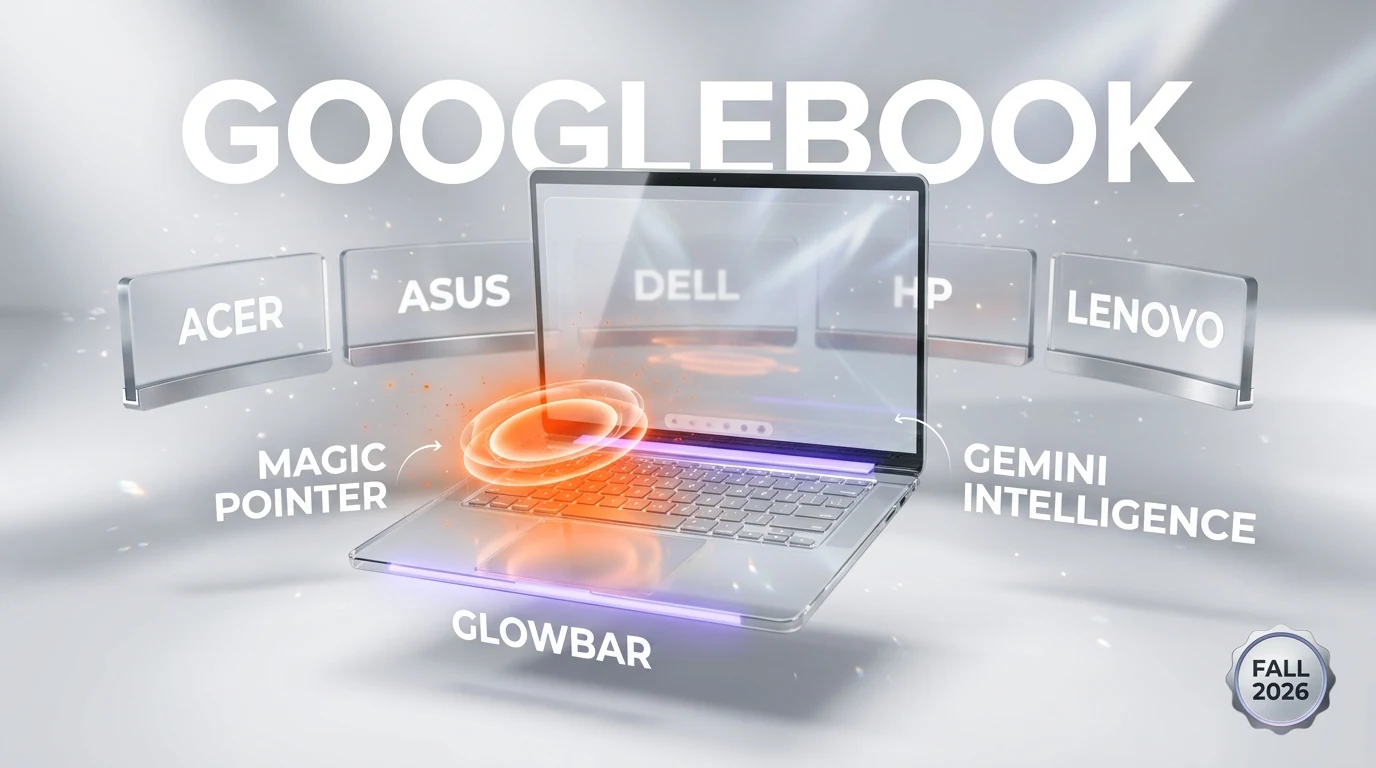
On May 12, 2026, at the Android Show I/O Edition keynote, Google killed the Chromebook brand and replaced it with Googlebook — a new laptop class built ground-up around Gemini, with five OEM partners (Acer, ASUS, Dell, HP, Lenovo) shipping devices in fall 2026. On the same stage, Google unveiled Gemini Intelligence, an agentic Android layer rolling to Pixel 10 and Galaxy S26 this summer. The timing is surgical: Apple's WWDC 2026 reboot lands June 8, and Google just preloaded the narrative.
The 30-second version. Googlebook is what Chromebook should have become — Android-based, Gemini-native, OEM-distributed at scale. Signature features: Magic Pointer (DeepMind contextual cursor), Glowbar design, agentic widgets, phone-to-laptop file continuity. Gemini Intelligence on Android adds multi-step task automation, Rambler voice typing, and custom widget generation. Five OEMs replicate the Chromebook distribution moat — at x10 the price tier. Apple's June 8 keynote now has to answer a story that's already in market.What Google actually shipped on May 12
The Android Show I/O Edition keynote — Google's traditional pre-I/O Android-focused stream — delivered three coordinated announcements stacked for maximum competitive damage. First: the death of ChromeOS as a brand. Second: a new laptop category called Googlebook, built from scratch on Android with Gemini as the primary interface. Third: Gemini Intelligence, the agentic Android layer that ties phones, watches, glasses, cars, and the new laptops into one assistant stack.
Alex Kuscher, Google's Senior Director of Laptops and Tablets, framed the shift as a move "from an operating system to an intelligence system." That's not a marketing line. Googlebook ships with the operating system explicitly behind Gemini — the OS exists to serve the AI, not the other way around. ChromeOS was a browser-first OS for cheap education laptops. Googlebook is an AI-first OS for premium consumer and prosumer machines.
The OEM partner list is the part that matters most for the long-term thesis. Acer, ASUS, Dell, HP, and Lenovo are the same five names that anchor every Windows laptop refresh cycle. Google didn't pick boutique partners. It picked the entire mainstream PC OEM roster. The distribution math is straightforward: if even one Googlebook SKU from each partner ships into the back-to-school 2026 cycle, that's hundreds of thousands of units against MacBook Air and Copilot+ PC in a single quarter.
Three signature features baked into Googlebook
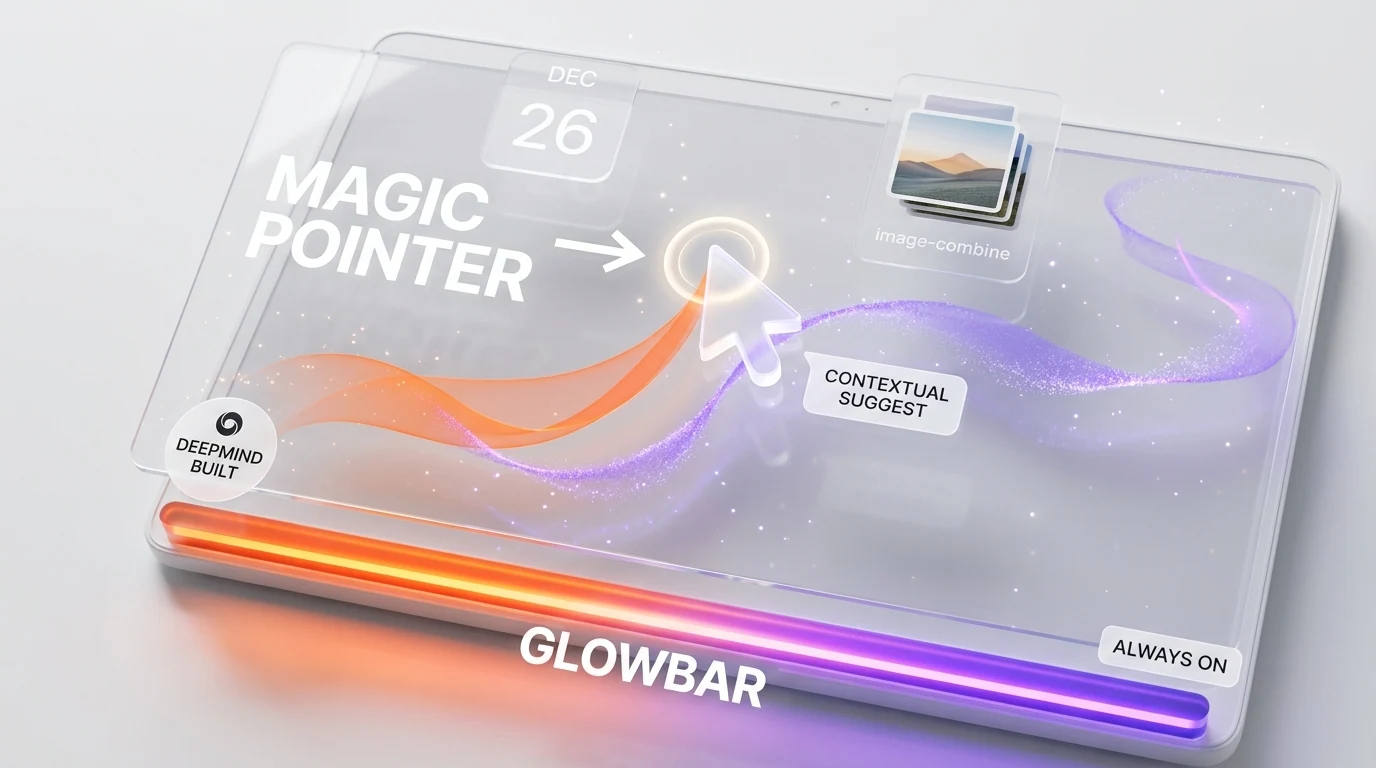
Magic Pointer is the headline feature and the one journalists will keep quoting. Built with Google DeepMind, it converts the cursor into a contextual suggestion surface. Point at a calendar date in an email and it offers to schedule the meeting. Hover over two images and it offers to visualize them combined. Kuscher's exact quote: "We thought, we can take Gemini Intelligence and make the pointer truly smart and intelligent." In demo footage, Magic Pointer reads what's under the cursor, generates a Gemini suggestion, and surfaces a one-click action. It is functionally a Copilot button — except always available, on every pixel.
Glowbar is the design signature. Google describes it as "both functional and beautiful" — a status bar built into the hardware that reflects Gemini's current state (listening, thinking, working). It is the closest thing Google has shipped to Apple's MacBook ambient-design language. Form factors vary by OEM, which means Acer, ASUS, Dell, HP and Lenovo all get to differentiate their Glowbar implementation while keeping the signature.
Create your Widget ports the Gemini Intelligence Android widget generator to the laptop. Type a natural language prompt and Gemini synthesizes a dashboard widget pulling from Gmail, Calendar, Drive and live web data. Google's demo example: a Berlin family reunion planner widget built from a single prompt. Quick Access closes the loop on cross-device: phone files appear inline in the Googlebook file picker, no transfer step.
Gemini Intelligence — the Android assistant layer
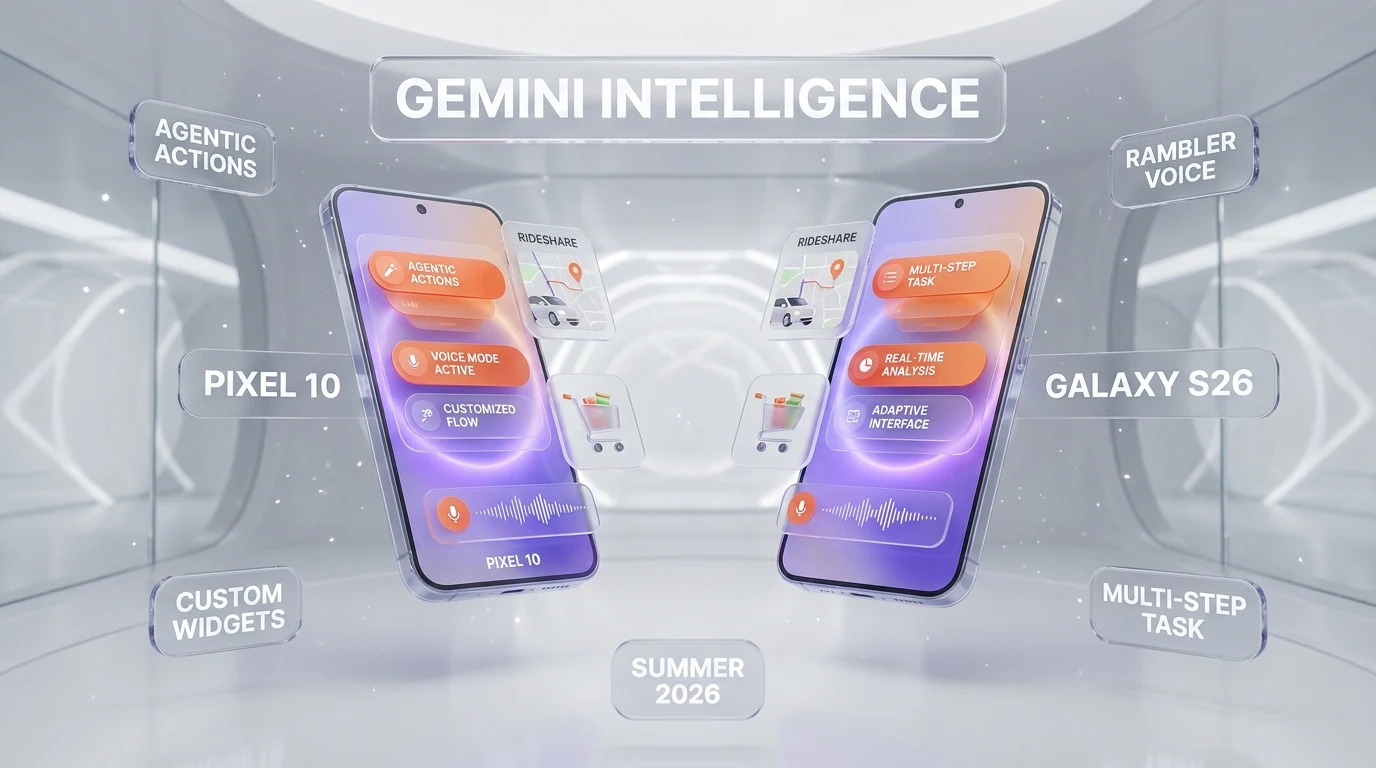
The phone story shipped at the same keynote with hard launch dates. Pixel 10 and Galaxy S26 receive Gemini Intelligence this summer, with broader rollout — Wear OS watches, Android Automotive, AR glasses, Chromebooks-now-Googlebooks — landing later in 2026. Samsung's inclusion at launch is the strategically loaded number: Galaxy is the single biggest non-Apple consumer phone fleet on the planet, and Samsung's previous AI features ran on its own Galaxy AI brand. Galaxy AI doesn't disappear, but Gemini Intelligence becomes the default user-facing layer Samsung markets.
The agentic feature most likely to define Gemini Intelligence in user perception is multi-step task execution. Google's framing: "Gemini only acts on your command and stops the moment the task is complete." Demos showed booking a rideshare end-to-end from a single voice command, and building a shopping cart from a photo of a handwritten grocery list. That second demo is the one that travels — it's a clean visual story for non-technical users.
Rambler voice typing — the small feature that wins users
Rambler is the sleeper hit of the announcement. It transcribes natural speech with self-corrections, filler words ("ums" and "ahs"), and mid-sentence language switching, then outputs a polished message. Google's privacy commitment: "Audio is only used to transcribe in real-time and is not stored or saved." Voice typing has been the most-broken core feature on Android for a decade. Rambler is Google admitting that and shipping a fix branded as a Gemini feature.
The second-tier Gemini Intelligence features are tightly integrated and conventionally good. Create My Widget on phone mirrors the Googlebook version — example prompt: "Suggest three high-protein meal prep recipes every week." Gemini in Chrome launches late June with content summarization, comparison, form filling, and appointment booking. Enhanced Autofill connects Gemini to Google's autofill system (opt-in) to populate complex forms using data from connected apps.
Why now: the Apple timing is not a coincidence
Apple's WWDC 2026 keynote is June 8 — less than four weeks after May 12. Per Mark Gurman's May 5, 2026 Bloomberg report, Apple is expected to ship Extensions in iOS 27 — a framework letting users replace ChatGPT with Claude, Gemini, Grok, Perplexity or Mistral inside Siri. That story has dominated AI-on-iPhone coverage for a week.
Google's calculation is visible. If Apple's June 8 reveal is "you can pick your AI inside our box," Google's May 12 reveal is "we built a whole new box around our AI." One is a permissions update. The other is a category launch. From a narrative-control perspective — which is what these pre-conference keynotes are actually for — Google moved first and moved bigger.
The second Apple pressure point is on the Mac. Apple's Q2 2026 results showed surprise Mac demand driven by local LLM inference workloads — covered in our Apple Q2 2026 Mac AI demand analysis. The MacBook Air M5 and MacBook Pro M5 are the strongest non-Windows laptops in market right now, and Apple has not yet shipped a credible cloud-AI counter to Copilot+ PC. Googlebook positions directly into that gap: cloud-native AI, Pixel-tier hardware tier, OEM-distributed at Best Buy-style scale.
Googlebook vs MacBook vs Copilot+ PC — the three-way race
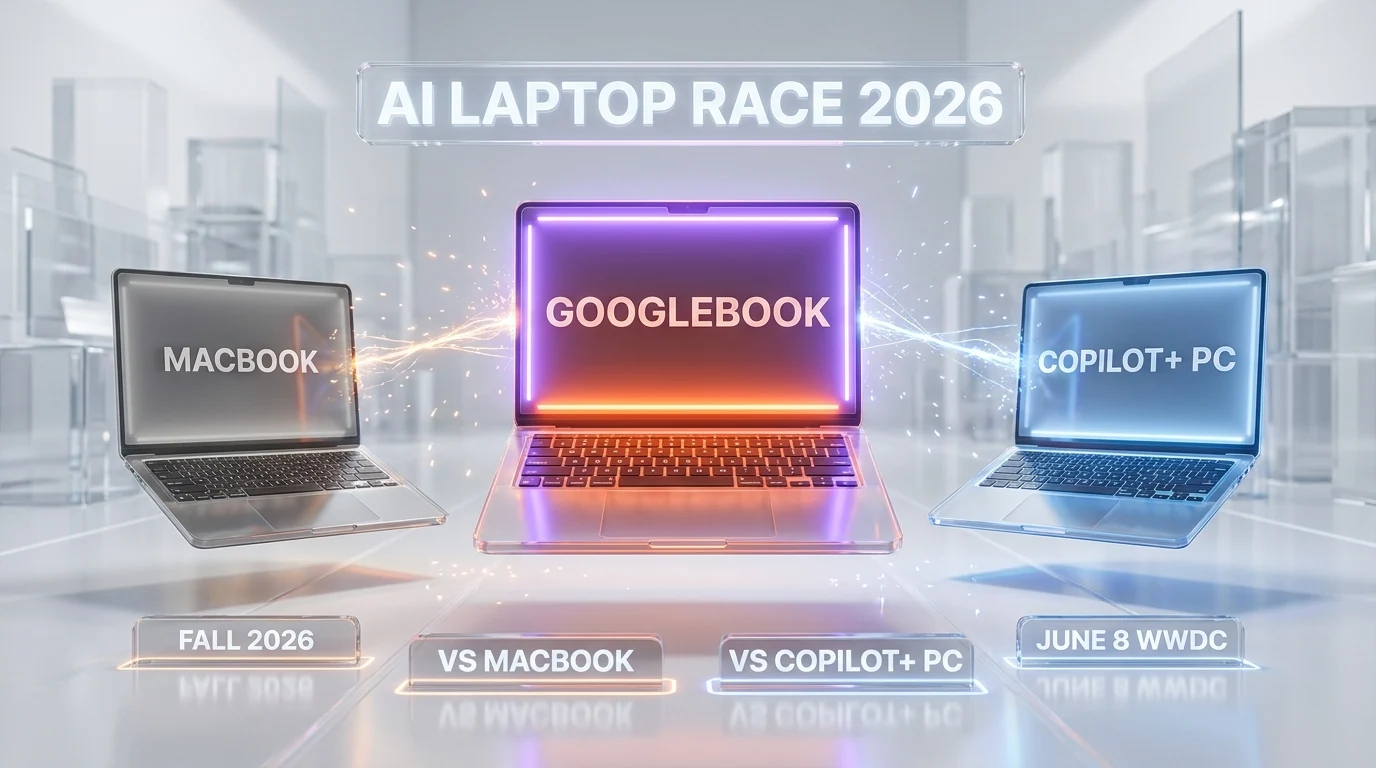
Stripped to fundamentals, the three platforms now sit at:
- MacBook (Apple Silicon). Local-first AI. Best-in-class neural engine for on-device LLM. Weak cloud assistant story. ~10% global laptop share but 90%+ of premium-tier mindshare. June 8 reveal will likely add Extensions for choice but keep Apple Intelligence as the native layer.
- Copilot+ PC (Microsoft + OEMs). Cloud + local hybrid via Copilot Runtime. NPU-mandated hardware floor. Same five OEM partners as Googlebook. Recently extended into agentic frontier territory — see Microsoft Copilot Cowork frontier agentic task execution. Strong enterprise channel.
- Googlebook (Google + OEMs). Cloud-first AI. Gemini-native everything. Magic Pointer as the differentiator. Same OEM panel as Copilot+ PC, which means head-to-head shelf placement at retail starting fall 2026.
The competitive question that decides this race is not which AI is smarter — Gemini 3 Pro, Claude 4.6 and GPT-5 are within striking distance on most evals. It is which AI is always available, always integrated, always free of friction. Magic Pointer is the most aggressive answer anyone has shipped to that question on a laptop. Copilot+ PC has the Copilot button. MacBook has the System Settings menu. Googlebook has the entire cursor.
The OEM distribution moat — Chromebook strategy at x10 the price
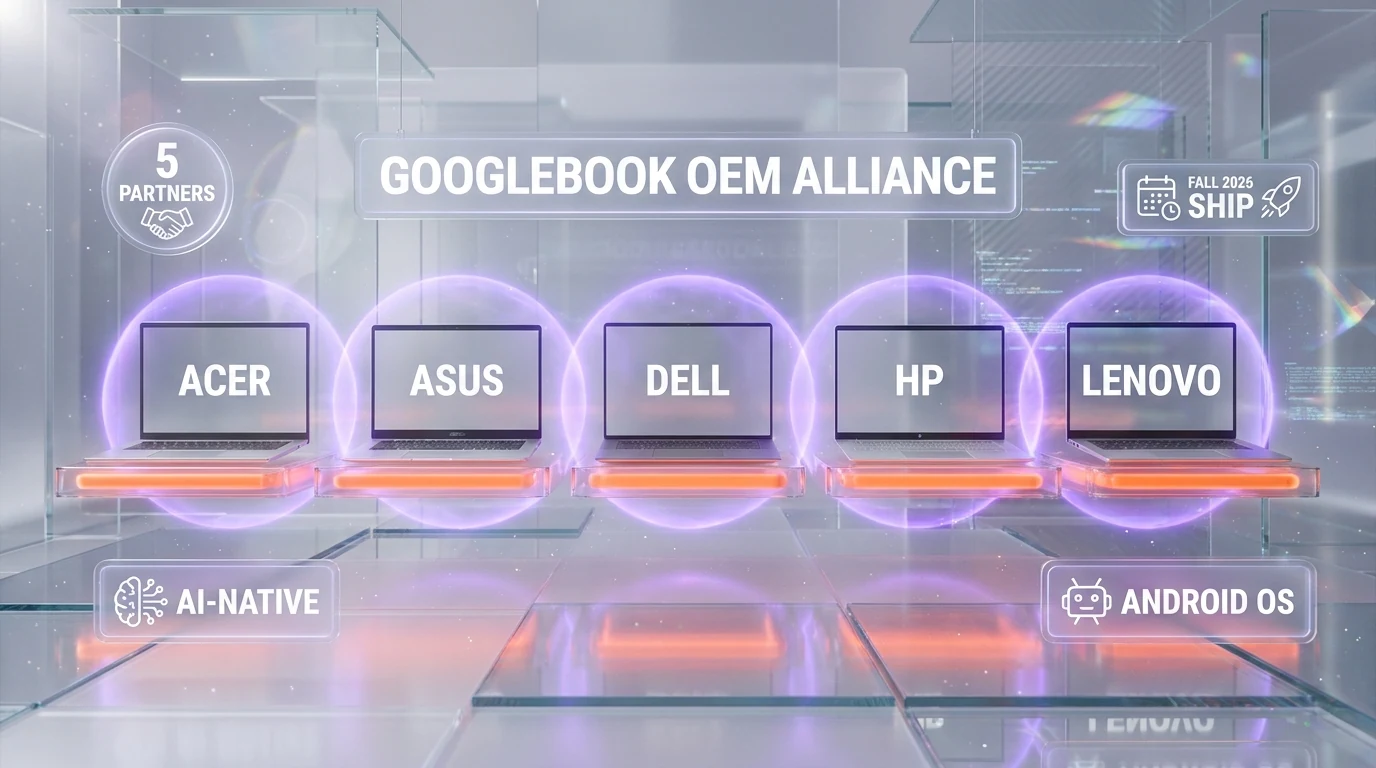
The Chromebook playbook is what made this announcement possible. Google spent 15 years convincing Acer, ASUS, Dell, HP and Lenovo that they could build laptops cheap enough to compete in education at sub-$300 SKUs. Margins were thin but volume was reliable. K-12 education in the US shifted from Windows to ChromeOS during that window — roughly 60% of US K-12 devices are now Chromebooks per IDC.
Googlebook reuses the OEM relationships but moves the price tier up. The expected SKU range, based on Magic Pointer integration cost and Glowbar hardware add, lands in the $700 to $1500 band — direct overlap with MacBook Air ($999 to $1499) and mid-tier Copilot+ PC ($899 to $1399). The volume math changes accordingly. Even at 5% of the back-to-school 2026 laptop market, Googlebook would ship more units in one quarter than Vision Pro has shipped lifetime.
The risk to that distribution math: OEMs already split development resources between Windows and ChromeOS. Adding a third stack — Googlebook running Android — without dropping Windows would stretch every OEM's product team. Acer and Lenovo have the deepest history with Google and will probably go biggest. Dell and HP are enterprise-anchored and may treat Googlebook as a consumer-line experiment first.
What dies with the Chromebook brand
The Chromebook brand survives only in education for now. Google has not committed to whether the K-12 fleet migrates to Googlebook or stays on a maintained ChromeOS LTS. Reading between the lines of the keynote and the supporting blog posts: education ChromeOS will keep getting Gemini features but won't get the Googlebook brand, because Gemini's privacy posture for minors is still under FTC scrutiny in multiple US states. Education is the slow lane. Consumer is the launch lane.
The pricing war angle is the other unresolved piece. Gemini 3.1 Flash Lite shipped at aggressive pricing in March 2026, signaling Google's willingness to undercut on API costs. Googlebook, if it leans into that pricing aggression at the SKU level, could repeat the Chromebook trick — sub-$500 entry tier eating the low end of MacBook Air's market while $1000-plus SKUs eat the mid-tier. Google has not confirmed pricing aggression at launch.
Gemini Intelligence everywhere: phones, watches, cars, glasses
The phone announcement is bigger than it reads at first pass because of where it goes next. Gemini Intelligence on Pixel 10 and Galaxy S26 this summer is the consumer wedge. The platform expansion to Wear OS watches, Android Automotive, AR glasses, and Googlebooks later in 2026 is the moat play.
Android Automotive is the dark horse. Google's existing GM and Polestar deals already put Gemini in cars, and Gemini Intelligence brings the agentic layer with it. Multi-step task automation in a car context — book a restaurant en route, reroute around traffic, pre-order coffee at the next exit — is the kind of in-vehicle AI demo Apple's CarPlay simply cannot match without Apple Intelligence in-car (which doesn't exist yet).
AR glasses is the long bet. Gemini Intelligence on glasses would be the head-up version of Magic Pointer — visual targeting, contextual suggestion, voice handoff. Google has not shipped glasses hardware yet. Samsung has hinted at AR glasses for late 2026. The Gemini Intelligence Wear OS / glasses rollout in "later 2026" likely lines up with a Samsung glasses launch at the Galaxy Unpacked event in August or October.
What this means for developers
The Googlebook + Gemini Intelligence stack creates a new app distribution surface that did not exist on May 11. Android apps run on Googlebook natively (Quick Access demonstrated phone files appearing in laptop UI). That means the entire Play Store catalog technically runs on Googlebook out of the box. The first developer question becomes: which apps need a laptop-aware UI revision before fall 2026, and which can ship as-is?
Magic Pointer adds an extension surface as well. Google has not yet published the Magic Pointer API specification, but the demo behavior implies a contextual suggestion provider model — apps register "what would the AI offer to do with this kind of content?" hooks, and Gemini ranks them. App developers who build that integration early get the equivalent of Siri Shortcut placement on iOS 17 — premium contextual real estate.
Widget generation creates a third surface. If Create your Widget on laptop can pull from any web data source, third-party data providers (financial APIs, weather, sports) become passive Gemini integrations the moment users start prompting widgets that need their data. The high-leverage developer move is publishing well-structured Open Graph and llms.txt metadata so Gemini can ingest your data cleanly when a user asks for a widget that needs it.
Material 3 Expressive — the design language refresh
Worth noting that Gemini Intelligence ships with an updated Material 3 Expressive design language that Google describes as "purposeful animation" reducing distraction. The motion design is more restrained than Material You and reads as a direct response to iOS 19's frosted-glass refresh. Material 3 Expressive applies across Android, Wear OS, and Googlebook — visual coherence is now a Gemini story, not just an Android one.
Competitive counter-moves incoming
Three counter-moves are already in flight or telegraphed.
Apple at WWDC 2026, June 8. Per the Mark Gurman leak, Extensions is the headline. The Mac side of that keynote is the part to watch. If Apple announces a Vision-Pro-style "Apple Intelligence Mac" SKU or commits to ship cloud-native Apple Intelligence in 2026 (vs the current local-first architecture), Googlebook's cloud differentiation narrows. If Apple keeps the local-first thesis, Googlebook's cloud story stays clean for at least a year.
Microsoft at Build 2026, also in May. Microsoft Build's traditional slot is mid-to-late May. Expect a Copilot+ PC narrative refresh that emphasizes the agentic Cowork features and probably announces a tighter coupling between Copilot and Windows Recall. Microsoft's advantage is enterprise channel depth — Googlebook will not displace Microsoft in IT-managed Windows fleets in 2026.
OpenAI device strategy. OpenAI has hinted at hardware (the Jony Ive partnership). May 12's Googlebook announcement raises the cost of OpenAI shipping a vanilla "AI device" — the category bar just moved to "full Android OS, five OEMs, Magic Pointer integration." Anything less from OpenAI's hardware project will read as catch-up.
What could break this thesis
Honest tail risks worth tracking.
OEM commitment falls short. Acer, ASUS, Dell, HP and Lenovo announced support, but support is a press-release commitment. The real test is whether each partner ships more than one SKU at launch and whether they commit retail floor space. If only two OEMs ship credible volume, the Chromebook x10 narrative collapses to "two interesting laptops."
Magic Pointer ships broken. DeepMind-built features have historically been excellent in demo and uneven in v1 release (Gemini Live had reliability issues at launch). If Magic Pointer's contextual suggestions are slow, wrong, or hallucinate calendar events, the entire Googlebook story turns into a meme.
Apple Silicon answers cloud with hybrid. If Apple's June 8 keynote ships a credible hybrid local + cloud architecture for Apple Intelligence — with MacBook M-series doing local inference and a new cloud tier filling the gaps — the Googlebook "we have the AI you actually want" pitch weakens significantly.
Privacy backlash on agentic features. Multi-step task automation that books rideshares and shopping carts is exactly the use case privacy regulators flag first. The EU AI Act compliance posture for Gemini Intelligence's agentic mode is the legal story to watch through 2026.
Our call
Googlebook is a real product category launch, not a vaporware fan-service announcement. The five-OEM commitment and the fall 2026 ship window are too specific for either to be soft. Magic Pointer is the most credible AI-laptop differentiator any vendor has shipped this year. The Apple-timing play is surgical and visible.
The thesis we'd defend in October 2026: Googlebook will outsell Vision Pro lifetime in its first quarter, will not outsell MacBook Air, and will land somewhere in the 1-3% of total US laptop volume in Q4 2026 — meaningful but not Chromebook-scale. The 12-month outlook depends entirely on Magic Pointer reliability and OEM SKU spread. The 36-month outlook depends on whether Gemini stays competitive with Claude 5 and GPT-6 at the model layer.
Apple's June 8 reveal is now the most-watched keynote of 2026. Google framed the comparison before Apple could speak — that is what this announcement was actually for.
Frequently asked questions
What is Googlebook?
Googlebook is a new laptop category announced by Google on May 12, 2026 at the Android Show I/O Edition keynote. Unlike Chromebooks, Googlebooks are built on Android (not ChromeOS) with Gemini AI as the primary interface. Launch partners are Acer, ASUS, Dell, HP and Lenovo, with devices shipping in fall 2026.
What is Magic Pointer?
Magic Pointer is the signature Googlebook feature, built with Google DeepMind. It turns the cursor into a contextual suggestion surface — hover over a date in an email and Gemini offers to schedule the meeting; point at two images and it offers to combine them. Alex Kuscher, Google's Senior Director of Laptops and Tablets, described it as making "the pointer truly smart and intelligent."
When does Googlebook ship?
Fall 2026. Google has not committed to a more precise date or to specific OEM SKUs. Hardware specs, pricing, and exact ship windows are expected at the individual OEM events between June and August 2026.
How is Googlebook different from a Chromebook?
Three core differences: (1) Operating system is Android, not ChromeOS; (2) Gemini is the primary interface, not a feature; (3) Price tier moves up from sub-$500 education SKUs to a $700-$1500 consumer/prosumer range competing directly with MacBook Air and Copilot+ PC. ChromeOS remains in education K-12 for now but does not get the Googlebook brand.
What is Gemini Intelligence on Android?
Gemini Intelligence is the agentic Android layer Google announced on May 12, 2026. It rolls to Pixel 10 and Galaxy S26 this summer, then to Wear OS, Android Automotive, AR glasses, and Googlebooks later in 2026. Headline features: multi-step task automation, Rambler voice typing, Create My Widget, Gemini in Chrome (late June), and enhanced autofill.
What is Rambler voice typing?
Rambler is the new Gemini Intelligence voice typing feature. It transcribes natural speech in real time, handles self-corrections, filler words, and mid-sentence language switching, and outputs a polished message. Google states: "Audio is only used to transcribe in real-time and is not stored or saved." Available on Pixel 10 and Galaxy S26 at summer 2026 launch.
What is Glowbar?
Glowbar is the Googlebook hardware design signature — a status bar built into the chassis that reflects Gemini's current state (listening, thinking, working). Form factor varies by OEM, giving Acer, ASUS, Dell, HP and Lenovo room to differentiate while keeping the visual signature consistent.
How does Googlebook compete with MacBook?
Googlebook's pitch versus MacBook is cloud-native Gemini versus Apple's local-first Apple Intelligence. MacBook leads on premium build, neural engine performance and brand. Googlebook leads on always-on cloud AI integration via Magic Pointer and on price-tier spread via five-OEM distribution. Apple's WWDC 2026 keynote on June 8 will likely answer the cloud-AI gap directly.
How does Googlebook compete with Copilot+ PC?
Both Googlebook and Copilot+ PC use the same five OEM partners (Acer, ASUS, Dell, HP, Lenovo), so retail head-to-head is unavoidable in fall 2026. Copilot+ PC ships an NPU hardware floor and a hybrid local-plus-cloud Copilot Runtime. Googlebook ships cloud-first Gemini with Magic Pointer as the daily-driver differentiator. Microsoft's enterprise channel depth is a Copilot+ PC advantage Google does not match.
Will my Android apps run on Googlebook?
Yes. Googlebook runs Android, so the Play Store catalog runs natively. Google's Quick Access feature also pulls phone files into the laptop file picker without a transfer step. Apps designed phone-first will work but may not be laptop-optimized; the developer opportunity is shipping laptop-aware UI revisions before fall 2026 launch.
Why did Google announce Googlebook on May 12 specifically?
The timing positions Google ahead of Apple's WWDC 2026 keynote on June 8. Apple is widely expected to announce iOS 27 Extensions (per Mark Gurman's May 5 Bloomberg leak), letting users pick Claude, Gemini, Grok, Perplexity, or ChatGPT inside Siri. Google's response is a full category launch rather than a permissions update — moving the narrative from "pick your AI" to "we built the box around our AI."
Is Chromebook dead?
The consumer Chromebook brand is effectively retired in favor of Googlebook. Education K-12 ChromeOS continues but does not get the Googlebook brand. Existing Chromebook owners will continue receiving updates; the migration path to Android-based Googlebook OS has not been detailed publicly as of May 12, 2026.