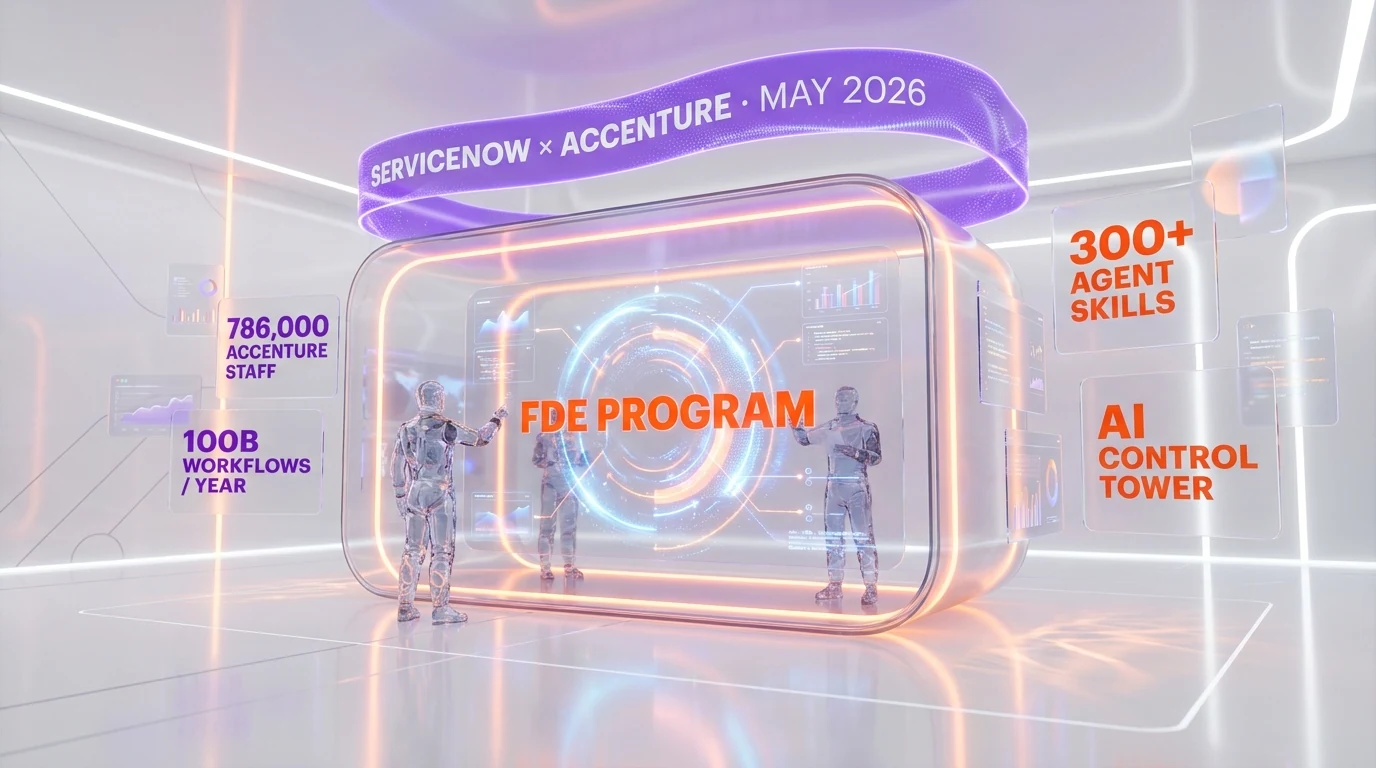
ServiceNow and Accenture announced on May 6, 2026 the joint Forward Deployed Engineering (FDE) Program — purpose-built pods that combine platform-native, AI-native, and industry expertise to take agentic workflows from concept to production. The program leverages over 300 pre-built AI agent skills on the ServiceNow AI Platform, with the AI Control Tower as the governance spine. The backdrop: only 32% of leaders report sustained enterprise-wide AI impact, and Accenture's 786,000-strong workforce now joins ServiceNow's 100 billion annual workflows on a single delivery model.
TL;DR — what shipped on May 6, 2026
- Program name: Forward Deployed Engineering (FDE) Program — a joint ServiceNow + Accenture initiative.
- Delivery model: Purpose-built pods that combine platform-native, AI-native, and industry expertise, deployed inside customer environments to take agentic AI from concept to production.
- 300+ pre-built AI agent skills and agentic workflows ready to be customized to specific enterprise contexts.
- AI Control Tower serves as the unified command center governing, securing, and managing AI agents at scale, with full visibility into agent performance and outcomes.
- ServiceNow AI Platform is the underlying foundation — 100 billion workflows run on the platform annually.
- Accenture workforce: approximately 786,000 people globally are eligible to be staffed into FDE pods.
- Market backdrop: Accenture's own research finds only 32% of leaders report sustained enterprise-wide AI impact today.
What happened
ServiceNow and Accenture jointly announced on May 6, 2026 the launch of the Forward Deployed Engineering Program, a delivery model in which purpose-built pods of ServiceNow platform engineers, Accenture industry consultants, and AI-native specialists embed inside customer environments to ship agentic workflows in production rather than as proof-of-concept artifacts. The press release positions the program as a direct response to the empirical reality, drawn from Accenture's own enterprise research, that the gap between AI ambition and AI production is the dominant barrier holding enterprise AI back: only 32% of leaders report sustained enterprise-wide AI impact today.
The program rests on three operational primitives. First, ServiceNow's 300+ pre-built AI agent skills and agentic workflows — pre-engineered components that cover common enterprise patterns (incident response, procurement, IT service management, HR ticketing, security operations) and that can be customized rather than built from scratch. Second, the ServiceNow AI Platform itself, which the company says runs roughly 100 billion workflows annually across its installed base. Third, the AI Control Tower — described in the announcement as a unified command center that governs, secures, and manages AI agents at scale, with full visibility into agent performance and outcomes.
Two executives are quoted. John Aisien, Senior Vice President and General Manager, Central Product Management, Security & Risk at ServiceNow, said: "Forward deployed engineering is how ServiceNow and Accenture turn mutual customers' agentic AI business goals into value-generating production workloads." Ram Ramalingam, Lead for Software and Platform Engineering at Accenture, said: "The question our clients ask is not whether to invest in AI — it's how to make it work at enterprise scale."
Why "Forward Deployed Engineering" is suddenly the term to know
Forward Deployed Engineering, or FDE, is not new — it has been the staffing model favored by frontier labs (OpenAI, Anthropic) and a handful of high-velocity startups (Palantir popularized the modern enterprise version in the late 2010s) for getting product engineers in front of high-value customers, on-site, with the authority to ship code rather than write specifications. What is new is the move from frontier labs into mainstream enterprise consulting. ServiceNow + Accenture launching a formally branded "FDE Program" in May 2026 is the signal that the model has crossed into the implementation-services mainstream.
The substantive innovation in the ServiceNow-Accenture version is the pod composition itself. Earlier FDE setups paired one or two engineers with a customer. The ServiceNow-Accenture model is a multi-disciplinary pod: platform-native (someone who knows the ServiceNow AI Platform deeply), AI-native (someone who knows agent design, evaluation, and orchestration), and industry expertise (someone who understands the customer's vertical). That triangulation is what large enterprises have struggled to assemble internally — it requires three different scarce skill profiles working as one team — and it is the operational answer to why 68% of leaders today say AI has not had sustained enterprise-wide impact.
Inside the AI Control Tower
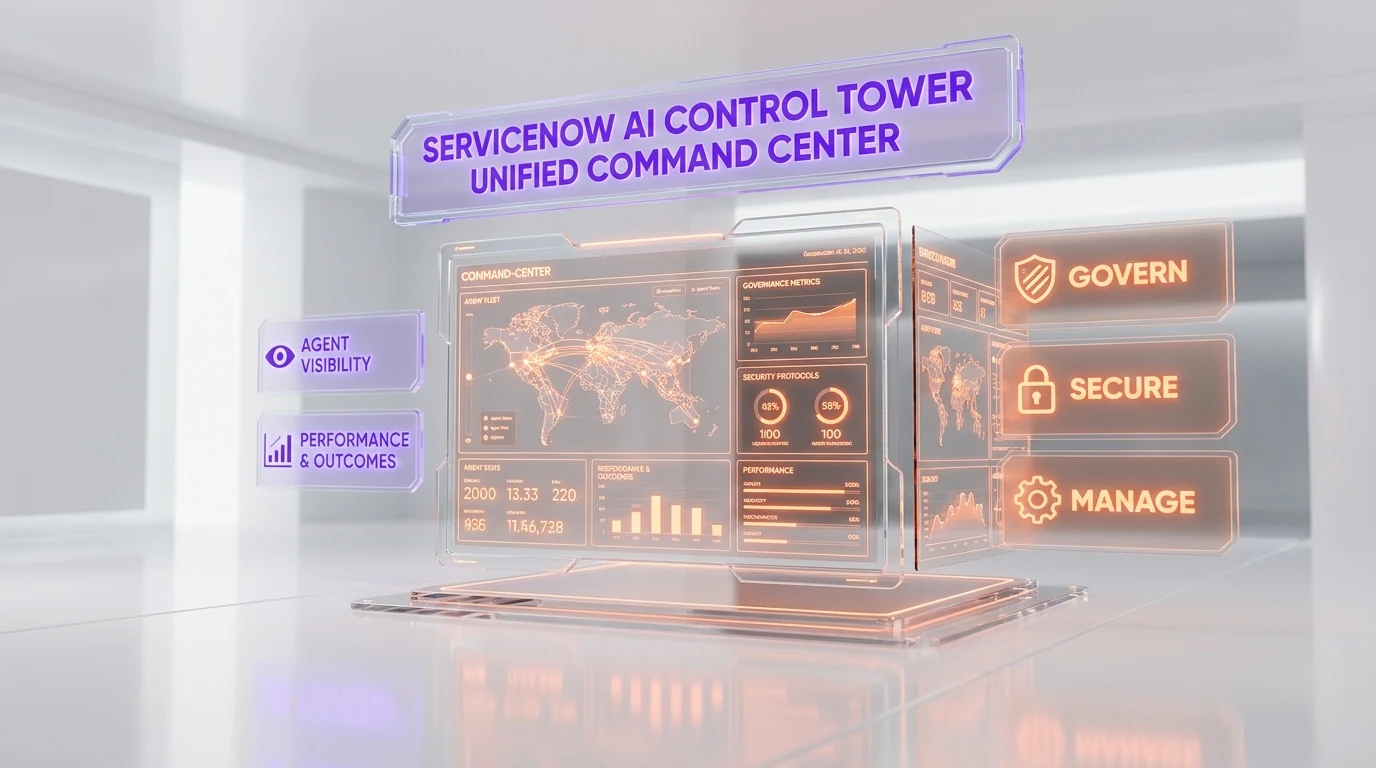
The AI Control Tower is the part of the announcement that enterprise CIOs will read most carefully. As described in the joint release, it is a unified command center that does three things: governs (policy, role-based access, audit trails), secures (identity, data lineage, anomaly detection), and manages (lifecycle, deployment, decommissioning) AI agents across the customer's estate. Crucially, it provides full visibility into agent performance and outcomes — the part most enterprise AI deployments today lack.
Three structural questions matter for technical buyers and we will track them as documents emerge:
- Is the AI Control Tower model-agnostic? ServiceNow has historically partnered with multiple frontier labs (OpenAI, Anthropic, Microsoft, Google). The release does not specify which models the FDE pods will route to by default, nor whether the Control Tower governs only ServiceNow-native agents or third-party agents running through ServiceNow.
- How does it interact with existing enterprise SIEM/SOC stacks? Most large enterprises already have Splunk, Microsoft Sentinel, or CrowdStrike Falcon running. The Control Tower's value depends on whether it integrates as a layer or competes as a replacement.
- What's the cost model? Per-agent, per-workflow, or platform-license? The release does not disclose pricing.
The 300+ pre-built agent skills: what they actually cover
ServiceNow has been steadily building out a library of pre-engineered agent skills since the AI Platform launched. The 300+ figure cited in the release covers patterns that include — based on ServiceNow's broader public communications and historical product roadmap — IT service management ticketing, security operations triage, HR case routing, procurement workflows, customer service deflection, finance close automation, vendor risk assessment, and incident response. Each skill is a pre-built, customizable agentic workflow that the FDE pod can clone, adjust to the customer's data sources and policy constraints, and deploy through the standard ServiceNow change-management pipeline.
For the customer, this changes the build-vs-buy math. Building 300 production agentic workflows from scratch is a multi-year effort. Customizing pre-built skills with an embedded FDE pod compresses the timeline to weeks per skill family. The trade-off is the same trade-off every platform vs custom-build decision involves: speed and reliability today, against the lock-in of being on the ServiceNow agent ecosystem long-term.
The market context: this is the second consulting partnership shipped today
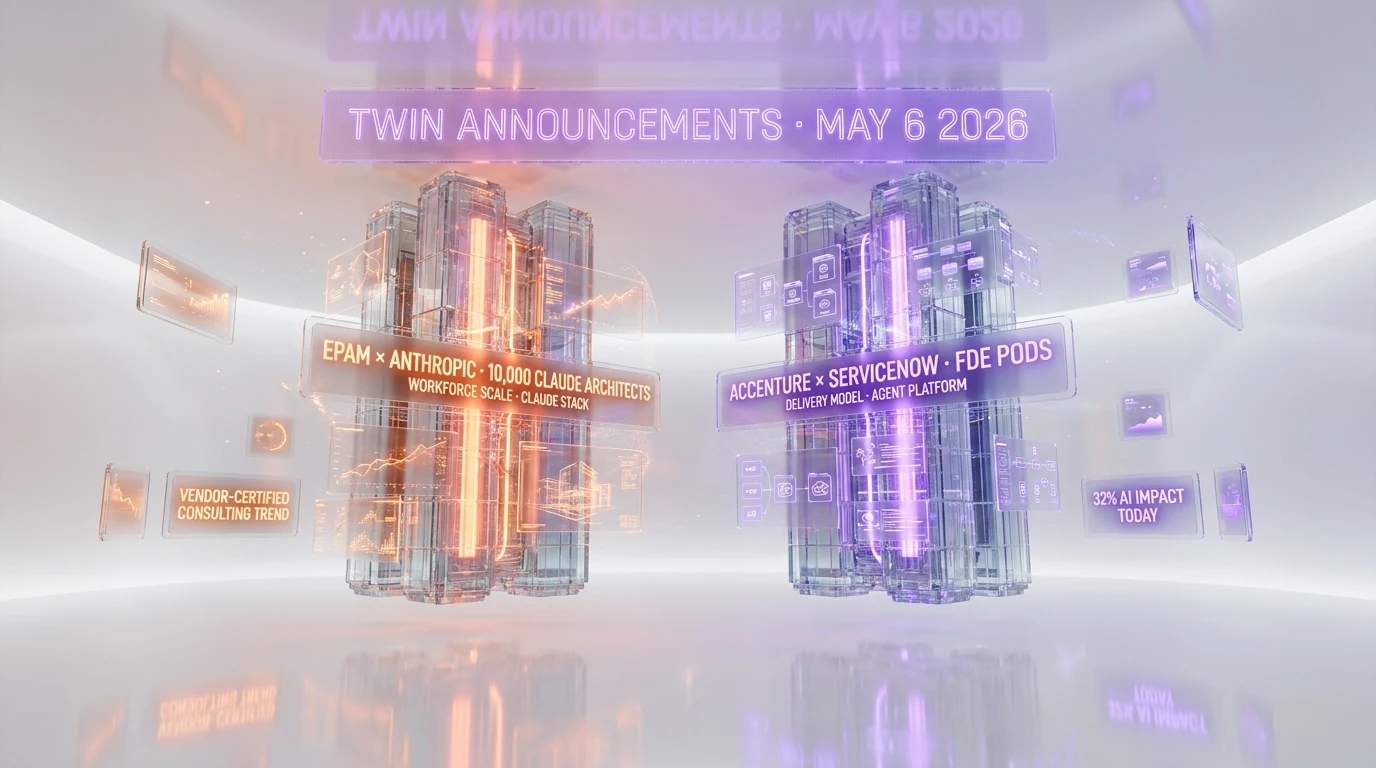
The ServiceNow-Accenture FDE Program announcement landed on the same day as the EPAM-Anthropic 10,000-architect partnership. Read together, the two announcements describe a single market shift: enterprise AI services is splitting into vendor-certified practices, each anchored on a specific stack, each commanding distinct delivery economics. EPAM-Anthropic is workforce scale (10,000 certified architects across the full Claude stack — base API, Claude Code, Claude Agent SDK, Claude Security). ServiceNow-Accenture is delivery-model innovation (purpose-built pods, 300+ pre-built agent skills, AI Control Tower governance). Both are bets that the days of generic AI strategy decks as the consulting deliverable are over.
For enterprise buyers, the practical question for the next RFP is which vendor stack to commit to — and which consulting practice has the deepest bench against that stack. The two answers from May 6, 2026 are clear: Anthropic-Claude is EPAM, and ServiceNow AI Platform is Accenture. Both are first-mover commitments at scale, and both make the next 90 days uncomfortable for generalist competitors who have not made an equivalent stack-specific bet.
What about other ServiceNow consulting partners?
Accenture is not ServiceNow's only major implementation partner — Deloitte, KPMG, EY, NTT DATA, DXC, and Wipro all run substantial ServiceNow practices. The May 6 announcement is exclusive to Accenture in name (the FDE Program is a joint Accenture-branded initiative), but the technological substrate (300+ agent skills, AI Control Tower, ServiceNow AI Platform) remains accessible to all ServiceNow partners. Expect counter-announcements from peer firms with their own variant on FDE-style delivery within the next 60 to 90 days, similar to how the AWS Partner Network expansions of 2023-2024 played out.
The "32% sustained AI impact" benchmark, in context
The 32% figure cited in the press release is not just framing — it is one of the most-cited benchmarks in enterprise AI today. It quantifies the gap between AI investment and AI value extraction, and it is the implicit economic justification for a delivery model as expensive and high-touch as on-site FDE pods. If the comparable enterprise can move from 32% sustained impact to 60-70% sustained impact through the FDE delivery model, the unit economics of the program close even at premium pricing. If FDE delivers only marginal impact lift over a traditional consulting engagement, the model collapses to a brand-new way of doing the same work.
The honest read is that the benchmark is a horizon, not a milestone. Most enterprise AI roll-outs through 2025 underestimated the data, governance, and change-management work required to run agentic systems at production scale. ServiceNow and Accenture's wager is that combining the pre-built skills (technical leverage), the Control Tower (governance leverage), and the FDE pod model (delivery leverage) produces a step-function improvement on the 32% baseline. The next 12 months of customer outcomes will tell whether that wager paid off.
What to watch next
- First named customer wins. Joint press releases with named Fortune 500 customers using the FDE Program — typical 60 to 120 days post-launch — are the first proof-point of pod efficacy.
- AI Control Tower pricing model. Whether it ships per-agent, per-workflow, or as a platform license materially affects how aggressively customers deploy.
- Counter-launches from Deloitte, KPMG, EY. Each runs a substantial ServiceNow practice and will likely announce a comparable FDE-style delivery model within 60 to 90 days.
- Model-routing transparency. Whether ServiceNow publicly commits to which frontier models the AI Control Tower routes to — Anthropic Claude, OpenAI GPT, Google Gemini, or Microsoft's in-house models — affects buyer choice.
- Accenture stock reaction. Accenture (NYSE: ACN) is the larger of the two firms and the one most leveraged to a successful FDE rollout. Watch for positive analyst coverage in Q3 2026 earnings.
- FDE as a category. If ServiceNow-Accenture and EPAM-Anthropic prove the FDE delivery model works at enterprise scale, expect frontier labs (OpenAI, Anthropic) and platform vendors (Salesforce, Microsoft) to push their own consulting partners toward the same model by Q4 2026.
The Planet Tools take
The most important sentence in the May 6, 2026 ServiceNow-Accenture release is the one that sounds like marketing: "purpose-built pods that combine platform-native, AI-native, and industry expertise." That triangulation — three scarce skill profiles working as one team inside the customer environment — is the operational answer to the 68% sustained-impact gap. ServiceNow has the platform. Accenture has the bench. The FDE pod is the delivery glue. If the model produces measurable lift on customer outcomes by end of 2026, the era of generic AI consulting is officially over and the era of stack-specific FDE practices is the new shape of the industry. Combined with the same-day EPAM-Anthropic 10,000-architect commitment, May 6, 2026 will be remembered as the day enterprise AI services finished its transition from advisory to implementation.
Frequently asked questions
What is the ServiceNow-Accenture Forward Deployed Engineering Program?
The Forward Deployed Engineering (FDE) Program is a joint ServiceNow and Accenture delivery model announced on May 6, 2026 in which purpose-built pods of platform engineers, AI specialists, and industry experts embed inside customer environments to take agentic workflows from concept to production. The program leverages 300+ pre-built AI agent skills on the ServiceNow AI Platform, with the AI Control Tower as the governance spine.
How many pre-built AI agent skills does ServiceNow offer?
According to the May 6, 2026 announcement, ServiceNow has more than 300 pre-built AI agent skills and agentic workflows available on the ServiceNow AI Platform. These cover common enterprise patterns including IT service management, security operations, HR case routing, procurement, customer service, finance close automation, vendor risk, and incident response, and can be customized rather than built from scratch.
What is the ServiceNow AI Control Tower?
The AI Control Tower is described in the May 6, 2026 announcement as a unified command center that governs, secures, and manages AI agents at scale, with full visibility into agent performance and outcomes. It functions as the policy, identity, and lifecycle plane for AI agents across a customer estate. Pricing model, model-routing transparency, and integration with third-party SIEM/SOC stacks were not disclosed in the launch announcement.
How big is the Accenture workforce supporting the FDE Program?
Accenture employs approximately 786,000 people globally. The full workforce is theoretically eligible to be staffed into Forward Deployed Engineering pods, though in practice the program will be served by Accenture's ServiceNow-specialist consulting bench, which is a meaningful but smaller subset of the global headcount.
How does ServiceNow scale agentic AI to production?
ServiceNow scales agentic AI through three primitives. First, the ServiceNow AI Platform, which runs approximately 100 billion workflows annually across its installed base. Second, 300+ pre-built AI agent skills that can be cloned and customized rather than built from scratch. Third, the AI Control Tower, which provides governance, security, and lifecycle management for all deployed agents. The May 6, 2026 FDE Program adds a delivery model — embedded pods — on top of those primitives.
Why is "only 32% of leaders report sustained AI impact" relevant?
The 32% figure is drawn from Accenture's own enterprise research and is the empirical justification for a high-touch delivery model. Most enterprise AI roll-outs through 2025 stalled at proof-of-concept or production-pilot stage. The FDE Program is positioned as the operational answer to that gap — combining pre-built skills (technical leverage), AI Control Tower (governance leverage), and embedded pods (delivery leverage). The 12-month customer outcome data will determine whether that combination materially moves the 32% benchmark.
How does the FDE Program compare to the EPAM-Anthropic partnership?
Both partnerships were announced on May 6, 2026 and signal the same market shift toward vendor-certified consulting practices. EPAM-Anthropic is workforce scale: 10,000 Claude-certified architects, 250 Black Belts, 20,000 EPAMers already trained on Claude. ServiceNow-Accenture is delivery-model innovation: purpose-built pods, 300+ pre-built agent skills, AI Control Tower governance. EPAM-Anthropic is the headcount commitment; ServiceNow-Accenture is the new way of working.
Is the FDE Program exclusive to Accenture?
The Forward Deployed Engineering Program as branded is exclusive to the Accenture-ServiceNow partnership. However, the underlying technical substrate — the ServiceNow AI Platform, the 300+ pre-built agent skills, and the AI Control Tower — remains accessible to all ServiceNow consulting partners including Deloitte, KPMG, EY, NTT DATA, DXC, and Wipro. Counter-announcements from peer firms with their own FDE-style models are likely within 60 to 90 days.
Who are the executives quoted in the ServiceNow-Accenture announcement?
Two executives are quoted in the joint release. John Aisien, Senior Vice President and General Manager of Central Product Management, Security and Risk at ServiceNow, framed FDE as how ServiceNow and Accenture turn agentic AI business goals into production workloads. Ram Ramalingam, Lead for Software and Platform Engineering at Accenture, said the question clients ask is not whether to invest in AI but how to make it work at enterprise scale.
What customers will be named in the FDE Program first?
The May 6, 2026 announcement does not name any specific customers. Joint press releases with named Fortune 500 deployments typically follow new programs of this type within 60 to 120 days. Watch the ServiceNow and Accenture newsrooms in July through August 2026 for the first named-customer announcements, which will be the earliest credible proof-points for FDE pod efficacy.
Will the AI Control Tower work with non-ServiceNow agents?
The May 6, 2026 announcement does not specify whether the AI Control Tower governs only ServiceNow-native agents or whether it can also manage third-party agents (for example, agents built directly on Anthropic Claude or OpenAI GPT) running through ServiceNow integrations. ServiceNow has historically partnered with multiple frontier labs, which suggests model-agnostic governance is a stated direction, but the documented surface area at launch is ServiceNow-native.
What does Forward Deployed Engineering mean as a delivery model?
Forward Deployed Engineering, or FDE, is a delivery model in which engineers and specialists embed inside customer environments and ship production code, rather than producing strategy documents or proof-of-concept artifacts. The model was popularized by Palantir for enterprise deployments and adopted by frontier AI labs (Anthropic, OpenAI) for high-value early customers. The May 6, 2026 ServiceNow-Accenture announcement is the signal that FDE has crossed from frontier labs into mainstream enterprise consulting — typically a multi-year cycle.