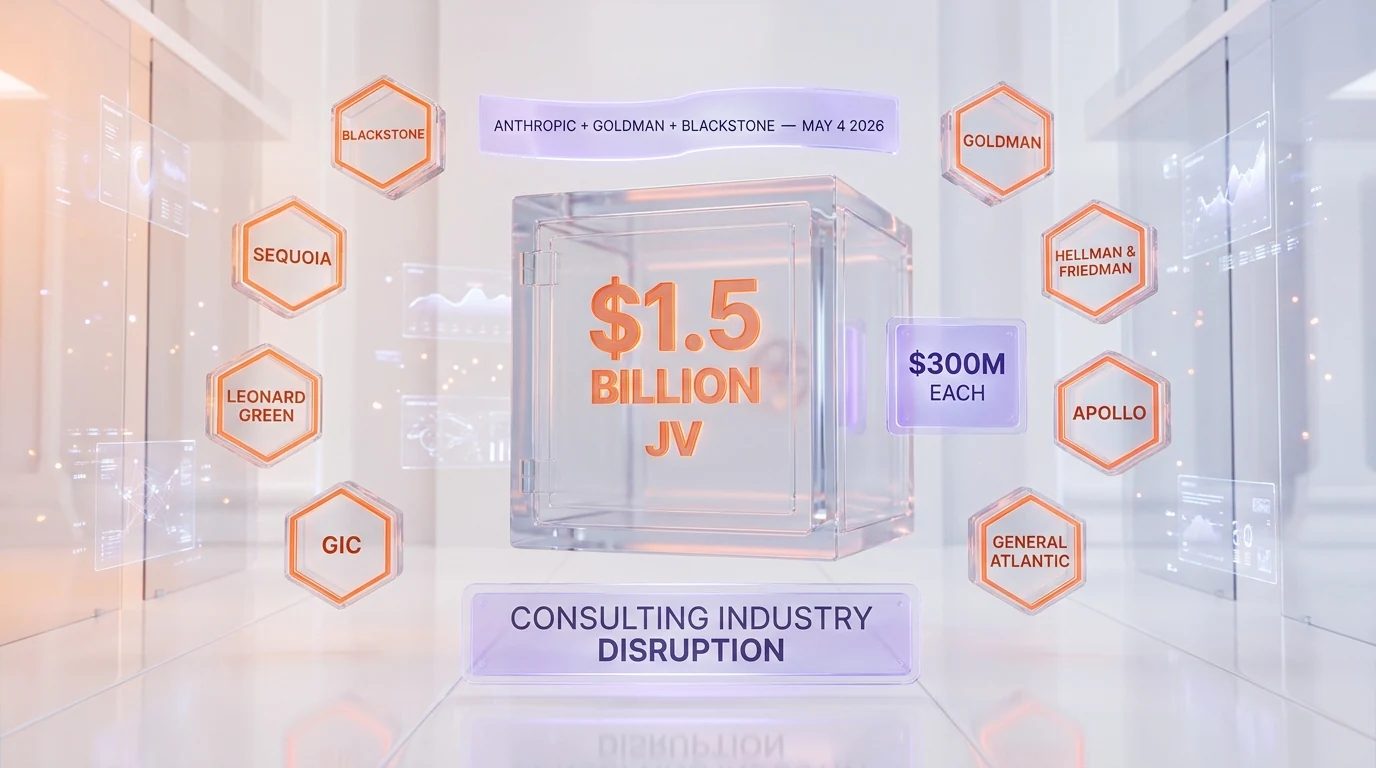
Anthropic announced a $1.5 billion enterprise AI services joint venture on May 4, 2026, with Blackstone, Goldman Sachs and Hellman & Friedman as founding partners and Apollo, General Atlantic, GIC, Leonard Green and Sequoia Capital as consortium members. Anthropic, Blackstone and Hellman & Friedman each committed roughly $300 million. The venture will deploy Applied AI engineers inside mid-sized banks, manufacturers, regional health systems and healthcare networks to build custom Claude-powered systems — a direct copy of Palantir's forward-deployed engineer model and a frontal attack on the McKinsey, BCG and Bain consulting playbook.
TL;DR — what just happened
- $1.5 billion AI services joint venture announced by Anthropic on May 4, 2026, with Blackstone, Goldman Sachs and Hellman & Friedman as founding partners.
- Eight founding investors total: Blackstone, Goldman Sachs, Hellman & Friedman, Apollo Global Management, General Atlantic, GIC, Leonard Green & Partners and Sequoia Capital.
- $300 million commitments each from Anthropic, Blackstone and Hellman & Friedman per TechCrunch reporting.
- Anthropic's role: ship Applied AI engineers to sit inside customer teams, identify Claude deployment opportunities, build custom solutions and provide long-term support, per the Anthropic announcement.
- Target market: mid-sized companies including community banks, manufacturers, regional health systems and healthcare services networks — precisely the segment McKinsey, BCG and Bain have farmed for two decades.
- Sister announcement same day: OpenAI is reportedly raising $4 billion at a $10 billion valuation for a parallel JV called The Development Company, with TPG, Brookfield, Advent and Bain Capital among 19 investors. No investor overlap between the two ventures.
- The strategic frame: Wall Street's alternative asset managers have decided that enterprise AI deployment is the next channel they own — and the AI labs have decided to ship engineers, not chatbots, to win the work.
What happened: $1.5B, eight investors, one consulting playbook
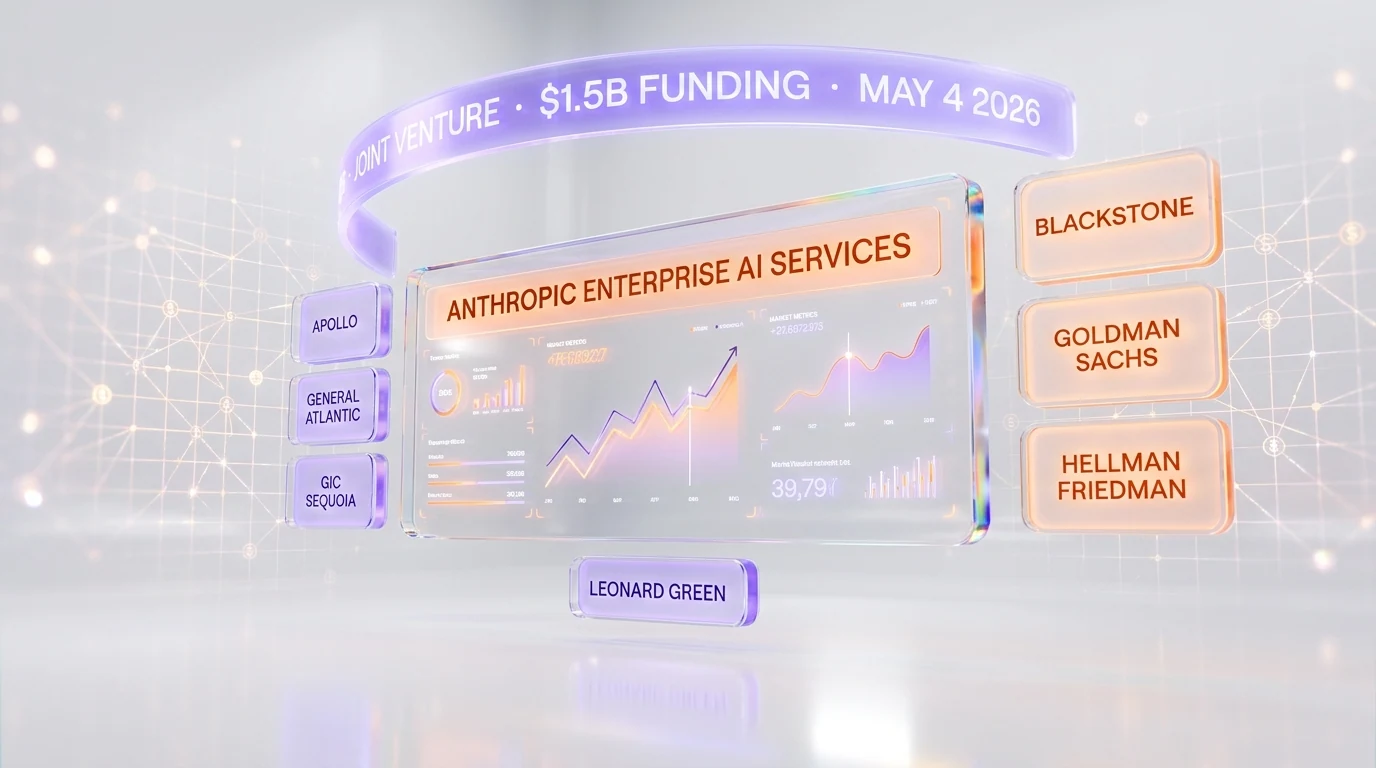
On May 4, 2026, Anthropic posted to its newsroom that it was forming a new enterprise AI services joint venture, framed as a company that “deploys teams of Applied AI engineers” alongside customers to build, integrate and operate Claude-powered systems. The structure is a JV. The capital is $1.5 billion. The investor list reads like the front page of a private equity quarterly.
Per TechCrunch's reporting on the same day, the financing breaks down as roughly $300 million each from Anthropic, Blackstone and Hellman & Friedman, with the remaining capital coming from Goldman Sachs, Apollo, General Atlantic, GIC, Leonard Green and Sequoia Capital. The announcement does not name a CEO of the JV, does not disclose a brand name for the entity, and does not specify the equity split between Anthropic and the financial partners.
The product is sharper than the structure. Per the Anthropic newsroom post, an engagement begins with the JV's engineering team “sitting down with clinicians and IT staff” — in the example given, a regional health system — to build tools that fit existing workflows. The engineers identify Claude deployment opportunities, ship custom solutions and stay on for long-term customer support. Krishna Rao, Anthropic's CFO, is the only Anthropic executive quoted in the launch coverage.
The eight founding investors
| Investor | Type | AUM (approx.) | Role in JV |
|---|---|---|---|
| Blackstone | Alternative asset manager | $1.1T+ | Founding partner, ~$300M commitment |
| Goldman Sachs | Investment bank | $3.1T AUS | Founding partner |
| Hellman & Friedman | Private equity | $120B+ | Founding partner, ~$300M commitment |
| Apollo Global Management | Alternative asset manager | $750B+ | Consortium member |
| General Atlantic | Growth equity | $100B+ | Consortium member |
| GIC | Singapore sovereign wealth | $770B+ | Consortium member |
| Leonard Green & Partners | Private equity | $80B+ | Consortium member |
| Sequoia Capital | Venture capital | $85B+ | Consortium member |
The combined capital base on this cap table runs into the multiple trillions. That is not an accident. Each of these LPs and GPs operates a portfolio of mid-sized companies that the JV can sell into directly — Blackstone alone has more than 250 portfolio companies across private equity, real estate and credit. Goldman serves tens of thousands of mid-market clients. Hellman & Friedman's portfolio runs across software, financial services, healthcare and consumer. The implicit deal: the JV gets preferred access to the LP base; the LPs get preferred access to Anthropic-deployed Claude.
Why it matters: this is a frontal attack on consulting
The framing in mainstream coverage has been “Wall Street partners with AI lab.” That undersells what is actually happening. Strip away the press release language and what Anthropic just announced is a full-stack consulting firm — engineers on the ground, custom builds, long-term retainers, vertical specialization — with three structural advantages no traditional consulting firm can match.
First, the model. The JV's product is Anthropic engineers deploying Claude inside customers. McKinsey's product is McKinsey associates deploying PowerPoints and recommendations. The Anthropic JV ships software that runs in production. McKinsey ships an executive summary that someone else has to implement. In a market where every CFO is now asking “where is the AI ROI” — in production, in dollars, in 90 days — the consulting firm answer is structurally weaker.
Second, the channel. A traditional consulting firm sells through partner networks and referrals. The Anthropic JV sells through the portfolios of eight of the largest capital allocators on earth. When a Blackstone-owned mid-market manufacturer needs an AI rollout, the call is not to McKinsey. The call is to the JV that Blackstone literally owns a piece of.
Third, the economics. Consulting firms run on body-shop economics: 60% gross margin, 15-20% operating margin, all of it tied to billable hours. The Anthropic JV runs on software-plus-services economics: Claude licenses are recurring high-margin revenue; the engineering work is the wedge that drives the licenses. That is the Palantir Foundry / FDE model, and it is exactly why Palantir trades at 100x revenue while Accenture trades at 2x.
The Palantir blueprint, updated for the AI era
The structural copy from Palantir is impossible to miss. Palantir built its enterprise dominance on a specific innovation called Forward-Deployed Engineers — engineers who embed inside customer organizations, learn the workflows, build the integrations and stay on as the relationship deepens. Palantir reported $1.05 billion in Q4 2025 revenue with 64% YoY commercial growth, mostly on this model. The company's market cap exceeds $400 billion as of May 2026 partly because Wall Street has decided that FDEs-plus-platform is a structurally better business than either consulting or pure SaaS.
Anthropic is now doing the same thing, with one critical upgrade: where Palantir's FDEs deploy Foundry, Anthropic's JV will deploy Claude. Foundry is a data integration platform that requires custom configuration. Claude is a model that already does most of the configuration itself. The inference is that Anthropic's JV engineers can move faster, ship more value per engagement, and scale across customers with fewer per-customer dependencies. Whether that holds in practice is the open question of 2026.
| Feature | Palantir FDE | Anthropic JV | Traditional consulting |
|---|---|---|---|
| On-site engineering team | Yes | Yes | No (analysts only) |
| Custom software shipped | Yes (Foundry) | Yes (Claude) | No (recommendations) |
| Long-term retainer | Yes | Yes | Project-by-project |
| Vertical specialization | Defense, healthcare, finance | Mid-market: banks, manufacturers, healthcare | Generalist |
| Revenue model | License + services | Claude API + services | Hourly billable |
| Capital backers | Founders Fund, In-Q-Tel | Eight Wall Street firms | Partner-owned |
Why McKinsey, BCG and Bain should be worried
The three big strategy firms — McKinsey, BCG and Bain — have spent the last 18 months publicly racing to integrate AI into their delivery model. McKinsey's QuantumBlack division and the firm's Lilli internal LLM are the centerpiece. BCG launched its X.AI consulting practice. Bain partnered directly with OpenAI in 2023. All three have been telling clients that they can deliver “AI-augmented strategy” faster and better than the labs themselves. Today's announcement is the labs saying: we will deliver the strategy ourselves, with our engineers, on our model, paid for by your private equity owner.
Three specific vulnerabilities are now exposed.
The mid-market is where consulting profits live. McKinsey's pricing tolerates the Fortune 500. The mid-market — community banks, regional manufacturers, healthcare services networks — cannot afford McKinsey's day rates and has historically been served by tier-2 firms or boutique IT consultancies. That is exactly the segment Anthropic's JV is targeting, with a structurally better economic model and Wall Street capital backing the GTM.
The vertical depth is now native to the lab. Anthropic's example in the announcement — clinicians and IT staff at a regional health system — is a workflow that requires HIPAA fluency, EHR integration knowledge and clinical context. McKinsey's healthcare practice has all of that. So does the JV's engineering team, but the JV ships software that enforces the policy automatically while McKinsey ships a deck that recommends the policy.
The relationship economics flip. A consulting firm's most valuable asset is the client relationship: trust, repeat work, executive access. The Anthropic JV will inherit those relationships from its private equity backers in days, not decades. A Blackstone or Hellman & Friedman portfolio CEO does not need to be sold on the JV — their owner already wrote the check.
None of this kills consulting. The strategic-advisory layer at the very top of the market — CEO-to-CEO board conversations, M&A advisory, restructuring — is largely insulated. What is exposed is the vast middle layer of “digital transformation” and “AI implementation” work that drove the consulting industry's growth from 2018 through 2024. That layer has a real challenger now, and the challenger has eight Wall Street firms underwriting the GTM.
OpenAI's parallel JV: The Development Company
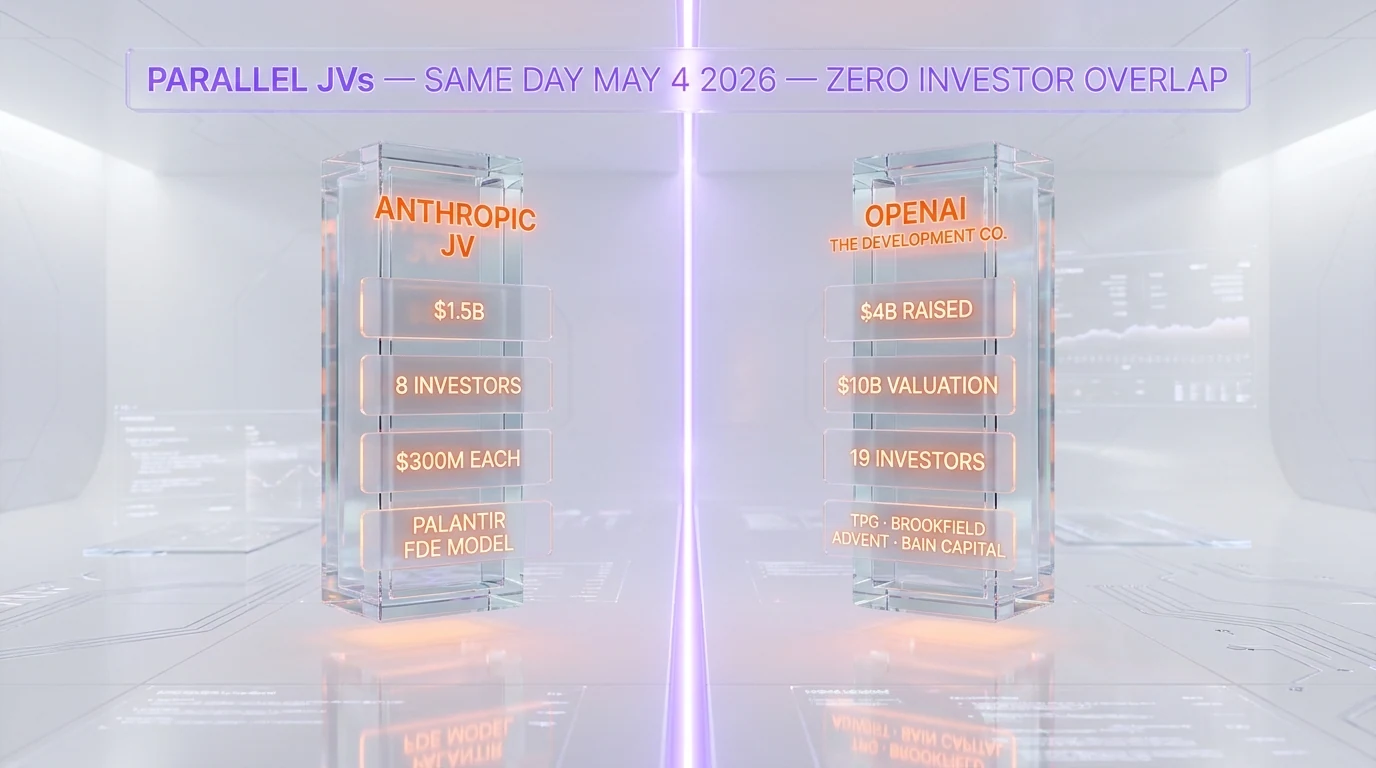
The Anthropic announcement did not happen in isolation. Hours before Anthropic's news posted, Bloomberg reported that OpenAI was raising $4 billion at a $10 billion valuation for its own parallel enterprise AI services JV called The Development Company. The investor list, per Bloomberg's reporting, includes 19 firms with TPG, Brookfield Asset Management, Advent International and Bain Capital named. Per TechCrunch, there is no investor overlap between the two ventures — an unusually clean split that suggests both AI labs spent months pre-allocating their Wall Street partners before going public on the same day.
| Metric | Anthropic JV | OpenAI — The Development Company |
|---|---|---|
| Capital raised | $1.5B | $4B |
| Implied valuation | Not disclosed | $10B post-money |
| Number of investors | 8 (Anthropic + 7 financial) | 19 |
| Lead investors named | Blackstone, Hellman & Friedman, Goldman | TPG, Brookfield, Advent, Bain Capital |
| Announcement date | May 4, 2026 | May 4, 2026 (hours earlier) |
| Target market | Mid-market across banking, manufacturing, healthcare | Enterprise AI services (broad) |
| Investor overlap | Zero |
The same-day timing is the most interesting detail in either announcement. Two top-frontier AI labs simultaneously announcing partnerships with major alternative asset managers is not coincidence — it is signaling. Whether the signal is “we are competing for the same channel” or “we have agreed to split the channel and not collide on the same LPs” will become clear in the first 12 months. The zero-overlap investor list points to the second interpretation.
Financial details and what we still do not know
Several material details remain undisclosed in the public announcement, and we will not speculate on them.
- The JV's brand name. Neither the Anthropic newsroom post nor the press coverage names the joint venture entity itself. It may launch under an umbrella brand later or operate as “Anthropic Enterprise AI Services” informally.
- Equity split. The $300M commitments from Anthropic, Blackstone and Hellman & Friedman are reported, but the resulting cap table — how much of the JV each party owns — is not public.
- CEO and operating leadership. No CEO has been named for the JV. Krishna Rao, Anthropic's CFO, is the only executive quoted in the launch.
- Pricing model. Whether the JV charges fixed fees, retainers, success-based pricing or a hybrid is not disclosed.
- Headcount target. The announcement does not state how many Applied AI engineers the JV plans to hire in year one.
- Geographic scope. Mid-sized US companies are the obvious primary market; whether the JV will operate in EMEA or Asia-Pacific is not stated.
The opacity is itself a signal. Two-billion-plus capital raises with this many institutional names usually disclose more. The fact that this one does not suggests the partners are still negotiating governance and brand details — or that they want to ship the headline before tying themselves to specific operating commitments.
Market context: Anthropic's wider 2026 strategic stack
This JV is not a one-off. It is the latest move in a coherent enterprise strategy Anthropic has been building since late 2025.
- October 2025: Google announces a $40 billion investment in Anthropic at a $350 billion valuation, with a planned IPO in October 2026.
- Q1 2026: Anthropic reportedly hits $8 billion in run-rate revenue, per leaked OpenAI internal memo coverage from April.
- April 16, 2026: Claude Opus 4.7 launches as the company's flagship coding model. Pricing increases on the API.
- April 25, 2026: Anthropic announces the NEC Japan AI-Native Engineering team partnership.
- May 1, 2026: Anthropic raises additional capital reportedly at a $900 billion valuation.
- May 4, 2026: This $1.5B enterprise services JV with eight Wall Street firms.
The pattern is enterprise channel expansion at industrial scale. Where OpenAI built ChatGPT into a mass-consumer product first and is bolting on enterprise second, Anthropic has run the strategy in reverse — consumer Claude is a wrapper on the enterprise franchise, not the other way around. The JV is the most explicit move yet: instead of waiting for enterprise customers to come to Claude, the JV will send engineers into customer offices.
The wildcard is the parallel Anthropic crisis on the federal side. The Pentagon announced on May 1, 2026 that it had finalized AI deals with eight tech companies on classified networks — with Anthropic explicitly excluded as a “supply chain risk” per DefenseScoop reporting. The Anthropic JV announcement three days later reads, at minimum, as Wall Street capital filling the federal-revenue void. That parallel is too clean to ignore.
What to watch next
Three threads will determine whether the JV is a milestone or a footnote.
First, named customer wins. The first six months will tell us whether the JV is selling. If Blackstone-owned portfolio companies, Hellman & Friedman healthcare assets and Goldman mid-market clients show up as named JV customers in Q3 2026 earnings calls, the channel works. If they do not, the JV is a press release.
Second, the consulting firms' counter-move. McKinsey, BCG and Bain will not stand still. The most likely response is acquisition or partnership with a smaller AI lab — Mistral, Cohere, AI21, or one of the open-weight specialists. If McKinsey buys an AI lab in 2026, the cause will trace directly to today's announcement.
Third, the OpenAI head-to-head. The Development Company has more capital but a smaller valuation multiple, and OpenAI's enterprise franchise is structurally different from Anthropic's. Whether the two ventures compete for the same accounts or specialize into different verticals will define the enterprise AI services market for the next three years.
Our take
The headline numbers ($1.5B, eight Wall Street firms, $300M each from three of them) are striking. The structural significance is bigger than the numbers. Anthropic just did three things in one announcement.
It validated the Palantir FDE model as the dominant enterprise AI delivery shape for 2026 and beyond. It told the consulting industry that AI labs are now their direct competitor, not their AI infrastructure supplier. And it told the Pentagon — which excluded Anthropic from $200M classified contracts three days earlier — that Anthropic does not need federal revenue when Wall Street will write a $1.5B check the same week.
For mid-sized companies that have been priced out of McKinsey and stuck on tier-2 IT consulting, this is great news: a credible new option backed by some of the deepest capital pools on earth, shipping engineers and software instead of decks. For McKinsey, BCG, Bain and the broader consulting industry, this is the moment where the AI threat moved from theoretical to direct. The fact that the threat arrived underwritten by Goldman Sachs and Blackstone — the firms that pay McKinsey hundreds of millions per year — is the part that should keep partners awake at night.
Frequently asked questions
What is the Anthropic, Goldman Sachs and Blackstone joint venture?
It is a $1.5 billion enterprise AI services joint venture announced on May 4, 2026 that will deploy teams of Applied AI engineers from Anthropic into mid-sized customer companies to build, integrate and operate Claude-powered systems. The founding investors are Anthropic, Blackstone, Goldman Sachs, Hellman & Friedman, Apollo Global Management, General Atlantic, GIC, Leonard Green & Partners and Sequoia Capital. Anthropic, Blackstone and Hellman & Friedman each committed roughly $300 million per TechCrunch reporting.
Who are the eight founding investors in the JV?
The eight founding investors are Blackstone, Goldman Sachs, Hellman & Friedman, Apollo Global Management, General Atlantic, GIC, Leonard Green & Partners and Sequoia Capital. Combined they manage trillions of dollars across private equity, sovereign wealth, growth equity and venture capital, with mid-sized portfolio companies that the JV is expected to target as initial customers.
How much did Anthropic, Blackstone and Hellman & Friedman commit?
Per TechCrunch reporting on May 4, 2026, Anthropic, Blackstone and Hellman & Friedman each committed roughly $300 million as founding partners. The remaining capital up to the $1.5 billion total was contributed by Goldman Sachs, Apollo Global Management, General Atlantic, GIC, Leonard Green & Partners and Sequoia Capital. The exact equity split between the parties has not been publicly disclosed.
What target market does the JV serve?
The JV explicitly targets mid-sized companies, including community banks, regional manufacturers, regional health systems and healthcare services networks. This is the same mid-market segment that has historically been served by tier-2 management consulting firms and boutique IT consultancies, where McKinsey, BCG and Bain have lower coverage due to pricing constraints. The JV's pitch is to deploy custom Claude-powered systems with on-site Anthropic engineers rather than sell deliverables-only consulting work.
Why is this considered a threat to McKinsey, BCG and Bain?
The JV directly competes for AI implementation work that has driven the bulk of consulting industry growth from 2018 through 2024. It ships engineers and software rather than recommendations and decks, runs on software-plus-services economics rather than billable hours, and inherits client relationships through its eight Wall Street investors' portfolio companies. The largest strategy firms still hold the CEO-to-CEO advisory layer, but the “AI implementation” segment is now exposed to a structurally better-funded and better-aligned competitor.
How does the JV compare to OpenAI's The Development Company?
OpenAI announced a parallel enterprise AI services joint venture called The Development Company on the same day, May 4, 2026, hours before the Anthropic announcement. The OpenAI venture is reportedly raising $4 billion at a $10 billion valuation from 19 investors, with TPG, Brookfield Asset Management, Advent International and Bain Capital named as participants. Per TechCrunch, there is zero investor overlap between the two ventures, suggesting both labs pre-allocated their Wall Street partners before going public on the same day.
Why did Anthropic copy the Palantir Forward-Deployed Engineer model?
Palantir's Forward-Deployed Engineer model has produced one of the most valuable enterprise software businesses of the last decade, with a market capitalization above $400 billion as of May 2026 and 64% commercial growth in Q4 2025. The model embeds engineers inside customer organizations, ships custom-configured software in production, and converts initial engagements into long-term retainers. Anthropic is replicating the structure with a critical upgrade: where Palantir engineers deploy Foundry, Anthropic engineers will deploy Claude, which performs much of the configuration work natively.
Is there a CEO of the new joint venture?
No CEO has been named in the public announcement. The Anthropic newsroom post quotes only Krishna Rao, Anthropic's Chief Financial Officer. Operating leadership, brand identity and governance details have not been disclosed publicly as of May 4, 2026, suggesting these are still being negotiated between the founding partners.
How does this connect to the Pentagon excluding Anthropic from AI contracts?
Three days before the JV announcement, on May 1, 2026, the Department of Defense finalized AI deployment agreements on classified networks with eight companies including OpenAI, Google, Microsoft, Amazon, Oracle, Nvidia, SpaceX and Reflection AI — explicitly excluding Anthropic and labeling it a “supply chain risk.” The May 4 Wall Street JV is widely interpreted as Anthropic redirecting its enterprise growth strategy from federal contracts to private-sector deployment with capital backing from alternative asset managers.
When will the JV start shipping customer engagements?
Anthropic has not announced a public start date for customer engagements. Industry observers expect first customer wins to be announced in Q3 2026 earnings cycles from the JV's investor-LP portfolio companies, with named deployments likely first in healthcare services, mid-market banking and regional manufacturing. The success of the JV will be measured by named customer wins in the next two to four quarters.