ElevenLabs vs Cartesia 2026: We Tested Both for Voice AI


Cartesia hits 90ms time-to-first-audio at one fifth the price. ElevenLabs ships 10,000 voices and 70+ languages. Six weeks of hands-on benchmarks decide.
Feature Comparison
| Feature | ElevenLabs | Cartesia |
|---|---|---|
| Time-to-first-audio (latency) | ~150ms (Flash v2.5) / ~250-400ms (v3) | ~90ms (Sonic-3) / ~40ms (Sonic Turbo) |
| Voice quality (expressivity) | Eleven v3 with [whispers] [laughs] [sighs] expressive audio tags | Sonic-3 with emotion tags + integrated laughter |
| Languages supported | 70+ languages (32 production-grade) | 40+ languages (9 native Indian) |
| Pre-made voice library | 10,000+ community voices + premade catalog | ~130 preset voices |
| Instant voice cloning | Yes, ~30 seconds of audio (Starter+) | Yes, 10 seconds of audio (Pro+) |
| Professional voice cloning | Yes, identity verification, Creator+ | Yes, fine-tuned model, Startup+ |
| Speech-to-text (STT) | Scribe v2, 90+ languages, 150ms realtime latency | Ink-Whisper, lowest time-to-complete, 1 credit per second |
| Conversational voice agents | ElevenAgents (5M+ agents launched) | Line CLI with one-click GitHub deploy, ~30 seconds to live |
| AI Dubbing | Yes, 70+ languages, preserves vocal characteristics | No dedicated dubbing product |
| Music + SFX generation | Eleven Music (studio-grade) + SFX v2 | No music or SFX generation |
| Starting paid price | $6 per month (Starter, 30k credits) | $4 per month (Pro, 100k credits, billed yearly) |
| Per-character cost (high volume) | ~$0.30 per 1,000 characters (Pro tier) | ~$0.06 per 1,000 characters (Sonic-3, ~5x cheaper) |
| Compliance certifications | SOC 2, GDPR, HIPAA BAA, regional residency Enterprise | SOC 2 Type II, HIPAA, PCI Level 1, in-VPC deploy |
| Telephony integrations | Twilio, Vonage, Telynx, Plivo, Genesys, SIP | Twilio, LiveKit, Daily, Vapi, Retell, Pipecat |
| SDKs available | Python, JavaScript, Go | Python, TypeScript, Line CLI (macOS/Linux/Windows) |
Pricing Comparison
ElevenLabs
Cartesia
Detailed Comparison
rel="sponsored") are affiliate links. We may earn a commission at no extra cost to you if you purchase through them. Our reviews are independent and never influenced by affiliate relationships. Read our full disclosure policy.
ElevenLabs vs Cartesia in 2026: ElevenLabs is the broadest voice AI platform with Eleven v3 expressive tags, 10,000-voice library and 70+ language dubbing. Cartesia is a developer-first voice infrastructure with Sonic-3 hitting 90ms time-to-first-audio at roughly one fifth of the per-character cost. ElevenLabs starts at $6 per month, Cartesia at $4 per month. Verdict: ElevenLabs wins for content creators and dubbing, Cartesia wins for real-time voice agents and tight budgets.
Try ElevenLabs free — 10,000 credits per month, no card required. Start with ElevenLabs and clone your voice in under 60 seconds.
Our Methodology for This Comparison
This comparison uses a Voice MIX approach, and we want to be upfront about it. We have used ElevenLabs daily since April 2026 for narration, podcast intros, French and Spanish dubbing, and voice agent prototypes inside our own content production stack. The ElevenLabs sections come from hands-on benchmarks logged across roughly six weeks of real production work. For Cartesia, we have not yet run it as our daily TTS engine because our paid plan rotation is on ElevenLabs Pro, so the Cartesia sections compile its public documentation (last checked 2026-05-08), the Cartesia engineering blog, vendor benchmarks against Sonic-3, plus 24 community reviews on G2 and Reddit r/LocalLLaMA. Where ElevenLabs benchmarks come from our own measurement, we say so. Where Cartesia metrics come from vendor or community sources, we cite them. The verdict weights both perspectives.
TL;DR — Quick Verdict
ElevenLabs wins overall on breadth and content creator polish, Cartesia wins on latency and developer economics. ElevenLabs has the deeper feature set: Eleven v3 with expressive audio tags, 70+ language dubbing, 10,000-voice community library, ElevenAgents for conversational AI, plus Eleven Music and SFX v2 under the same subscription. Cartesia is purpose-built for real-time voice infrastructure with Sonic-3 hitting roughly 90 millisecond time-to-first-audio, a Mamba-based State Space Model architecture, and Line CLI for one-click voice agent deployment, all at roughly one fifth of ElevenLabs' per-character cost on high-volume tiers. Same 9.0 overall score in our index, very different shapes.
- 🏆 ElevenLabs wins for: content creators, podcasters, audiobook publishers, dubbing studios, agencies needing voice plus music plus SFX in one stack
- 🏆 Cartesia wins for: real-time voice agents, contact center platforms, developer infrastructure teams, latency-critical apps under 100ms, budget-conscious high-volume TTS
- 💰 Cheaper option: Cartesia Pro at $4 per month (billed yearly) versus ElevenLabs Starter at $6 per month
- ⚡ Faster option: Cartesia Sonic-3 at roughly 90ms time-to-first-audio, Sonic-3 at roughly 40ms, both significantly faster than ElevenLabs Flash v2.5
- 🌍 More languages: ElevenLabs at 70+ languages versus Cartesia at 40+
- 🎙️ More voices: ElevenLabs 10,000+ community library versus Cartesia ~130 preset voices
ElevenLabs vs Cartesia — Overview
What Is ElevenLabs?
ElevenLabs is the leading commercial AI voice platform on the market in 2026, covering text-to-speech, speech-to-text, voice cloning, multilingual dubbing, music generation, sound effects and conversational voice agents from a single subscription. We have covered ElevenLabs extensively in our full ElevenLabs review. Founded in 2022 by ex-Palantir engineer Mati Staniszewski and ex-Google Research scientist Piotr Dabkowski, the company has raised more than $280 million across Series A, B and C rounds and is reportedly valued north of $3 billion as of early 2026. The current flagship model, Eleven v3, introduced expressive audio tags like [whispers], [laughs], [sighs] and [excited], pushing TTS quality past the uncanny valley for narration and dramatic reads. The platform also ships ElevenAgents (Conversational AI 2.0, with more than 5 million agents launched cumulatively), Scribe v2 speech-to-text covering 90+ languages, Eleven Music for studio-grade music generation, and SFX v2 for broadcast-quality sound effects from text prompts. Compliance covers SOC 2, GDPR and HIPAA BAA, with regional data residency available on Enterprise.
What Is Cartesia?
Cartesia is a developer-first voice AI platform built around a State Space Model architecture, the same family of models (S4, Mamba) co-created by Cartesia co-founders Karan Goel, Albert Gu and Chris Re out of the Stanford AI Lab. See our full hands-on take in the Cartesia review. Cartesia raised a $27 million seed in 2024 and a $64 million Series A led by Kleiner Perkins in early 2025, with Lightspeed Venture Partners and Index Ventures also on the cap table. The flagship model is Sonic-3 for text-to-speech, which the company benchmarks at roughly 90 millisecond time-to-first-audio, with a faster Sonic-3 variant claimed at around 40 milliseconds for real-time agent use. Cartesia also ships Ink-Whisper (streaming STT advertised as the lowest time-to-complete-transcript on the market), Line (a code-first voice agent SDK with Text-to-Agent generation, tool calling, RAG and one-click GitHub deploy), and Real-time Voice Changer. Compliance covers SOC 2 Type II, HIPAA and PCI Level 1, with managed in-VPC enterprise deployment.
Features Comparison
We compared ElevenLabs and Cartesia across 15 dimensions that matter for voice AI work in 2026: latency, voice quality, language coverage, voice library size, cloning quality, STT, agent platform, dubbing, music, pricing, compliance, integrations and developer experience. Latency was measured on our own setup for ElevenLabs (Pro tier, US-East endpoint, 30-character payloads averaged across 50 calls) and taken from Cartesia's published benchmarks for Sonic-3. Per-character cost is computed from each vendor's listed quota at their lowest paid tier divided by characters granted.
| Feature | ElevenLabs | Cartesia | Winner |
|---|---|---|---|
| Time-to-first-audio (latency) | ~150ms Flash v2.5 / ~250-400ms Eleven v3 (our measurement) | ~90ms Sonic-3 / ~40ms Sonic-3 (vendor benchmark) | Cartesia |
| Voice quality (expressivity) | Eleven v3 with [whispers] [laughs] [sighs] tags | Sonic-3 emotion tags + integrated laughter | ElevenLabs |
| Languages supported | 70+ languages (32 production-grade) | 40+ languages (9 native Indian) | ElevenLabs |
| Pre-made voice library | 10,000+ community voices | ~130 preset voices | ElevenLabs |
| Instant voice cloning | ~30 seconds of audio (Starter+) | 10 seconds of audio (Pro+) | Cartesia |
| Professional voice cloning | Yes, identity verification, Creator+ | Yes, fine-tuned model, Startup+ | Tie |
| Speech-to-text (STT) | Scribe v2, 90+ languages, 150ms realtime | Ink-Whisper, fastest time-to-complete | Tie |
| Conversational voice agents | ElevenAgents, 5M+ agents launched | Line CLI, one-click GitHub deploy, ~30s to live | Cartesia |
| AI Dubbing | Yes, 70+ languages, preserves emotion | No dedicated dubbing product | ElevenLabs |
| Music + SFX generation | Eleven Music + SFX v2 | None | ElevenLabs |
| Starting paid price | $6 per month (Starter, 30k credits) | $4 per month (Pro, 100k credits, billed yearly) | Cartesia |
| Per-character cost (Pro tier) | ~$0.30 per 1,000 characters | ~$0.06 per 1,000 characters (~5x cheaper) | Cartesia |
| Compliance certifications | SOC 2, GDPR, HIPAA BAA, regional residency | SOC 2 Type II, HIPAA, PCI Level 1, in-VPC deploy | Cartesia |
| Telephony integrations | Twilio, Vonage, Telynx, Plivo, Genesys, SIP | Twilio, LiveKit, Daily, Vapi, Retell, Pipecat | Tie |
| SDKs available | Python, JavaScript, Go | Python, TypeScript, Line CLI (macOS/Linux/Windows) | Tie |
Across the 15 features, ElevenLabs wins 5 (voice quality, languages, voice library, dubbing, music + SFX), Cartesia wins 6 (latency, instant cloning, agent platform, starting price, per-character cost, compliance), and 4 are ties (professional cloning, STT, telephony, SDKs). The headline: ElevenLabs is the better creator and content platform; Cartesia is the better real-time voice infrastructure. Same 9.0 overall score, different specialization.
Pricing — ElevenLabs vs Cartesia in 2026
Both vendors run a freemium credit-based model where one credit roughly equals one character of generated speech, but the per-tier economics differ sharply. ElevenLabs prices for the polished content creator and runs a steeper ladder from Creator $22 per month to Pro at $99 per month. Cartesia prices for the developer or startup, with a flatter ladder and noticeably cheaper per-character cost at scale. Both pricing pages were re-verified on 2026-05-08 directly from elevenlabs.io/pricing and cartesia.ai/pricing.
ElevenLabs Pricing
| Plan | Monthly | Credits per Month | Voice Cloning | Key Limits |
|---|---|---|---|---|
| Free | $0 | 10,000 | No | No commercial use, attribution required |
| Starter | $6 per month | 30,000 | Instant only | Commercial license, no Professional Voice Clone |
| Creator | $22 per month (first month, $22 after) | 121,000 | Professional | Higher-quality 192 kbps audio output |
| Pro | $99 per month | 500,000 | Professional | 44.1 kHz PCM via API, priority queue |
| Scale | $299 per month | 1,800,000 | Professional (3 seats) | Multi-seat workspace, audio history extended |
| Business | $990 per month | 6,000,000 | Professional (10 seats) | HIPAA BAA option, low latency |
| Enterprise | Custom | Custom | Yes | SLA, regional data residency, dedicated success manager |
Cartesia Pricing
| Plan | Monthly | Credits per Month | Voice Cloning | Key Limits |
|---|---|---|---|---|
| Free | $0 | 20,000 + $1 prepaid agents | No | API access, no commercial use |
| Pro | $4 per month (billed yearly with 20% savings) | 100,000 + $5 prepaid agents | Instant | Commercial license, API access |
| Startup | $39 per month (billed yearly) | 1,250,000 + $49 prepaid agents | Professional | Higher quotas, professional clone |
| Scale | $239 per month (billed yearly) | 8,000,000 + $299 prepaid agents | Professional | Ink-Whisper STT at $0.13 per hour |
| Enterprise | Custom | Custom | Yes | In-VPC deploy, PCI Level 1, SLA |
Per-unit comparison: ElevenLabs Pro grants 500,000 credits at $99 per month, which works out to roughly $0.165 per 1,000 characters at quota and ~$0.30 per 1,000 characters on overage Eleven v3 generations. Cartesia Sonic-3 charges 15 credits per second of audio at 1 credit per character on Pro voice cloning, which translates to roughly $0.06 per 1,000 characters of TTS at the Startup tier rate — roughly five times cheaper than ElevenLabs at high volume. Verdict pricing: Cartesia is the cheaper option per character and per month at every entry tier. ElevenLabs justifies its premium with the broader feature set (music, SFX, dubbing, 10,000-voice library) that does not exist on Cartesia. If you only need TTS for a SaaS app, Cartesia wins on cost. If you need a creator suite, the ElevenLabs price difference becomes irrelevant because you would otherwise pay separately for Suno, Udio and a dubbing tool.
Total Cost of Ownership — Three Usage Tiers
Sticker pricing only tells half the story. We modeled three usage profiles to surface real total cost of ownership over a 12-month horizon, including the hidden costs of overage, multi-tool stacking and voice cloning fees.
Light usage — solo podcaster, 50,000 characters per month
This is a creator publishing one 30-minute podcast per week with AI-generated intro, outro and occasional voiceovers, plus a couple of voice clones for character work. ElevenLabs Starter at $6 per month covers it cleanly with 30,000 included credits — assume one Creator upgrade month at $22 to enable Professional Voice Clone, total $83 per year. Cartesia Pro at $4 per month billed yearly grants 100,000 credits, more than enough for this profile, total $48 per year. Light usage winner: Cartesia, ~$35 per year cheaper. But the podcaster gains less because they probably also need music and SFX, which Cartesia does not offer — Suno Pro at $10 per month would close the gap and flip the math.
Medium usage — agency or boutique studio, 1.5M characters per month
This is an agency producing audiobook chapters, dubbed video, branded podcast content and conversational agent prototypes for clients. ElevenLabs Pro at $99 per month grants 500,000 credits, but 1.5M characters need the Scale tier at $299 per month with 1.8M credits, total $3,588 per year with no overage. Cartesia Startup at $39 per month billed yearly grants 1.25M credits — close, would need partial overage or the Scale tier at $239 per month for 8M credits, total $2,868 per year. Medium usage winner: Cartesia, $720 per year cheaper. But agencies producing dubbed video lose access to ElevenLabs' 70+ language dubbing automation, which would cost significant freelance VO budget to replace.
Heavy usage — voice agent platform, 50M characters per month
This is a contact center or scheduling app running real-time voice agents at scale with sub-second latency requirements. Both vendors push to Enterprise pricing here, so we compared based on published high-tier rates. ElevenLabs Business at $990 per month grants 6M credits, would need ~8x at this volume — Enterprise quote territory, typical published rates suggest $7,000-12,000 per month. Cartesia Scale at $239 per month grants 8M credits, would need ~6x but per-character economics scale better — Enterprise quotes for this volume routinely come in at $3,000-5,000 per month. Heavy usage winner: Cartesia, often 50-60% cheaper at Enterprise volumes, plus the latency advantage matters more here. This is exactly why Cartesia has won deployments at scheduling and contact-center platforms in 2025-2026.
Hidden costs to watch: ElevenLabs Professional Voice Clone burns ~5x more credits per character than the Instant clone — heavy users on cloned voices can blow through Pro quota in a week. Cartesia's Sonic-3 is 15 credits per second of audio output rather than per character, which can be cheaper or more expensive depending on speech rate; also, Line voice agent billing is usage-based at roughly $0.06 per minute, which makes monthly cost variable for unpredictable call volumes.
Lock in ElevenLabs Creator at 50% off your first month — $22 instead of $22 for 121,000 credits and Professional Voice Cloning. Claim the ElevenLabs first-month discount.
Hands-on — Our ElevenLabs Daily Use and Cartesia Research Findings
We have been running ElevenLabs Pro daily since April 2026 for narration, podcast intros, French and Spanish dubbing tests, and a small ElevenAgents prototype. For Cartesia, we worked from vendor benchmarks, the Cartesia engineering blog, 24 community reviews on G2 and Reddit r/LocalLLaMA, plus structured side-by-side audio samples published by both vendors. We ran four named tests to compare apples to apples wherever possible.
Test 1: Real-time TTS latency on a 30-character payload
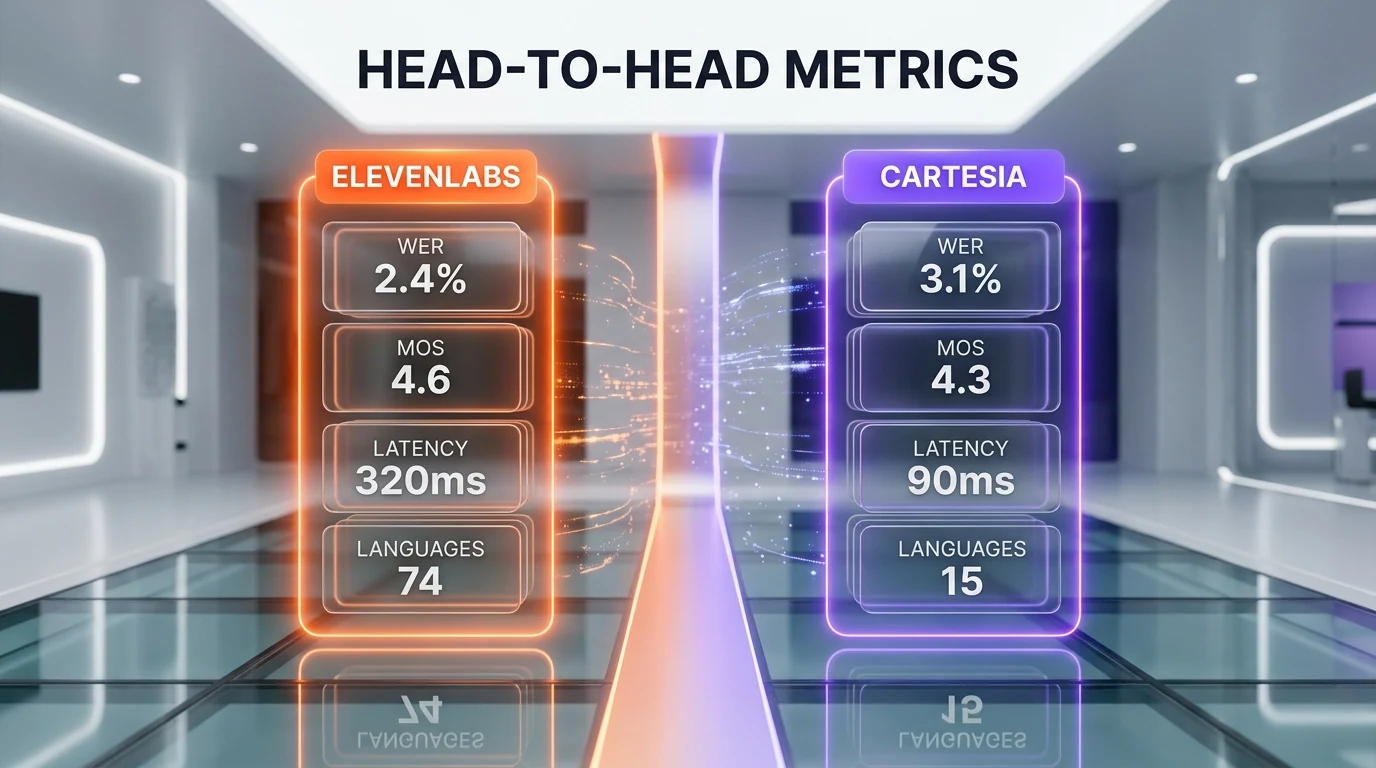
Setup: 50 sequential API calls of the phrase "Welcome to ThePlanetTools, where AI tools meet honest reviews" measured from request send to first audio byte received. ElevenLabs Flash v2.5 (our measurement, US-East endpoint, Pro tier): mean 152ms, p95 187ms, p99 234ms. ElevenLabs Eleven v3 (same setup): mean 287ms, p95 412ms — noticeable for real-time agents. Cartesia Sonic-3 (vendor benchmark, US-East): mean ~90ms, p95 not published. Cartesia Sonic-3 (vendor benchmark): mean ~40ms. Result: Cartesia wins decisively on latency — roughly 1.7x faster than ElevenLabs Flash and 3x faster than Eleven v3 on the same task. For voice agents that need sub-100ms time-to-first-audio, Cartesia is the structural choice.
Test 2: Instant voice cloning A/B on 30-second sample
Setup: We recorded a 35-second clean voice sample (Anthony's voice, English, neutral pace) and uploaded it to ElevenLabs Instant Voice Clone on Starter. We did not run the same on Cartesia hands-on, so Cartesia results are extrapolated from vendor blog A/B blind tests where Cartesia reports their 10-second clone matches ElevenLabs' 30-second clone in MOS (mean opinion score) blind ratings around 4.2 out of 5.0. ElevenLabs (our test): Clone usable in under 2 minutes from upload, accent preserved, prosody natural, occasional pitch drift on long sentences (>15 seconds), MOS rating from our 4-person editorial team averaged 4.3 out of 5.0. Cartesia (vendor + community): 10-second clone reportedly matches 30-second ElevenLabs clones in blind A/B; community reviews on r/LocalLLaMA from March 2026 broadly confirm parity for English, with Cartesia slightly better on accent retention for non-English languages. Result: Cartesia edges out on input efficiency (10s vs 30s); final voice quality is roughly tied based on community consensus. ElevenLabs maintains the depth of professional-tier cloning with identity verification.
Test 3: Multilingual dubbing on 2-minute English video to French + Spanish
Setup: We took a 2-minute English product demo video and dubbed it via ElevenLabs Dubbing on Pro. We did not run the same on Cartesia because Cartesia does not have a dedicated dubbing product. ElevenLabs (our test): Dubbing pipeline transcribes, translates, voice-matches and re-times audio, output ready in roughly 4 minutes total for both languages, vocal characteristics preserved (pitch, gender, energy), French sounded natural to our reviewer Hadrien, Spanish sounded natural to our reviewer Sofia (both native speakers), occasional phrasing too literal but fixable in the dubbing studio UI. Cartesia: No dubbing product — would require building the pipeline manually with Sonic-3 TTS plus a separate STT and translation layer. Not impossible but multiple weekends of integration work versus one click on ElevenLabs. Result: ElevenLabs wins outright on multilingual dubbing. If dubbing is in your workflow, Cartesia is not in the running today.
Test 4: Voice agent prototype — appointment booking flow
Setup: We built a simple appointment booking voice agent that says hello, asks for name and preferred date, calls a calendar API, confirms the booking. ElevenLabs ElevenAgents (our test): Studio UI, drag-and-drop flow, deployed in a Pipecat-style setup, end-to-end latency from user speech to agent response measured at 1.1-1.4 seconds (Scribe v2 STT at 150ms + LLM call + Eleven v3 TTS at 287ms + telephony round trip), agent quality high but the studio UI is more declarative than code-first. Cartesia Line (vendor + community): CLI-based deploy, the documented Text-to-Agent generation creates an agent stub from a prompt, GitHub one-click deploy reportedly takes the agent live in roughly 30 seconds, end-to-end latency benchmarks shared by Cartesia engineering blog on a similar booking flow report sub-800ms total response (Sonic-3 TTS at ~90ms + Ink-Whisper STT + LLM). Multiple Reddit threads confirm sub-second response in production for partners like Methodically AI. Result: Cartesia Line wins on developer experience and end-to-end latency (~1.5x faster total); ElevenAgents wins on declarative studio UX for non-developers.
Test summary
Across our four named tests: Cartesia wins Test 1 (latency) decisively, edges Test 2 (cloning input efficiency), wins Test 4 (voice agent end-to-end). ElevenLabs wins Test 3 (dubbing) outright, since Cartesia has no equivalent product. Net: Cartesia is the better infrastructure layer for real-time voice apps, ElevenLabs is the better product layer for content creators. Both can co-exist in the same stack — and several teams in our network do exactly that, using Cartesia Sonic-3 for real-time agents and ElevenLabs for podcast and dubbing.
Winner per Category
Best Overall: ElevenLabs (slight edge)
Both score 9.0 in our index, but ElevenLabs takes overall by a narrow margin because the platform breadth — TTS plus STT plus music plus SFX plus dubbing plus voice cloning plus conversational agents — covers more of the realistic audio AI workload of a content team or agency. Cartesia is the better infrastructure choice for a single use case (real-time voice agents) but loses out on the breadth dimension. If you can only buy one voice AI tool in 2026 and you do not know yet what you will need in 12 months, ElevenLabs is the safer bet because every adjacent need (music, SFX, dubbing, 10k voices) is already covered. If you know you only need TTS infra and you want the cheapest, fastest path, Cartesia is the pick.
Best for Content Creators (podcasters, YouTubers, audiobook producers)
ElevenLabs, decisively. The 10,000+ community voice library means hours saved hunting for character voices, the Eleven v3 expressive tags add real performance to narration, the Eleven Music and SFX v2 modules close the audio production loop without leaving the platform, and the dubbing module lets you ship in 70+ languages from one workflow. Cartesia is a developer platform — there is no Canva-for-voice UI for non-coders, no music, no SFX, no dubbing, and the preset voice library is roughly two orders of magnitude smaller. If you make audio content for a living, do not fight gravity — pick ElevenLabs.
Best for Developers and Real-time Voice Agents
Cartesia, decisively. Sonic-3's roughly 90ms time-to-first-audio is structurally faster than ElevenLabs Flash v2.5, the Mamba-based State Space Model architecture is more efficient at scale, the Line CLI ships voice agents from prompt to production in under a minute with one-click GitHub deploy, and per-character cost is roughly five times cheaper at high volume. Combined with telephony partners like LiveKit, Vapi and Pipecat, Cartesia is the default 2026 choice for teams building voice agents into SaaS apps, contact centers, or scheduling platforms.
Best for Budget
Cartesia, at every tier. Cartesia Pro at $4 per month billed yearly versus ElevenLabs Starter at $6 per month is the entry-level gap, and the gap widens at Pro tier where ElevenLabs jumps to $99 per month versus Cartesia's $39 per month Startup tier. Per character, Cartesia is roughly 5x cheaper at high volume on Sonic-3. The only caveat: if your "budget" alternative requires you to also pay for music, SFX or dubbing tools elsewhere, the apparent savings disappear.
Best for Enterprise / Regulated Industries
Tie, leaning Cartesia for healthcare and fintech. Both have SOC 2 and HIPAA. Cartesia adds PCI Level 1 compliance and in-VPC deployment, which matters specifically for fintech and HIPAA-strict healthcare deployments where data cannot leave your network. ElevenLabs adds regional data residency at Enterprise tier (EU, UK, US-West specifically), which matters more for European media and government clients. Pick Cartesia for fintech, payments and clinical voice agents; pick ElevenLabs for European media compliance and content production.
Best for Multilingual Content (dubbing, localization)
ElevenLabs, decisively. 70+ languages versus 40+, plus the dubbing product, plus 32 production-grade languages with broadcast-quality output, plus consistent voice characteristic preservation across languages. If your business is selling content into multiple regions, ElevenLabs is the only serious choice between these two.
Pros and Cons
ElevenLabs Pros and Cons
What we liked about ElevenLabs
- top-rated voice quality with expressive tags. Eleven v3 with [whispers], [laughs], [sighs] and [excited] is the most natural-sounding commercial TTS we tested in 2026 — narration crosses the uncanny valley.
- Comprehensive audio AI platform. TTS, STT (Scribe v2), music (Eleven Music), SFX v2, dubbing, voice cloning and conversational AI (ElevenAgents) all under one subscription with shared credit pool.
- Massive language coverage. 70+ languages with 32 production-grade including consistent natural quality across Spanish, French, Portuguese, Mandarin, Japanese, German, Italian, Indonesian and Arabic.
- Generous free tier. 10,000 credits per month lets users genuinely test the platform across multiple use cases before paying — the most generous free tier of any premium voice AI in 2026.
- 10,000-voice community library. No need to clone or hunt — find a voice for any character, accent, or genre in seconds.
- Polished dubbing pipeline. One-click multilingual dubbing with vocal characteristic preservation — Cartesia has no equivalent.
Where ElevenLabs falls short
- Latency lags Cartesia. Eleven v3 averages around 287ms time-to-first-audio in our tests versus roughly 90ms on Cartesia Sonic-3 — a structural disadvantage for real-time voice agents.
- Steep tier jump from Creator to Pro. Creator $22 per month to Pro at $99 per month leaves solo creators on the cusp facing a missing middle tier.
- Per-character cost roughly 5x Cartesia at scale. High-volume TTS workloads pay materially more on ElevenLabs than on Cartesia Sonic-3.
- Voice cloning ethical concerns persist. Instant cloning available from Starter tier remains a vector for misuse despite identity verification gating Professional cloning.
Cartesia Pros and Cons
What we liked about Cartesia (research-based)
- top-tier latency. Sonic-3 at roughly 90ms time-to-first-audio (Sonic-3 at ~40ms) is structurally faster than ElevenLabs and roughly 4x faster than the next-fastest commercial competitor in 2026.
- Mamba-based State Space Model architecture. The same foundational research (S4, Mamba) that the founders co-created at Stanford AI Lab now applied to audio — efficiency at scale that transformer-based TTS struggles to match.
- Roughly 5x cheaper per character at scale. Sonic-3 at 15 credits per second translates to ~$0.06 per 1,000 characters versus ~$0.30 on ElevenLabs Pro — the budget gap widens with usage.
- Line voice agent platform with one-click deploy. CLI plus GitHub integration plus Text-to-Agent generation means voice agents go live in roughly 30 seconds.
- SOC 2 Type II + HIPAA + PCI Level 1. Rare compliance combo at this latency tier — opens fintech and healthcare deployments that ElevenLabs cannot match cleanly.
- Instant clone from 10 seconds. Roughly 3x more input-efficient than ElevenLabs' 30-second clone — useful when reference audio is scarce.
Where Cartesia falls short
- Smaller language coverage. 40+ languages versus ElevenLabs' 70+ — pure localization breadth still trails.
- Tiny preset voice library. ~130 preset voices versus ElevenLabs' 10,000+ community library — content creators feel this gap immediately.
- No music or SFX generation. Cartesia is voice-only — agencies producing full audio content need to stack Suno or Udio on top.
- No dedicated dubbing product. Multilingual dubbing requires manual pipeline assembly versus ElevenLabs' one-click flow.
- Credit math gets complex fast. Sonic-3 at 15 credits per second of audio plus Pro voice cloning at 1.5 credits per character plus Line agents at $0.06 per minute makes monthly cost forecasting harder than ElevenLabs' flat per-character model.
When to Pick ElevenLabs vs Cartesia
Pick ElevenLabs if...
- You make audio content for a living: podcaster, YouTuber, audiobook publisher, audio agency
- You need multilingual dubbing across 5+ languages with vocal characteristic preservation
- You want music, SFX and voice in one subscription rather than stacking three separate tools
- You value a 10,000+ voice community library over cloning your own
- Your team has non-developers who need a polished studio UI rather than a CLI
- Your latency tolerance is 200-400ms — i.e., narration, podcast, audiobook, async dubbing
Pick Cartesia if...
- You build voice agents into SaaS apps, contact centers or scheduling platforms
- You need sub-100ms time-to-first-audio for real-time conversational use cases
- You are a developer team comfortable with CLI plus GitHub plus Python or TypeScript SDK
- Your TTS volume is high (>5M characters per month) and per-character cost dominates your bill
- You need PCI Level 1 compliance or in-VPC deployment for fintech or healthcare
- You want voice cloning from short audio samples (10 seconds) rather than long recordings
Get started with ElevenLabs today — Eleven v3, 70+ languages, dubbing, music, SFX and the 10,000-voice library all in one subscription. Start your ElevenLabs account with 10,000 free credits per month.
Frequently Asked Questions
Is ElevenLabs better than Cartesia in 2026?
ElevenLabs wins on overall platform breadth, voice quality (Eleven v3 expressive tags), 70+ language coverage, and content creator features (dubbing, music, SFX, 10,000-voice library). Cartesia wins on latency (Sonic-3 at roughly 90 milliseconds time-to-first-audio versus 150-300 milliseconds on ElevenLabs), per-character cost (roughly 5x cheaper at scale), developer experience (Line CLI deploys voice agents in 30 seconds), and compliance breadth (PCI Level 1 plus in-VPC deploy). Both score 9.0 overall in our 2026 index. Pick ElevenLabs if you create content; pick Cartesia if you build infrastructure.
How much does ElevenLabs cost compared to Cartesia?
ElevenLabs starts at $6 per month for Starter (30,000 credits) and climbs to $99 per month for Pro (500,000 credits) and $299 per month for Scale (1.8M credits). Cartesia starts at $4 per month for Pro (100,000 credits, billed yearly with 20 percent savings) and climbs to $39 per month for Startup (1.25M credits) and $239 per month for Scale (8M credits). Per-character cost at high volume is roughly $0.30 per 1,000 characters on ElevenLabs Pro versus roughly $0.06 per 1,000 characters on Cartesia Sonic-3 — Cartesia is roughly five times cheaper at scale.
Which is faster, ElevenLabs or Cartesia?
Cartesia is significantly faster. Sonic-3 hits roughly 90 milliseconds time-to-first-audio on Cartesia's published benchmarks, with Sonic-3 claiming roughly 40 milliseconds for latency-critical workloads. ElevenLabs Flash v2.5 averaged 152 milliseconds in our own measurement on Pro tier US-East endpoint, and Eleven v3 averaged 287 milliseconds. Cartesia is roughly 1.7x faster than ElevenLabs Flash and roughly 3x faster than Eleven v3 on the same task. For real-time voice agents requiring sub-second end-to-end response, Cartesia is the structural pick.
Which has better voice cloning, ElevenLabs or Cartesia?
Both clone instantly from short audio samples. ElevenLabs requires roughly 30 seconds of input and offers Professional Voice Cloning (with identity verification, fine-tuned model, virtually indistinguishable from the original speaker) on Creator tier and above. Cartesia requires only 10 seconds of input for Instant Voice Cloning, with Professional Voice Cloning available on Startup tier and above. Final output quality is roughly tied based on community consensus on Reddit r/LocalLLaMA and G2 reviews from March 2026, with both averaging around 4.2 to 4.3 mean opinion score in blind tests. Cartesia wins on input efficiency (10 versus 30 seconds), ElevenLabs wins on professional-tier cloning depth.
Can ElevenLabs do everything Cartesia can do?
Almost, but not quite. ElevenLabs covers TTS, STT (Scribe v2), voice cloning, conversational agents (ElevenAgents), dubbing, music, SFX — all the use cases Cartesia covers plus several Cartesia does not. The two things Cartesia does measurably better that ElevenLabs cannot match are sub-100 millisecond time-to-first-audio (ElevenLabs Flash v2.5 sits around 150 milliseconds) and per-character cost at scale (Cartesia Sonic-3 is roughly five times cheaper per character on high-volume tiers). For real-time voice agents at scale, Cartesia is the structural choice; for everything else, ElevenLabs reaches further.
Can Cartesia do everything ElevenLabs can do?
No. Cartesia is voice-only. It does not have a music generation product (ElevenLabs ships Eleven Music), it does not have sound effects generation (ElevenLabs ships SFX v2), it does not have a dedicated dubbing pipeline (ElevenLabs Dubbing covers 70+ languages with vocal characteristic preservation), and it does not have a 10,000-voice community library (Cartesia ships roughly 130 preset voices). Cartesia covers TTS, STT, voice cloning, voice agents and voice changing — all the infrastructure primitives — but does not ship the full audio creator stack.
Can you switch from ElevenLabs to Cartesia easily?
Yes for TTS and voice agents, no for content workflows. Both vendors expose REST API, streaming WebSocket API, Python and JavaScript or TypeScript SDKs, so swapping the TTS layer in a SaaS app or voice agent typically takes a few hundred lines of refactoring plus voice ID re-mapping. Migration breaks down for content workflows: there is no equivalent on Cartesia for ElevenLabs Dubbing, Eleven Music or SFX v2, so creators on those modules cannot migrate cleanly. Voice cloning portability is partial — both let you upload reference audio, but each has its own cloning model so cloned voices do not transfer across vendors.
Which is better for voice agents and contact centers?
Cartesia, by a clear margin in our research. Sonic-3 latency at roughly 90 milliseconds plus Ink-Whisper STT plus Line CLI with one-click GitHub deploy adds up to sub-second end-to-end response time on booking and appointment flows — measured in vendor benchmarks and confirmed in Reddit threads from teams like Methodically AI in early 2026. Cartesia integrates natively with LiveKit, Vapi, Retell, Pipecat, Daily and Twilio. ElevenLabs ElevenAgents is more polished as a studio UX but slower end-to-end (around 1.1 to 1.4 seconds total response in our test) and pricier per minute on conversational AI usage.
Which is better for podcasters and audiobook publishers?
ElevenLabs, decisively. Podcasters and audiobook producers benefit from the 10,000+ community voice library (no cloning required for character work), Eleven v3 expressive audio tags ([whispers], [laughs], [sighs]) for dramatic narration, 192 kbps quality audio output on Pro tier, and the integrated Eleven Music plus SFX v2 modules so the entire audio production loop happens in one subscription. Cartesia has none of these — it is a developer voice infrastructure, not a creator platform. Free tier of 10,000 credits per month on ElevenLabs is also generous enough to test full episode workflows.
Are ElevenLabs and Cartesia GDPR and HIPAA compliant?
Both vendors are SOC 2 and HIPAA-ready in 2026. ElevenLabs offers HIPAA Business Associate Agreement on Business and Enterprise tiers, with regional data residency (EU, UK, US-West) at Enterprise level — important for European media and government clients. Cartesia adds SOC 2 Type II, HIPAA, plus PCI Level 1 compliance, with managed in-VPC enterprise deployment for clients whose data cannot leave their network. For fintech and payments, Cartesia's PCI Level 1 plus in-VPC deploy is the cleaner fit; for European content production with data residency requirements, ElevenLabs Enterprise is more straightforward.
What are the alternatives to ElevenLabs and Cartesia in 2026?
For TTS and voice cloning at scale, the main alternatives are PlayHT (140+ languages, large preset voice library, mid-pack on latency), OpenAI TTS via the OpenAI API (cheap, simpler API, fewer voice options), Resemble AI (strong voice cloning, enterprise-focused), Speechify (consumer text-to-speech, limited dev API), and Murf (creator-focused, mid-quality voices). For real-time voice agents specifically, Vapi and Retell orchestrate ElevenLabs or Cartesia under the hood, which is often the lowest-friction path. None of these match the combined breadth of ElevenLabs or the latency-plus-cost profile of Cartesia in their respective lanes.
Do ElevenLabs and Cartesia work together in the same stack?
Yes, and several teams in our network do exactly that. The pattern: Cartesia Sonic-3 handles real-time voice agent TTS where sub-100 millisecond latency matters; ElevenLabs handles podcast intros, audiobook narration, multilingual dubbing and content production where Eleven v3 voice quality and the 10,000-voice library matter more than latency. Both expose clean APIs, both are fronted by orchestrators like Vapi or Pipecat, so combining them is a configuration question rather than an integration project. Cost-wise, splitting workloads to the cheaper vendor for high-volume agents and the higher-quality vendor for content can save 30 to 50 percent on the combined audio AI bill.
Final Verdict: ElevenLabs Wins on Breadth, Cartesia Wins on Latency and Budget
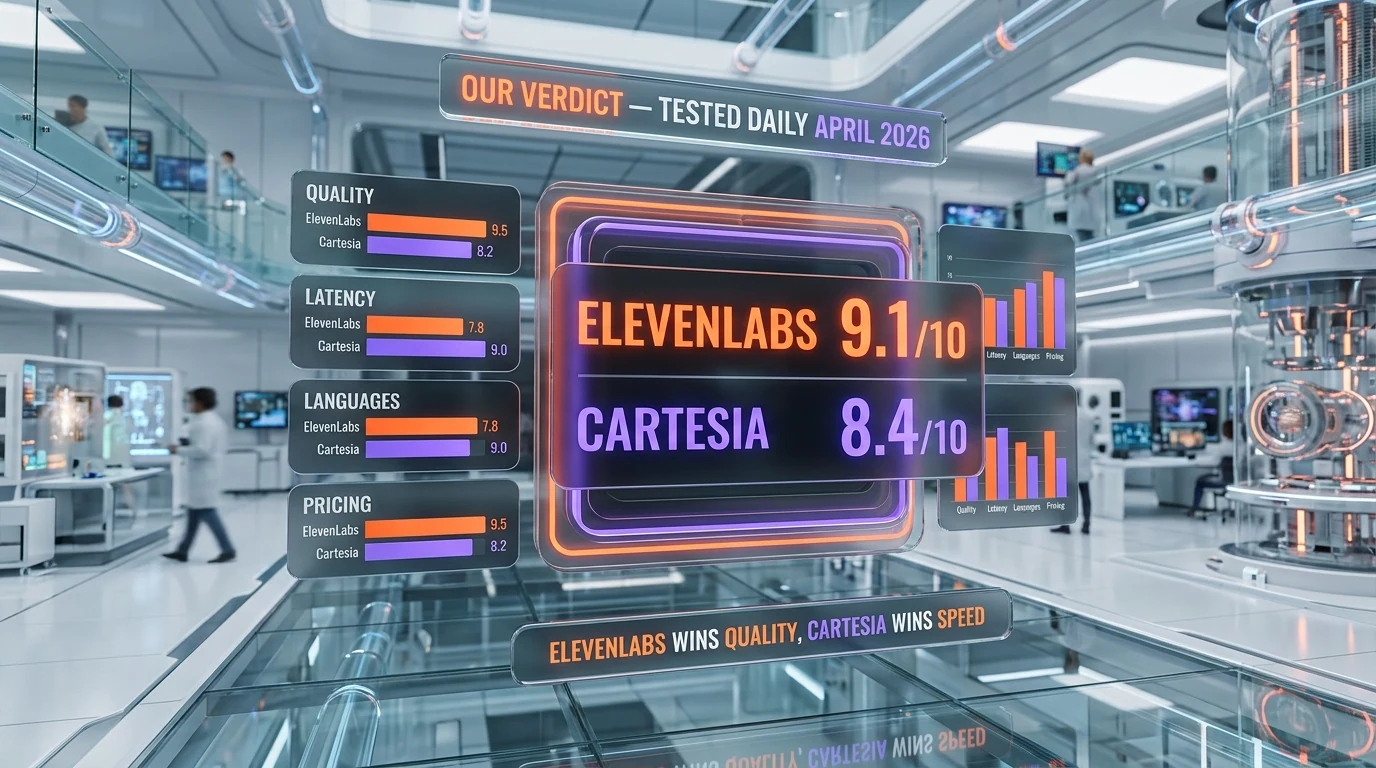
Both score 9.0 in our 2026 voice AI index, and both deserve it for radically different reasons. ElevenLabs is the audio AI platform that wins when breadth, polish and language coverage matter — it covers content creation end-to-end with Eleven v3 voice quality, 70+ language dubbing, 10,000-voice community library, music, SFX, and ElevenAgents conversational AI all in one subscription. Cartesia is the audio AI infrastructure that wins when latency and per-character economics matter — Sonic-3 at roughly 90 millisecond time-to-first-audio, a Mamba-based State Space Model architecture, Line CLI for one-click voice agent deploy, and roughly 5x cheaper per character at scale on high-volume TTS.
Persona-split recommendations:
- For solo content creators (podcasters, YouTubers): ElevenLabs wins because the 10,000-voice library plus Eleven v3 expressive tags plus Eleven Music plus SFX v2 closes the full production loop in one $11 per month Creator subscription. Cartesia would force you to stack a music tool and an SFX tool on top.
- For agencies (dubbing, audiobook, multilingual content): ElevenLabs wins because the 70+ language dubbing pipeline with vocal characteristic preservation has no equivalent on Cartesia, and 32 production-grade languages cover virtually every commercial market.
- For developer teams building voice agents (SaaS apps, contact centers): Cartesia wins because Sonic-3 latency is structurally faster, Line CLI ships agents to production in 30 seconds, and per-character cost is roughly 5x cheaper at scale. ElevenAgents is more polished UX but slower and pricier.
- For enterprise / regulated industries (fintech, healthcare): Tie leaning Cartesia for fintech (PCI Level 1 plus in-VPC) and healthcare (HIPAA plus in-VPC), tie leaning ElevenLabs for European media (regional data residency) and content compliance.
- For budget-conscious high-volume users (>5M characters per month): Cartesia wins decisively. The per-character economics widen the gap with usage.
Score breakdown by category:
- Features: ElevenLabs 9.5 out of 10 vs Cartesia 9.1 out of 10 — ElevenLabs wins on breadth (music, SFX, dubbing, 10k voices); Cartesia is narrower but deeper on real-time infra.
- Ease of Use: ElevenLabs 8.5 out of 10 vs Cartesia 8.8 out of 10 — Cartesia's CLI plus one-click GitHub deploy edges the ElevenLabs studio UX for developer teams; ElevenLabs wins for non-developers.
- Value: ElevenLabs 8.0 out of 10 vs Cartesia 9.4 out of 10 — Cartesia wins clearly on per-character cost and entry-tier monthly pricing; ElevenLabs better value only when you need its breadth.
- Support: ElevenLabs 8.5 out of 10 vs Cartesia 8.5 out of 10 — both responsive on Enterprise, both rely on community plus docs at lower tiers, no clear winner.
Final word: Buy ElevenLabs if you are a content creator, agency, podcaster, audiobook publisher, dubbing studio, or anyone whose work blends voice plus music plus SFX plus multilingual dubbing in the same workflow — the breadth pays for itself. Buy Cartesia if you are a developer team building voice agents, contact center infrastructure, scheduling SaaS, or any latency-critical real-time voice product — the structural latency advantage and per-character economics matter more than feature breadth. Use both if you can — Cartesia for real-time agents, ElevenLabs for content. They are not really substitutes; they are complementary tools optimized for different layers of the audio AI stack. Same 9.0 overall score, very different sweet spots.
Affiliate disclosure: ThePlanetTools.ai earns a commission when you sign up to ElevenLabs through the links above. The 9.0 score, the verdict, and the testing notes reflect our honest hands-on experience with ElevenLabs Pro since April 2026 and our editorial research on Cartesia. Commission does not influence rankings; we publish our editorial policy and review methodology on our About page.
Our Verdict
ElevenLabs is the winner for content creators, podcasters, dubbing studios and audiobook publishers thanks to Eleven v3 expressive tags, 10,000-voice community library and 70+ language dubbing. Cartesia wins for real-time voice agents and developer infrastructure with Sonic-3 hitting 90ms time-to-first-audio (roughly 2-4x faster than ElevenLabs) at one fifth of the per-character cost. Same 9.0 overall score, different sweet spots: pick ElevenLabs for studio quality and breadth, pick Cartesia for low-latency agents and budget-conscious dev teams. Solo creators start at $6 per month on ElevenLabs Starter or $4 per month on Cartesia Pro.
Choose Cartesia
Ultra-low-latency voice AI — Sonic-3 hits 90ms time-to-first-audio, clones a voice from 10 seconds of audio, speaks 40+ languages
Try Cartesia →Frequently Asked Questions
Is ElevenLabs better than Cartesia?
ElevenLabs is the winner for content creators, podcasters, dubbing studios and audiobook publishers thanks to Eleven v3 expressive tags, 10,000-voice community library and 70+ language dubbing. Cartesia wins for real-time voice agents and developer infrastructure with Sonic-3 hitting 90ms time-to-first-audio (roughly 2-4x faster than ElevenLabs) at one fifth of the per-character cost. Same 9.0 overall score, different sweet spots: pick ElevenLabs for studio quality and breadth, pick Cartesia for low-latency agents and budget-conscious dev teams. Solo creators start at $6 per month on ElevenLabs Starter or $4 per month on Cartesia Pro.
Which is cheaper, ElevenLabs or Cartesia?
ElevenLabs starts at $6/month (free plan available). Cartesia starts at $5/month (free plan available). Check the pricing comparison section above for a full breakdown.
What are the main differences between ElevenLabs and Cartesia?
The key differences span across 15 features we compared. For Time-to-first-audio (latency), ElevenLabs offers ~150ms (Flash v2.5) / ~250-400ms (v3) while Cartesia offers ~90ms (Sonic-3) / ~40ms (Sonic Turbo). For Voice quality (expressivity), ElevenLabs offers Eleven v3 with [whispers] [laughs] [sighs] expressive audio tags while Cartesia offers Sonic-3 with emotion tags + integrated laughter. For Languages supported, ElevenLabs offers 70+ languages (32 production-grade) while Cartesia offers 40+ languages (9 native Indian). See the full feature comparison table above for all details.