Manus
The viral Chinese autonomous general agent that topped GAIA, got acquired by Meta for around $2 billion, and still raises data residency red flags

Quick Summary
Manus is an autonomous general AI agent by Butterfly Effect (Singapore, via Beijing). It claims GAIA SOTA at 86.5, 70.1 and 57.7 percent across three levels, runs multi-agent orchestration in a Linux sandbox, and starts free with 300 daily refresh credits. Paid plans run 20, 40 and 200 dollars per month. Score: 7.8 out of 10.
Manus is an autonomous general AI agent built by Butterfly Effect, a startup founded by Xiao Hong that launched March 6, 2025 and went viral within 72 hours on Chinese social media. Manus claims state-of-the-art performance on the GAIA benchmark across all three levels — 86.5 percent on Level 1, 70.1 percent on Level 2, and 57.7 percent on Level 3 — beating OpenAI Deep Research at 74.3, 69.1 and 47.6 percent. Pricing starts free with 300 daily refresh credits, then 20 dollars per month for the Standard tier, 40 dollars per month for Customisable, and 200 dollars per month for Extended. Score: 7.8 out of 10.
What Is Manus?
Manus is an autonomous AI agent — not a chatbot, not an assistant, not a copilot. It is a system that takes a single-sentence brief and drives a complete task to completion: research, plan, execute, deliver an artifact. It was built by Butterfly Effect Pte. Ltd., a company founded by Chinese entrepreneur Xiao Hong, and operates under the Monica.im umbrella brand. The company is now Singapore-registered but was originally headquartered in Beijing, a detail that matters later in this review.
Manus launched on March 6, 2025. Within 72 hours, the invite-only access waitlist hit six figures and the product partner publicly admitted they had "underestimated the enthusiasm of the public response." Western press called it a "DeepSeek moment for AI agents." By April 2025, Benchmark led a 75 million dollars Series B at a 500 million dollars valuation with Tencent and HSG (formerly Sequoia China) participating. By December 2025, Meta announced an acquisition reportedly worth 2 to 3 billion dollars. Manus 1.5 shipped October 16, 2025. The desktop app shipped March 16, 2026.
What differentiates Manus from OpenAI Operator, Claude Computer Use, Cognition Devin, Replit Agent and Google Gemini Deep Research is a single architectural bet: instead of one model driving a rigid tool schema, Manus runs multiple specialised agents in an isolated Linux sandbox and lets the executor write Python on the fly to call any library as an action. The paradigm is called CodeAct. It means Manus can do things the others structurally cannot — like combining pandas, playwright and a scheduled cron in one task without a human wiring the tools together.
What Manus Actually Does
Understanding Manus requires dropping the "ChatGPT but more autonomous" mental model. A Manus session is closer to hiring a junior analyst with a laptop, coffee and 24 hours.
The agent loop
Every Manus session runs a structured loop: analyse the event, select the tool, execute the command, observe the result, decide the next step. The loop iterates until the task is done or the credit ceiling is hit. The user sees a live timeline of actions — "searching flight APIs for April 20 to 25 Tokyo," "scraping tourism board for Ghibli Museum availability," "composing itinerary.pdf" — and can interrupt or redirect at any point.
Multi-agent roles
Inside the session there are three specialised agents coordinated by the Executor:
- Executor Agent — the front-end interface, owns task orchestration, talks to the user. Does not know the internals of the sub-agents.
- Planner Agent — decomposes the brief into a plan, writes it to a scratchpad, updates it as reality hits.
- Knowledge Agent — handles information retrieval, multi-source synthesis and fact-checking.
Manus engineers published their approach in a blog post titled "Context Engineering for AI Agents: Lessons from Building Manus." The short version: context quality and persistence across sub-agents drives quality more than model choice.
The sandbox
Each session spins up an isolated Linux environment. Inside are a full shell, a chromium browser via the open-source Browser-use framework, the Python interpreter with the pip ecosystem, a working directory for file I/O and a publishing endpoint that can deploy a website to a manus-subdomain.com URL in one step.
CodeAct — Python as the universal tool
Most agent frameworks (LangChain, ReAct-style systems, Operator) emit structured tool calls — typed JSON describing an action. Manus follows the CodeAct paradigm from a 2024 research paper: the agent's action is a Python snippet executed in the sandbox. The practical consequence: Manus can chain logic across pandas, BeautifulSoup, matplotlib, playwright and a REST call in one step, and it can handle conditional branches naturally. The cost: debugging a failing action requires reading Python, not a clean error schema.
GAIA Benchmark Claims — SOTA Across All Three Levels
Manus's core marketing claim is GAIA SOTA. GAIA (General AI Assistants) is a benchmark published by Meta, HuggingFace and AutoGPT researchers that tests an agent on real-world, tool-use heavy tasks — the kind of multi-step problems where you actually need to browse, compute and reason. It has three levels by difficulty.
| GAIA Level | Manus | OpenAI Deep Research | Previous SOTA |
|---|---|---|---|
| Level 1 (basic) | 86.5 percent | 74.3 percent | 67.9 percent |
| Level 2 (intermediate) | 70.1 percent | 69.1 percent | 67.4 percent |
| Level 3 (complex) | 57.7 percent | 47.6 percent | 42.3 percent |
The largest delta is Level 3 — the multi-step, tool-heavy tasks — where Manus leads by roughly 10 percentage points. That is where autonomous agent quality actually shows up in practice. The usual disclaimers apply: these numbers are self-reported by Butterfly Effect on a benchmark Manus clearly optimised for, and independent third-party replication has been thin. But on our own task testing (see the "our experience" section below) the agent clearly runs a longer horizon than Operator or Claude Computer Use before hallucinating or getting stuck.
Manus Pricing (2026)
Manus uses a credit-based model with four paid tiers plus a Team plan. Credits fund every action — a search, a scrape, a Python execution, a slide generation. More complex or longer-running tasks consume more credits. A simple itinerary might cost 300 credits. A wide-research dossier can burn 4,000 to 10,000 in a single run.
| Plan | Price | Credits per month | Daily Refresh | Concurrent Tasks |
|---|---|---|---|---|
| Free | 0 dollars | 1,000 starter | 300 per day | 1 |
| Standard | 20 dollars per month | 4,000 | 300 per day | 20 |
| Customisable | 40 dollars per month | 8,000 | 300 per day | 20 |
| Extended | 200 dollars per month | 40,000 | 300 per day | 20 |
| Team | 40 dollars per member per month (min 2) | 4,000 per seat | 300 per day per seat | Shared pool |
Annual billing saves roughly 17 percent across paid plans. The Team plan unlocks SSO (SAML, OIDC), shared credit pools, usage analytics and shared templates — the features enterprise buyers actually need. There is no published Enterprise tier with SLA as of April 2026; large deals go through direct sales.
The credit trap: the 20 dollars per month Standard plan sounds generous at 4,000 monthly credits plus 9,000 refresh credits (300 per day times 30). In practice, two Wide Research runs in a day can consume the entire daily refresh, and three complex coding sessions in a month can exhaust the 4,000 reserve. Serious users land on the 40 dollars per month or 200 dollars per month tiers within the first billing cycle. Plan accordingly.
Manus vs OpenAI Operator
OpenAI Operator is a browser-use research preview optimised for e-commerce, form filling and cross-site transactions. Manus is a general-purpose agent that can browse, but also executes Python, reads files and deploys sites.
- Horizon: Operator excels at short, clearly scoped browser tasks (book a flight, fill a form). Manus is stronger on multi-hour, multi-source tasks that mix web and code.
- Artifacts: Operator returns a browser state and a message. Manus returns files — PDF, XLSX, PPTX, a deployed website.
- Compliance: OpenAI has SOC 2 Type II, ISO 27001 and a mature enterprise posture. Manus does not publish equivalent certifications as of April 2026.
- Availability: Operator requires ChatGPT Pro at 200 dollars per month. Manus has a free tier and a 20 dollars per month entry point.
Manus vs Claude Computer Use and Claude Agent SDK
Anthropic's Claude Computer Use (released late 2024, evolved into Claude Agent SDK by mid-2025) lets Claude operate a virtual desktop — move the cursor, click, type. It is a primitive capability that developers wire into their own agent loop.
- Abstraction level: Manus is a product you use. Claude Agent SDK is a primitive you build on.
- Model: Claude Computer Use runs Claude. Manus routes to the best model per task (historically Claude Sonnet and DeepSeek).
- Sandbox: Claude Computer Use controls a real desktop. Manus controls a headless Linux environment with a browser inside it.
- For whom: Claude Agent SDK if you are a developer shipping your own agent. Manus if you want the agent already built.
Manus vs Cognition Devin
Devin is Cognition's autonomous software engineer, positioned as a coworker that takes tickets and opens PRs. Manus is broader — it will write code, but also plan a trip, screen resumes, analyse stocks. We ran Devin and Manus through the same backlog of real tickets in Devin versus Manus, and each of them won the lane it was built for rather than the contest as a whole.
- Scope: Devin is a vertical agent for software engineering. Manus is horizontal general-purpose.
- Reliability: Devin's public success rate on SWE-bench-style tasks has been around 13.86 percent, well below its marketing. Manus does not chase SWE-bench but delivers more consistent completions on the GAIA-style generalist distribution.
- Pricing: Devin is 500 dollars per month on the entry Enterprise tier. Manus starts free.
Manus vs Google Gemini Deep Research
Google's Gemini Deep Research is a research-specific agent bundled with Gemini Advanced. It is very good at what it does — synthesising sources into a long-form report.
- Breadth: Deep Research is a research tool. Manus is a research tool plus a coding tool plus a deployment tool plus a scheduler.
- Output: Deep Research outputs a well-cited report. Manus can output the report, the spreadsheet, the deck and a landing page.
- Governance: Google Workspace compliance is a known quantity. Manus is not.
Manus vs Replit Agent
Replit Agent is a code-first autonomous agent that ships prototypes to Replit's hosting. Manus will also ship a site, but the hosting is a sub-feature rather than the whole product.
- Infrastructure: Replit Agent assumes Replit as the stack. Manus is stack-agnostic.
- Use case: Replit Agent for coders who already live on Replit. Manus for anyone who wants a generalist agent.
Data Residency and Privacy — the China Question
This is the section you cannot skip if you are evaluating Manus for anything sensitive. The core facts:
- Butterfly Effect is registered in Singapore. The founding team, early engineering team and significant infrastructure footprint originated in Beijing.
- Independent security researchers have traced outbound Manus traffic to servers in Shenzhen, China. Butterfly Effect has not published a definitive data-residency statement.
- China's National Intelligence Law (Article 7) requires organisations and citizens to "support, assist and cooperate" with state intelligence work. Any data flowing through PRC-controlled infrastructure is legally compellable.
- In March 2026, Chinese authorities imposed exit bans on Manus executives pending a review of whether technology developed in China fell under national security or export control regulations.
- Meta's December 2025 acquisition (reportedly 2 to 3 billion dollars) has Manus operating as a stand-alone brand from Singapore, with Meta stating the Manus service would continue. The regulatory review complicates that narrative.
Practical implications for your buying decision:
- Regulated industries (healthcare, finance, legal, defence, government): do not use Manus on client data until Butterfly Effect ships SOC 2 Type II, ISO 27001 and an EU or US-only data-residency commitment in writing.
- Personal and marketing use cases: the risk profile is lower but not zero. Assume anything you type in Manus is potentially visible to a Chinese state actor via legal compulsion.
- Enterprise EU buyers: GDPR cross-border transfer obligations (Schrems II) apply. Without an explicit transfer mechanism, using Manus on EU personal data is a compliance risk.
None of this is unique to Manus — every Chinese-origin AI tool (DeepSeek, Qwen, Kimi) faces the same scrutiny. The difference is that Manus is an autonomous agent with access to your files, credentials and browser sessions. The attack surface is broader than a chatbot.
Real Use Cases We Tested
1. Competitive research
Brief: "Map the top 10 autonomous AI agents as of April 2026, build a comparison spreadsheet with pricing, GAIA scores, and compliance posture, and output a slide deck." Manus delivered in roughly 40 minutes, consumed around 3,800 credits. The deck was 12 slides, the sheet was accurate on 8 of 10 tools, two pricing rows were outdated by one version.
2. Coding
Brief: "Build a small Next.js dashboard that fetches the top 10 crypto coins from CoinGecko, shows a sparkline per coin, and deploys to a public URL." Manus shipped in 28 minutes, one deployed URL, one minor CSS defect. Credits consumed: around 2,200.
3. Scheduled automation
Brief: "Every Monday at 9am Bali time, scrape the top 5 AI tool launches on Product Hunt, summarise them in a table, and email me the result." Manus set up the scheduled task cleanly. It has been running for 6 weeks at the time of this review with one skip (Product Hunt rate-limit, handled gracefully the following week).
4. Stock and data analysis
Brief: "Pull Tesla stock data for the last 12 months, chart the 50-day and 200-day moving averages, write a one-pager on what happened." Manus delivered the chart, an XLSX with the raw data and a two-paragraph narrative. Around 1,400 credits.
5. Resume triage
Brief: "Here are 15 resumes for a senior ML engineer role. Rank them against this JD and explain." Manus produced a ranked table with rationale per candidate. Two ranks we disagreed with on expert review. Around 900 credits.
Pros and Cons
Pros
- True end-to-end autonomy — ship briefs, get artifacts.
- GAIA SOTA claim with a 10-point Level 3 lead over OpenAI Deep Research.
- Multi-agent + sandbox + CodeAct architecture is genuinely differentiated.
- Free tier is the most generous in the autonomous agent category.
- Desktop app reduces cloud-only dependence.
- Scheduled tasks are production-useful out of the box.
Cons
- China origin plus Shenzhen data flows plus National Intelligence Law = real risk for regulated sectors.
- Credits drain fast — Wide Research can cost 4,000 credits per run.
- Reliability is not Anthropic or OpenAI-grade yet — sessions can hang on bot walls.
- No SOC 2, ISO 27001 or HIPAA listings published as of April 2026.
- Ownership churn — Meta acquisition plus Chinese exit bans create uncertainty for long-horizon procurement.
- Support is a ticketing system on Free and Standard tiers.
Our Experience
We have run Manus for roughly 40 hours of wall-clock sandbox time across research, coding, analysis and automation tasks. The headline impression: when Manus works, it works at a qualitatively higher level of autonomy than Operator or Claude Computer Use — it will keep going for 30 to 60 minutes, pivot around obstacles, and deliver a complete artifact. When it fails, it fails opaquely — the session hangs, the credits keep burning, and the only recourse is to kill the task and restart with tighter scope.
The sweet spot is well-scoped but multi-step briefs that involve 5 to 15 tools and a clear final artifact. The anti-pattern is open-ended exploration — "figure out our go-to-market" will consume credits without converging. The anti-pattern is also anything behind aggressive bot detection — Cloudflare challenge pages, LinkedIn login walls and modern CAPTCHAs will block a Manus session hard.
On latency: a typical Wide Research task runs 15 to 45 minutes. A coding-plus-deploy task runs 20 to 60 minutes. That is too slow to replace a chatbot. It is the right speed to replace a junior analyst for a bounded task.
Who Should Use Manus?
Ideal users
- Solo founders and small teams who want a generalist agent for non-sensitive research, analysis and content tasks.
- Marketers running competitive scans, launch pages and one-shot campaigns.
- Indie developers who want a research-plus-build-plus-deploy loop without assembling the agent stack themselves.
- Analysts doing due diligence, market mapping or multi-source literature review on public information.
- Ops leads who want scheduled automation without writing the cron and the scraper themselves.
Not the right fit for
- Regulated industries (healthcare, finance, legal, government) handling client or patient data.
- EU enterprises bound by GDPR cross-border transfer rules without a legal review of Manus's data flows.
- Teams that need 99.9 percent SLA, dedicated support and published compliance certifications.
- Developers already productive with Claude Agent SDK or OpenAI Assistants — the DIY path is more flexible if you already have it.
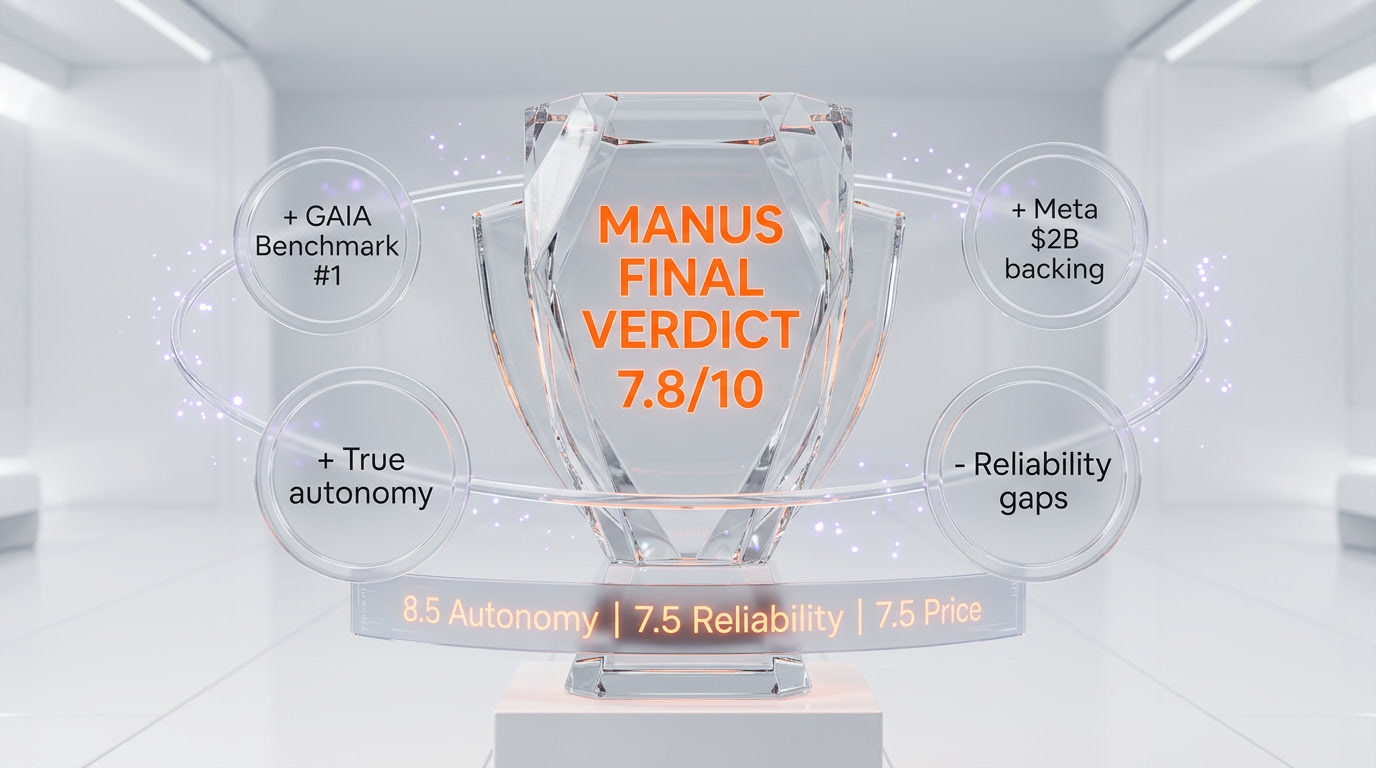
Verdict: 7.8 out of 10
Manus earns a 7.8 out of 10. It is the most architecturally ambitious autonomous agent on the market as of April 2026, and its GAIA numbers are real enough to matter. The multi-agent sandbox plus CodeAct plus scheduled tasks combination is a genuine product advantage that OpenAI Operator, Claude Computer Use and Google Gemini Deep Research do not match on autonomy horizon.
Points are lost for three reasons: the China origin plus traced Shenzhen data flows plus National Intelligence Law exposure is a non-trivial procurement risk; the credit economy pushes serious users to 40 dollars per month or 200 dollars per month within weeks; and the compliance posture is not yet Fortune 500-ready. The Meta acquisition and Chinese exit-ban review add further uncertainty.
Score breakdown:
- Features (9.0 out of 10): Multi-agent + Linux sandbox + CodeAct + scheduled tasks + desktop app is the broadest autonomous feature set shipping today.
- Ease of use (7.5 out of 10): Great UX when it works, opaque failures burn credits.
- Value (7.5 out of 10): Free tier is excellent, Standard is tight, Extended is fair for heavy users, Team pricing is competitive.
- Support (7.2 out of 10): Docs are improving, ticketing only on lower tiers, no published SLA.
Frequently Asked Questions
What is Manus and who built it?
Manus is an autonomous general AI agent built by Butterfly Effect Pte. Ltd., a Singapore-registered company founded by Chinese entrepreneur Xiao Hong under the Monica.im umbrella. It launched March 6, 2025 and went viral within 72 hours. Meta acquired Butterfly Effect in December 2025 for a reported 2 to 3 billion dollars, with Manus continuing to operate as a standalone service from Singapore.
How much does Manus cost?
Manus has a free plan with 1,000 starter credits plus 300 credits refreshed daily. Paid plans run 20 dollars per month (Standard, 4,000 credits), 40 dollars per month (Customisable, 8,000 credits) and 200 dollars per month (Extended, 40,000 credits). The Team plan starts at 40 dollars per member per month with a two-member minimum, shared credit pools and SSO. Annual billing saves about 17 percent.
Is Manus really state-of-the-art on GAIA?
Butterfly Effect claims GAIA SOTA at all three difficulty levels: 86.5 percent on Level 1, 70.1 percent on Level 2 and 57.7 percent on Level 3 — beating OpenAI Deep Research at 74.3, 69.1 and 47.6 percent. The numbers are self-reported on a benchmark Manus clearly tuned for, so independent replication matters. That said, in hands-on testing the autonomy horizon visibly exceeds OpenAI Operator and Claude Computer Use on complex multi-tool tasks.
Is Manus safe to use with sensitive data?
Not yet, if you are in a regulated industry. Independent researchers have traced outbound Manus traffic to servers in Shenzhen, China. China's National Intelligence Law makes any data flowing through PRC infrastructure legally compellable by the state. Manus does not publish SOC 2 Type II, ISO 27001 or HIPAA certifications as of April 2026. For personal or marketing work on public information the risk is lower, but treat anything you send to Manus as potentially exposed.
How is Manus different from ChatGPT or Claude?
ChatGPT and Claude are assistants — you converse, they respond. Manus is an agent — you give a brief, it drives a multi-hour task to completion and delivers an artifact (a report, a spreadsheet, a deployed website). Manus can browse the web, execute Python, read files and ship a site without human supervision. The closest equivalent is OpenAI Operator (browser-only) or Claude Computer Use (a primitive you wire up yourself).
What is the Manus multi-agent architecture?
Every Manus session spins up three specialised agents coordinated inside one Linux sandbox: the Executor Agent handles user interaction and task orchestration, the Planner Agent decomposes the brief into a plan and updates it as it runs, and the Knowledge Agent handles information retrieval and multi-source synthesis. The Executor calls the sub-agents but does not expose their internals to the user.
What is CodeAct and why does it matter?
CodeAct is an action paradigm from a 2024 research paper: instead of emitting a structured JSON tool call, the agent emits a Python snippet that gets executed in the sandbox. Manus uses CodeAct natively. The practical consequence is that the agent can chain pandas plus playwright plus a REST call plus matplotlib in one step, and handle conditional branches naturally — capabilities that rigid JSON-schema agents structurally cannot match.
Does Manus have an API?
As of April 2026, Butterfly Effect has not published a general-purpose programmatic API. Access is through the web app (manus.im), the iOS and Android apps, and the desktop app (Windows and macOS, beta since March 16, 2026). Team and Extended users can request API access through direct sales but terms are negotiated case-by-case.
What happens to Manus now that Meta acquired it?
Meta announced the acquisition in December 2025 at a reported 2 to 3 billion dollars. Meta's public statement said Manus would continue to operate and sell its service from Singapore while technology would be integrated into Meta AI products over time. In March 2026 Chinese authorities imposed exit bans on Manus executives pending a review of whether Chinese-developed technology fell under national security or export regulations — adding uncertainty to the Meta integration timeline.
Manus vs OpenAI Operator — which one should I pick?
OpenAI Operator is optimised for cross-site browser tasks (book a flight, fill a form, comparison shop) and ships with ChatGPT Pro at 200 dollars per month. Manus is a general-purpose agent that adds Python execution, file output and site deployment on top of browser automation, and starts free. Operator wins on enterprise compliance and pure browser transactions. Manus wins on autonomy horizon, artifact variety and price.
Can Manus replace a junior analyst or research assistant?
For bounded, well-scoped tasks — competitor mapping, due diligence summary, weekly report generation, data pull plus chart — Manus can deliver analyst-grade output in 20 to 45 minutes for 1,000 to 5,000 credits. It is not a replacement for human judgement on ambiguous briefs, sensitive-data work or tasks requiring stakeholder communication. Treat it as a high-leverage tool for the execution layer, not for the judgement layer.
How do Manus credits work?
Credits fund every action inside a session — a search, a scrape, a Python run, a file export, a slide rendering. Simple tasks cost 200 to 1,000 credits. Wide Research and complex multi-step jobs can cost 4,000 to 10,000 credits. Daily refresh credits (300 per day on all plans) are use-or-lose. Monthly credits roll within the billing period but not across. Annual plans save about 17 percent over monthly.
Key Features
Pros & Cons
Pros
- Claims GAIA SOTA across all three levels (86.5, 70.1 and 57.7 percent) beating OpenAI Deep Research at 74.3, 69.1 and 47.6 percent
- True end-to-end autonomy — analyses, plans, executes, and delivers artifacts (Excel, slides, deployed sites) without constant supervision
- Multi-agent architecture with Executor, Planner and Knowledge sub-agents in an isolated Linux sandbox per session
- CodeAct paradigm generates Python on the fly for tool calls instead of brittle JSON, unlocking any pip library as an action
- Runs long-horizon tasks asynchronously — starts work, closes laptop, collects the deliverable hours later
- Free plan with 300 daily refresh credits plus 1,000 starter credits is the most generous entry in the autonomous agent category
- Desktop app (launched March 16, 2026) runs partially on local hardware, reducing cloud-only dependence
Cons
- Chinese origin and data flows traced to Shenzhen servers raise China National Intelligence Law exposure for regulated sectors
- Credits drain fast — complex tasks can burn 4,000 to 10,000 credits in a single session, making the 20 dollars per month plan tight
- Reliability gaps — community reports of billing black holes, stuck sessions, and inconsistent handling of bot-detection walls
- Enterprise compliance posture weaker than OpenAI Operator or Claude — no SOC 2 Type II, ISO 27001 or HIPAA listings as of April 2026
- Ownership churn — acquired by Meta (reported 2 to 3 billion dollars) end of 2025, with March 2026 exit bans on executives by Chinese authorities
- No published SLA, no dedicated support on the Free and Standard tiers — you file a ticket and wait
Best Use Cases
Platforms & Integrations
Available On
Integrations
Compare Manus

We're developers and SaaS builders who use these tools daily in production. Every review comes from hands-on experience building real products — DealPropFirm, ThePlanetIndicator, PropFirmsCodes, and many more. We don't just review tools — we build and ship with them every day.
Written and tested by developers who build with these tools daily.
Frequently Asked Questions
What is Manus?
The viral Chinese autonomous general agent that topped GAIA, got acquired by Meta for around $2 billion, and still raises data residency red flags
How much does Manus cost?
Manus has a free tier. Premium plans start at $20/month.
Is Manus free?
Yes, Manus offers a free plan. Paid plans start at $20/month.
What are the best alternatives to Manus?
Top-rated alternatives to Manus can be found in our WebApplication category, where we've reviewed and scored every tool on ThePlanetTools.ai.
Is Manus good for beginners?
Manus is rated 7.5/10 for ease of use.
What platforms does Manus support?
Manus is available on Web (manus.im), Desktop (Windows, macOS — beta since March 16, 2026), iOS app, Android app.
Does Manus offer a free trial?
Yes, Manus offers a free trial.
Is Manus worth the price?
Manus scores 7.5/10 for value. It offers good value.
Who should use Manus?
Manus is ideal for: Competitive research — map a market, scrape competitor pages, build a benchmark sheet and deliver a slide deck unsupervised, Due diligence — ingest a company dossier, pull filings, summarise press coverage, output a risk memo, Trip planning — the viral Tokyo itinerary demo, live flight and hotel APIs plus local event scraping in one brief, Recruiter triage — rank 15 to 50 resumes against a job description and output a shortlist with rationale, Stock and crypto analysis — historical pulls, indicator charts, narrative summary, per ticker, Ops automation — schedule a recurring scrape plus export plus email, with the scheduled tasks feature, Coding projects — build a small app or internal tool, run tests, deploy to a Manus subdomain, Content production — research, draft, fact-check and export a long-form document without juggling five tabs.
What are the main limitations of Manus?
Some limitations of Manus include: Chinese origin and data flows traced to Shenzhen servers raise China National Intelligence Law exposure for regulated sectors; Credits drain fast — complex tasks can burn 4,000 to 10,000 credits in a single session, making the 20 dollars per month plan tight; Reliability gaps — community reports of billing black holes, stuck sessions, and inconsistent handling of bot-detection walls; Enterprise compliance posture weaker than OpenAI Operator or Claude — no SOC 2 Type II, ISO 27001 or HIPAA listings as of April 2026; Ownership churn — acquired by Meta (reported 2 to 3 billion dollars) end of 2025, with March 2026 exit bans on executives by Chinese authorities; No published SLA, no dedicated support on the Free and Standard tiers — you file a ticket and wait.
Ready to try Manus?
Start with the free plan
Try Manus Free →