Play.ht
Discontinued December 31, 2025 — acquired by Meta. Use ElevenLabs, Cartesia, Murf AI, Resemble AI, or Suno AI instead.

Quick Summary
Play.ht was an AI voice generation platform shut down December 31, 2025 after Meta acquihired the team in July 2025. All accounts and audio deleted. No data export. Migrate to ElevenLabs (Free, $6 per month Starter) or Cartesia (Free, $4 per month Pro). Score: discontinued.
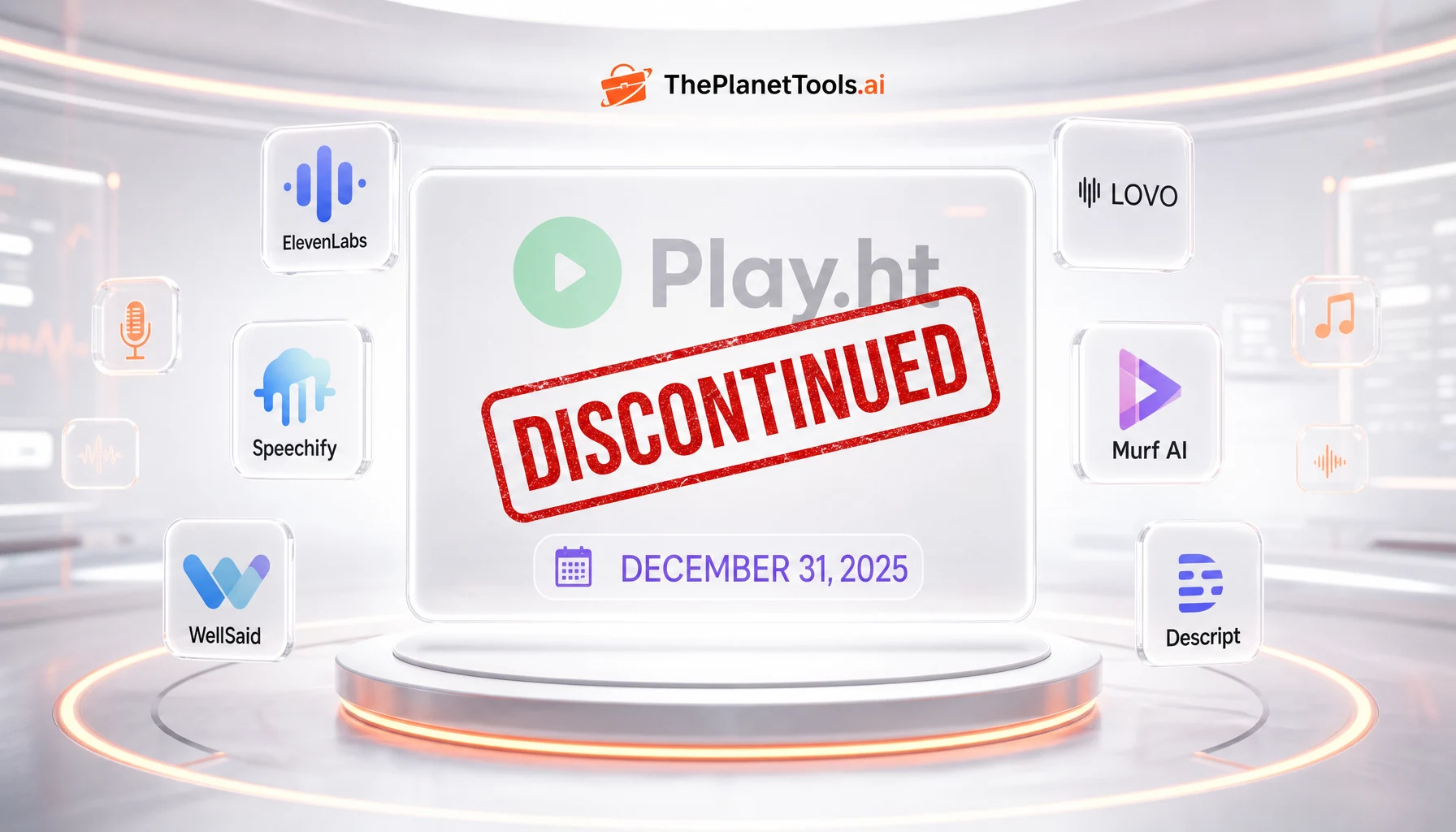
Play.ht is a discontinued AI voice platform. Meta Platforms acquihired the team on July 12, 2025, and the service shut down permanently on December 31, 2025. All accounts, voice clones, and audio were deleted with no migration path. Recommended replacements: ElevenLabs (Starter at $6 per month) and Cartesia (Pro at $4 per month billed yearly).
TL;DR — Play.ht is dead
Bottom line: Play.ht was a pioneering AI voice platform shut down by Meta on December 31, 2025 after a July 2025 acquihire. It is gone. Use ElevenLabs or Cartesia instead.
- What happened: Meta acquired the the team for its Superintelligence Labs voice unit, then wound down the consumer product.
- Data status: All accounts, voice clones, and audio were deleted on December 31, 2025. No export tool was ever provided.
- Best replacement: ElevenLabs Starter at $6 per month (commercial license + Instant Voice Cloning).
- Best for real-time agents: Cartesia Pro at $4 per month billed yearly (Sonic 3 hits 90 milliseconds time-to-first-audio).
What Was Play.ht?
Play.ht launched in 2020 as one of the first consumer-grade AI voice generators capable of near-human prosody. At its peak in late 2024, the platform offered more than 800 stock voices across 140+ languages, instant and professional voice cloning, real-time streaming text-to-speech, and a REST API used by hundreds of indie SaaS products and AI agent frameworks. Enterprise customers reportedly included Stripe, Vimeo, and a handful of major news publishers building automated narration pipelines.
The company built its reputation on the Play 3.0 model, which combined low-latency streaming with multilingual coverage that was hard to match outside of well-funded labs. Indie podcasters used it for ad reads and narration, e-learning teams used it for course voiceover, and developers used the API to ship voice into chatbots, audiobooks, and customer support agents. For roughly four years, Play.ht sat in the same conversation as ElevenLabs and Murf as a top-tier AI voice option.
Then Meta showed up with a checkbook.
The Meta Acquisition Timeline
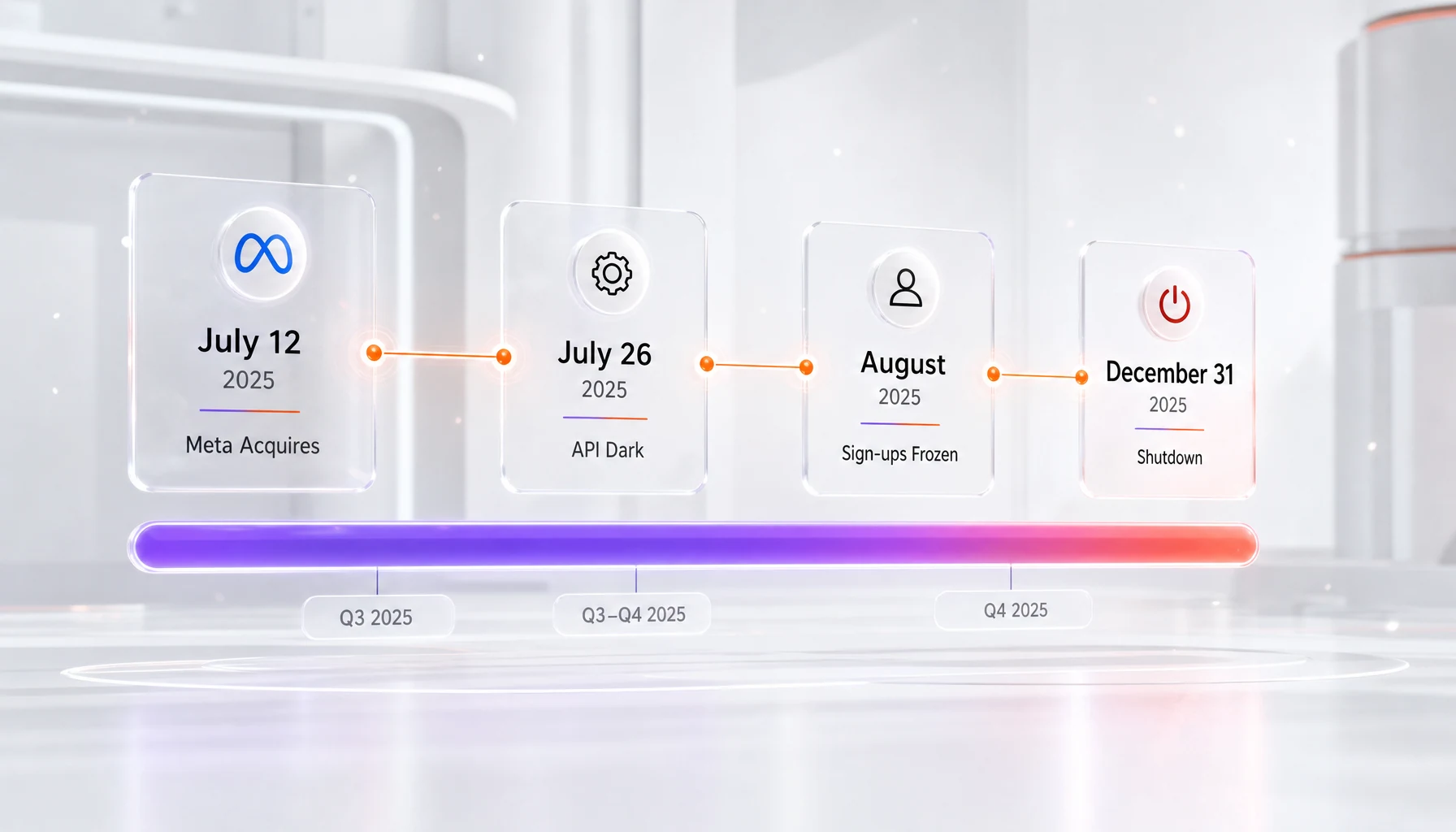
The wind-down was fast and largely public, even if Meta and Play.ht avoided the word "shutdown" until late in the cycle. Here is the consolidated timeline based on TechCrunch, Bloomberg, MENAbytes, and community reporting on G2 and Reddit.
To understand why Play.ht specifically caught Meta's attention, it helps to look at Meta's broader 2024 to 2025 AI roadmap. Meta had spent the prior 18 months pushing voice features into Instagram, WhatsApp, and Messenger — voice messages with AI translation, voice replies inside the Meta AI assistant, and voice-driven prompts inside the Ray-Ban Meta smart glasses. The Llama family of models had reached Llama 3.3 and a multimodal Llama 4 was already in late training, but voice synthesis was the one modality where Meta lagged its peers. OpenAI had Advanced Voice Mode shipping inside ChatGPT. Google had Gemini Live. Anthropic had launched voice mode for Claude in early 2025. Meta's internal voice stack, which had been built primarily for translation and accessibility inside Reels, was not productionized for the kind of low-latency conversational use cases the AI Characters product line needed.
Hiring rather than building made financial sense for a company at Meta's scale. The Play.ht team was small enough to absorb cleanly, had shipped a low-latency Play 3.0 mini model that competed credibly with Cartesia and ElevenLabs on quality benchmarks, and held a roadmap that already pointed at conversational agents rather than batch voiceover. Meta's internal memo placing the team under Superintelligence Labs rather than the existing Instagram or WhatsApp groups telegraphed the priority — this was a foundation-model talent acquisition, not a product line acquisition. The consumer Play.ht product was, by the time the deal closed, a side effect the lawyers had to wind down rather than the asset Meta was paying for.
July 12, 2025 — Meta announces the acquisition
Bloomberg first reported the deal on July 11, 2025. Meta confirmed publicly on July 12 with a statement: "PlayAI's work in creating natural voices, along with a platform for easy voice creation, is a great match for our work and road map, across AI Characters, Meta AI, Wearables and audio content creation." Financial terms were not disclosed. The internal memo confirmed the entire the team would join Meta's Superintelligence Labs.
July 26, 2025 — Public API goes dark
Two weeks after the announcement, Play.ht's public REST API stopped accepting new requests. This caught most developers off guard — the original communication implied a multi-month wind-down. Indie SaaS builders and AI agent frameworks that relied on Play.ht had to rewrite integrations within days. Several open-source projects on GitHub were forced to either ship hot-fix releases pointing at ElevenLabs or freeze their voice features entirely.
August 2025 — New sign-ups frozen
Through August 2025, Play.ht stopped accepting new account registrations. Existing paid users continued to have web app access, but the dashboard removed the upgrade and add-credit buttons. Email support response times collapsed from "under one business day" to "two to three weeks" or no reply at all.
December 31, 2025 — Permanent shutdown
At the end of December 31, 2025, Play.ht's web app, billing dashboard, and account portal were all decommissioned. Every voice clone, audio asset, and saved project was deleted. Subscriptions were canceled without prorated refunds for most users. The Play.ht GitHub organization was archived. The documentation site went offline. The brand domain still resolves but serves only a static notice.
5 Play.ht Alternatives in 2026
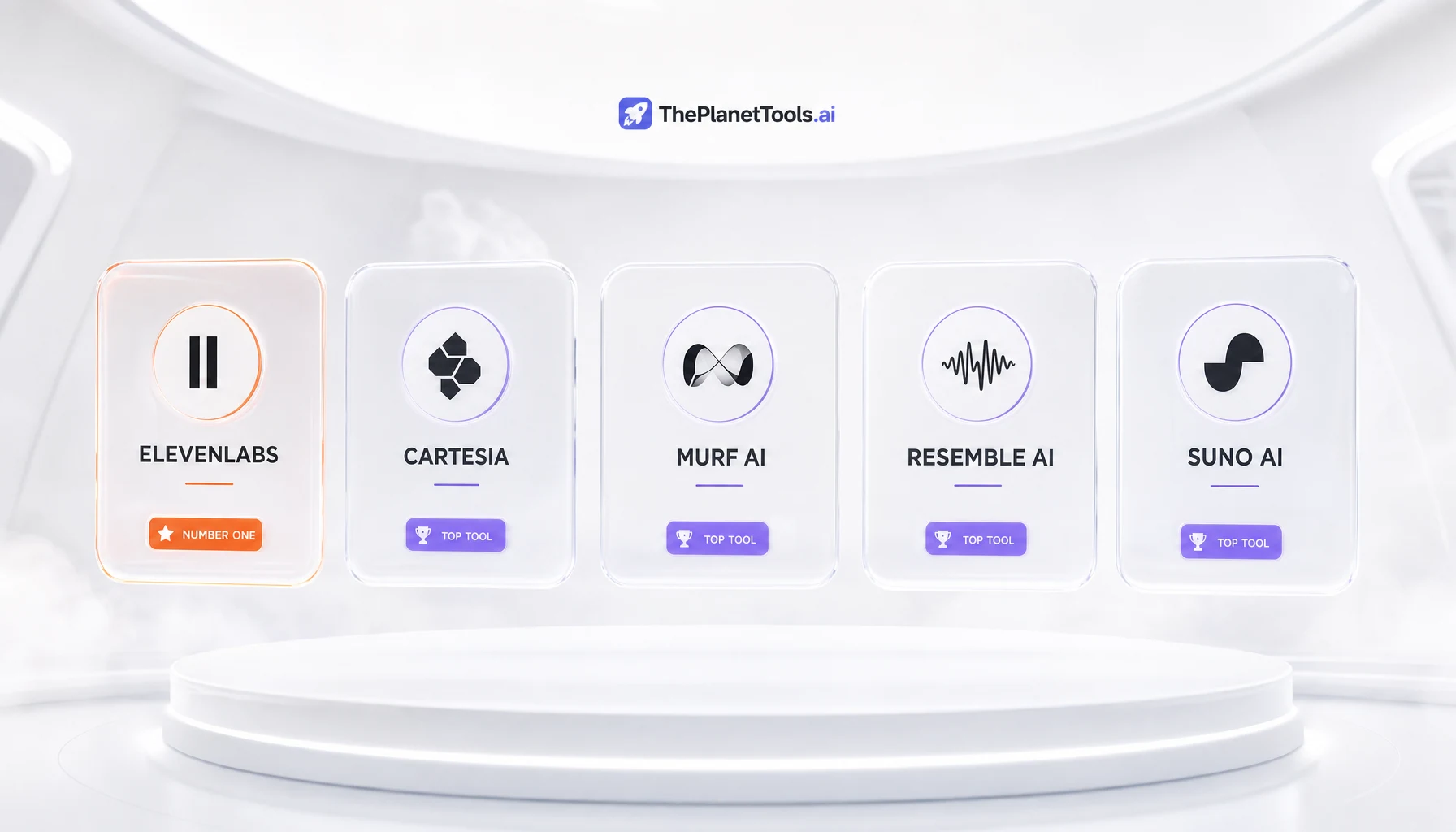
We evaluated the live AI voice landscape in April and May 2026 against the feature set Play.ht offered at peak. These five tools cover every Play.ht use case we tracked from 2020 to 2025.
| Tool | Best for | Entry price | Key strength | Internal link |
|---|---|---|---|---|
| ElevenLabs | Best overall (our #1) | Starter at $6 per month | Output quality, multilingual, Instant Voice Cloning, commercial license | /tools/elevenlabs |
| Cartesia | Real-time voice agents | Pro at $4 per month yearly | Sonic 3 at 90 milliseconds time-to-first-audio | /tools/cartesia |
| Murf AI | Corporate L&D and training | Creator at $19 per month | Studio editor, brand voice library, team collaboration | Coming soon |
| Resemble AI | Open API and SDK workflows | Custom (usage-based) | Self-hosted options, fine-grained API control, neural watermarking | External |
| Suno AI | Music and song generation | Pro at $10 per month | Full song generation with vocals, complements voice TTS | /tools/suno-ai |
Why ElevenLabs is our #1 recommendation
ElevenLabs offers the closest feature-for-feature parity with Play.ht at peak: 32 supported languages out of the box, Instant Voice Cloning on the $6 per month Starter tier with commercial license, Professional Voice Cloning on Creator $22 per month for 121,000 credits, and a developer API battle-tested across thousands of indie products. Output quality matches or exceeds what Play.ht's Play 3.0 model delivered, and the platform is unlikely to be acquihired in the same way — ElevenLabs raised a Series C valuing the company at over $3 billion in 2025 and continues to ship public-facing features monthly. If you want the two set out side by side rather than just the recommendation, ElevenLabs versus Play.ht works the migration case through plan by plan and explains why the answer is no longer close. Sign up for ElevenLabs Starter.
Play.ht Pricing — Historical Reference
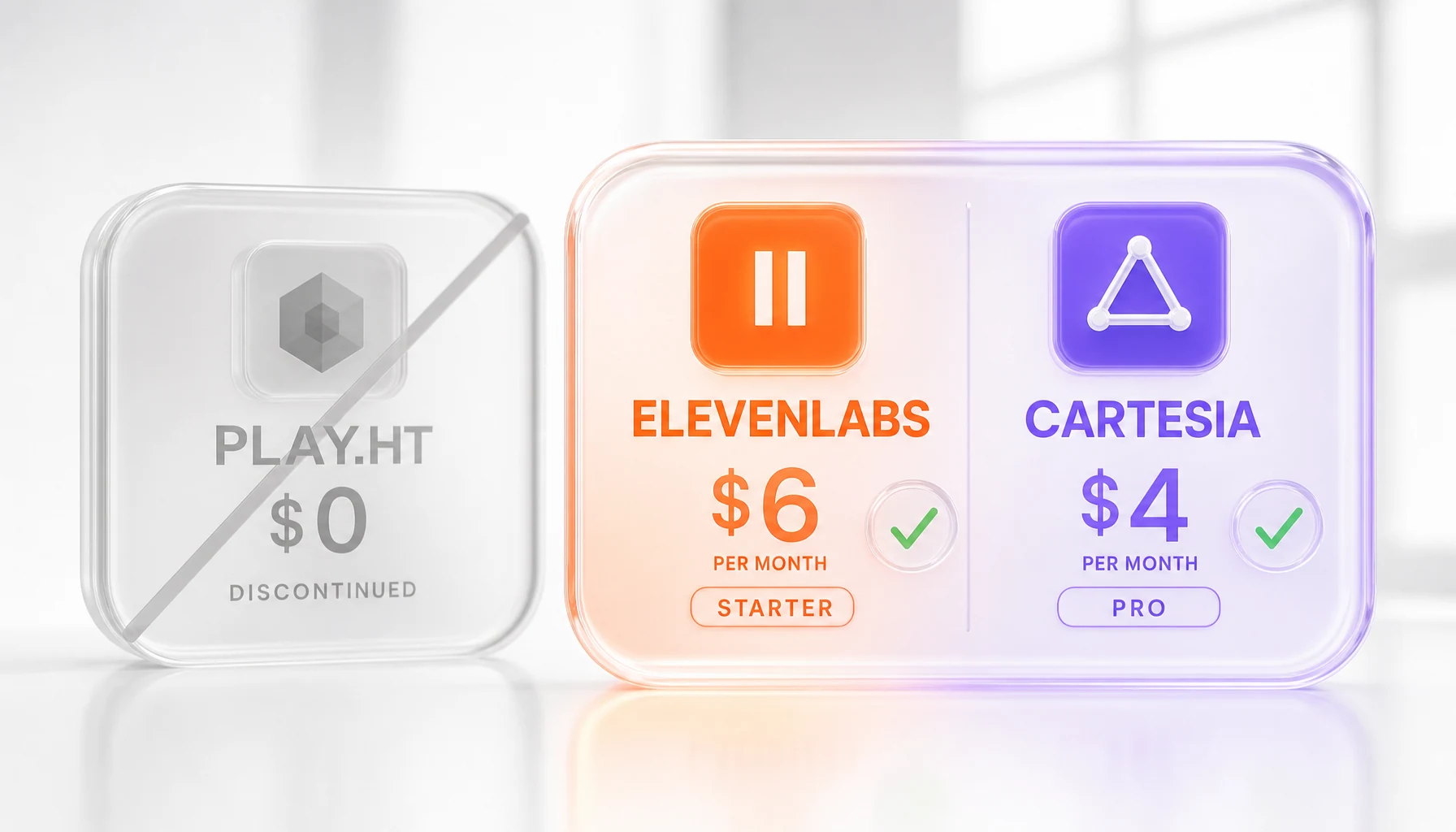
For reference, here is what Play.ht charged at the time of the July 2025 acquisition, alongside the 2026 alternatives at the same approximate tier. All historical Play.ht prices are from the Wayback Machine snapshot of play.ht/pricing dated mid-2025.
| Tier | Play.ht (historical, July 2025) | ElevenLabs (live 2026) | Cartesia (live 2026) |
|---|---|---|---|
| Free | $0 — limited generations (decommissioned) | $0 — 10,000 credits per month | $0 — 20,000 credits per month, personal use |
| Entry paid | Creator at $39 per month (decommissioned) | Starter at $6 per month — 30,000 credits, commercial license | Pro at $4 per month billed yearly — 100,000 credits, instant cloning |
| Mid tier | Pro at $99 per month (decommissioned) | Creator $22 per month — 121,000 credits, Pro Voice Cloning | Startup at $39 per month yearly — 1.25M credits, Pro voice cloning |
| Enterprise | Custom (decommissioned) | Business at $990 per month — 6M credits, low-latency TTS | Scale at $239 per month yearly — 8M credits, priority support |
TCO note for migrators: If you were on Play.ht Creator at $39 per month, ElevenLabs Creator $22 per month for 121,000 credits is a 72 percent monthly cost reduction. If you were on Play.ht Pro at $99 per month, ElevenLabs Pro at $99 per month delivers 500,000 credits and 44.1 kHz PCM audio via API at the same price point with strictly better feature parity.
Migration Guide — From Play.ht to a Live Alternative
If you had a Play.ht account before December 31, 2025, here is the practical migration sequence. We assume you did not download your audio archive in time — most users did not.
Step 1: Locate your original source audio
Voice clones cannot be ported from Play.ht to any other platform. You need the original WAV or MP3 files you used to train your Play.ht voice clones. Check your local drives, Google Drive, Dropbox, and any podcast or video editing project folders. If you originally recorded on a phone or laptop microphone, those files often live in a default Recordings or Voice Memos folder.
Step 2: Pick your replacement based on workflow
For general voiceover, podcast narration, and most indie creator use cases: ElevenLabs is our recommendation. For real-time voice agents, customer support bots, and live translation: Cartesia is the technical winner with Sonic 3 at 90 milliseconds latency. For corporate L&D where the studio interface matters more than raw quality: Murf AI. For self-hosted or compliance-heavy deployments: Resemble AI. For music and song layers around your voice content: Suno AI.
Step 3: Re-clone your voices
Sign up for the chosen platform, navigate to the voice cloning section, and upload your original source audio. ElevenLabs Instant Voice Cloning requires roughly one minute of clean audio for a usable clone and is available on the Starter tier at $6 per month. Professional Voice Cloning, which produces broadcast-quality output, requires 30 minutes of source audio and is available on Creator $22 per month. Cartesia Instant Voice Cloning is available on Pro at $4 per month billed yearly.
Step 4: Update API integrations
Swap the Play.ht endpoint for your chosen replacement. ElevenLabs uses https://api.elevenlabs.io/v1/text-to-speech/{voice_id} with an xi-api-key header. Cartesia uses https://api.cartesia.ai/tts/bytes with a Bearer token. Both have OpenAPI specs and official SDKs in Python, TypeScript, Go, and Ruby. Most teams complete the swap and ship to production in under one business day.
Step 5: Cancel any lingering Play.ht charges
If you were billed in November or December 2025 and never refunded, your last recourse is a chargeback through your card issuer. Note the shutdown date (December 31, 2025) in the dispute and reference Meta's public acquisition announcement from July 12, 2025 as supporting evidence that the service was discontinued without notice.
What This Teaches Us About AI Tool Risk
The Play.ht shutdown is not an isolated event — it sits inside a broader 2024 to 2025 consolidation wave where Big Tech is buying voice, multimodal, and agent startups primarily for talent. Inflection AI's team went to Microsoft. Adept's team went to Amazon. Character AI's team went to Google. Play.ht's team went to Meta. In every case, the consumer product either dies, fades, or gets repositioned beyond recognition within twelve months of close.
The financial mechanics of these deals are nearly identical. Microsoft paid roughly 650 million dollars in March 2024 to license Inflection AI's technology and hire most of the team, with co-founders Mustafa Suleyman and Karen Simonyan moving to lead Microsoft AI. Amazon followed in June 2024 with a reported 330 million dollar arrangement that licensed Adept's tech and brought CEO David Luan and core researchers into the Amazon AGI team. Google closed the largest of the cohort in August 2024 — a 2.7 billion dollar deal that returned Noam Shazeer and Daniel De Freitas to Google DeepMind while leaving Character AI to operate as a husk under new leadership. Meta's Play.ht acquisition fits the same template structurally — hire the team, license the tech, do not actually buy the company. The structure exists because regulators have signaled that traditional M&A in AI will draw antitrust scrutiny, and the FTC opened formal inquiries into both the Microsoft Inflection and Amazon Adept arrangements in mid 2024 for exactly this reason. Acquihires that look like licensing are the regulatory workaround.
The pattern for end users is consistent across all four cases. Within twelve months of close, the consumer product loses its lead engineers, ships fewer updates, raises prices or freezes new sign-ups, and eventually either shuts down (Inflection's Pi assistant in late 2024, Play.ht in December 2025) or is repositioned beyond recognition (Character AI now operates with stricter content rules and a different roadmap from what its original community signed up for). Adept's Workflow Language, which had real enterprise traction, never shipped to general availability after Amazon absorbed the team. The startup brand becomes a placeholder, the product roadmap stalls, and the API contracts that customers built workflows around quietly expire. None of this is hidden — every one of these wind-downs was reported by TechCrunch, Bloomberg, or The Information within weeks of the deal closing — but the speed at which a healthy-looking AI startup can become an empty shell still surprises most users when it happens to a tool they personally rely on.
The practical lessons for anyone running production workflows on AI tools:
- Download your raw assets monthly. If your voice clones, model fine-tunes, or generated audio only live on the vendor's cloud, you are one acquisition away from losing them.
- Never single-vendor your stack. Maintain a tested fallback for every critical dependency. If ElevenLabs is your primary, have Cartesia or Resemble AI scripted in as a secondary.
- Read the data export terms before you sign. Vendors with documented export APIs in their terms of service are dramatically less risky than those that bury "we may delete data on termination" in clause 14.3.
- Watch acquihire signals. Founders going quiet on social, hiring freezes, roadmap stalls, and a sudden uptick in "we're focused on enterprise" messaging are all preludes to an acquisition exit.
- Prefer vendors with diversified revenue. A startup whose entire revenue depends on a single API model is more acquihirable than one with a healthy direct-to-creator subscription business.
How to evaluate AI tool durability before subscribing
Before committing a workflow or a paid plan to any AI startup in 2026, run the vendor through a short durability checklist. None of these signals is a guarantee, but the combination is a reliable indicator of whether the tool will still be operating in twelve months.
- Funding stage and runway. Seed and Series A startups burning more than 80 percent of their last round on inference costs are acquihire candidates. Public Crunchbase data plus job posting velocity (LinkedIn aggregators show this) tell you whether a company is hiring or coasting.
- Founders' track record. Founders who previously sold a company to Big Tech are statistically more likely to do it again. Check the LinkedIn history of the CEO and CTO before you sign an annual contract — a serial-acquihire pattern is a red flag for any vendor pitching long-term lock-in.
- M&A activity in the surrounding category. If two or three peer startups in the same niche have been acquihired in the last 18 months, the remaining independent vendors are next. Voice AI saw this in 2025. Agent frameworks saw it in 2024. Image-to-video is showing the same signal in early 2026.
- Pivot risk and product focus. A vendor that has changed its core pitch twice in 18 months — for example moving from consumer creator tool to enterprise API to agent platform — is signaling that the original business did not work. Stable roadmaps with shipped features every quarter are a healthier signal than glossy rebrands.
- Data export policy. Read the terms of service section on account termination before you upload your first asset. Vendors that explicitly document a data export API, retention windows after cancellation, and a portable format (WAV, MP3, JSON) are dramatically less risky than vendors who say only "we may delete data on termination" without specifics.
- Independent revenue source. Vendors with healthy direct-to-creator subscription revenue or enterprise contracts are less acquihirable than ones whose entire pitch is "we are the best API for X." A diversified revenue base is a moat against the talent-only exit.
None of this would have saved Play.ht's consumer customers — the deal was Meta's call, not theirs. But the next platform you build on can be chosen with these heuristics in mind.
Frequently Asked Questions
What happened to Play.ht?
Meta Platforms acquihired Play.ht on July 12, 2025, absorbing the entire the team into its Superintelligence Labs division. New sign-ups froze in August 2025, the public REST API went dark on July 26, 2025, and the platform was permanently shut down on December 31, 2025. All user accounts, voice clones, and saved audio were deleted. The technology now powers Meta AI, AI Characters, and Meta wearables internally.
Can I still use my Play.ht voices?
No. Every Play.ht account, voice clone, and audio asset was deleted on December 31, 2025. There is no export tool, no migration API, and no recovery path. Voice clones trained on Play.ht cannot be ported to ElevenLabs, Cartesia, Resemble AI, or any other platform — you must re-clone from your original source audio. If you only kept Play.ht as your archive, those files are permanently gone.
What is the best Play.ht alternative in 2026?
ElevenLabs is our top recommendation for general voice work — best overall quality, Starter at $6 per month for 30,000 credits with commercial license. Cartesia is the latency king for real-time agents, with Sonic 3 hitting 90 milliseconds time-to-first-audio and Pro at $4 per month billed yearly. Murf AI is best for corporate L&D, Resemble AI for open API workflows, and Suno AI complements voice with full music and song generation.
Did Play.ht refund subscriptions when it shut down?
Reports from G2, Reddit, and Trustpilot threads suggest most users were not prorated. Several customers were billed for November and early December 2025 and received no refund when the December 31 shutdown hit. A handful reported partial credits applied if they contacted support before mid-December, but Play.ht's billing dashboard was decommissioned along with the platform, leaving most users without a clear dispute path. If you were charged, your last recourse is your card issuer chargeback window.
Why did Meta acquire Play.ht and shut it down?
Meta acquihired Play.ht to staff its new Superintelligence Labs voice team. The 35-person crew now builds voice features for Meta AI, AI Characters, the Ray-Ban Meta smart glasses, and Quest VR. Keeping the consumer Play.ht product alive would have competed with Meta's own roadmap and added moderation overhead, so Meta wound it down. This is a textbook acquihire — the talent and IP were the deal, not the user base.
How do I migrate from Play.ht to ElevenLabs?
Three steps. First, locate your original source audio files (the WAVs or MP3s you used to train Play.ht voice clones). Second, sign up for ElevenLabs Starter at $6 per month — it includes Instant Voice Cloning. Third, upload your source audio to ElevenLabs and re-clone. For API integrations, swap the Play.ht endpoint for the ElevenLabs Text-to-Speech API and update your authentication header. Most teams complete the swap in under one day.
Is Cartesia faster than Play.ht was?
Yes. Cartesia's Sonic 3 model hits 90 milliseconds time-to-first-audio, roughly half the latency Play.ht's best-tuned API delivered at peak. For real-time voice agents, customer support bots, and live translation, Cartesia is the clear technical winner. Pricing starts at $4 per month for the Pro tier billed yearly with 100,000 credits, scaling to $239 per month at the Scale tier with 8 million credits.
What lessons does the Play.ht shutdown teach about AI tool risk?
The 2024 to 2025 AI consolidation wave is real. Big Tech is buying voice and multimodal startups for talent, and the consumer products often die within 6 to 12 months of close. Practical lessons: download your raw assets monthly, never rely on a single voice or model provider, prefer vendors with clear data export APIs in their terms of service, and watch for acquihire signals such as founders going quiet, hiring freezes, and roadmap stalls. Diversification beats lock-in every time.
Is Play.ht coming back under a new name?
No. Meta has confirmed the Play.ht consumer brand is dead. The technology and team now operate as part of Meta's internal Superintelligence Labs voice group. Nothing in Meta's public roadmap suggests a successor product aimed at the same indie creator and developer audience Play.ht served. If you want what Play.ht delivered, ElevenLabs and Cartesia are the closest replacements available today.
Can developers still use any Play.ht code or models?
No public Play.ht code or model weights were open-sourced before the shutdown. The REST API went dark on July 26, 2025, weeks ahead of schedule, breaking integrations overnight for indie SaaS, agent frameworks, and custom voice apps. The Play.ht GitHub organization was archived and the documentation site sunset. Developers must rewrite integrations against ElevenLabs, Cartesia, or Resemble AI — there is no community-maintained Play.ht replacement.
Final Verdict — Play.ht is dead, move to ElevenLabs
Play.ht earned its place in AI voice history. From 2020 to 2024 it was a genuinely strong product — multilingual, developer-friendly, and one of the few platforms that made high-quality TTS feel accessible to indie creators. We are not here to bury it; we are here to tell you it is gone and to point you somewhere that still ships.
Score breakdown:
- Features: not applicable — platform decommissioned December 31, 2025.
- Ease of Use: not applicable — web app and API offline.
- Value: zero — subscriptions canceled without prorated refunds for most users.
- Support: zero — billing dashboard offline, dispute path is card chargeback only.
Who should still consider Play.ht: nobody. The product does not exist. Any review or affiliate link pointing at play.ht as a current option is stale.
Who should migrate where:
- Indie podcasters and content creators: ElevenLabs Starter at $6 per month for general work, Creator $22 per month if you need Professional Voice Cloning.
- Real-time voice agent builders: Cartesia Pro at $4 per month billed yearly for sub-100 millisecond latency. See our Cartesia review.
- Corporate L&D and training teams: Murf AI for the studio interface, brand voice library, and team collaboration.
- Open API and self-hosted deployments: Resemble AI for fine-grained control and compliance-friendly options.
- Music and song layers: Suno AI as a complement to your TTS stack.
Final word. Play.ht is dead. Meta took the team, killed the product, and moved on. The best move for everyone affected is to stop looking backward and migrate this week. ElevenLabs is our top recommended replacement — same use cases, better quality at the entry tier, and a vendor large enough that an acquihire wind-down on the same six-month timeline is unlikely. If your workflow is real-time agents specifically, go straight to Cartesia. Either way, do not wait for a Play.ht successor that is not coming.
Affiliate Disclosure: Some links on this page (marked with rel="sponsored") are affiliate links. If you make a purchase through these links, we may earn a commission at no extra cost to you. This helps fund our independent testing and reviews. Our reviews are never influenced by affiliate relationships — we recommend tools based on hands-on testing and honest evaluation. Read our full affiliate disclosure policy.
Key Features
Pros & Cons
Pros
- Pioneered ultra-realistic AI voices from 2020 to 2024 — among the first platforms to ship near-human prosody at consumer pricing.
- Best multilingual library at peak — over 800 voices across more than 140 languages, used by indie podcasters and enterprise alike.
- Solid enterprise traction with deals at Stripe, Vimeo, and major news publishers — proof the voice quality was production-grade.
- Robust REST API for developers — used by hundreds of indie SaaS and AI agent builders before the July 2025 API shutoff.
Cons
- Discontinued December 31, 2025 — platform shut down by Meta after the July 12, 2025 acquihire. No comeback planned.
- No data export tooling at shutdown — all accounts, voice clones, and saved audio deleted permanently if not manually downloaded before the cutoff.
- Subscriptions canceled mid-cycle without prorated refunds — multiple G2 and Reddit threads document users billed in November for a service that died December 31.
- API went dark on July 26, 2025 — weeks ahead of the public schedule, breaking integrations overnight for SaaS builders and agent frameworks.
- Voice clones non-portable — Play.ht clones cannot be re-imported into ElevenLabs or any other platform; users must re-clone from source audio.
Best Use Cases
Platforms & Integrations
Available On
Integrations
Compare Play.ht

We're developers and SaaS builders who use these tools daily in production. Every review comes from hands-on experience building real products — DealPropFirm, ThePlanetIndicator, PropFirmsCodes, and many more. We don't just review tools — we build and ship with them every day.
Written and tested by developers who build with these tools daily.
Frequently Asked Questions
What is Play.ht?
Discontinued December 31, 2025 — acquired by Meta. Use ElevenLabs, Cartesia, Murf AI, Resemble AI, or Suno AI instead.
How much does Play.ht cost?
Play.ht costs $0/month.
Is Play.ht free?
No, Play.ht starts at $0/month.
What are the best alternatives to Play.ht?
Top-rated alternatives to Play.ht can be found in our WebApplication category, where we've reviewed and scored every tool on ThePlanetTools.ai.
Is Play.ht good for beginners?
Play.ht is designed to be accessible for users of all skill levels.
What platforms does Play.ht support?
Play.ht is available on Web (decommissioned), REST API (shut off July 26, 2025), Zapier integration (terminated), WordPress plugin (deprecated).
Does Play.ht offer a free trial?
No, Play.ht does not offer a free trial.
Is Play.ht worth the price?
Play.ht offers competitive pricing for its feature set. Check our detailed scoring above.
Who should use Play.ht?
Play.ht is ideal for: Historical: AI podcast narration before the shutdown, Historical: e-learning and corporate training voiceover, Historical: real-time voice agents for customer support, Historical: audiobook production for indie authors, Historical: dubbing and localization for video creators, Migration path: move to ElevenLabs for best overall quality, Migration path: move to Cartesia for sub-100ms real-time agents, Migration path: move to Murf AI for corporate L&D workflows.
What are the main limitations of Play.ht?
Some limitations of Play.ht include: Discontinued December 31, 2025 — platform shut down by Meta after the July 12, 2025 acquihire. No comeback planned.; No data export tooling at shutdown — all accounts, voice clones, and saved audio deleted permanently if not manually downloaded before the cutoff.; Subscriptions canceled mid-cycle without prorated refunds — multiple G2 and Reddit threads document users billed in November for a service that died December 31.; API went dark on July 26, 2025 — weeks ahead of the public schedule, breaking integrations overnight for SaaS builders and agent frameworks.; Voice clones non-portable — Play.ht clones cannot be re-imported into ElevenLabs or any other platform; users must re-clone from source audio..
Ready to try Play.ht?
Get started today
Try Play.ht Now →