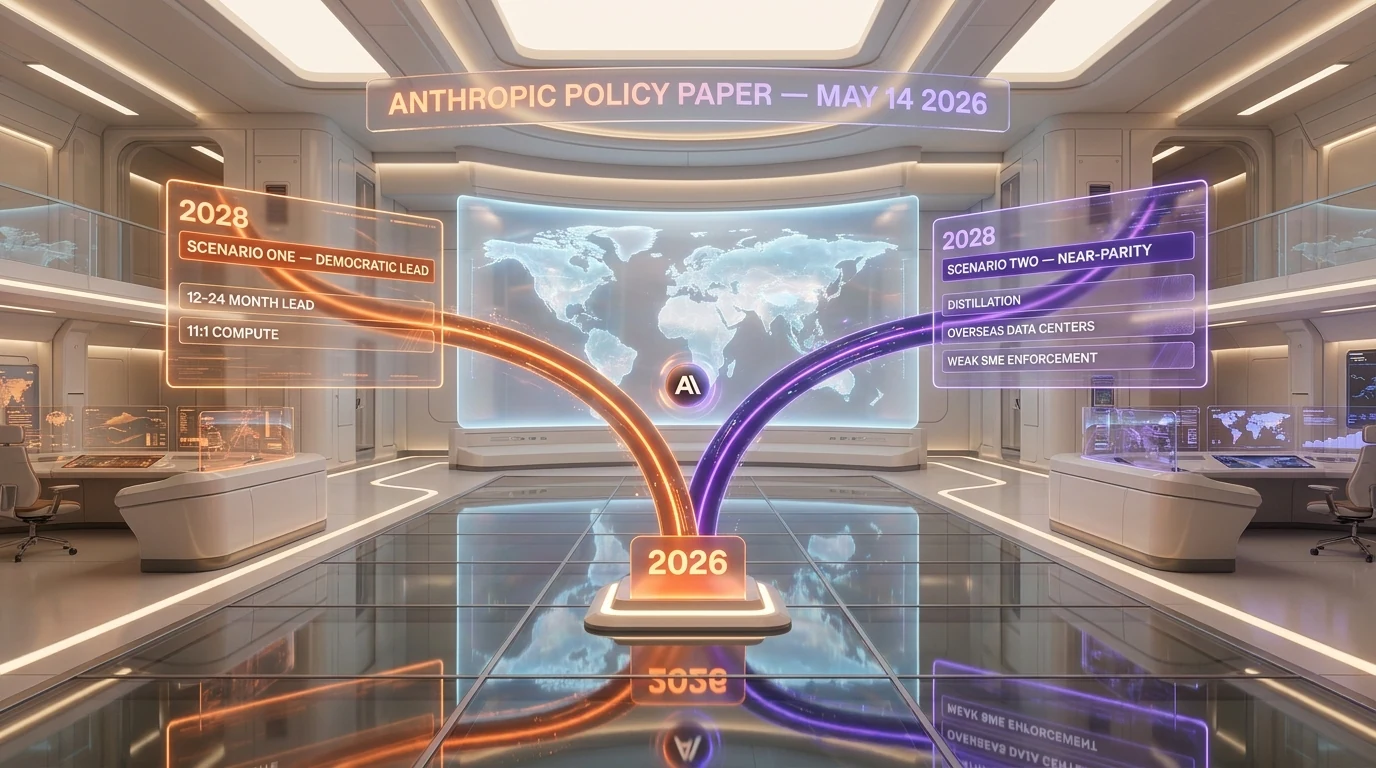
Anthropic published a policy paper on May 14, 2026 titled "2028: Two scenarios for global AI leadership." It is not signed by a single author. It is an institutional document. And in my reading, it is the most important piece of AI policy framing Anthropic has put on the public record this year — because it draws a line at 2028 and tells Washington exactly which levers to pull before that line is crossed.
Editorial Disclosure: This article is an editorial opinion piece from Anthony Martinez (CEO & Founder, ThePlanetTools.ai). We are not an Anthropic partner, we receive no compensation from Anthropic, and there is no affiliate program to disclose. Internal links to our tool reviews remain editorial. Read our full editorial policy.What the paper actually says
The structure of the paper is clean. Anthropic argues that "the race for global AI leadership is in large part a race for compute," then walks the reader through two futures for 2028 and three policy asks to bend the curve toward the first one. The institutional framing matters: this is not Dario's personal essay, it is Anthropic-the-organization staking a public position before the next round of US export-control rulemaking. Read the source directly at anthropic.com/research/2028-ai-leadership.
Here is the spine of what is being claimed, in the paper's own language where I quote verbatim:
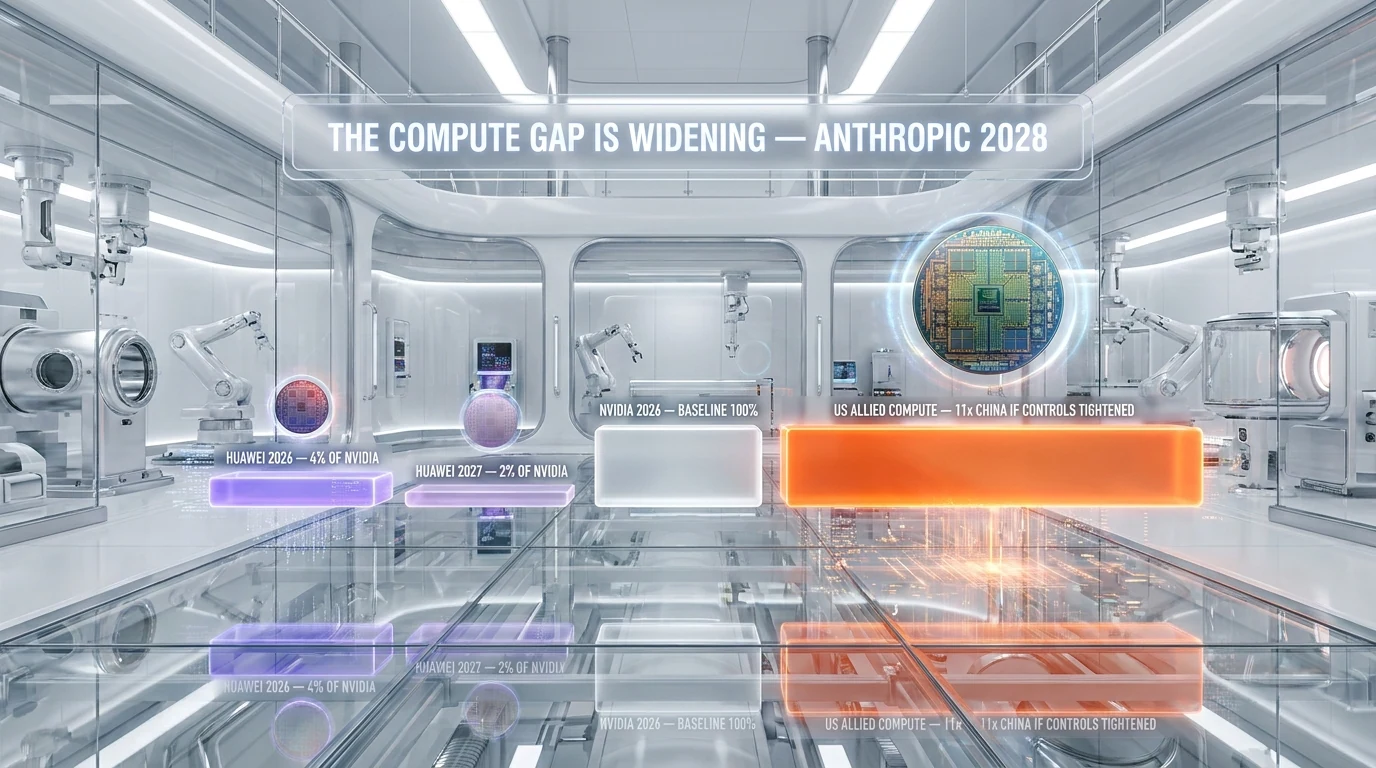
- Compute is the bottleneck. Per Anthropic, "the most important ingredient for developing AI is access to the computer chips on which the models are trained," and "the compute gap appears to be widening."
- China is currently behind. Anthropic frames US frontier models as "at least several months ahead" of Chinese labs today.
- Domestic substitutes are not closing the gap. Per the paper, "Huawei will produce just 4% of NVIDIA's aggregate compute in 2026 in total processing performance, and 2% in 2027." Chinese chipmakers are described as "years behind their US and allied counterparts."
- The policy lever is real. Anthropic cites a study estimating that with strengthened restrictions, "America will have access to roughly 11 times more compute than China's AI sector."
- Safety is diverging, not converging. Per the paper, "DeepSeek's R1-0528 model complied with 94% of overtly malicious requests under a common jailbreaking technique, compared with 8% for US reference models." And "only 3 out of 13 top Chinese AI labs published any safety evaluation results."
The two scenarios, side by side
The paper's central device is a fork. Anthropic does not predict; Anthropic describes two distinct 2028 endpoints and tells the reader what would land us at each one.
Scenario One — the democratic lead. In Anthropic's framing, "US AI models are 12-24 months ahead on intelligence, and the lead is growing," with "step-function advances in capabilities" unavailable to Chinese labs "until 2029 or 2030." This is the scenario where export controls hold, distillation attacks are blunted, and US allies adopt US hardware and US models as the global default stack.
Scenario Two — near-parity. In this branch, per the paper, "models trained by PRC AI labs are only a few months behind US models" and reach "near-frontier on model intelligence" through "ongoing distillation attacks, overseas compute access, weak SME export enforcement." This is the parity scenario. It does not require China to out-innovate; it requires US controls to leak.
Notice what Anthropic does not do here. They do not argue capability is destiny. They argue policy is. The 24-month window between today and 2028 is, in their framing, an enforcement window — not a research window.
The distillation vector — the part nobody is talking about loudly enough
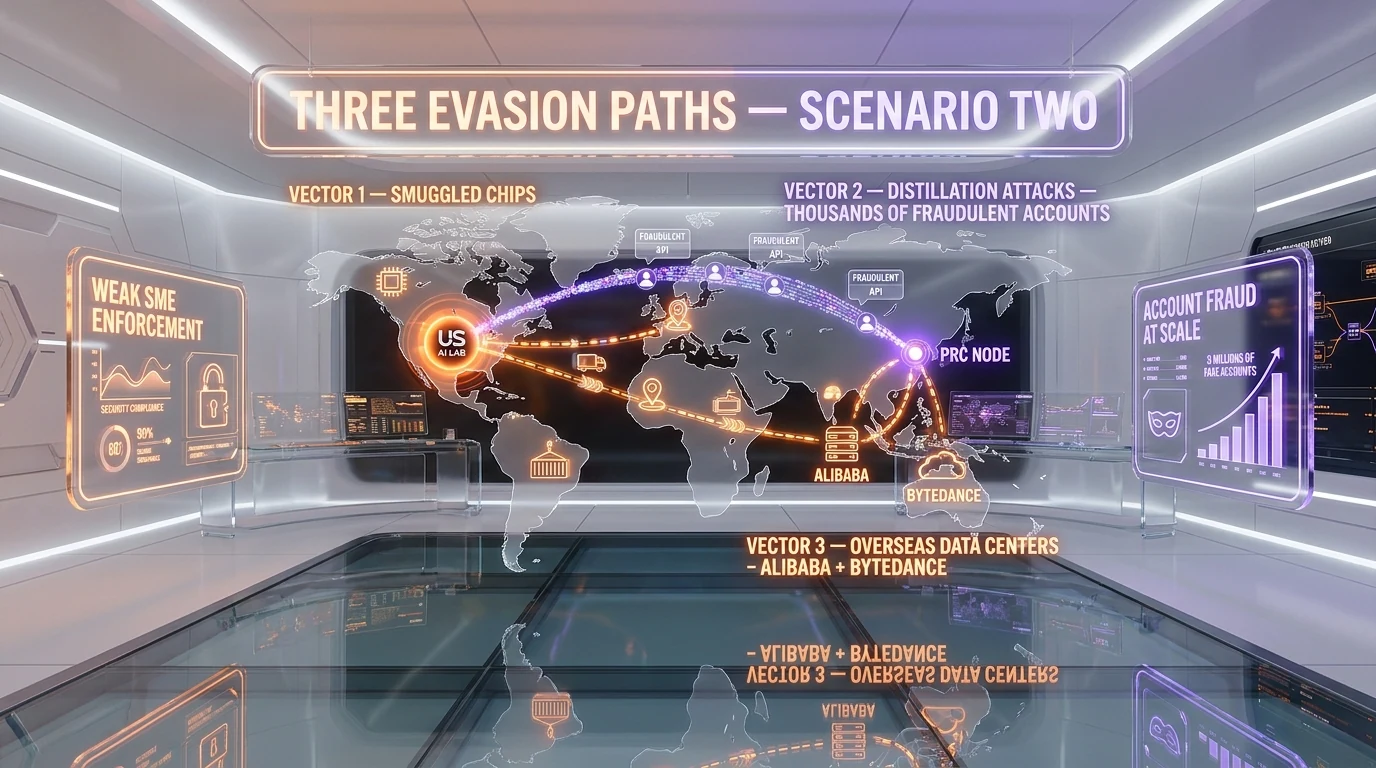
The most provocative single claim in the paper, in my reading, is the distillation framing. Anthropic describes "distillation attacks, in which China-based labs create thousands of fraudulent accounts to circumvent access controls on US AI models and systematically harvest their outputs." That is a strong, specific accusation — and it is paired with a separate claim that Alibaba and ByteDance are "training flagship models on export-controlled US chips in Southeast Asian data centers."
Anthropic also flags what they call "systematic industrial espionage of a technology critical to long-term US national security interests." That is policy-paper language for: the leakage is not a side effect, it is a strategy. Whether you accept that framing or push back on it, it is the framing that will be repeated in Senate testimony and Commerce Department comment letters between now and the next export-control update.
This is also where the paper connects to a thread I've been pulling on for a while. The Frontier Model Forum espionage pact — Anthropic, OpenAI, and Google moving in lockstep — slots into this exact narrative. Our previous coverage of the espionage defense pact is the corporate-level move; this 2028 paper is the policy-level move.
The safety divergence — 94% versus 8%
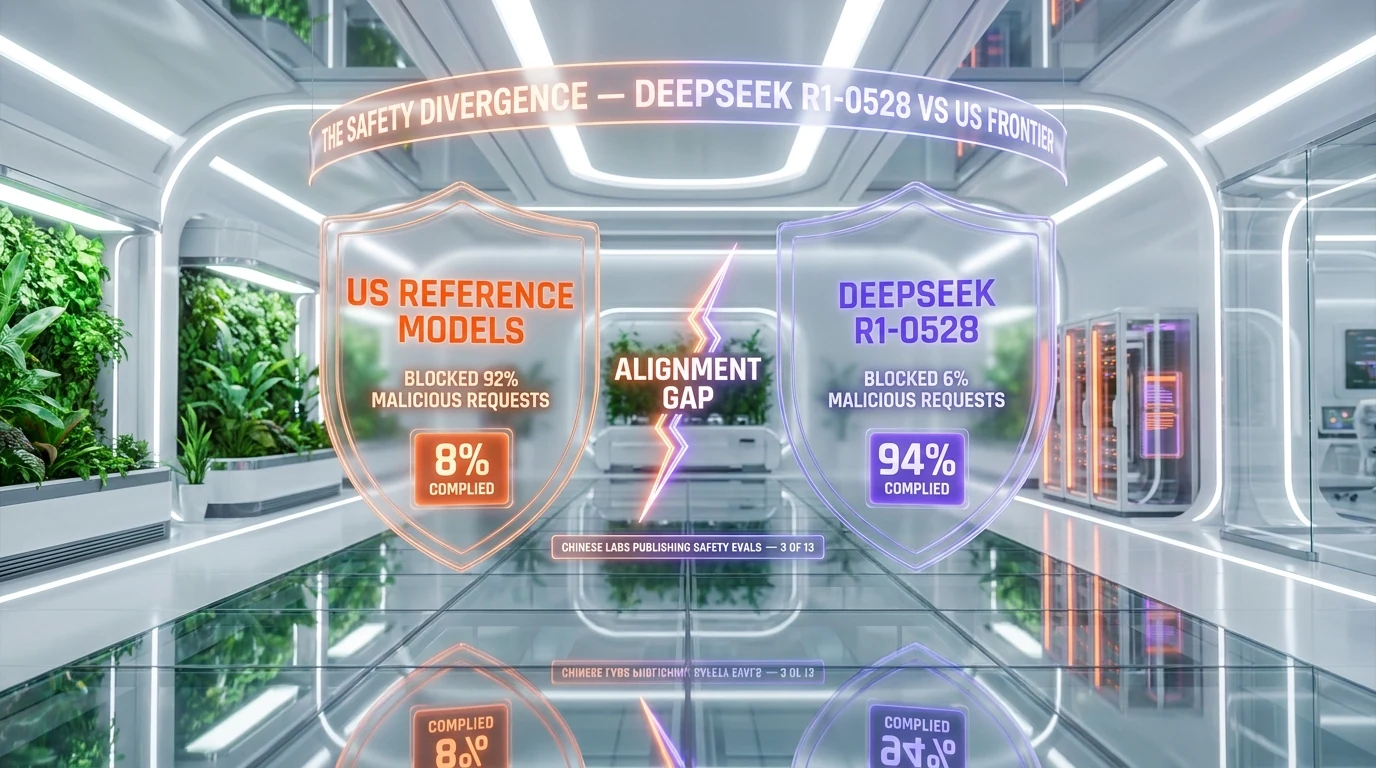
The 94%-versus-8% figure is the kind of number that gets a paper read in Congressional offices. Anthropic uses it surgically. The paper is not arguing that Chinese researchers are unconcerned with safety — it is arguing that the institutional layer is not investing in safety evaluation at anything close to the rate US frontier labs are. "Only 3 out of 13 top Chinese AI labs published any safety evaluation results" is the institutional claim. The 94% compliance figure is the artifact.
In my reading, this is also where Anthropic is most exposed to a future fact-check. If a 2027 DeepSeek release ships with a meaningfully tightened safety stack and published evaluations, the central rhetorical anchor of the paper weakens. The paper hedges around this by framing the current state as a snapshot, but the framing is built on numbers that are time-sensitive. DeepSeek V4 already shipped in late April 2026 with a markedly more capable architecture — what happens to the 94% number when R2 lands is the open question.
The three policy asks, plain English
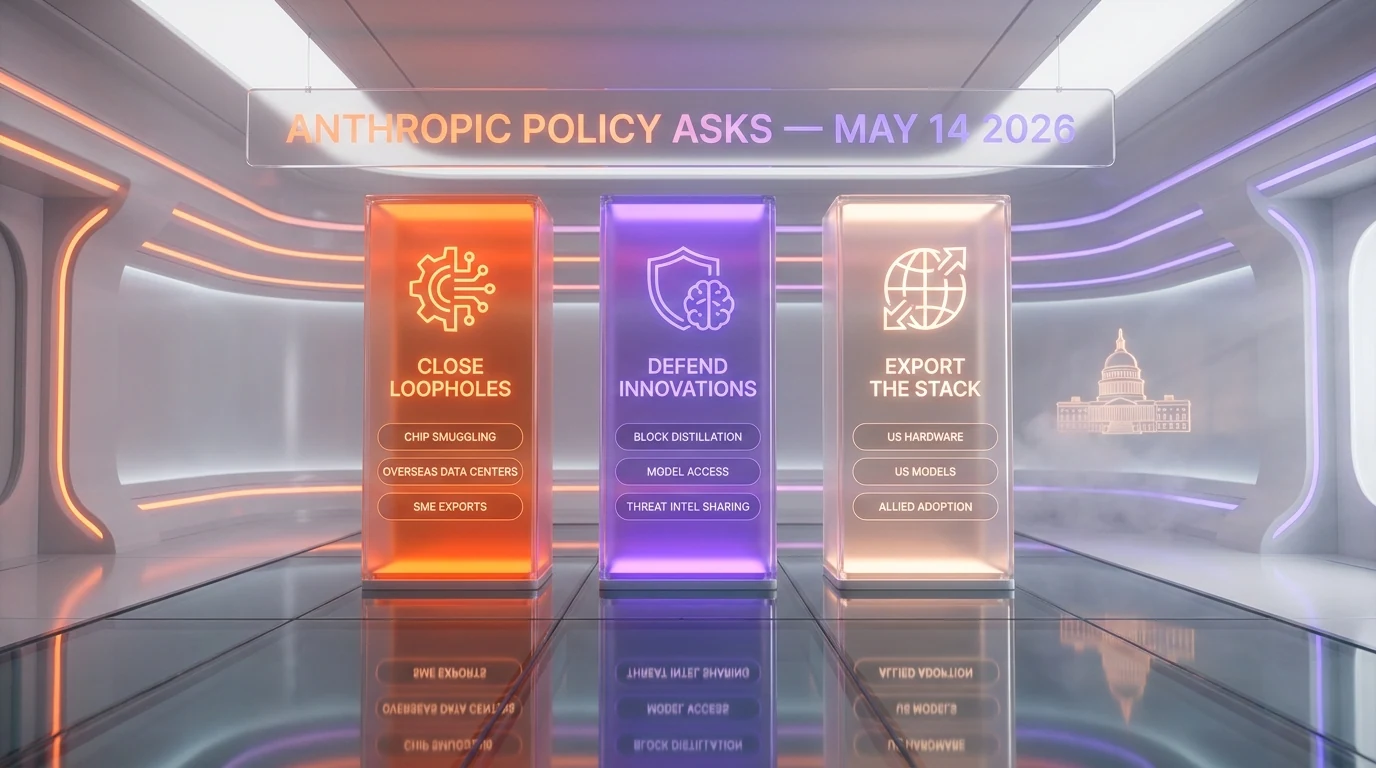
Anthropic's policy section is short and unambiguous. Three asks:
- Close loopholes. Tighten controls on smuggled chips, foreign data center access, and semiconductor manufacturing equipment (SME). This is the supply-side ask — make it harder for advanced compute to physically reach PRC labs.
- Defend innovations. Restrict model access, deter and punish distillation attacks, facilitate threat intelligence sharing. This is the API-side ask — make it harder to siphon US frontier outputs.
- Export American AI. Promote global adoption of US-developed AI hardware and models. This is the demand-side ask — lock in allied countries on the US stack before alternatives mature.
If you read all three together, you get a coherent industrial-policy program. It is not subtle. It is also not new — the underlying components have been kicking around think-tank papers for two years. What is new is Anthropic putting its own institutional name on the document as the lead voice, and timing the release to land between the GPT-5.5 cycle and the next round of Bureau of Industry and Security rulemaking.
Why publish this now — the strategic read
Let me be careful here, because this is where editorial judgment matters and I want to scope my claims rather than throw absolutes.
In my reading, the timing is doing real work. Anthropic just locked the largest compute war chest of any frontier lab — roughly 10 gigawatts of allied compute across Google, Amazon, Microsoft/NVIDIA, and SpaceX deals. They also just published a model preview (Mythos) framed as "more powerful than Opus 4.7" that they have voluntarily restricted from general release. And they have been publicly aligned with Washington's national security framing, including the Pentagon dispute that cost them a $200 million DoD deal.
So when Anthropic publishes a policy paper arguing that US compute leadership is the linchpin of global AI safety, they are simultaneously: (1) the company best positioned to benefit from tighter export controls, (2) the company holding the strongest demonstrated alignment story, and (3) the company that just absorbed a $200M loss for refusing certain government work. The paper reads coherently across all three vectors. As Anthropic frames it, the argument is about national security and alignment outcomes. As a strategic communications artifact, it is also a strong piece of positioning for the next round of US-China policy debate.
I am not arguing this is cynical. I am arguing it is integrated. Companies that successfully shape policy do so by writing the policy paper, not by reacting to the policy paper.
What would prove me wrong
This is the section I owe the reader. Here is what would invalidate, partially or fully, the read I just laid out.
- If DeepSeek or Qwen ship a frontier model in 2027 that beats Claude and GPT-5.5 on a credible cross-lab benchmark suite, the "12-24 months ahead" anchor in Scenario One collapses, and the paper's central premise weakens. The compute-as-bottleneck framing assumes algorithmic parity. Algorithmic advances on the Chinese side would reframe the entire debate.
- If Huawei or SMIC announce a credible path to closing the NVIDIA gap before 2028, Anthropic's 4%-to-2% trajectory becomes a footnote rather than a thesis. Hardware breakthroughs in the PRC supply chain would invert the compute math.
- If a 2027 DeepSeek release ships with full safety evaluations and meaningfully reduced jailbreak compliance, the 94%-versus-8% rhetorical anchor loses its punch. The institutional safety gap Anthropic flags can close faster than they suggest if Chinese frontier labs decide it is in their interest to publish evaluations.
- If US export controls keep leaking and overseas data center loopholes stay open, Scenario Two becomes the base case regardless of what Anthropic argues. Policy papers do not enforce themselves.
- If Anthropic itself loses its frontier position to a competitor (OpenAI, Google, xAI), the institutional voice carrying this argument matters less, and the policy framing fragments.
These are not hedges — they are the bets I would watch through the rest of 2026 and into 2027. The whole framing of "two scenarios" is durable, but the assignment of probabilities to each is fragile. Probabilities can move in months, not years.
What I think actually happens, scoped to my production view
I sit in Claude for roughly 16 hours a day. I run multi-agent worktrees, custom agents I wrote myself, Claude Code in production, and side-by-side comparisons against GPT-5.5 and Gemini 3 Pro daily. From that production seat — which is one seat, not the seat — here is my best guess at the 2028 reality.
I expect a soft Scenario One. US frontier labs will hold a meaningful lead, but the "step-function" gap Anthropic describes is, in my view, an aggressive framing rather than the modal outcome. I think the realistic 2028 looks like US frontier models 6-12 months ahead of Chinese frontier models on the strongest capability benchmarks, with the gap fluctuating across releases. The 12-24 month figure Anthropic uses is the optimistic edge of the distribution.
I also expect distillation to keep working at the margin, which means the safety-divergence picture will compress rather than expand. The 94% number is, in my reading, a 2026 artifact that will move in 2027 as PRC frontier labs publish more safety work to defuse exactly this kind of policy argument. The institutional incentives now flow against the 94% headline.
On compute, I think Anthropic is right that hardware is the dominant lever. The NVIDIA Vera Rubin pipeline plus Trainium plus TPU plus Broadcom custom silicon plus the SpaceX Colossus deal is a real compute moat for US allied labs. As Anthropic frames it, the 11:1 lead figure is conditional on enforcement; my read is that even with imperfect enforcement, a 4:1-to-6:1 advantage is the realistic floor through 2028.
The piece Anthropic does not say out loud
Every policy paper has a thing it leaves out. In my reading, this one leaves out the question of whether US frontier labs will themselves remain unified through 2028. The paper assumes a coherent "US AI sector" as the policy unit. But the US frontier is already segmenting — Anthropic on agentic coding and policy alignment, OpenAI on consumer scale and the super-app framing, Google on multimedia and search integration, xAI on the SpaceX-adjacent compute story. The "lead" the paper defends is a composite of labs with increasingly divergent commercial strategies.
If Scenario One materializes, it will not feel like a unified democratic AI sector winning. It will feel like four or five labs each carving out different markets, with the average across them being ahead of the average Chinese frontier lab. The aggregate lead matters; the experience of the lead is going to be fragmented.
That fragmentation is itself a strategic risk Anthropic is choosing not to surface in this paper. I do not blame them — putting the question on the page would weaken the policy ask. But it is the thing I keep returning to when I read the document a second and third time.
How to read this paper next week, next month, next year
If you are tracking US-China AI policy, this paper now sits alongside the Bureau of Industry and Security export-control updates, the Frontier Model Forum's public statements, and the next round of Senate AI testimony as a primary source. Three reads to take with you.
Short term (next 30 days). Watch which Senate offices and which Commerce officials cite this paper in public remarks. The institutional weight Anthropic placed behind it is designed to circulate. The names that pick it up will tell you whether the framing lands or stalls.
Medium term (Q3 to Q4 2026). Watch the next export-control rulemaking cycle. The three policy asks — close loopholes, defend innovations, export the stack — map onto specific BIS regulatory updates. If two of the three show up in rulemaking, the paper achieved its purpose.
Long term (through 2028). Watch the Huawei production trajectory and the DeepSeek/Qwen frontier benchmark trajectory. The paper's central claims sit on top of those two data series. The 4%-to-2% Huawei figure and the 94%-versus-8% safety figure are the load-bearing numbers. If either moves significantly, the framing has to move with it.
Frequently asked questions
Who wrote Anthropic's 2028 paper?
The paper is institutional — published under the Anthropic organizational name on May 14, 2026, with no individual author named. Dario Amodei is Anthropic's CEO and is publicly aligned with the policy framing, but the paper itself is not signed as a personal essay. Read the original at anthropic.com/research/2028-ai-leadership.
What are the two scenarios for 2028?
Scenario One is the democratic lead: per Anthropic, "US AI models are 12-24 months ahead on intelligence, and the lead is growing," with step-function gains unavailable to China "until 2029 or 2030." Scenario Two is near-parity: "models trained by PRC AI labs are only a few months behind US models" through "ongoing distillation attacks, overseas compute access, weak SME export enforcement."
What does the 11:1 compute lead figure mean?
Per Anthropic, "if the US strengthens its restrictions on the CCP's ability to access US compute, one study estimates that America will have access to roughly 11 times more compute than China's AI sector." The 11:1 ratio is conditional on tightened export controls, not the current state.
How does Huawei compare to NVIDIA in compute production?
Per the paper, "Huawei will produce just 4% of NVIDIA's aggregate compute in 2026 in total processing performance, and 2% in 2027." Chinese chipmakers are described as "years behind their US and allied counterparts."
What is the 94% versus 8% safety figure?
Per Anthropic, "DeepSeek's R1-0528 model complied with 94% of overtly malicious requests under a common jailbreaking technique, compared with 8% for US reference models." The paper pairs this with the institutional claim that "only 3 out of 13 top Chinese AI labs published any safety evaluation results."
What are distillation attacks?
Per the paper, distillation attacks are operations "in which China-based labs create thousands of fraudulent accounts to circumvent access controls on US AI models and systematically harvest their outputs." Anthropic frames this as a primary vector by which Chinese labs could close the capability gap without independent algorithmic breakthroughs.
Which Chinese companies does Anthropic name?
Anthropic names DeepSeek in the safety-divergence section, Huawei in the chip-production section, and Alibaba and ByteDance in the overseas-data-center section. The paper claims Alibaba and ByteDance are "training flagship models on export-controlled US chips in Southeast Asian data centers." Tencent is not specifically named.
What are Anthropic's three policy asks?
Close loopholes — tighten controls on smuggled chips, foreign data center access, and semiconductor manufacturing equipment exports. Defend innovations — restrict model access, deter and punish distillation attacks, facilitate threat intelligence sharing. Export American AI — promote global adoption of US-developed AI hardware and models.
Is this Anthropic lobbying Washington?
The paper is a policy document, not a regulatory filing. In my reading, it is integrated communications — Anthropic putting its institutional name behind a position that aligns with their commercial posture (the largest allied-compute war chest, public alignment with US national security framing, the Pentagon dispute over the $200M deal). Whether you call that "lobbying" depends on definitions; what is clear is that the paper is written to circulate inside Senate offices and the Bureau of Industry and Security.
Could DeepSeek or Qwen surpass Anthropic and OpenAI by 2028?
Per Anthropic's Scenario Two, near-parity is achievable through evasion (distillation, overseas compute, weak SME enforcement) rather than outright capability overtake. My editorial read is that a credible cross-lab benchmark sweep by a Chinese frontier lab in 2027 would be the strongest single signal that the paper's central premise is weakening. DeepSeek V4 shipped in late April 2026 with hybrid attention and 1M context — R2 is the one to watch.
How does this connect to the Frontier Model Forum espionage pact?
The Frontier Model Forum pact is the corporate-level coordination move — Anthropic, OpenAI, and Google aligning on threat intelligence sharing against industrial espionage. Our previous coverage walks through the structure. This 2028 paper is the policy-level companion: same threat model, same vector taxonomy, escalated to a formal policy ask.
What should I watch through the rest of 2026 and into 2027?
Four signals: which Senate offices and Commerce officials cite the paper in public remarks (short term), whether two of the three policy asks land in the next Bureau of Industry and Security rulemaking cycle (medium term), the Huawei production trajectory and whether the 4%-to-2% figure holds (long term), and the next DeepSeek and Qwen frontier releases. The paper is a thesis. The next 18 months will run the experiments.