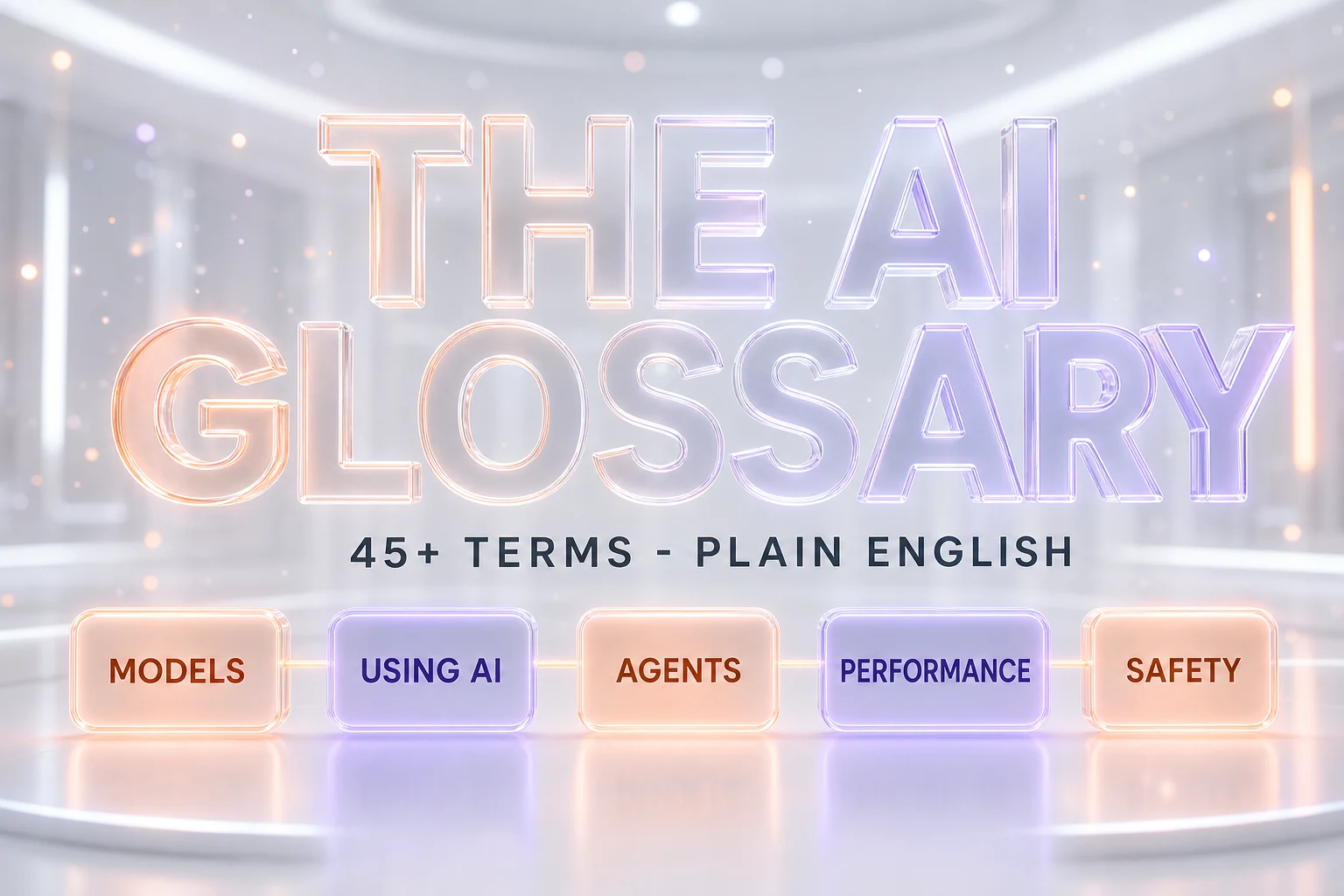
An AI glossary is a plain-English reference that defines the core vocabulary of artificial intelligence — the words you keep seeing in headlines, product pages, and pricing tables without ever getting a clear explanation. This one covers more than 45 of the terms that matter most in 2026, from token and context window to agent, MCP, RAG, and quantization. Each term is defined in one or two sentences you can quote on their own, and grouped into five sections so related ideas sit together.
You do not need to read it top to bottom — jump to the term you need. Where a concept has more depth than a single definition can hold, we link to a full explainer, like how large language models work or what AI agents actually are. The definitions here are deliberately short; the linked pillars are where you go deep. Every term is written to stand alone, so you can read one entry and walk away understanding it.
Models & Architecture
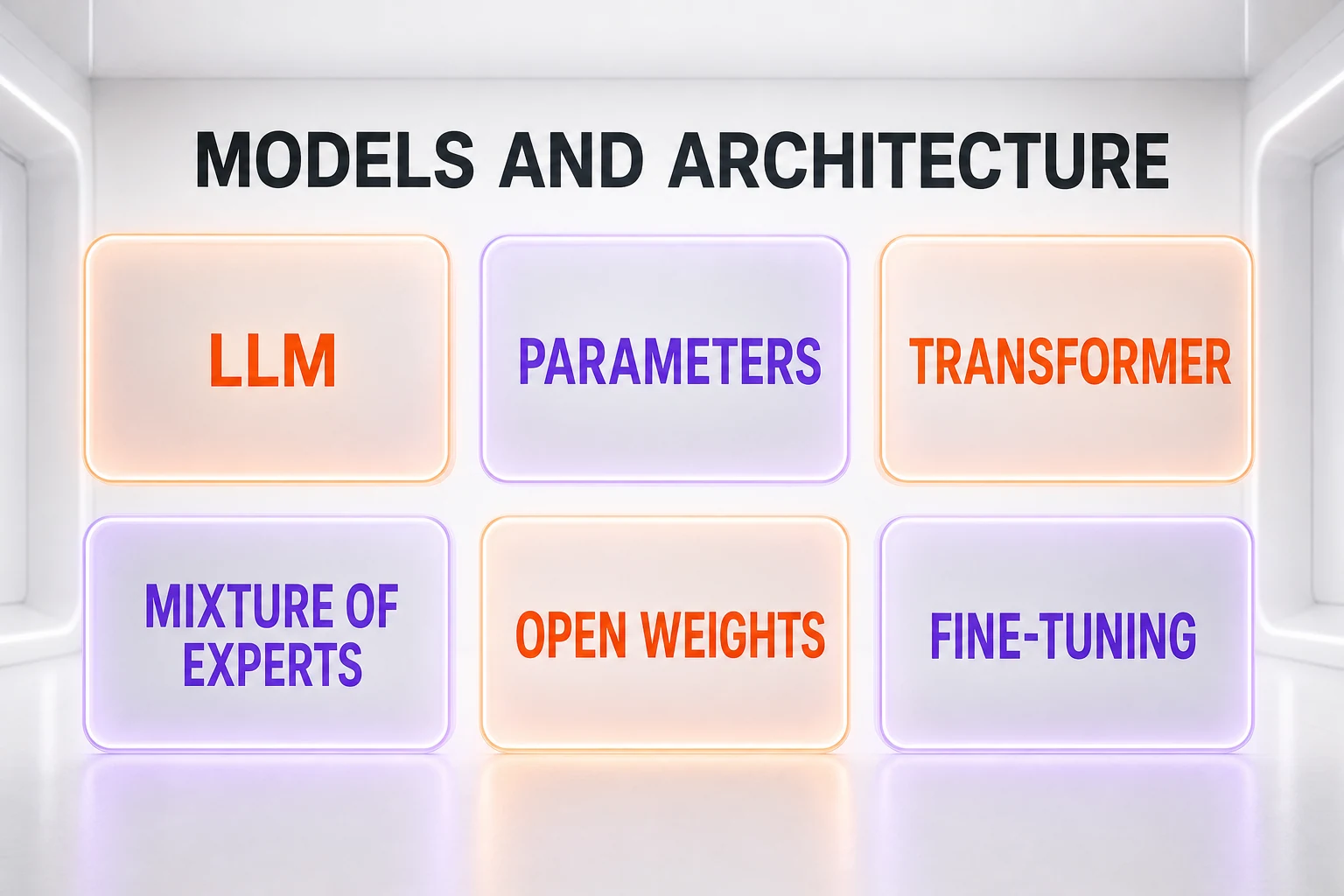
These are the terms that describe what an AI model is — how it is built, how big it gets, and the different flavors you will run into. Start here if the jargon around "70B parameters," "transformers," and "open weights" has ever left you nodding along without following.
Large Language Model (LLM)
A large language model is an AI system trained on massive amounts of text to predict the next token in a sequence, which lets it write, summarize, translate, and answer questions. It stores everything it learned as billions of numbers called parameters, and it generates text one token at a time rather than looking anything up. Chat assistants like ChatGPT, Claude, and Gemini are all built on LLMs. For the full mechanics in plain English, see our explainer on how large language models work.
Parameters
Parameters are the internal numbers a model adjusts during training to store what it has learned — think of them as the millions or billions of tiny dials that encode patterns in language. A model described as "70B" has roughly 70 billion parameters. More parameters generally mean more capability, but also more memory and compute to run. Parameter count is one of the first specs you will see when comparing models.
Transformer
The transformer is the neural-network architecture behind nearly every modern LLM, introduced by Google researchers in 2017. Its key idea is attention, which lets the model weigh how much every word in the input relates to every other word, so it can track context across long passages. Almost all frontier models — the GPT, Claude, Gemini, and Llama families — are transformers under the hood.
Attention
Attention is the mechanism inside a transformer that decides which other words in the input each word should "pay attention to" when the model builds its understanding. It is what lets a model connect "it" back to the right noun three sentences earlier, or keep a function's variables straight while coding. Attention is the main reason transformers handle context so much better than the models that came before them.
Mixture of Experts (MoE)
A mixture-of-experts model splits its parameters into many specialized sub-networks called "experts" and, for each token, activates only a few of them instead of the whole model. This lets a model carry a huge total parameter count while keeping the cost of each response low, because most experts stay idle at any moment. Many 2026 frontier models, including several open-weight ones, use MoE to get big-model quality at smaller-model running costs.
Multimodal model
A multimodal model can take in or produce more than one type of data — text, images, audio, and sometimes video — rather than text alone. A multimodal assistant can read a screenshot, describe a photo, or answer a spoken question. By 2026 most flagship models are natively multimodal, meaning image and audio understanding is built into the model rather than bolted on afterward.
Reasoning model
A reasoning model is an LLM trained to "think" before it answers by generating a hidden chain of intermediate steps, which makes it much stronger on math, coding, and multi-step logic. It typically spends more time and more tokens per question in exchange for higher accuracy. In 2026, most labs ship a fast standard model alongside a slower reasoning mode for hard problems.
Small Language Model (SLM)
A small language model is a compact LLM — often in the range of one to a few billion parameters — designed to run cheaply, quickly, and sometimes entirely on a phone or laptop. SLMs trade some raw capability for speed, privacy, and low cost. They are increasingly good enough for focused jobs like classification, extraction, and on-device assistants.
Open weights
An open-weight model is one whose trained parameters are published for anyone to download, run, and fine-tune on their own hardware, as opposed to a closed model you can only reach through an API. Open weights are not the same as open source, since the training data and code often stay private. If you are weighing the trade-offs, see our guide to closed versus open-weight models and how to self-host an open-weight model.
Fine-tuning
Fine-tuning is continuing a model's training on a smaller, focused set of examples to teach it a specific style, format, or skill. It changes how the model behaves rather than giving it new facts at answer time — that is what RAG does instead. Fine-tuning is useful when you need consistent tone or output structure; it is overkill when you simply need the model to know current information.
Distillation
Distillation is training a smaller "student" model to imitate the outputs of a larger "teacher" model, transferring much of the big model's capability into something cheaper to run. It is how labs ship fast, affordable versions of their flagship models. Distillation is also legally contentious when one company distills a rival's model without permission.
Diffusion model
A diffusion model generates images — and increasingly video and audio — by starting from random noise and repeatedly refining it into a coherent result that matches your prompt. It is the technique behind most modern image generators. Diffusion is a different family from the transformers that power text models, though the two are often combined in multimodal systems.
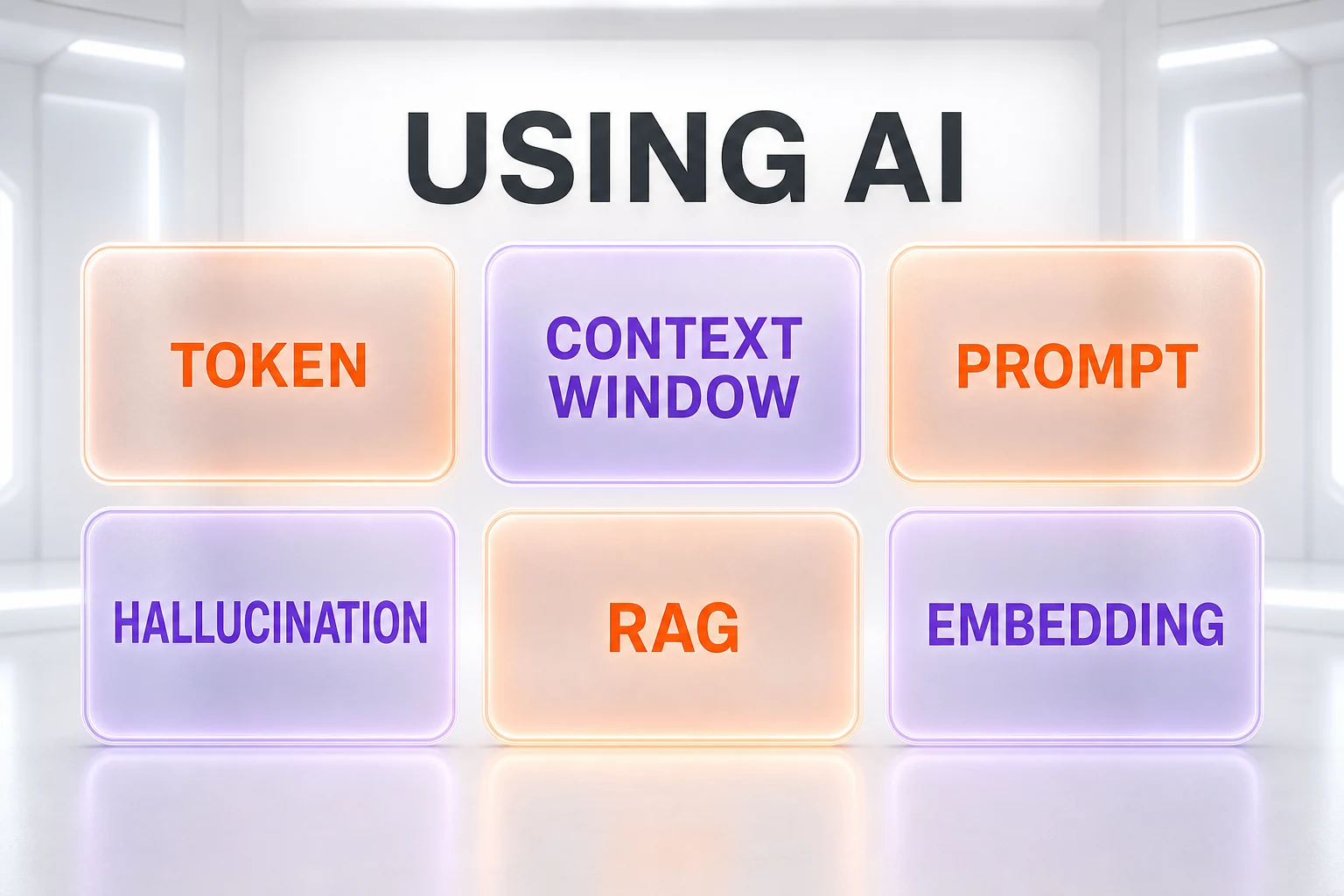
Using AI
This is the vocabulary of actually working with a model day to day: what you feed it, what it costs, and why it sometimes gets things confidently wrong. If you use an AI tool or API, these are the words that explain what is happening on your screen.
Token
A token is the small chunk of text — roughly three-quarters of a word — that a language model reads and writes as its basic unit. Prompts and responses are measured in tokens, and API pricing is charged per token, so "cost" and "context limits" are really about token counts. A useful rule of thumb: 1,000 tokens is about 750 words. Our AI pricing explainer breaks down how input, output, and cached tokens are billed differently.
Context window
The context window is the maximum amount of text — measured in tokens — that a model can consider at once, including your prompt, any documents you paste, the conversation history, and its own reply. If a conversation exceeds the window, the oldest content falls out of view. In 2026, context windows range from tens of thousands of tokens to one million or more on frontier models.
Prompt
A prompt is the input you give a model — your question, instruction, or the text you want it to work on. Prompt engineering is the practice of wording and structuring that input to get better results, for example by giving examples, constraints, or a clear role. Everything the model sees, including retrieved documents and prior turns, is part of the prompt.
System prompt
A system prompt is a hidden instruction set at the start of a conversation that tells the model who it is, how to behave, and what rules to follow, before the user says anything. It is how apps give an assistant its persona, tone, and guardrails. You see the chat; the system prompt is the stage direction behind it.
Temperature
Temperature is a setting, usually from 0 to 2, that controls how random a model's output is. Low temperature makes responses more focused and predictable, which is better for factual or coding tasks; high temperature makes them more varied and creative. Note that some 2026 frontier models no longer accept a custom temperature at all and reject the request if you send one.
Hallucination
A hallucination is when a model states something false or invented with complete confidence, because it is predicting plausible-sounding text rather than checking facts. Hallucinations are the single biggest reliability problem with LLMs. Techniques like retrieval-augmented generation and citing sources reduce them sharply but do not fully eliminate them.
Knowledge cutoff
The knowledge cutoff is the date after which a model has no built-in information, because its training data was collected up to that point and no further. Ask about something newer and the model will either say it does not know or guess. Connecting a model to live search or your own documents is how you get around the cutoff.
Retrieval-Augmented Generation (RAG)
RAG is a technique that lets a model look things up in an external knowledge base before answering, instead of relying only on what it memorized during training. It retrieves the most relevant passages, adds them to the prompt, and generates an answer grounded in that text — turning a closed-book exam into an open-book one. It is the most common way to give an AI access to private or current data; see our full explainer on how RAG works.
Embedding
An embedding turns a piece of text or an image into a list of numbers that captures its meaning, like coordinates in a vast "meaning space." Things that mean similar things land close together, even if they share no words, which is what makes search by meaning possible. Embeddings are the foundation of RAG, recommendation systems, and clustering.
Vector database
A vector database is a store built to hold embeddings and find the ones closest in meaning to a query, extremely fast, across millions of items. It is the retrieval engine behind most RAG systems. When you ask a document assistant a question, a vector database is usually what fetches the relevant passages before the model writes its answer.
Few-shot prompting
Few-shot prompting is giving a model a handful of worked examples inside the prompt so it can copy the pattern for your actual request. "Zero-shot" means no examples, just the instruction. A few good examples often improve accuracy and formatting more cheaply and quickly than fine-tuning.
Structured output (JSON mode)
Structured output is a setting that forces a model to return data in a strict format such as JSON matching a schema you define, instead of free-form prose. This makes model responses safe to plug directly into software. It is essential for agents and any pipeline where a program, not a person, reads the answer.
Agents & Tools
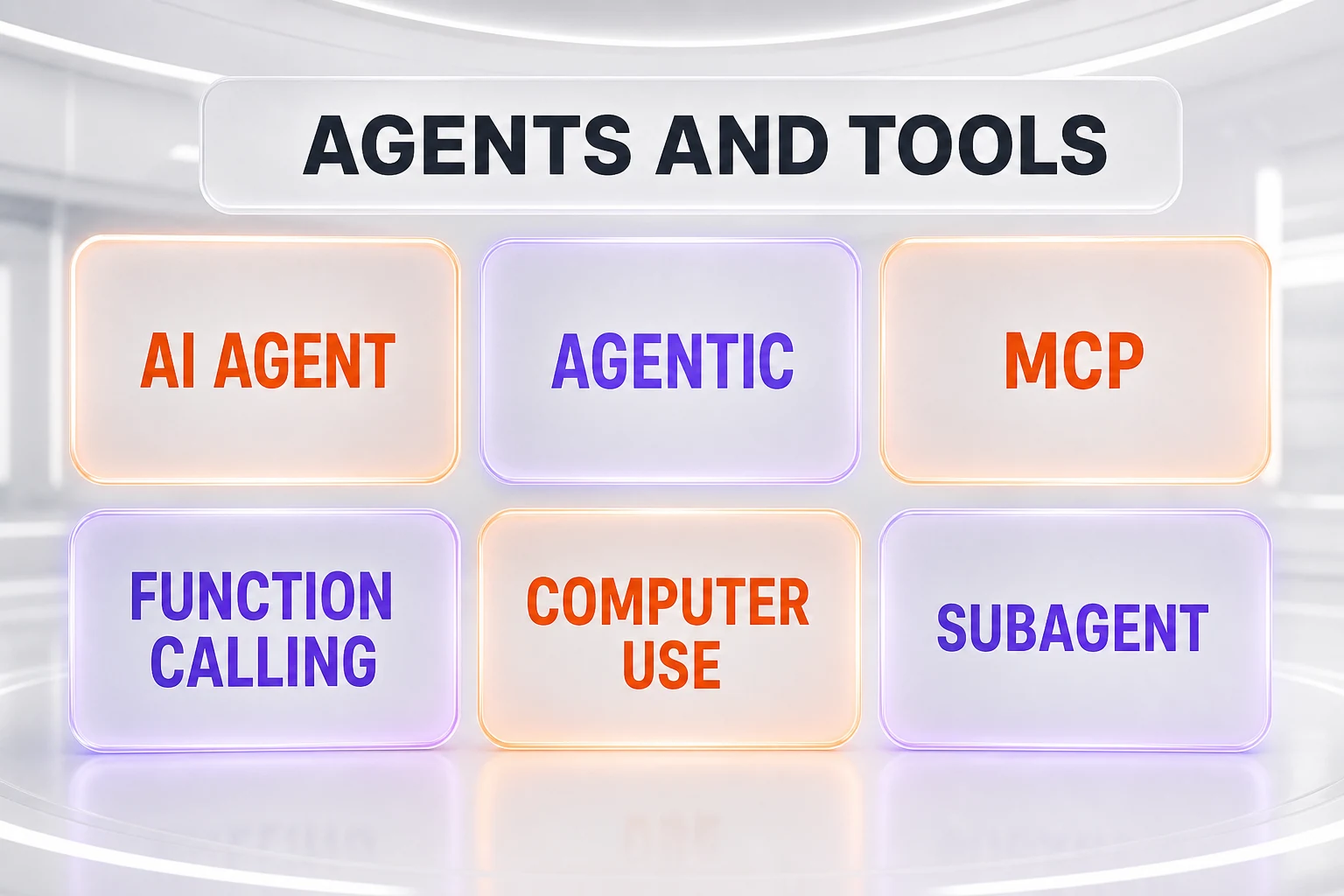
Agents are where AI stops chatting and starts doing. This section covers the vocabulary of systems that plan, take actions, and use tools — the defining shift of 2026, and the reason "agentic" is suddenly everywhere.
AI agent
An AI agent is a system that uses a language model to pursue a goal over multiple steps — planning, taking actions with tools, observing the results, and adjusting — rather than answering in a single turn. Where a chatbot replies, an agent does: it can search, run code, call APIs, and chain those actions toward an outcome. See our explainer on what AI agents are and how they work and the broader rise of AI agents in 2026.
Agentic
"Agentic" describes AI that acts with autonomy — making decisions and taking actions toward a goal — instead of just producing text. An "agentic coding model," for instance, can edit files, run tests, and fix its own errors across a whole project without hand-holding. It is one of the defining shifts of 2026; our piece on agentic coding models versus chatbots unpacks the difference.
Model Context Protocol (MCP)
MCP is an open standard, introduced by Anthropic, that lets AI assistants connect to external tools, data sources, and services through a single, consistent interface. Instead of a custom integration for every app, a tool exposes an "MCP server" that any MCP-capable assistant can use. It has become the de facto plug for agent tooling; see our explainer on what MCP is.
Function calling (tool use)
Function calling is the ability of a model to output a structured request to run a specific function or tool — like get_weather(city) — which your code then executes, feeding the result back to the model. It is the basic mechanism that turns a text model into something that can take real actions. Function calling and tool use are the building blocks under every AI agent.
Computer use
Computer use is an AI capability where the model controls a computer the way a person would — reading the screen, moving the cursor, clicking, and typing — to operate software that has no API. It lets an agent fill forms, navigate apps, and complete web tasks end to end. It is powerful but slower and more error-prone than calling a clean API.
Subagent
A subagent is a secondary AI agent that a main agent spawns to handle a focused part of a larger task, working in its own context and reporting back. Splitting work across subagents keeps each one's context clean and lets several run in parallel. Our multi-agent teams guide shows the pattern in practice.
Orchestration
Orchestration is the coordination layer that decides which model, tool, or agent handles each step of a task, in what order, and how their outputs combine. A good orchestrator routes simple work to cheap models and hard work to powerful ones. It is what turns a pile of individual agents into a reliable system.
Agent-to-agent (A2A)
Agent-to-agent refers to protocols and patterns that let independent AI agents communicate, delegate, and negotiate with each other directly, rather than routing everything through a human. As agents proliferate, A2A standards aim to let, say, your shopping agent talk to a vendor's sales agent. It is an emerging pillar of the "agentic web" being built for machines.
Performance & Cost
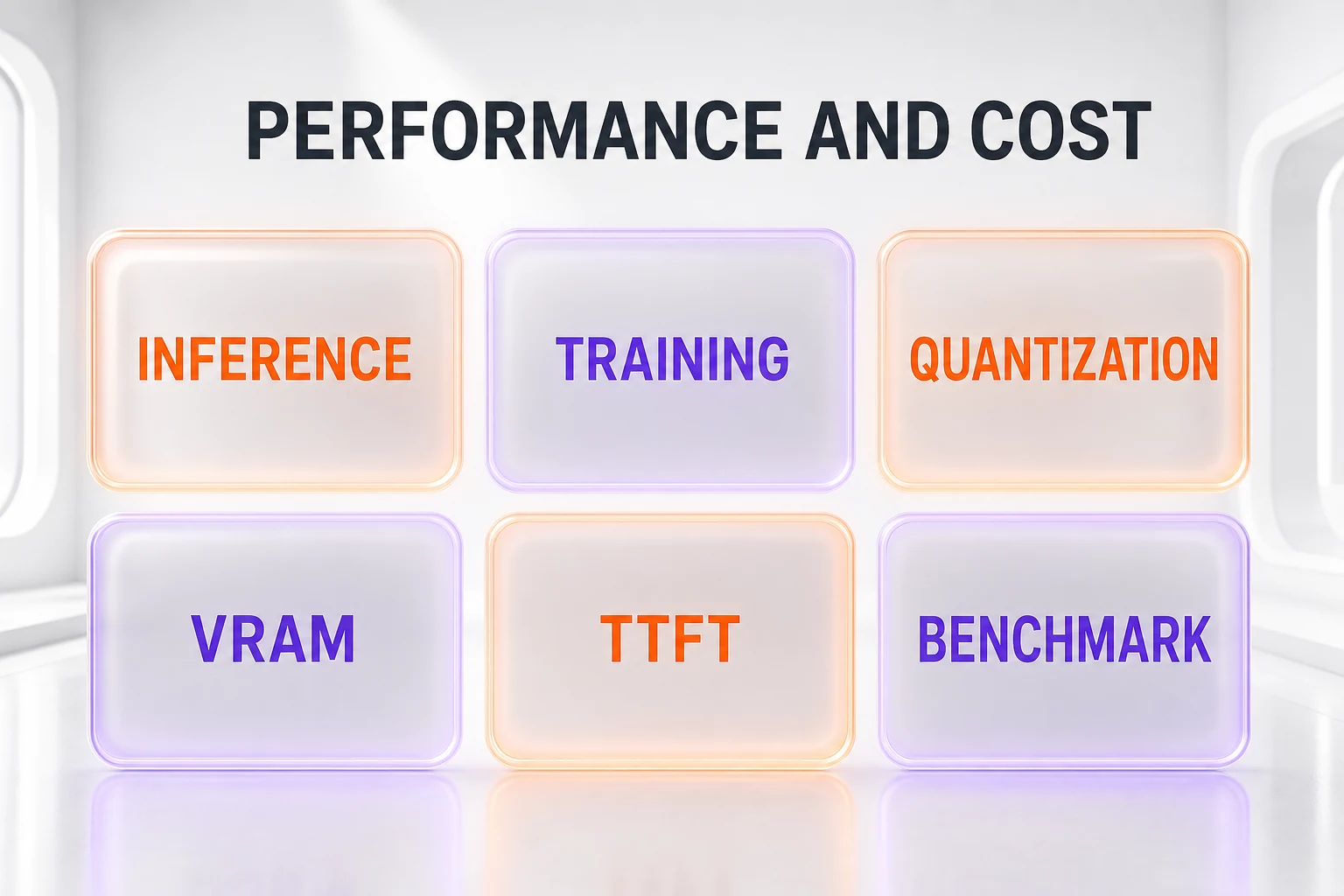
This section is about how fast a model runs, how much it costs, and what hardware it needs. These are the numbers on pricing pages and benchmark charts — the terms that decide whether a plan is affordable and whether a model will even fit on your machine.
Inference
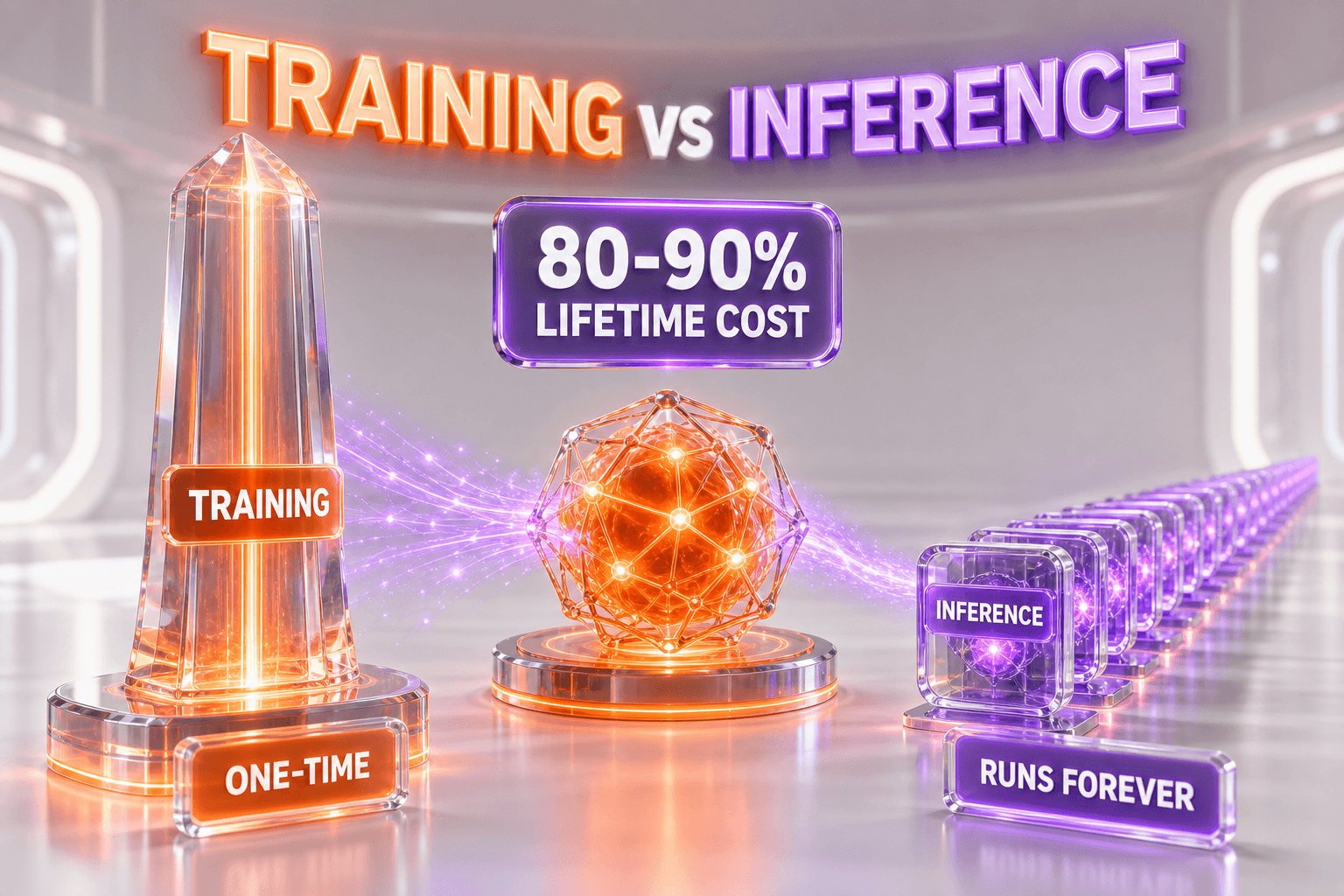
Inference is the act of running a trained model to produce an output — every time you send a prompt and get a response, that is one inference. It is distinct from training, which is the far more expensive process of creating the model in the first place. Inference cost, billed per token, is what you actually pay day to day; our guide on cutting your AI API costs covers how to lower it.
Training
Training is the one-time, compute-heavy process of creating a model by feeding it enormous amounts of data and adjusting its parameters until it predicts well. It can cost millions of dollars and take weeks on thousands of GPUs. Once trained, the model is used many times over through inference — the cheap, fast part.
Quantization
Quantization shrinks a model by storing its parameters at lower numerical precision — for example 4-bit instead of 16-bit — which cuts memory use and speeds up inference with only a small quality loss. It is the main trick that lets big models run on consumer hardware. See how it affects memory in our guide to how much VRAM you need to run an LLM.
VRAM
VRAM is the dedicated memory on a graphics card, and it is the main hardware limit on which models you can run locally, because the model's parameters must fit inside it. A rough guide: a 7-billion-parameter model needs about 8 GB of VRAM when quantized. Our VRAM explainer gives the full sizing math.
Latency
Latency is the delay between sending a request and getting a response. For chat it feels like responsiveness; for agents doing many steps it compounds into real waiting time. Latency depends on model size, prompt length, hardware, and how much reasoning the model does before it replies.
Time to first token (TTFT)
TTFT measures how long you wait from sending a prompt until the very first token of the reply appears. It is what makes a model feel snappy or sluggish, especially in a streaming chat interface. A low TTFT matters most for interactive use; total speed also depends on how fast the tokens come after the first one.
Throughput (tokens per second)
Throughput is how many tokens a model generates each second once it starts replying — usually quoted as tokens per second. Higher throughput means faster completions and, for a provider, more requests served per GPU. It is a key number for anyone running models at scale or streaming long outputs.
Benchmark
A benchmark is a standardized test used to measure and compare model capabilities, such as SWE-bench for coding or MMLU for general knowledge. Benchmarks give a common yardstick, but they can be gamed or leak into training data, so treat any single score with care. Our breakdown of SWE-bench Pro versus SWE-bench Verified shows why the details matter.
Prompt caching
Prompt caching lets a provider store the processed form of a repeated prompt prefix — like a long system prompt or document — so it does not have to be reprocessed on every call, cutting both cost and latency. Cached input tokens are billed at a steep discount. It is one of the easiest wins for high-volume apps; see our cost-cutting guide.
Batch API
A batch API lets you submit many requests at once for processing within a window — often up to 24 hours — in exchange for a large discount, typically around half price. It suits non-urgent, high-volume jobs like bulk classification or content generation. You trade immediacy for cost, the opposite priority from an interactive chat.
Safety & Quality
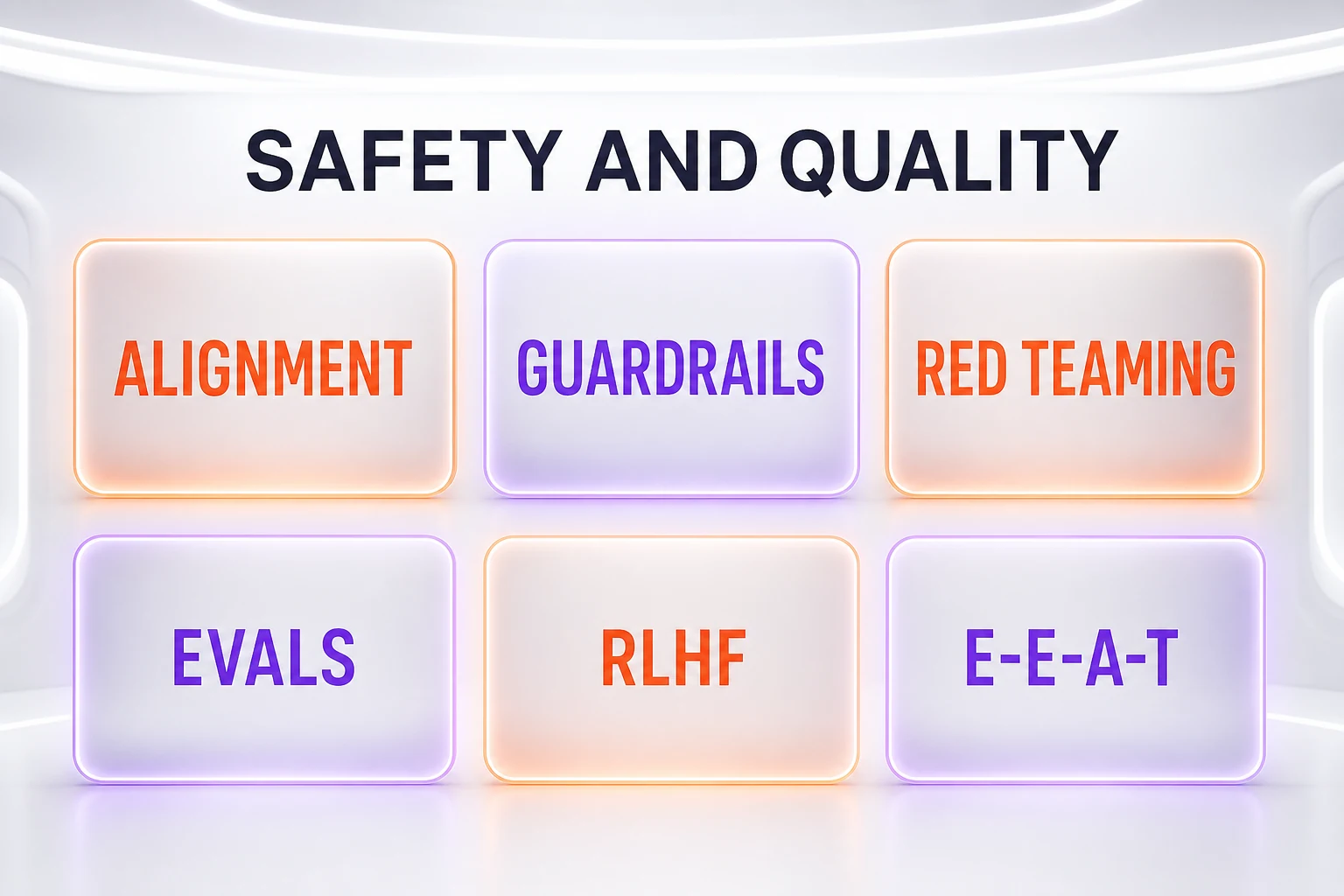
The last section covers how AI is kept honest, safe, and measurable — plus the quality signal that decides whether your content gets cited by AI search at all. These terms matter more every year as models get more capable and more autonomous.
Alignment
Alignment is the effort to make an AI system pursue what its designers and users actually intend — safely and honestly — rather than exploiting loopholes or producing harmful output. It spans training techniques, testing, and oversight. Alignment is the central research problem behind trustworthy AI as models grow more capable.
Guardrails
Guardrails are the rules and filters placed around a model to keep it from producing disallowed content or taking unsafe actions — for example refusing dangerous requests or blocking private-data leaks. They can live in the system prompt, in a separate moderation model, or in the surrounding code. Guardrails control behavior at runtime, distinct from the deeper work of alignment.
Red teaming
Red teaming is deliberately attacking your own AI system — trying to trick it into breaking its rules, leaking data, or misbehaving — so you can find and fix weaknesses before real users or bad actors do. It borrows the term from cybersecurity. Serious labs red-team every major model before release.
Evals
Evals, short for evaluations, are structured tests that measure whether a model or AI system meets your quality bar on the tasks you care about — from accuracy to safety to formatting. Unlike public benchmarks, good evals are tailored to your specific use case. "You cannot improve what you cannot measure" is why teams invest in them; related reading is our look at how coding benchmarks are scored.
RLHF (Reinforcement Learning from Human Feedback)
RLHF is a training method where humans rank a model's possible answers, and that feedback is used to steer it toward responses people prefer — more helpful, honest, and harmless. It is a big part of why raw language models became usable chat assistants. Newer variants use AI feedback in place of some human labeling to scale the process.
E-E-A-T for AI search
E-E-A-T — Experience, Expertise, Authoritativeness, and Trustworthiness — is Google's framework for judging content quality, and it increasingly shapes what AI search engines choose to cite. For creators, it means showing real authorship, sourcing claims, and demonstrating first-hand experience. Our SEO, GEO, and AEO guide explains how to earn it in the age of AI answers.
Where to Go Deeper
This glossary is intentionally short — one or two sentences per term. When a concept clicks and you want the full picture, these explainers and guides pick up where the definition stops. They are the backbone of everything else on the site:
- How large language models work — the mechanics behind tokens, parameters, and prediction, with no math.
- What RAG is — retrieve, augment, generate, and the building blocks that power it.
- What AI agents are and the rise of AI agents in 2026.
- What MCP is — the open standard that connects assistants to tools.
- Agentic coding models versus chatbots — why "agentic" changes everything.
- Closed versus open-weight models and how to self-host one.
- AI model pricing explained and how to cut your AI API costs.
- How much VRAM you need to run an LLM — the local-hardware sizing guide.
- SWE-bench Pro versus SWE-bench Verified — how to read AI coding scores.
- Ready to pick a tool? Compare Claude Code versus Cursor or browse the best AI coding tools of 2026.
Keep this page bookmarked. The vocabulary of AI moves fast, and a shared, plain-English definition is the quickest way to cut through the hype and understand what a new model, feature, or headline actually means.
Frequently Asked Questions
What is an AI glossary, and who is this one for?
An AI glossary is a plain-English reference that defines the core vocabulary of artificial intelligence — words like token, agent, RAG, and quantization that appear everywhere without explanation. This one covers more than 45 essential terms for 2026, each defined in one or two sentences, and it is written for anyone who uses or reads about AI and wants the jargon to finally make sense.
What is the difference between a token and a parameter?
A token is a chunk of text — about three-quarters of a word — that a model reads and writes, and it is the unit used to measure prompts, responses, and API cost. A parameter is one of the billions of internal numbers a model adjusts during training to store what it learned. In short, tokens are what flow through a model at runtime; parameters are what the model is made of.
What is the difference between an LLM and an AI agent?
A large language model (LLM) predicts text and answers in a single turn — you ask, it replies. An AI agent uses an LLM as its brain but pursues a goal over many steps, planning, using tools, running code, and adjusting based on the results. Put simply, a chatbot replies while an agent acts.
What does "agentic" mean in AI?
Agentic describes AI that acts with autonomy — making decisions and taking actions toward a goal — rather than only producing text. An agentic coding model, for example, can edit files, run tests, and fix its own errors across a whole project. It is one of the defining shifts of 2026.
What is the difference between RAG and fine-tuning?
RAG gives a model external knowledge at answer time by retrieving relevant passages and adding them to the prompt, without changing the model — so facts update the moment you update a document. Fine-tuning changes how the model behaves by continuing its training on examples, teaching a style, format, or skill. Use RAG for current, verifiable knowledge and fine-tuning for consistent behavior.
What are open-weight models, and why do they matter?
An open-weight model publishes its trained parameters for anyone to download, run, and fine-tune on their own hardware, unlike a closed model reachable only through an API. That means privacy, control, and no per-token API bill. The training data and code often stay private, though, so open weights are not the same as fully open source.
What is quantization, and why does it reduce VRAM?
Quantization stores a model’s parameters at lower numerical precision — for example 4-bit instead of 16-bit — so each parameter takes less memory. Because a model’s parameters must fit in a graphics card’s VRAM to run locally, quantizing a model shrinks its memory footprint and lets far larger models fit on consumer hardware, with only a small quality loss.
What is the difference between training and inference?
Training is the one-time, expensive process of creating a model by feeding it huge amounts of data and adjusting its parameters — it can cost millions of dollars and take weeks on thousands of GPUs. Inference is running the finished model to get an answer, which happens every time you send a prompt. Training builds the model; inference uses it, and inference is what you pay for day to day.
What is a context window, and how big are they in 2026?
The context window is the maximum amount of text, measured in tokens, that a model can consider at once — your prompt, pasted documents, the conversation so far, and its own reply. Anything beyond the limit falls out of view. In 2026, context windows range from tens of thousands of tokens to one million or more on frontier models.
What is MCP (Model Context Protocol)?
MCP is an open standard introduced by Anthropic that lets AI assistants connect to external tools, data, and services through one consistent interface. Instead of building a custom integration for every app, a tool exposes an "MCP server" that any MCP-capable assistant can use. It has become the de facto way to give agents access to tools.
What does TTFT (time to first token) measure?
TTFT measures how long you wait from sending a prompt until the first token of the reply appears. It is what makes a model feel fast or sluggish in a streaming chat. A low TTFT matters most for interactive use, while total speed also depends on throughput — how many tokens per second arrive after the first one.
What is E-E-A-T for AI search?
E-E-A-T stands for Experience, Expertise, Authoritativeness, and Trustworthiness — Google’s framework for judging content quality, which increasingly shapes what AI search engines choose to cite. For creators it means showing real authorship, sourcing claims, and demonstrating first-hand experience so both search engines and AI answer engines treat the content as reliable.