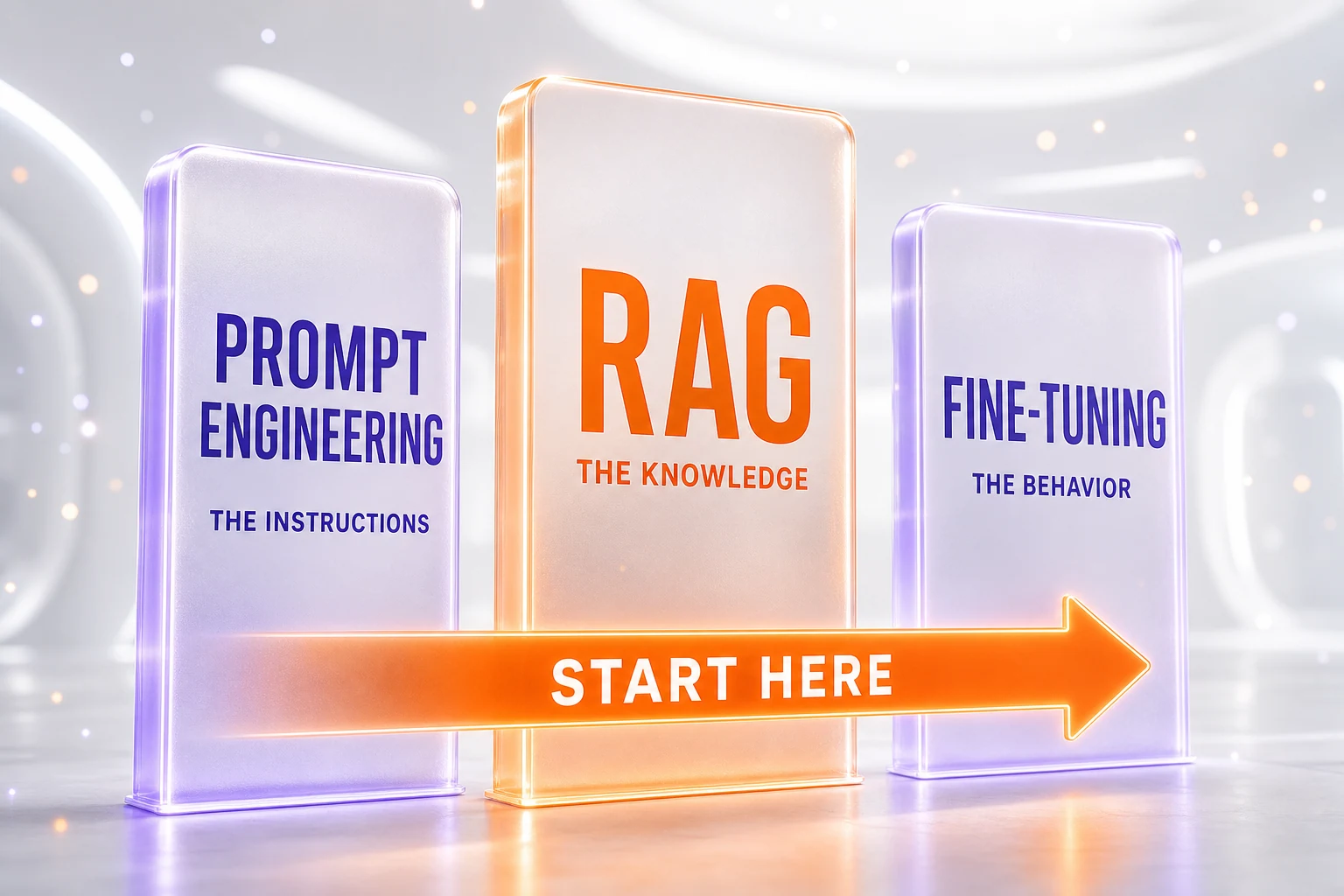
Prompt engineering, RAG, and fine-tuning are three different ways to steer a large language model, and they are not interchangeable. Prompt engineering changes the instructions you give the model. Retrieval-augmented generation (RAG) changes the knowledge the model can see by feeding it your own documents at answer time. Fine-tuning changes the behavior of the model by continuing its training. The decision rule is simple: start with prompt engineering, add RAG when the model needs data it was never trained on, and fine-tune only when prompting and RAG both fall short on behavior, format, or latency.
Most teams get this backwards. They reach for fine-tuning first because it sounds the most powerful, burn weeks building a dataset, and end up with a model that still invents facts and has already gone stale. This is the decision guide we wish every team had before spending that money: what each approach actually changes, a side-by-side on cost, speed, data freshness, maintenance, and skills, the specific jobs each one is built for, the combinations that work, and the classic mistakes that waste the most time. If you want the deep mechanics of retrieval itself, our plain-English explainer on how RAG works covers the pipeline in detail — here we focus purely on the decision.
The Short Answer: Which One Do You Actually Need?
You almost never choose one of these three in isolation. They sit in a natural order, from cheapest and fastest to most expensive and slowest, and you move down the list only when the cheaper option runs out of road.
- Start with prompt engineering. Rewrite the instruction, add a few examples, and give the model the context it needs in the prompt. It costs nothing but tokens and takes minutes. A surprising share of "we need a custom model" problems are really "we need a better prompt" problems.
- Add RAG when the model needs your data — or anything that changes. If the answer lives in documents the model was never trained on — your product docs, a support archive, last week's pricing — retrieval is the right tool. It supplies fresh, private, verifiable knowledge without touching the model.
- Fine-tune only when both fall short. If, after a strong prompt and good retrieval, the model still will not hold a format, tone, or specialized behavior — or you need lower latency and cost at high volume — then fine-tuning earns its keep.
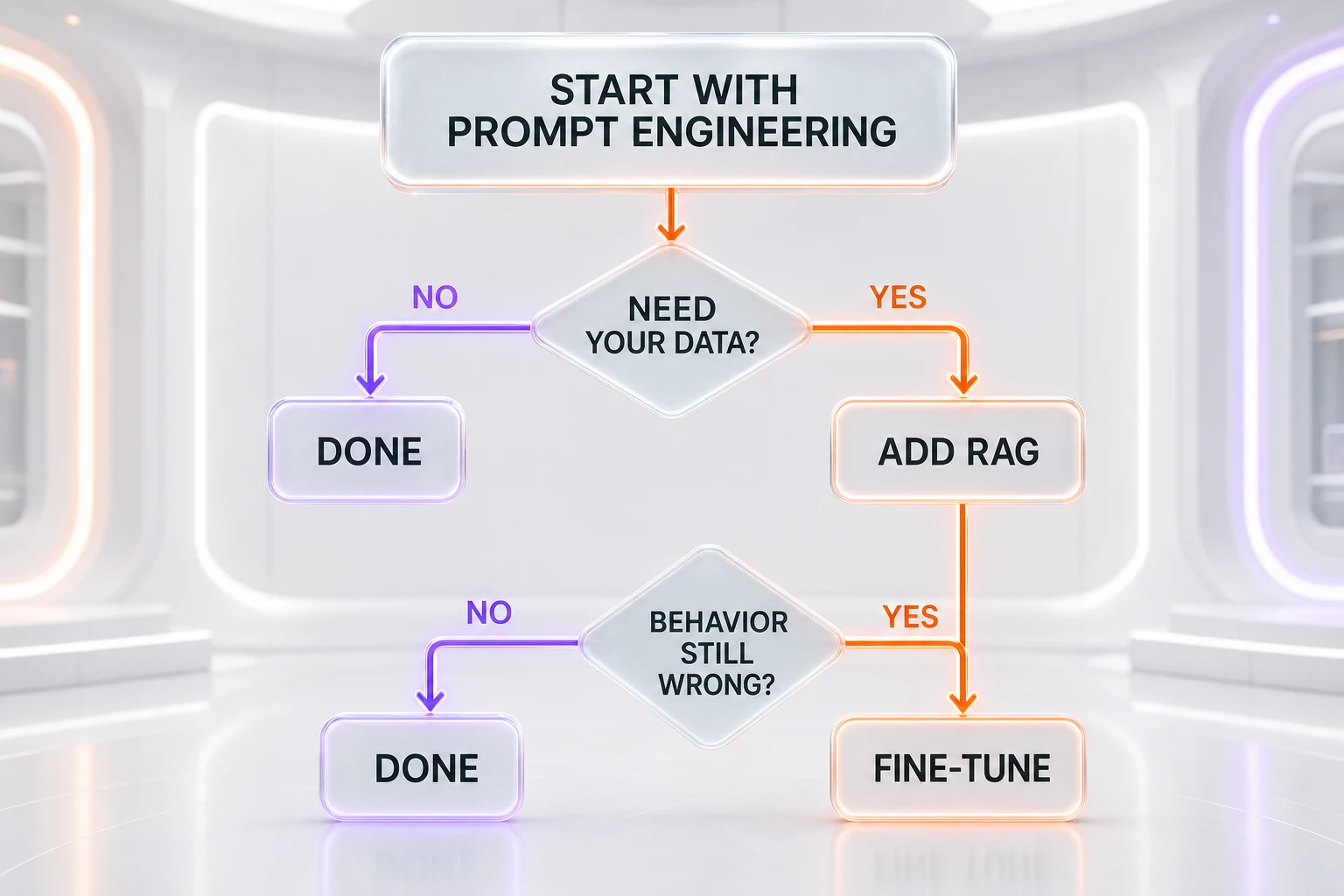
Read that as a flowchart, not a menu. The question is never "RAG or fine-tuning?" It is "have I exhausted the cheaper layer before paying for the next one?" The three approaches solve different problems, so the honest answer to "which one do I need?" is usually "prompt engineering now, RAG soon, and fine-tuning maybe never."
What Each Approach Actually Changes
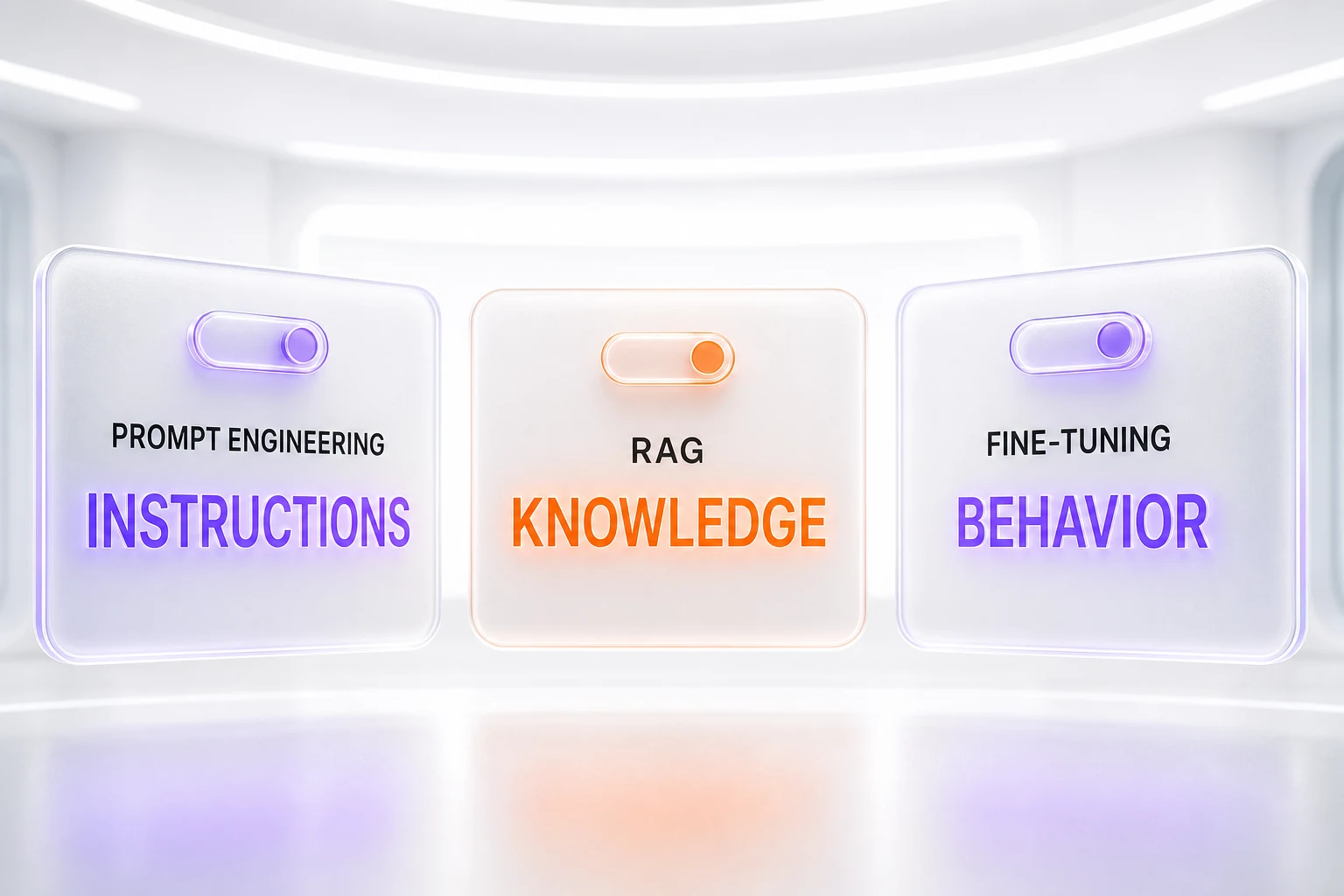
The fastest way to stop confusing these three is to notice that each one touches a different part of the system. Prompt engineering touches the input, RAG touches the context, and fine-tuning touches the model itself. Keep that mapping straight and most of the confusion disappears.
Prompt Engineering Changes the Instructions
Prompt engineering is the craft of getting a better answer out of the same model by changing what you send it. That includes the system prompt that sets the model's role, a few worked examples that show the pattern you want (few-shot prompting), an instruction to reason step by step, and a precise description of the output format. Nothing about the model changes — you are working with an off-the-shelf model such as Claude Opus 4.8 or GPT-5.5 exactly as it shipped, and simply steering it with words. Because the model already has enormous general capability baked into its weights during training — the process our explainer on how large language models work walks through — a well-designed prompt unlocks far more than people expect. It is the cheapest, fastest lever, and it should always be the first one you pull.
RAG Changes the Knowledge
RAG changes what the model can see at the moment it answers. Instead of relying only on what the model memorized during training, a retrieval step searches an external store of your documents, pulls the most relevant passages, and pastes them into the prompt so the model answers from real source text. The model's weights are untouched; you are changing its context, not its brain. This is the right tool whenever the problem is facts — the model needs information it was never trained on, especially information that changes. Update a document and the next answer reflects it instantly, with no retraining, and the model can cite which passage it used so a human can verify the claim. The full retrieve-augment-generate pipeline, along with embeddings, chunking, and reranking, is covered in our RAG explainer.
Fine-Tuning Changes the Behavior
Fine-tuning is the only one of the three that actually changes the model. You continue training a base model on your own examples so its weights shift, teaching it a style, a format, a tone, or a narrow specialized skill — always replying in a particular JSON shape, adopting a house voice, or handling a niche classification task better than the general model does. It bakes behavior in, but it does not give the model live access to a knowledge base, and it goes stale the moment your facts change. Fine-tuning also comes in lighter forms: parameter-efficient methods such as LoRA adapters train only a small slice of the model, which is cheaper than a full fine-tune and is often what "fine-tuning" means in practice. It is easiest to do on open-weight models you control — the tradeoffs are in our guide to closed versus open-weight models, and the mechanics of running your own model are in our self-hosting guide.
Side-by-Side: Cost, Speed, Freshness, Maintenance, Skills
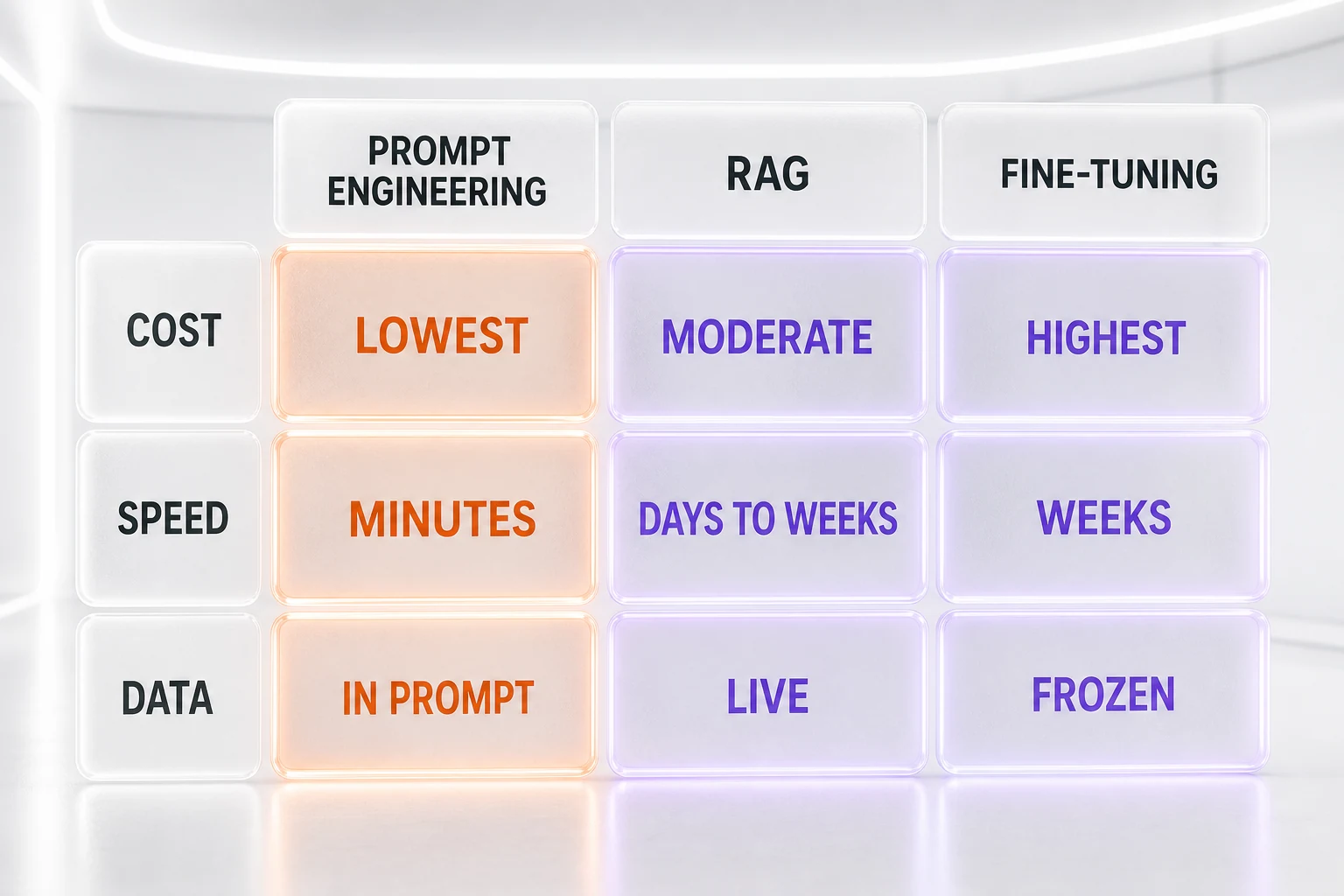
When you line the three approaches up against the practical questions a team actually asks — how much will this cost, how fast can we ship, will the answers stay current, who has to maintain it, and who is qualified to build it — a clear pattern appears. Effort and cost climb steeply as you move from prompting to RAG to fine-tuning, which is exactly why you work down the list in that order.
| Dimension | Prompt Engineering | RAG | Fine-Tuning |
|---|---|---|---|
| What it changes | The instructions | The knowledge | The behavior |
| Cost | Lowest — just tokens | Moderate — retrieval infrastructure | Highest — training and hosting |
| Time to first result | Minutes | Days to weeks | Weeks |
| Data freshness | Only what is in the prompt | Live — update a document, instantly reflected | Frozen at training time |
| Maintenance | Low — edit text | Ongoing — keep the index and retrieval healthy | High — retrain when data or base model changes |
| Skills required | Prompt design — almost anyone | Software and data engineering | Machine-learning engineering |
| Best for | General tasks and quick wins | Proprietary or fast-changing knowledge, with citations | Consistent format, tone, or a narrow specialized skill |
Two rows matter most. Data freshness is the line that decides between RAG and fine-tuning for anything factual: RAG is live and fine-tuning is frozen, so if your knowledge changes, retrieval wins by default. And cost is why prompting comes first: token spend is the lowest of the three, and the details of what you pay per token are in our breakdown of AI model pricing. Stuffing a huge static document into every prompt looks free but quietly becomes the most expensive option at volume, which is one of the reasons RAG exists.
When to Use Prompt Engineering
Prompt engineering is the right tool for the widest range of problems, and it should be your default until it visibly stops working. Because the frontier models already know an enormous amount and follow instructions well, most tasks that feel like they need a custom model are solved by a clearer prompt and two or three good examples.
Reach for prompting alone when the task relies on general knowledge and reasoning the model already has: summarizing a document you paste in, drafting and rewriting copy, extracting structured fields from text, translating, classifying sentiment, or writing and explaining code. It is also the fastest way to prototype anything — before you build retrieval or train a model, you should always confirm that a strong prompt cannot already get you 80 percent of the way there. In practice, few-shot examples fix most "the model keeps formatting it wrong" complaints, and a sharper system prompt fixes most "the tone is off" complaints, at zero infrastructure cost. Prompt engineering only runs out of road on two fronts: when the model needs facts it does not have (a job for RAG) or when it needs to internalize a behavior so consistently that examples in the prompt are not enough (a job for fine-tuning).
When to Use RAG
RAG is the right tool the moment the answer depends on knowledge the model was never trained on. That covers a huge share of real business AI, because the useful answer almost always lives in documents that are private, current, or both.
The flagship case is customer support that quotes your actual help center and policies instead of plausible-sounding fiction. Close behind is the internal knowledge assistant — point retrieval at your wikis, runbooks, and past tickets, and new hires can ask "how do we deploy to staging?" and get an answer sourced from real documents. RAG also dominates high-stakes domains like legal, compliance, and research, where every answer must be traceable to a cited passage rather than paraphrased from memory. The common thread is that the knowledge changes or is proprietary: pricing, inventory, documentation, contracts, this quarter's numbers. Because RAG keeps that knowledge in an external store, you can also run the whole pipeline in-house on an open-weight model such as DeepSeek V4 or Llama 4 and keep sensitive data on your own hardware. Crucially, RAG is what you use to inject facts — not fine-tuning, which is the single most common and most expensive mistake teams make.
When to Use Fine-Tuning
Fine-tuning is the right tool only when the problem is not what the model knows but how it behaves — and only after prompting and RAG have genuinely failed to get you there. It is the smallest of the three by frequency of appropriate use, and that is by design: it is the most expensive to build and the hardest to maintain.
The situations where it pays off are specific. You need the model to hold a rigid output format across millions of calls, and few-shot examples in the prompt are not reliable enough. You need a distinctive brand voice or a domain style baked in so deeply that you do not want to spend prompt tokens re-teaching it every time. You have a narrow, well-defined task — a specialized classifier, a structured-extraction step, a niche coding dialect — where a smaller fine-tuned model beats a larger general one on accuracy, latency, or cost at scale. That last point is often the real driver: a fine-tuned small model can be dramatically cheaper and faster to serve at high volume than prompting a frontier model on every request. What fine-tuning is not for is teaching the model new facts; for that, the facts belong in a retrieval store, not in the weights.
They Are Combos, Not Rivals
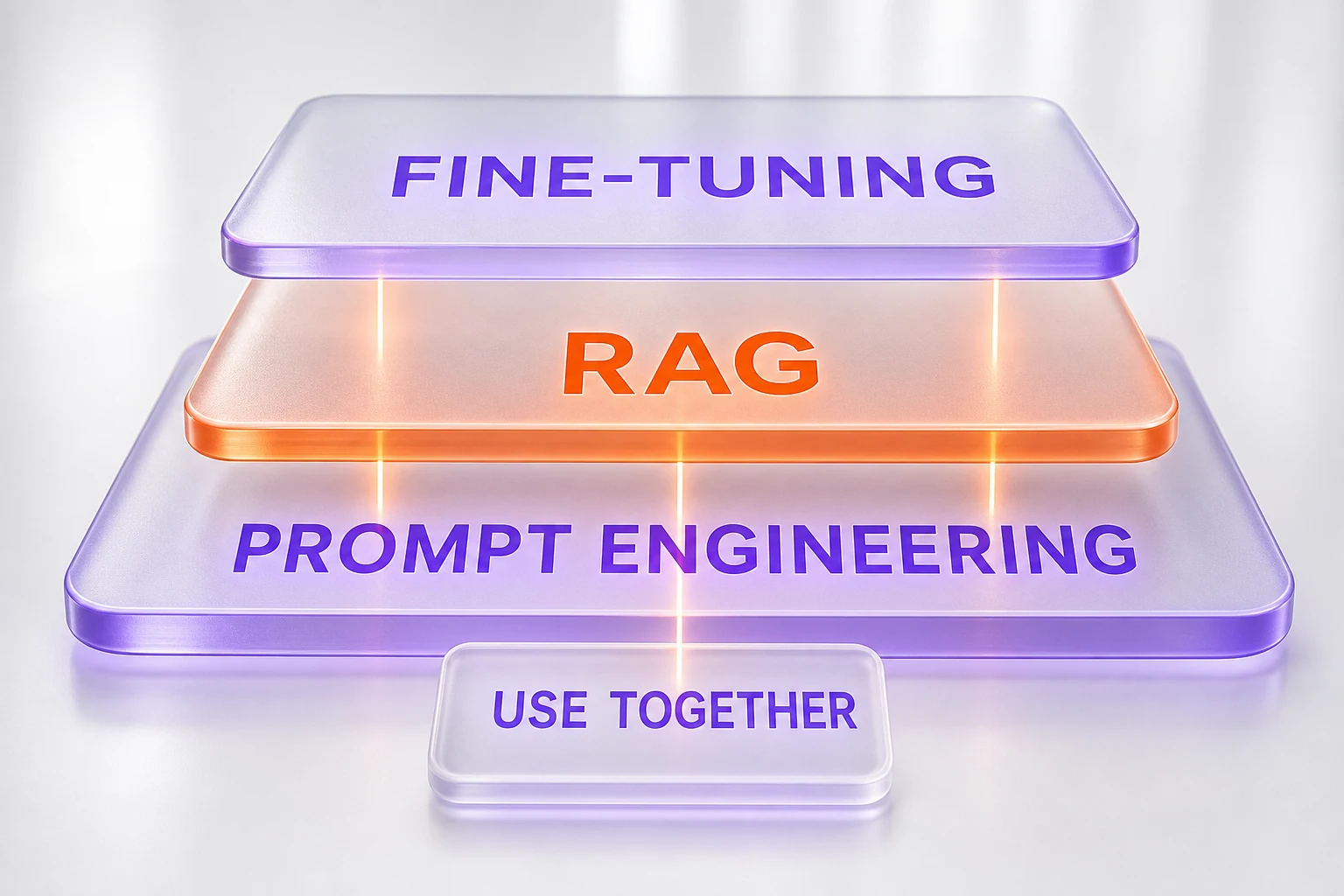
The framing of "RAG versus fine-tuning" is misleading, because the most capable production systems use all three together. They are layers, not alternatives, and each one handles the job the others cannot.
The classic stack looks like this: fine-tune a model so it reliably follows instructions and answers in exactly the format and voice you need, wrap it in RAG so it has fresh, verifiable facts to answer from, and drive the whole thing with a carefully engineered prompt that assembles the retrieved context and states the task. Fine-tuning fixes the behavior, RAG fixes the knowledge, and prompt engineering orchestrates the moment of answering. In modern agentic systems the combination goes further still: an AI agent decides when to retrieve, what to search for, and whether the passages it got back are good enough, treating retrieval as one tool among many alongside running code and calling APIs — the pattern we cover in what AI agents are and how they work. Seen that way, the question is never which approach to pick, but which layers your problem actually needs.
The Classic Mistakes
Nearly every expensive misstep with these three approaches comes from using the right tool for the wrong job. Four mistakes account for most of the wasted time and money.
Fine-Tuning to Inject Facts
This is the big one. Teams assume that if the model does not know something, they should fine-tune it on their documents to "teach" it the facts. It works badly. Fine-tuning shifts the model's behavior and style, but it is an unreliable way to store specific facts: the model may still misremember or invent them, you cannot cite a source, and the moment your data changes the fine-tune is stale and must be redone. Facts belong in a retrieval store you can update in seconds, not baked into weights you have to retrain. If the goal is "the model should know our current information," the answer is almost always RAG.
RAG Without Good Chunking
RAG can only be as good as what it retrieves, and retrieval quality is decided largely by how you split your documents into passages — the chunking step. Slice a document mid-thought, make chunks too large so the relevant sentence drowns in noise, or too small so the surrounding context is lost, and the retriever hands the model useless passages. A brilliant model on top of bad chunking still returns bad answers, because it never received the passage it needed. Much of the real work in production RAG is this unglamorous tuning, and skipping it is why many RAG pilots quietly disappoint.
Reaching for the Expensive Tool First
The mirror image of the facts mistake: teams jump straight to fine-tuning because it sounds serious, when a sharper prompt with a few examples would have solved the problem in an afternoon. Always exhaust prompt engineering before building retrieval, and exhaust retrieval before training a model. The cost curve is steep, and most problems never need to climb it.
Stuffing Everything Into the Prompt
The opposite failure: pasting an entire, ever-growing knowledge base into every prompt to avoid building retrieval. It works until it does not — costs balloon with each token, latency rises, and models get worse at finding the one relevant fact buried in a wall of context. Once the knowledge is large or changing, that is precisely the signal to move from prompt engineering to RAG.
The Decision Tree in Three Questions
When you are staring at a real problem, you do not need a framework — you need three questions, answered in order. Stop at the first one that solves your problem.
- Can a better prompt get you there? Rewrite the instruction, add a few examples, give the model the context it needs. If a strong prompt and a couple of worked examples produce the answer you want, you are done. Do not build anything else.
- Does the model need your data — facts it does not reliably know, or anything that changes? If yes, add RAG. Put the knowledge in a retrieval store, chunk it well, and let the model answer from real, current, citable passages. This is also the answer whenever you were tempted to fine-tune "so the model knows our information."
- After good prompting and RAG, is the behavior still wrong — or too slow or expensive at scale? Only now does fine-tuning earn its place. If the format, tone, or specialized skill still will not hold, or a smaller fine-tuned model would be materially cheaper and faster at high volume, fine-tune — on top of RAG, not instead of it.
Three questions, in that order, will route almost every project correctly. Most stop at question one. Many more stop at question two. Only a genuine minority ever need to answer yes to question three — and when they do, they keep the RAG and the prompt work they already built.
The Bottom Line
Prompt engineering, RAG, and fine-tuning are not competing answers to the same question — they are three different levers for three different problems. Prompt engineering changes the instructions and should always come first, because it is the cheapest and fastest way to improve an answer. RAG changes the knowledge and is the right tool the moment the model needs your data or anything that changes, because it keeps facts live and verifiable without retraining. Fine-tuning changes the behavior and earns its cost only when prompting and RAG both fall short on format, tone, or latency at scale — and never as a way to inject facts. Work down the list in that order, combine the layers when a serious system needs them, and you will spend your effort exactly where it moves the needle, instead of building a custom model to solve a problem a better prompt already had covered.
Frequently Asked Questions
RAG vs fine-tuning vs prompt engineering — which one do I need?
Start with prompt engineering, because it is the cheapest and fastest way to improve an answer and solves a surprising share of problems on its own. Add RAG when the model needs knowledge it was never trained on, such as your own documents or anything that changes. Fine-tune only when prompting and RAG both fall short on behavior, format, or latency. They sit in that order from cheapest to most expensive, and you move down the list only when the cheaper layer runs out of road.
What is the difference between RAG and fine-tuning?
RAG changes what a model knows by giving it external knowledge at answer time, without touching its weights, so facts update the moment you update a document. Fine-tuning changes how a model behaves by continuing its training on examples, teaching a style, format, or skill, but it goes stale when your facts change and cannot cite a source. Use RAG for current, verifiable knowledge and fine-tuning for consistent behavior. Sophisticated systems often use both together.
Is prompt engineering enough on its own?
Often, yes. Because frontier models already have enormous general knowledge and follow instructions well, a clear prompt with a few worked examples solves most tasks that rely on reasoning and general knowledge — summarizing, drafting, extraction, translation, classification, and coding. Prompt engineering only runs out of road when the model needs facts it does not have, which is a job for RAG, or when it must internalize a behavior so consistently that examples in the prompt are not enough, which is a job for fine-tuning.
Can fine-tuning teach a model new facts?
Not reliably, and trying to is the most common expensive mistake. Fine-tuning shifts a model's behavior and style, but it is a poor way to store specific facts: the model may still misremember or invent them, you cannot cite a source, and the fine-tune goes stale the moment your data changes. Facts belong in a retrieval store you can update in seconds. If the goal is that the model should know your current information, the right tool is almost always RAG, not fine-tuning.
Which is cheaper, RAG or fine-tuning?
Prompt engineering is cheapest of all, costing only tokens. RAG is moderate — you pay for embeddings, a vector store, and the retrieval infrastructure. Fine-tuning is the most expensive, because you pay for data preparation, training compute, and hosting a custom model, plus retraining whenever your data or the base model changes. That said, a small fine-tuned model can be cheaper to serve at very high volume than prompting a frontier model on every request, which is one of the few cases where fine-tuning saves money.
Do I have to choose only one approach?
No, and the best systems do not. Prompt engineering, RAG, and fine-tuning are complementary layers, not rivals. A common production stack fine-tunes a model for reliable format and voice, wraps it in RAG so it has fresh, verifiable facts, and drives it with a carefully engineered prompt that assembles the retrieved context. Fine-tuning fixes behavior, RAG fixes knowledge, and prompt engineering orchestrates the answer. The real question is which layers your problem needs, not which single approach to pick.
When should I use RAG instead of a longer prompt?
Move from prompting to RAG when the knowledge is large or changing. Pasting an entire knowledge base into every prompt works until costs balloon with each token, latency rises, and the model gets worse at finding the one relevant fact in a wall of context. RAG retrieves only the passages that matter for each question, keeps the source easy to update, and lets the model cite what it used. If your reference material is small and static, a longer prompt is fine; once it grows or changes, retrieval wins.
How long does each approach take to set up?
Prompt engineering takes minutes — you are editing text and testing examples. RAG takes days to weeks, because you have to ingest documents, choose a chunking strategy, stand up a vector store, and tune retrieval quality. Fine-tuning takes weeks, dominated by preparing a clean labeled dataset, running training, and evaluating the result before you trust it. The steep climb in setup time is the main reason you should exhaust each cheaper layer before paying for the next.
Does fine-tuning work on any AI model?
It is easiest on open-weight models you control, such as DeepSeek V4, Llama 4, or Mistral Large 3, because you can train and host them yourself. Some closed providers also offer managed fine-tuning of their hosted models through an API. In both cases, lighter parameter-efficient methods like LoRA adapters train only a small slice of the model and are cheaper than a full fine-tune, which is usually what fine-tuning means in practice. Open weights give you the most freedom and keep sensitive data in-house.
Why does bad chunking ruin a RAG system?
Because RAG can only be as good as what it retrieves, and how you split documents into passages decides what gets retrieved. Cut a document mid-thought and the passage loses the context that made it meaningful; make chunks too large and the relevant sentence drowns in noise; too small and the surrounding context is lost. A capable model on top of bad chunking still returns bad answers, because it never received the passage it needed. Tuning this unglamorous step is much of the real work in production RAG.
What skills does each approach require?
Prompt engineering requires almost no specialized skill beyond clear writing and a sense for examples — anyone on the team can do it. RAG requires software and data engineering: ingesting documents, managing embeddings and a vector database, and tuning retrieval. Fine-tuning requires machine-learning engineering: building and cleaning datasets, running training jobs, and evaluating the model rigorously before trusting it. The rising skill requirement tracks the rising cost, which is another reason to work from the cheapest layer upward.
What is a simple three-question test to decide?
Ask three questions in order and stop at the first yes. One: can a better prompt with a few examples get you there? If so, you are done. Two: does the model need your data — facts it does not reliably know, or anything that changes? If so, add RAG. Three: after good prompting and RAG, is the behavior still wrong, or too slow or expensive at scale? Only then fine-tune, and do it on top of RAG rather than instead of it. Most projects stop at question one or two.