
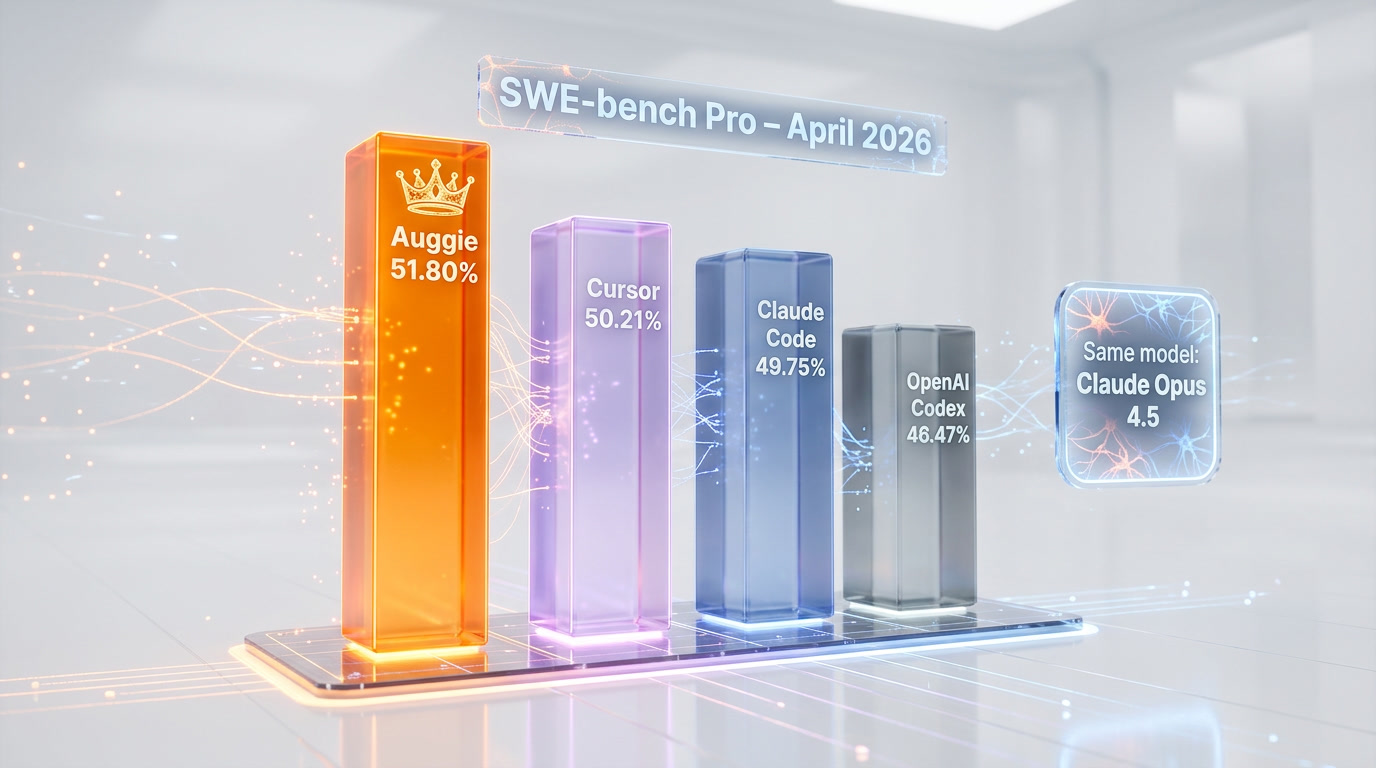
Augment Code is an AI software development platform built around a proprietary semantic Context Engine that indexes codebases of 400,000+ files. In April 2026, its Auggie CLI agent scored 51.80% on Scale AI's SWE-bench Pro benchmark — the highest of any tested agent, ahead of Cursor (50.21%), Claude Code (49.75%), and OpenAI Codex (46.47%). Founded in 2022 by Igor Ostrovsky and Guy Gur Ari, the company has raised $252 million including a $227M Series B at a $977M valuation. Pricing starts at $20 per month for the Indie plan with 40,000 credits.
Why Augment Code Matters Right Now
The AI coding assistant space has consolidated around a handful of serious players: GitHub Copilot dominates in IDE integrations, Cursor owns the agentic editor niche, and Claude Code has carved out terminal-first architectural reasoning. Augment Code enters this landscape with a fundamentally different bet — that context retrieval, not model quality alone, determines code generation quality.
The evidence is hard to dismiss. On SWE-bench Pro, four agents (Auggie, Cursor, Claude Code, and SWE-Agent) all used the same underlying model — Claude Opus 4.5. Yet Auggie solved 15 more problems than Cursor and 17 more than Claude Code out of 731 total. The difference? Augment's Context Engine builds a semantic index of the full codebase, mapping dependency chains, call sites, type definitions, and historical changes rather than relying on text-based search.
We have been testing Augment Code since its Indie plan launched, and the context-awareness difference is real — especially on repositories exceeding 50,000 lines of code where traditional grep-based approaches break down.
Pricing and Plans: From Solo Dev to Enterprise
| Plan | Price | credits per month | Users | Key Features |
|---|---|---|---|---|
| Indie | $20 per month | 40,000 | 1 | Context Engine, MCP & Native Tools, Code Review, SOC 2 Type II |
| Standard | $60 per month per dev | 130,000 | Up to 20 | Everything in Indie + Advanced Analytics, Slack, GitHub Multi Org |
| Max | $200 per month per dev | 450,000 | Up to 20 | Everything in Standard, for intensive usage teams |
| Enterprise | Custom | Custom | Unlimited | SSO/OIDC/SCIM, dedicated support, volume discounts, CMEK & ISO 42001 |
Best for: Professional developers working on large, complex codebases (50K+ LOC) who need deep cross-file understanding. Enterprise teams managing distributed systems with multiple repositories will see the biggest ROI from the Context Engine.
The credit-based model pools credits across teams, which means high-usage developers on a team can consume more while low-usage members use less. If you exceed your monthly credits, auto top-up adds 24,000 credits for $15. For the Indie plan, that works out to roughly 125 user messages per month — which Augment says covers about 70% of active developers' typical usage.
How Augment Code Stacks Up Against Competitors
| Feature | Augment Code | Cursor | GitHub Copilot | Claude Code |
|---|---|---|---|---|
| SWE-bench Pro Score | 51.80% | 50.21% | N/A | 49.75% |
| Starting Price | $20 per month | $20 per month (Pro) | $10 per month (Individual) | Usage-based (~$3-15/MTok) |
| Context Engine | Semantic, 400K+ files | Codebase indexing | Repo-level context | Full project context |
| IDE Support | VS Code, JetBrains, CLI | Custom VS Code fork | VS Code, JetBrains, Neovim | Terminal only |
| Multi-Agent | Intent (coordinated agents) | Background agents | Copilot Workspace | Single agent |
| Code Review | Built-in ($1.50 per PR) | No | Copilot for PRs | No |
| Pricing Model | Credit-based (pooled) | Per-seat, flat rate | Per-seat, flat rate | Token-based |
| Enterprise SSO | Yes (OIDC/SCIM) | Yes | Yes | No |
The comparison reveals Augment Code's specific advantage: it is the only platform combining a semantic codebase index, multi-agent orchestration (Intent), and built-in code review in a single product. However, GitHub Copilot remains significantly cheaper for individual developers at $10 per month, and Claude Code's pay-per-token model can be more cost-efficient for light usage.
The Context Engine: What Makes Augment Different
Augment Code's core technical differentiator is the Context Engine — a proprietary system that maintains a live semantic understanding of your entire codebase, including code, dependencies, architecture patterns, and git history. Unlike text-search approaches (grep, ripgrep) used by most competitors, the Context Engine uses semantic dependency analysis to understand relationships between code elements.
In practice, this means when you ask Augment to modify a function, it automatically retrieves the relevant dependency chains, call sites, type definitions, test fixtures, and historical changes — without you manually pointing it to the right files. According to Augment's own benchmarks, the Context Engine adds approximately 6 points over a bare SWE-Agent scaffold running the same model.
We tested this on a 120K-line TypeScript monorepo and the difference was noticeable. Augment consistently found the right files to modify across package boundaries, while competitors sometimes missed indirect dependencies. The effect scales: the larger and more interconnected your codebase, the bigger the advantage.
The Elasticsearch Benchmark
In a blind study on the Elasticsearch repository — 3.6 million lines of Java from 2,187 contributors — Augment's agents generated 500 pull requests that were compared against merged human code. The results were striking: Augment scored +12.8% overall, +14.8% on correctness, and +18.2% on code reuse compared to human baselines. Competing AI agents scored -13.9 and -11.8 on the same tasks.
This is particularly significant because Elasticsearch is a mature, complex enterprise project — exactly the kind of codebase where shallow context retrieval fails.
Auggie CLI: The Terminal Agent
Auggie CLI is Augment's answer to Claude Code — a terminal-native coding agent that brings the Context Engine to your command line. Installed via npm install -g @augmentcode/auggie, it operates in two modes:
- Interactive mode: Real-time streaming with visual progress indicators and tool call visibility
- Automation mode: Single-shot execution via
--printflag for CI/CD pipelines
Key capabilities include resumable sessions (pick up where you left off), parallel sub-agents for specialized tasks (security audits, test generation), custom commands for team workflows, and MCP support connecting to GitHub, Linear, and Jira. Auggie also supports the Agent Client Protocol (ACP), making it compatible with Zed, JetBrains, Neovim, and Emacs.
What sets Auggie CLI apart from Claude Code is the persistent semantic index. When you run Auggie in a project directory, it automatically indexes the codebase through the Context Engine. Claude Code reads files on-demand; Auggie pre-understands the architecture before you ask your first question.
Intent: Coordinated Multi-Agent Development
Launched in public beta on February 26, 2026, Intent is Augment's most ambitious product — a workspace for coordinating multiple AI agents on real codebases. The architecture follows a three-phase pattern:
- Coordinator agent — Uses the Context Engine to analyze your task, then proposes a plan as a "living spec" for your approval
- Implementor agents — Run in parallel across isolated Git worktrees, each tackling a portion of the spec
- Verifier agent — Checks results against the spec, flagging inconsistencies, bugs, or missing pieces
Each workspace is backed by its own Git worktree, so agents can explore changes without affecting each other's work or your main branch. As agents implement, the living spec updates to reflect what was actually built — creating a synchronized document of intent and reality.
We have been experimenting with Intent on medium-sized feature work (500-2000 lines of change) and it works best when the task can be cleanly decomposed into independent subtasks. For tightly coupled changes, the coordination overhead sometimes exceeds the parallelism benefit.

Code Review: AI That Understands Context, Not Just Diffs
Augment's Code Review product ($1.50 per PR) is designed to catch logic errors, security vulnerabilities, and breaking changes — not just style nitpicks. Unlike diff-based review tools, it analyzes the changed files alongside their dependencies and the broader architecture using the Context Engine.
Teams can define coding conventions in plain English, point to existing style guides, and set rules per repository or per team. Augment then enforces these conventions on every PR. The company claims it has been benchmarked against 7 leading code review tools on production PRs, achieving the highest precision and recall.
At $1.50 per PR, the economics are straightforward: if it saves 90 seconds per review or catches a single production bug that would require a hotfix, it pays for itself. For a team merging 200 PRs per month, that is $300 per month — less than the cost of a single engineering hour in most markets.
Who Should Use Augment Code (And Who Shouldn't)
Best Fit
- Enterprise teams with large codebases (100K+ LOC) across multiple repositories — the Context Engine delivers outsized value here
- Teams needing compliance — SOC 2 Type II, CMEK, ISO 42001, SSO/SCIM are built in
- Organizations standardizing on AI dev tools — the platform covers IDE, CLI, code review, and multi-agent orchestration in one vendor
- Java/TypeScript/Python shops working on mature, interconnected codebases where cross-file context matters most
Less Ideal Fit
- Solo indie developers with small projects — the Context Engine advantage shrinks on sub-10K LOC codebases, and GitHub Copilot at $10 per month is more cost-effective
- Developers who want transparent pricing — the credit-based pooling model makes cost forecasting harder than Cursor's flat $20 per month or Copilot's per-seat pricing
- Teams already embedded in the GitHub ecosystem — Copilot's native integration with GitHub Issues, PRs, and Actions is tighter than what Augment offers
The $252M Question: Can Augment Code Sustain Its Lead?
Augment Code's $252 million in total funding (including a $227M Series B led by Sutter Hill Ventures at a $977M valuation) gives it significant runway to compete. Its customer list — MongoDB, Spotify, Crypto.com, Webflow, Snyk, MoneyGram, Pure Storage — demonstrates enterprise traction.
But the margin between Auggie and Cursor on SWE-bench Pro is thin: 51.80% vs 50.21%, or 15 problems out of 731. Model improvements from Anthropic or OpenAI could close that gap overnight. Augment's real moat is not benchmark scores — it is the Context Engine infrastructure and the enterprise sales motion built around compliance, team analytics, and multi-agent orchestration.
The competitive pressure is intense. GitHub Copilot has 1.8 million+ paying subscribers and Microsoft's distribution machine. Cursor raised $900M at a $9B valuation in early 2026. Claude Code benefits from Anthropic's model leadership. And new entrants like Warp and Antigravity are targeting overlapping niches.
We think Augment Code's best path is doubling down on what the others cannot easily replicate: deep codebase understanding at scale, coordinated multi-agent workflows via Intent, and enterprise-grade compliance. The SWE-bench Pro crown is a marketing win, but the Context Engine is the actual product.
Our Verdict
Augment Code is the most technically ambitious AI coding platform we have tested in 2026. The Context Engine genuinely works better on large codebases than anything else available — this is not marketing fluff. The SWE-bench Pro results confirm what we experienced hands-on: better context retrieval produces better code, even with identical underlying models.
The caveats are real: credit-based pricing is harder to forecast than flat-rate competitors, the Indie plan's 40,000 credits can run thin for heavy users, and the ecosystem is less mature than GitHub Copilot's. But for enterprise teams managing complex, multi-repo codebases, Augment Code offers a combination of capabilities — semantic indexing, multi-agent orchestration, built-in code review, and compliance certifications — that no single competitor matches today.
Bottom line: If your codebase is large enough to need it, Augment Code is the best AI coding platform for understanding and working across complex software systems. If your codebase is small, Cursor or Copilot will serve you just as well at a clearer price point.
Frequently Asked Questions
What is Augment Code and how does it differ from GitHub Copilot?
Augment Code is an AI software development platform built around a proprietary semantic Context Engine that indexes codebases of 400,000+ files. Unlike GitHub Copilot, which uses repository-level context within your IDE, Augment maps semantic relationships, dependency chains, and historical changes across your entire codebase. It also includes multi-agent orchestration (Intent) and built-in AI code review, features Copilot lacks. Pricing starts at $20 per month for the Indie plan vs Copilot's $10 per month Individual plan.
Is Augment Code really #1 on SWE-bench Pro?
Yes. As of April 2026, Auggie CLI scored 51.80% on Scale AI's SWE-bench Pro benchmark, solving 379 of 731 real-world software engineering problems. This places it ahead of Cursor (50.21%), Claude Code (49.75%), and OpenAI Codex (46.47%). Notably, Auggie, Cursor, and Claude Code all used the same underlying model (Claude Opus 4.5), with the performance difference attributed to Augment's Context Engine.
How much does Augment Code cost per month?
Augment Code offers four plans: Indie at $20 per month (40,000 credits, 1 user), Standard at $60 per month per developer (130,000 credits, up to 20 users), Max at $200 per month per developer (450,000 credits, up to 20 users), and Enterprise with custom pricing. Credits are pooled across teams, and additional credits cost $15 per 24,000 via auto top-up.
What is Augment Code's Context Engine?
The Context Engine is Augment's core technology — a semantic indexing system that maintains a live understanding of your codebase including code, dependencies, architecture patterns, and git history. It uses semantic dependency analysis rather than text-based search, automatically retrieving relevant dependency chains, call sites, type definitions, and test fixtures when you make changes. It adds approximately 6 points over standard SWE-Agent scaffolding on benchmarks.
Can I use Augment Code with VS Code and JetBrains?
Yes. Augment Code supports Visual Studio Code and JetBrains IDEs (IntelliJ IDEA and related products) through IDE extensions. It also offers Auggie CLI for terminal-based development, which supports the Agent Client Protocol (ACP) for compatibility with Zed, Neovim, and Emacs. Installation is via npm: npm install -g @augmentcode/auggie.
What is Augment Code Intent?
Intent is Augment's multi-agent orchestration workspace, launched in public beta on February 26, 2026. It coordinates multiple AI agents: a coordinator agent creates a plan (living spec), implementor agents execute tasks in parallel across isolated Git worktrees, and a verifier agent checks results. It is designed for complex feature work that can be decomposed into independent subtasks.
How does Augment Code's credit system work?
Each plan includes a monthly credit pool. Credits are consumed based on task complexity — more complex operations (multi-file changes, deep context retrieval) cost more credits than simple completions. Credits are pooled across team members on team plans, meaning high-usage developers can draw from the shared pool. If you exceed your monthly allocation, auto top-up adds 24,000 credits for $15. Credits from top-ups roll over for 12 months.
Is Augment Code better than Cursor for solo developers?
For solo developers working on small to medium projects, Cursor is generally the better choice. Its flat $20 per month pricing is more predictable than Augment's credit-based model, and Cursor's custom VS Code fork provides a more integrated editing experience. Augment Code's advantage emerges on larger codebases (50K+ LOC) where the semantic Context Engine provides significantly better cross-file understanding. For enterprise teams, Augment offers compliance features (SOC 2, ISO 42001, CMEK) and multi-agent orchestration that Cursor lacks.
Frequently Asked Questions
Is Augment Code better than Cursor for large codebases?
Yes, for large codebases. Augment Code scored 51.80% on SWE-bench Pro vs Cursor's 50.21% — both running Claude Opus 4.5. Augment solved 15 more problems out of 731, the difference coming from its semantic Context Engine indexing 400K+ files. Cursor remains excellent for agentic editor workflows on mid-sized projects, but Augment's architecture advantage compounds beyond 50,000 lines of code.
How does Augment Code compare to Claude Code?
Augment Code scored 51.80% vs Claude Code's 49.75% on SWE-bench Pro using the identical Claude Opus 4.5 model — a gap of 17 more problems solved out of 731. Augment adds a persistent semantic codebase index, VS Code and JetBrains IDE support, multi-agent Intent coordination, and built-in code review at $1.50 per PR. Claude Code is terminal-only with token-based pricing (roughly $3–15/MTok), making it more cost-efficient for light or exploratory usage.
Is Augment Code better than GitHub Copilot?
Augment Code outperforms GitHub Copilot on complex, multi-repo enterprise codebases through its semantic Context Engine and coordinated multi-agent Intent system. However, GitHub Copilot Individual costs $10 per month vs Augment's $20 per month Indie plan and has broader IDE coverage. For autocompletion on smaller projects, Copilot is more cost-effective. For architectural changes across distributed systems with 50K+ lines of code, Augment delivers measurably better results.
How does Augment Code compare to OpenAI Codex?
Augment Code significantly outperforms OpenAI Codex on SWE-bench Pro: 51.80% vs 46.47% — a gap of over 5 percentage points. This advantage comes from Augment's proprietary Context Engine, not from model differences. OpenAI Codex lacks a semantic codebase indexing layer, making it less effective on large, interconnected repositories with complex dependency chains.
Who should use Augment Code?
Augment Code is best suited for professional developers and enterprise teams on large, complex codebases exceeding 50,000 lines of code. Teams managing distributed systems, mature enterprise projects (similar to Elasticsearch at 3.6M lines), or multiple repositories will see the strongest ROI. The Indie plan at $20 per month covers solo developers; Standard at $60 per month per dev and Max at $200 per month per dev serve teams up to 20 developers with 130,000 and 450,000 monthly credits respectively.
What are Augment Code's limitations?
Augment Code's credit-based model can be restrictive: the Indie plan provides approximately 125 user messages per month. Intent multi-agent coordination introduces coordination overhead for tightly coupled changes and works best when tasks can be decomposed into independent subtasks in the 500–2,000 lines of change range. For small projects under 50K LOC, GitHub Copilot at $10 per month delivers comparable results at half the price. Auto top-up adds 24,000 credits for $15 when limits are exceeded.
Does Augment Code integrate with GitHub, Linear, or Jira?
Yes. Augment Code's Auggie CLI supports MCP (Model Context Protocol) connections to GitHub, Linear, and Jira natively. It also implements the Agent Client Protocol (ACP), enabling compatibility with Zed, JetBrains, Neovim, and Emacs. Enterprise plans add GitHub Multi Org support, Slack integration, SSO/OIDC/SCIM provisioning, and CMEK with ISO 42001 compliance.
What is Augment Code's Intent feature and how does it work?
Intent, launched in public beta on February 26, 2026, is Augment Code's multi-agent coordination workspace. A Coordinator agent uses the Context Engine to analyze your task and proposes a 'living spec' for your approval. Implementor agents then run in parallel across isolated Git worktrees, each handling a portion of the spec. A Verifier agent checks results for inconsistencies, bugs, or missing pieces. The living spec updates in real-time to reflect what was actually built, creating a synchronized record of intent and implementation.