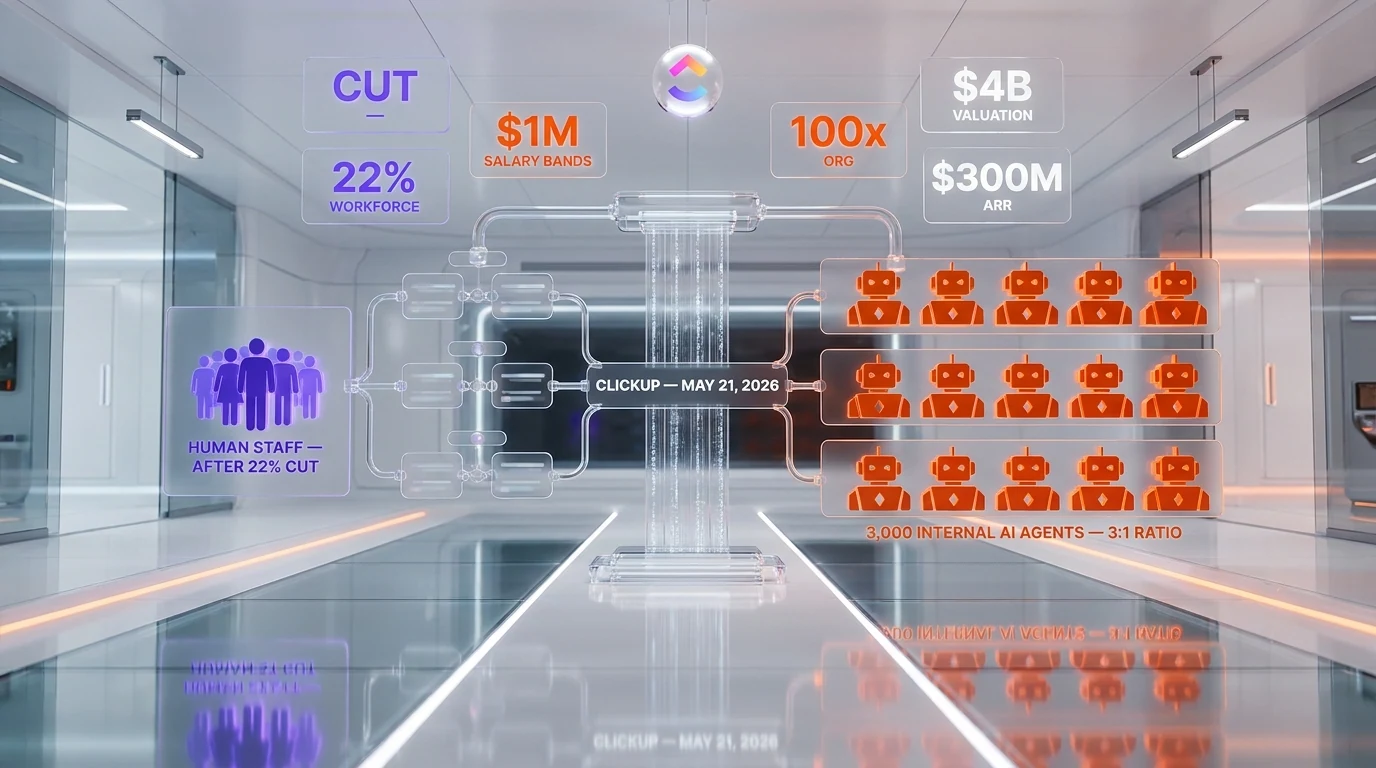
ClickUp announced a 22% workforce reduction on May 21, 2026, paired with new million-dollar salary bands for AI-savvy employees and roughly 3,000 internal AI agents — a 3:1 agent-to-employee ratio — under what CEO Zeb Evans calls a 100x organization pivot. In my reading, this is not a cost-cutting layoff dressed in AI marketing language. It is the cleanest live statement to date of the post-2026 employment contract at AI-native software companies.
Editorial Disclosure: This article is an editorial opinion piece from Anthony Martinez (CEO & Founder, ThePlanetTools.ai). We are not a ClickUp partner, we receive no compensation from ClickUp, and there is no affiliate program to disclose here. Internal links to our tool reviews and prior coverage remain editorial. Read our full editorial policy.What ClickUp actually announced
Per TechCrunch's reporting by Marina Temkin on May 25, 2026, ClickUp cut 22% of its workforce and deployed roughly 3,000 internal AI agents across the company to take on the work the reduction was vacating (TechCrunch). CEO Zeb Evans announced the change on X on Wednesday, May 21, 2026 at 7:34 PM, and per separate reporting in The Next Web the affected count was "in the low hundreds, spread across product, engineering, design, and customer-facing roles" inside a company valued at $4 billion with about $300 million in annual recurring revenue as of 2025 (The Next Web).
Here is the spine of what Evans wrote, in his own words where I quote verbatim:
- On the layoff framing. Per Evans, "This wasn't about cutting costs. Most savings from this change will flow directly back into the people who stay. We'll be introducing million-dollar salary bands."
- On the new comp ladder. Per Evans, "If you create outsized impact using AI, you'll be paid outside of traditional bands."
- On the employment contract itself. Per Evans, "The people that automate their jobs with AI will always have a job."
- On the AI productivity wedge. Per Evans, as quoted in The Next Web, "AI makes the best engineers wildly more productive, and everyone else using AI slows these engineers down. More code is just another bottleneck."
- On the operating shape. Per Evans, "the best engineers are not writing code any more. They are directing agents."
Notice the order. The compensation lever sits ahead of the AI lever in his own framing. That ordering matters, and I will come back to it.
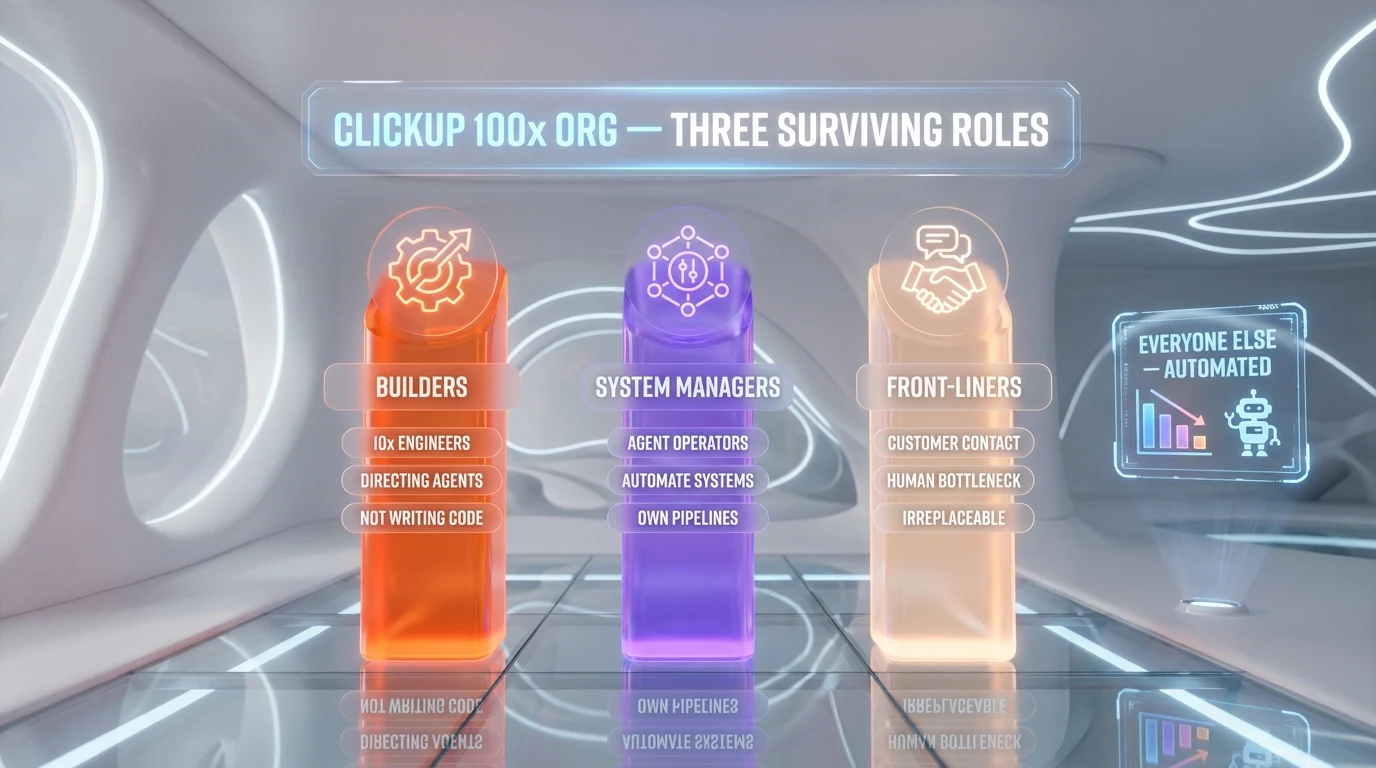
The three roles Evans says survive a 100x org
Per The Next Web's coverage of Evans's X post, the new ClickUp organization is built around three role categories, and in my reading these are the most important sentences of the announcement because they describe who the company is willing to pay a million dollars in cash.
- Builders. Per Evans, these are "10x engineers and product managers directing code-writing agents." In his framing, the best engineers are not the people typing the most code — they are the people composing, debugging, and steering agent workflows.
- System managers. These are operators of agent infrastructure: people who automate processes and own the resulting systems end-to-end. Per Evans's framing, this is where most of the historical middle of a software organization is being collapsed into agent supervision.
- Front-liners. Customer-facing staff. Per Evans's logic, human contact is the irreplaceable bottleneck — the role where a human in the loop is a feature, not a cost.
Everything outside those three buckets, in the framing on the page, is automatable. That is the part you cannot soft-pedal. ClickUp did not say "we are using AI to make people more productive." They said: if you are not building agents, running agents, or talking to customers, your role is on the wrong side of the new org chart.
Why I think this is different from the rest of the 2026 layoff wave
I have been tracking AI-related layoffs since early Q1, and the case I have been making to myself for months is that we are seeing two distinct phenomena get conflated under the same headline.
Pattern A — cost-cut, AI label. A company misses a quarter, lays off 8% to 15% of the org, and the press release includes the word "AI" because that is the polite frame for the trim. The AI work that follows is mostly operational efficiency, not a structural rebuild.
Pattern B — structural rebuild, AI engine. A company hits its revenue plan, lays off a meaningful slice of the org anyway, deploys agents into the gap, and rewrites the comp grid around AI leverage. The work that follows is a different operating system.
ClickUp's May 21 announcement is the cleanest live example of Pattern B I have seen this year, and the tell is the comp move. If this were Pattern A, Evans would have kept the comp grid stable and reinvested the savings into capex or reserves. He didn't. He moved the savings up the org chart into seven-figure cash bands for AI-leveraged roles. That is a hiring posture, not a cost-cutting posture.
For the broader Pattern A context, our earlier piece on AI becoming the number one reason for US layoffs in April 2026 tracked the headline-level wave. ClickUp is the same wave, but the shape is different.
The million-dollar band — how it actually works, as we understand it
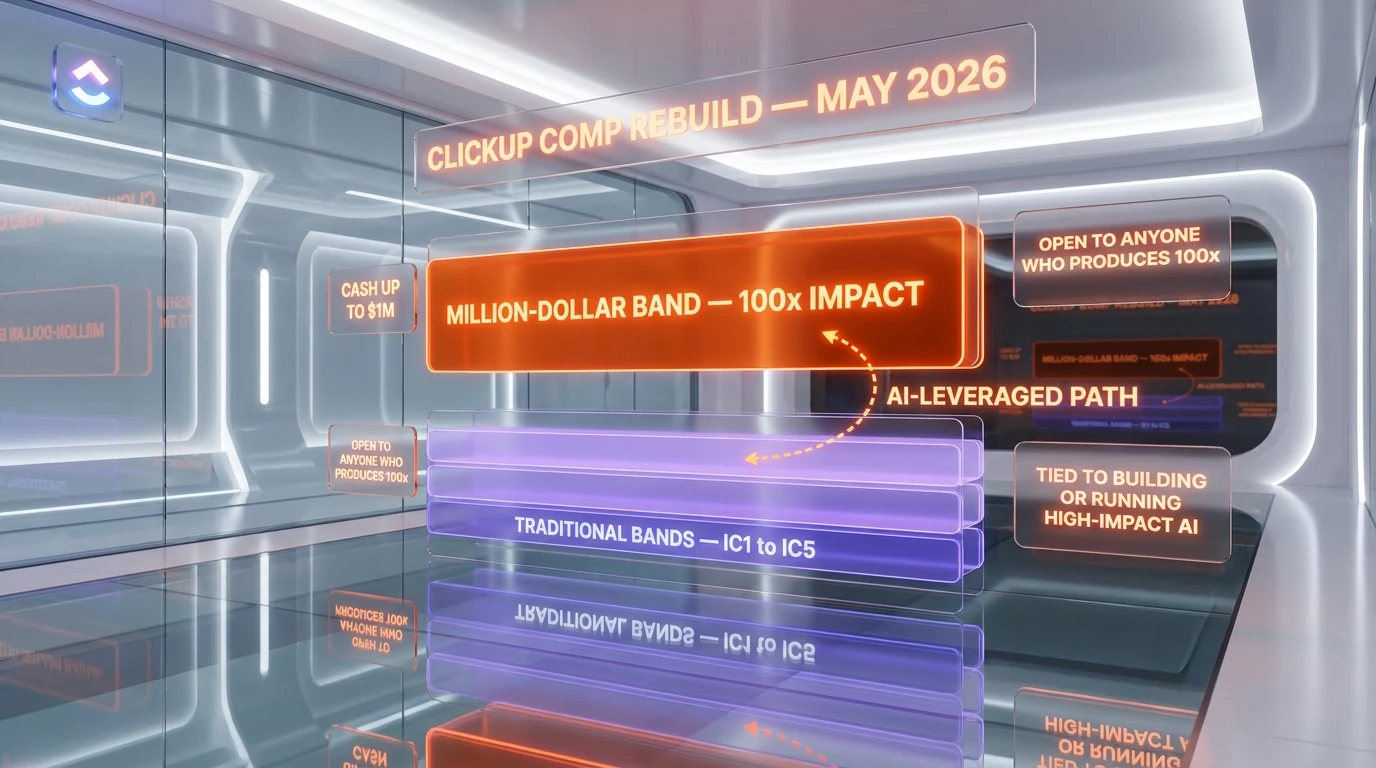
Per the public reporting, the million-dollar bands are cash, not total-comp loaded with equity, and per The Next Web "the path is available to nearly anyone in the company who produces 100x impact by creating or managing AI systems." That is a meaningful design choice in three ways, in my reading.
First, it decouples seniority from compensation. Traditional comp grids run on years-in-role and scope-of-responsibility. A 100x band that anyone can hit by producing measurable AI leverage is, structurally, a piece-rate model dressed in a salary band. That is closer to how trading floors and law-firm partner comp work than how SaaS engineering comp has historically worked.
Second, it concentrates upside in the AI-fluent. A junior who ships a high-impact agent system can, in this design, out-earn a senior who does not. That is a strong selection signal — the kind of pay structure that pulls a certain kind of operator to the company and pushes a different kind out. ClickUp is not subtle about which.
Third, it is testable. Pay grids are observable. By Q4 2026 we will know whether ClickUp actually hit million-dollar cash on a meaningful number of payouts, or whether the bands stayed theoretical. If the bands sit empty, the announcement was rhetoric. If they fill, the design is real. Right now we cannot tell which, and Evans's track record on follow-through is what I would watch over the next two earnings cycles.
The 3,000 internal agents — what we know and what we don't
The "roughly 3,000 internal AI agents" figure is the part of the announcement that is hardest to verify from outside the company. Per TechCrunch and The Next Web, the number is being used to describe agents deployed across product, engineering, design, customer-facing operations, and back-office workflows, and per The Next Web's framing this is a 3:1 ratio of agents to remaining employees.
What we don't know publicly: how many of those 3,000 agents are bespoke ClickUp-built versus configured instances of off-the-shelf agent frameworks; how many are persistent versus short-lived task workers; what the actual MAU pattern on those agents looks like internally; and crucially, what fraction of them are running on third-party LLM APIs (Claude, GPT, Gemini) versus on models ClickUp controls. That last variable is the one I would push the company on if I had a microphone in front of Evans tomorrow, because it is the difference between a structural moat and an OPEX line that scales with token costs.
Context matters here. ClickUp acquired Codegen, the AI coding-platform startup, late in 2025 — a deal that, in retrospect, looks like the engine block of the 100x architecture. The acquisition narrative gave the company an in-house code-generation stack to point agents at, and the May 21 announcement is what comes downstream of that bet. Whether it works at scale is unproven; that it was a deliberate sequence is now clear.
The wider 2026 pattern — and where ClickUp sits inside it
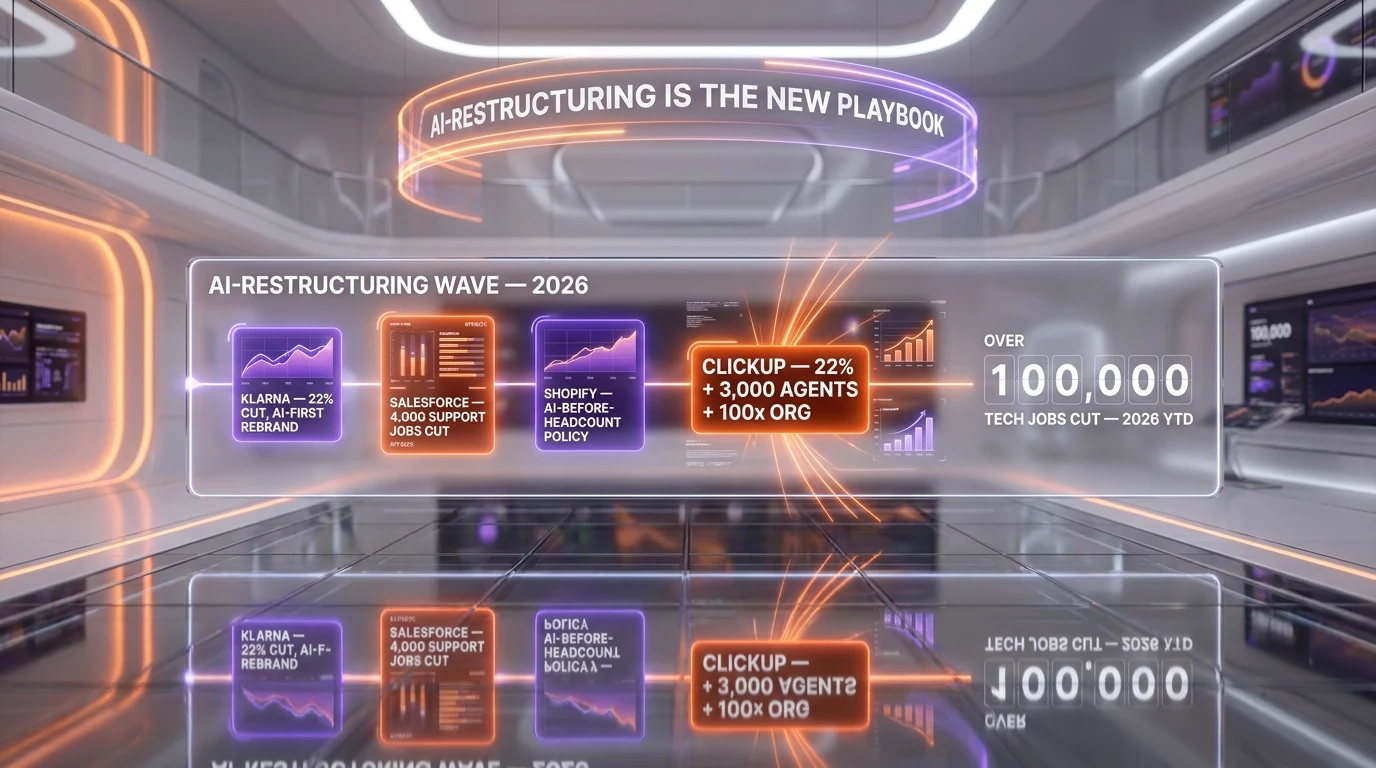
ClickUp is not the first 22%. Per The Next Web, Klarna ran a comparable workforce reduction paired with an AI-first rebrand earlier in the cycle. Salesforce trimmed roughly 4,000 customer-service roles to reroute volume into AI agents. Shopify adopted an explicit "AI-before-headcount" hiring policy that requires managers to justify why a role cannot be done by an agent before they are allowed to backfill. Per the same reporting, "over 100,000 tech jobs" have been shed across approximately 250 layoff events in 2026 year-to-date.
What separates ClickUp from the rest is the comp grid move. Klarna did not announce million-dollar bands. Salesforce did not. Shopify did not. Evans is the first founder I am aware of who paired the workforce cut with a structural upside reallocation on the same day. In my reading, that is the part other founders are going to copy, because the workforce cut without the comp reallocation reads as defensive — and the comp reallocation alone, without the cut, is hard to fund.
The broader competitive backdrop is consistent with this. Microsoft's Copilot Cowork rollout is rewriting Office workflows around agent task execution. ServiceNow's autonomous workforce announcements at Knowledge 2026 moved enterprise IT operations toward standing agent teams. SAP making Claude the reasoning brain of Joule pushed agent supervision into the Fortune 500 ERP layer. The infrastructure is being laid in by the giants. ClickUp's move is the mid-cap statement that the operating shape is now safe to adopt.
The part nobody is printing in big type
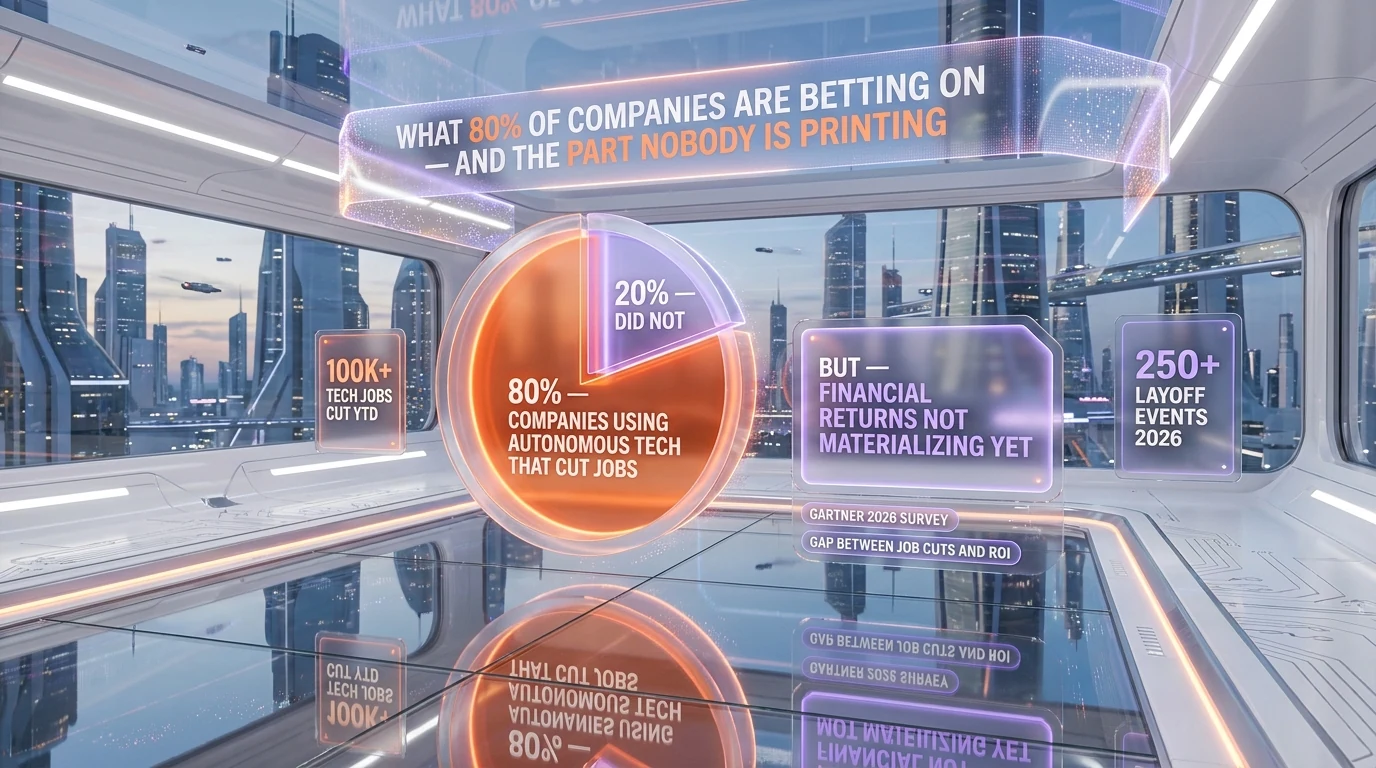
Buried inside the TechCrunch piece is a line I think is more important than the comp grid, and I want to pull it out because it is the one that should make any operator pause. Per the TechCrunch reporting citing a Gartner survey, about 80% of companies using autonomous technology have already cut jobs — but financial returns from those AI deployments "aren't materializing" on the same timeline.
That is a critical asymmetry. The workforce reduction is happening at scale. The productivity payback to justify it has not yet shown up in aggregate financials. In my reading, that gap is the macro story of the next four quarters. Either the productivity catches up — agents start producing the output that the headcount cuts assumed — or it doesn't, and the layoffs end up structural without the offsetting growth.
ClickUp is making the bet that for them, in their specific operating model, the productivity does catch up. Evans's argument, scoped to ClickUp, is that the 3,000 agents will produce the output the cut staff used to produce, that the remaining humans will direct those agents at a 3:1 ratio, and that the million-dollar bands will pull in the operator profile required to make that ratio work. He may be right. He may be wrong. We will know inside 18 months.
What I think this means for other SaaS founders watching
Three observations from where I sit, as someone running operations at ThePlanetTools.ai and watching this cycle close.
One — the "AI restructuring" framing has crossed from press-release jargon into a defensible org design pattern. Six months ago, announcing a 22% cut framed as an AI strategy would have read as cover. Today, with the Codegen acquisition in the rear-view and a public comp grid restructure on the table, it reads as a serious operating bet. The bar for what counts as a credible AI-restructuring story just moved.
Two — the bottleneck is no longer "can we build agents," it is "can we trust agents at scale without supervision-fatiguing our remaining staff." A 3:1 agent-to-employee ratio implies a non-trivial supervision load on the humans who stay. If the agent outputs need heavy review, the productivity gain compresses. If review can be automated by another layer of agents (agent-of-agents architectures), the math holds. That second condition is unproven at meaningful scale today. ClickUp is going to be a useful real-world test.
Three — the comp grid is going to follow. If the ClickUp bands fill — meaningful payouts at $1M cash — every Series C and later SaaS company in the 200 to 2,000 employee range is going to feel pressure to put a similar top-band on their grid by H2 2027. Talent compete works through gravity, and seven-figure cash is heavy gravity. We have already seen the front edge of this in Anthropic's acquisition of Stainless and the PwC certification deal for 30,000 architects on Claude — the AI labs and consultancies are already paying outside traditional bands for AI-fluent operators. ClickUp is the first software company outside the lab tier to formalize it.
What would prove me wrong
I have been getting more cautious about declaring "this is the pattern" without scoping the kill conditions, so let me be explicit about what I am watching that would invalidate the read above.
- If the 3,000 agents degrade product quality. The cleanest signal would be a measurable drop in ClickUp's net retention or NPS over the next two earnings cycles. A 22% reduction in human staff replaced by agent supervision should not cost the product. If it does, the architecture is wrong, and the public narrative will reverse fast.
- If ClickUp quietly re-hires inside six months. If by November 2026 the company is posting roles that look structurally similar to the ones cut on May 21, the 100x framing was rhetoric. Watch the public careers page, watch LinkedIn, watch the engineering blog hiring callouts.
- If the million-dollar bands stay theoretical. Pay grids are observable through proxy data — leveling data on Levels.fyi, equity disclosures in any later financing round, comp benchmarking in surveys. If no million-dollar cash payouts show up in the data over the next 18 months, the announcement was marketing.
- If revenue or ARR growth slows materially. ClickUp at $300M ARR with a 22% cut and 3,000 agents needs to keep growing ARR at or above its pre-announcement trajectory for the math to work. A noticeable deceleration through 2026 H2 would be the loudest signal that the productivity payback did not arrive.
- If Gartner's "80% cut jobs but ROI hasn't materialized" line stays true through 2027. The macro asymmetry is the dependent variable. If aggregate AI-restructuring ROI is still negative or flat by mid-2027, the entire Pattern B thesis is structurally fragile — including the ClickUp version.
Any one of those, in isolation, would not kill the read. Two or more, stacked, would.
My bottom line
In my reading, May 21, 2026 is the day a mid-cap software company put on the public record what the post-2026 employment contract at AI-native firms actually looks like: a smaller human floor, a much larger agent stack on top of it, and a comp ceiling pulled high enough to attract the operator profile required to run the new shape. The cut is the headline. The comp band is the strategy. The 3,000 agents are the bet.
I do not know if ClickUp specifically will pull this off. I do think the structural pattern Evans laid out — three role archetypes, agent-leveraged comp, AI-restructuring framed as a hiring posture rather than a defensive trim — is now the default story other founders will copy through the back half of 2026 and into 2027. Whether the productivity actually catches up to the workforce cut, in aggregate, is the question that decides whether this whole cycle ends in a structurally larger software industry or a structurally smaller one. The Gartner line is the one to watch.
For our broader take on the AI infrastructure side of the same trade, see our editorial on Anthropic's 10-gigawatt compute empire. The hardware buildout and the workforce restructure are two halves of the same operating model. ClickUp is the first SaaS-tier company to publicly stitch them together.
Frequently asked questions
What did ClickUp announce on May 21, 2026?
ClickUp announced a 22% workforce reduction paired with new million-dollar salary bands for AI-savvy employees, alongside the deployment of roughly 3,000 internal AI agents — a 3:1 agent-to-employee ratio — under what CEO Zeb Evans calls a 100x organization pivot. The announcement was posted on X on Wednesday, May 21, 2026 at 7:34 PM, and was reported by TechCrunch's Marina Temkin on May 25, 2026.
How many employees did ClickUp lay off?
ClickUp cut 22% of its workforce. Per The Next Web's reporting, the affected count was "in the low hundreds, spread across product, engineering, design, and customer-facing roles." ClickUp has not publicly disclosed exact headcount figures before or after the reduction.
What did Zeb Evans say about the million-dollar salary bands?
Per Evans's X post, "Most savings from this change will flow directly back into the people who stay. We'll be introducing million-dollar salary bands." He added: "If you create outsized impact using AI, you'll be paid outside of traditional bands." Per The Next Web, the bands are cash, not total-comp loaded with equity, and the path is open to nearly anyone in the company who produces 100x impact by creating or managing AI systems.
What are the 3,000 AI agents ClickUp deployed?
Per TechCrunch and The Next Web, ClickUp deployed roughly 3,000 internal AI agents across the company to handle complex tasks previously performed by staff, with the surviving humans supervising and reviewing agent outputs rather than performing the work themselves. The number represents approximately a 3:1 agent-to-employee ratio at the new headcount. ClickUp has not publicly disclosed which underlying models or frameworks the agents run on.
What is a "100x org" in Zeb Evans's framing?
Per Evans, a 100x org is a company structurally rebuilt around three role archetypes — "builders" (10x engineers and product managers directing code-writing agents), "system managers" (operators of automated systems), and "front-liners" (customer-facing roles where human contact is irreplaceable). Everything else, in the framing on the page, is automatable. The 100x figure refers to the per-employee impact multiplier Evans is targeting through AI leverage, not a headcount or revenue multiple.
How does this compare to other 2026 tech layoffs?
Per The Next Web, comparable AI-restructuring moves include Klarna (a 22% reduction paired with an AI-first rebrand), Salesforce (approximately 4,000 customer-service roles cut and rerouted to AI agents), and Shopify (an explicit "AI-before-headcount" hiring policy). Over 100,000 tech jobs have been shed across approximately 250 layoff events in 2026 year-to-date. ClickUp's distinguishing move is the simultaneous restructuring of the compensation grid around million-dollar cash bands — none of the other companies in this set has publicly announced a comparable comp ceiling.
Is the million-dollar salary band actually $1M in cash?
Per The Next Web's reporting, the bands are described as "salary bands that reach $1 million per year in cash" with the path available to nearly anyone in the company who produces "100x impact" by creating or managing AI systems. ClickUp has not publicly disclosed the gating criteria, target payout density, or how many employees the company expects to land in the top band over the next 12 to 18 months. The figure is observable through proxy data over time.
What was ClickUp's valuation and revenue context at the time?
Per The Next Web, ClickUp was valued at approximately $4 billion with about $300 million in annual recurring revenue as of 2025. Late in 2025 the company acquired Codegen, an AI coding-platform startup, which appears in retrospect to be the engine block of the 100x architecture rolled out on May 21, 2026.
What is the Gartner statistic about 80% of companies cutting jobs?
Per TechCrunch's reporting citing a Gartner survey, about 80% of companies using autonomous technology have cut jobs — but the financial returns from those AI deployments are not yet materializing on the same timeline. That asymmetry is the macro context for the ClickUp announcement. Workforce reductions are happening at scale; the productivity payback to justify them has not yet shown up in aggregate financials.
What should I watch to know if this strategy worked?
Four observable signals over the next 18 months: net retention and NPS data through ClickUp's next two earnings or financing cycles (product-quality test), whether ClickUp quietly re-hires structurally similar roles before November 2026 (rhetoric test), whether million-dollar cash payouts actually show up in proxy comp data on Levels.fyi or in any later financing disclosures (comp-design test), and whether ARR growth holds at or above the pre-announcement trajectory through 2026 H2 (productivity-payback test). Any one signal failing does not kill the thesis; two or more stacked would.
How does ClickUp compare to Meta, Microsoft, and Salesforce on AI restructuring?
The hyperscaler-tier moves at Microsoft (Copilot Cowork, agent task execution in Office), Salesforce (4,000 customer-service roles cut into AI agent rerouting), and adjacent platform plays at SAP (Claude as reasoning brain of Joule) and ServiceNow (Knowledge 2026 autonomous workforce announcements) are the infrastructure layer. ClickUp sits one tier below — a mid-cap SaaS company adopting the same operating pattern and adding the explicit comp grid restructure that the larger players have not yet announced publicly. In my reading, ClickUp is the first software company outside the AI lab tier to formalize the seven-figure AI-leveraged comp band.
Is this article affiliated with ClickUp?
No. This is an independent editorial opinion piece from Anthony Martinez, CEO of ThePlanetTools.ai. We are not a ClickUp partner, we receive no compensation from ClickUp, and there is no affiliate program to disclose. All facts are sourced from public reporting in TechCrunch, The Next Web, BusinessToday, and StartupHub.ai, with direct quotes attributed to CEO Zeb Evans's public X post dated May 21, 2026.
Editorial Disclosure: This is an opinion piece from Anthony Martinez, CEO of ThePlanetTools.ai. We have no affiliate relationship with ClickUp, and there is no public ClickUp affiliate program. The opinions are my own based on industry observation and analysis of public reporting from TechCrunch, The Next Web, BusinessToday, and StartupHub.ai. Read our full editorial and affiliate disclosure policy.