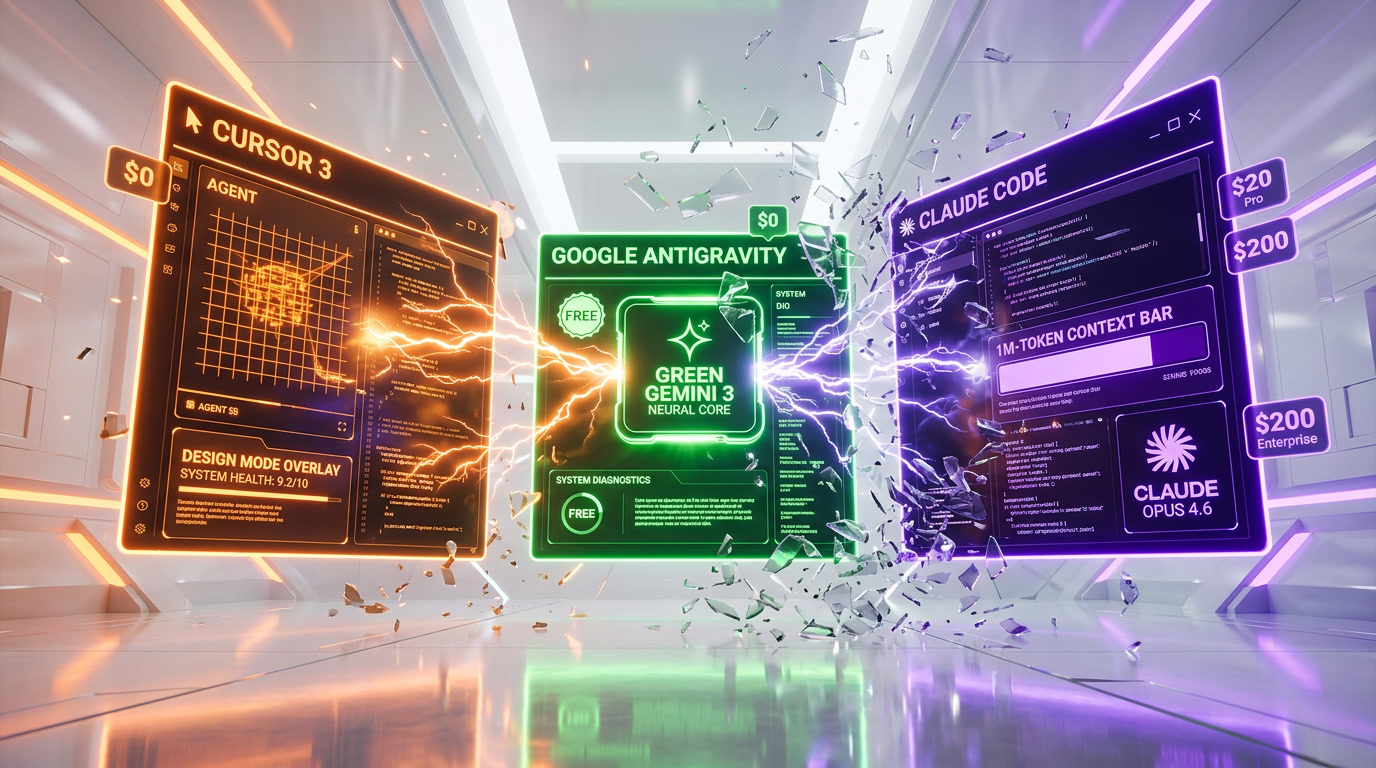
Cursor 3, Google Antigravity, and Claude Code are the three dominant AI-assisted coding platforms as of April 2026. Cursor 3 launched April 2, 2026 with an Agents Window and Design Mode at $20 per month (Pro). Google Antigravity is free during public preview with Gemini 3.1 Pro, or $20 per month (Pro) and $249.99 per month (Ultra). Claude Code runs in-terminal with Opus 4.6 and 1M-token context at $20 per month (Pro) or $200 per month (Max 20x). On SWE-bench Verified, Antigravity scores 76.2%, Claude Code scores 72%, and Cursor 3 ranks top-3 depending on model selection.
Why This Comparison Matters in April 2026
The AI coding landscape shifted dramatically in early 2026. Three products now define three fundamentally different philosophies of how developers should interact with AI agents. Cursor 3 bets on a visual IDE where you orchestrate fleets of agents. Google Antigravity bets on a free, agent-first platform powered by Gemini 3. Claude Code bets on the terminal as the natural habitat for power developers who want maximum control.
We use Cursor and Claude Code daily to build and maintain production applications. We have tested Google Antigravity extensively since its public preview launch. This is not a surface-level comparison — we are writing this article right now using Claude Code, and we built parts of our infrastructure with Cursor. Here is what matters after months of real use.
Head-to-Head Comparison Table
| Feature | Cursor 3 | Google Antigravity | Claude Code |
|---|---|---|---|
| Launch | April 2, 2026 | November 18, 2025 (preview) | GA March 2026 (1M context) |
| Type | Visual IDE (VS Code fork) | Visual IDE (standalone) | CLI / Terminal agent |
| Starting Price | Free (limited) / $20 per month Pro | Free (preview) / $20 per month Pro | $20 per month Pro |
| Top Tier Price | $200 per month Ultra | $249.99 per month Ultra | $200 per month Max 20x |
| Primary AI Model | Multi-model (Claude, GPT, Gemini) | Gemini 3.1 Pro | Claude Opus 4.6 |
| SWE-bench Verified | Top-3 (model-dependent) | 76.2% | ~72% |
| Context Window | Varies by model | Varies by model | 1M tokens (Opus 4.6) |
| Multi-Agent | Agents Window (parallel) | Manager Surface (parallel) | Agent Teams (experimental) |
| Cloud Agents | Yes (cloud handoff) | Yes (async agents) | Background agents (Ctrl+B) |
| Design Mode | Yes (annotate UI elements) | Browser integration | No (terminal-only) |
| MCP Support | Marketplace (hundreds) | Limited | Full MCP (remote + local) |
| Voice Mode | No | No | Yes (/voice, 20 languages) |
| Git Integration | Built-in (staging, PRs) | Built-in | Native (gh CLI, worktrees) |
| Platforms | macOS, Windows, Linux | macOS, Windows, Linux | macOS, Windows, Linux |
| Team Plan | $40 per user/mo | Enterprise (coming soon) | $100 per seat/mo (Premium) |
Pricing Comparison: What You Actually Pay
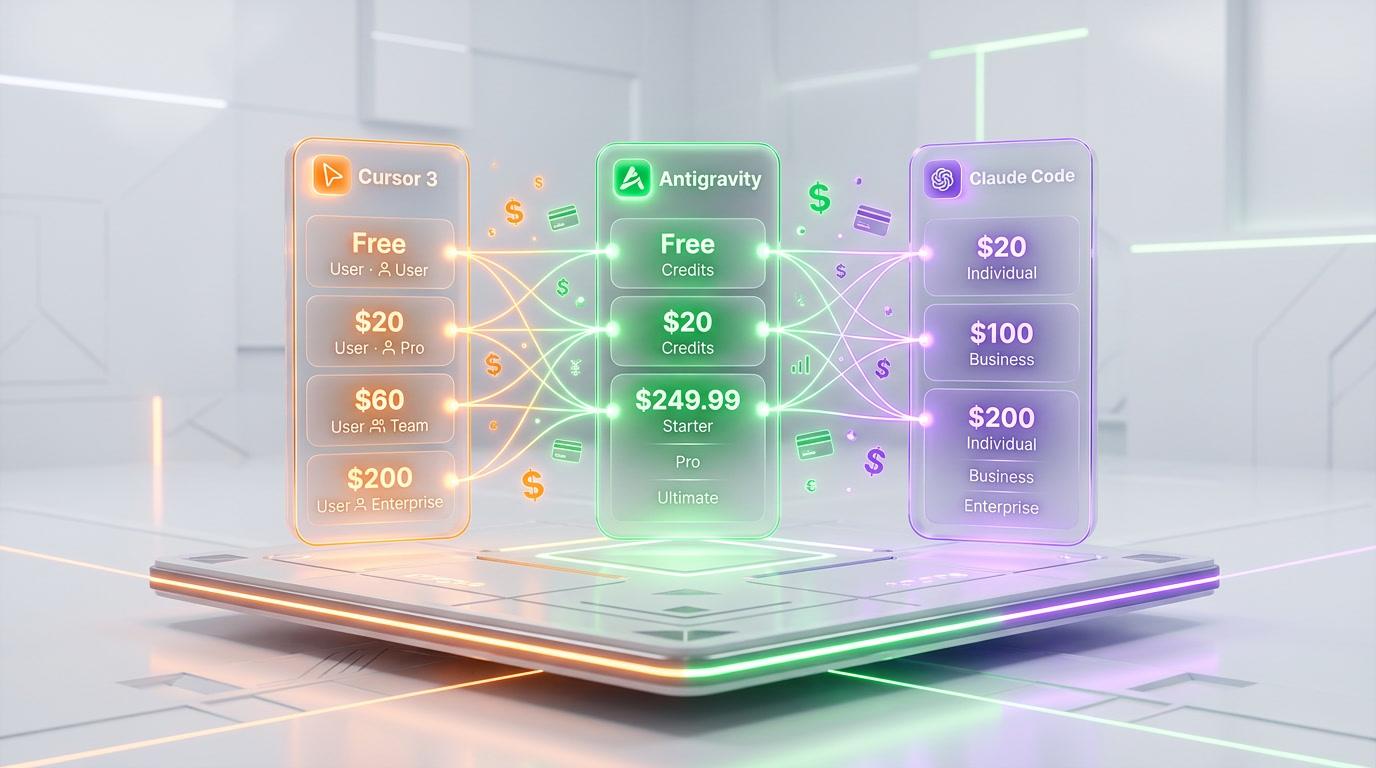
Pricing in AI coding tools has become increasingly complex. All three platforms now use credit-based or token-based billing under the hood, which means your actual cost depends on how heavily you use AI features and which models you select. Here is the full breakdown.
| Plan | Cursor 3 | Google Antigravity | Claude Code |
|---|---|---|---|
| Free | Limited agents + tabs | Gemini 3 Pro with weekly rate limits | No free tier (API pay-per-token) |
| $20 per month | Pro: extended agent limits, frontier models, MCPs, cloud agents | Pro: priority access, 5-hour quota refresh | Pro: Sonnet 4.6 + Opus 4.6, terminal + web + desktop |
| $60 per month | Pro+: 3x usage on all models | -- | -- |
| $100 per month | -- | -- | Max 5x: ~88K tokens/5-hour window, priority |
| $200 per month | Ultra: 20x usage, priority features | -- | Max 20x: ~220K tokens/5-hour window |
| $249.99 per month | -- | Ultra: highest rate limits, priority | -- |
| Teams | $40 per user/mo | Enterprise (TBD, ~$40-60/user) | $100 per seat/mo Premium |
| Billing Model | Credit pool = subscription cost | AI credits (built-in + purchasable) | Token budget per 5-hour window |
Pricing Verdict
At the $20 per month entry point, all three are competitive. Google Antigravity has the strongest free tier — generous Gemini 3 Pro access at no cost. Cursor 3 offers the most flexible mid-tier with Pro+ at $60 per month (3x usage). Claude Code's Max plans are the most expensive for individuals but give you access to Opus 4.6 with a 1M-token context window that neither competitor matches. For teams, Cursor wins at $40 per user/month versus Claude Code's $100 per seat Premium requirement.
Cursor 3: The Visual Agent Orchestrator
Cursor 3, launched April 2, 2026 by Anysphere, represents the most radical rethinking of what an IDE should be. The team rebuilt the interface from scratch around one thesis: most code will be written by AI agents, and the developer's job is to orchestrate them.
The Agents Window
The headline feature is the Agents Window — a standalone interface for running multiple AI agents in parallel. You access it via Cmd+Shift+P -> Agents Window. From this dashboard, you can see agents running across local machines, cloud environments, worktrees, SSH sessions, and remote setups. Agent Tabs let you view multiple conversations side-by-side in a grid layout.
The local-to-cloud handoff is particularly useful. Start a complex refactoring task locally with Composer 2 for rapid iteration, then hand it off to a cloud agent for overnight execution. When you come back, the diffs are ready for review.
Design Mode
Design Mode lets you annotate and target UI elements directly in the browser. Click on a button, highlight a section, and tell the agent exactly what to change. This is something neither Antigravity nor Claude Code can match — it turns frontend iteration from "describe what you want" to "point at what you want."
Ecosystem and Model Flexibility
Cursor 3 supports all major models — Claude (Anthropic), GPT (OpenAI), and Gemini (Google). The Cursor Marketplace offers hundreds of plugins, including MCPs, skills, and subagents. Teams can create private marketplace distributions. This model-agnostic approach means you are never locked into one AI provider's strengths or weaknesses.
Strengths and Weaknesses
Where Cursor 3 excels: Visual workflows, frontend development, Design Mode, multi-model flexibility, team collaboration at affordable pricing, cloud agent handoff for long-running tasks.
Where Cursor 3 falls short: Still a VS Code fork at its core (inherits some limitations), credit-based billing can be unpredictable for heavy users, the Agents Window is new and still maturing. No voice mode. Tab completions on the free tier are limited enough to feel restrictive.
Google Antigravity: The Free Agent-First Disruptor
Google Antigravity launched in November 2025 alongside Gemini 3 and immediately disrupted the market with a simple proposition: a full agent-first IDE, powered by Google's best models, at zero cost during public preview.
Editor View and Manager Surface
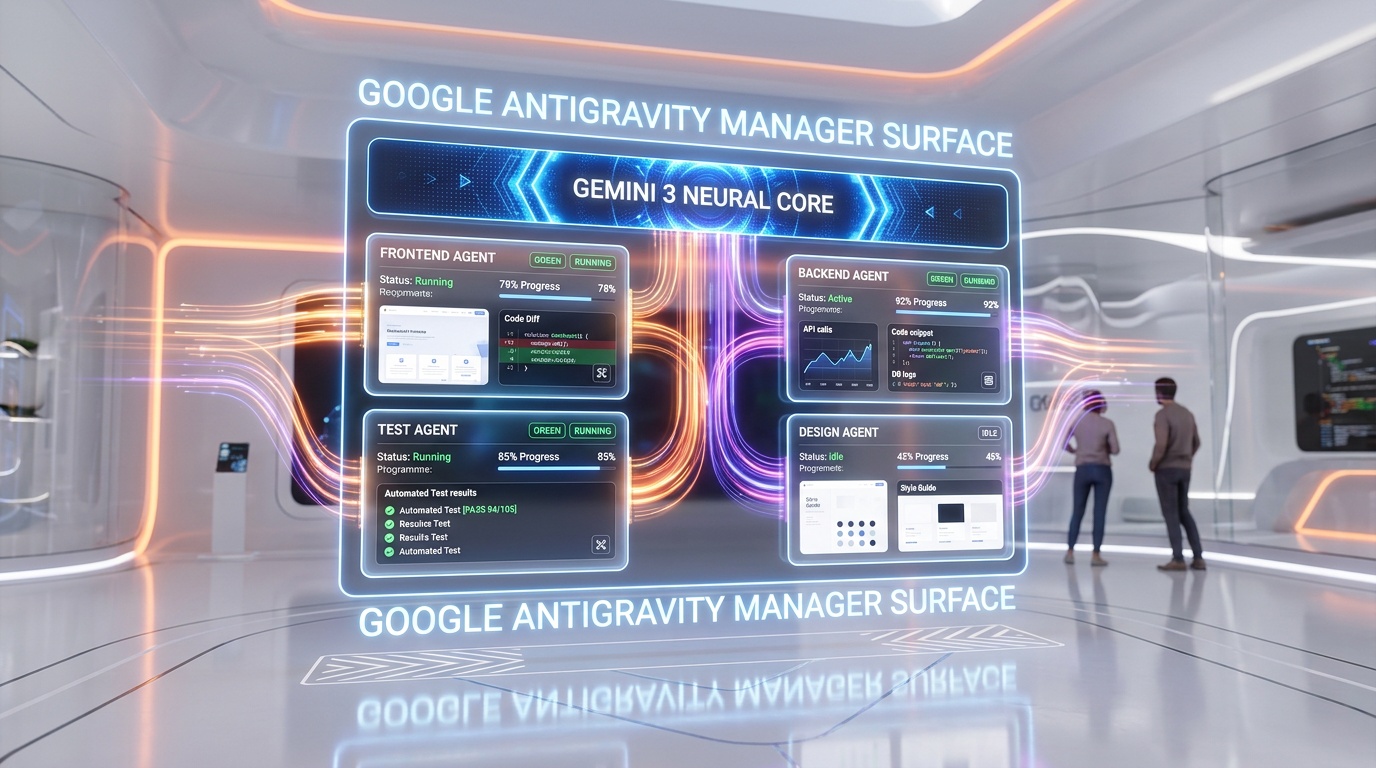
Antigravity offers two primary views. The Editor View is a familiar IDE interface with tab completions and inline AI commands — similar to what you get in Cursor or VS Code with Copilot. The Manager Surface is where Antigravity differentiates: a dedicated control center for spawning, orchestrating, and observing multiple agents working asynchronously across different workspaces.
Agents communicate progress through "Artifacts" — tangible deliverables like screenshots and recordings rather than raw logs. This makes verification faster and more intuitive than reading terminal output.
AgentKit 2.0
Released in March 2026, AgentKit 2.0 includes 16 specialized agents, 40+ domain-specific skills, and 11 pre-configured commands covering frontend, backend, and testing. This is the most opinionated agent system of the three — Google has pre-built agents for common workflows rather than asking developers to configure everything from scratch.
Benchmark Performance
Antigravity scores 76.2% on SWE-bench Verified — the highest published score for a coding agent platform as of April 2026. It also scores 54.2% on Terminal-Bench 2.0. The underlying Gemini 3.1 Pro model scores 78.8% on the model-level SWE-bench harness, statistically tied with Claude Opus 4.6 at 78.2%.
Model Support
Despite being Google's product, Antigravity supports multiple AI providers: Gemini 3.1 Pro and Gemini 3 Flash natively, plus Anthropic's Claude Sonnet 4.5 and OpenAI's GPT-OSS. This multi-model approach is a strategic move — Google wants Antigravity to be the IDE of choice regardless of your preferred model.
Strengths and Weaknesses
Where Antigravity excels: Free tier is unmatched (Gemini 3 Pro at no cost), highest SWE-bench score, AgentKit 2.0 with pre-built specialized agents, Artifacts system for visual verification, multi-model support including Claude and GPT.
Where Antigravity falls short: Still in public preview (expect breaking changes), the free tier has weekly rate limits that can be restrictive during intensive coding sessions, no Enterprise tier yet, ecosystem is less mature than Cursor's marketplace. The IDE itself is new — edge cases and stability issues are more common than in the battle-tested Cursor. Pricing after preview ends is uncertain.
Claude Code: The Terminal-First Power Tool
Claude Code is the outlier in this comparison. It is not an IDE — it is a CLI agent that runs in your terminal, connecting directly to Anthropic's models. Where Cursor and Antigravity compete on visual interfaces, Claude Code competes on raw power, context capacity, and developer control.
1M Token Context Window
The single biggest technical advantage Claude Code holds: a 1 million token context window with Opus 4.6. To put this in perspective, that is roughly 750,000 words — enough to hold an entire medium-sized codebase in memory simultaneously. Neither Cursor nor Antigravity offer anything close. When we work on complex refactoring across dozens of files, Claude Code can see the entire picture without losing context.
Agent Teams
Claude Code's Agent Teams feature (experimental, launched February 2026) lets you coordinate multiple Claude Code instances as a team. One session acts as the team lead, coordinating work, assigning tasks, and synthesizing results. Teammates work independently, each in its own context window, and communicate directly with each other through a shared task list and mailbox system.
Key capabilities include plan approval workflows (teammates must get lead approval before implementing), direct teammate messaging, shared task lists with dependency management, and quality gate hooks (TeammateIdle, TaskCreated, TaskCompleted). You can use subagent definitions to create reusable teammate roles like "security-reviewer" or "test-runner."
Unique Features No Competitor Has
- Voice Mode (
/voice): push-to-talk coding in 20 languages. Hold spacebar to speak, release to send. No other AI IDE offers voice input. - /loop Command: Cron-like scheduled tasks.
/loop 5m /testruns your test command every 5 minutes. Useful for CI monitoring and deployment checks. - Background Agents: Press
Ctrl+Bto move a running task to the background, freeing your terminal immediately. - Dispatch + Channels: Trigger Claude Code programmatically via API. Channels provide a structured event stream from running sessions — enabling production-grade automation.
- /effort Command: Adjust reasoning depth on the fly. Use "ultrathink" for maximum effort on complex problems.
- /context Command: Identifies which tools consume the most context, flags memory bloat, and warns when approaching capacity limits.
Strengths and Weaknesses
Where Claude Code excels: 1M token context (unmatched), terminal-native workflow for backend/infrastructure developers, Agent Teams for coordinated multi-agent work, voice mode, /loop scheduled tasks, Dispatch API for programmatic access, MCP support (remote + local), deepest reasoning with Opus 4.6.
Where Claude Code falls short: No visual IDE (terminal only — not ideal for frontend-heavy work), no Design Mode equivalent, Agent Teams still experimental with known limitations (no session resumption, no nested teams), higher team pricing ($100 per seat vs $40 per seat for Cursor), no free tier (API pay-per-token is the cheapest option), token limits on Pro can feel tight during long sessions.
Feature-by-Feature Matrix
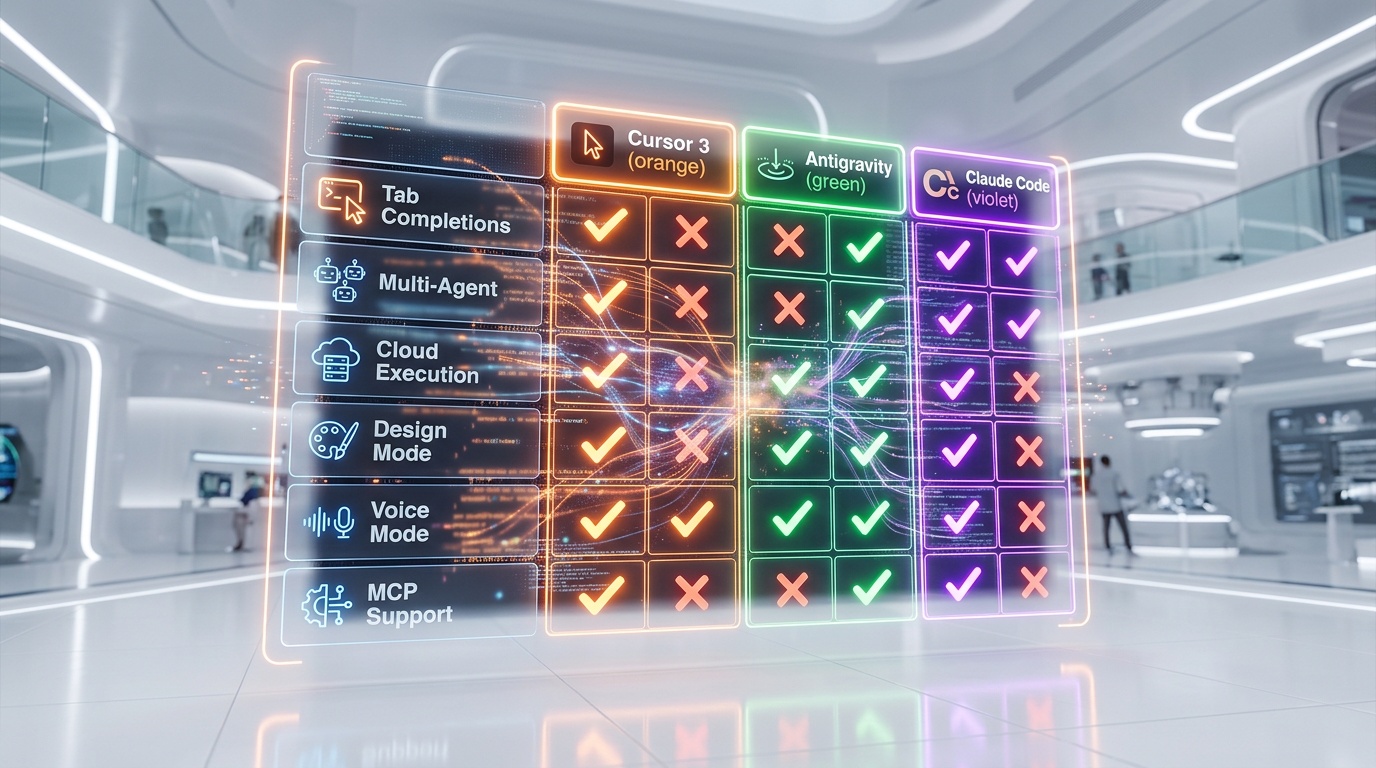
| Capability | Cursor 3 | Antigravity | Claude Code |
|---|---|---|---|
| Tab Completions | Yes | Yes (unlimited free) | No (CLI-based) |
| Inline Code Edit | Yes (Cmd+K) | Yes | No (file-level edits) |
| Multi-File Refactoring | Yes (Composer 2) | Yes (Agent) | Yes (native) |
| Parallel Agents | Agents Window | Manager Surface | Agent Teams + Subagents |
| Cloud Execution | Cloud agents | Async agents | Background + Dispatch |
| UI/Design Iteration | Design Mode | Browser integration | Not supported |
| Voice Input | No | No | Yes (20 languages) |
| Scheduled Tasks | No | No | Yes (/loop) |
| Programmatic API | Limited | Limited | Dispatch + Channels |
| Plugin Marketplace | Yes (hundreds) | AgentKit (16 agents) | MCP ecosystem |
| Git Worktrees | Yes (multi-repo) | Yes | Yes (native) |
| Custom Rules | Yes (.cursorrules) | Yes | Yes (CLAUDE.md) |
| SSH Remote | Yes | Yes | Yes |
| BYOK (Bring Your Own Key) | Yes | No | Yes (API mode) |
| SSO/Enterprise | Yes (SAML/OIDC) | Coming soon | Yes |
Our Real-World Testing: What We Actually Use and Why
We have been using Cursor (since v1) and Claude Code (since beta) as our primary development tools. We tested Antigravity for 3+ months since the preview launched. Here is what our daily workflow looks like in practice.
Frontend Development
Winner: Cursor 3. Design Mode alone makes this a clear win. When building UI components, being able to point at a button and say "make this 2px bigger and change the hover color" is dramatically faster than describing the same change in text. Antigravity's browser integration is decent but less precise. Claude Code simply does not play in this space — there is no visual feedback loop.
Backend and Infrastructure
Winner: Claude Code. When we work on API routes, database migrations, CI/CD pipelines, or server configuration, Claude Code's terminal-native workflow is unbeatable. The 1M token context means it can hold our entire backend codebase in memory. We frequently use /loop 5m /test to monitor test suites during refactoring sessions. No context switching between IDE and terminal.
Rapid Prototyping (Zero to MVP)
Winner: Google Antigravity. For greenfield projects, Antigravity's free tier with AgentKit 2.0 is the fastest path from zero to working prototype. Spawn an agent, describe your app, and let it scaffold the entire project. The pre-built agents for frontend, backend, and testing mean less configuration than Cursor or Claude Code. The fact that it is free removes all friction.
Complex Multi-File Refactoring
Winner: Claude Code. This is where the 1M token context window earns its price. When we refactored our authentication system across 40+ files, Claude Code held the entire dependency graph in memory and made coordinated changes without losing track of any file. With Agent Teams, we assigned a security reviewer, a test writer, and a refactoring lead — each working in parallel, communicating through the shared task list. Cursor 3's Agents Window can do parallel work too, but context fragmentation across separate agents is a real limitation.
Debugging
Winner: Tie (Cursor 3 + Claude Code). Cursor 3 excels at visual debugging — you can see the UI break in Design Mode and fix it inline. Claude Code excels at deep logical debugging — the massive context window means it can trace an issue across your entire codebase, and Agent Teams can test competing hypotheses in parallel. Antigravity's Artifact system (screenshots and recordings) is useful but less interactive.
Who Should Use What: Our Recommendation
| Developer Profile | Best Choice | Why |
|---|---|---|
| Frontend developer (React, Next.js, Vue) | Cursor 3 | Design Mode, visual workflow, fast iteration |
| Backend/infrastructure engineer | Claude Code | Terminal-native, 1M context, /loop, Dispatch API |
| Student or budget-conscious developer | Google Antigravity | Free Gemini 3 Pro, no credit card needed |
| Startup founder (MVP builder) | Google Antigravity | Zero cost, AgentKit scaffolding, fast prototyping |
| Full-stack developer (solo) | Cursor 3 | Best of both worlds: visual + agent orchestration |
| DevOps / SRE | Claude Code | Terminal-first, /loop monitoring, CI/CD integration |
| Enterprise team (10+ developers) | Cursor 3 | Cheapest team plan ($40 per user), SSO, analytics |
| AI/ML engineer | Claude Code | Deepest reasoning (Opus 4.6), 1M context for large codebases |
| Agency / client work | Cursor 3 + Claude Code | Cursor for frontend delivery, Claude Code for backend complexity |
The Real Winner: Using Them Together
Here is the truth nobody in the AI coding space wants to admit: the best workflow in April 2026 is using multiple tools. We use Cursor 3 for frontend work and visual iteration, and Claude Code for backend logic, refactoring, and automation. Antigravity serves as our free testing ground for evaluating new approaches before committing to a full implementation.
The three tools are not perfect substitutes — they are complementary. Cursor 3 is the best visual IDE with unmatched Design Mode and the most mature ecosystem. Google Antigravity is the best free option and the fastest path from zero to prototype. Claude Code is the most powerful terminal agent with capabilities (voice, /loop, 1M context, Agent Teams) that no visual IDE can replicate.
If you can only pick one: Cursor 3 at $20 per month is the safest all-around choice. If you are budget-constrained: Antigravity is free and genuinely capable. If you are a power user who lives in the terminal: Claude Code is the clear winner.
What to Watch Next
- Antigravity Enterprise pricing: When Google exits public preview and sets final pricing, the free tier may change dramatically. Enjoy it while it lasts.
- Cursor 3 maturation: The Agents Window launched days ago. Expect rapid iteration and bug fixes over the next 2-3 months.
- Claude Code Agent Teams GA: Currently experimental. When it exits beta with session resumption and nested teams, it could change the multi-agent landscape entirely.
- Model wars: Gemini 3.1 Pro and Opus 4.6 are statistically tied on SWE-bench. The next model upgrade from either side could tip the balance.
- Windsurf, Kiro, and GitHub Copilot: The three-way war we cover here may become a five-way war by Q3 2026.
Frequently Asked Questions
Is Cursor 3 better than Google Antigravity for coding?
Cursor 3 is better for developers who want a mature visual IDE with Design Mode, multi-model support, and a plugin marketplace. Google Antigravity is better for developers who want a free agent-first platform with pre-built agents (AgentKit 2.0) and strong benchmark performance (76.2% SWE-bench). For frontend work, Cursor 3 wins. For free prototyping, Antigravity wins.
Is Claude Code better than Cursor 3?
Claude Code is better for terminal-first developers, backend work, and complex multi-file refactoring thanks to its 1M-token context window and Agent Teams. Cursor 3 is better for visual workflows, frontend development, and team collaboration at lower cost ($40 per user vs $100 per seat). They excel in different areas and many developers use both.
How much does Google Antigravity cost in 2026?
Google Antigravity is free during public preview with generous Gemini 3 Pro rate limits. Paid plans include Pro at $20 per month and Ultra at $249.99 per month for higher rate limits and priority access. An Enterprise tier is expected but not yet available. Additional AI credits can be purchased at $25 for 2,500 credits.
What is the best AI coding tool for beginners in 2026?
Google Antigravity is the best starting point for beginners — it is free, requires no credit card, includes pre-built agents for common tasks, and offers a familiar IDE interface. Cursor 3's free Hobby tier is the second-best option but has more restrictive limits. Claude Code requires terminal familiarity and is better suited for intermediate to advanced developers.
Can I use Claude Code and Cursor 3 together?
Yes. Many professional developers use Cursor 3 for frontend/visual work and Claude Code for backend/terminal work in the same project. They do not conflict — Cursor 3 is an IDE and Claude Code is a CLI agent. You can even use Claude Code inside Cursor 3's integrated terminal. Both support .cursorrules/CLAUDE.md project configuration files.
Which AI coding tool has the best benchmark scores?
As of April 2026, Google Antigravity leads with 76.2% on SWE-bench Verified. Claude Code scores approximately 72%. On the model level (not tool level), Gemini 3.1 Pro (78.8%) and Claude Opus 4.6 (78.2%) are statistically tied. Cursor 3's score varies by model selection but consistently ranks top-3 on Terminal-Bench 2.0.
What happened to GitHub Copilot and Windsurf?
GitHub Copilot and Windsurf remain active competitors but have lost market share to Cursor 3, Antigravity, and Claude Code in 2026. Copilot still integrates natively with VS Code and GitHub but lacks the multi-agent orchestration that defines the current generation of AI coding tools. Windsurf was acquired by OpenAI and is being integrated into their broader coding platform.
Is the free tier of Google Antigravity actually usable?
Yes, but with caveats. The free tier provides Gemini 3 Pro access with weekly rate limits. For light to moderate use (a few hours of coding per day), it is genuinely sufficient. Heavy users who code 8+ hours daily will hit limits and need to wait for weekly quota resets. The paid Pro tier at $20 per month removes most friction with 5-hour refresh cycles.
Frequently Asked Questions
Is Cursor 3 better than Google Antigravity for frontend development?
Yes, Cursor 3 has a decisive advantage over Google Antigravity for frontend work due to its exclusive Design Mode, which lets you annotate and click on live UI elements in the browser to instruct the agent. Neither Google Antigravity nor Claude Code offers this feature. Cursor 3 Pro starts at $20 per month and also includes the Agents Window for running parallel agents across local and cloud environments.
Who should use Claude Code instead of Cursor 3 or Google Antigravity?
Claude Code is the best choice for terminal-native power developers who need maximum control and context depth. It runs Claude Opus 4.6 with a 1M-token context window — a feature neither Cursor 3 nor Google Antigravity matches. It also supports full MCP (remote and local), voice mode via /voice in 20 languages, native GitHub CLI with worktrees, and experimental Agent Teams. Claude Code Pro starts at $20 per month; Max 20x at $200 per month.
What are Google Antigravity's limitations compared to Cursor 3 and Claude Code?
Google Antigravity scores 76.2% on SWE-bench Verified — the highest of the three — but it has real limitations: no full MCP marketplace (Cursor 3 has hundreds of plugins; Claude Code has full remote and local MCP support), no model flexibility (Gemini-only vs. Cursor 3's multi-model support), and the Ultra tier at $249.99 per month is the most expensive top-tier of the three platforms.
Does Claude Code integrate with GitHub and MCP tools?
Yes. Claude Code has native GitHub CLI integration with staging, PRs, and Git worktrees built in. It also offers full MCP support for both remote and local servers — the deepest MCP integration of the three platforms. Background agents launch via Ctrl+B. Voice mode supports 20 languages. Agent Teams (experimental) enable multi-agent orchestration directly from the terminal.
Is Google Antigravity actually free, or are there hidden costs?
Google Antigravity is genuinely free during public preview — it provides full Gemini 3 Pro access with weekly rate limits at no cost. Paid tiers are $20 per month (Pro) with priority access and 5-hour quota refresh, and $249.99 per month (Ultra) for highest rate limits. Additional AI credits are purchasable beyond the built-in allowance. This makes it the strongest free offering: Cursor 3's free tier limits tab completions, and Claude Code has no free tier at all.
How does Cursor 3's SWE-bench Verified score compare to Claude Code and Google Antigravity?
Google Antigravity leads the three platforms with 76.2% on SWE-bench Verified. Claude Code scores approximately 72%. Cursor 3 ranks top-3 depending on the model selected, since it supports multiple providers including Claude (Anthropic), GPT (OpenAI), and Gemini (Google). At the model level, Gemini 3.1 Pro scores 78.8% on the SWE-bench harness, statistically tied with Claude Opus 4.6.
Which AI coding tool is cheapest for development teams in 2026?
Cursor 3 is the most affordable for teams at $40 per user/month. Claude Code's Premium team plan costs $100 per seat/month. Google Antigravity's enterprise pricing is still TBD, estimated at $40–60/user. For individuals, all three offer $20 per month Pro tiers, but only Google Antigravity provides a free tier with real model access (Gemini 3 Pro with weekly rate limits).
What multi-agent features differentiate Cursor 3, Google Antigravity, and Claude Code?
Each platform has a distinct multi-agent system. Cursor 3 offers the Agents Window — a grid view for running agents across local machines, cloud, SSH sessions, and worktrees with local-to-cloud handoff. Google Antigravity uses the Manager Surface with AgentKit 2.0 (16 specialized agents, 40+ domain skills, progress tracked via Artifacts). Claude Code provides experimental Agent Teams with background agents launched via Ctrl+B. AgentKit 2.0 is the most pre-configured out of the box.