Disclosure. ThePlanetTools.ai has no commercial relationship with Google DeepMind, Google, OpenAI, or Anthropic. I do not own GOOG or MSFT positions tied to this take. This is an editorial-opinion piece by me, Anthony Martinez. The quotes attributed to Demis Hassabis are verbatim from the May 22, 2026 MIT Technology Review interview by Grace Huckins (linked in-content). I am not an MIT Tech Review contributor; I am reading their article like any other reader and giving you my own view.
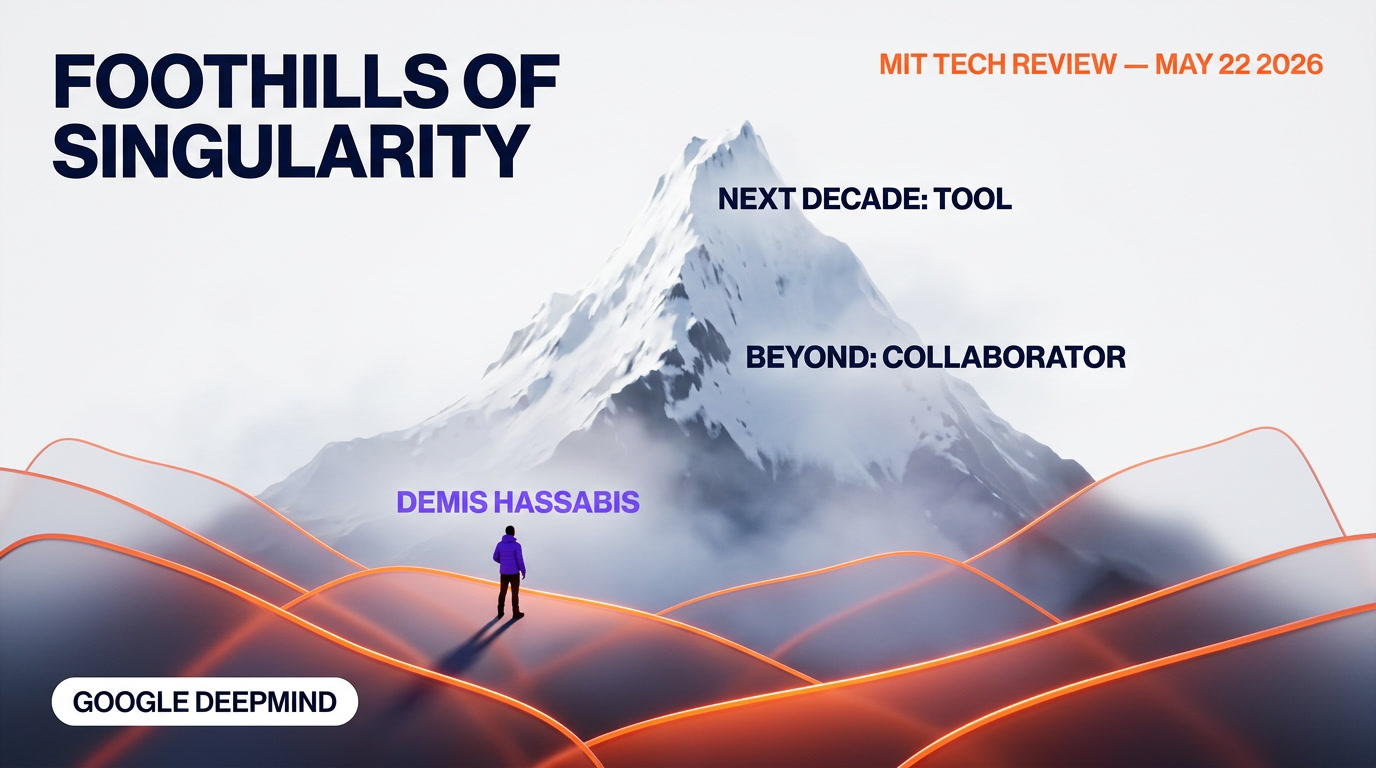
What did Demis Hassabis say about the singularity in May 2026? In a May 22, 2026 interview with MIT Technology Review's Grace Huckins, Google DeepMind CEO Demis Hassabis described the world as "standing in the foothills of the singularity" and reframed artificial intelligence as a scientific instrument, not an imminent replacement for human researchers. He told the magazine that "for the next decade or so, we should think about AI as this amazing tool to help scientists," adding that beyond that horizon "perhaps these systems will become more like collaborators." In my reading, this is the cleanest split we have seen yet between the two dominant AI CEO worldviews in 2026 — Hassabis the scientific instrumentalist, and Sam Altman the eschatological technologist of The Gentle Singularity.
What Hassabis actually said — and what he did not
The interview was published by MIT Technology Review on May 22, 2026, two days after Google I/O 2026 closed. Grace Huckins framed the piece around a simple question: now that Google's I/O keynote leaned heavily on Gemini for Science, AlphaFold lineage, and agentic research tools, how does Hassabis himself think about AI's near-term role in science? His answer, in three sentences, is the most quoted line in AI policy circles this week.
Read literally, Hassabis is doing three things at once. First, he is conceding terrain to the singularity narrative: he calls today's vantage point "the foothills of the singularity." Foothills is not the summit; foothills is also not flat ground. We are climbing. Second, he is collapsing the timeline. "For the next decade or so," AI is — in his words — an "amazing tool to help scientists." That is a remarkable downgrade from the "superintelligence within years" rhetoric that has dominated investor decks since 2024. Third, he is keeping an option on the upside: "perhaps these systems will become more like collaborators" beyond that decade. Notice the verb. Perhaps. Not will.
What he did not say is just as load-bearing. He did not predict AGI by a specific year. He did not say AI will replace researchers. He did not invoke automation of the economy. He did not promise a phase change. As Hassabis frames it, the singularity is an era we are walking through, not a wall we are about to hit. That is a different epistemological posture from most of his peers, and it deserves attention.
The split with Altman: science vs eschatology
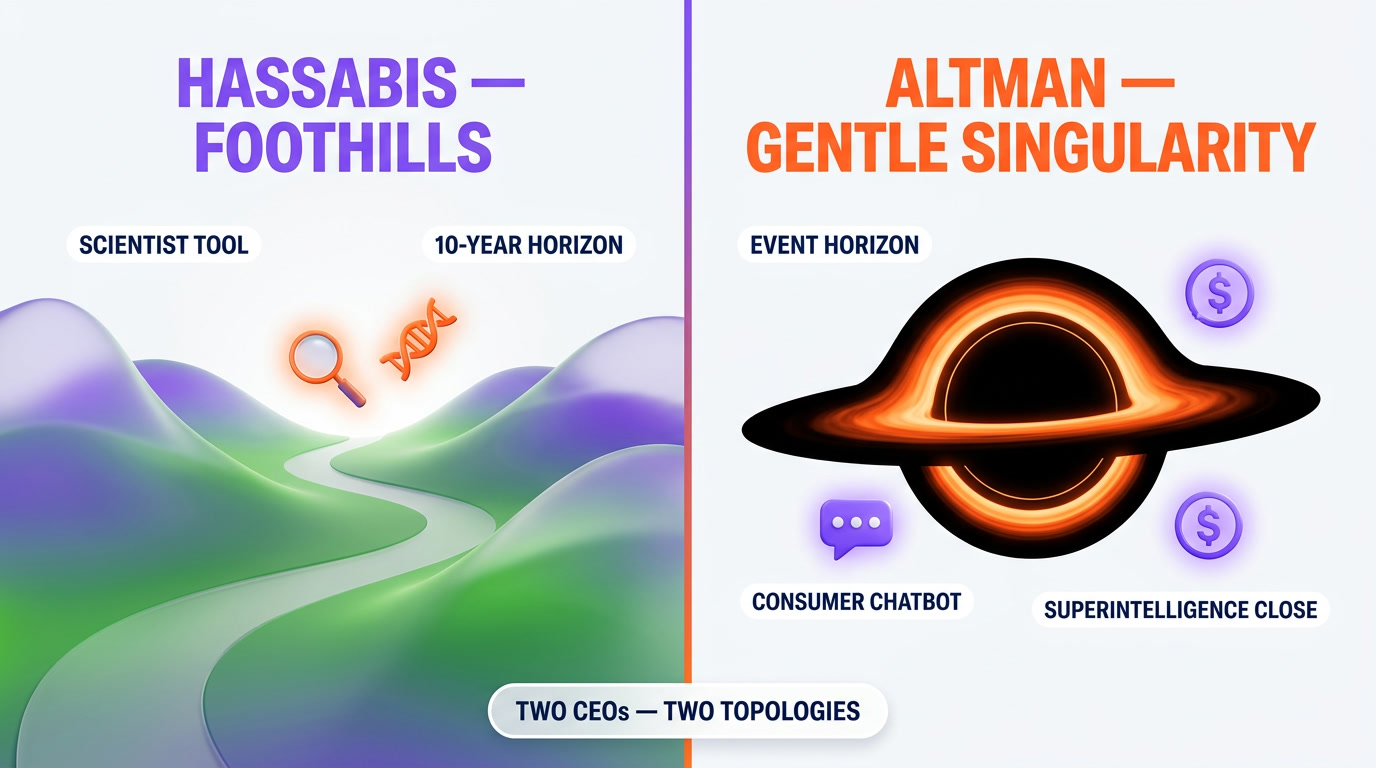
This is where the editorial angle gets sharp for me. In June 2025, Sam Altman published The Gentle Singularity on his personal blog. The essay opened with the line: "We are past the event horizon; the takeoff has started. Humanity is close to building digital superintelligence." In Altman's framing, the singularity is a thing that happens to you. It is already underway. It is an event horizon — a one-way physics metaphor implying inevitability.
Hassabis, in May 2026, is using a different topology entirely. Foothills imply geography, not gravity. They imply choice of route. They imply that you can climb slowly, you can stop, you can find pleasant valleys on the way up. In my production workflow I have read both texts back to back this week, and the contrast is not just rhetorical — it tracks the underlying business strategy of each company.
- Altman / OpenAI: the value lever is consumer scale plus enterprise automation. ChatGPT has ~800M weekly active users. The investor pitch — and the recent $4B OpenAI Deployment Company joint venture with Bain, McKinsey, and Capgemini — is built on the premise that AI replaces or fundamentally reorganizes human labor. The eschatological framing fits the business model. If the singularity is already happening, you should pay OpenAI to get inside the tent now.
- Hassabis / Google DeepMind: the flagship demonstrations are AlphaFold (2020), AlphaProteo, AlphaGenome, Gemini for Science. The 2024 Nobel Prize in Chemistry for Hassabis and John Jumper anchors the brand to peer-reviewed scientific contribution. An instrumentalist framing — AI as the next microscope, the next telescope — fits that book of work. It also fits Google's broader narrative of Gemini in every product rather than Gemini replaces every worker.
Strategically, Hassabis's framing is the more defensible one in 2026. It is testable. It is falsifiable on a decade-scale horizon. It does not require investors or regulators to accept an unobservable claim about a transition we cannot define. It also creates running room for Google: if the next 10 years of AI value is in accelerating science, Google's research division — the one that just took a Nobel — has a structural advantage over a consumer-facing lab.
Why the physics biography matters here
Huckins surfaces a biographical detail in the interview that I think under-rated commentators have missed. Hassabis tells her he turned to AI partly because he was frustrated by the apparent stagnation in physics since the 1970s. He wondered whether human minds had reached the natural limits of certain domains, and whether AI could break through where humans seemed stuck.
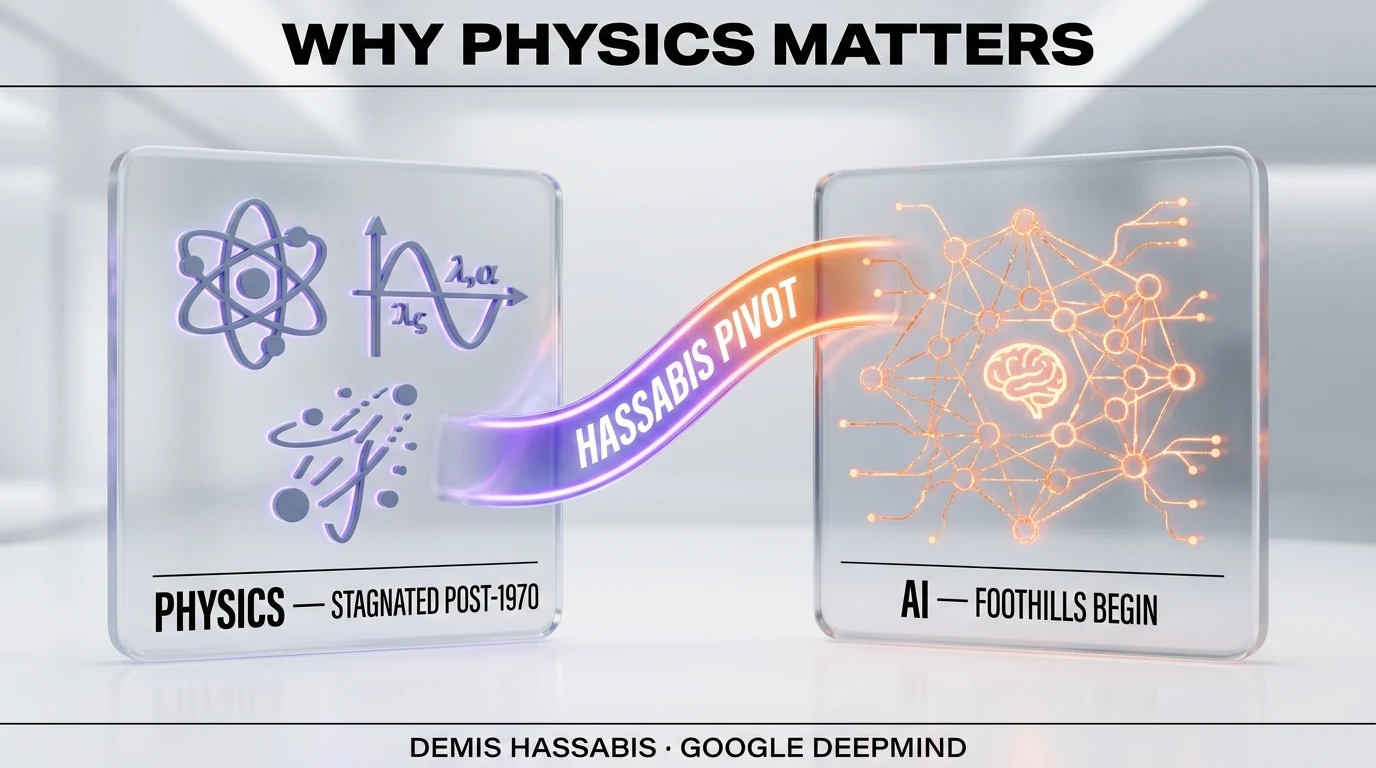
Read that origin story alongside the "foothills" quote and the picture sharpens. Hassabis is not a futurist hoping AI will transcend humans. He is a working scientist who built AI because he wanted to do better science. AlphaFold is the Rosetta Stone of that worldview: a tool that solved a 50-year structural biology problem, then was open-sourced for 200+ million protein predictions, then earned a Nobel in chemistry, not in computer science. The output, in his telling, is the science. The AI is the instrument.
That distinction matters because it changes what "winning" looks like. For Altman, winning is a recursive self-improving system that compounds intelligence. For Hassabis, as Hassabis frames it, winning is the next room-temperature superconductor, the next disease cure, the next material breakthrough — delivered with AI in the loop. The product is the discovery. The model is the lab equipment.
Google I/O 2026 makes the framing inevitable
Hassabis did not give this interview in a vacuum. It dropped two days after I/O 2026, where Google staged its largest research-themed keynote in years. Some receipts:
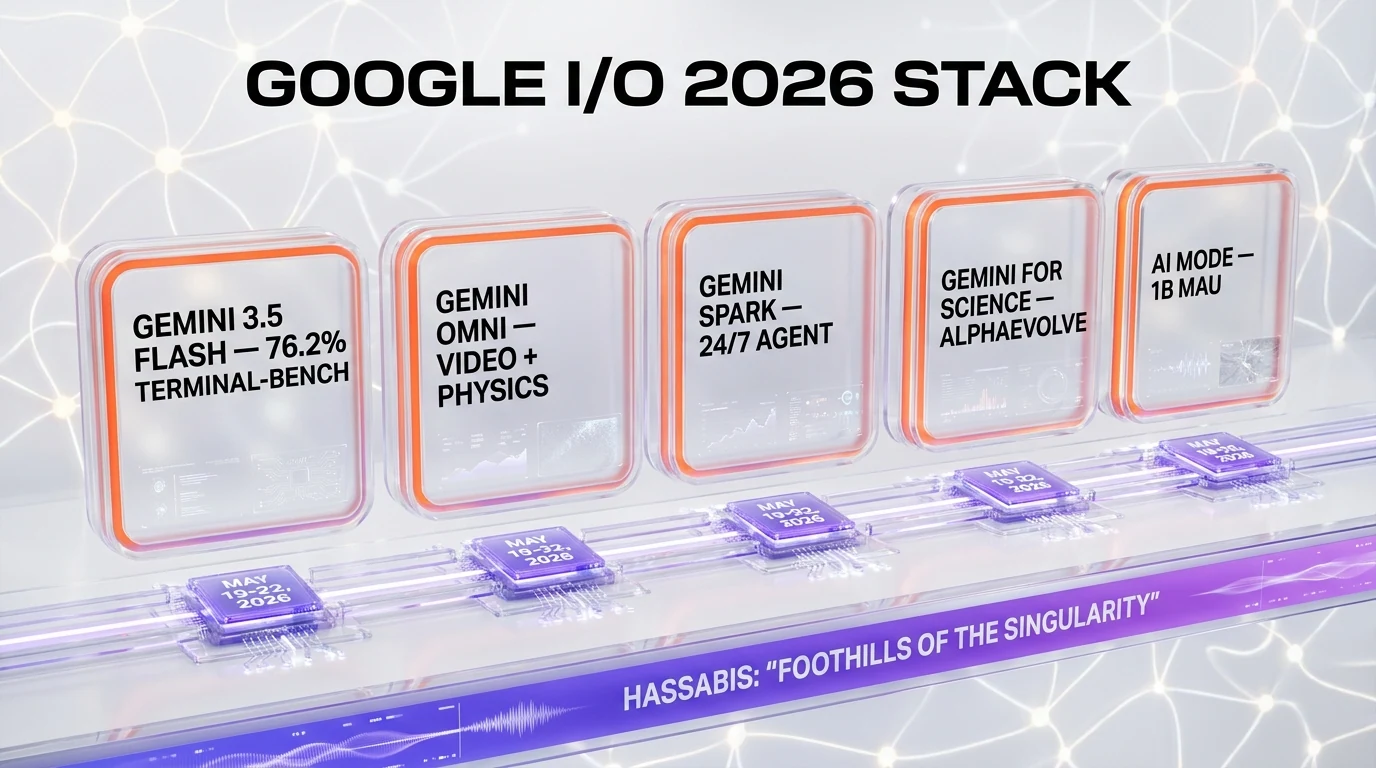
- Gemini 3.5 Flash launched at I/O 2026 with agentic reasoning improvements and aggressive enterprise pricing that has Anthropic procurement teams reportedly worried.
- AI Mode in Google Search crossed 1 billion monthly active users, an answer-engine distribution figure no rival can touch.
- Gemini Omni Flash shipped natural-language video editing as a Veo-tier consumer product.
- Gemini Spark, Google's 24/7 autonomous agent, took the stage as Google's answer to Claude Opus 4.7 Routines and ChatGPT Pulse.
- Gemini Robotics-ER 1.6 was already out from Google DeepMind in April, giving the keynote an embodied-AI through-line.
The keynote spent unusual stage time on Gemini for Science — agents that read papers, design experiments, and summarize lab results. The MIT Tech Review piece reads, in part, as Hassabis's gloss on the keynote. Of course AI is "a tool to help scientists for the next decade" — that is the product Google just shipped on stage. The framing follows the goods.
My read: foothills is the most honest CEO framing of 2026
I am going to be direct about my position. In my reading, "foothills of the singularity" is the most epistemically honest framing any of the frontier-lab CEOs has offered in 2026. Here is why.
- It admits we are on the slope. Hassabis is not anti-AGI. He is not playing the "just a chatbot" defense. He concedes that something singularity-shaped is happening — and that we are inside it now. That matches what I see in our own production pipeline. The model gap between a 2023 GPT-4 and a 2026 Gemini 3.5 Flash or Claude Opus 4.7 is wider than the gap between Windows 95 and Windows 11.
- It refuses to time the summit. Most singularity discourse is sleight-of-hand on dates. Altman's June 2025 essay strongly implies a 2027-2030 superintelligence; Dario Amodei's October 2024 "Machines of Loving Grace" targeted 2026-2027. Hassabis just says foothills, for a decade. No one can fact-check him on that in 2026. Everyone can fact-check him in 2036.
- It keeps the option open both ways. If the next decade is steady tool progress, Hassabis was right. If something explodes in 2030, the "collaborator" line absorbs the surprise. It is the rare CEO position that pays out under both worlds.
- It is also marketing — and I think that is fine. "Foothills" is a great line. It will end up in a Google ad campaign by Q4 2026. The instrumentalist framing happens to align perfectly with Google's research-prestige narrative and with the kind of regulatory posture that does not invite calls for AI moratoria.
What would prove me wrong
Voice 3 means I do not get to hide behind hedges. Here are the specific things that would force me to retract this take:
- A 2026 or 2027 reasoning-model leap that closes the "tool vs. collaborator" gap. If a frontier model — from any lab — autonomously produces a peer-reviewed scientific result that wins a Nobel-class prize without a human PI named as the principal investigator, the "foothills, for a decade" framing collapses. We are then on the summit, not the slope.
- Hassabis himself walking it back. If, before May 2027, Demis publicly accelerates the timeline ("collaborators in 3-5 years, not 10"), that is him conceding the eschatological framing was right. It would also mean the "tool" line was a 2026 PR posture, not a real prediction.
- Mass scientist replacement, not augmentation, by 2028. If Gemini for Science or its successors lead to documented mass layoffs in research roles at major universities or pharma — not just CS-adjacent ones — the instrumentalist defense fails empirically. Tools that replace their users were not tools.
- An AlphaFold-grade discovery from a non-Google lab using a non-Google model. If a Claude or GPT model produces an equivalent breakthrough first, my claim that "Google's research moat fits the foothills framing" loses its strategic punch. The framing becomes a side-show, not a moat.
I will revisit this article in May 2027 with a follow-up. I will mark the predictions above as confirmed, partially confirmed, or wrong. That is the standard.
What this means if you are building with AI right now
I run a small content engine. We use Claude Opus 4.7 daily, Gemini 3.5 Flash for high-volume tasks, and we test Gemini Spark in our 24/7 background pipeline. The Hassabis framing matters for builders in three concrete ways:
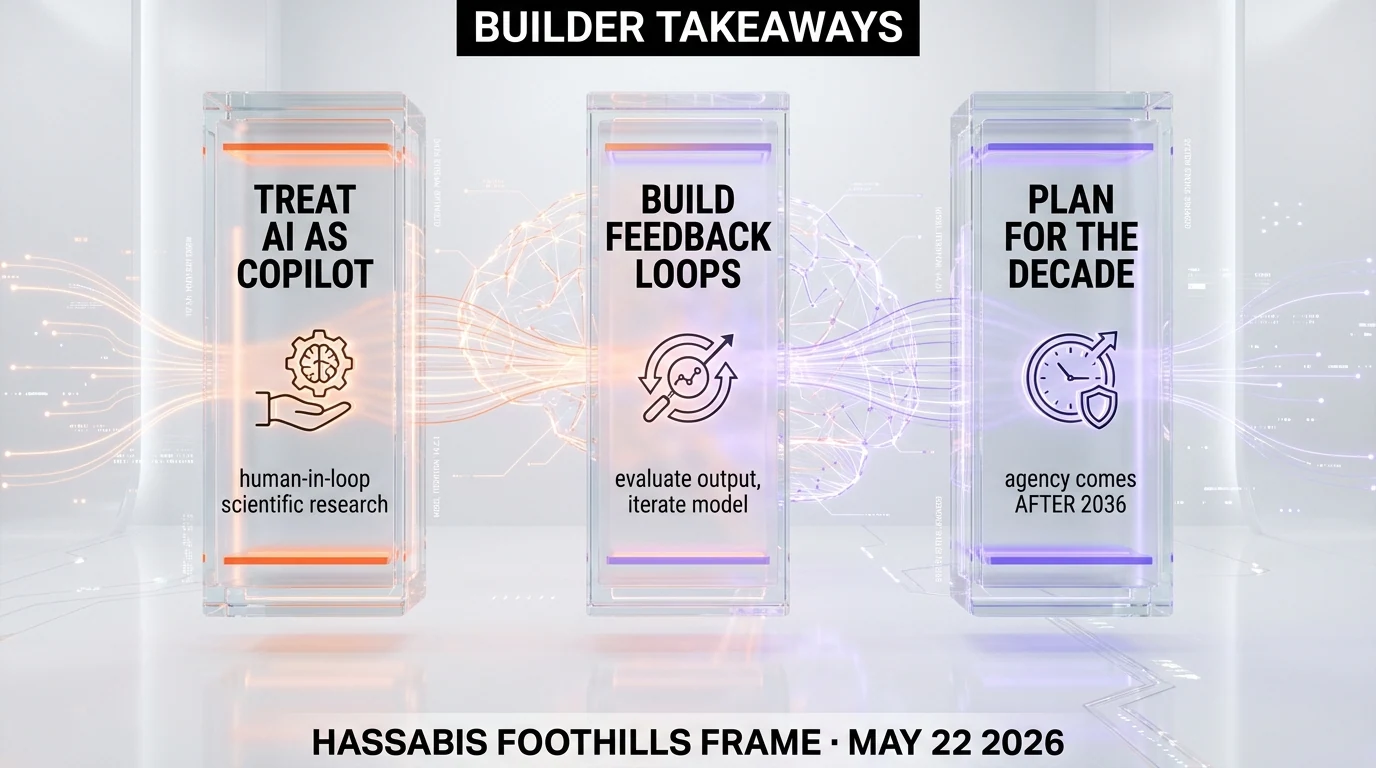
- The "tool" window is real, and it is roughly 10 years long. If you are starting a company in 2026 that depends on AI being an instrument under human direction, Hassabis just told you the runway. Build for that window. Do not build a 2026 startup on the assumption that AGI-as-coworker arrives in 2027.
- Science-stack AI is where the prestige capital flows. Expect more Google research output. Expect more DeepMind papers. The signal is that AlphaProteo and AlphaGenome get more 2026-2028 budget than consumer surface area. Position accordingly if you serve research customers.
- The discourse is bifurcating. CEO X-risk talk and CEO instrumentalism are now visibly different camps. Watch which one your enterprise buyers anchor on. EU regulators are closer to the Hassabis frame; US Senate hearings are closer to the Altman frame. Sales scripts should match.
The line everyone will quote
If you read only one sentence from the MIT Tech Review piece, read this one: "For the next decade or so, we should think about AI as this amazing tool to help scientists." It is the cleanest answer Hassabis has ever given to the question "what is your AI for?". The answer is: better science. Not better marketing. Not better automation. Not better superintelligence theology. Better science.
I think that is correct. I also think the foothills metaphor will outlive most 2026 AI takes — including, probably, this one. Foothills are not the cliff. They are also not the parking lot. We are climbing. Hassabis just told you the trail name.
FAQs about Hassabis, the foothills line, and what it means
What exactly did Demis Hassabis say about the singularity?
In a May 22, 2026 MIT Technology Review interview by Grace Huckins, Hassabis said the world is "standing in the foothills of the singularity." He added that "for the next decade or so, we should think about AI as this amazing tool to help scientists" and that beyond that horizon, "perhaps these systems will become more like collaborators." All three quotes are verbatim from the published article.
How is Hassabis's framing different from Sam Altman's "Gentle Singularity"?
Altman's June 2025 essay The Gentle Singularity argued that "we are past the event horizon" and that digital superintelligence is close. Hassabis uses geographic metaphors — foothills — that imply choice of route and a decade-plus horizon before AI shifts from tool to collaborator. Altman's framing is eschatological; Hassabis's is instrumental. The business models behind each company track these metaphors.
Is Hassabis predicting AGI by a specific year?
No. In the May 22, 2026 interview, Hassabis explicitly avoided naming a date for AGI. He used the phrase "for the next decade or so" to describe AI's role as a scientific tool and only said "perhaps" AI becomes a collaborator after that. The framing is deliberately falsifiable on a decade-scale horizon, not a 2-3 year horizon.
Why does Hassabis emphasize science instead of automation?
Google DeepMind's flagship outputs are AlphaFold (2020), AlphaProteo, AlphaGenome, and Gemini for Science. Hassabis and John Jumper won the 2024 Nobel Prize in Chemistry for AlphaFold. His framing — AI as the next microscope or telescope — aligns with peer-reviewed research outputs and with Google's strategic narrative that distinguishes DeepMind from OpenAI's consumer-and-automation focus.
What is the "foothills of the singularity" metaphor actually saying?
Foothills suggest geography rather than physics. Unlike Altman's "event horizon" metaphor — which implies one-way gravitational inevitability — foothills imply that humanity is climbing toward something but can choose pace, route, and pauses. As Hassabis frames it, the singularity is an era already underway, not a wall about to be hit.
How does this connect to Google I/O 2026?
Hassabis gave the interview two days after Google I/O 2026, where Google staged a heavily research-themed keynote. The keynote shipped Gemini 3.5 Flash, AI Mode at 1 billion MAU, Gemini Omni Flash for video editing, and Gemini Spark for 24/7 autonomous agents — alongside extensive Gemini for Science demos. Hassabis's "tool for scientists" framing reads partly as a strategic gloss on what Google just shipped.
What does Hassabis's physics background have to do with this?
In the interview, Hassabis tells Grace Huckins that he was drawn to AI partly because physics progress appeared to stagnate after the 1970s. He wondered whether human minds had hit the natural limits of certain domains and whether AI could break through where humans seemed stuck. AlphaFold — which solved a 50-year-old structural biology problem — exemplifies this worldview.
Could Hassabis be wrong about the 10-year horizon?
Yes. If a 2026 or 2027 reasoning-model leap autonomously produces a Nobel-class scientific result without a human principal investigator, the "tool vs. collaborator" gap collapses faster than Hassabis predicts. Equally, if Hassabis himself accelerates his timeline before May 2027, that would signal he treated the 2026 framing as a positioning move, not a real forecast.
Does this affect how I should build with AI today?
In my reading, yes. Hassabis's framing tells builders that the next 10 years of AI value will likely come from instruments under human direction — not from autonomous coworkers. Companies starting in 2026 that depend on AGI-as-employee arriving by 2027 are taking a bet against the dominant lab. Science-stack AI is where prestige capital will flow through 2028.
Is Hassabis's framing just marketing for Google?
In my reading, partly yes, partly no. The framing fits Google's research-prestige narrative perfectly and reduces regulatory friction. But it is also the most falsifiable AI-CEO position of 2026 — Hassabis is offering a decade-scale prediction that can be checked against future evidence. Marketing and honest forecasting are not mutually exclusive. The Altman framing is also marketing; it just markets a different product.
Sources and further reading
- Grace Huckins, "Google I/O showed how the path for AI in science is shifting," MIT Technology Review, May 22, 2026 — primary source for all Hassabis quotes in this article.
- Sam Altman, The Gentle Singularity, June 10, 2025 — primary source for the contrasting Altman framing.
- Google DeepMind, DeepMind Research Blog — for AlphaFold, AlphaProteo, AlphaGenome context.
Disclosure (repeat). ThePlanetTools.ai has no commercial relationship with Google DeepMind, Google, OpenAI, or Anthropic. No affiliate fees were paid for the writing of this piece. The Hassabis quotes are verbatim from MIT Technology Review's May 22, 2026 interview by Grace Huckins. The interpretations, strategic readings, and predictions are my own. I will revisit this article in May 2027 to mark the "What would prove me wrong" predictions as confirmed, partially confirmed, or wrong.