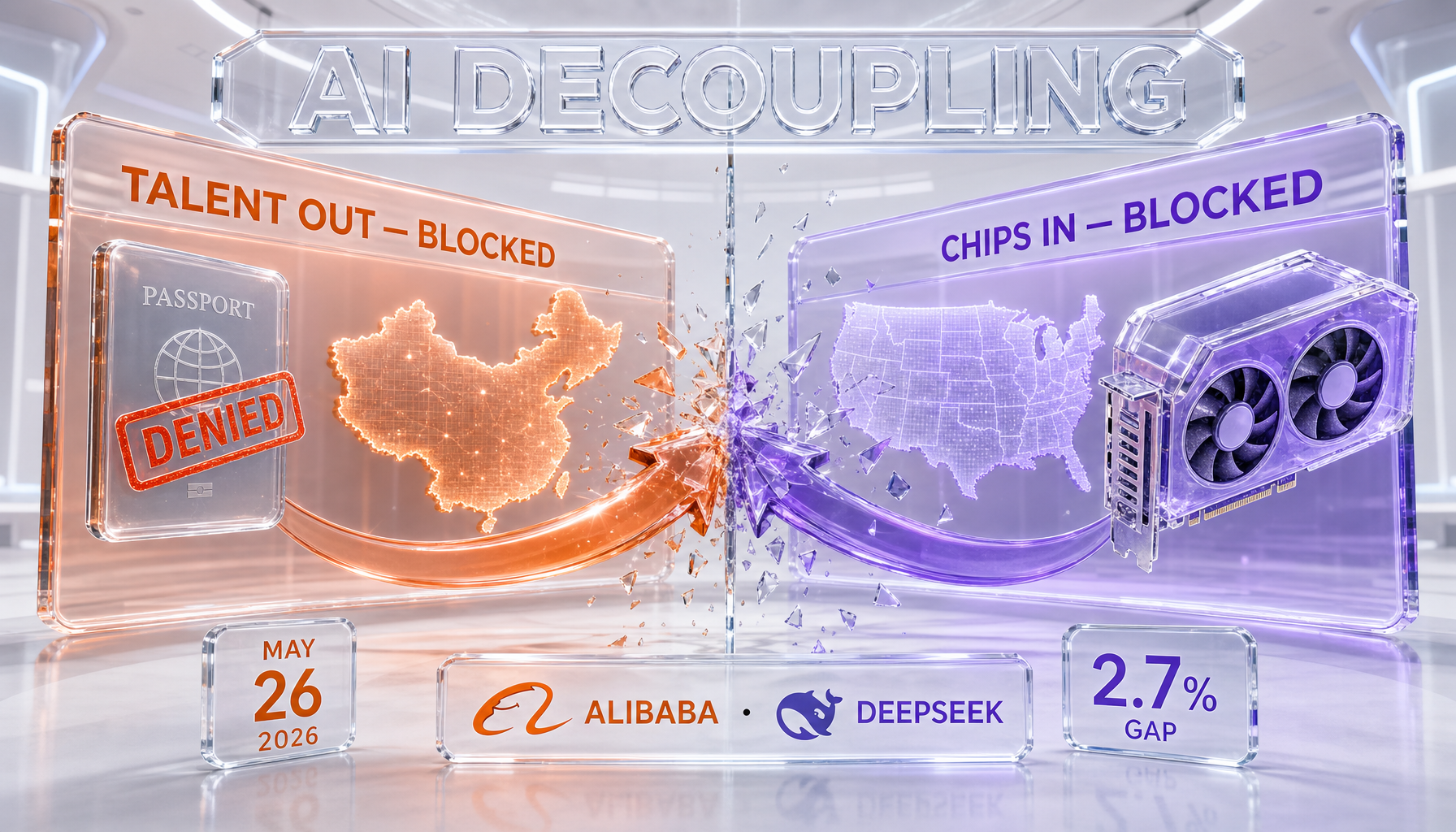
What did China announce on travel restrictions for AI talent? On May 26, 2026, Bloomberg reported that Beijing extended international travel curbs to private-sector AI staff at firms like Alibaba and DeepSeek, requiring government approval before overseas trips. Selected founders, researchers, and executives working on advanced AI are now reportedly judged by strategic value rather than job title, and must clear authorities before leaving the country. According to Bloomberg's reporting, this formalizes a control that started inside DeepSeek and previously applied mainly to nuclear scientists and state-owned-enterprise executives.
Editorial disclosure: This is an opinion piece. ThePlanetTools.ai has no affiliate relationship with Alibaba, DeepSeek, or any company named here, and no commercial stake in the US–China AI rivalry. What follows is my strategic read of a geopolitical move, not investment, legal, or immigration advice.
The Thesis: Outbound Talent Curbs Are the Mirror of Inbound Chip Curbs
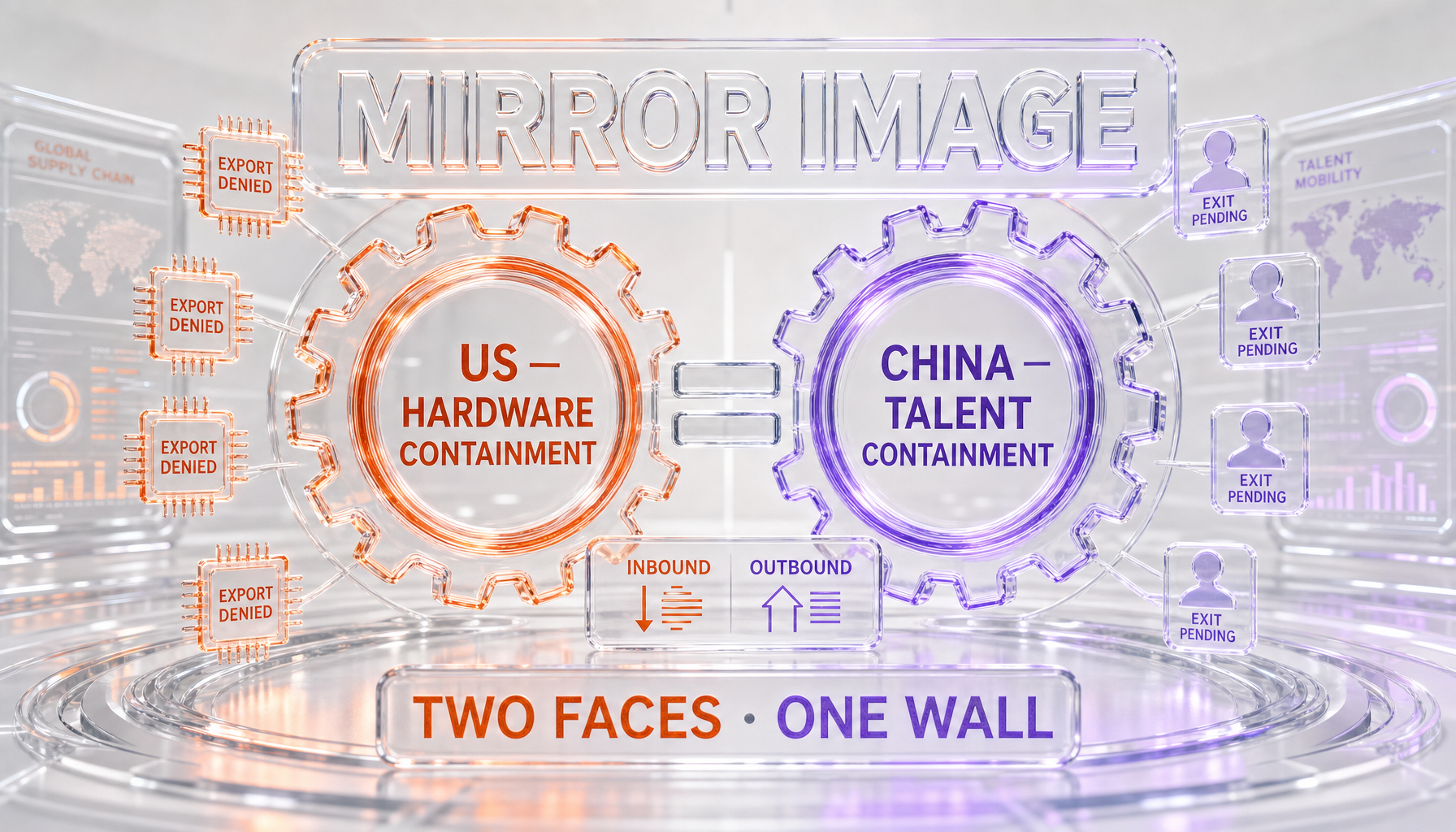
Here is the frame I keep coming back to. For seven years, the United States has built a wall to keep hardware from flowing into China — successive rounds of chip export controls on advanced GPUs, lithography tools, and high-bandwidth memory. What Beijing reportedly formalized on May 26, 2026 is the structurally identical move pointed the opposite way: a wall to keep talent from flowing out of China. Same logic, inverted vector. One side fences the silicon. The other side fences the people who know what to do with it.
In my read, that symmetry is the whole story. The US controls the input China can't easily manufacture at the frontier — leading-edge compute. China controls the input the US would love to recruit away — the small population of researchers who turned a compute disadvantage into models that benchmark within striking distance of the best American systems. Both governments looked at the AI race, identified the scarce resource they could physically gate at a border, and gated it. Chip export controls and talent exit controls are not two unrelated stories. They are two faces of the same decoupling.
I want to be precise about what I am and am not claiming. I am not arguing that one wall is morally equivalent to the other, or that they will be equally effective, or that the people involved face comparable stakes (they do not — an export license is paperwork; a passport hold touches a person's freedom of movement). I am making a narrower, strategic point: as a containment instrument, gating outbound talent is the conceptual twin of gating inbound chips, and reading them together explains the 2026 moment better than reading either alone.
What Beijing Actually Did — and Didn't
Let me keep the facts and my opinion in separate buckets. On the facts, according to Bloomberg reporting relayed by The Next Web and implicator.ai, Chinese government agencies have begun requiring selected AI professionals at private firms — Alibaba and DeepSeek were named — to obtain official approval before traveling abroad. The defining detail: people are reportedly selected by their strategic value to China's technology ambitions, not their seniority or formal title. A mid-level researcher on a frontier model can be flagged while a more senior administrator is not.
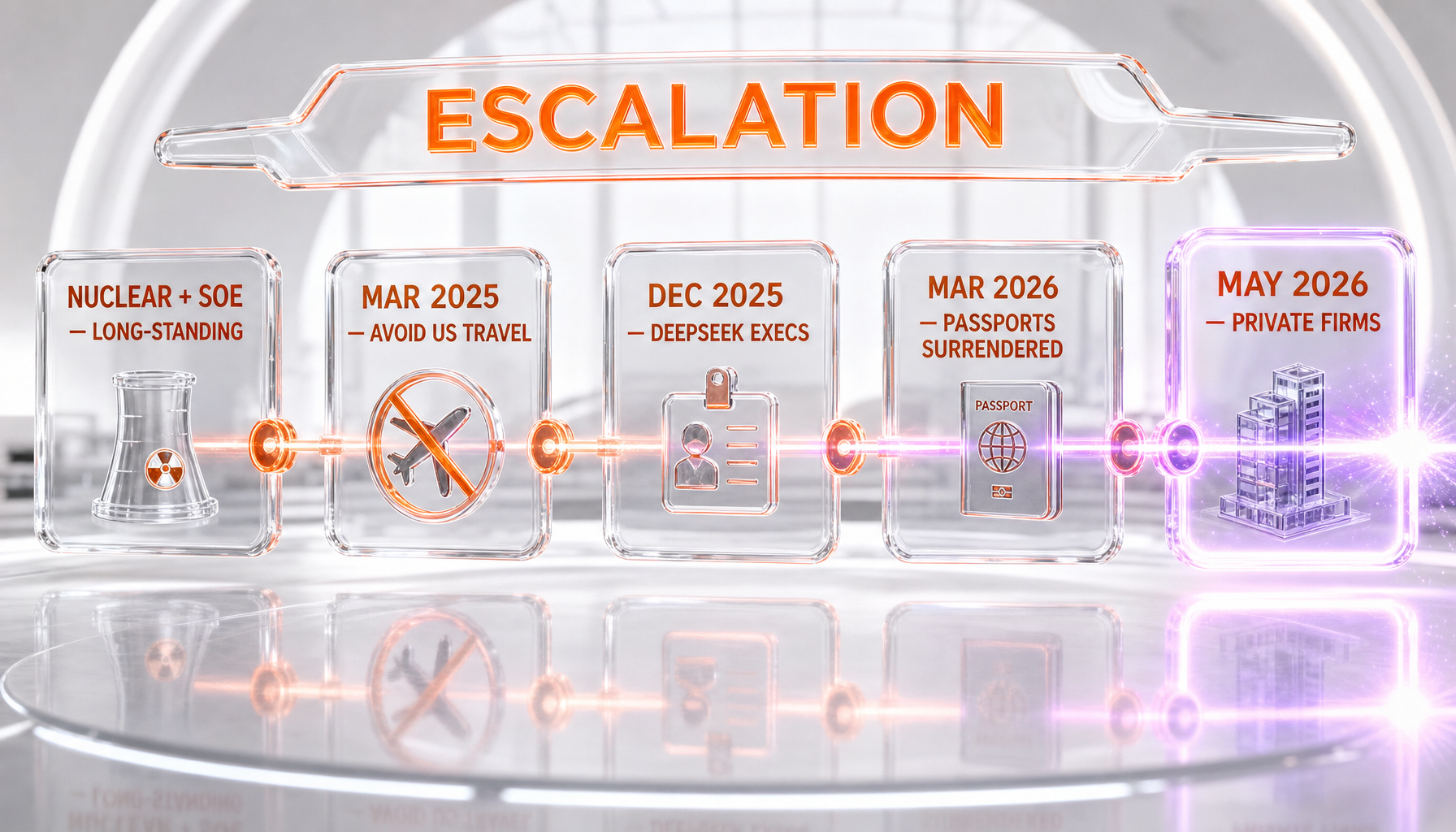
This did not appear from nowhere. The reporting traces a clear escalation ladder. Controls of this kind were long-standing for nuclear scientists and senior executives at state-owned enterprises. In early 2025, authorities reportedly advised top AI founders and researchers to avoid US travel — guidance, not a requirement. Around March 2026, after DeepSeek's R1 breakthrough drew global attention, key DeepSeek engineers were reportedly asked to surrender passports to their employer, with the formal justification that their work could expose state or commercial secrets. In February 2026, DeepSeek founder Liang Wenfeng declined an invitation to the Paris AI summit. By May 2026, the same playbook reportedly widened from a handful of DeepSeek staff to private firms broadly — what implicator.ai summarized as the shift from "notice" to "approval."
And here is the "didn't." Beijing has neither confirmed nor denied the policy, and per TechTimes, China's Ministry of Industry and Information Technology has not responded to press requests for comment. There is reportedly no formal statute behind it; it operates through administrative pressure, sometimes dressed as corporate HR policy, sometimes as government guidance, with the line between the two deliberately blurred. That ambiguity is not a bug. In my view, it is the design — denial is cheap, deterrence is real, and an informal rule is harder to litigate than a published one.
One quote captured the intent better than any official statement could. Xiaomeng Lu of the Eurasia Group told the Wall Street Journal the message was simple: "The initial signal is: Stay here, don't run away." That is the policy in seven words.
Why This Mirrors the Chip Wall So Precisely
Look at the mechanics side by side and the symmetry is almost uncanny. US chip controls work by inserting a government approval step between a willing seller and a Chinese buyer: you may not ship the advanced GPU without a license, and licenses for the most capable parts are effectively denied. China's talent rule inserts a government approval step between a willing traveler and an airport gate: you may not leave without clearance, and clearance for the most strategically valuable people is the friction point. Both interpose the state into a transaction that markets and individuals would otherwise complete on their own.
Both also share the same targeting philosophy: gate the frontier, let the commodity flow. The US never tried to block every chip — it drew a performance line and controlled everything above it. Beijing, by the reporting, is not grounding every engineer in the country — it is flagging the people whose specific knowledge sits at the frontier. Tourists fly. Frontier researchers wait for approval. Lagging-node chips ship. Bleeding-edge accelerators don't. In both cases the policy is a scalpel aimed at the capability gap, not a blanket.
And both rest on the same underlying bet: that the scarce, hard-to-reproduce input is more controllable than the abundant one. You cannot easily un-invent EUV lithography or re-grow a senior research team overnight, so whoever holds the choke point on that input holds leverage. The US bet that compute is China's choke point. China appears to be betting that, post-DeepSeek, its people are the input the US most wants and can least easily replicate domestically. If you believe AI advantage now flows more from a few hundred elite researchers than from any single dataset or chip, fencing them in is the rational mirror move.
Why Now: The Gap Got Small Enough to Be Worth Fencing
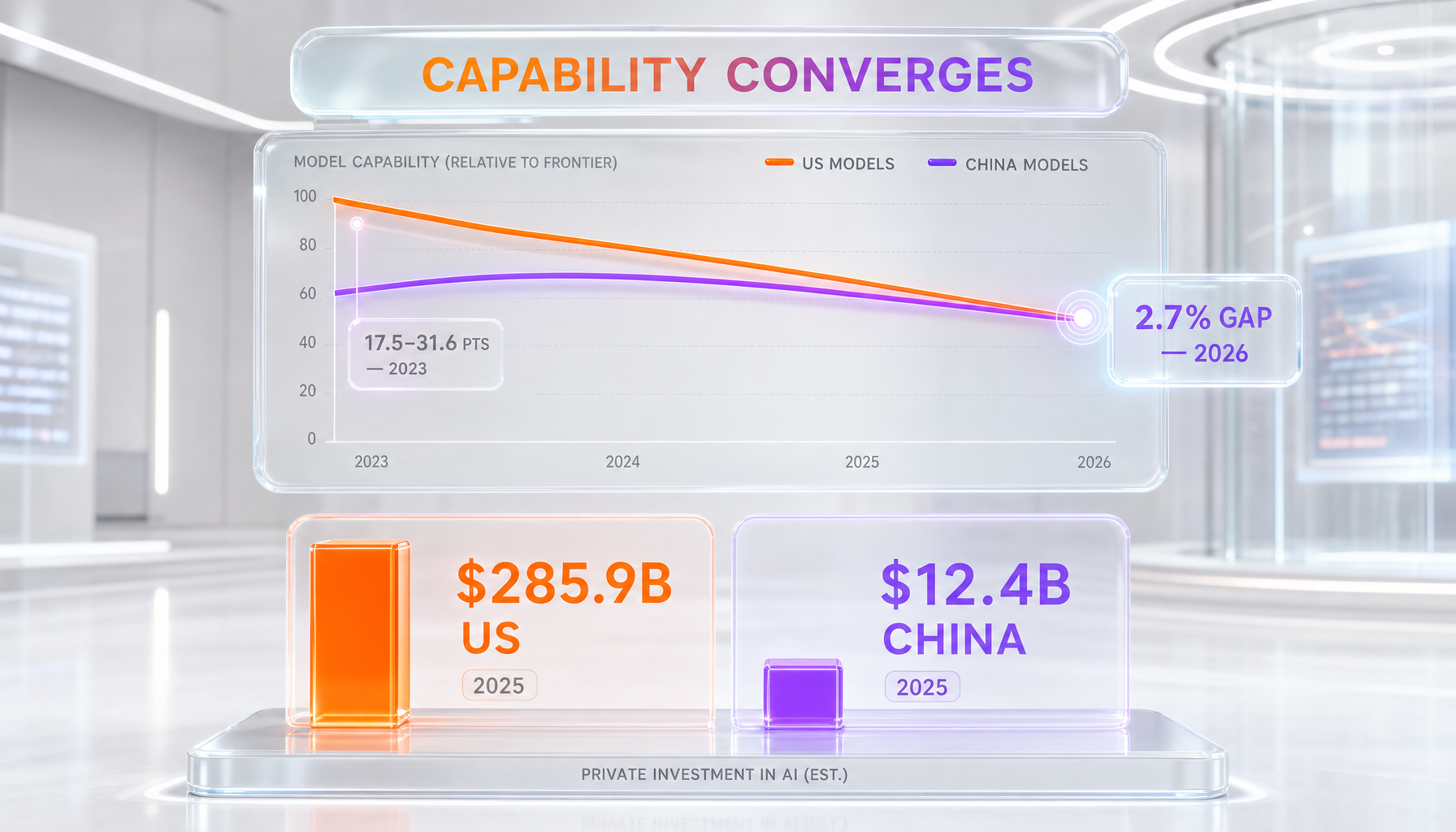
Containment instruments get deployed when the thing being contained becomes genuinely valuable. That is the timing signal I read in 2026. According to Stanford's 2026 AI Index (as cited in the reporting), the performance gap between the top US and top Chinese frontier models narrowed to roughly 2.7 percent, down from a chasm of 17.5 to 31.6 percentage points in 2023. When you are 30 points behind, your researchers are a flight risk you can tolerate. When you are essentially at parity, every one of those researchers is a national-security asset — and a poaching target.
The investment picture sharpens the same point from the other side. The reporting cites US private AI investment at about $285.9 billion in 2025 against roughly $12.4 billion in China. Read that gap honestly and it reframes the travel curbs entirely: China is producing near-frontier results on a fraction of the capital, which means its human efficiency — the talent — is doing disproportionate work. If your edge is people-per-dollar rather than dollars, you protect the people. The travel rule is, in that light, an admission of where China believes its real advantage lives.
This is also why I do not think the curbs are mainly defensive paranoia about espionage, even though the espionage framing dominates the US side of this story. The simplest explanation is competitive: a near-parity competitor protecting the input it cannot afford to lose. The Qwen models from Alibaba and DeepSeek's open-weight releases did not just impress benchmark-watchers — they made the individual humans behind them strategically legible to Beijing in a way they weren't when China was a clear second. Success created the asset. The asset created the wall.
The Catch: Easy to Announce, Hard to Enforce
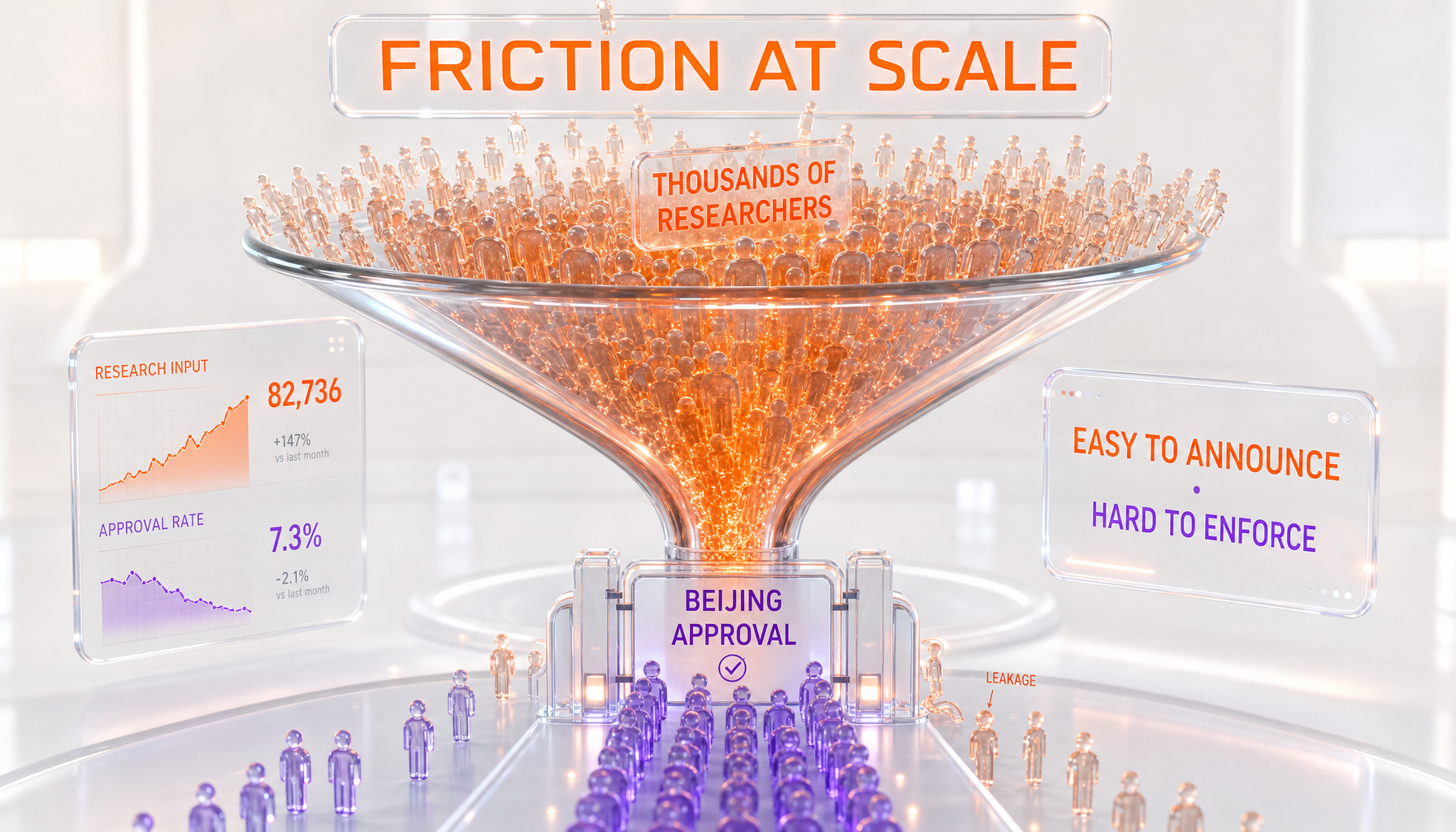
Now the strategic critique — and I want to keep it strategic, not a judgment of whether the policy is good or bad in the abstract. The mirror has an asymmetry that I think Beijing has to be aware of. Chip controls scale down well: there are a handful of fabs and tool-makers in the world, so policing the choke point means policing a short list of companies. Talent controls scale up badly: the moment you widen from a handful of DeepSeek staff to "strategically valuable researchers across private firms," you are trying to monitor several thousand individuals, each with their own incentives, networks, and exit options.
The Next Web's framing stuck with me: the travel controls are "easier to impose than to enforce, particularly as the affected population grows from a handful of DeepSeek staff to several thousand researchers." A short list is a wall. A long list is a sieve with a sign on it. In my view, the policy's real near-term effect is deterrence by ambiguity — the chilling signal Xiaomeng Lu described — rather than airtight prevention. It changes behavior at the margin: fewer conference trips, more hesitation about foreign offers, a quieter brain-drain rather than an open one.
There is a second-order cost the chip wall doesn't carry, and it cuts against Beijing's own stated goal. Hardware doesn't have feelings about being export-controlled; researchers do. A talent fence that reads as "you are too valuable to be trusted to leave" can corrode the very loyalty it tries to secure, and it complicates exactly the international collaboration — conferences, co-authorship, open-weights goodwill — that helped Chinese labs close the gap in the first place. The instrument that protects the asset can also degrade it. That tension doesn't exist on the US chip side, which is part of why I think the mirror is imperfect even as it is real.
This Fits a Pattern of Jurisdictional Control
The travel rule does not stand alone. It rhymes with a string of 2026 moves in which Beijing reached for jurisdiction over strategically sensitive tech assets. In April 2026, regulators blocked Meta’s reported $2 billion acquisition of Manus and reportedly barred its founders from leaving — capital control and exit control fused into a single act. Around the same window, the reporting describes guidance pushing leading AI firms to reject US-origin capital without prior clearance, and pressure on companies like Moonshot AI weighing reincorporation onto the mainland. China also built a national registry assigning every humanoid robot a 29-character lifecycle ID — a different domain, same instinct toward state-legible control over the physical and human substrate of advanced tech.
implicator.ai called the through-line a shift "from import controls to jurisdictional controls" — keeping capital, technology, and key personnel reachable by the state. I think that is exactly right, and it is the lens through which the travel curbs make the most sense. This is not a one-off security reflex. It is a deliberate widening of what Beijing considers a controllable export: first chips and tech it imports, now the capital that funds AI, the corporate domicile, and the people themselves.
What It Means for the AI Race
If you zoom out, both walls point at the same uncomfortable conclusion: the AI race is hardening into a contest where governments, not labs, increasingly draw the boundaries of who can buy what and who can go where. The optimistic 2023 story — a borderless research community where open weights and shared papers lifted everyone — is being replaced by a 2026 story where the frontier is a national-security perimeter on both sides. US researchers can't freely sell into China; Chinese researchers can't freely move out. The same fence, built twice, facing opposite directions.
For the rest of us watching from outside both blocs, the practical signal is concentration. Expect fewer cross-border collaborations at the frontier, more parallel ecosystems, and a widening premium on talent that can move freely — which, ironically, makes researchers in neutral jurisdictions more valuable, not less. And expect the financing layer to feel it too: a world where NVIDIA’s equity bets and trillion-dollar order books ride on a US-centric compute stack, while China builds a self-contained one staffed by people it has quietly asked to stay home. Two stacks, two talent pools, one wall mirrored down the middle.
What Would Prove Me Wrong
I hold this thesis with conviction, not certainty. Here is what would tell me I've read it wrong:
- Beijing formally denies and reverses. If Chinese authorities issue a clear, on-the-record denial and named researchers at Alibaba or DeepSeek are documented traveling abroad freely without approval through late 2026, then this was over-read reporting, not a policy, and my mirror frame collapses.
- The curbs turn out to be narrow security vetting, not strategic containment. If the rule only ever touches people with literal access to classified state contracts — a small, conventional security set — then it is ordinary counter-espionage, not the talent-containment twin of chip controls I'm describing.
- The capability gap re-widens sharply. If US frontier models pull back to a double-digit lead through 2026–2027, the "talent is now the scarce asset" premise weakens, and the timing logic I built on the Stanford 2026 AI Index falls apart.
- Talent keeps flowing anyway. If, despite the rule, there's clear evidence of continued senior departures from Chinese frontier labs to US firms, then the wall is theater, and my read of it as a meaningful deterrent is too generous.
- The US dismantles its chip wall. If Washington materially rolls back export controls, the symmetry I'm leaning on disappears on one side, and "two faces of one decoupling" becomes a one-sided story.
Until I see those, the simplest model that fits the evidence is the one I started with: a near-parity competitor fencing in the input it can least afford to lose, in exact structural mirror of the rival fencing out the input it controls. Same wall. Opposite directions. One race.
Editorial disclosure, repeated for clarity: ThePlanetTools.ai has no affiliate or commercial relationship with Alibaba, DeepSeek, Meta, NVIDIA, or any government or entity referenced above. This is independent editorial opinion based on Bloomberg reporting (paywalled at time of writing) and corroborating coverage from The Next Web, implicator.ai, TechTimes, and Wall Street Journal / Financial Times references cited in those reports. Facts are attributed; the strategic interpretation is my own.
Frequently Asked Questions
What did China announce on travel restrictions for AI talent?
On May 26, 2026, Bloomberg reported that Beijing extended international travel curbs to private-sector AI staff at firms like Alibaba and DeepSeek, requiring government approval before overseas trips. Selected founders, researchers, and executives are reportedly chosen by strategic value rather than job title.
Which companies are affected by China's AI travel curbs?
Bloomberg named Alibaba and DeepSeek directly. Related reporting also references Moonshot AI, StepFun, and ByteDance in the context of capital and jurisdictional controls. The rule reportedly started inside DeepSeek and widened from there to private firms more broadly.
Why does China require AI researchers to get approval before traveling abroad?
The official justification is preventing leakage of state or commercial secrets and the outward transfer of sensitive technology. My strategic read is competitive: with the US–China frontier model gap down to roughly 2.7 percent per Stanford's 2026 AI Index, Beijing now treats its top researchers as national-security assets worth fencing in.
How are China's AI travel curbs the mirror image of US chip export controls?
US controls insert a government approval step to stop advanced chips flowing into China; China's rule inserts a government approval step to stop strategic talent flowing out. Same instrument — a state-gated border on the scarce input — pointed in opposite directions. I read them as two faces of one AI decoupling.
Did Beijing officially confirm the AI travel restrictions?
No. Per TechTimes, Beijing has neither confirmed nor denied the policy, and China's Ministry of Industry and Information Technology has not responded to press requests for comment. The reporting describes an informal rule enforced through administrative pressure, with no published statute behind it.
When did China start restricting AI talent travel?
Controls were long-standing for nuclear scientists and state-owned-enterprise executives. Reporting traces escalation: early-2025 guidance to avoid US travel, December 2025 restrictions on DeepSeek executives, March 2026 passport surrenders at DeepSeek after its R1 breakthrough, and the May 2026 widening to private firms.
How does this connect to China blocking Meta's Manus acquisition?
It is the same jurisdictional-control instinct. In April 2026 China blocked Meta's reported $2 billion Manus acquisition and reportedly barred its founders from leaving the country — fusing capital control and exit control. The travel curbs extend that pattern from one deal to a whole class of researchers.
Can China actually enforce travel curbs across thousands of AI researchers?
Enforcement is the catch. As The Next Web noted, the controls are easier to impose than to enforce as the affected population grows from a handful of DeepSeek staff to several thousand researchers. In my view the near-term effect is deterrence by ambiguity — a chilling signal — more than airtight prevention.
What is the US–China AI model gap in 2026?
According to Stanford's 2026 AI Index as cited in the reporting, the performance gap between the top US and top Chinese frontier models narrowed to roughly 2.7 percent, down from 17.5 to 31.6 percentage points in 2023. That convergence is why I think talent became valuable enough to fence.
How much does China invest in AI compared to the US?
The reporting cites US private AI investment at about $285.9 billion in 2025 versus roughly $12.4 billion in China. China producing near-frontier results on a fraction of the capital suggests its human talent does disproportionate work — which is, in my read, exactly why it protects the people.
What would change your view that these are talent-containment controls?
A formal Beijing denial paired with documented free travel by named Alibaba or DeepSeek researchers; evidence the rule only ever touches classified-contract personnel; a sharp re-widening of the US model lead; continued senior departures despite the rule; or the US dismantling its chip wall. Any of those would break the mirror thesis.