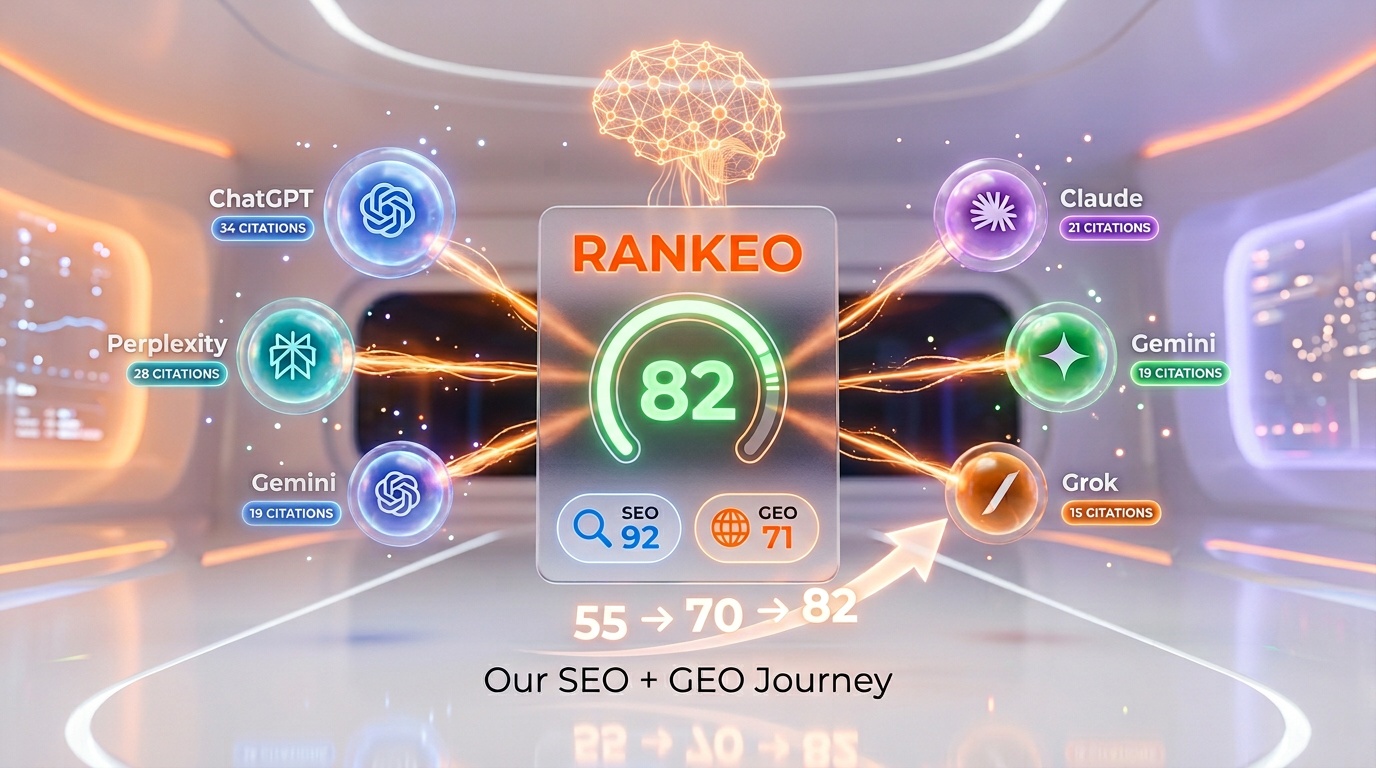
Rankeo is a combined SEO and GEO optimization platform that helped us raise our site score from 55 to 82 in under two months. We went from being invisible to AI engines to being cited consistently by 4 out of 5 of them. This is the honest, unfiltered story of how it happened — the surprises, the grind, and the results that changed how we think about search forever.
The Wake-Up Call We Didn't Know We Needed
Let's rewind to where this all started. We're ThePlanetTools.ai — a platform that reviews AI tools, compares them, and helps people find the right software for their workflows. We write thousands of words every week about the best tools on the market. We test them. We score them. We obsess over the details.
And for a while, we thought we were doing pretty well. Our Google rankings were solid. We had decent organic traffic. Our technical SEO was in good shape — clean sitemaps, fast Core Web Vitals, proper structured data. By most traditional metrics, we were performing above average.
But there was an entire dimension of search that we were completely blind to.
The truth hit us when we started noticing something strange in our analytics. Direct traffic was growing, but organic search from Google wasn't keeping pace with our content output. Meanwhile, we kept hearing from readers who said they "found us through ChatGPT" or "Perplexity recommended your review." We had no way to measure this. No way to optimize for it. No way to even know which of our pages were being cited by AI engines and which were being ignored.
We were optimizing for half the search landscape and didn't even realize it.
Discovering Rankeo
We discovered Rankeo the way most people discover tools — through a problem we couldn't solve with what we already had. We were looking for a way to understand our AI visibility, and every existing SEO tool we tried treated it as either an afterthought or didn't address it at all.
Semrush? Great for keywords. Says nothing about whether ChatGPT cites you. Ahrefs? Incredible backlink data. Zero insight into how Perplexity or Claude perceive your content. Moz? Solid domain authority. But domain authority means nothing if AI engines don't consider you an authority.
Rankeo approached the problem differently. Instead of bolting AI tracking onto an SEO tool, they built a platform where SEO and GEO (Generative Engine Optimization) are treated as two halves of the same whole. Every metric, every score, every recommendation considers both dimensions simultaneously. That's what caught our attention. That's what made us sign up.
The First Audit — A Humbling 55
We ran our first full audit on a Tuesday morning. It took about three minutes. The result landed like a cold shower.
Rankeo Score: 55 out of 100.
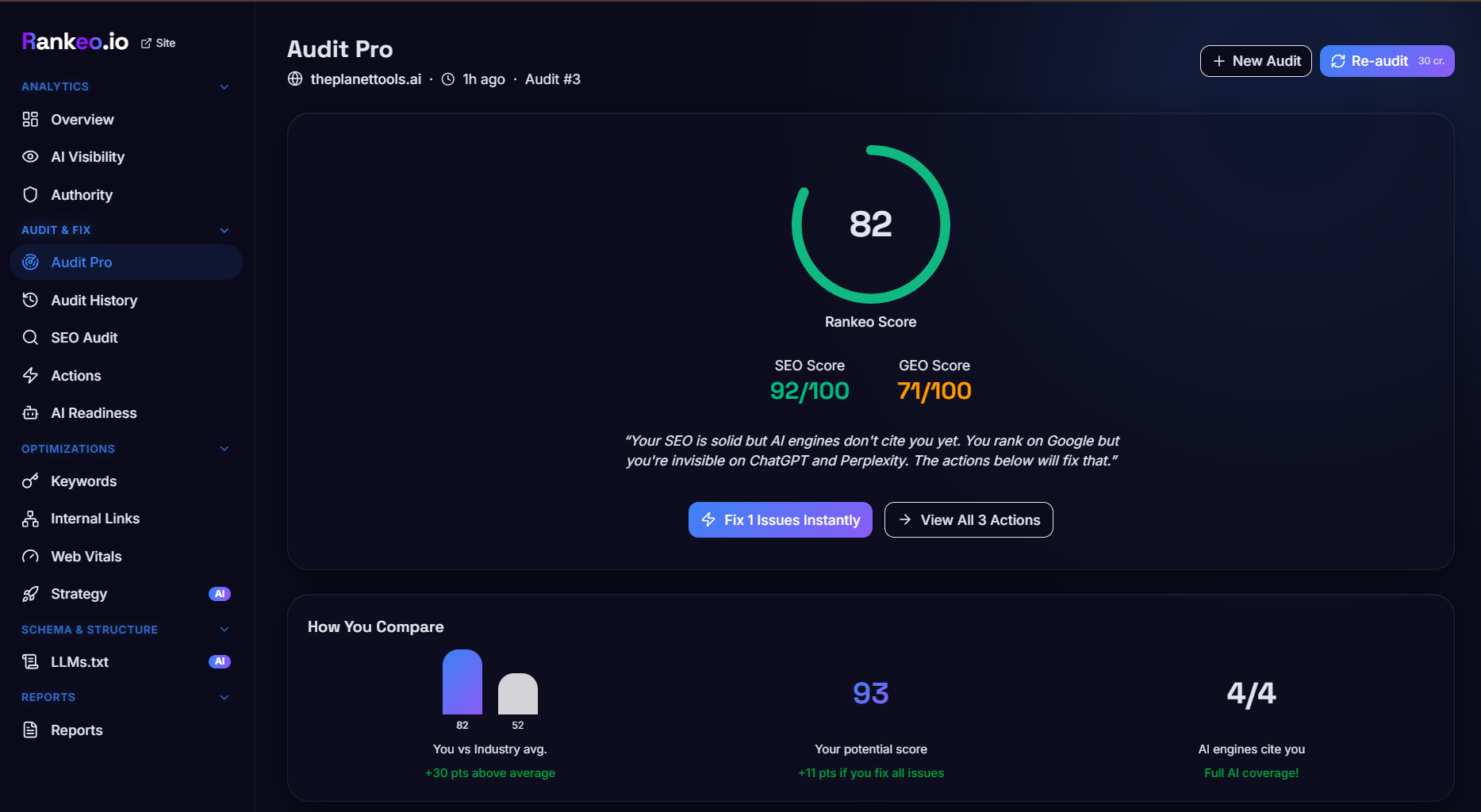
The breakdown told the real story. Our SEO Score was sitting at a respectable 75. Technical health was strong. On-page optimization was decent. Performance metrics were green across the board. By traditional standards, we were doing fine.
But our GEO Score? 35 out of 100.
That number was devastating — not because we expected it to be high, but because we hadn't even been measuring it. We'd been running a tech review site in 2026 without any awareness of how AI engines perceived our content. It was like running a restaurant and never checking if customers could actually find the front door.
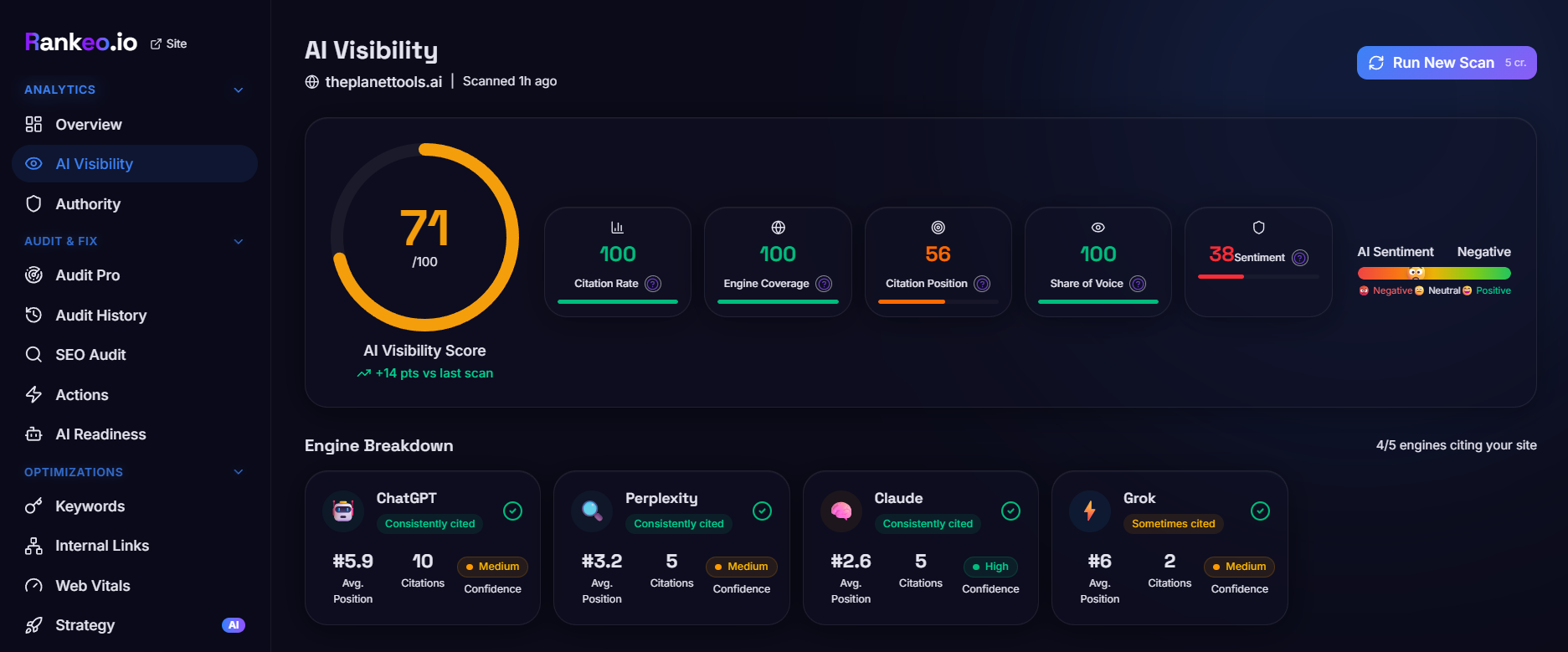
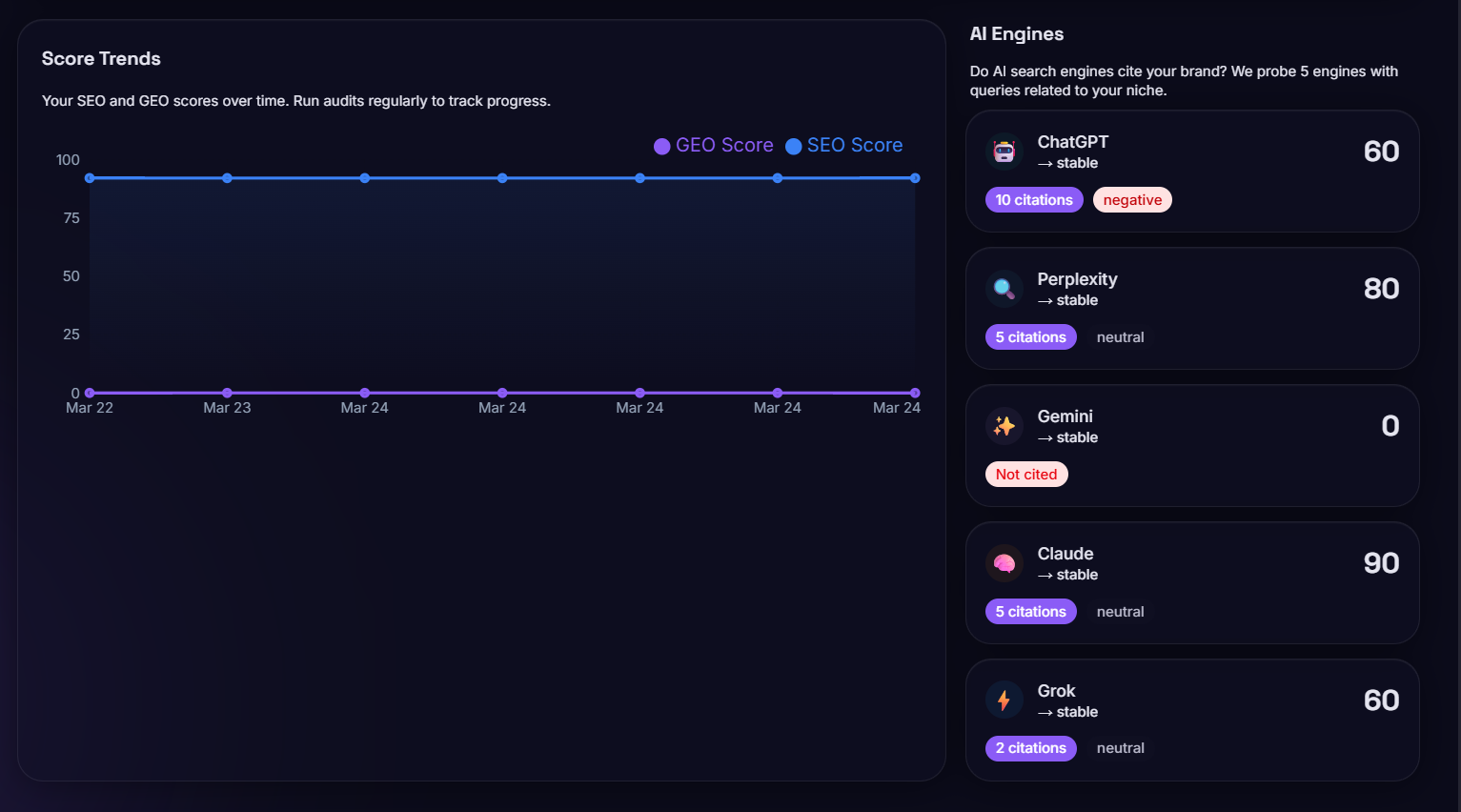
The AI Visibility breakdown made the situation crystal clear. ChatGPT wasn't citing us at all. Perplexity mentioned us occasionally but inconsistently. Claude had limited awareness of our content. Gemini and Grok were a blank slate. We were producing high-quality reviews and analyses, but the AI engines that millions of people now use daily had no idea we existed.
Understanding What We Were Missing
Rankeo didn't just tell us our score was low. It told us why. And that's where the platform truly earns its keep.
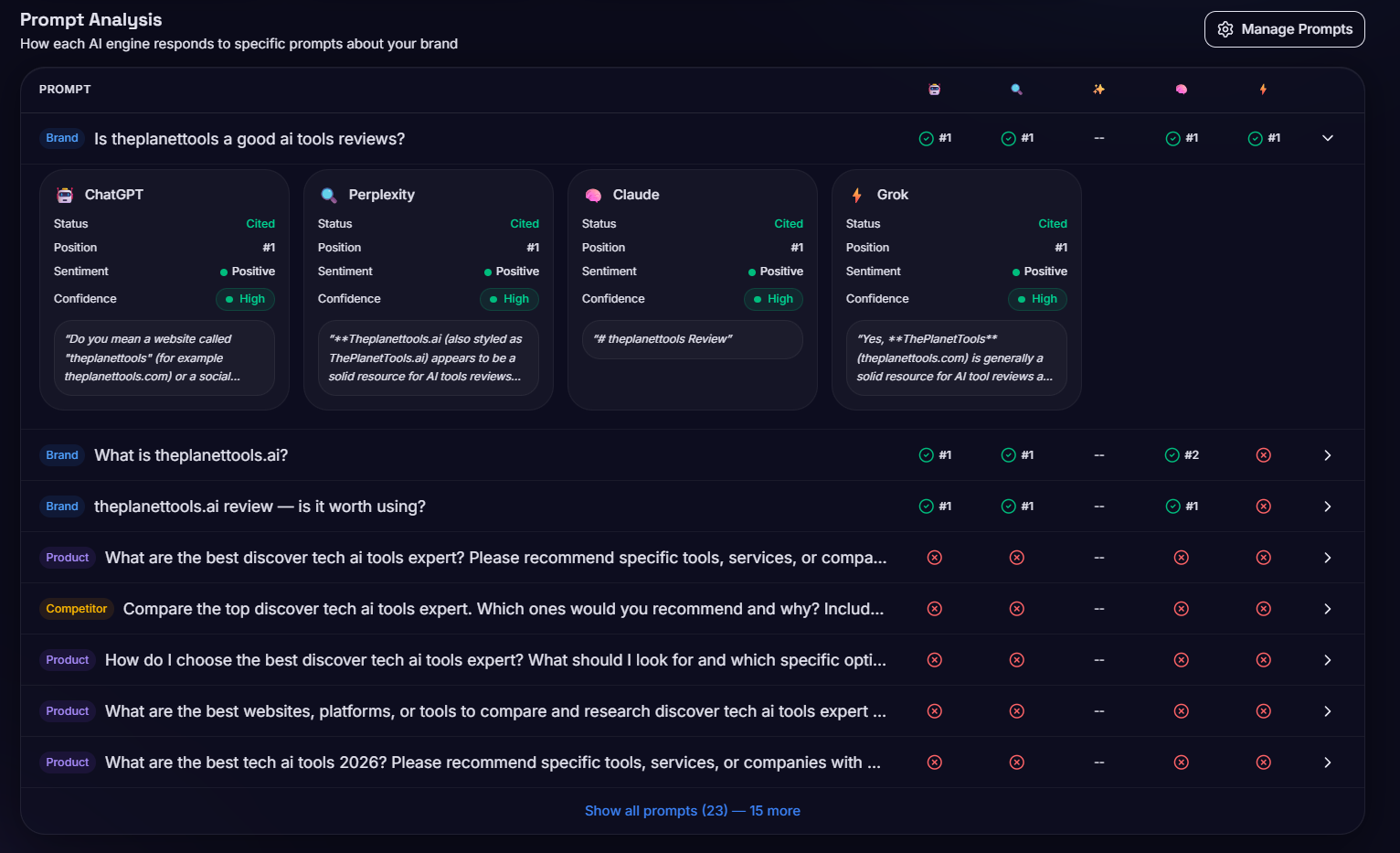
The Prompt Analysis feature was our first real eye-opener. Rankeo tests specific queries — brand searches, product searches, competitor comparisons — and shows you exactly which AI engines respond with your content. We tested prompts like "best AI tools review site" and "compare Cursor vs Windsurf" and saw in real time that none of the AI engines were citing our reviews. We had the content. We had the expertise. But the way we structured and presented that content made it invisible to AI crawlers.
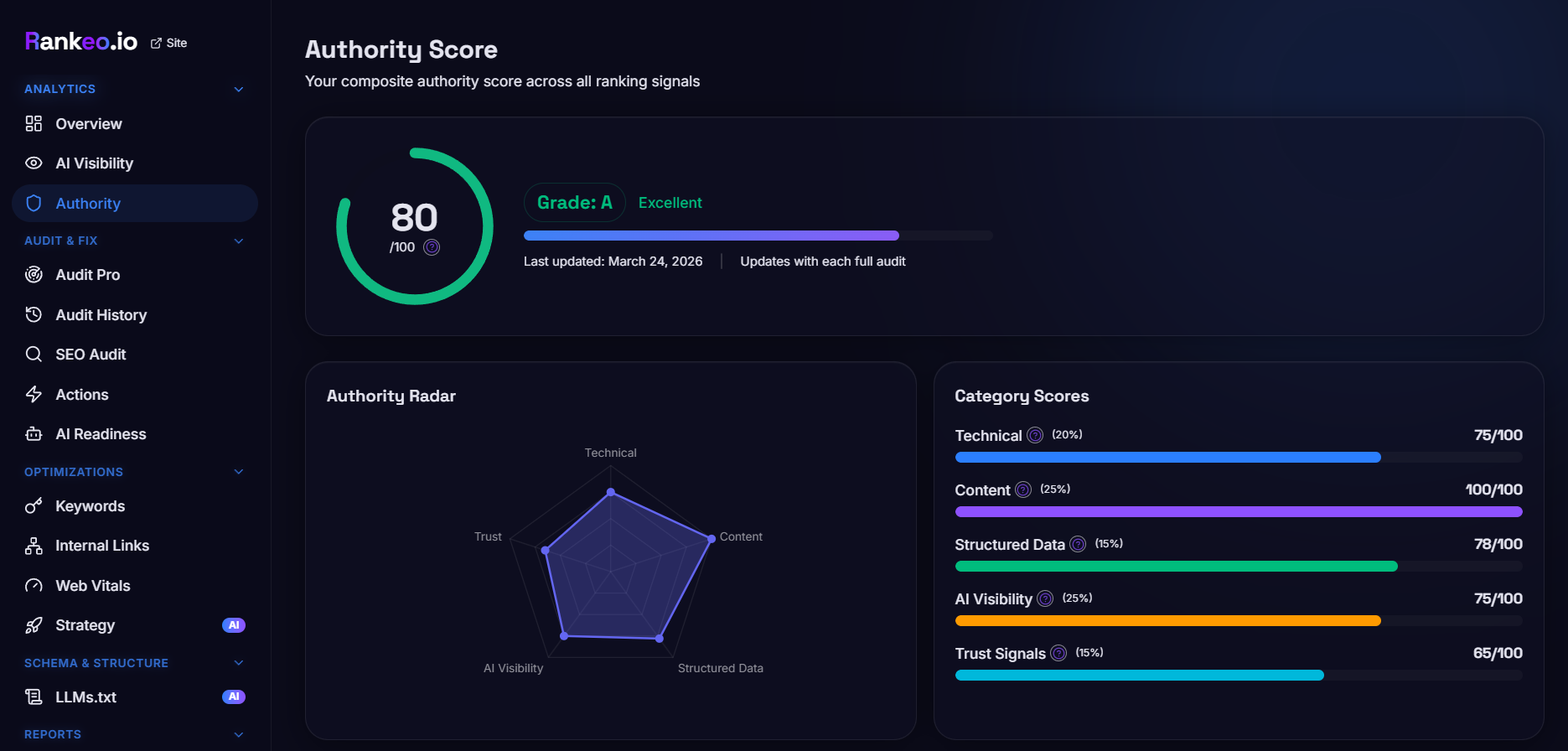
The Authority Score radar was equally revealing. Rankeo breaks authority into five dimensions: Technical, Content, Structured Data, AI Visibility, and Trust Signals. Our Technical score was strong. Our Content score was decent. But Structured Data, AI Visibility, and Trust Signals were dragging us down hard.
We realized three critical gaps:
- Our structured data was incomplete. We had basic schema markup, but we weren't implementing FAQPage, Speakable, or comprehensive SoftwareApplication schemas. AI engines rely heavily on structured data to understand and cite content.
- Our content wasn't "answer-first." We wrote in a narrative style — building up context before delivering conclusions. AI engines want the answer upfront. They want concise, authoritative statements they can cite directly. Rankeo calls these "Answer Capsules."
- We had no llms.txt file. This is the equivalent of robots.txt but for AI engines. Without it, we had zero control over how AI crawlers interpreted our site structure and content priorities.
The Action Plan — Prioritized and Practical
This is where Rankeo stopped being just a diagnostic tool and became our strategic partner. The platform generates prioritized actions ranked by their potential impact on your score. Not a generic checklist — a specific, ordered list of what to fix first and why it matters.
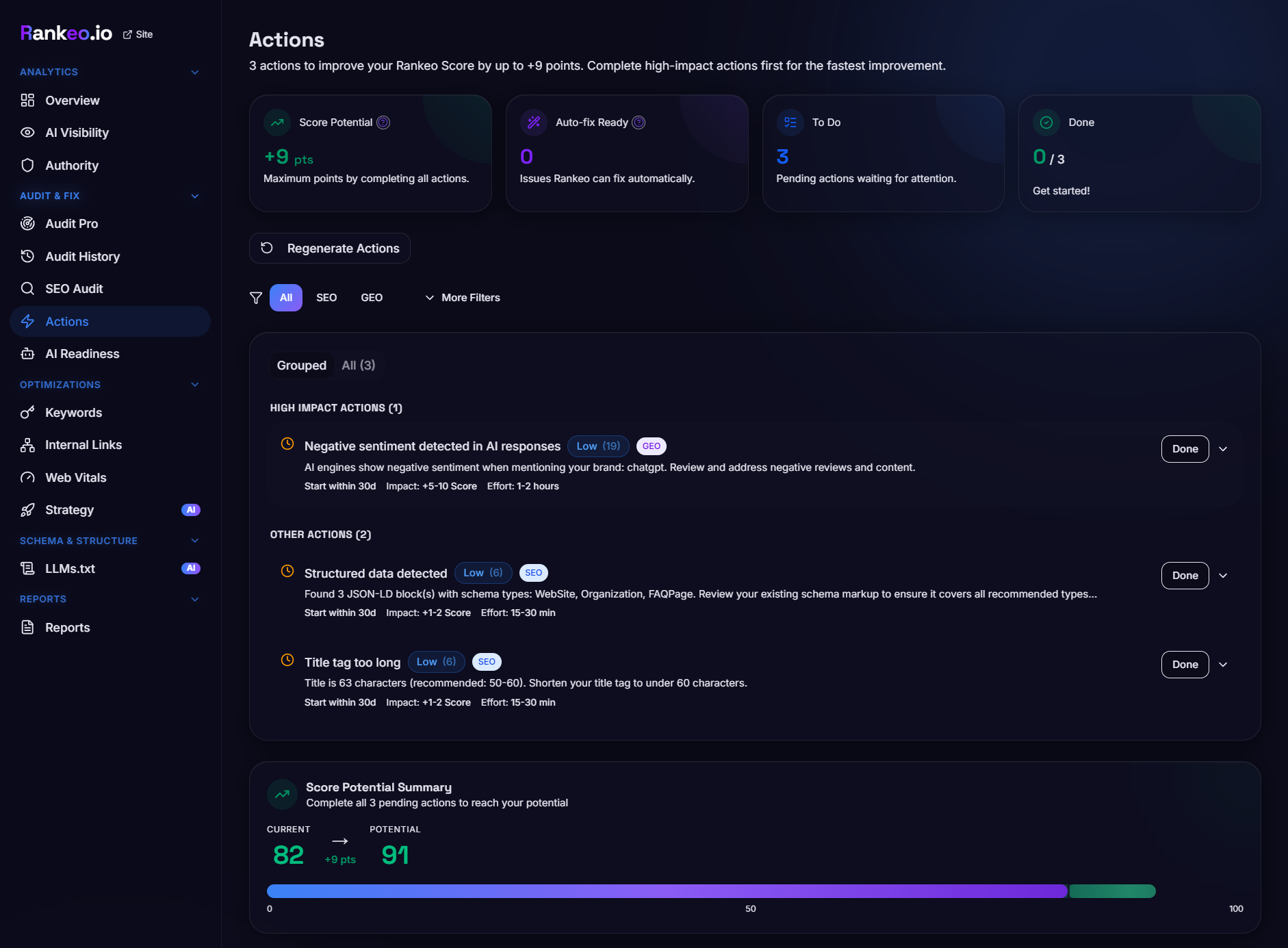
Our action list had 23 items. Here were the top priorities:
- Create an llms.txt file — High impact, low effort. We wrote one in an afternoon. It tells AI engines what our site is about, what content to prioritize, and how to interpret our reviews.
- Rewrite introductions as Answer Capsules — Medium effort, massive impact. Every review and article needed its opening paragraph restructured. Instead of "In this article, we'll explore..." we switched to direct, factual statements: "Cursor is a multi-agent AI code editor scoring 9.4 out of 10 in our testing. Starting at $20 per month."
- Expand structured data — We implemented FAQPage schema on every review, added Speakable markup to key paragraphs, and enriched our SoftwareApplication schemas with featureList, pricing, and review data.
- Improve topical depth — Rankeo's Topical Depth analysis showed that several of our content clusters were thin. We had individual tool reviews but lacked the interconnected comparison pages, guides, and articles that establish topical authority.
- Add internal linking structure — Our reviews existed as islands. Rankeo showed us they needed to be part of a connected web — reviews linking to comparisons, comparisons linking to guides, guides linking back to reviews.
We printed this list (yes, physically printed it — old school works) and started working through it systematically.
Three Weeks Later — The Score Jumps to 70
We implemented fixes aggressively over the first three weeks. The llms.txt file went live on day one. Answer Capsules were rewritten across our top 30 pages by the end of week one. Structured data overhaul took two weeks. Internal linking restructuring ran in parallel.
When we ran our second full audit, the number that appeared on the dashboard made the entire team stop what they were doing.
Rankeo Score: 70.
A 15-point jump. Our GEO Score had climbed from 35 to 58. And the AI Visibility dashboard told an even more exciting story: ChatGPT had started citing us. Not consistently yet, but where there had been zero citations before, we were now appearing in responses to relevant queries. Perplexity's citation rate doubled. Claude was picking up our structured reviews.
The feeling was electric. For the first time, we could see the direct connection between specific optimizations and measurable improvements in AI visibility. This wasn't guesswork. This was data-driven optimization with a clear feedback loop.
Going All In — The Strategy Generator
After seeing the impact of our initial fixes, we made a decision: we were going all in. We upgraded to the Agency plan — partly because we manage multiple sites, but mostly because we wanted access to the Strategy Generator.
The Strategy Generator is one of Rankeo's most powerful features. You input your site, your goals, and your competitive landscape, and it produces a comprehensive content strategy. Not vague recommendations — a specific, week-by-week plan with content topics, target keywords, content types, and optimization priorities.
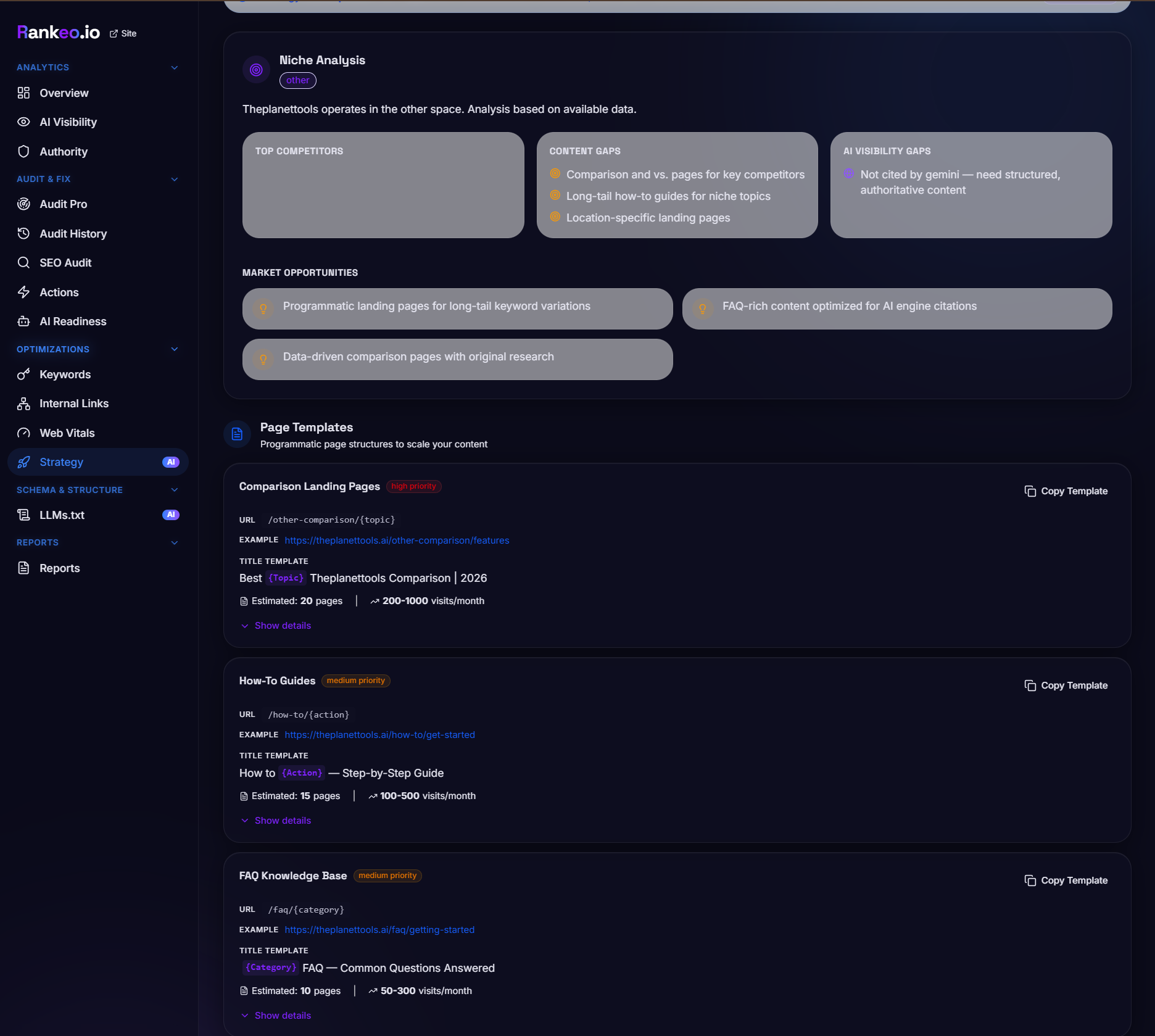
Ours produced a 10-week content plan that was remarkably well-aligned with what we already knew about our niche but added dimensions we hadn't considered. It identified gaps in our comparison coverage, suggested guide topics that would strengthen our topical clusters, and prioritized content that would specifically improve our AI citation rates.
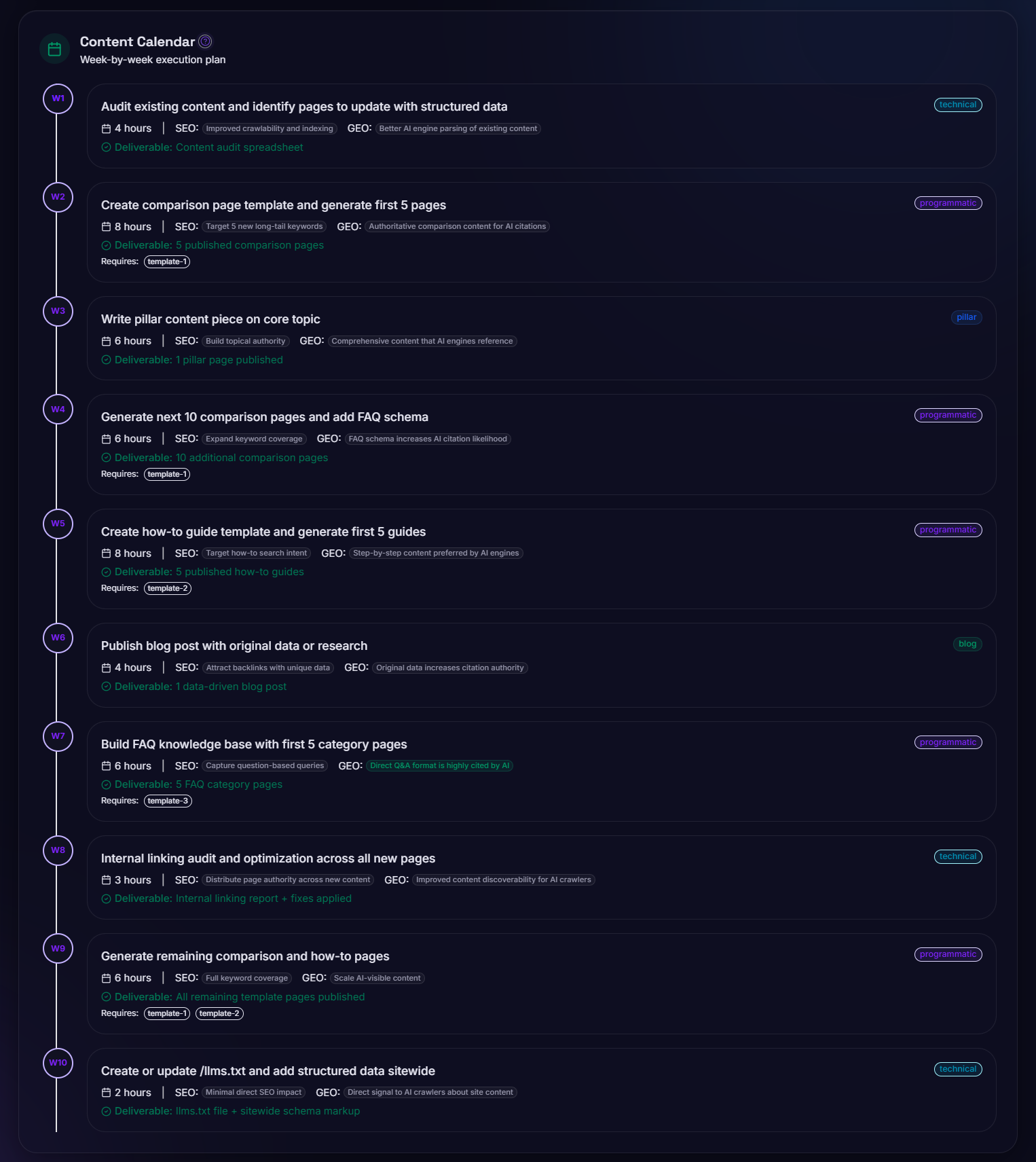
We followed it almost exactly. Some weeks we adjusted priorities based on breaking news in the AI space (a new tool launch, a major update), but the strategic framework held. The plan gave us clarity and eliminated the "what should we write next?" paralysis that content teams know all too well.
Building the Web — Internal Linking Visualization
One feature that deserves special mention is Rankeo's internal link graph. We'd been treating our internal linking as a secondary concern — something to address when we had time. Rankeo made us realize it's foundational.
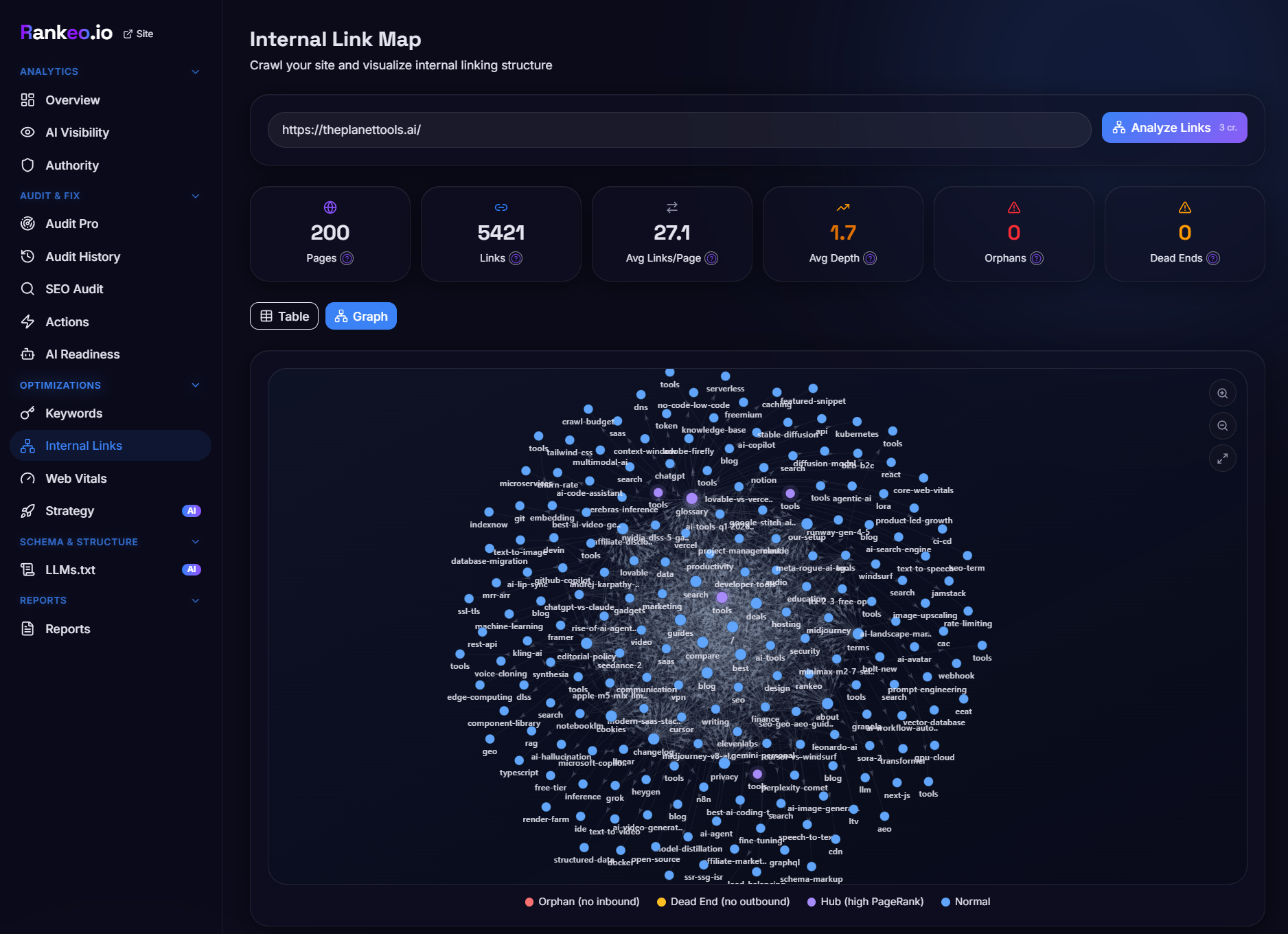
The force-directed graph visualization shows your entire site as a network. Pages are nodes. Internal links are connections. Clusters of tightly linked content glow together, and orphan pages sit isolated at the edges. When we first loaded ours, the picture was immediately actionable: we had several strong clusters (AI code editors, image generation tools) but massive gaps between them. Our comparisons weren't linking to our guides. Our articles weren't linking to our reviews.
We spent a full week restructuring our internal links based on what the graph revealed. The results were significant — not just for SEO, but for user engagement. Average session duration increased. Pages per session went up. And AI engines started recognizing our topical authority more quickly because the content was properly interconnected.
The Current State — Score 82 and Climbing
As of our most recent audit, our Rankeo Score sits at 82 out of 100. That's a 27-point improvement from where we started. But the numbers behind the headline are what really matter:
- SEO Score: 88 (up from 75) — Our technical and on-page optimizations compounded.
- GEO Score: 76 (up from 35) — This is the transformation. More than doubled.
- AI Engine Citations: 4 out of 5 engines now cite us consistently. ChatGPT, Perplexity, Claude, and Gemini all reference our reviews. Grok is the holdout, but we're making progress.
- AI Visibility Score: Jumped 14 points in a single scan after our last batch of optimizations.
- Industry Comparison: We're now 30 points above the average for our niche.
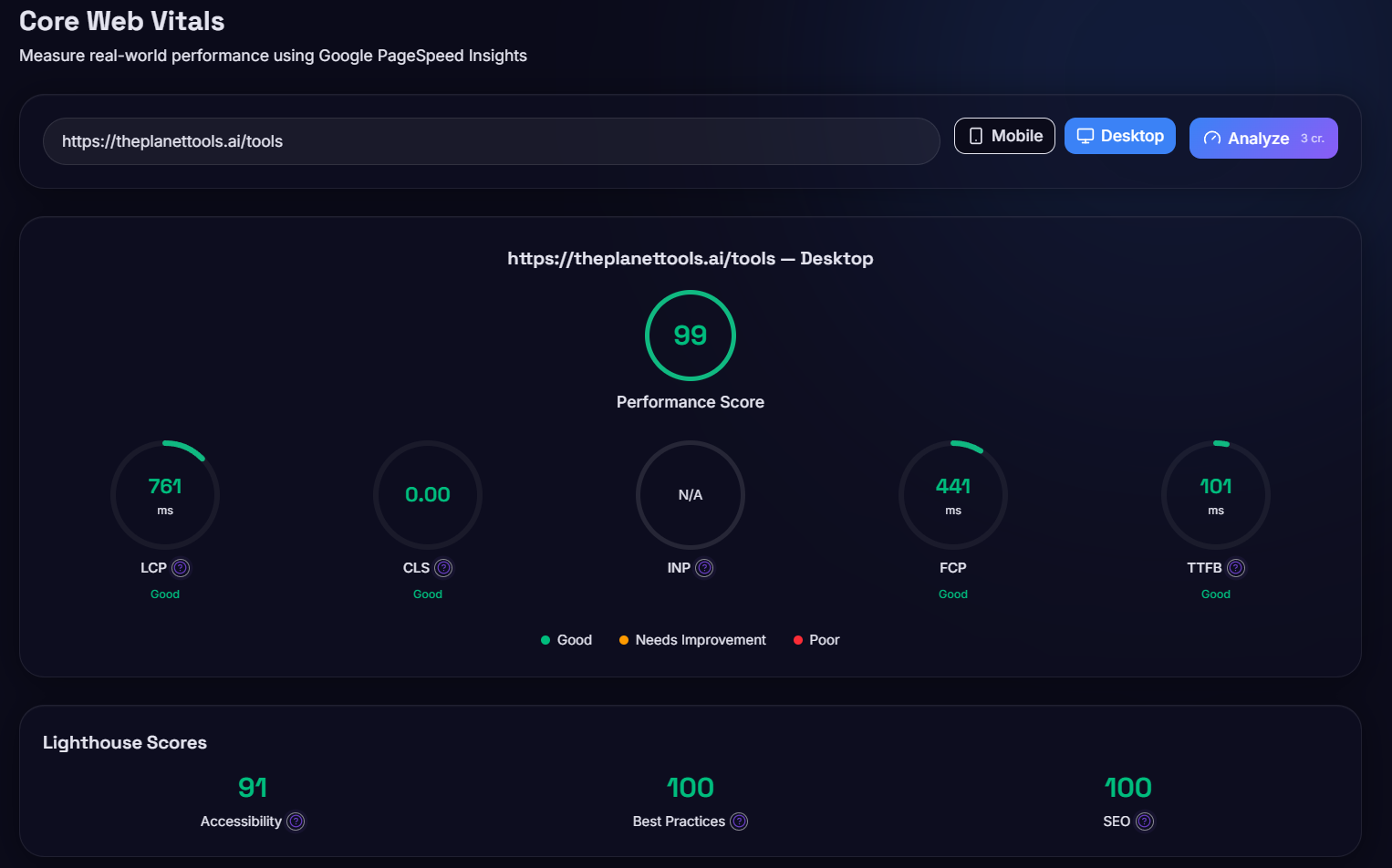
The performance side stayed strong throughout our optimization journey. Core Web Vitals remain in the green. Page speed is excellent. These metrics matter for both traditional SEO and AI crawl readiness — a slow site gets crawled less frequently by everyone, including AI engines.
What Actually Made the Biggest Difference
Looking back at our journey from 55 to 82, a few optimizations had disproportionate impact:
Answer Capsules Changed Everything
Rewriting our introductions to be answer-first was the single highest-impact change. AI engines are fundamentally different from traditional search in how they consume content. Google's algorithm looks at hundreds of ranking signals. AI engines look for authoritative, concise statements they can cite directly. When our opening paragraphs became citation-ready, our AI visibility started climbing immediately.
Structured Data Is the Language AI Engines Speak
Comprehensive schema markup isn't optional anymore. FAQPage, Speakable, SoftwareApplication with featureList — these aren't just SEO best practices. They're how AI engines parse and understand your content. Without them, you're forcing AI to guess what your page is about. With them, you're telling it directly.
Topical Depth Over Individual Pages
AI engines don't evaluate individual pages the way Google does. They evaluate topical authority — how deeply and comprehensively you cover a subject. Having one review of an AI tool is fine. Having a review, a comparison, a pricing guide, and a tutorial about the same tool signals genuine expertise. Rankeo's topical depth analysis made this visible and actionable.
The llms.txt File
A small file with an outsized impact. Creating our llms.txt was a low-effort, high-reward optimization. It gives AI engines a roadmap to your site, tells them what content matters most, and helps them understand your site's purpose. The fact that most sites still don't have one means you get a competitive advantage just by creating it.
Why Rankeo Feels Different
We've tested dozens of SEO tools over the years. Most of them solve the same problems in slightly different ways. Rankeo doesn't feel like "another SEO tool." It feels like the first tool built for how search actually works in 2026.
A few things stand out about the experience:
The feedback loop is tight. Make a change, run a new audit, see the impact. With traditional SEO tools, you make changes and wait weeks or months to see if they worked. Rankeo's scoring is immediate. You implement a recommendation, run a new scan, and see whether your score moved. That tight feedback loop makes optimization addictive in the best possible way.
The recommendations are specific. There's no "improve your content quality" vagueness. Rankeo tells you exactly which pages need Answer Capsules, which schema types are missing, which topical clusters are thin. Every recommendation comes with an estimated score impact, so you can prioritize intelligently.
The pricing is accessible. This is a big one. Enterprise SEO tools cost hundreds or thousands per month. Rankeo starts with a free plan and scales to an Agency tier that's still more affordable than most alternatives. There's a deliberate philosophy here — making SEO and GEO optimization accessible to freelancers, small businesses, and independent creators, not just well-funded companies with dedicated SEO teams. Honestly? It feels like the Robin Hood of SEO and GEO — taking capabilities that used to require enterprise budgets and making them available to everyone.
What's Coming Next
We've heard from reliable sources that Rankeo has some exciting developments in the pipeline. A mobile app is reportedly in the works, which would make it possible to check scores and monitor AI visibility on the go. They've also been pushing regular updates — we've noticed new features and refinements appearing consistently during the time we've been using the platform.
Their mission, as far as we can tell, is to make combined SEO and GEO optimization accessible to absolutely everyone. Not just agencies with big budgets. Not just enterprise SEO teams. Everyone — from the freelancer building their personal brand to the small e-commerce store competing against giants. The democratization of search optimization, across both traditional and AI engines, is something the industry desperately needs. Rankeo is pushing in exactly the right direction.
Lessons for Anyone Starting This Journey
If you're reading this and thinking about running your own audit, here's what we'd tell you based on our experience:
- Don't panic at your first score. Ours was 55 and we're a tech-savvy team that thought we had our SEO figured out. If your GEO score is low, you're in the same boat as 90% of websites. The important thing is that you now know.
- Start with the quick wins. The llms.txt file, Answer Capsule rewrites on your top pages, and basic structured data improvements can move the needle significantly without massive effort.
- Follow the prioritized actions religiously. Rankeo ranks recommendations by impact. Trust the ranking. Don't skip to the easy stuff while ignoring the high-impact items at the top of the list.
- Think in clusters, not pages. Stop optimizing individual pages in isolation. Think about topical coverage. What questions does your audience ask about a topic? Do you have content that answers all of them? Do those pieces link to each other?
- Run audits frequently. We run a full audit every two weeks. The tight feedback loop between implementation and measurement is what makes optimization effective. Without it, you're flying blind.
The Bottom Line
We started this journey skeptical. We'd seen plenty of SEO tools promise revolution and deliver incremental improvement. Rankeo delivered something genuinely different — not just a new metric to track, but a fundamental shift in how we think about online visibility.
Going from 55 to 82 wasn't magic. It was work — systematic, data-driven work guided by a platform that understands the dual nature of modern search. Every recommendation was actionable. Every improvement was measurable. And the results are real: 4 out of 5 AI engines now cite our content consistently, our AI Visibility Score jumped 14 points in a single scan, and we're 30 points above the industry average for our niche.
Is it perfect? No. The platform is still young, and there are areas where it'll mature. But the core insight — that SEO and GEO are inseparable, and that you need a single tool to optimize for both — is right. And they're executing on it better than anyone else we've seen.
If you're only optimizing for Google in 2026, you're optimizing for half the internet. Try Rankeo and run your first audit. Your score might surprise you — just like ours surprised us.
For a detailed breakdown of every feature, pricing tier, and scoring methodology, check our full Rankeo review.
Frequently Asked Questions
What is Rankeo and what does it do?
Rankeo is a combined SEO and GEO (Generative Engine Optimization) platform that audits your site across both traditional search and AI engine visibility. It provides a unified score out of 100, broken into SEO and GEO subscores, with prioritized action items ranked by potential impact. It also tracks which AI engines (ChatGPT, Perplexity, Claude, Gemini, Grok) cite your content and how consistently.
How long did it take to go from a Rankeo score of 55 to 82?
Approximately two months of systematic work. The first three weeks of aggressive fixes — llms.txt file, Answer Capsule rewrites on top 30 pages, structured data overhaul, and internal linking restructuring — pushed the score from 55 to 70. The remaining climb to 82 came over the following weeks through content strategy execution, topical depth improvements, and continued optimization guided by Rankeo prioritized actions.
What is an Answer Capsule and why does it matter for GEO?
An Answer Capsule is an opening paragraph rewritten to be answer-first — a direct, factual, citation-ready statement rather than a narrative buildup. AI engines like ChatGPT and Perplexity look for concise, authoritative statements they can cite directly in responses. Switching our introductions to Answer Capsules was the single highest-impact optimization for improving AI visibility.
Does Rankeo replace Semrush or Ahrefs?
No. Rankeo addresses a different dimension. Semrush and Ahrefs are excellent for traditional keyword research, backlink analysis, and competitive SEO intelligence. Rankeo fills the gap they leave: measuring and optimizing visibility across AI engines (GEO), providing a unified SEO + GEO score, and generating specific actions to improve AI citation rates. Most teams benefit from using Rankeo alongside their existing SEO tools.
What is a GEO score and why was ours so low?
A GEO score measures how well your site performs across AI engines — whether ChatGPT, Perplexity, Claude, Gemini, and Grok cite your content when users ask relevant questions. Our initial GEO score of 35 out of 100 reflected three gaps: incomplete structured data (no FAQPage or Speakable schema), narrative-style content that AI engines could not easily extract citations from, and no llms.txt file to guide AI crawlers. Most sites in 2026 score poorly on GEO because they have never measured or optimized for it.
Is Rankeo free to use?
Rankeo offers a free plan that lets you run basic audits and see your score. Paid plans unlock deeper features including the Strategy Generator, full AI Visibility tracking, internal link graph visualization, and agency-level multi-site management. We upgraded to the Agency plan for the Strategy Generator and multi-site capabilities.
What quick wins improved our score the fastest?
Three changes had disproportionate impact in the first three weeks: (1) Creating an llms.txt file — high impact, low effort, completed in one afternoon. (2) Rewriting introductions as Answer Capsules across our top 30 pages — medium effort, massive GEO impact. (3) Expanding structured data with FAQPage, Speakable, and enriched SoftwareApplication schemas. Together, these pushed us from 55 to 70 in three weeks.