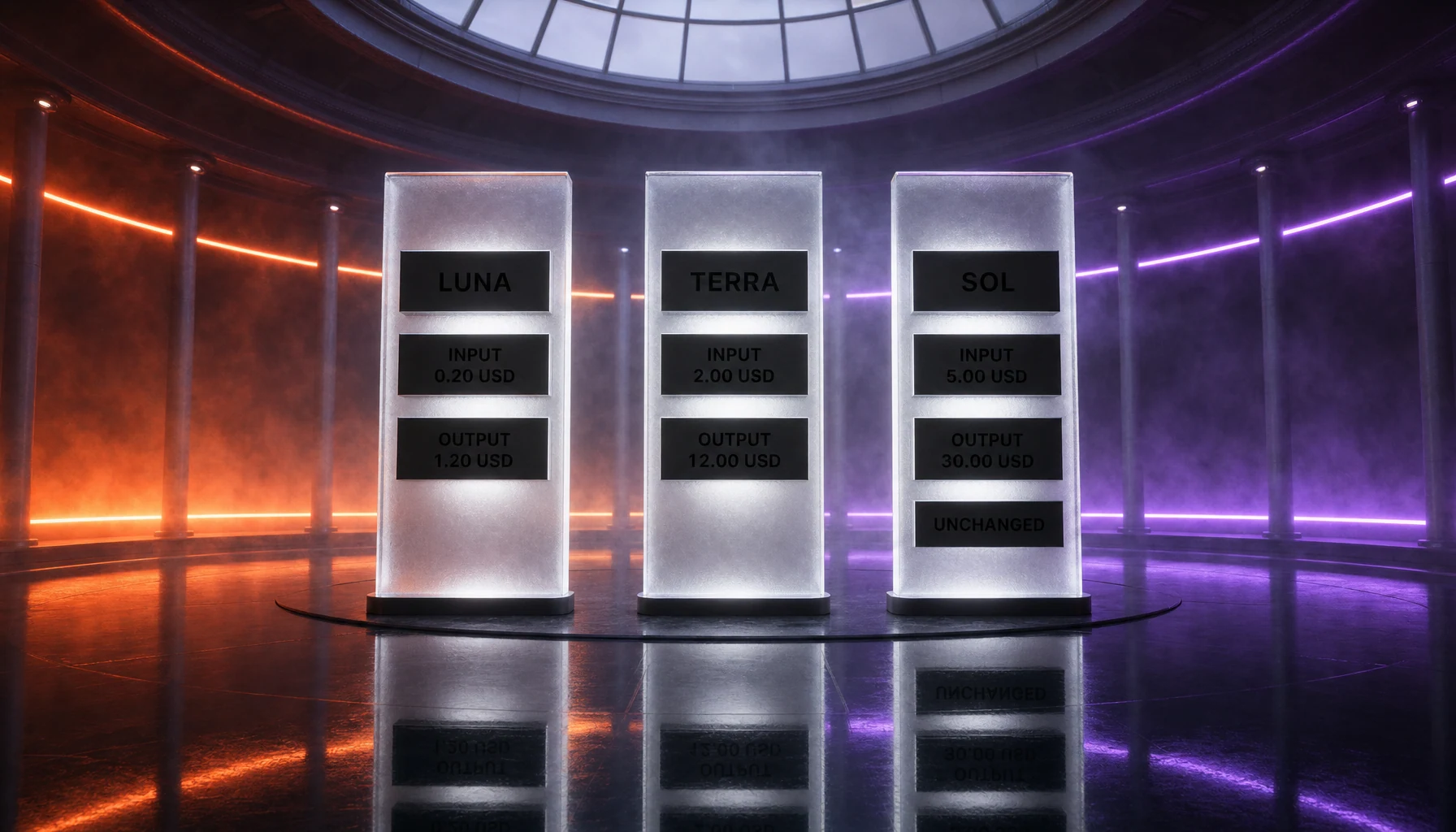
On July 30, 2026, OpenAI cut GPT-5.6 Luna to $0.20 per million input tokens and $1.20 per million output tokens, and GPT-5.6 Terra to $2.00 and $12.00. Sol was left unchanged at $5.00 and $30.00. The day before, OpenAI published two posts arguing that efficiency, not raw capability, is now the frontier, and Microsoft AI published a third that told businesses to assume any model they depend on could disappear. Three primary sources in 48 hours, all pivoting from capability to cost per task.
Key takeaways
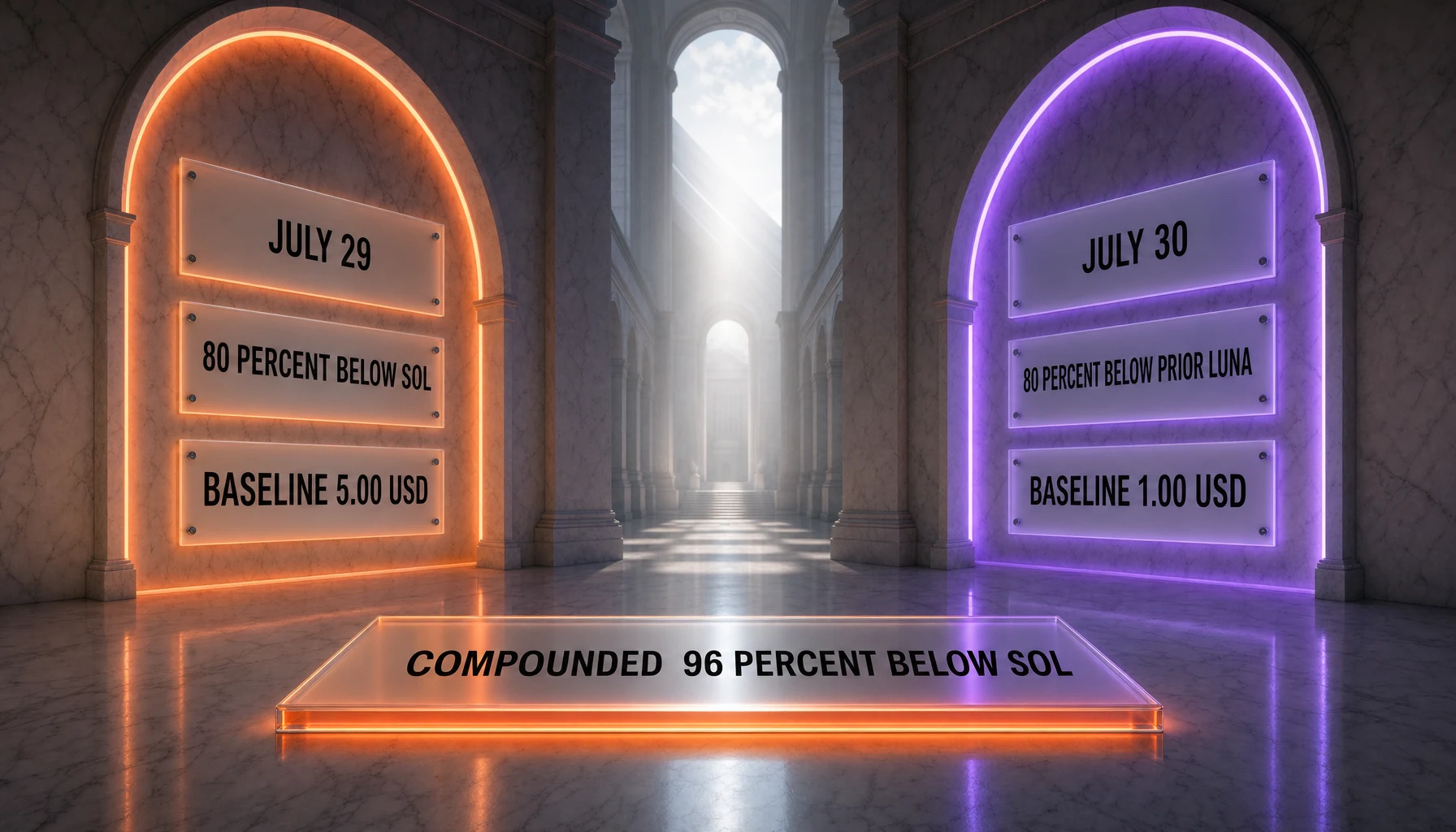
- Two separate "80% less" claims were published one day apart, against two different baselines. On July 29 Luna was "priced 80% less than the cost of Sol." On July 30 Luna "will cost 80% less" than its own previous price. They compound: on July 30, 2026 that put Luna 96% below Sol, not 80%.
- The new API rates are $0.20 and $1.20 for Luna, $2.00 and $12.00 for Terra, per million input and output tokens. Sol stayed at $5.00 and $30.00 that day. Cached input was $0.02, $0.20 and $0.50 respectively.
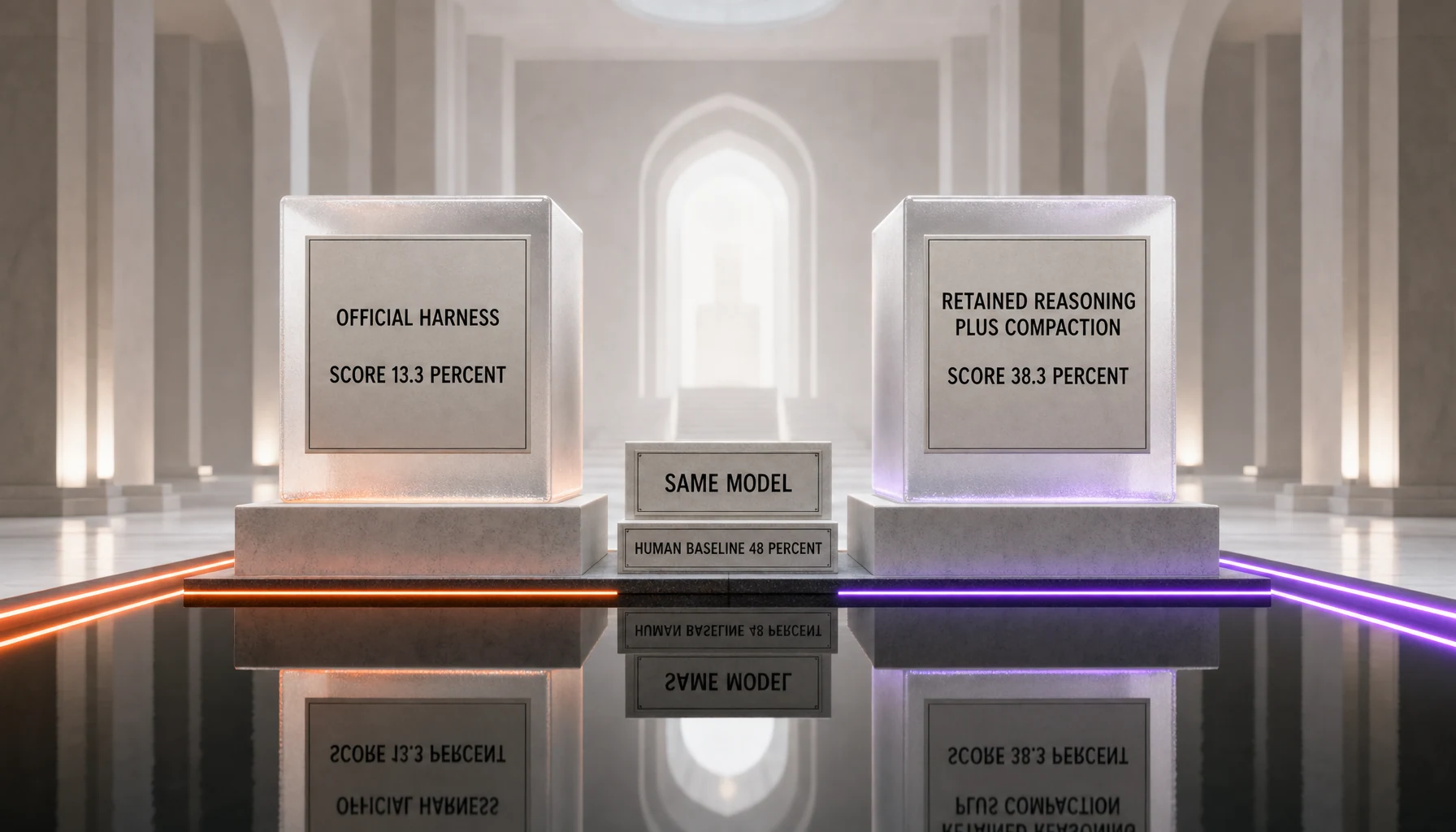
- "Two settings tripled our scores" is a disclosure about benchmark harnesses, not a capability gain. GPT-5.6 Sol moved from 13.3% to 38.3% on the ARC-AGI-3 public set by enabling retained reasoning and compaction. The model did not change.
- 38.3% remains below the 48% human baseline OpenAI itself estimates, and the result is self-reported. The most recent post on the ARC Prize blog is dated July 6, 2026.
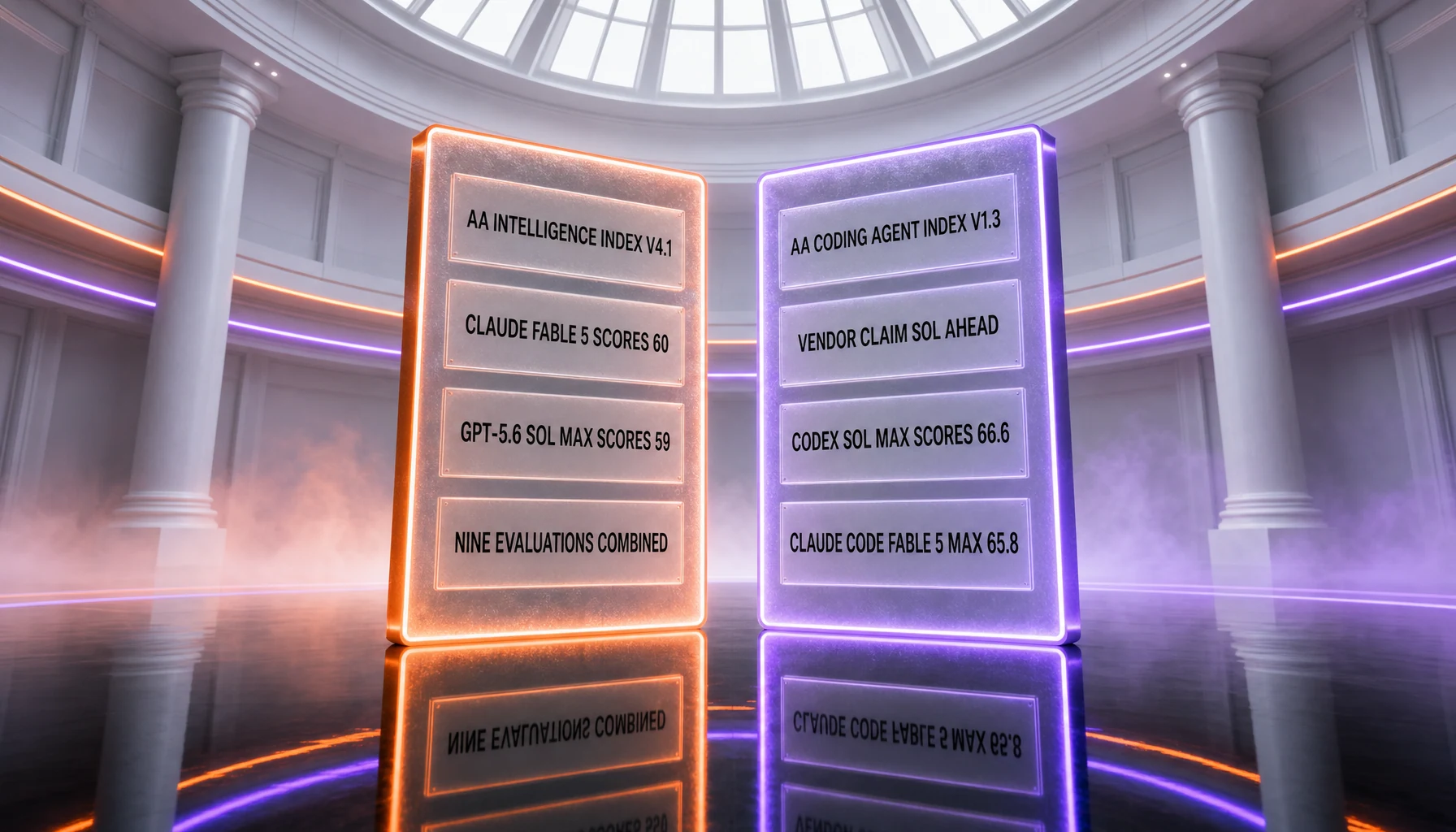
- OpenAI's claim that Sol beats Claude Fable 5 is scoped to the Artificial Analysis Coding Agent Index, at max reasoning. On the Artificial Analysis Intelligence Index v4.1, Fable 5 scores 60 and Sol scores 59.
What actually changed on July 30
OpenAI reduced two of the three GPT-5.6 models. Luna dropped to $0.20 per million input tokens and $1.20 per million output tokens. Terra dropped to $2.00 and $12.00. Sol was untouched at $5.00 and $30.00. The company also replaced Priority Processing with a new Fast mode for Sol.
The announcement is unambiguous about the numbers: "Starting July 30, API pricing is $2 per million input tokens and $12 per million output tokens for Terra, and $0.20 per million input tokens and $1.20 per million output tokens for Luna. Sol pricing remains unchanged." The API pricing page confirms the full table, including cached input at $0.02 for Luna, $0.20 for Terra and $0.50 for Sol.
| Model | Input | Cached input | Output |
|---|---|---|---|
| GPT-5.6 Luna | $0.20 | $0.02 | $1.20 |
| GPT-5.6 Terra | $2.00 | $0.20 | $12.00 |
| GPT-5.6 Sol | $5.00 | $0.50 | $30.00 |
Rates per million tokens, as published on developers.openai.com on July 30, 2026.
There is a second rate card that is easy to miss. The GPT-5.6 model documentation states: "Prompts with >272K input tokens are priced at 2x input and 1.5x output for the full request." The multiplier applies to the entire request, not to the tokens above the threshold. In practice Luna long-context work is billed at $0.40 and $1.80, Terra at $4.00 and $18.00, and Sol, on the July 2026 rates, at $10.00 and $45.00. Anyone budgeting agent runs on long repositories should price against the second table, not the first. If the distinction between input, output and cached rates is unfamiliar, our explainer on how AI model pricing actually works covers the mechanics.
The two "80% less" claims are not the same number
OpenAI published two claims of "80% less" for Luna one day apart, measured against different baselines. On July 29 the comparison was to Sol's price. On July 30 the comparison was to Luna's own previous price. Both are true, and they stack. As of July 30, 2026, that put Luna roughly 96% below Sol, not 80%.
On July 29, the engineering post "How GPT-5.6 fuses frontier intelligence with frontier efficiency" states: "Luna is our fastest and most affordable model, priced 80% less than the cost of Sol." Sol cost $5.00 and $30.00. Eighty percent below that is $1.00 and $6.00, which was Luna's price at the time of writing.
On July 30, the pricing post states something structurally different: "Starting today, GPT-5.6 Luna, our fastest and most affordable model, will cost 80% less, while GPT-5.6 Terra, our balanced model for everyday work, will cost 20% less." Here the baseline is Luna's own price the day before. Eighty percent below $1.00 and $6.00 gives $0.20 and $1.20, which is exactly the new rate.
Both sentences are accurate. Read together without attention to the baseline, they collapse into a single "Luna is 80% cheaper," which is now wrong in both directions: it understates the cut against Sol and overstates nothing against the old Luna. The correct statement after July 30 was that Luna sat 96% below Sol on both input and output. The same arithmetic recovers Terra's previous price: a 20% cut landing at $2.00 and $12.00 means the prior rate was $2.50 and $15.00.
Fast mode replaces Priority Processing
OpenAI introduced Fast mode in the API, replacing Priority Processing. For Sol it delivers up to 2.5 times faster speeds than Standard processing at twice the price, with no change in intelligence. Existing requests tagged priority automatically use Fast mode, so the change is backward compatible.
The post is careful on this point: Fast mode delivers "up to 2.5× faster speeds than Standard processing at twice the price, with no change in intelligence." Two things follow. First, this is a latency product, not a quality product, and OpenAI says so explicitly. Second, Sol's headline price did not move, but a Sol workload that opted into Fast mode then cost $10.00 and $60.00 per million tokens on the July 2026 rates, which was the most expensive configuration in the GPT-5.6 family outside long context. The company also notes that "Pricing changes will begin rolling out in AWS later today," so the effective date depends on where the workload runs.
"Two settings tripled our scores" is a disclosure, not a win
OpenAI reported that GPT-5.6 Sol scored 13.3% on the ARC-AGI-3 public set with the official harness, and 38.3% after enabling retained reasoning and compaction. The model was identical in both runs. Only the API settings changed, which means published ARC-AGI-3 scores are not comparable unless harness configuration is disclosed alongside them.
The July 29 research post describes two properties of the official harness. First, private reasoning was discarded after each game action, so the model re-derived the game every turn. Second, a rolling truncation window dropped the oldest messages once context exceeded 175,000 characters, so past actions disappeared as well. Enabling retained reasoning and compaction through the Responses API removed both constraints and, in OpenAI's words, "tripled scores and cut output tokens by 6x on the public task set."
This is the most consequential item of the three announcements, and it is not a product claim. If two configuration flags move a score from 13.3% to 38.3%, then every ARC-AGI-3 number published without its harness configuration is uninterpretable. OpenAI concedes the general form of the problem: "evals rarely measure models in isolation—they also measure a bundle of less visible choices about API settings, harness design, and prompting." It adds that "this isn't the first time we've been surprised by low scores on a public benchmark and then discovered that the eval runner was using a generic harness that dropped reasoning messages."
Three caveats belong next to the 38.3%. It is self-reported, produced by OpenAI's own reimplementation of the harness. The most recent post on the ARC Prize blog is dated July 6, 2026, so no independent evaluation of this result has been published by the benchmark's maintainers. And 38.3% sits below the human reference point in the same post: scores measure Relative Human Action Efficiency, and "based on official gameplay logs, we estimate the average human tester scored 48%."
One number in the post deserves care. It opens by saying Sol "scored just 7.8%" on ARC-AGI-3, then reports 13.3% with the official harness on the public set. The post does not reconcile the two figures, and they are not interchangeable — the tripling described in the title is 13.3% to 38.3%. ARC's own framing explains the design tension: the benchmark "uses an intentionally generic harness, without tools or special features," because "a simple harness makes model shortcomings more visible and makes model comparisons more fair," whereas "commercial developers, by contrast, optimize harnesses for each model's features and quirks." Two defensible philosophies, producing different numbers for the same model. The public games are at arcprize.org/tasks.
A 24-hour edit: "autonomously" acquires a chaperone
The same efficiency results were described twice in 24 hours with different framing. On July 29, Sol "autonomously rewrote and optimized our production kernels." On July 30, the identical work is introduced with "Within a human-led process." The measurements did not change: a 20% reduction in serving cost and more than 15% better token-generation efficiency.
The July 29 engineering post is direct: "With Codex, GPT-5.6 Sol autonomously rewrote and optimized our production kernels." It says the kernel work "reduced end-to-end serving costs by 20%," and that Sol "launched and monitored the speculator training process, autonomously intervening when issues arose, including hardware failures and training instability," yielding token-generation efficiency gains of "more than 15%."
The July 30 post restates the same two measurements with a prepended qualifier: "Within a human-led process, Sol autonomously rewrote and optimized production kernels, designed and ran hundreds of experiments to improve token generation, and monitored training, intervening when problems arose." The second instance of "autonomously" is gone; the model now simply intervenes. The phrase recurs later in the same post: "Within a human-led process, more capable models help our technical team find the next generation of improvements."
Nothing was retracted and no number moved. A research audience was told a model did the work by itself; a commercial audience one day later was told the same work happened under human supervision. Both descriptions can be true of one process, which is precisely why the framing choice is worth recording. It is a fact of method, not a contradiction.
Which index? The Fable 5 comparison only holds on one of them
OpenAI states that Sol with max reasoning outperforms Claude Fable 5 on the Artificial Analysis Coding Agent Index at less than half the cost. That claim is scoped to one index and one reasoning setting. On the Artificial Analysis Intelligence Index v4.1, Claude Fable 5 scores 60 and GPT-5.6 Sol scores 59.
The exact wording from July 29 is: "Our flagship model, GPT-5.6 Sol, with max reasoning outperforms Claude Fable 5 on the Artificial Analysis Coding Agent Index at less than half of the cost." Two qualifiers are load-bearing. The index is the Coding Agent Index, not the general intelligence ranking. And the configuration is max reasoning, which is not the default.
We were able to check that claim against the board itself. Version 1.3 of the Artificial Analysis Coding Agent Index, read on August 2, 2026, lists Codex with GPT-5.6 Sol at max reasoning at 66.6 and Claude Code with Fable 5 at max at 65.8, so OpenAI's ordering holds on that index, by eight tenths of a point. Two things the sentence does not say. The leading entry is neither model but Claude Code with Opus 5 at extra-high effort, at 66.7. And the cost figures the same board publishes for those runs are a mean $7.08 per task for Sol against $11.71 for Fable 5, a ratio nearer three fifths than one half. The index scores a harness and a model together, never a model on its own, which is why the configuration OpenAI names carries so much of the claim.
Checked against the independent source, the Artificial Analysis model leaderboard puts Claude Fable 5 at 60 on the Intelligence Index and GPT-5.6 Sol at 59 at max reasoning, with lower settings scoring down to 49. The methodology page specifies that Intelligence Index v4.1 "incorporates 9 evaluations" weighted across agents, coding, scientific reasoning and general categories. Two different composites, two different answers. Repeating "Sol beats Fable 5" without naming the index inverts the general-purpose ranking. Our side-by-side of GPT-5.6 Sol against Claude Fable 5 holds the index and effort constant, and the Claude Fable 5 profile carries the current numbers.
The July 30 post adds a second cross-vendor claim on a different benchmark: "On professional work, as measured by Agents' Last Exam, Luna outperforms Fable 5 at an estimated cost per task nearly 99% lower." The word "estimated" is OpenAI's. Several customer figures in the same post — Notion's "half the cost per task and in 60% less time," Blitzy's "87% lower cost than GPT-5.4 mini" — are testimonials published by the vendor, and should not be stacked alongside independent measurements as though they carried the same weight.
Microsoft's answer: substitutability as stated doctrine
On July 29, Mustafa Suleyman published a Microsoft AI post arguing that every model in a product should be replaceable. It positions cost efficiency as a resilience strategy rather than a procurement detail, and it benchmarks Microsoft's in-house models directly against OpenAI's, despite the partnership.
The post states the doctrine plainly: "But the benefit is not only cost. It's resilience. Every business now must assume that any one model it depends on could disappear, through a security incident, a business or policy misalignment, or a geopolitical shift. Every model in a product or agentic system should be substitutable, and that's only possible when you build the harness, context, memory and action space independently of a single model family."
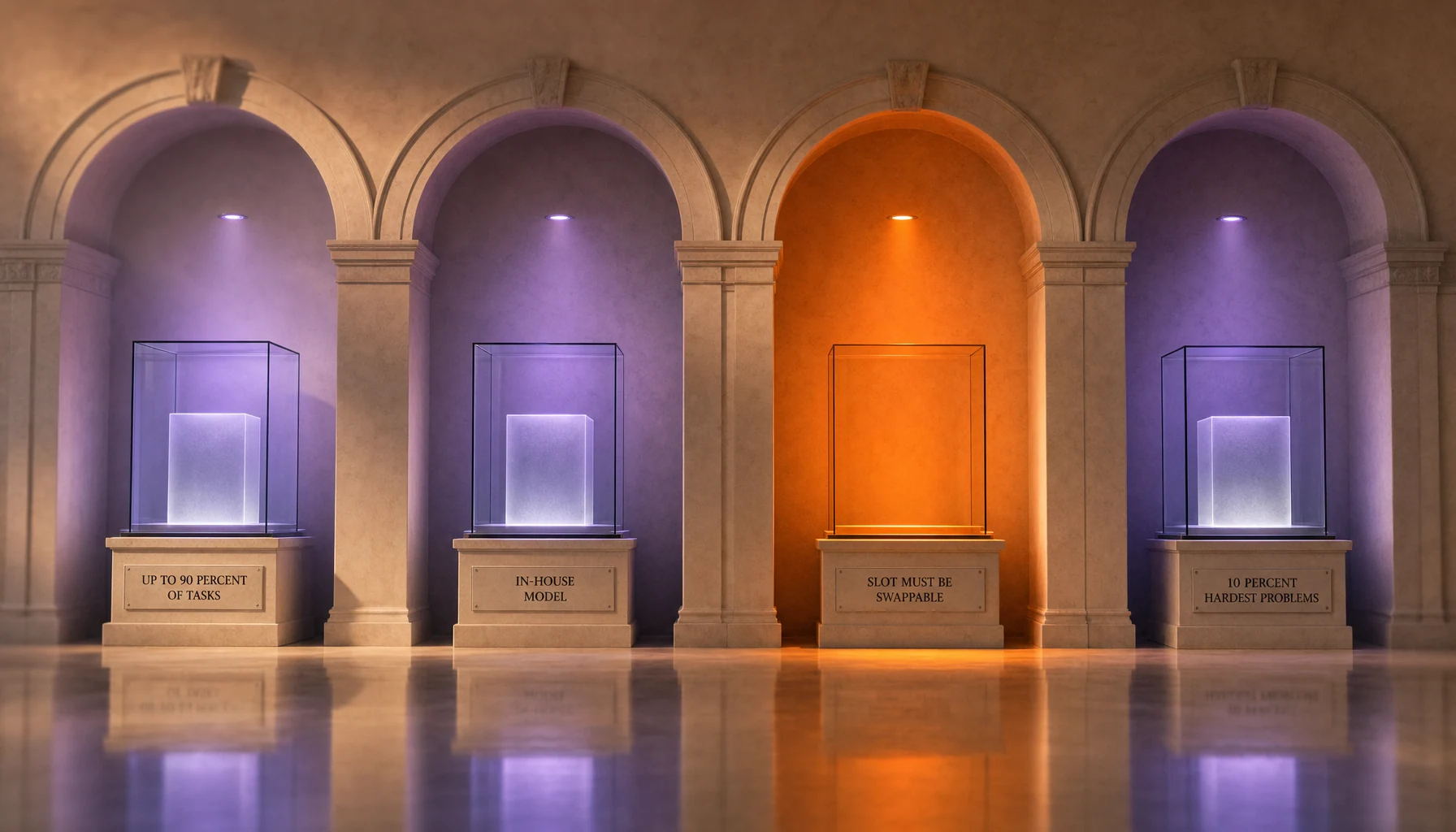
What makes this notable is who is saying it. Microsoft benchmarks its own models against OpenAI's in the same text: MAI-Image-2.5-Flash "is now the end-to-end default in Bing Image Creator, in production in PowerPoint where it is reducing GPU costs up to 84% compared with GPT-Image-2." Another model is credited with "10% higher code accept rate and 10% lower median token usage than GPT-5.4 Mini and Claude Haiku 4.5 in VS Code." The routing philosophy is explicit: a model "designed to handle up to 90% of tasks efficiently, so that MDASH can reserve the largest and most expensive models in our fleet (in this case GPT 5.4) for the 10% of exceptionally hard problems that truly need them."
That is the same architecture OpenAI describes for its own family — Sol to resolve uncertainty and plan, Luna to implement well-specified changes — with one difference. Microsoft's version treats the expensive tier as a supplier that can be swapped, and names GPT-5.4 as the current occupant of that slot rather than a permanent dependency. Our earlier analysis of Microsoft's token economics traced the beginning of this position.
The part of a price cut nobody budgets for
A price change of this size invalidates published content instantly. Every page that quoted the previous rate becomes factually wrong the moment the new rate ships, and derived phrasings like "half the price" or "seven times cheaper" break in ways that are harder to detect than a stale number.
This is not a hypothetical for anyone maintaining a reference corpus. Across our own published pages, 35 quote a dollar figure for GPT-5.6 Luna or Terra — 27 comparisons, 5 tool profiles and 3 articles. Every one of them had to be re-checked against a rate card that changed at 10:00 GMT on July 30. The raw figures are the easy part. The harder part is the sentences built on top of them: a comparison describing one model as "half the price" of another, or "roughly seven times cheaper," encodes an arithmetic relationship that silently becomes false when only one side moves. Derived rates behave the same way — a batch price quoted as "half of standard" is wrong the moment standard moves, even though the words are still correct. A find-and-replace on "$1.00" catches none of that.
The same applies downstream of the ARC-AGI-3 post: any page citing an ARC-AGI-3 score without stating which harness produced it now carries a number that cannot be defended, regardless of whether it was accurate when written. The lesson from a 48-hour window like this one is that cost-per-task claims and benchmark scores have shorter half-lives than the pages quoting them, and the cheapest moment to record a measurement's scope — date, index version, harness, reasoning effort — is when you first write it down.
What to watch next
Three questions follow from these announcements: whether ARC Prize publishes an independent evaluation of the 38.3% result, whether competitors match Luna's new floor, and whether harness configuration becomes a standard disclosure alongside benchmark scores.
The first is the most testable: an independent run under both harness configurations would settle whether 38.3% survives outside OpenAI's own implementation. The second is a matter of weeks — a model at $0.20 and $1.20 per million tokens with tool use and multi-step workflow support resets what "cheap tier" means, shifting the Terra against Luna and Sol against Terra trade-offs. The third is cultural. OpenAI's recommendation — "Use our Responses API, not our legacy Chat Completions API," retain reasoning, use compaction — is framed as developer advice, but read as a benchmarking standard it implies that any score published without those settings measures the harness as much as the model. For background, see our explainer on why GPT-5.6 is not GPT-6 and our coverage of the gated Sol rollout.
Frequently asked questions
How much does GPT-5.6 Luna cost after the July 30, 2026 price cut?
GPT-5.6 Luna costs $0.20 per million input tokens, $0.02 per million cached input tokens, and $1.20 per million output tokens. For prompts above 272K input tokens, the rate doubles on input and increases by half on output, giving $0.40 and $1.80 for the full request.
Did GPT-5.6 Sol get cheaper on July 30, 2026?
No. OpenAI stated that "Sol pricing remains unchanged." Sol stayed at $5.00 per million input tokens, $0.50 cached, and $30.00 per million output tokens; only Luna and Terra were reduced that day. OpenAI cut Sol separately on August 21, 2026, to $4.00 and $20.00.
Why are there two different "80% less" claims about GPT-5.6 Luna?
They use different baselines. On July 29, OpenAI wrote that Luna was "priced 80% less than the cost of Sol," comparing Luna to Sol's $5.00 and $30.00. On July 30, OpenAI wrote that Luna "will cost 80% less," comparing Luna to its own previous price of $1.00 and $6.00. Both are accurate, and they compound.
How much cheaper is GPT-5.6 Luna than GPT-5.6 Sol now?
Approximately 96% cheaper on both input and output at the rates set on July 30, 2026: Luna was $0.20 against Sol's $5.00 on input, and $1.20 against Sol's $30.00 on output. OpenAI cut Sol to $4.00 and $20.00 on August 21, 2026, which narrows the gap to roughly 95% on input and 94% on output. The "80% less than Sol" figure described Luna's pricing before July 30, 2026.
What were the previous GPT-5.6 Terra prices?
$2.50 per million input tokens and $15.00 per million output tokens. OpenAI described the change as a 20% reduction, and the new published rates are $2.00 and $12.00, which implies those prior figures exactly.
What are the two settings that tripled OpenAI's ARC-AGI-3 scores?
Retained reasoning and compaction, both available through the Responses API. Retained reasoning preserves the model's private reasoning across turns instead of discarding it after each action. Compaction summarizes long context instead of dropping the oldest messages through rolling truncation.
What score did GPT-5.6 Sol achieve on ARC-AGI-3?
13.3% on the ARC-AGI-3 public set with the official harness, and 38.3% with retained reasoning and compaction enabled. OpenAI reported both figures on July 29, 2026, and said the change also cut output tokens by six times.
Is the 38.3% ARC-AGI-3 result independently verified?
No. It is self-reported by OpenAI using its own reimplementation of the harness. The most recent post on the ARC Prize blog is dated July 6, 2026, so the benchmark's maintainers have not published an evaluation of this result.
How does 38.3% compare to human performance on ARC-AGI-3?
It is below it. Scores measure Relative Human Action Efficiency, and OpenAI wrote that "based on official gameplay logs, we estimate the average human tester scored 48%." That 48% baseline is OpenAI's own estimate.
Does GPT-5.6 Sol beat Claude Fable 5?
It depends on the index. OpenAI states that Sol "with max reasoning outperforms Claude Fable 5 on the Artificial Analysis Coding Agent Index at less than half of the cost." On the Artificial Analysis Intelligence Index v4.1, Claude Fable 5 scores 60 and GPT-5.6 Sol scores 59. Citing the claim without naming the index reverses the general-purpose ranking.
What is Fast mode in the OpenAI API?
Fast mode replaces Priority Processing. For GPT-5.6 Sol it delivers "up to 2.5× faster speeds than Standard processing at twice the price, with no change in intelligence." It is backward compatible: requests already tagged priority automatically use Fast mode.
What did Mustafa Suleyman say about model substitutability?
In a Microsoft AI post dated July 29, 2026, he wrote: "Every business now must assume that any one model it depends on could disappear, through a security incident, a business or policy misalignment, or a geopolitical shift. Every model in a product or agentic system should be substitutable." He tied that to building the harness, context, memory and action space independently of any single model family.
Sources and references
- OpenAI — Advancing the price-performance frontier with GPT-5.6, July 30, 2026
- OpenAI — How GPT-5.6 fuses frontier intelligence with frontier efficiency, July 29, 2026
- OpenAI — How enabling two settings tripled our scores on the ARC-AGI-3 benchmark, July 29, 2026
- OpenAI — API pricing, retrieved July 30, 2026
- Microsoft AI — Optimizing the frontier performance curve, Mustafa Suleyman, July 29, 2026
- ARC Prize — Blog index, retrieved July 30, 2026
- Artificial Analysis — Model leaderboard, retrieved July 30, 2026
- Artificial Analysis — Intelligence Index v4.1 methodology, retrieved July 30, 2026