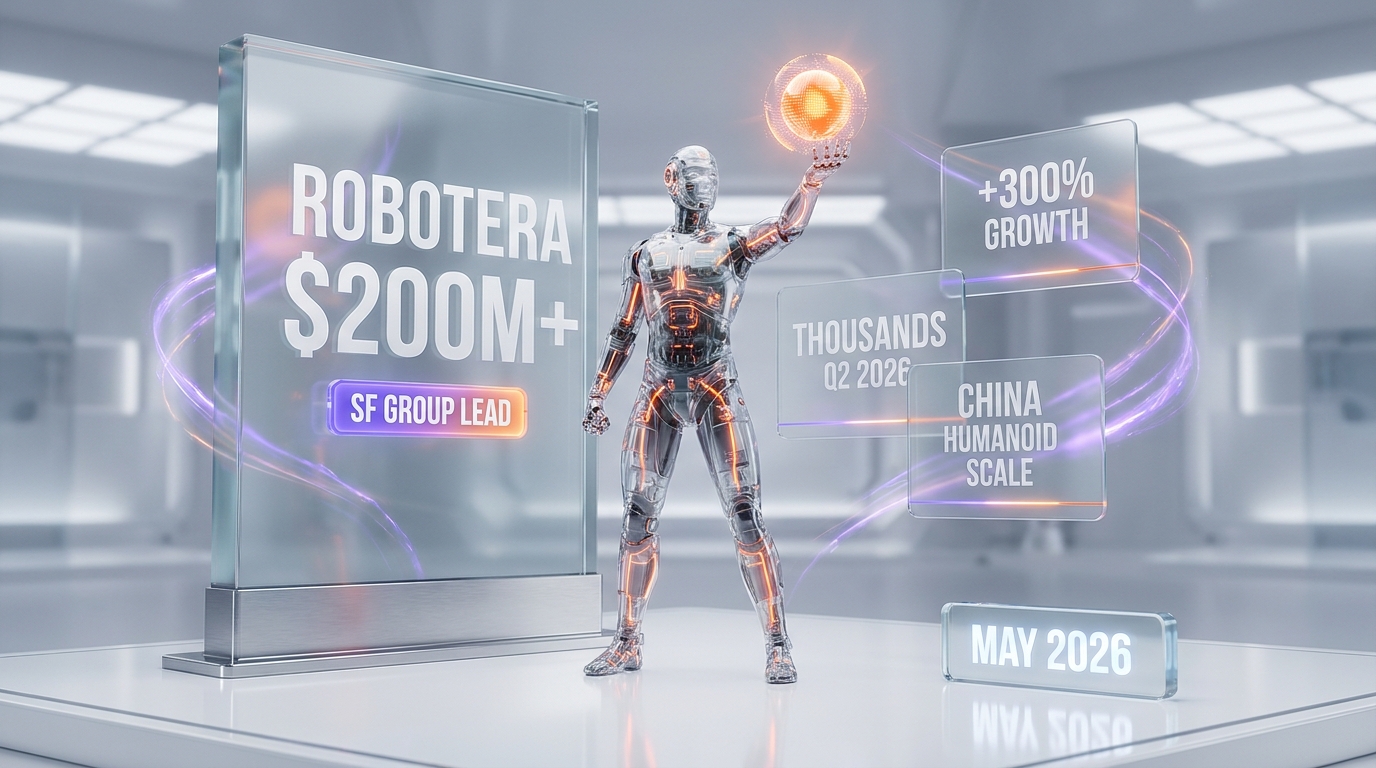
Robotera, a Beijing-based humanoid robotics developer, raised more than USD 200 million in a new financing round led by SF Group with HSG and IDG Capital, disclosed on May 8, 2026, and reported thousand-unit deliveries during the second quarter of 2026 with growth exceeding 300 percent over the period. The round follows a roughly RMB 1 billion strategic financing reported in March 2026, and lands while Chinese humanoid makers collectively shipped the large majority of the approximately 13,000 humanoid units delivered globally in 2025 — a volume position that, as reported, materially exceeds the combined output of US humanoid programs at this stage. We read the round less as a single-company milestone and more as the clearest funded signal yet that the Chinese embodied-AI stack has moved from demo to dispatch, with logistics and industrial automation as the first commercial lane.
We have tracked the humanoid funding and deployment cycle since the early-2025 wave of vision-language-action model launches, and the Robotera dispatch is the cleanest funded data point on a structural shift that has been visible in shipment data but underreported in the largely US-centric coverage cycle: the center of gravity for humanoid volume — not necessarily frontier capability, but units actually delivered into paying deployments — has moved to China. All figures in this analysis are attributed to Robotera's own disclosure as reported by The AI Insider on May 8, 2026, and corroborated across PR Newswire, Caixin Global, and CNBC coverage of the same round; we scope every claim as reported rather than independently audited, and we flag where the public record stops.
The $200M+ Round: SF Group Lead, Strategic Investor Stack
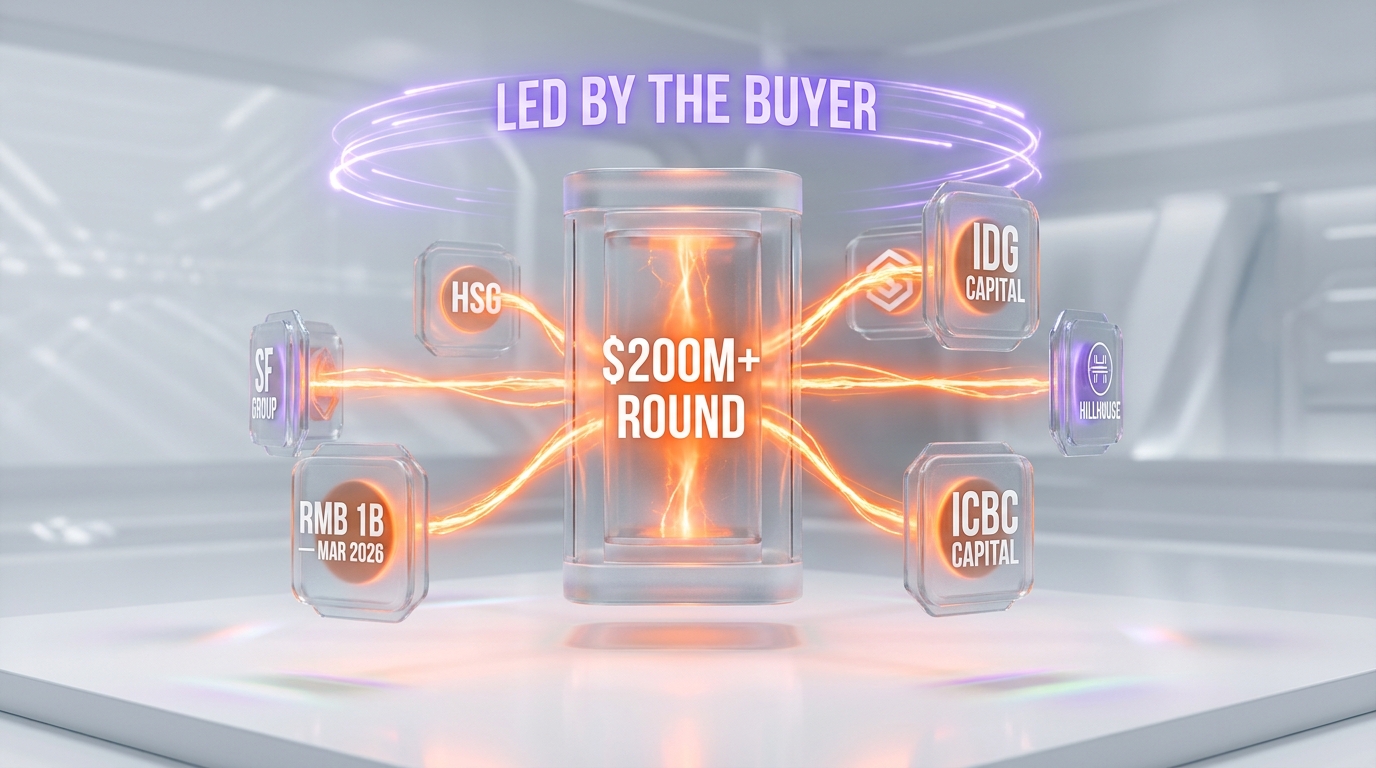
Robotera disclosed on May 8, 2026 that it raised more than USD 200 million in a new financing round led by SF Group, the parent of SF Express, with HSG (Sequoia's China-affiliated franchise as commonly identified) and IDG Capital named as co-leads in the PR Newswire headline. This is the round's most strategically legible feature: the lead investor is not a generalist growth fund but the logistics operator that also functions as a deployment customer. When the capital provider and the demand-side buyer are the same entity, the round is implicitly underwriting a delivery pipeline, not just a research runway.
Investor Composition: Industrial and State-Adjacent Capital
The reported participant list extends well beyond the leads. Financial investors named in the disclosure include Hillhouse Investment, CICC Capital, Jingming Capital, SparkEdge Capital, Luxin Venture Capital Group, Unite Pioneers Capital, and Longqi Investment. Industrial and state-adjacent participants include KENGIC, Dongfeng Asset Investment, ICBC Capital, and funds affiliated with China Unicom. Existing investors Tsinghua Holding Tiancheng Asset Management and Horizon Investment increased their stakes. The composition matters: a round anchored by a delivery operator, a state telecom's affiliated funds, a major bank's capital arm, and an automotive asset investor describes an industrial deployment thesis far more than a frontier-research bet.
Round Sequencing: RMB 1 Billion in March, $200M+ in May
This is not a standalone event. Robotera reportedly closed a roughly RMB 1 billion strategic financing in March 2026 — approximately USD 143 million at prevailing rates — and the May round stacks on top within roughly eight weeks. Two large rounds inside a single quarter is a financing cadence consistent with a company scaling a delivery operation rather than extending a research timeline. The compressed sequencing is itself the signal: capital is being deployed against a ramp that is already in motion, not a roadmap.
What Robotera Builds: L7, Q5, M7 and a Direct-Drive Hand
Robotera is a Beijing-based humanoid robotics developer focused on logistics, industrial, and service-sector applications. Its reported product line spans three platforms: the L7, a full-size bipedal humanoid; the Q5, a wheeled humanoid configuration; and the M7, positioned for logistics workloads. The platform split is itself a deployment-strategy tell — a wheeled variant alongside a bipedal one signals a company optimizing for the warehouse floor, where wheeled locomotion is often more reliable and energy-efficient than bipedal gait for the actual job to be done.
Vertical Integration: 95%+ Core Components In-House
Robotera reports developing more than 95 percent of its core components internally, spanning actuation systems and the humanoid platforms themselves, with what it describes as a full direct-drive dexterous hand architecture it characterizes as a first of its kind. Vertical integration at this depth is strategically significant for a volume thesis: it compresses the bill of materials, reduces supply-chain exposure, and — most importantly for a delivery ramp — gives the company unit-economics control that an integrator dependent on third-party actuators and hands does not have. The direct-drive hand claim specifically targets the manipulation bottleneck that gates most real-world humanoid labor.
Third-Party Research Adoption Signal
Robotera's disclosure states that its hardware system has been adopted by NVIDIA, Apple, and Boston Dynamics for research purposes. We treat this as a reported credibility signal rather than a commercial relationship — research adoption of hardware components is a different category from a production deployment partnership, and the public record does not detail the scope. The signal is still meaningful: hardware that frontier US labs and a leading robotics company select for research benchmarking carries an implicit quality validation that pure-play integrators rarely accumulate.
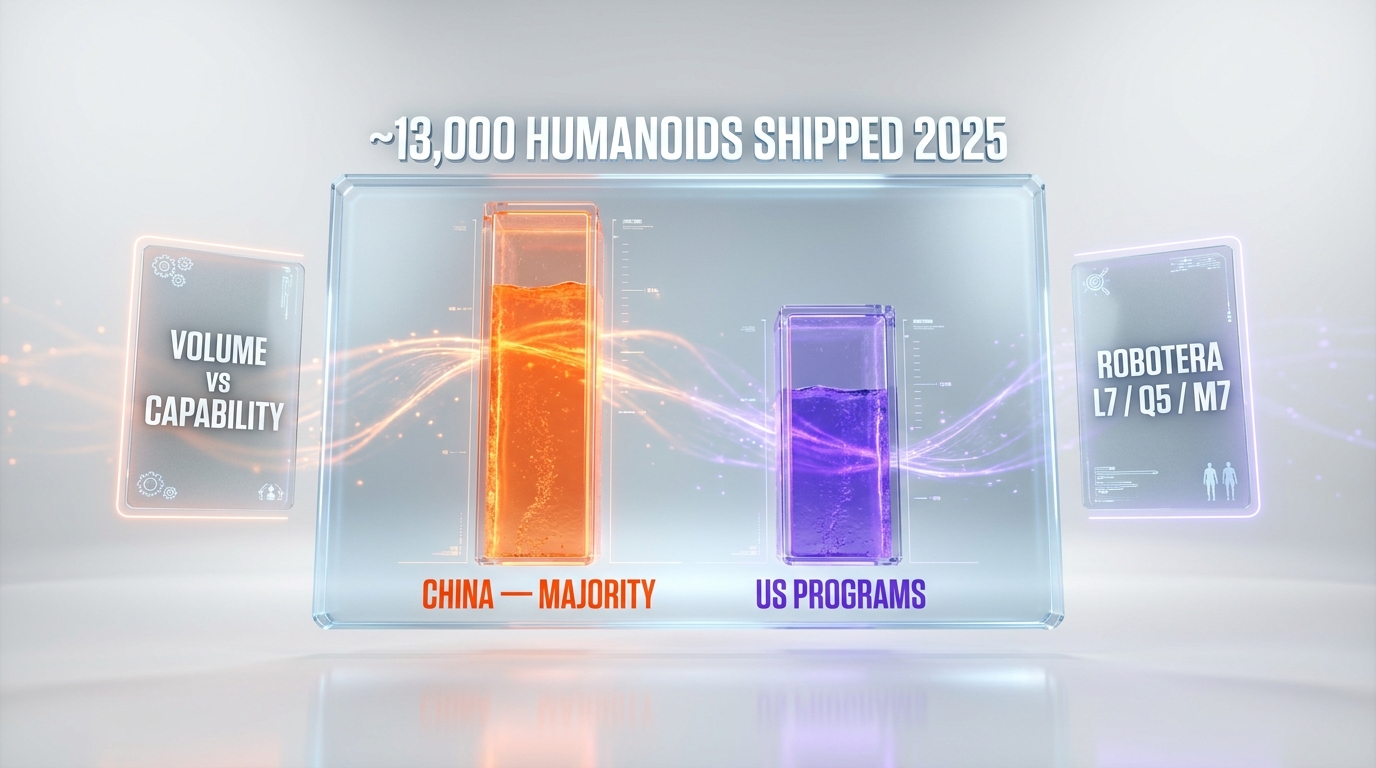
The Underreported Story: China Leads Humanoid Volume, Not Just Capability
The most strategically important context around the Robotera round is not in the round itself — it is in the shipment baseline it accelerates. As reported across multiple outlets covering 2025 global humanoid shipments, Chinese companies accounted for the large majority of the roughly 13,000 humanoid units delivered worldwide in 2025, far outstripping US programs including Tesla's Optimus effort and Figure AI in raw delivered volume. This is the part of the embodied-AI narrative that the predominantly US-centered coverage cycle has underweighted.
Volume Leadership Is a Different Axis Than Capability Leadership
We want to be precise here because the distinction is strategically load-bearing and easy to blur. Volume leadership and capability leadership are different axes. The US programs — Figure, 1X, and Tesla's Optimus among them — compete primarily on the autonomy and generalist-manipulation frontier, where the benchmark is how much a robot can do without teleoperation. The Chinese cohort, Robotera included, is currently winning the axis that converts to revenue first: units actually delivered into narrow, high-repetition deployments like logistics sortation. Neither axis is the whole game. But the funded ramp Robotera just disclosed is on the axis that produces near-term operating data, and operating data is what compounds into capability over time.
Why Logistics Is the Right First Lane
Logistics and industrial sortation is the correct beachhead for a volume strategy, and Robotera's deployment posture reflects it. The work is repetitive, the environment is semi-structured, the success criteria are measurable, and the buyer — a delivery operator like SF Express or China Post — has a quantifiable labor-cost baseline to measure against. This is the same structural logic that made warehouse automation the first scaled robotics market a decade ago. A humanoid that can reliably do tote handling across more than 10 logistics centers generates the deployment telemetry that a humanoid doing open-ended household tasks in a lab cannot. We read Robotera's lane choice as deliberate and correct for the thesis it is funded against.
Q2 2026: Thousand-Unit Deliveries and 300%+ Growth
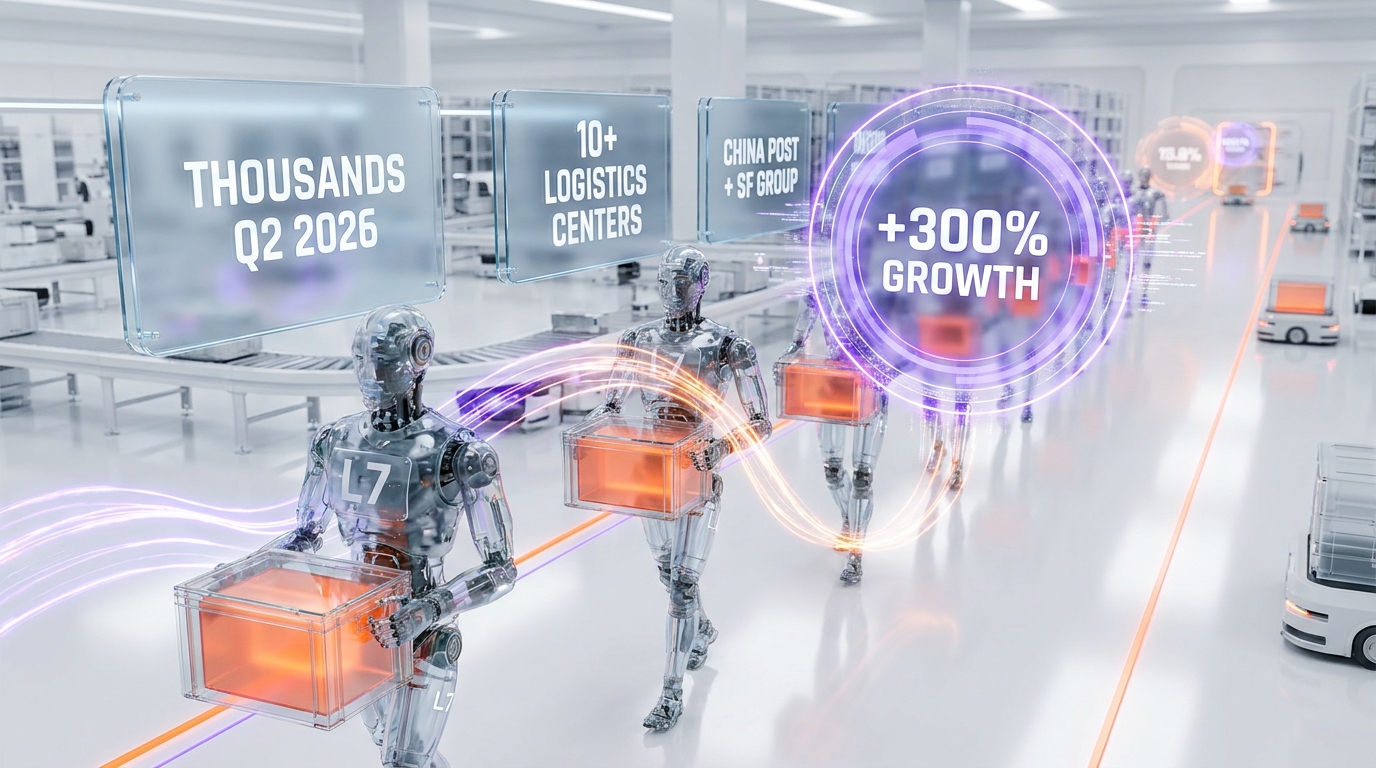
Robotera reported beginning thousand-unit deliveries during the second quarter of 2026, with growth exceeding 300 percent over the period, deploying its flagship L7 humanoids across more than 10 logistics centers through partnerships with China Post and SF Group. We scope each of these figures as the company's own disclosure as reported; the public record at the time of writing does not include an independently audited unit count or a precise definition of the 300 percent growth base.
Reading the "Thousand-Unit" Threshold
The thousand-unit delivery threshold is the number that matters most in the disclosure, and not because four digits is a large absolute figure for an industrial-equipment company. It matters because thousand-unit delivery into operating logistics centers crosses the line from pilot to production. A pilot is dozens of units in one or two sites with heavy on-site engineering support. Thousand-unit delivery across 10-plus sites is a different operational regime: it requires manufacturing throughput, field-service infrastructure, spare-parts logistics, and a support organization. The disclosure, taken as reported, describes a company that has built the unglamorous operational scaffolding that most humanoid programs have not yet had to build.
Scoping the 300% Growth Claim Honestly
Growth exceeding 300 percent over the period is a striking figure, and it deserves honest scoping rather than amplification. Triple-digit growth off a small base is mathematically routine for an early-stage deployment ramp — moving from a few hundred units to a few thousand units produces exactly this kind of percentage. The figure is real as reported, but the strategically meaningful read is the absolute trajectory it implies, not the percentage headline. We read it as: Robotera went from pilot-scale to production-scale delivery inside a single quarter, which is the operationally significant fact regardless of how the percentage is framed.
The Product-Market Fit Claim and Why It Is Unusual
Robotera's disclosure includes a claim worth isolating: the company describes itself as having achieved the first product-market fit in the embodied-intelligence sector. We treat this as a positioning claim rather than a measured fact — product-market fit is not an externally audited metric, and several Chinese and US humanoid programs would contest the "first" qualifier. But the claim is strategically interesting independent of whether it is literally first.
What PMF Means in a Humanoid Context
Product-market fit in humanoid robotics has a specific operational meaning that differs from the SaaS usage of the term. It means a defined customer segment is repeatedly purchasing units at a price that supports unit economics, for a job the robot does reliably enough that the buyer renews and expands. Robotera's 10-plus logistics-center deployment with repeat delivery to logistics operators is the closest public evidence to that definition in the humanoid category. Whether or not it is the first, it is a credible claim to being among the earliest deployment patterns that fits the operational definition rather than the demo-reel definition.
The Gap Between Demo and Dispatch
The humanoid sector's central credibility problem in 2026 is the gap between demonstration and dispatch. The category has produced a steady stream of impressive autonomy demos, and a much thinner stream of audited, scaled, paying deployments. The Robotera disclosure is notable specifically because it claims to be on the dispatch side of that gap with a funded operator-customer underwriting it. We do not treat the PMF claim as settled, but we do treat the deployment structure behind it — operator lead investor, repeat delivery, multi-site footprint — as the most dispatch-shaped public evidence in the category to date.
The Embodied-China Ecosystem: Robotera in Context
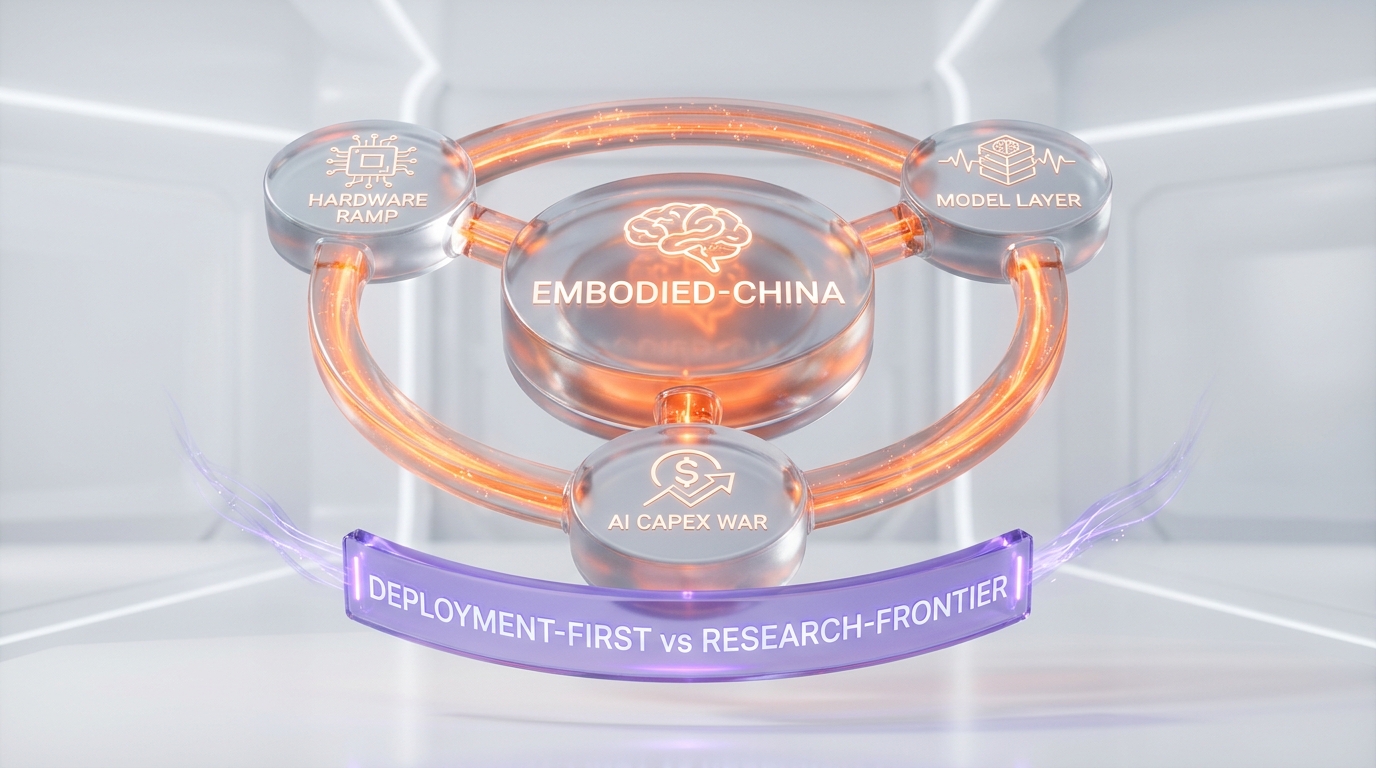
Robotera does not exist in isolation, and the round's significance compounds when read against the broader Chinese embodied-AI ecosystem rather than as a single financing. The Chinese humanoid cohort is dense, vertically integrated, and increasingly funded against deployment rather than research milestones. This is the structural difference from much of the US cohort, and it is the difference that produces the shipment-volume gap.
The Model Layer: Embodied Reasoning Is Converging
The hardware ramp is only half the embodied-AI stack. The reasoning and vision-language-action model layer is the other half, and it is converging fast across both geographies. Google DeepMind's embodied-reasoning work is one reference point on the model side of this race — our analysis of Gemini Robotics-ER 1.6 and its embodied-reasoning benchmark gains covers the brain-layer trajectory that complements the hardware-ramp story Robotera represents. The strategically important point is that a vertically integrated hardware company shipping at volume accumulates the real-world manipulation data that the model layer needs to improve — the hardware ramp and the model ramp are not independent races, they feed each other.
The Capital Layer: China's AI Capex War Extends to Embodiment
The Robotera round also reads as an extension of the broader China AI capital cycle into the embodiment lane. The same capital intensity we documented in the China model-and-cloud capex war — visible in our coverage of Tencent's doubled 2026 AI capex guidance and in the open-weight pressure from DeepSeek's V4 release — is now flowing into humanoid hardware with the same operator-underwritten, deployment-first structure. The embodiment lane is becoming the next front of the same war, and the funding structure of the Robotera round is a clean illustration of how that capital is being deployed: against ramps already in motion, led by the buyers of the output.
What This Means for the US Cohort
For the US humanoid programs, the strategic implication is not that they are losing the capability race — the autonomy frontier remains genuinely contested and the US labs are strong on it. The implication is narrower and sharper: the data flywheel favors whoever ships first. A company delivering thousands of units into operating logistics centers is collecting manipulation-failure data at a rate a lab running controlled demos cannot match, and that data compounds into capability. The Robotera round funds exactly that flywheel. The US response that matters is not a better demo — it is a faster path to audited, scaled, paying dispatch.
Risks, Unknowns, and What the Public Record Does Not Show
Honest analysis requires being explicit about what the disclosure does not establish. The unit count, the 300 percent growth base, the revenue per unit, the gross margin at the delivered price, and the renewal and expansion rate of the logistics-center deployments are all outside the public record at the time of writing. The "first product-market fit" and "first-of-its-kind direct-drive hand" claims are company positioning, not audited facts. The NVIDIA, Apple, and Boston Dynamics research-adoption references are reported credibility signals, not detailed commercial relationships.
Where the Bear Case Lives
The credible skeptical reading is that thousand-unit logistics deployment into a captive operator-investor is closer to a vertically subsidized pilot than to open-market product-market fit, and that the 300 percent figure is base-effect math. That reading is defensible on the public record, and we will not pretend otherwise. The counter is the round structure itself: industrial and state-adjacent capital does not typically stack two large rounds in a quarter into a subsidized vanity deployment. The honest position is that the deployment is real and the unit economics are unproven, and both can be true simultaneously.
What Would Change the Read
Three subsequent data points would materially update this analysis. First, an audited unit count and a deployment count from a third party rather than the company. Second, evidence of delivery to operators outside the SF Group and China Post relationship — open-market traction is the test the captive-deployment critique can only be answered by. Third, any disclosure on revenue per unit or gross margin at the delivered price, which would convert the volume story into a unit-economics story. Absent those, the responsible read is exactly what the speakable summary says: a clearly funded signal that the Chinese embodied-AI stack has moved from demo to dispatch, with the magnitude of the dispatch still being established.
Our Take
We read the Robotera round as the most strategically legible humanoid financing of 2026 so far, not because USD 200 million is a large number in absolute terms, but because of what the round's structure encodes. A logistics operator leading the round and also buying the output, two large financings stacked inside a quarter, deep vertical integration on actuators and hands, and a deployment footprint across 10-plus operating sites is a coherent volume-and-dispatch thesis, fully funded and already in motion. That coherence is rare in a category dominated by demo cycles.
The broader signal is the one worth carrying forward: humanoid volume leadership has moved to China, the embodiment lane is becoming the next front of the China AI capital war, and the company that ships first builds the data flywheel that compounds into capability. None of that means the US capability frontier is lost — it is not, and the autonomy race remains genuinely open. It means the strategic question for the US cohort has shifted from "who has the best demo" to "who reaches audited, scaled, paying dispatch first." Robotera, as reported, is running that play with the capital to fund it. We will update this analysis the moment a third-party audited unit count or open-market traction data enters the public record.
How much did Robotera raise and who led the round?
Robotera disclosed on May 8, 2026 that it raised more than USD 200 million in a new financing round led by SF Group, the parent of SF Express, with HSG and IDG Capital named as co-leads in the PR Newswire headline. The round follows a roughly RMB 1 billion strategic financing reported in March 2026, which translates to approximately USD 143 million at prevailing rates. The two large rounds stack inside roughly eight weeks, a financing cadence consistent with scaling a delivery operation rather than extending a research runway. All figures are as reported by Robotera and corroborated across The AI Insider, PR Newswire, Caixin Global, and CNBC coverage of the round.
What is Robotera and what robots does it build?
Robotera is a Beijing-based humanoid robotics developer focused on logistics, industrial, and service-sector applications. Its reported product line spans three platforms: the L7, a full-size bipedal humanoid; the Q5, a wheeled humanoid configuration; and the M7, positioned for logistics workloads. The company reports developing more than 95 percent of its core components internally, including actuation systems and the humanoid platforms, with what it describes as a full direct-drive dexterous hand architecture it characterizes as a first of its kind. The wheeled-plus-bipedal platform split signals a company optimizing for the warehouse floor where the first commercial demand exists.
Who invested in the Robotera $200M+ round besides SF Group?
The reported participant list includes financial investors Hillhouse Investment, CICC Capital, Jingming Capital, SparkEdge Capital, Luxin Venture Capital Group, Unite Pioneers Capital, and Longqi Investment, alongside industrial and state-adjacent participants KENGIC, Dongfeng Asset Investment, ICBC Capital, and funds affiliated with China Unicom. Existing investors Tsinghua Holding Tiancheng Asset Management and Horizon Investment increased their stakes. The composition — a delivery operator lead, a state telecom's affiliated funds, a major bank's capital arm, and an automotive asset investor — describes an industrial deployment thesis rather than a frontier-research bet.
How many humanoid robots did Robotera deliver in Q2 2026?
Robotera reported beginning thousand-unit deliveries during the second quarter of 2026, with growth exceeding 300 percent over the period, deploying its flagship L7 humanoids across more than 10 logistics centers through partnerships with China Post and SF Group. We scope these as the company's own disclosure as reported; the public record at the time of writing does not include an independently audited unit count or a precise definition of the 300 percent growth base. The strategically significant fact is the crossing from pilot-scale to production-scale delivery inside a single quarter, regardless of how the percentage is framed.
Does China ship more humanoid robots than the US?
As reported across multiple outlets covering 2025 global humanoid shipments, Chinese companies accounted for the large majority of the roughly 13,000 humanoid units delivered worldwide in 2025, far outstripping US programs including Tesla's Optimus effort and Figure AI in raw delivered volume. Volume leadership and capability leadership are different axes — the US programs compete primarily on the autonomy frontier, while the Chinese cohort currently leads the axis that converts to revenue first: units actually delivered into narrow, high-repetition deployments like logistics sortation. The Robotera round funds the volume-and-dispatch axis specifically.
Why is logistics the first market for Robotera's humanoids?
Logistics and industrial sortation is the correct beachhead for a volume strategy because the work is repetitive, the environment is semi-structured, the success criteria are measurable, and the buyer — a delivery operator like SF Express or China Post — has a quantifiable labor-cost baseline to measure against. This is the same structural logic that made warehouse automation the first scaled robotics market a decade ago. A humanoid reliably handling totes across more than 10 logistics centers generates deployment telemetry that a humanoid doing open-ended tasks in a lab cannot, and that telemetry compounds into capability.
How does Robotera compare to Figure, 1X, and Tesla Optimus?
The comparison is best understood as two different axes rather than a single ranking. The US programs — Figure, 1X, and Tesla's Optimus among them — compete primarily on the autonomy and generalist-manipulation frontier, where the benchmark is how much a robot can do without teleoperation. Robotera and the broader Chinese cohort currently lead the volume-and-dispatch axis: units actually delivered into paying logistics deployments. Neither axis is the whole game, but the Robotera round funds the axis that produces near-term operating data, and operating data is the input that compounds into capability over time.
What is Robotera's direct-drive dexterous hand?
Robotera describes a full direct-drive dexterous hand architecture that it characterizes as a first of its kind, developed as part of its more than 95 percent in-house core-component stack. Direct-drive hand design targets the manipulation bottleneck that gates most real-world humanoid labor — reliable, dexterous grasping is the capability that separates a demo from a deployable logistics worker. We treat the "first of its kind" qualifier as company positioning rather than an audited fact, but the strategic point holds: vertical integration on the hand gives Robotera unit-economics and reliability control that integrators dependent on third-party hands do not have.
Have NVIDIA, Apple, or Boston Dynamics adopted Robotera's hardware?
Robotera's disclosure states that its hardware system has been adopted by NVIDIA, Apple, and Boston Dynamics for research purposes. We treat this as a reported credibility signal rather than a detailed commercial relationship — research adoption of hardware components is a different category from a production deployment partnership, and the public record does not detail the scope. The signal is still meaningful: hardware that frontier US labs and a leading robotics company select for research benchmarking carries an implicit quality validation that pure-play integrators rarely accumulate.
Is Robotera's product-market fit claim credible?
Robotera describes itself as having achieved the first product-market fit in the embodied-intelligence sector. We treat the "first" qualifier as a positioning claim rather than a measured fact — product-market fit is not externally audited, and several Chinese and US programs would contest it. Independent of the "first" claim, the deployment structure behind it is the most dispatch-shaped public evidence in the humanoid category to date: an operator lead investor, repeat delivery, and a multi-site footprint match the operational definition of product-market fit more closely than the demo-reel definition that dominates the sector.
What does the Robotera round mean for the broader China AI capex war?
The round reads as an extension of the broader China AI capital cycle into the embodiment lane. The same capital intensity visible in the China model-and-cloud capex war — Tencent's doubled 2026 AI capex guidance and the open-weight pressure from DeepSeek's V4 release — is now flowing into humanoid hardware with the same operator-underwritten, deployment-first structure. The embodiment lane is becoming the next front of the same war, and the Robotera round is a clean illustration of how that capital is being deployed: against ramps already in motion, led by the buyers of the output.
What are the main unknowns and risks in the Robotera story?
The unit count, the 300 percent growth base, revenue per unit, gross margin at the delivered price, and the renewal and expansion rate of the logistics-center deployments are all outside the public record at the time of writing. The "first product-market fit" and "first-of-its-kind hand" claims are company positioning, not audited facts. The credible bear case is that thousand-unit logistics deployment into a captive operator-investor resembles a vertically subsidized pilot rather than open-market product-market fit, and that the 300 percent figure is base-effect math. The honest position is that the deployment is real and the unit economics are unproven, and both can be true simultaneously.
Sources and further reading
- The AI Insider — China's Humanoid Robot Maker Robotera Raises Over USD $200M in New Funding Round (May 8, 2026)
- PR Newswire — ROBOTERA Raises Over USD 200 Million in New Round Led by SF Group, HSG and IDG Capital (May 8, 2026)
- Caixin Global — Robot Era Raises Over $200 Million as Humanoid Robot Race Heats Up
- CNBC — China ships more humanoid robots than the U.S. as investors diverge on AI bets