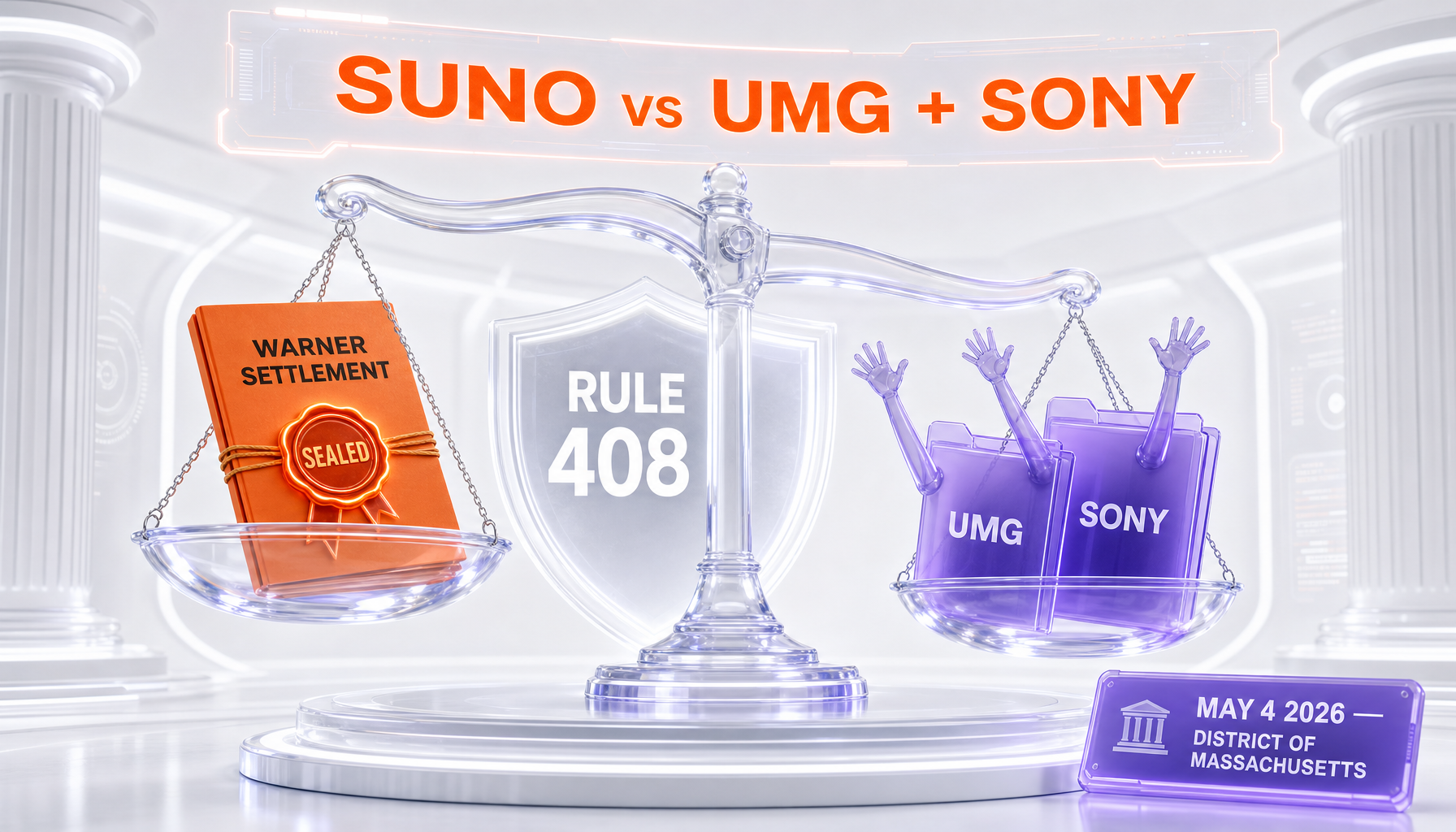
Suno filed a 21-page opposition on May 4, 2026 asking US Magistrate Judge Paul Levenson to keep its November 2025 Warner Music settlement terms sealed from Universal Music Group and Sony Music Entertainment. The two labels want the deal exposed as a discovery blueprint before the summer fair-use ruling that could redefine how AI music generators license training data. We pulled the filing, the April 6 ruling Suno is defending, and the Songkick acquisition that complicates the labels' damages model. The fight matters because Suno is closing on a $5 billion valuation while its core copyright case in the District of Massachusetts heads toward a precedent-setting decision.
The May 4 Filing Explained
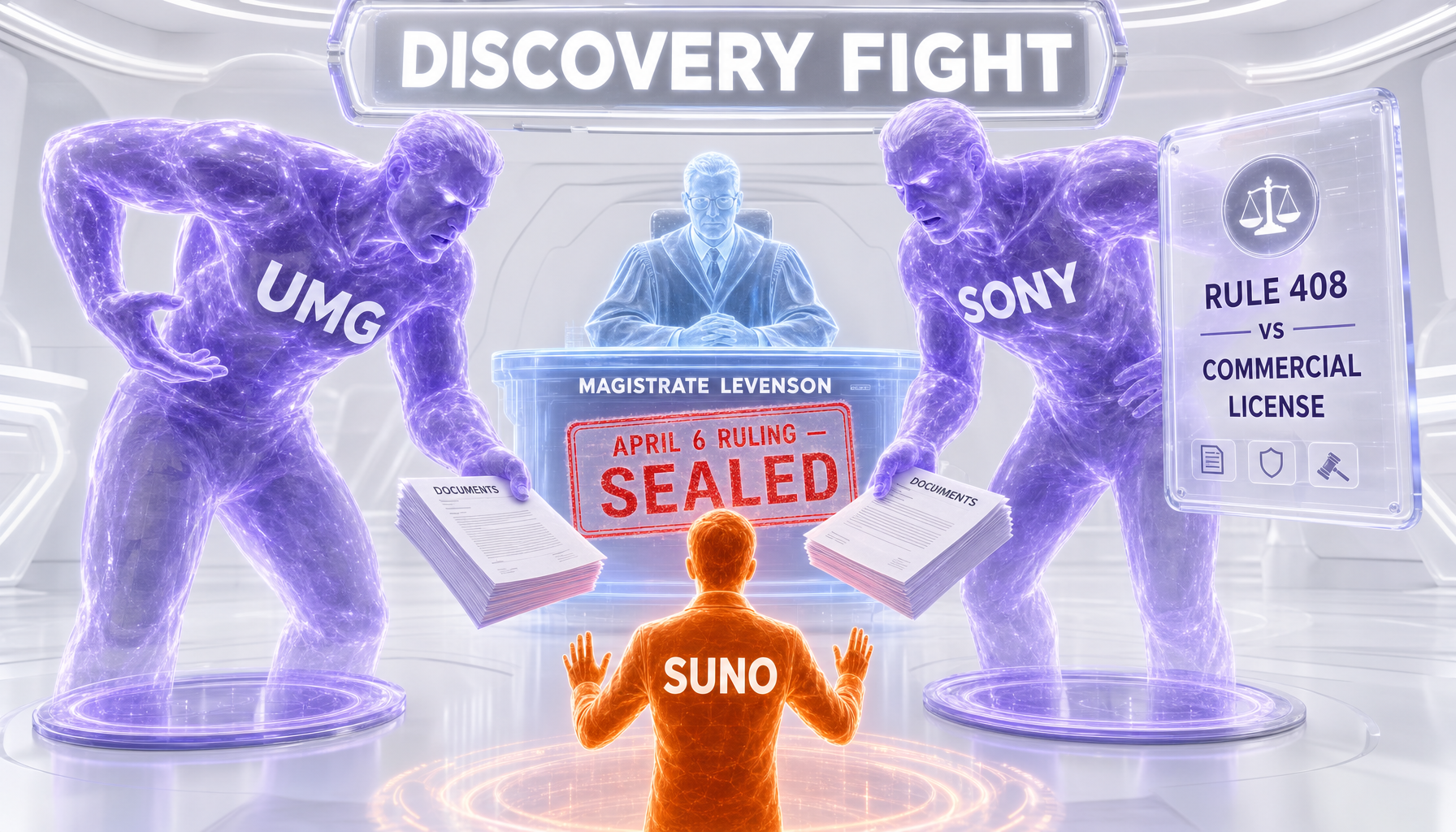
Suno's opposition responds to a March objection filed by UMG and Sony challenging Magistrate Levenson's April 6, 2026 ruling. That earlier ruling carved out the confidential settlement agreement Suno reached with Warner Music Group in November 2025, blocking the two remaining label plaintiffs from accessing the terms during ongoing discovery. UMG and Sony argued the Warner deal includes forward-looking commercial licensing for training data — not merely a litigation settlement — and therefore bears on damages calculations they would seek if Suno loses the broader fair-use case.
Suno's legal team frames the request as a fishing expedition. The opposition argues that settlements of litigation have, in Suno's words, "little persuasive bearing on identifying and characterizing markets" because they are shaped by fear-of-loss dynamics rather than open-market negotiation. Disclosure, the filing warns, would compromise settlement dynamics across the AI music sector and chill future settlements between similarly situated parties. That argument tracks Federal Rule of Evidence 408, which generally prohibits using settlement agreements to prove or measure damages in related litigation.
Rule 408 and the Blueprint Argument
The most pointed line in the filing accuses UMG and Sony of seeking a blueprint of Suno's settlement posture. That phrase is doing strategic work. Suno is signaling that the labels do not need the Warner numbers to value their own potential damages — they need them to calibrate their own demand against Suno's revealed willingness to pay. In commercial negotiation terms, that is a poker tell. In legal terms, Suno argues Rule 408 was written precisely to prevent that kind of inferential leakage between settlement and active litigation.
UMG and Sony counter that the Warner arrangement is not a clean Rule 408 settlement. Their objection emphasizes the forward-looking commercial licensing component for training Suno's next-generation models on Warner's recorded catalog. If the Warner deal functions as a market-rate license — which is how the labels frame it — then it speaks to the value of similar inputs in a hypothetical license to UMG and Sony, which is exactly the kind of evidence Rule 408 carve-outs typically allow when the settlement embeds a forward commercial term.

What the Warner Deal Actually Contains
The November 2025 Suno-Warner settlement was announced as a first-of-its-kind partnership between an AI music generator and a major label. The public-facing terms confirm three discrete components: a litigation settlement closing Warner's copyright claim, a commercial license for Suno to train on Warner's recorded music catalog going forward, and Suno's acquisition of Songkick — Warner's live music and concert-discovery platform — as part of the broader transaction.
The dollar value of the settlement and the licensing component has never been disclosed publicly. The Songkick acquisition price is also confidential. That triple bundle is exactly what makes UMG and Sony's discovery push aggressive. If the labels can show the court that the licensing component and the Songkick transaction were negotiated as part of the same package, they have a stronger argument that the entire agreement reflects a forward commercial relationship — and therefore falls outside the protections Rule 408 was designed to provide.
The Songkick Complication
Songkick is the wildcard. Warner acquired Songkick's data and brand in 2017 after a long legal fight with Live Nation, and the platform powered concert metadata, artist-page tour widgets, and a meaningful slice of the live-music discovery web. Selling it to Suno turns a pure licensing settlement into a corporate transaction. UMG and Sony will argue that Songkick's transfer price is a knowable, separable number that the court can extract from the bundle without exposing the litigation settlement itself.
Suno's opposition resists that surgical reading. The filing characterizes the deal as an integrated package where unbundling the components would distort each one. That is a defensible position commercially — sophisticated parties negotiate against the total deal economics, not against each line item in isolation. But courts have broad discretion to compel partial disclosure when one component is clearly commercial and another is clearly settlement, and that discretion is what UMG and Sony are betting on.
Why the Summer Fair-Use Ruling is the Real Prize
The discovery fight is not happening in a vacuum. The underlying case in the District of Massachusetts is heading toward a fair-use ruling expected this summer. That ruling will determine whether Suno's training of its v3 and v4 models on the labels' recorded music catalogs qualifies as fair use — the same threshold question that has shaped every AI copyright case from the Bartz Anthropic settlement to the New York Times v. OpenAI proceedings. A pro-Suno fair-use ruling would dramatically reset the leverage in the labels' damages negotiation. A pro-labels ruling would expose Suno to potential statutory damages running into the hundreds of millions or higher.
That ruling is why the Warner settlement matters now, not later. If the court rules for Suno on fair use, the Warner deal becomes a voluntary commercial license that Suno chose to enter despite winning the legal merits. If the court rules for the labels, the Warner deal becomes the floor for damages calculations against UMG and Sony — and the structure of that deal becomes the model for forced licensing across the industry. Both outcomes are massive. Both outcomes hinge in part on whether UMG and Sony can see what Warner agreed to before they argue their own damages position.
The $5 Billion Valuation Timing
Suno is closing on a $5 billion valuation round despite the active litigation. That number is not separable from the Warner deal. Investors pricing Suno's equity have to model the legal risk from UMG and Sony, and the Warner settlement gave the market a partial read on what an acceptable resolution looks like. If UMG and Sony force disclosure now, the market gets a much sharper read — which is good or bad for Suno depending on what the actual Warner numbers are. That is exactly the inferential leakage Suno's lawyers are trying to prevent.
The valuation timing also affects the discovery push from the labels' side. UMG and Sony have a window before Suno's next funding round closes where the pressure of disclosure could shift negotiation dynamics. Once the round closes at $5 billion, the labels lose some leverage — Suno's balance sheet absorbs more legal risk. Before the round closes, every piece of public information about Suno's litigation exposure matters more. That is a deliberate, sophisticated piece of timing pressure from the labels' side, regardless of how the court rules on the discovery motion.
Suno's Revenue and the Cost of Disclosure
Suno does not publish revenue figures, but the company has signaled subscription growth running well into the eight figures annually based on its Pro and Premier tier mix. That revenue base is what gives Suno standing to settle with Warner on commercial terms in the first place. If UMG and Sony see the Warner economics and conclude Suno overpaid relative to its revenue, they will demand more. If they conclude Suno underpaid, they will use that as evidence that the market rate for training-data licensing is higher than Warner's number suggests. Either reading hurts Suno.
The Bartz Anthropic Precedent
The Suno fight sits inside a broader AI copyright landscape that has shifted dramatically over the past six months. The Bartz v. Anthropic $1.5 billion copyright settlement set the high-water mark for AI training-data payouts, with a final approval hearing scheduled for May 14, 2026. That settlement covered roughly 500,000 books at $3,000 per work and reset the conversation about what AI labs are willing to pay for training data they have already used.
The Anthropic precedent matters for Suno in two ways. First, it establishes that AI companies will settle for very large numbers when faced with overwhelming copyright exposure — which means UMG and Sony can credibly threaten Suno with a comparable outcome if discovery and fair-use rulings break their way. Second, it establishes that settlements in AI copyright cases include forward commercial terms, not just backward-looking damages. That is the exact pattern UMG and Sony are pointing to in their objection — they argue the Warner deal almost certainly contains a forward training-data license that is commercially comparable to what UMG and Sony would seek in a settlement of their own.
The Music vs. Text Distinction
One reason the Suno case is harder to predict than Anthropic's is the structural difference between music and text training data. Recorded music has identifiable sound recordings owned by specific labels, with clean chain-of-title and per-track licensing infrastructure that has existed for decades. Text training data is messier — books are owned by publishers, web text is owned by a fragmented universe of creators, and licensing infrastructure is still being built. The labels know exactly what their catalog is worth in licensing terms. Anthropic was negotiating against an emerging asset class.
That clarity cuts both ways for Suno. The labels have a stronger initial position because the licensing economics are well-established. But Suno has a stronger fair-use position because the transformative nature of music generation is arguably greater than text completion — the output is a new composition, not a continuation of an existing text. The fair-use ruling this summer will be the first major test of that distinction at the federal court level.

How This Changes the AI Music Licensing Market
Whatever the magistrate rules on the discovery motion, the Suno-Warner deal has already changed the licensing landscape. The labels now have a public confirmation that an AI music generator is willing to settle on commercial terms with at least one major. That alone reprices the negotiating position of every smaller AI music platform that has not yet been sued. Suno setting a market precedent — even with confidential numbers — gives every label a stronger floor in future negotiations.
For competitors like ElevenMusic and Udio, the Suno precedent creates a forking outcome. If Suno wins on fair use, the cost of building an AI music generator drops sharply because the labels' leverage drops sharply. If Suno loses on fair use or settles broadly, every competitor faces the same licensing math Suno is now navigating. We covered the head-to-head competitive positioning in our ElevenMusic vs Suno AI comparison, but the regulatory overlay is now the dominant variable.
ElevenLabs and the Licensed-First Bet
ElevenLabs built its broader voice and music stack with a licensing-first posture from day one, which looked expensive at the time and looks prescient now. If the Suno fair-use ruling favors the labels, ElevenLabs' licensed catalog approach becomes the structural template for the industry. If the ruling favors Suno, ElevenLabs paid for licenses it might not have legally needed — but the company likely retains commercial relationships and catalog access that fair-use winners do not.
That bifurcation is the most consequential second-order effect of the Suno-Warner dispute. The AI music sector splits into two camps depending on the summer ruling: the train-then-litigate camp and the license-first camp. Each camp has very different cost structures, time-to-market profiles, and partnership opportunities with major labels. Investors pricing the sector right now have to weight both outcomes.
Magistrate Judge Levenson and the Massachusetts Track
The case is moving through the US District Court for the District of Massachusetts, with US Magistrate Judge Paul Levenson handling the discovery disputes. Levenson's April 6 ruling protecting the Warner agreement was the first major signal of how the court views the Rule 408 question. That ruling tilted toward Suno, which is why UMG and Sony filed their objection in March. The May 4 opposition from Suno is the procedural response defending the original ruling.
The Massachusetts venue matters because the First Circuit has a relatively settled body of law on Rule 408 and settlement confidentiality. Suno's lawyers chose to lean heavily on settled First Circuit precedent rather than push for novel arguments. That is a defensive posture that signals confidence in the existing law and risk-aversion on the procedural front. UMG and Sony are pushing the court to read Rule 408 narrowly when commercial terms are bundled into a settlement — a reading that has support in other circuits but is less settled in the First.
Appeals Pathway and Timing
If Magistrate Levenson rules against Suno on the disclosure motion, Suno can appeal to the District Court judge before disclosure happens. That appeal pathway is fast — typically resolved in 30 to 60 days — but it adds time pressure on the summer fair-use ruling. If UMG and Sony win the disclosure fight at the magistrate level, Suno's appeal options extend the fight by months, which could push the summer ruling later in 2026.
That timing is exactly what UMG and Sony want to avoid. The labels prefer disclosure before the fair-use ruling because the Warner numbers shape their damages argument under either fair-use outcome. Suno prefers a quick fair-use ruling before any disclosure forces a procedural delay. The procedural chess match is as important as the substantive arguments on either side.

What Suno Customers Should Know
For working musicians and creators using Suno today, the dispute does not affect current Pro and Premier tier output rights. Suno's terms of service confirm that user-generated outputs from Suno's models remain usable under the platform's commercial license, regardless of the broader litigation. The Warner deal in fact expanded that protection for Warner-catalog-influenced outputs — Suno's lawyers will argue, and have argued, that the November 2025 license covers commercial use of Warner-style outputs going forward.
The bigger uncertainty for power users is what happens to the model itself. If Suno loses on fair use and is forced to remove training data, model quality could regress noticeably. That is a real downside scenario customers should price into their workflow dependence on Suno. Hedging through cross-platform workflow — keeping ElevenMusic, Udio, or other alternatives in rotation — is reasonable risk management until the summer ruling clarifies the trajectory.
Enterprise and Sync Licensing
For enterprise users licensing Suno outputs for sync placement in film, TV, or advertising, the litigation creates more friction. Sync agents and music supervisors increasingly demand indemnification from AI music platforms before clearing AI-generated tracks. Suno's Warner settlement provides partial cover for Warner-adjacent outputs. The UMG and Sony exposure remains unresolved, which means sync placements that touch UMG or Sony rightsholder territory still carry residual risk until the broader case resolves.
The Broader Implications for AI Copyright Law
The Suno case is being watched closely by every AI lab training on copyrighted material — text, image, music, or video. The fair-use ruling this summer will be the most significant federal court decision on AI training data since the Bartz Anthropic settlement, and unlike Anthropic, Suno has chosen to fight the fair-use question rather than settle. That choice means the music industry will likely produce the first definitive appellate-track precedent on AI training fair use.
That precedent will travel beyond music. Image generators, video generators, and text generators all face structurally similar fair-use defenses. A pro-Suno ruling would strengthen every AI lab's litigation posture. A pro-labels ruling would push the entire industry toward licensed-first models, dramatically reshaping who can build AI generators and at what cost. The Suno-Warner discovery fight is the procedural fork-in-the-road that determines how that bigger question gets argued.
What We Are Watching Next
Three near-term signals will tell us how this resolves. First, Magistrate Levenson's ruling on Suno's May 4 opposition — expected within 30 to 45 days given typical magistrate-court timelines. Second, any movement in Suno's $5 billion funding round, which is a real-time market signal of how investors are pricing the legal risk. Third, the summer fair-use ruling itself, which is the substantive endpoint that all the procedural fighting is designed to influence.
We also expect parallel filings from UMG and Sony arguing that the magistrate's reasoning extends — or does not extend — to other forms of evidence about Suno's licensing posture. The labels have already signaled they will push to discover Suno's plans to alter its business and AI music generation service following the Warner license. That broader discovery push is the next procedural battle even if the immediate disclosure motion goes Suno's way.
Frequently Asked Questions
What did Suno file on May 4, 2026?
Suno filed a 21-page opposition asking US Magistrate Judge Paul Levenson to keep its November 2025 Warner Music settlement terms sealed from UMG and Sony during discovery. The filing defends an earlier April 6, 2026 ruling that protected the Warner agreement and argues that disclosure would compromise settlement dynamics and chill future settlements under Federal Rule of Evidence 408.
What do UMG and Sony want from the Warner deal?
UMG and Sony want to see the Warner deal's commercial licensing terms because they argue the agreement is not a pure litigation settlement. The Warner arrangement includes forward-looking training data licensing and Suno's acquisition of Songkick, which the labels say falls outside Rule 408 settlement protections and bears directly on damages calculations in their own copyright case against Suno.
When is the Suno fair-use ruling expected?
The fair-use ruling is expected this summer in the US District Court for the District of Massachusetts. The ruling will determine whether Suno's training of its v3 and v4 models on the labels' recorded music catalogs qualifies as fair use under US copyright law. It will be the first major federal court decision on AI music training data and a precedent for the broader AI copyright landscape.
What did Suno acquire from Warner Music in the settlement?
Suno acquired Songkick, Warner Music's live music and concert-discovery platform, as part of the November 2025 settlement bundle. The Songkick transaction is one reason UMG and Sony argue the Warner deal exceeds a pure litigation settlement and should be partially disclosed in discovery. Warner had originally acquired Songkick in 2017 after a Live Nation legal dispute.
How much is Suno worth in 2026?
Suno is closing on a $5 billion valuation round despite ongoing copyright litigation from UMG and Sony. The valuation reflects investor pricing of Suno's revenue growth across its Pro and Premier subscription tiers, balanced against legal risk exposure. The timing of the funding round and the discovery dispute are linked, with the labels gaining leverage from any pre-close disclosure of Suno's settlement posture.
What is Federal Rule of Evidence 408?
Federal Rule of Evidence 408 generally prohibits using settlement agreements to prove or measure damages in related litigation. Suno's opposition leans heavily on Rule 408 to argue that the Warner settlement terms cannot be used by UMG and Sony to anchor their own damages case. UMG and Sony counter that the rule has carve-outs when settlements embed forward-looking commercial licenses.
How does this compare to the Anthropic copyright settlement?
The Bartz v. Anthropic $1.5 billion settlement covered roughly 500,000 books at $3,000 per work and includes forward commercial terms, with a final approval hearing scheduled for May 14, 2026. UMG and Sony point to that pattern as evidence that AI copyright settlements typically embed commercial licensing, which would put the Warner deal outside Rule 408 protection and inside discoverable damages territory.
Who is Magistrate Judge Paul Levenson?
US Magistrate Judge Paul Levenson is handling discovery disputes in the Suno copyright case in the US District Court for the District of Massachusetts. His April 6, 2026 ruling sealed the Warner Music settlement from UMG and Sony during discovery. The May 4 opposition from Suno asks him to maintain that ruling against the labels' objection.
What does this mean for ElevenMusic and Udio?
The Suno fair-use ruling will set the federal standard for AI music generators that train on copyrighted recordings. A pro-Suno ruling reduces licensing pressure on competitors like ElevenMusic and Udio. A pro-labels ruling pushes every AI music platform toward licensed-first models with structurally higher costs. ElevenLabs already runs a licensed-first stack, which positions ElevenMusic well under either outcome but particularly under a pro-labels ruling.
Can current Suno customers keep using AI-generated tracks?
Yes. Suno's terms of service confirm that user-generated outputs from Suno's Pro and Premier tiers remain usable under the platform's commercial license regardless of the broader litigation. The Warner settlement expanded coverage for Warner-catalog-influenced outputs. Sync placements touching UMG or Sony rightsholder territory still carry residual legal risk pending the summer fair-use ruling.
What happens if Suno loses the fair-use ruling?
If Suno loses on fair use, it faces potential statutory damages from UMG and Sony and would likely need to negotiate forward licensing on terms shaped by the court's findings. Model quality could regress if Suno is forced to remove training data, and the entire AI music sector would shift toward licensed-first models. The Warner settlement would become the floor for damages calculations across remaining label-vs-AI cases.
How does the Songkick acquisition affect the discovery fight?
Songkick is the wildcard that complicates Suno's Rule 408 argument. Because Songkick changed corporate hands as part of the Warner settlement bundle, UMG and Sony argue the deal contains a separable commercial transaction with a knowable price that the court can extract from the litigation settlement. Suno resists that surgical reading and characterizes the deal as integrated, but courts have broad discretion to compel partial disclosure when commercial and settlement components are clearly distinguishable.
Sources: Filings and reporting drawn from Music Business Worldwide and Digital Music News. Court docket: US District Court for the District of Massachusetts. Editorial analysis by Anthony Martinez for ThePlanetTools.ai.