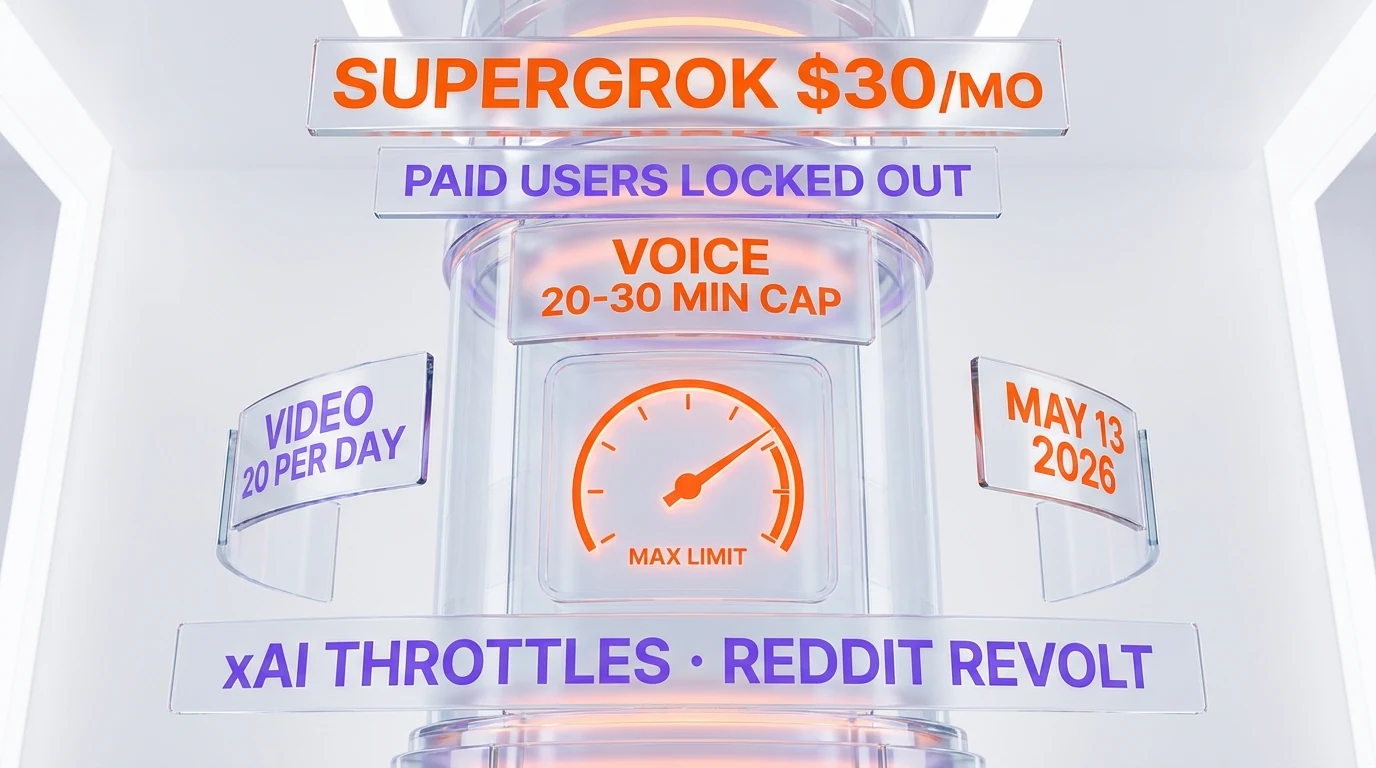
xAI tightened rate limits on its SuperGrok $30 per month paid tier on May 13, 2026, locking voice sessions after 20 to 30 minutes, capping video generation at 20 clips per day, and cutting daily image edits from roughly 100 to about 30. The premium Heavy tier at $300 per month saw its daily video allowance drop from 500 to about 160. PiunikaWeb first reported the throttling after a 24-hour surge of complaints concentrated on the r/grok subreddit and on X, where paying subscribers said features had become "practically useless" mid-session. An xAI employee acknowledged the limits "can fluctuate daily" and advised users to "try again," but no rate-limit documentation has been published for any tier. The pattern lands after xAI's free-tier restrictions in March 2026 and during a politically heated stretch for the company.
We have been tracking Grok across every release since the v3 cycle, and the May 13 throttle is the cleanest data point yet that xAI's paid-monetization motion is under structural pressure. The pricing-to-usage ratio on SuperGrok $30 per month was already aggressive against ChatGPT Plus at $20 per month and Claude Pro at $20 per month. A silent reduction in the actual usage envelope — without a price cut, without prior notice, and without published limits — pushes the gap between paid promise and paid delivery wider than the SuperGrok positioning can absorb on a sustained basis. The Heavy tier downgrade from 500 to roughly 160 daily videos is the load-bearing data point because Heavy at $300 per month is where xAI's revenue concentration sits. For the broader category landscape, see our Grok vs ChatGPT comparison and the xAI plus SpaceX merger context alongside the xAI dissolution into SpaceXAI structural reorganization.
What changed on May 13, 2026
The throttle event is small in surface area but large in implication. According to PiunikaWeb's aggregation of paid-user reports on r/grok and on X, four concrete usage parameters tightened overnight on May 13, 2026, for active SuperGrok and Heavy subscribers. Voice mode sessions on SuperGrok lock out after 20 to 30 minutes of continuous use, where earlier sessions in late April and early May ran longer without forced lockouts. Video generation on SuperGrok caps at 20 clips per day, which paid subscribers described as a hard ceiling rather than a soft prompt to upgrade. Image editing on SuperGrok dropped from roughly 100 daily edits to about 30 overnight, a roughly 70 percent reduction in the most-used creative endpoint of the paid tier. The Heavy tier at $300 per month saw its video generation allowance fall from 500 daily clips to approximately 160 — a 68 percent cut on the headline allowance that Heavy subscribers point to as the reason they pay the premium price.
A second-order detail is the cap on moderated generations. Paid subscribers report that requests blocked by xAI's content moderation still count against the daily allowances. That is procedurally different from how OpenAI and Anthropic treat moderation events on ChatGPT Plus and Claude Pro respectively, where blocked requests typically do not consume usage tokens or daily message quotas. For a paid subscriber attempting an image edit that the moderation layer rejects, the SuperGrok behavior is that the user has effectively paid for the rejection — once the daily limit is hit, no further attempts succeed regardless of whether prior failures were the user's choice or xAI's moderation decision.
Third, the company has not published rate-limit documentation for any tier. An xAI employee response circulating on X acknowledged that limits "can fluctuate daily" and advised users to "try again," but no canonical rate-limit page exists on the Grok billing or settings pages. For a $30 per month consumer subscription, the absence of published limits is unusual against the rest of the consumer AI category. ChatGPT Plus, Claude Pro, and Google Gemini Advanced all publish either explicit message-cap numbers or explicit usage windows, even when the underlying limits adjust dynamically. The undocumented-and-fluctuating combination at SuperGrok is the procurement friction that paid users have organized around in the May 13 backlash.

Why the Heavy tier downgrade is the load-bearing data point
The Heavy tier at $300 per month is where the throttle event compounds into a structural risk for xAI's paid-monetization motion. SuperGrok at $30 per month is a wide-funnel consumer subscription, designed to convert free Grok users into paid users by exposing voice, video, and image-edit endpoints behind a manageable price gate. Heavy at $300 per month is the narrow-funnel professional subscription, designed to convert SuperGrok power users into high-ARPU users by removing the SuperGrok caps. When SuperGrok caps tighten and Heavy caps tighten at the same time, the upgrade path argument loses its load-bearing strength.
A SuperGrok user hitting the new 20-clip video cap and considering Heavy at $300 per month had a clear pre-May-13 mental model: pay 10 times the price, get roughly 25 times the daily video allowance (from 20 to 500). Post-May-13, the mental model is: pay 10 times the price, get roughly 8 times the daily video allowance (from 20 to 160). The marginal value of the upgrade collapsed by approximately two-thirds overnight without any price adjustment. For subscribers already on Heavy at $300 per month, the reverse equation is equally bad: the daily video allowance they paid for at signup time dropped by 68 percent without the price dropping, which is a unilateral contract modification in the subscriber's perception.
Field reports from r/grok cite an xAI prompt that surfaces at the limit trigger offering a $99 promotional discount on the upgrade path. The promotional offer is a tell on xAI's monetization posture — the company is willing to discount the upgrade to retain conversion velocity, but it has not adjusted the downstream usage allowances that justify the upgrade in the first place. The net effect is that paid subscribers experience a price-modulated downgrade rather than an unambiguous value increase.
The community backlash evidence base
The complaint volume on the May 13 throttle is concentrated on r/grok and on X, with secondary traffic on developer forums and adjacent subreddits. PiunikaWeb's reporting reads the r/grok activity over a roughly 24-hour window and identifies recurring complaint patterns. The most-quoted user line — that paid features become "practically useless" after hitting limits during extended use periods — surfaces in dozens of independent posts rather than in a coordinated thread. The second-most-quoted pattern is the upgrade-prompt screenshot circulating on X, where the limit-trigger message uses language that paid users described as adversarial: "I hit a limit and got this gem slashing your access" reads one post that gathered substantial engagement.
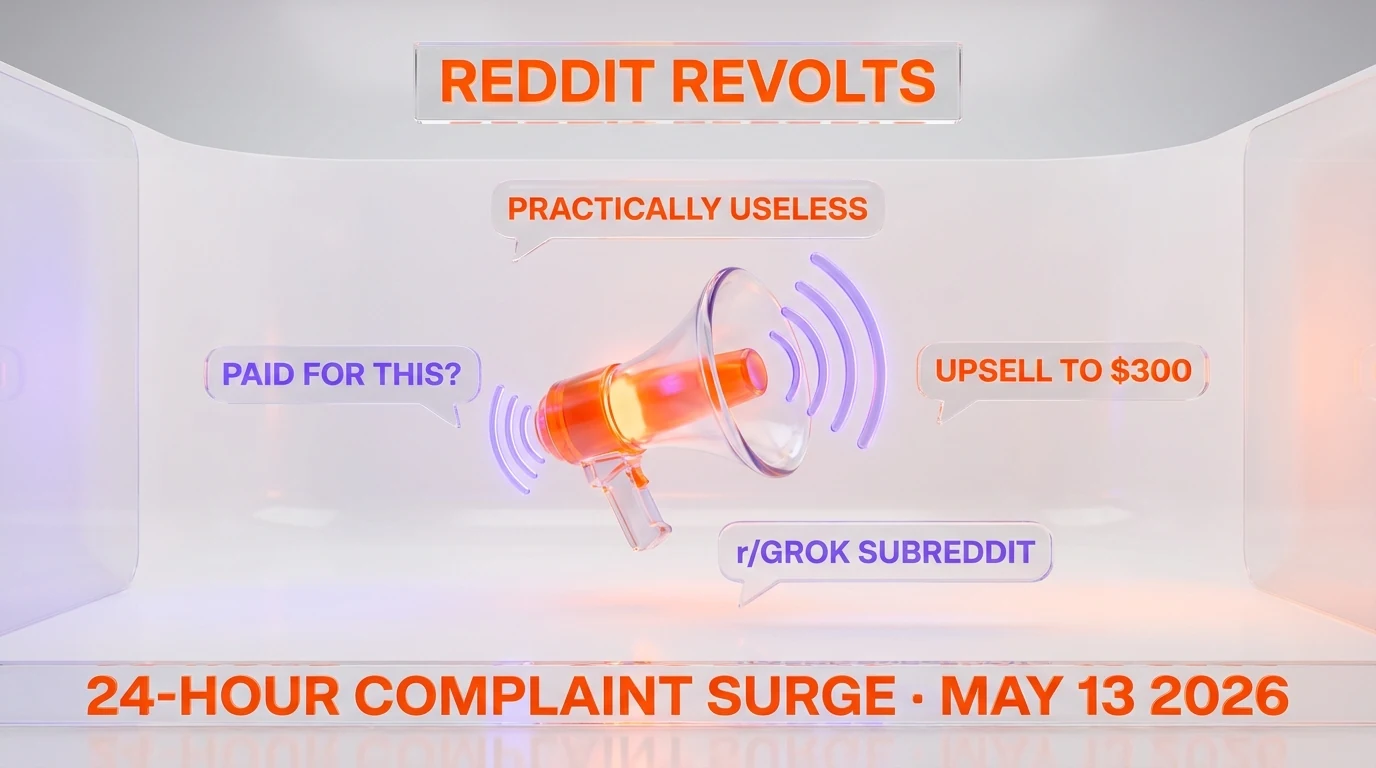
Three structural details from the backlash matter beyond the complaint volume. First, the affected user cohort is not the free-tier population that historically generates the bulk of Grok complaints. The May 13 backlash is concentrated among paying subscribers — users who already converted, who already cleared the price-sensitivity filter, and who therefore represent xAI's monetization base rather than its acquisition top-of-funnel. Backlash from the conversion-and-retention base is structurally more expensive than backlash from the acquisition base because the unit economics of replacing a churned paid subscriber are materially worse than the unit economics of replacing a churned free user.
Second, the complaint specificity is unusually high. Posts cite exact session lengths before lockout (20 to 30 minutes), exact daily-cap numbers (20 videos, 30 image edits), and exact upgrade-prompt language. Specificity at that level points to organized observation rather than ambient frustration, which is what makes the r/grok thread an effective procurement-information source. Procurement teams evaluating consumer AI subscriptions read r/grok and r/ChatGPT and r/ClaudeAI exactly because the cohort-specific cap behavior is harder to extract from vendor documentation. The May 13 thread surfaced cap data that xAI's own pages do not publish.
Third, the brand-comparison frame in the backlash leans toward ChatGPT Plus and Claude Pro rather than toward Gemini Advanced or Microsoft Copilot. The pricing parity at $20 per month for both ChatGPT Plus and Claude Pro versus $30 per month for SuperGrok is the operative reference point in most r/grok complaints. When paid subscribers describe SuperGrok as overpriced, they are pricing against the two most-cited competitors in the consumer AI category, which is the comparison set that xAI's monetization motion needs to win to defend the premium price.
The xAI monetization pattern: from free-tier restriction to paid-tier friction
The May 13 throttle event sits inside a larger xAI monetization pattern that has played out over March, April, and May 2026. In March 2026, xAI restricted free-tier Grok access, narrowing the unmetered access that drove early adoption to a more constrained envelope. The free-tier restriction was the first acknowledgment that the open-access posture xAI used to seed early adoption was not sustainable against the unit-economics math of frontier-model inference at scale. Through April 2026, paid-tier usage envelopes held roughly steady while the company built out the SuperGrok and Heavy positioning. The May 13 throttle is the third step in the same trajectory: now the paid envelopes contract as well.
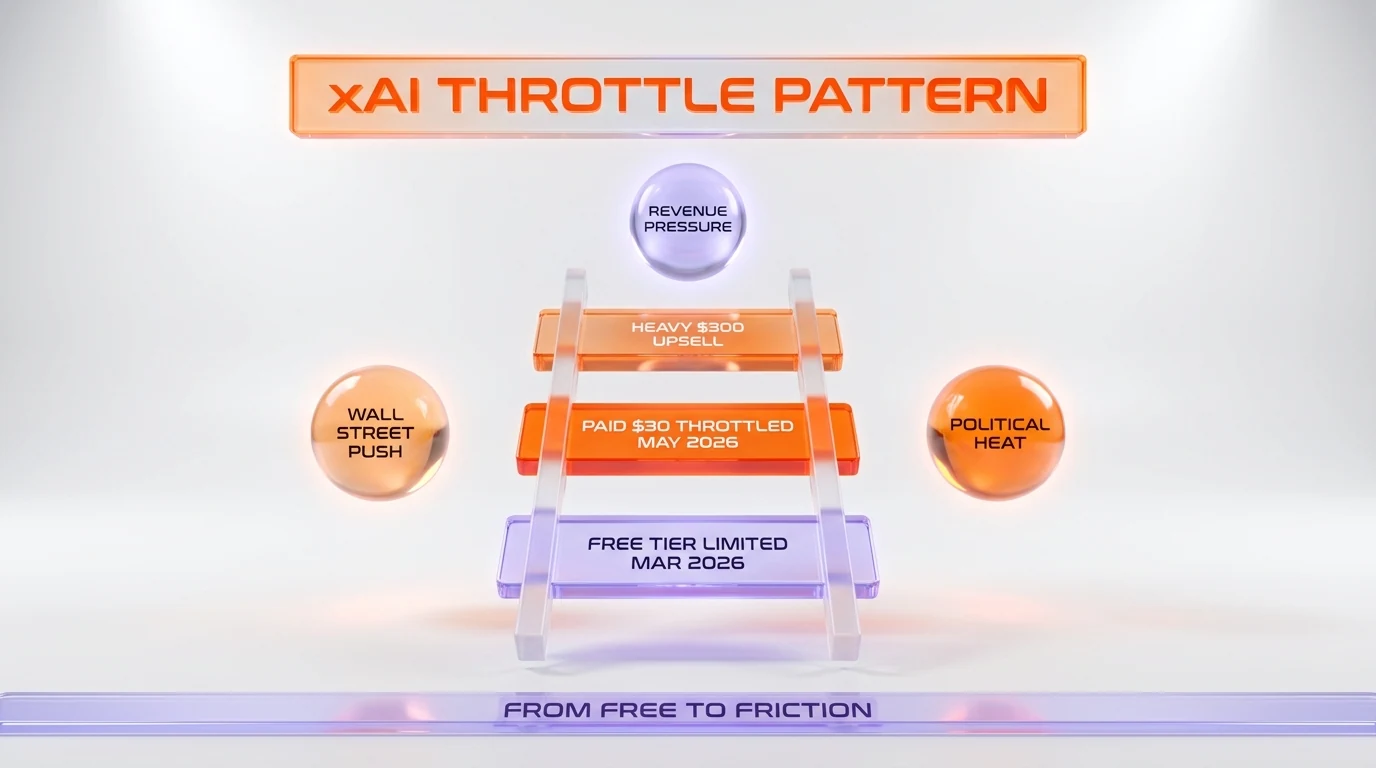
The contextual factors compounding the throttle event are worth holding separately from the throttle itself. xAI's Wall Street push — the recent reporting on the company's preparation for the public-markets pathway and the SpaceXAI consolidation — sits on the same timeline. Investor-facing materials in that pathway typically emphasize revenue per user, gross margin per user, and unit-economics improvement. Tightening usage envelopes without cutting prices is the most direct lever for those metrics, which is consistent with the May 13 throttle behavior. The strategic logic of the throttle is legible: the company is moving to defend unit economics during the period when the unit economics are most under public-markets scrutiny.
The political backdrop is the second contextual layer. Grok's political endorsement behavior — Grok is currently the only major chatbot that answers "who should I vote for" prompts with named candidate recommendations — has drawn editorial coverage and active scrutiny from political-content moderation observers. A consumer subscription experiencing both tightened usage envelopes and political-content controversy in the same news cycle compresses the strategic window for sustained subscriber goodwill. The combined effect raises the bar on xAI's communication around the throttle event, which the company has so far not met with published rate-limit documentation.
Paid-tier economics: what the throttle implies for SuperGrok and Heavy unit economics
The unit-economics math behind the May 13 throttle is straightforward in its structure even though the inputs are not public. xAI's compute cost per user scales with three primary variables: minutes of voice interaction, number of generated videos, and number of image edits or generations. Voice interaction is the highest-cost endpoint on a per-minute basis because real-time streaming inference at conversational latency budgets requires reserved compute capacity. Video generation is the highest-cost endpoint on a per-output basis because video diffusion or generation models burn substantial GPU-seconds per clip. Image editing sits between the two on a per-output cost basis but at much higher per-user volume.
A SuperGrok subscriber at $30 per month who previously consumed unlimited voice minutes, unlimited video generations beyond the prior practical limits, and approximately 100 daily image edits would have produced a per-user compute cost meaningfully above the $30 per month subscription price for the heaviest 5 to 10 percent of the user base. Tightening voice to 20-30 minute lockouts, video to 20 daily clips, and image edits to 30 daily edits brings the upper-bound per-user compute cost into closer alignment with the $30 per month revenue. The throttle is therefore not arbitrary — it is a calibration of paid-tier usage envelopes to defend gross margin per subscriber. The execution complaint is not that the calibration happened, but that it happened silently, without published limits, and without a corresponding pricing or communication adjustment.

The Heavy tier at $300 per month likely operates on different unit-economics math because the user cohort is structurally heavier-use and the price-per-output is structurally lower. Cutting daily video from 500 to 160 changes the gross margin per Heavy subscriber by a meaningful margin, but it also changes the upgrade-path argument that converts SuperGrok subscribers to Heavy subscribers. The conversion funnel from SuperGrok to Heavy is now compressed in dollar terms (the value gap shrank from 25x to 8x on video) while the price gap remained constant at 10x. Future Heavy conversions need to be justified on something other than the pre-May-13 video-allowance math, which means the Heavy positioning needs new feature differentiation or a price recalibration to maintain conversion velocity.
How this compares to ChatGPT Plus and Claude Pro
The comparative frame matters because it determines whether SuperGrok subscribers churn to competitors or absorb the throttle. ChatGPT Plus at $20 per month publishes message-cap numbers for GPT-4-class models and exposes usage transparency through both the chat UI and account settings. Claude Pro at $20 per month publishes 5-hour usage windows with explicit messaging on cap proximity and reset times. Google Gemini Advanced at $20 per month exposes daily-cap behavior through the Gemini app interface. The pattern across the three is consistent: published limits, in-product transparency, and predictable reset behavior.
SuperGrok at $30 per month sits outside that pattern on all three dimensions. The limits are not published, the in-product transparency is limited to the upgrade-prompt that surfaces at the cap trigger, and the reset behavior is described by an xAI employee as "fluctuates daily." For a subscriber comparing the three consumer AI subscriptions on a $20 versus $30 per month decision, the post-May-13 SuperGrok experience reads as a premium-price tier with sub-standard transparency. That comparative gap is the most consequential strategic risk from the throttle event because it shifts the procurement-evaluation frame for the next subscriber cohort, which compounds across the next several quarters.
The mitigation pathway is documentation. Publishing explicit rate-limit numbers — even if the numbers are dynamic and the dynamic-range is disclosed — would close the transparency gap against ChatGPT Plus and Claude Pro. The combination of "your daily envelope is X" plus "your envelope may flex up or down by Y percent based on system load" is the documentation pattern that the rest of the consumer AI category has converged on, and it is the pattern that SuperGrok needs to match to recover the perceived-value parity.
What the throttle implies for the Grok product roadmap
The Grok product roadmap implications fall into three buckets. First, voice mode infrastructure scaling. The 20 to 30 minute lockout pattern is most economically explained by reserved-compute capacity constraints on voice inference. Either xAI is approaching the practical capacity ceiling of its voice infrastructure footprint, or the company is electing to defend gross margin on voice by capping the heaviest-use sessions. Either explanation implies the next several quarters of Grok roadmap will need to include voice-infrastructure expansion or a voice-specific pricing tier that aligns price with the marginal cost of unlimited voice. The current pattern — voice included in the SuperGrok and Heavy bundles with silent caps — is structurally unstable.
Second, video model selection and capacity. The Heavy tier video cut from 500 to 160 daily clips implies the cost-per-clip on Grok's video stack has either risen since the Heavy tier was priced or that the original 500-clip allowance was a marketing number rather than a unit-economics-justified number. The Grok roadmap will need to address video-model cost reductions through either model swaps to cheaper video stacks, in-house video model improvements, or capacity-tier restructuring. For an enterprise procurement frame, the video-allowance volatility is now a documented data point that competing video-AI providers will use in next quarter's procurement conversations. See our Grok 4.20 tool page and Grok 4.3 tool page for the model-level context.
Third, billing and communication infrastructure. The absence of published rate limits is a fixable problem that does not require model or capacity changes. Standing up a rate-limit documentation page, surfacing daily-usage progress in the Grok UI, and committing to a 14-day notice window on cap adjustments would close the most operationally tractable gap from the May 13 event. The roadmap question is whether xAI prioritizes that documentation work in the next sprint or absorbs the procurement-friction cost of continued opacity. Both options are tractable; only one is consistent with sustained paid-subscriber retention.
What happens next for paid subscribers and procurement teams
For active SuperGrok and Heavy subscribers, the practical decision tree is short. Option one is to absorb the throttle and continue at the current price, which works for users whose usage pattern fits inside the new envelopes. Option two is to downgrade to free-tier Grok, which works for occasional users who can tolerate the March 2026 free-tier restrictions. Option three is to migrate to ChatGPT Plus at $20 per month or Claude Pro at $20 per month, which works for users whose primary use case is text reasoning or coding assistance rather than the voice and video endpoints where SuperGrok's differentiation sits. Option four is to upgrade to Heavy at $300 per month, which only makes sense for users whose daily video volume exceeds the SuperGrok 20-clip cap by a meaningful margin and who can absorb the Heavy tier's own 160-clip ceiling.
For procurement teams evaluating consumer AI subscriptions for organizational use, the May 13 throttle adds a documented data point to the SuperGrok evaluation. The evaluation rubric now includes rate-limit transparency as an explicit criterion, with ChatGPT Plus, Claude Pro, and Gemini Advanced clearing the bar and SuperGrok currently below it. For organizations that already standardized on SuperGrok or Heavy, the procurement question is whether to renew at the current envelope or to renegotiate the contract on the basis of the documented allowance change.
For investors and analysts tracking xAI's path to public markets, the May 13 event is a small but legible signal in the broader monetization-discipline story. The company is moving to defend unit economics during the window when unit economics are most under scrutiny, which is consistent with the financial-discipline narrative that Wall Street wants to see. The execution risk is whether the monetization discipline translates into a sustained paid-subscriber base or into a paid-subscriber churn event that compounds into the company's revenue-trajectory narrative. The next 60 days of r/grok thread activity, of paid-subscriber retention metrics, and of competitive procurement-decision patterns will be the leading indicator on which side of that balance the throttle event ultimately lands.
The bottom-line strategic read
The May 13 throttle is a small operational event with an outsized strategic implication. xAI silently tightened paid-tier usage envelopes across SuperGrok and Heavy on May 13, 2026, in a way that defended gross margin per subscriber but compressed the perceived value of both tiers against the consumer-AI competitive set. The execution choice — silent enforcement, no published limits, no proactive subscriber communication — created procurement friction at exactly the moment when the company is most exposed to procurement-decision scrutiny from both individual subscribers and from public-markets investors. The mitigation pathway is straightforward in principle (publish the limits, surface the usage, commit to notice windows) but the company has not yet executed on it. The next 60 days of subscriber behavior and competitive response will be the period when the strategic implication crystallizes one way or the other.
For our coverage of the broader xAI strategic context — the SpaceXAI consolidation that folded Grok into Elon Musk's combined empire, the political-content controversies that have drawn editorial scrutiny, and the unit-economics math that drives the company's monetization decisions — see our xAI plus SpaceX merger analysis and our xAI dissolved into SpaceXAI consolidation coverage. For the consumer-subscription competitive landscape that frames the May 13 throttle event, see our Grok vs ChatGPT comparison and the underlying tool pages for Grok, ChatGPT, and Claude.
Frequently asked questions
What exactly changed on SuperGrok on May 13, 2026?
xAI silently tightened four paid-tier usage envelopes on May 13, 2026, for SuperGrok subscribers at $30 per month. Voice mode sessions now lock out after 20 to 30 minutes of continuous use. Daily video generation caps at 20 clips. Daily image edits dropped from approximately 100 to about 30. Heavy tier subscribers at $300 per month saw the daily video allowance fall from 500 to roughly 160 clips. PiunikaWeb first reported the changes after a 24-hour surge of complaints concentrated on r/grok and on X. No rate-limit documentation has been published by xAI for any tier.
Did xAI announce the throttle or publish updated rate limits?
No. xAI did not publish a public announcement on the rate-limit changes and has not published a canonical rate-limit documentation page for SuperGrok or Heavy. An xAI employee responding to user complaints on X acknowledged that limits "can fluctuate daily" and advised users to "try again," but no concrete numbers were disclosed. The opacity is the operative complaint in the r/grok backlash — competing consumer AI subscriptions like ChatGPT Plus, Claude Pro, and Gemini Advanced publish either explicit cap numbers or explicit usage windows, while SuperGrok does not.
How does SuperGrok at $30 per month compare to ChatGPT Plus and Claude Pro at $20 per month?
SuperGrok at $30 per month sits 50 percent above ChatGPT Plus at $20 per month and Claude Pro at $20 per month on the consumer subscription price point. The post-May-13 throttle widens the perceived-value gap against the two competitors because both ChatGPT Plus and Claude Pro publish their rate limits in user-facing documentation and surface usage progress in the product interface. The SuperGrok positioning needs voice and video endpoints to justify the price premium, and the May 13 throttle directly compressed both endpoints on the SuperGrok tier without a corresponding price cut.
Why does the Heavy tier video cut from 500 to 160 daily clips matter most?
The Heavy tier at $300 per month is the upgrade destination for SuperGrok power users, and the daily-video-allowance gap is the load-bearing argument for the upgrade. Pre-May-13, the upgrade math was pay 10 times the price for roughly 25 times the daily video allowance (20 to 500 clips). Post-May-13, the math is pay 10 times the price for roughly 8 times the daily video allowance (20 to 160 clips). The marginal value of the upgrade collapsed by approximately two-thirds overnight without any price adjustment. For Heavy subscribers who pre-paid at the old allowance, the change reads as a unilateral contract modification.
What is the $99 promotional discount that surfaced at limit triggers?
Paid subscribers on r/grok report that an upgrade-prompt surfaces when SuperGrok daily limits are hit, offering a $99 promotional discount on the upgrade path to Heavy or to an annual plan. The promotional offer is a behavioral tell on xAI's monetization posture — the company is willing to discount the upgrade to retain conversion velocity, but it has not adjusted the downstream allowances that justify the upgrade. The discounted-upgrade plus reduced-allowance combination is the structural complaint that r/grok subscribers are organizing the May 13 backlash around.
Do moderation-blocked requests count against the new daily caps?
Yes, according to paid-subscriber reports on r/grok. Requests blocked by xAI's content moderation layer still consume daily allowance against the new SuperGrok and Heavy caps. That behavior is procedurally different from ChatGPT Plus and Claude Pro, where moderation events typically do not deduct from user-visible usage tokens or daily message quotas. The combined effect is that SuperGrok subscribers can exhaust the daily envelope through a series of moderation-rejected requests without producing a single usable output, which is the most-flagged user-experience complaint in the May 13 backlash beyond the headline allowance cuts.
Is this throttle event connected to xAI's Wall Street push?
The timing is consistent with xAI's broader monetization-discipline narrative, though no direct causation is publicly documented. Investor-facing materials in a public-markets pathway emphasize revenue per user, gross margin per user, and unit-economics improvement. Tightening usage envelopes without cutting prices is the most direct lever for those metrics. The throttle event lands during the period when xAI is most exposed to public-markets unit-economics scrutiny, and the silent enforcement pattern is consistent with a company moving to defend gross margin per subscriber. The execution risk is that the discipline translates into paid-subscriber churn rather than into a sustained margin improvement.
How should SuperGrok subscribers respond to the throttle?
The practical decision tree has four options. Absorb the throttle and continue at $30 per month if usage fits inside the new envelopes. Downgrade to free-tier Grok if occasional use is the primary pattern. Migrate to ChatGPT Plus at $20 per month or Claude Pro at $20 per month if text reasoning or coding assistance is the primary use case rather than voice or video. Upgrade to Heavy at $300 per month only if daily video volume exceeds the SuperGrok 20-clip cap by a margin that justifies the price step. The choice depends on the dominant use case (voice, video, image, or text) and on whether published rate-limit transparency is a hard requirement for the procurement decision.
What would xAI need to do to recover paid-subscriber goodwill?
The most operationally tractable mitigation is documentation. Publishing explicit rate-limit numbers for SuperGrok and Heavy — even with disclosed dynamic-range flex — would close the transparency gap against ChatGPT Plus, Claude Pro, and Gemini Advanced. Surfacing daily-usage progress in the Grok user interface would address the in-product transparency complaint. Committing to a 14-day notice window before future cap adjustments would close the unilateral-modification complaint. None of those changes require model or capacity-infrastructure work, and any combination of the three would materially de-escalate the r/grok backlash without requiring a pricing change.
Could competitors use this event to capture SuperGrok churn?
Yes, the conditions favor competitive capture if the competitors actively pursue it. ChatGPT Plus and Claude Pro both publish rate limits, both surface usage transparency, and both price 33 percent below SuperGrok. A targeted onboarding-friction reduction (one-click migration, prompt-history import, voice-mode parity messaging) from either OpenAI or Anthropic would convert a non-trivial share of dissatisfied SuperGrok subscribers, especially those whose primary use case is text or voice rather than video. The competitive-capture window is roughly the next 60 days, during which the r/grok backlash narrative is fresh and the search behavior for "Grok alternative" or "switch from SuperGrok" is structurally elevated.
How does this affect xAI's path to public markets?
The throttle event is small in surface area but is now a documented data point on xAI's monetization-discipline narrative. Public-markets investors will read it two ways depending on the underlying intent. The bullish read is that xAI is calibrating paid-tier unit economics in line with the financial-discipline narrative the company wants to project. The bearish read is that the silent execution and the documented backlash signal subscriber-retention risk that compounds into the revenue-trajectory story. The next 60 days of paid-subscriber retention metrics, of competitive procurement decisions, and of company communications around rate limits will determine which read dominates the public-markets framing.
Where can I track the developing story on the May 13 throttle?
Three sources cover the story with the most fidelity. r/grok on Reddit is the live subscriber-experience aggregator and is where the complaint pattern surfaced first. X searches for SuperGrok plus rate-limit or throttle return the highest-engagement user posts and screenshots. PiunikaWeb's May 13 report is the primary journalistic synthesis of the r/grok and X activity. Our coverage tracks the strategic and unit-economics implications rather than the operational reports, with adjacent context in our xAI plus SpaceX merger analysis and xAI dissolution into SpaceXAI pieces.