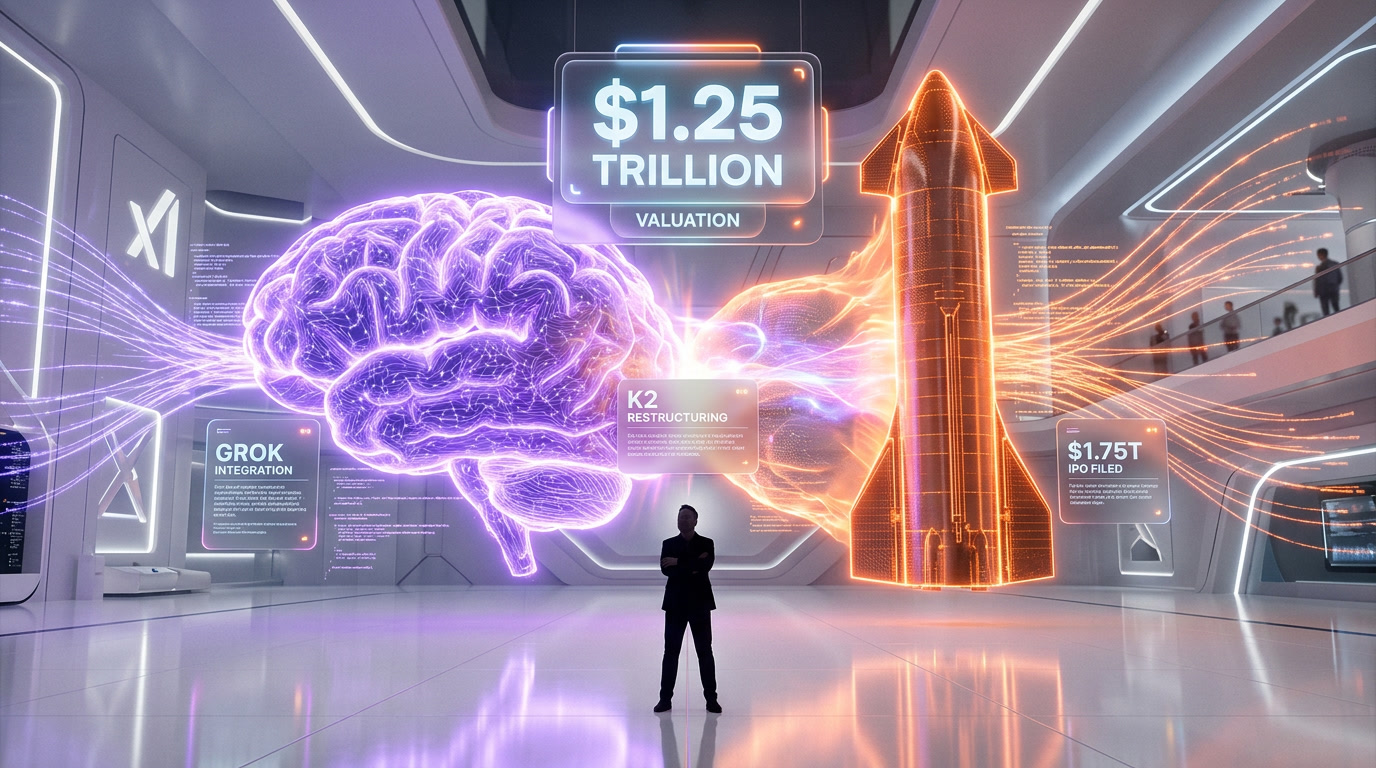
In February 2026, Elon Musk merged xAI (valued at $250 billion) with SpaceX (valued at $1 trillion) into a single entity worth approximately $1.25 trillion under a restructuring codenamed "K2." The combined company controls 200,000+ NVIDIA H100 GPUs, 4 million+ Starlink subscribers, and has applied for 1 million compute-capable satellites. This is the first AI-space convergence at trillion-dollar scale in history.
The Merger: What Actually Happened
On February 10, 2026, Elon Musk officially announced that xAI—the company behind the Grok large language model—would merge with SpaceX, the private space exploration company that operates the Starlink satellite internet constellation and the Falcon/Starship rocket fleet. The K2 restructuring was structured as a stock-swap merger, with existing shareholders of both entities receiving equity in the combined company.
The deal structure — internally called the "K2 restructuring" — was finalized in February 2026. The move did not come out of nowhere. Since founding xAI in March 2023, Musk had repeatedly emphasized the synergies between AI computation and space-based infrastructure. By late 2025, xAI had already been using SpaceX’s launch capacity to explore the feasibility of orbital data centers, and SpaceX engineers were integrating Grok into mission planning software. Post-merger, xAI’s Grok models are now integrated directly into SpaceX’s operational architecture — from mission planning to satellite constellation management. The merger formalized what had been an increasingly tight operational relationship.
The combined entity retains the SpaceX brand for launch operations and Starlink for satellite internet, while xAI continues operating as the AI research division. Grok remains the flagship consumer AI product, now with dedicated satellite backhaul for inference at the edge—meaning users in remote locations get the same latency as those in data-center-adjacent cities.
The Numbers: A $1.25 Trillion Breakdown
| Metric | xAI (Pre-Merger) | SpaceX (Pre-Merger) | Combined Entity |
|---|---|---|---|
| Valuation | $250B | $1T | ~$1.25T (SpaceX $1T + xAI $250B) |
| GPU Compute | 200,000+ H100 GPUs | N/A | 200,000+ H100 GPUs |
| Satellite Network | N/A | 6,000+ Starlink sats | 6,000+ active + 1M applied |
| Subscribers (Starlink) | N/A | 4M+ | 4M+ (growing 30%+ YoY) |
| Annual Revenue | ~$3B (est.) | ~$15B (est.) | ~$18B+ combined |
| Employees | ~1,500 | ~13,000 | ~14,500 |
| Launch Cadence | N/A | 90+ launches/year | 90+ launches/year |
| Flagship AI Model | Grok-3 | N/A | Grok-3 (+ orbital inference roadmap) |
To put this in perspective: the combined entity’s $1.25 trillion valuation makes it the most valuable private company in history. For comparison, Alphabet (Google’s parent) had a market cap of roughly $2.2 trillion in early 2026, and Microsoft sat around $3.1 trillion. The xAI-SpaceX merger instantly created a private competitor operating at public mega-cap scale.
The Orbital Compute Vision: AI Beyond Earth
The strategic thesis behind the merger is orbital compute—the idea that AI inference and training can be distributed across satellite constellations in low Earth orbit (LEO), rather than concentrated in terrestrial data centers. SpaceX has applied for authorization to deploy 1 million compute-capable satellites, which would form the backbone of a distributed AI network in space.
Here is why that matters. Traditional AI infrastructure faces three bottlenecks: energy costs (a single H100 GPU consumes ~700W), cooling requirements (data centers spend 30-40% of energy on cooling), and geographic concentration (most compute is in the US, with growing clusters in the Middle East and Asia). Orbital compute sidesteps all three: solar power is abundant and free in orbit, passive cooling in the vacuum of space is effectively unlimited, and a satellite constellation provides global coverage by definition.
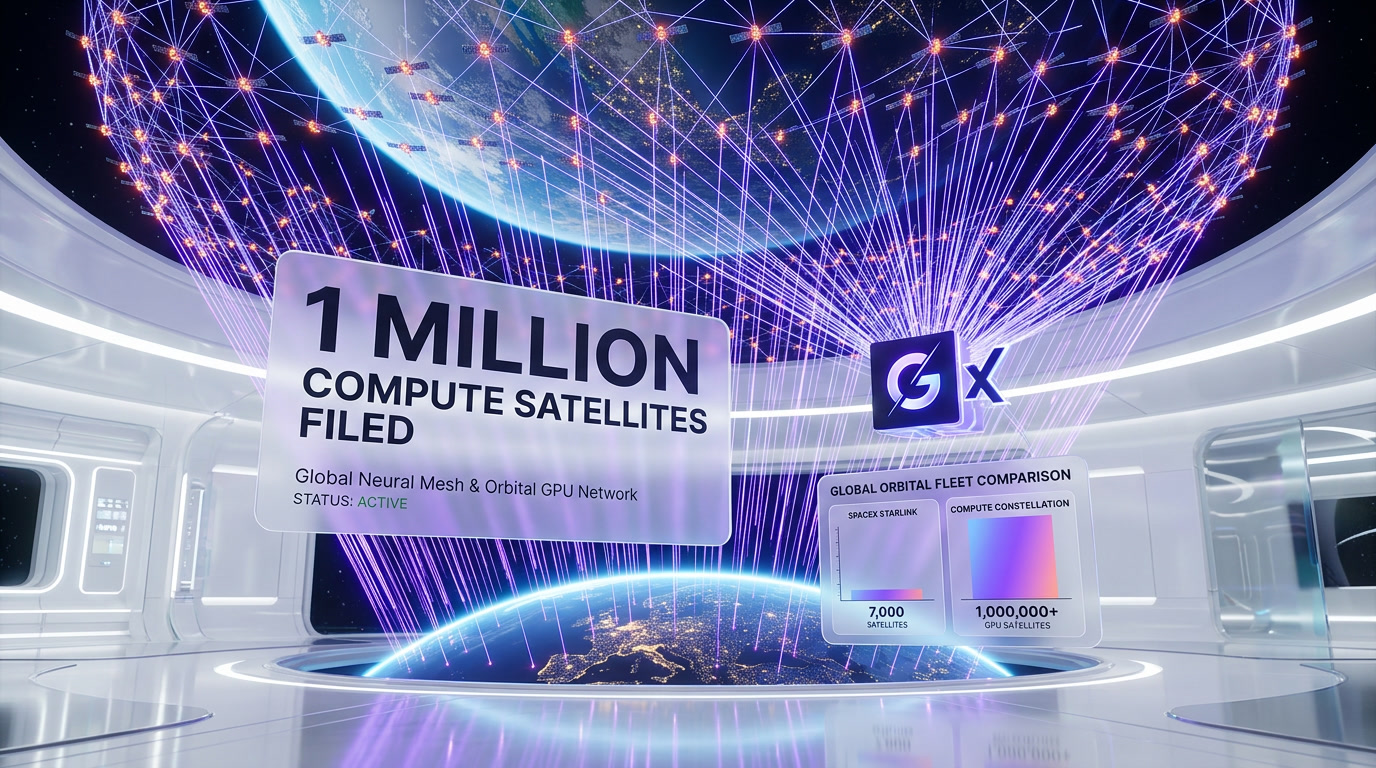
The 1-million satellite figure is ambitious but not without precedent in Musk’s playbook. SpaceX’s initial Starlink filing targeted 12,000 satellites for internet connectivity; the company later expanded its application to 42,000. The compute satellite application represents a 24x increase over that expanded figure, signaling a fundamentally different architecture: not just relaying internet traffic, but running AI workloads in orbit.
According to internal documents referenced in the FCC filing, the first-generation compute satellites would each carry a custom AI accelerator chip (co-designed with xAI) capable of running inference workloads equivalent to approximately 2-4 NVIDIA H100 GPUs. At scale, 1 million satellites would provide the equivalent of 2-4 million H100 GPUs in orbit—roughly 10-20x the compute capacity of the largest terrestrial data centers in existence today.
Competition: The Starcloud Factor
The xAI-SpaceX merger did not happen in a vacuum. Several companies had been exploring the intersection of space and AI compute before the merger was announced. The most notable competitor is Starcloud, a joint venture between satellite operator Loft Orbital and compute provider Lambda Labs, which announced its own orbital compute plans in late 2025.
| Dimension | xAI + SpaceX | Starcloud (Loft Orbital + Lambda) |
|---|---|---|
| Valuation | ~$1.25T | ~$5-10B (estimated) |
| Launch Capability | Own fleet (Falcon 9, Falcon Heavy, Starship) | Depends on third-party launches |
| Existing Satellite Network | 6,000+ Starlink operational | ~30 Loft Orbital satellites |
| GPU Count (Terrestrial) | 200,000+ H100s | ~20,000 H100s (Lambda fleet) |
| Satellite Compute Application | 1 million satellites | Hundreds (initial phase) |
| Consumer AI Product | Grok (100M+ users) | None (B2B only) |
| Internet Subscribers | 4M+ Starlink | None |
| Vertical Integration | Full stack (rockets + sats + AI + consumer) | Partial (sats + compute, no rockets) |
| First Orbital Compute Target | 2027-2028 | 2028-2029 |
The asymmetry is stark. xAI-SpaceX controls its own launch infrastructure, meaning it can deploy satellites at marginal cost ($2,700 per kg to LEO on Falcon 9, projected under $100 per kg on Starship once fully reusable). Starcloud must contract launches from third parties—potentially including SpaceX itself, creating an uncomfortable dependency on a direct competitor. Starcloud’s advantage is focus: as a pure-play orbital compute company, it can optimize every decision for that single mission, while xAI-SpaceX must balance AI research, consumer products, launch operations, and satellite internet.
Other players worth watching include Amazon’s Project Kuiper (3,236 satellites authorized for broadband, with potential compute expansion), Microsoft’s Azure Space partnership with SpaceX (now complicated by the xAI merger), and China’s Guowang constellation (13,000 planned satellites with state-backed compute ambitions).
Industry Implications: 5 Things That Change
1. Data Center Geography Becomes Irrelevant
If orbital compute works at scale, the current scramble to secure land, power, and water for terrestrial data centers loses urgency. Countries that today cannot compete in AI because they lack energy infrastructure could access orbital compute via Starlink terminals. This is potentially the most democratizing—or monopolizing—shift in AI infrastructure history, depending on who controls the satellites.
2. AI Sovereignty Gets More Complex
Governments have been racing to build sovereign AI infrastructure—France’s Jean Zay supercomputer, the UK’s Isambard-AI, Saudi Arabia’s NEOM compute clusters. Orbital compute challenges this because satellites cross every jurisdiction. If xAI runs inference in orbit, which country’s data laws apply? The regulatory framework does not exist yet, and the merger will force its creation.
3. NVIDIA’s Monopoly Faces a Space-Based Challenge
xAI’s plans to co-design custom AI accelerator chips for orbital deployment signal a move away from pure NVIDIA dependency. While the terrestrial 200,000 H100 fleet remains, the next-generation compute expansion will run on custom silicon optimized for space constraints—low power, radiation-hardened, high inference throughput. This could create the first viable alternative to NVIDIA’s data center GPU monopoly at scale.
4. Starlink Becomes an AI Distribution Network
With 4 million+ subscribers and growing at 30%+ year-over-year, Starlink is already the world’s largest satellite internet provider. Post-merger, every Starlink terminal becomes a potential AI inference endpoint. Grok could run with sub-50ms latency anywhere on Earth that has a clear view of the sky—ships, planes, rural areas, disaster zones. This is a distribution moat that no other AI company can replicate without building their own constellation.
5. The Trillion-Dollar Private Company Precedent
The xAI-SpaceX entity is the first private company to cross the $1 trillion valuation threshold. This matters beyond symbolism: at this scale, the combined company has more resources than most nation-states’ technology budgets. It can self-fund R&D, launch infrastructure, and satellite deployment without needing public markets or sovereign wealth fund backing. The concentration of this much capital and capability under a single private entity—controlled by one individual—is unprecedented in the modern economy.
Breaking: SpaceX Files Confidential S-1 for Historic IPO
On April 1, 2026, SpaceX filed a confidential S-1 registration statement with the SEC, targeting an IPO at a valuation of approximately $1.75 trillion. If it proceeds, this would be the largest IPO in history — dwarfing Saudi Aramco’s $29.4 billion debut in 2019 by an extraordinary margin.
The filing comes just weeks after the K2 restructuring merged xAI into SpaceX, meaning investors in the IPO would be buying into the combined AI-space entity — not just a rocket company. The $1.75 trillion target valuation represents a significant premium over the $1.25 trillion post-merger valuation, reflecting market appetite for the orbital compute thesis and the Grok AI platform’s rapid growth.
The IPO is expected in late summer 2026, according to sources cited by CNN, Fortune, CNBC, and Motley Fool. Teslarati reported that early investor interest has been "overwhelming," with several sovereign wealth funds and institutional investors already signaling participation. If the timing holds, this would make the xAI-SpaceX entity the most valuable company to ever go public, instantly entering the top tier of publicly traded companies worldwide.
This changes the stakes of the entire AI-space convergence story. A public listing gives the combined entity access to public capital markets, enabling the kind of sustained multi-decade investment that the 1-million satellite constellation requires. It also subjects the company to public disclosure requirements, quarterly earnings scrutiny, and SEC oversight — a significant governance shift for what has been Musk’s most privately controlled enterprise.
Our Take
We have been tracking both xAI and SpaceX since their earliest days on ThePlanetTools.ai, and this merger is the most consequential move in AI infrastructure since NVIDIA shipped the first H100. The strategic logic is sound: AI needs compute, compute needs energy and cooling, space has both for free. The execution risk is enormous—nobody has run production AI workloads in orbit—but if anyone has the launch capacity to iterate fast, it is SpaceX.
For AI practitioners and tool users, the near-term impact is clear: Grok gets better distribution via Starlink, and xAI gets a war chest that rivals OpenAI’s Microsoft backing. The long-term impact—orbital compute as a production platform—remains speculative but increasingly plausible. We will be watching the first compute satellite test launches, expected in late 2027, very closely.
The competition angle matters too. Starcloud is real but operates at 100x smaller scale. Amazon’s Kuiper is focused on broadband first. Microsoft’s Azure Space partnership with SpaceX is now awkward at best. In the near term, xAI-SpaceX has no peer in the AI-space convergence category. Whether that concentration of power is good for the industry is a question we will be debating for years.
Frequently Asked Questions
What is the xAI and SpaceX merger?
In February 2026, Elon Musk merged xAI (the company behind the Grok AI model, valued at $250 billion) with SpaceX (the rocket and Starlink satellite company, valued at $1 trillion) into a single entity worth approximately $1.25 trillion. The restructuring, internally codenamed "K2," was finalized in February 2026 as a stock swap. xAI’s Grok models are now directly integrated into SpaceX’s operational architecture.
Why did Musk merge xAI with SpaceX?
The core strategic rationale is orbital compute—running AI workloads on satellites in space rather than in terrestrial data centers. Space offers free solar energy and passive cooling in vacuum, solving the two biggest cost drivers for AI infrastructure. SpaceX also provides Starlink’s 4 million+ subscriber network as a distribution channel for Grok AI services worldwide.
What is orbital compute and how does it work?
Orbital compute refers to running AI inference and potentially training workloads on satellite-based processors in low Earth orbit (LEO). Each compute satellite carries custom AI accelerator chips equivalent to 2-4 NVIDIA H100 GPUs. The satellites form a mesh network, powered by solar panels and cooled passively by the vacuum of space. SpaceX has applied for authorization to deploy 1 million such satellites.
How does the xAI-SpaceX entity compare to Starcloud?
xAI-SpaceX is approximately 125-250x larger by valuation ($1.25 trillion vs. $5-10 billion estimated for Starcloud). The critical difference is vertical integration: xAI-SpaceX owns its rocket fleet and can launch satellites at marginal cost, while Starcloud depends on third-party launch providers. xAI-SpaceX also has 200,000+ H100 GPUs, 6,000+ operational satellites, and a consumer AI product (Grok) with 100 million+ users.
Is SpaceX going public?
Yes. On April 1, 2026, SpaceX filed a confidential S-1 with the SEC targeting an IPO at approximately $1.75 trillion valuation. If completed, it would be the largest IPO in history. The offering is expected in late summer 2026 and would cover the combined xAI-SpaceX entity created by the K2 restructuring. Sources include CNN, Fortune, CNBC, Motley Fool, and Teslarati.
When will orbital compute satellites actually launch?
According to SpaceX’s FCC filing, the first test compute satellites are targeted for late 2027, with initial operational capability expected in 2028. Full-scale deployment of the 1-million satellite constellation would take several years beyond that. Starcloud’s competing timeline targets 2028-2029 for its first orbital compute nodes. Both timelines are ambitious and subject to regulatory approval and technical validation.
Frequently Asked Questions
What exactly is the xAI + SpaceX K2 restructuring?
The K2 restructuring is a stock-swap merger finalized on February 10, 2026, combining xAI (valued at $250 billion) with SpaceX (valued at $1 trillion) into a single private entity worth approximately $1.25 trillion. The combined company retains the SpaceX brand for launch operations and Starlink for satellite internet, while xAI operates as the AI research division. Post-merger assets include 200,000+ NVIDIA H100 GPUs, 6,000+ active Starlink satellites, 4 million+ subscribers growing 30%+ year-over-year, and an FCC application for 1 million compute-capable satellites in low Earth orbit. Grok remains the flagship consumer AI product, now with dedicated satellite backhaul for edge inference.
How does xAI + SpaceX compare to Starcloud (Loft Orbital + Lambda Labs)?
The gap is enormous. xAI + SpaceX is valued at ~$1.25 trillion vs. Starcloud's estimated $5–10 billion. xAI-SpaceX controls 200,000+ H100 GPUs vs. Lambda Labs' ~20,000. SpaceX operates 6,000+ active Starlink satellites vs. Loft Orbital's ~30. The compute satellite roadmap targets 1 million satellites vs. Starcloud's initial hundreds. The decisive structural moat is launch ownership: xAI-SpaceX flies its own Falcon 9 and Starship, targeting under $100 per kg to LEO on a fully reusable Starship, while Starcloud must pay third-party launch providers — potentially SpaceX itself. First orbital compute deployment: xAI-SpaceX targets 2027–2028 vs. Starcloud's 2028–2029.
How does the $1.25T xAI-SpaceX valuation compare to Alphabet and Microsoft?
At $1.25 trillion, the merged entity is the most valuable private company in history — still below Alphabet's ~$2.2 trillion public market cap and Microsoft's ~$3.1 trillion as of early 2026, but operating without public market scrutiny. The comparison shifts dramatically if the SpaceX IPO proceeds: the confidential S-1 filed April 1, 2026 targets a $1.75 trillion public valuation, which would make it the largest IPO in history and place it in direct valuation range of Alphabet. That would mean Musk's combined empire (xAI-SpaceX + Tesla + X) would rival Microsoft as the most valuable corporate group on Earth.
What is orbital compute and why does it threaten NVIDIA's GPU monopoly?
Orbital compute distributes AI inference and training across satellites in low Earth orbit rather than concentrating it in terrestrial data centers. It resolves three fundamental bottlenecks: energy (a single H100 GPU consumes ~700W vs. free solar power in orbit), cooling (data centers spend 30–40% of energy on thermal management vs. passive vacuum cooling in space), and geographic lock-in (a satellite constellation provides global coverage by definition). xAI-SpaceX's 1-million satellite application envisions each satellite carrying a custom AI accelerator co-designed with xAI, equivalent to 2–4 H100 GPUs per unit — producing 2–4 million H100-equivalent GPUs in orbit, or 10–20x the capacity of today's largest terrestrial data centers. The co-designed chip signals a deliberate long-term strategy to reduce dependency on NVIDIA hardware.
How does xAI + SpaceX compare to Amazon Project Kuiper for global AI infrastructure?
Amazon Project Kuiper has authorization for 3,236 broadband satellites with potential compute expansion but currently lacks its own consumer AI product and dedicated GPU fleet at xAI-SpaceX scale. The comparison: xAI-SpaceX has 200,000+ H100 GPUs, 6,000+ active satellites, 4 million+ internet subscribers, and 100 million+ Grok users; Kuiper has 0 commercial subscribers as of early 2026 and no AI inference product. AWS gives Amazon massive ground-side data center depth, but xAI-SpaceX's projected Starship launch cost under $100 per kg to LEO is a structural moat that Kuiper cannot replicate without building its own heavy-lift capability. Kuiper's first launch target remains 2026 for commercial service.
Does xAI + SpaceX still integrate with Microsoft Azure Space after the K2 merger?
The merger has fundamentally complicated the pre-existing Microsoft Azure Space partnership with SpaceX. Before February 2026, Azure Space used Starlink connectivity for satellite-connected cloud and edge services. Post-merger, SpaceX is now owned by xAI, which competes directly with Microsoft's Copilot AI products and Azure AI platform. The article classifies Microsoft Azure Space among 'players worth watching,' signaling the formal partnership is under renegotiation or at structural risk. Microsoft's ~$3.1 trillion market cap gives it leverage, but running deep cloud integrations through a direct AI competitor is unlikely to continue at its prior scale.
What are the main risks and limitations of the xAI + SpaceX merger?
Five core risks: (1) Regulatory vacuum — no legal framework yet defines which country's data laws govern AI inference run on satellites crossing every jurisdiction; (2) Execution scale — the 1-million satellite compute application is 24x larger than SpaceX's expanded 42,000-satellite Starlink authorization; (3) Competitive retaliation — Alphabet, Microsoft, Amazon Kuiper, and China's 13,000-satellite state-backed Guowang constellation are all accelerating responses; (4) Concentration risk — Musk simultaneously controls Tesla, SpaceX, xAI, and X; and (5) Custom chip dependency — the orbital AI accelerator co-designed with xAI must outperform NVIDIA's own roadmap to justify replacing H100s in a space environment with zero on-orbit servicing.
Who should follow the xAI + SpaceX orbital compute story most closely?
Five audiences have direct exposure: (1) AI infrastructure investors and data center operators — orbital compute at 10–20x terrestrial H100 capacity could partially obsolete GPU farm investments by 2030; (2) National governments running sovereign AI programs (France's Jean Zay, UK's Isambard-AI, Saudi Arabia's NEOM clusters) — orbital inference bypasses jurisdiction-based data sovereignty frameworks entirely; (3) NVIDIA shareholders — xAI's custom orbital chip co-design is a declared intent to reduce H100 dependency at planetary scale; (4) Competing satellite operators including Starcloud, Amazon Kuiper, and China's Guowang; and (5) Grok developers and enterprise AI buyers who stand to gain low-latency satellite-backhaul inference from any point on Earth starting 2027–2028.