Q1 2026 wasn't just another quarter of incremental AI progress. It was the quarter where the gap between "AI as a toy" and "AI as infrastructure" closed completely. In the span of 90 days, we got models that use computers like humans, coding agents that work in parallel teams, video generators that spooked Hollywood, and the largest private funding round in history.
We track AI tools for a living at ThePlanetTools.ai. We test them, we use them, we build with them. This isn't a list we compiled from press releases — it's a curated assessment of what actually shipped, what actually works, and what you should actually pay attention to.
Here's everything that mattered in Q1 2026.
Large Language Models: The Intelligence Layer Levels Up
GPT-5.4 by OpenAI (March 5, 2026)
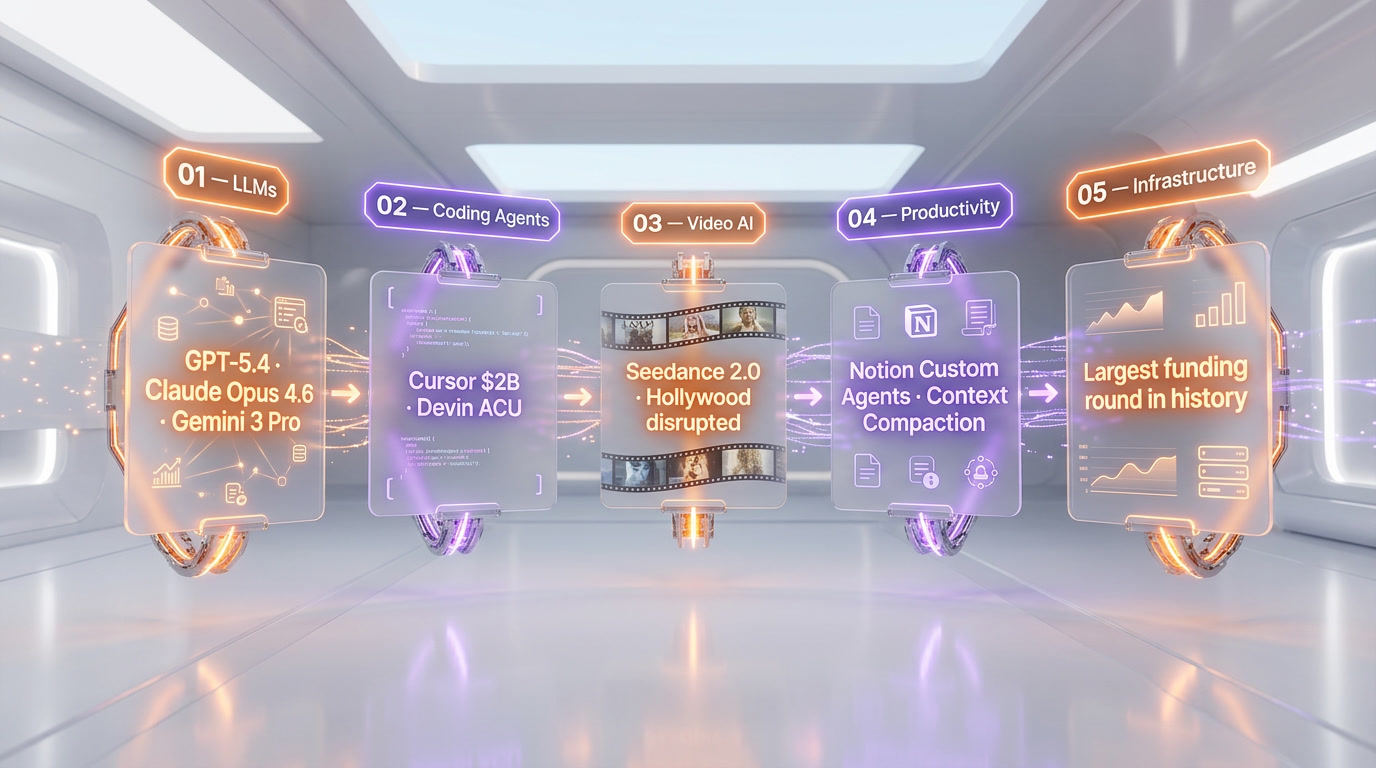
Q1 2026 delivered GPT-5.4 with native computer use and a 1M-token context window, Claude Opus 4.6 with 128K output and adaptive thinking, and Gemini 3.1 Pro with the highest abstract reasoning score at 77.1% on ARC-AGI-2. Cursor crossed $2 billion in annualized revenue, multi-agent parallel coding became table stakes across every major IDE, and Seedance 2.0 brought Hollywood-grade AI video to consumer pricing.
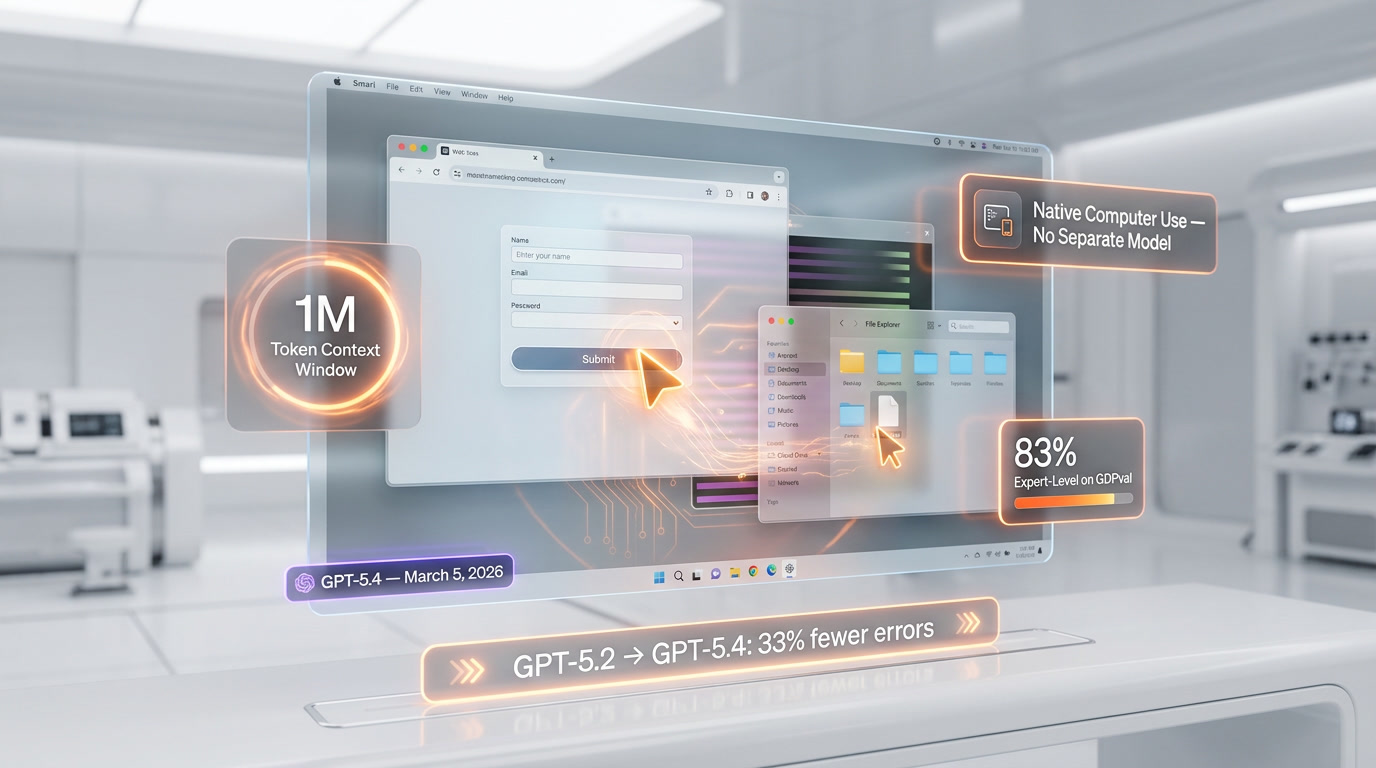
The headline feature: native computer use. GPT-5.4 is the first general-purpose OpenAI model that can read a screen and issue mouse and keyboard commands directly, without relying on a separate specialized model. This means AI agents built on GPT-5.4 can operate applications, navigate websites, fill out forms, and execute multi-step workflows across different software — just like a human sitting at a computer.
Other key capabilities:
- 1M token context window, enabling agents to plan and execute across long-horizon tasks
- 33% fewer errors in individual claims compared to GPT-5.2, with responses 18% less likely to contain errors overall
- Tool Search, a new capability that helps agents find and use the right tools across large ecosystems of connectors more efficiently
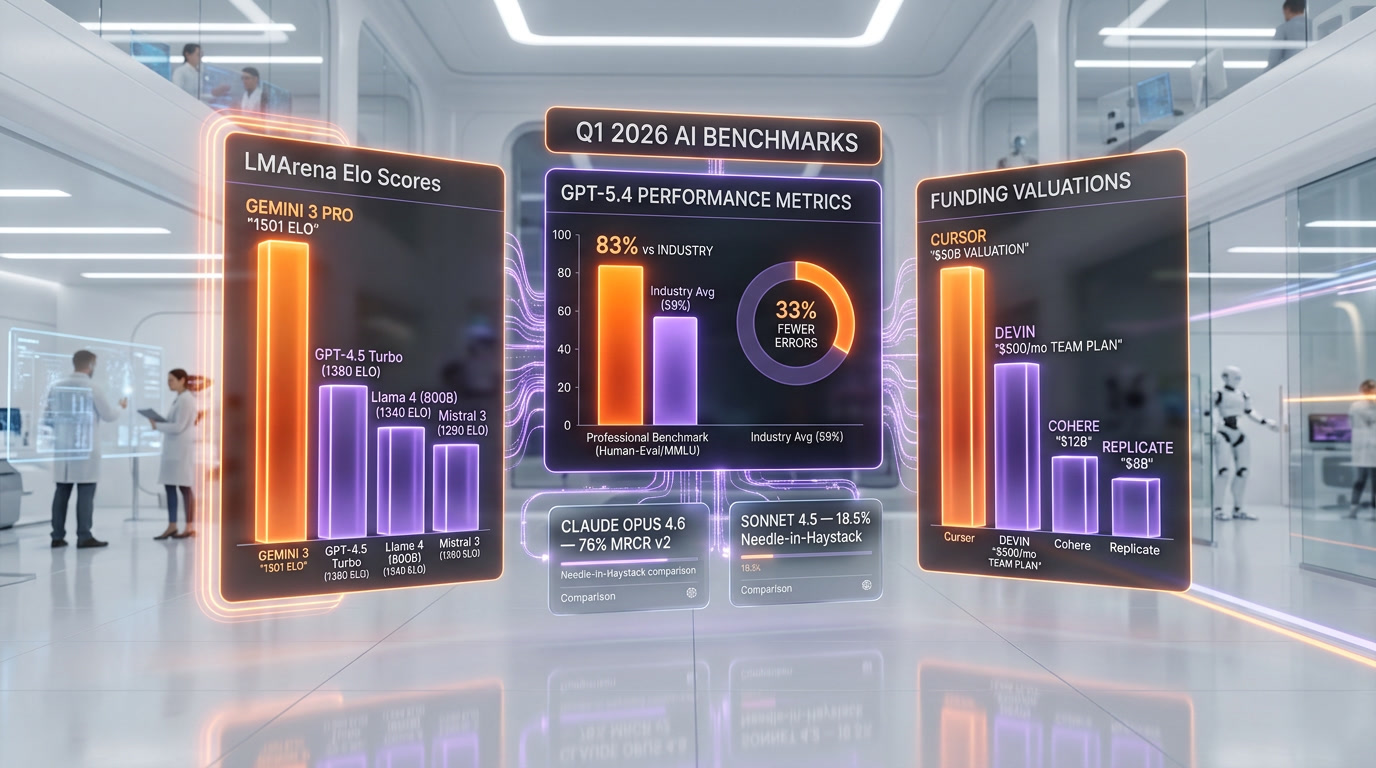
- Matches or exceeds industry professionals in 83% of comparisons on GDPval knowledge-work benchmarks (up from 70.9% for GPT-5.2)
Available as standard, reasoning (GPT-5.4 Thinking), and high-performance (GPT-5.4 Pro) variants.
Claude Opus 4.6 by Anthropic (February 5, 2026)
Anthropic released Claude Opus 4.6 a month before GPT-5.4, and it immediately became the model of choice for developers building agentic applications. Three features set it apart:
1M token context with 128k output: The first Opus-class model with a million-token context window (in beta). On the MRCR v2 needle-in-a-haystack benchmark, Opus 4.6 scores 76% on the 8-needle 1M variant, while Sonnet 4.5 manages just 18.5%. This means it can find and reason about multiple pieces of information scattered across enormous codebases or document collections. The 128k output limit (double the previous cap) enables generating entire features or comprehensive analyses in a single response.
Adaptive thinking: The recommended thinking mode for Opus 4.6. Instead of always thinking at maximum depth (which is slow and expensive), the model dynamically decides when and how much internal reasoning to apply. Simple questions get quick answers; complex problems get deep analysis. This makes it dramatically more efficient for agentic workloads where tasks vary in complexity.
Context compaction: A beta feature addressing the reality that long-running agentic tasks hit context window limits. Context compaction automatically summarizes and replaces older context when the conversation approaches a configurable threshold, letting agents run for much longer without losing critical information.
Claude Sonnet 4.6 also shipped on February 17, offering the same generation's capabilities at a lower price point for tasks that don't require Opus-level reasoning.
Gemini 3 Pro and 3.1 Pro by Google
Google's Gemini 3 Pro hit the top of the LMArena Leaderboard with a breakthrough score of 1,501 Elo, outperforming Gemini 2.5 Pro on every major AI benchmark. Key features include thinking-level control (low or high), media resolution control for multimodal inputs, streaming function calling, and the ability to comprehend text, audio, images, video, PDFs, and entire code repositories within its 1M context window.
Gemini 3.1 Pro followed in March 2026 in preview, further advancing agentic workflow capabilities. Google also introduced Gemini 3.1 Flash-Lite, an efficiency-focused model delivering 2.5x faster response times and 45% faster output generation compared to earlier versions — a clear play for high-volume production workloads where speed and cost matter more than peak intelligence.
Coding Tools: The Agent War Goes Nuclear
Cursor Hits $2B Revenue, Eyes $50B Valuation
Cursor's trajectory in Q1 2026 is staggering. The AI coding IDE surpassed $2 billion in annualized revenue and is in talks for a new funding round at a $50 billion valuation — nearly double the $29.3 billion valuation from its $2.3 billion raise in November 2025. Large corporate buyers now account for 60% of revenue, signaling that AI-assisted development has moved firmly into the enterprise mainstream.
On the product side, Cursor continues to refine its agent mode, multi-file editing, and model-agnostic approach (supporting Claude, GPT, and Gemini). The VS Code v1.109 release in January 2026 also introduced the ability to run Claude and Codex models side by side, blurring the line between Cursor and standard VS Code.
Devin's Post-Windsurf Evolution
Devin by Cognition has matured substantially since acquiring Windsurf's product, brand, and IP (after OpenAI's $3 billion acquisition attempt collapsed in July 2025 when Microsoft blocked the deal, and Google's DeepMind hired Windsurf's CEO with a $2.4 billion package). The $20 per month Core plan with $2.25 per Agent Compute Unit makes autonomous coding accessible to individual developers, while the Team plan at $500 per month ($2.00 per ACU) serves enterprise needs.
Devin's strength remains clearly defined, verifiable tasks — bug triage, documentation maintenance, migration work — where the success criteria are unambiguous and the agent can iterate until tests pass.
The February Multi-Agent Wave
The most significant development of Q1 2026 happened in a two-week window in February when every major player shipped multi-agent capabilities simultaneously:
- Grok Build: 8 parallel agents
- Windsurf (under Cognition): 5 parallel agents
- Claude Code: Agent Teams
- Codex CLI: Agents SDK integration
- Devin: Parallel sessions
Running multiple agents on different parts of a codebase simultaneously is now table stakes. The implications are significant: a single developer can have one agent handling frontend changes, another working on the API layer, and a third writing tests — all in parallel. This isn't a marginal productivity improvement; it's a fundamental change in how software gets built.
GitHub Copilot Agent Upgrades
GitHub Copilot's agent mode got major upgrades in Q1 2026. Custom agents, sub-agents, and plan agents reached general availability. The coding agent now does self-review using Copilot code review before opening pull requests. New features include MCP server integration, skill-based workflow customization, and auto-model selection. Agent instruction files and agent hooks are expanding how teams customize Copilot's behavior.
Video Generation: Hollywood Has Entered the Chat
Seedance 2.0 by ByteDance (February 2026)
ByteDance launched Seedance 2.0 in early February 2026, and it went viral immediately. The quality of the output is a significant step up from anything previously seen in AI video generation — realistic enough to spook Hollywood.
What makes Seedance 2.0 technically remarkable:
- Multimodal input: Accepts up to 12 simultaneous input files — images, video clips, audio, and text — using all of them as constraints on the output
- Dual-Branch Diffusion Transformer: Generates audio and video simultaneously, not separately
- 15-second generation: Currently limited to 15-second clips from text prompts
The controversy: Hollywood organizations are pushing back aggressively, claiming the tool enables "blatant" copyright infringement. Generated videos featuring Disney-owned characters (Spider-Man, Darth Vader, Grogu) prompted legal action. ByteDance reportedly paused the global launch on March 15, 2026, while the legal situation plays out.
Available to Chinese users via ByteDance's Jianying app, with the global CapCut rollout now uncertain due to the Hollywood pushback.
Sora 2 by OpenAI
OpenAI's Sora 2 evolved beyond its initial text-to-video roots with several major additions in Q1 2026:
- Character Cameos: Record a short video of yourself, and Sora creates a digital likeness you can insert into any scene. These characters can be tagged and reused across generations.
- Disney partnership: A landmark deal with Disney allowing Sora to generate fan-inspired videos using 200+ Disney, Marvel, Pixar, and Star Wars characters. Disney is making a $1 billion equity investment in OpenAI as part of the agreement.
- Stitching: Create longer narratives by linking multiple video segments with granular control over each segment.
- Synchronized audio: Dialogue and sound effects are now generated in sync with the video.
- Social app: OpenAI launched a dedicated Sora iOS app for creating, remixing, and sharing generated videos, with Android availability expanding globally.
Reports indicate OpenAI plans to integrate Sora's video generation directly into ChatGPT, making video creation a native capability alongside text and image generation.
Voice AI: Conversations Get Real
ElevenLabs Conversational AI 2.0 (March 6, 2026)
ElevenLabs launched Conversational AI 2.0 on March 6, 2026, and it represents the most complete voice agent platform available. Key features:
- State-of-the-art turn-taking: A new model engineered to eliminate awkward pauses and unnatural interruptions in voice dialogue — the primary reason previous voice agents felt robotic
- Integrated RAG: Retrieval-Augmented Generation built directly into the voice agent architecture, enabling real-time knowledge retrieval with minimum latency
- Multimodality: Agents that communicate over text, voice, or both simultaneously. Define once, deploy everywhere.
- Batch Calling: Automate and scale outbound voice communications — simultaneous initiation of multiple calls for alerts, surveys, or personalized outreach
- WhatsApp integration: Agents can now send audio messages in WhatsApp conversations
ElevenLabs also launched Eleven v3, their most expressive text-to-speech model yet, and 11.ai (alpha), a personal voice assistant built to explore conversational AI technology's potential.
The voice AI space is moving fast: the combination of natural turn-taking, RAG integration, and multimodal deployment makes ElevenLabs 2.0 the first platform where building a production-quality voice agent is genuinely practical for small teams.
AI Browsers: Perplexity Comet Goes Cross-Platform
Perplexity Comet (iOS launch March 2026)
Perplexity's AI-powered browser Comet completed its cross-platform rollout in Q1 2026 with the iOS launch in March (following Windows and macOS in July 2025 and Android in November 2025).
Comet is a Chromium-based browser with an integrated AI assistant that can generate article summaries, send emails, buy products, and perform a variety of tasks while you browse. It's essentially what browsers should have become years ago — an active assistant rather than a passive content viewer.
The Comet browser is free. Perplexity subscriptions are available separately: Comet Plus at $5 per month, Pro at $20 per month, and Max at $200 per month. The strategic play is clear: Perplexity wants to be the interface between you and the internet, not just a search engine you visit.
For developers and SaaS builders, Comet is significant because it represents a new browsing paradigm where AI mediates between users and web content. This has implications for how you build web applications — your content needs to be optimized not just for human readers and search engines, but for AI assistants that summarize and interact with it on behalf of users.
Productivity: AI Agents Enter the Workspace
Notion Custom Agents (February 24, 2026)
Notion's release of Custom Agents with version 3.3 is arguably the most significant productivity tool launch of Q1 2026. Custom Agents are autonomous AI teammates that live inside your Notion workspace and handle recurring workflows 24/7.
How they work:
- Give the agent a job description
- Set a trigger or schedule
- Connect it to tools (Slack, Notion Mail, Notion Calendar, and external tools like Linear, Figma, and HubSpot via MCP)
- The agent runs autonomously, with every action logged for transparency and reversibility
Use cases we've seen in practice: automated task triaging (new issues get categorized and assigned without human intervention), daily standup summaries (agent reads updates across channels and generates a brief), internal Q&A bots (agent answers team questions using your Notion knowledge base), and email management workflows.
Custom Agents build on the Personal Agents introduced with Notion 3.0 in September 2025. The January 2026 update (Notion 3.2) brought full mobile AI support, meaning everything agents can do on desktop now works on your phone.
Pricing: free to try through May 3, 2026. Starting May 4, they'll use Notion credits, available as add-ons for Business and Enterprise plans.
Granola AI
Granola continued its rise as the meeting notes tool of choice for professionals who hate meeting bots. Unlike tools that join your Zoom as a visible participant (creating social friction), Granola records system audio locally and generates AI-powered meeting notes after the call ends.
The 2026 updates include Outlook calendar integration and the Recipes feature — expert AI prompts that combine your meeting context with specific analysis frameworks. Think of a Recipe as a "lens" for your meeting: sales call analysis, user research synthesis, decision documentation, action item extraction.
Pricing: Free plan (limited to 25 meetings/month), $14 per user/month Business, $35 per user/month Enterprise. It's become a staple in our own meeting workflow.
Infrastructure: The Money Behind the AI Boom
OpenAI's $110 Billion Mega-Round (February 27, 2026)
The numbers are hard to process. On February 27, 2026, OpenAI announced a $110 billion funding round — more than double the size of its last raise and the largest private funding round in history. The investors: Amazon ($50 billion, starting with $15 billion initially), Nvidia ($30 billion), and SoftBank ($30 billion).
The round values OpenAI at $730 billion pre-money (approximately $840 billion post-money), a massive jump from $500 billion in a secondary financing in October 2025. Reports suggest OpenAI is pursuing an additional $10 billion from sovereign wealth funds, potentially pushing the round to $120 billion.
What this means for developers: OpenAI has nearly unlimited resources to invest in model development, infrastructure, and developer tools. Expect aggressive pricing, expanded free tiers, and more developer-facing products. The competitive pressure this puts on Anthropic, Google, and others means better tools and lower prices across the board.
AWS + Cerebras Partnership (March 13, 2026)
AWS and Cerebras announced a collaboration to deliver what they claim will be the fastest AI inference available through Amazon Bedrock. The approach is "disaggregated inference" — AWS Trainium handles prefill (processing the input prompt), while Cerebras CS-3 handles decode (generating the output tokens). By specializing each hardware for its computational strength, they're promising a 5x increase in inference speed.
AWS will also offer leading open-source LLMs and Amazon Nova using Cerebras hardware. This is the first cloud deployment for Cerebras's disaggregated inference solution, available exclusively through Bedrock.
Why this matters: faster inference means AI agents can iterate faster, real-time AI features become more responsive, and compute-intensive tasks become more practical. For anyone building on AWS, this is the most significant inference infrastructure announcement of the quarter.
Cursor's Revenue Trajectory
Beyond the $50 billion valuation talks, Cursor's $2 billion+ annualized revenue is a proof point for the entire AI coding tools market. The fact that 60% comes from enterprise buyers validates that AI-assisted development has moved from early adopter to mainstream enterprise tool. This has knock-on effects for every company in the space — it proves the market is real, large, and growing.
What to Watch in Q2 2026
Based on the trajectories established in Q1, here's what we expect to matter most in the next quarter:
- Multi-agent maturity: The February multi-agent wave was the launch. Q2 will be about refinement — better coordination between agents, more sophisticated task decomposition, and real-world case studies from teams using multi-agent workflows in production.
- Computer use agents in production: GPT-5.4's native computer use and Claude's computer use capabilities will start showing up in production applications. Expect new categories of AI tools that automate entire workflows across multiple applications.
- AI video regulation: The Seedance 2.0 controversy and Disney's OpenAI partnership create a fascinating tension. Q2 will likely see clearer legal frameworks around AI-generated video and licensed characters.
- Cerebras + AWS benchmarks: When the disaggregated inference solution launches on Bedrock, real-world benchmarks will determine if the 5x speed claim holds up. If it does, expect a wave of latency-sensitive AI applications.
- Notion Custom Agent ecosystem: As the free trial period ends in May, we'll see how enterprises adopt and extend Custom Agents. The MCP integrations make this potentially the hub that connects all your work tools through AI.
- Model pricing war: With OpenAI's massive war chest and Google, Anthropic, and others competing aggressively, expect further pricing drops on AI model inference. This is great for builders — AI features will get cheaper to implement.
- Gemini 3.1 Pro GA: Google's latest model is in preview as of March 2026. Its general availability in Q2, combined with deeper Google Workspace integration, could reshape the enterprise AI landscape.
The Big Picture
Step back from the individual products and a clear pattern emerges: AI is becoming infrastructure, not features.
In 2024, AI was a feature you added to your product. In 2025, AI was a tool you used to build your product. In Q1 2026, AI became the infrastructure your product runs on — the development environment (Cursor, Claude Code), the deployment pipeline (GitHub Copilot agent), the content generation layer (Claude API, GPT API), the user interface (voice agents, AI browsers), and the operational backbone (Notion agents, n8n workflows).
For developers and SaaS builders, the implication is clear: every product decision now has an AI dimension. Not "should we add AI?" but "how does AI change the way we build, deploy, and operate this product?" That shift — from AI as optional feature to AI as fundamental infrastructure — is the real story of Q1 2026.
We'll keep tracking all of these tools and trends at ThePlanetTools.ai. The pace isn't slowing down. If anything, the infrastructure investments made this quarter (OpenAI's $110B, Cerebras + AWS, Cursor's growth) guarantee that Q2 will be even more intense.
Frequently Asked Questions
What was the biggest AI launch of Q1 2026?
The most impactful launch was GPT-5.4 on March 5, 2026, which introduced native computer use capabilities, a 1M token context window, and significantly improved accuracy (33% fewer errors than GPT-5.2). For coding specifically, the February multi-agent wave — where every major tool shipped parallel agent support in a two-week window — was arguably more transformative as it fundamentally changed how software development works.
How much did OpenAI raise in Q1 2026?
OpenAI announced a $110 billion funding round on February 27, 2026 — the largest private funding round in history. The investors included Amazon ($50 billion), Nvidia ($30 billion), and SoftBank ($30 billion). This values OpenAI at $730 billion pre-money (approximately $840 billion post-money). The company is reportedly pursuing an additional $10 billion from sovereign wealth funds.
What is Seedance 2.0 and why is it controversial?
Seedance 2.0 is ByteDance's AI video generator launched in February 2026. It accepts up to 12 simultaneous input files (images, video, audio, text) and generates 15-second video clips using a Dual-Branch Diffusion Transformer that creates audio and video simultaneously. It's controversial because users generated videos featuring Disney-owned characters like Spider-Man and Darth Vader, prompting legal action from Hollywood studios. ByteDance reportedly paused the global launch on March 15, 2026.
What are AI multi-agent coding systems?
Multi-agent coding involves running multiple AI agents simultaneously on different parts of a codebase. In February 2026, major tools shipped this capability: Grok Build (8 agents), Claude Code (Agent Teams), Windsurf (5 agents), Codex CLI (Agents SDK), and Devin (parallel sessions). This enables a single developer to have separate agents working on frontend, backend, and testing simultaneously, fundamentally multiplying development throughput.
Is Cursor worth the investment at $20 per month?
Based on our daily usage: yes, overwhelmingly. Cursor's $2 billion+ annualized revenue and 60% enterprise adoption rate validate the value proposition. The agent mode alone — which lets AI edit multiple files, run terminal commands, and iterate on errors within the IDE — saves hours of manual work daily. The Pro plan at $20 per month is among the highest-ROI investments a developer can make in 2026.
What is Claude Opus 4.6's 1M context window used for?
The 1M token context window enables several game-changing use cases: loading entire codebases for deep understanding and cross-file refactoring, analyzing extensive document collections, maintaining context across long-running agentic tasks, and processing large datasets. On the MRCR v2 benchmark, Opus 4.6 scores 76% at finding multiple pieces of information across the full 1M context, compared to 18.5% for Sonnet 4.5. Premium pricing applies for prompts exceeding 200k tokens.
What is ElevenLabs Conversational AI 2.0?
Released March 6, 2026, Conversational AI 2.0 is ElevenLabs' platform for building sophisticated voice agents. Key features include state-of-the-art turn-taking (eliminating awkward pauses), integrated RAG for real-time knowledge retrieval, multimodal support (text and voice simultaneously), batch calling for scaled outbound voice campaigns, and WhatsApp audio integration. It's the first platform where building production-quality voice agents is practical for small teams.
How does the AWS + Cerebras partnership affect developers?
Announced March 13, 2026, the AWS-Cerebras collaboration uses "disaggregated inference" — AWS Trainium for prefill and Cerebras CS-3 for decode — to deliver up to 5x faster AI inference through Amazon Bedrock. For developers, this means faster AI agent iterations, more responsive real-time AI features, and more practical compute-intensive applications. AWS will also offer open-source LLMs and Amazon Nova on Cerebras hardware, exclusively through Bedrock.
What is Notion Custom Agents?
Launched February 24, 2026, with Notion 3.3, Custom Agents are autonomous AI teammates in your Notion workspace. You give them a job description, set triggers or schedules, and connect them to tools via MCP (Slack, Linear, Figma, HubSpot). They handle recurring workflows 24/7 — task triaging, standup summaries, Q&A, email management. Free to try through May 3, 2026, then credit-based pricing for Business and Enterprise plans.
What should developers focus on learning in Q2 2026?
Three areas: (1) Multi-agent orchestration — learn to effectively coordinate multiple AI agents on complex tasks. (2) Computer use APIs — GPT-5.4 and Claude's computer use capabilities will enable new categories of automation tools. (3) GEO/AEO optimization — as AI browsers and assistants become primary interfaces, understanding how to make your products and content visible to AI systems is a critical skill. Read our guides on AI agents and SEO in the age of AI for deep dives.