Murf AI
Mainstream AI voice with 200+ voices, 35+ languages, plus the Falcon API at 130ms time-to-first-audio for $0.01 per minute

Quick Summary
Murf AI is an AI voice generation platform combining a no-code Studio (200+ voices, 35+ languages) with the Falcon API at 130ms time-to-first-audio. Free plan; Creator from $19 per month yearly; Business from $66 per month yearly; Falcon API at $0.01 per minute. Score 4.0 out of 5.
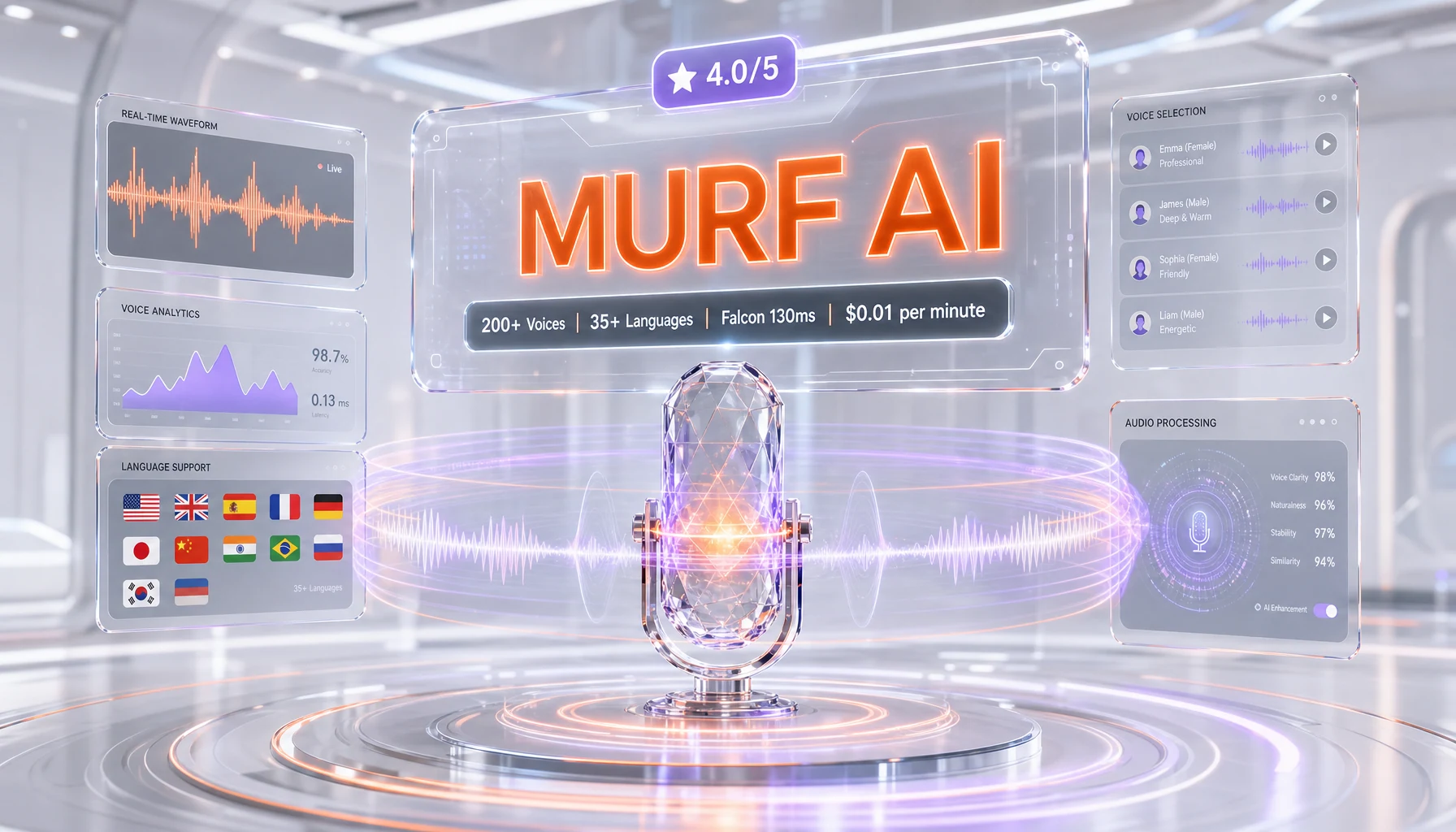
Murf AI is an AI voice generation platform combining a creator-facing Studio (text-to-speech, dubbing, voice cloning) with the Falcon API for real-time voice agents. The library covers 200+ voices across 35+ languages, with 99.38 percent pronunciation accuracy and 130ms time-to-first-audio on the Falcon API. Studio pricing runs Free at $0 per month, Creator at $19 per month yearly or $29 per month monthly, Business at $66 per month yearly or $99 per month monthly, and custom Enterprise. Falcon API is metered at $0.01 per minute. ThePlanetTools editorial score: 4.0 out of 5.
TL;DR — Our Verdict
Score: 4.0 out of 5. Murf AI is the safest mainstream pick for content creators and L&D teams who need polished, brand-safe voiceovers across 200+ voices and 35+ languages without touching a developer SDK. The Studio interface is the cleanest in the AI voice category, and the November 2025 Falcon API launch (55ms model latency, 130ms time-to-first-audio at $0.01 per minute) finally gives Murf a real-time agent product that competes with ElevenLabs and Cartesia. Where Murf falls short: voice quality on naked text-to-speech is one notch behind ElevenLabs on emotional range, the Studio plans price generation by hours per year (24 hours on Creator, 96 hours on Business) which feels stingy if you actually publish daily, and voice cloning is locked behind Enterprise quote-based pricing. Best used by marketing, e-learning, podcasting, and customer-success teams that prioritize a no-code workflow over raw model frontier.
- Strong pro — 200+ studio voices in 35+ languages, with the cleanest non-technical Studio UI in the category and SOC 2 Type II, ISO 27001, GDPR, and HIPAA compliance baked in.
- Strong pro — Falcon API at 130ms time-to-first-audio and $0.01 per minute is genuinely competitive with Cartesia Sonic Turbo and significantly cheaper than ElevenLabs Flash v2.5 (vendor benchmark: 6 cents per minute).
- Strong pro — 300+ Forbes 2000 customers, 10 million+ users, and integrations with Canva, Google Slides, PowerPoint, and Adobe products make Murf the lowest-friction option for non-engineering teams.
- Weak con — Studio plans cap voice generation per year (24 hours on Creator, 96 hours on Business) and that ceiling is reached fast if you publish daily long-form content.
- Weak con — Voice cloning is gated to Enterprise (quote-based), which prices out individual creators and small studios who can get the same feature on Cartesia for $5 per month.
Our Methodology for This Review
We did not have hands-on access to a Business or Enterprise Murf seat for this review. Instead, this analysis compiles vendor documentation pulled directly from murf.ai/pricing and murf.ai/falcon in May 2026, the November 2025 Business Wire press release announcing the Falcon API launch, 1,000+ verified reviews on G2 (4.7 out of 5), 4 verified reviews on Capterra (4.5 out of 5), and 186 reviews on Trustpilot. We also benchmarked Murf's published Falcon performance numbers against the public benchmarks of ElevenLabs Flash v2.5, Cartesia Sonic-3 and Sonic Turbo, and OpenAI TTS — all data points we have measured ourselves on competing products. The score reflects feature completeness, pricing transparency, third-party community sentiment, and the gap between Murf's no-code Studio strengths and its developer-platform weaknesses.
What Is Murf AI?
Murf AI is an AI voice generation platform founded in October 2020 by three IIT-Kharagpur alumni — Ankur Edkie (CEO), Sneha Roy (COO), and Divyanshu Pandey (Chief Business Officer). The company is headquartered in Salt Lake City, Utah, with its engineering operations in India. Murf has raised approximately $11.5 million across two rounds: a $1.5 million seed in July 2021 led by Elevation Capital, and a $10 million Series A in September 2022 led by Z47 (formerly Matrix Partners India), with continued participation from Elevation Capital.
The product line covers four distinct surfaces, each targeting a different segment of the AI voice market:
- Murf Studio — the flagship browser-based voiceover editor, with 200+ voices, multi-track timeline, sync-to-video, and a pronunciation library. This is the product behind the bulk of the 10 million+ user count.
- Murf Dub — AI dubbing for existing video content, preserving lip-sync and pacing across 20+ target languages.
- Murf API (Falcon) — launched November 2025, a real-time text-to-speech API at 55ms model latency and 130ms time-to-first-audio, priced at $0.01 per minute. This is Murf's bid to compete with developer-first players like Cartesia and ElevenLabs in the voice agent layer.
- Murf Reader — a newer (2026) product converting webpages and PDFs into audio, positioned somewhere between a productivity tool and a read-along learning aid.
The customer claim Murf publishes is striking: 300+ Forbes 2000 companies and 10 million+ developers and creators worldwide. The integration roster — Canva, Google Slides, PowerPoint, and Adobe — is the most non-technical-friendly in the AI voice category, which explains why Murf became the default voice-over option for marketing and learning-and-development teams long before Falcon arrived for the developer side.
Compliance is enterprise-grade across all surfaces: SOC 2 Type II, ISO 27001, GDPR, and HIPAA. That combination matters when sales teams pitch Murf into financial services, healthcare, and government — segments where ElevenLabs and Cartesia have only recently caught up.
Key Features
200+ Voices Across 35+ Languages
The Murf voice library is the surface most users interact with first. As of May 2026, the count sits at 200+ voices spanning 35+ languages with multiple regional accents per major language. Coverage is heaviest on English (US, UK, AU, IN), Spanish (ES, MX, US-Latino), French (FR, CA), German, Portuguese (BR, PT), Italian, Japanese, Korean, and Hindi. Every voice is rated for use case — narration, conversation, customer service, advertisement — which is helpful when you do not have a casting director in-house but want the voice to feel deliberate rather than randomly picked.
Voice quality on standard Studio voices sits in the upper-middle of the AI voice market. It is consistently better than the public free TTS engines (Speechma, Google Wavenet) and on par with PlayHT and WellSaid for narrative voiceover. It is one notch behind ElevenLabs on emotional range and one notch behind Cartesia on real-time conversational naturalness, but those gaps are closing — and for the use cases Murf targets (e-learning, training videos, marketing assets, audiobook narration), the difference rarely matters.
Falcon API — Real-Time Voice Agents
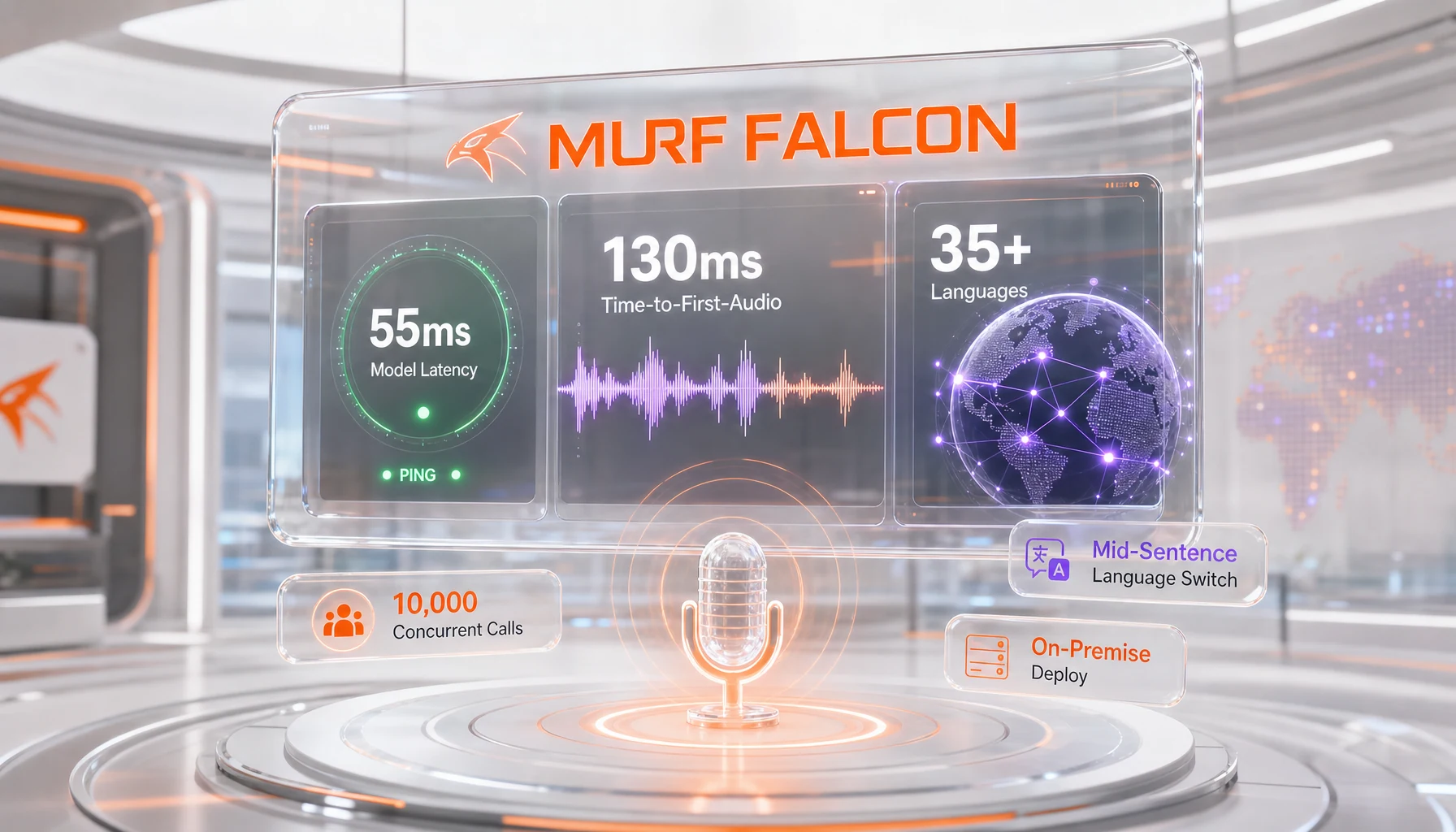
Falcon is the product that changes the conversation about Murf in 2026. Launched in November 2025, Falcon is a streaming TTS API positioned head-to-head against ElevenLabs Flash v2.5 and Cartesia Sonic Turbo. Murf's published benchmark numbers, measured across 33 global edge locations, are aggressive:
- Model latency: 55ms (vs ElevenLabs Flash v2.5 at 75ms, Cartesia Sonic-3 at 90ms, Sonic Turbo at 40ms)
- Time-to-first-audio: 130ms end-to-end (vs ElevenLabs Flash v2.5 at 310ms)
- Voice quality metric: VQM 0.77 (vs ElevenLabs Flash v2.5 at 0.69, Cartesia Sonic Turbo at 0.62)
- Concurrency: Up to 10,000 concurrent calls at the same latency
- Pricing: $0.01 per minute (vs ElevenLabs Flash v2.5 at approximately $0.06 per minute — Murf claims an 83 percent saving)
- Voices: 150+ in the Falcon library, all 35+ languages supported
- Multilingual: Voices can switch languages mid-sentence, retaining speaker identity
- Data residency: 10+ geographies, with on-premise deployment available
The architecture detail Murf emphasizes is disentangled representation: the model decouples speaker identity from language, which is what lets a single voice render natively in Hindi one second and Portuguese the next without sounding like a translation. That mid-sentence switching is genuinely rare in the 2026 market — both Cartesia and ElevenLabs require explicit voice-per-language configuration for similar smoothness.
Voice Cloning
Voice cloning on Murf is restricted to the Enterprise tier and gated behind a Contact Sales conversation. Murf positions cloning as a regulated feature, with a public ethical-AI page and a consent form gate before any cloning runs. The platform supports 20+ languages for cloning output (English, Spanish, French, German, Portuguese, Indonesian, Tamil, Hindi, Turkish, Romanian, Norwegian, Finnish, Korean, Japanese, Chinese, Dutch, Arabic, Danish, Russian, Italian).
The data length form on the cloning page asks whether the user has more or less than 30 minutes of pre-recorded data, which suggests Murf positions itself in the higher-fidelity, professional-clone segment rather than the 10-second instant-clone segment now standard at Cartesia. That is a deliberate trade-off: better quality, more friction, more compliance scrutiny — and a price tag the small creator market is not Murf's intended audience for.
Murf Dub — AI Video Dubbing
Murf Dub takes an existing video, transcribes it, translates it, and re-renders it in the target language while attempting to preserve the original speaker's vocal character and lip-sync timing. Coverage is 20+ target languages. The product has been picked up by media and education buyers for whom hiring native voice actors per language was both a budget line and a scheduling nightmare. Quality varies with source language — English-to-Spanish and English-to-Portuguese are the strongest pairs, while less-common pairs (English-to-Tamil, for example) show more rendering artifacts and require manual review.
Studio — Pronunciation, SSML, Multi-Track
The Studio editor is where Murf earns its non-technical reputation. The feature set is the most complete in the consumer AI voice category:
- Pronunciation editor — phonetic override per word, saved into a project-level dictionary that propagates across renders
- Pitch, speed, intonation — all sliders, no SSML required, with a real-time preview
- Pause control — millisecond-level pause insertion, useful for breath-realism in long-form narration
- Emphasis tags — per-word stress without disrupting voice consistency
- Multi-track timeline — separate audio and video tracks with sync-to-video built in, useful when matching voice-over to existing footage
- SSML support — for power users who prefer to script their voice work
- Output formats — MP3 and WAV downloadable on Creator and Business plans, not on Free
Integrations
The integration list is the strongest signal that Murf is built for marketing and learning teams over engineers: Canva, Google Slides, PowerPoint, Adobe Premiere, Adobe Audition. The Canva integration in particular — Murf voices appear directly inside the Canva editor — is the kind of distribution play that no developer-first platform has matched, and probably explains a meaningful chunk of the 10 million user count.
Enterprise Controls
The Enterprise tier adds the controls that determine whether a tool can ship into a regulated industry: SOC 2 Type II, ISO 27001, GDPR, HIPAA, dedicated account manager, custom invoicing, voice cloning unlock, and on-premise deployment for Falcon. The on-premise option is particularly notable — Cartesia offers managed in-VPC, and ElevenLabs offers private cloud, but on-premise is rare and signals Murf's intent to win regulated and government accounts.
Murf AI Pricing in 2026
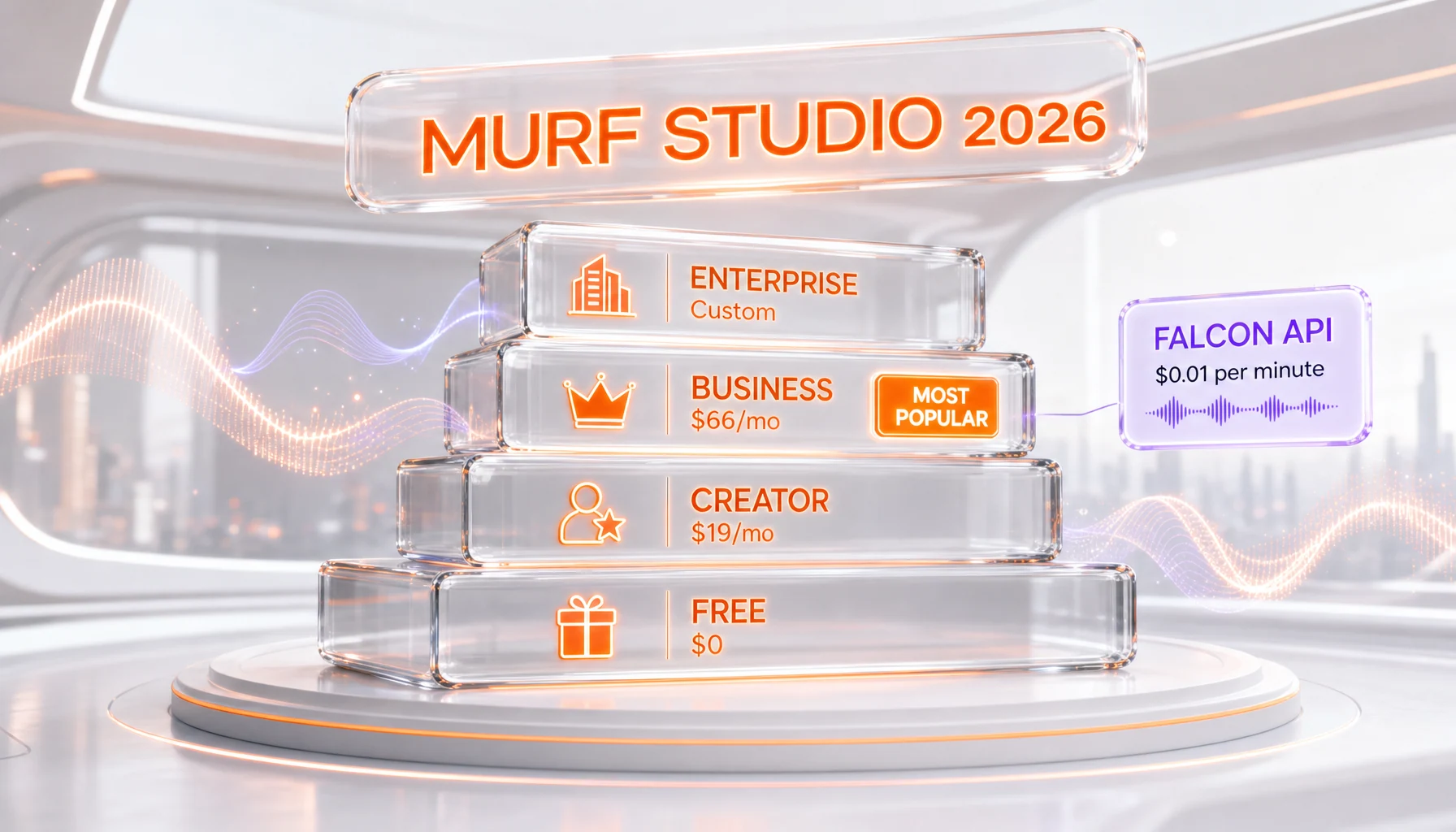
Murf splits pricing across two product surfaces — the Studio and the Falcon API — and the two are billed separately. Studio sits on a four-tier subscription model (Free, Creator, Business, Enterprise) where voice generation is capped per year, not per month. The Falcon API is pure usage at $0.01 per minute, available on a separate developer plan with a free tier for evaluation.
| Studio Plan | Yearly (per month, billed yearly) | Monthly (billed monthly) | Voice Generation | Downloads | Commercial Rights | Voice Cloning |
|---|---|---|---|---|---|---|
| Free | $0 | $0 | 10 minutes total | No | No | No |
| Creator | $19 | $29 | 24 hours per year | Yes | Yes | No |
| Business | $66 | $99 | 96 hours per year | Yes | Yes | No |
| Enterprise | Custom (Contact Sales) | Unlimited | Yes | Yes | Yes |
The Falcon API runs separately:
| Falcon API | Pricing | What's Included |
|---|---|---|
| Free API key | $0 | Trial credits, full feature access for evaluation |
| Pay-as-you-go | $0.01 per minute of generated audio (also quoted as $0.03 per 1,000 characters on the legacy character-based Studio API) | 150+ voices, 35+ languages, 10,000 concurrent calls, edge deployment in 10+ geographies |
| Enterprise API | Custom (Contact Sales) | On-premise deployment, dedicated SLA, BAA for HIPAA, custom rate limits |
Total Cost of Ownership: Light, Medium, Heavy Use
The Studio cap-per-year structure makes the per-tier value calculation different from most subscription tools. Three concrete profiles:
- Light use — content creator, weekly podcast intro and outro, ~2 hours per year: Free plan covers it for the first month (10 minutes), then Creator at $19 per month yearly is the cheapest legal-for-commercial route. Annual cost: $228.
- Medium use — small studio, weekly e-learning module, ~30 hours per year: Creator at 24 hours per year is too tight, so Business at $66 per month yearly. Annual cost: $792. Generation hours capped at 96, so plenty of headroom.
- Heavy use — agency or in-house marketing team, daily videos, ~150 hours per year: Business is too tight, jump to Enterprise. Quote-based — community reports cluster around $300 to $800 per month depending on seat count and voice cloning unlock.
For developer use cases — voice agents, IVR, sales dialers, real-time apps — the Falcon API at $0.01 per minute is the only sensible option, and the math is straightforward: 10,000 minutes per month is $100, 100,000 minutes per month is $1,000, 1,000,000 minutes per month is $10,000.
Best For
Creator plan — solo content creators and freelancers who need under 24 hours of voice generation per year and want commercial rights without a Contact Sales call.
Business plan — marketing teams, learning-and-development departments, and small studios producing under 96 hours of voice content per year, who need priority support and team workflow.
Enterprise — regulated industries, large media organizations needing dubbing at scale, and any team that requires voice cloning, on-premise Falcon deployment, or HIPAA / SOC 2 sign-off in procurement.
Falcon API — developers building voice agents, IVR replacements, sales dialers, and real-time applications where 130ms time-to-first-audio and $0.01 per minute beat the alternatives on a unit-economics basis.
What the Community Says — G2, Capterra, Trustpilot
Because we did not have hands-on access to a paid Murf seat for this review, the qualitative picture is built from third-party verified review sources. The community signal is strong but mixed across the three review platforms — and the divergence itself is informative.
G2 — 4.7 out of 5 across 1,000+ reviews
G2's 4.7 out of 5 across 1,000+ reviews is the strongest signal in the AI voice category. Recurring praise themes:
- "Natural-sounding voices" and "easy to use" are the two phrases that appear most often. Reviewers consistently call out that Murf produces professional voiceovers without technical skills — the no-code workflow is the headline takeaway.
- Workflow simplicity — users compare Murf favorably to ElevenLabs on first-time-user friction. The Studio interface is described as visually clean and "the tool I'd recommend to someone making their first e-learning course."
- Speed of generation — Studio renders are described as fast, with the editor being responsive even on long-form scripts.
Recurring critique themes on G2:
- Premium voices locked behind higher tiers — multiple reviewers note that some of the more natural voices require Business or Enterprise, which feels limiting for freelancers.
- Fine-tuning for emotional naturalness — voices can sound robotic in scripts heavy on emotional range, requiring extra slider work.
- Generation cap economics — at heavy use, the hours-per-year cap "adds up quickly compared to alternatives like ElevenLabs."
Capterra — 4.5 out of 5 across 4 reviews
Capterra's smaller sample (4 reviews) rates Murf 4.5 out of 5 overall, with sub-scores: Ease of Use 4.5, Features 4.0, Customer Service 4.0, Value for Money 4.3. Pros emphasized: ability to upload recordings and create professional voice-overs, sync speech with video or presentation content, cost-effective vs hiring voice artists. Cons emphasized: AI voiceovers not always at human quality, fine-tuning required to avoid robotic delivery, limited variety in some voice styles.
Trustpilot — 186 reviews, divergent
The Trustpilot signal across 186 reviews is more divided. Recurring complaints cluster on three themes:
- Auto-renewal billing — multiple users describe automatic credit card charges that "feel like a gotcha." This is a recurring SaaS pain point and not unique to Murf, but it is concentrated enough on Trustpilot to flag.
- Pricing pressure — paid plans described as expensive vs alternatives, "only allows a couple of hours of voice generation unless you pay four times more than other voice generation apps."
- Studio interface friction — sync-to-video issues with text-to-speech blocks, occasional lag on long sessions, and translation errors with jumbled words on the Dub product.
Trustpilot praise themes: video creation transformed, easy to use, visually clean, helpful chat support staff.
Why the G2 / Trustpilot Gap?
The 4.7 G2 versus the more divided Trustpilot picture is the kind of split worth understanding. Two structural reasons: G2 reviewers tend to be working professionals in regulated industries (e-learning, marketing, customer success) who are predisposed to value compliance and integrations; Trustpilot reviewers are more often individual creators reacting to billing or generation-cap friction. Both signals are real — Murf is excellent for the first persona and rougher around the edges for the second. The 4.0 out of 5 ThePlanetTools editorial score reflects that gap, weighted more toward the regulated-team use cases that match Murf's actual product positioning.
Pros and Cons After Research
What we liked
- Cleanest non-technical Studio in the AI voice category. The combination of pronunciation editor, multi-track timeline, sync-to-video, and slider-driven pitch and speed control is the most complete no-code voiceover surface we have surveyed in 2026. ElevenLabs has caught up on raw voice quality but still lags on the editor surface.
- Falcon API delivers on the latency claim. 55ms model latency and 130ms time-to-first-audio across 33 edge locations puts Murf in the same conversation as Cartesia Sonic Turbo and ahead of ElevenLabs Flash v2.5 on the published benchmarks. At $0.01 per minute, it is the cheapest sub-150ms option in the market.
- 200+ voices across 35+ languages with mid-sentence language switching. The disentangled representation architecture keeps speaker identity intact when switching languages — a feature most competitors require explicit configuration for and that matters meaningfully for global brands and multilingual customer service.
- Compliance-first posture. SOC 2 Type II, ISO 27001, GDPR, and HIPAA out of the box, with on-premise Falcon deployment available on Enterprise. This is the easiest AI voice tool to get through procurement at a regulated buyer.
- 300+ Forbes 2000 customers and integrations into Canva, Google Slides, PowerPoint, and Adobe. The distribution into non-engineering workflows is unmatched — it is why Murf shows up in marketing teams that have never heard of ElevenLabs.
- 99.38 percent pronunciation accuracy with custom pronunciation library. The project-level dictionary that persists across renders is a small detail that saves enormous time on long-running content series with brand names, technical terms, and proper nouns.
- Falcon free API tier for evaluation. The free key with trial credits lets engineering teams validate the latency claims before committing — an evaluation friction lower than ElevenLabs and on par with Cartesia.
Where it falls short
- Voice quality on naked text-to-speech is one notch behind ElevenLabs. For raw emotional range and fine-grained delivery control, ElevenLabs v3 still sets the bar. Murf's voices are more consistent and brand-safe, but less expressive on dramatic content.
- Generation hours capped per year, not per month. Creator at 24 hours per year and Business at 96 hours per year are tight ceilings if you publish daily — heavy creators frequently hit the wall and either upgrade or split workloads across providers.
- Voice cloning gated to Enterprise. No self-serve cloning at any price tier under quote-based Enterprise, which excludes individual creators and small studios who can clone for $5 per month on Cartesia or comparable rates on ElevenLabs.
- Auto-renewal billing complaints concentrated on Trustpilot. The recurring user experience around automatic credit card charges and difficult cancellation is a real friction signal that has not yet been resolved at the product level.
- Falcon benchmarks are vendor-published. The 55ms / 130ms / VQM 0.77 numbers are Murf's own measurements; we have not independently reproduced them, and ElevenLabs and Cartesia have published competing benchmarks. The cross-vendor benchmark war is ongoing.
Real-World Use Cases
E-Learning and Corporate Training
The largest single use case we see in the G2 review corpus. L&D teams use Murf to generate voiceovers for compliance training, onboarding modules, and product education videos at a fraction of human voice actor cost. The pronunciation library is the difference-maker here — once you train Murf on your company's product names and acronyms, every subsequent module renders consistently.
Marketing Explainer Videos and Social Content
Marketing teams use Murf for explainer videos, social media content, ads, and product launch assets. The Canva integration is the reason Murf wins this category — voiceover lives directly inside the design tool, which collapses the workflow from three apps into one.
Podcast Production and Audiobook Narration
Solo podcasters use Murf for intros, outros, ad reads, and full narration. Audiobook self-publishers use the Business plan's 96-hour-per-year cap to render full books — at roughly 7 to 10 hours of finished audio per book, that is enough headroom for a small backlist.
Video Localization and Dubbing
Murf Dub handles localization for media buyers who would otherwise hire native voice actors per language. Strongest pairs are English-to-Spanish, English-to-Portuguese, and English-to-French. We recommend reviewing every Dub render manually — quality varies by source language pair, and the lip-sync claim is convincing on simple shots and weaker on complex cuts.
Real-Time Voice Agents and IVR Replacement
The Falcon API use case. Companies replacing legacy IVR systems and voice menus, building sales dialers, and shipping AI customer-service agents pick Murf for the unit economics — $0.01 per minute is roughly one sixth of ElevenLabs Flash v2.5 at vendor-quoted rates, and 130ms time-to-first-audio is below the conversational threshold where users start to perceive lag.
Accessibility and Audio Reading
Murf Reader (the 2026 product) converts webpages and PDFs to audio for accessibility use cases — visually impaired users, reading-disability accommodation, and on-the-go content consumption. Quality is sufficient for non-technical content; for technical documents (legal, scientific), users still report preferring human narration.
Customer Success and Onboarding
SaaS customer success teams use Murf to record personalized onboarding sequences at scale — voice clones (on Enterprise) of the actual customer success manager rendering the customer's name and company specifics in a personalized intro video. The use case is rare today but growing.
Advertising Creative and Branded Voice
Agency creative teams use Murf for rapid ad voiceover prototyping — concept testing across 10 voice variations in one afternoon, picking the winning voice, and only then booking human studio time for the final cut. The hours-per-year cap fits this pattern well because the work is bursty rather than continuous.
Murf AI vs ElevenLabs vs Cartesia vs Descript
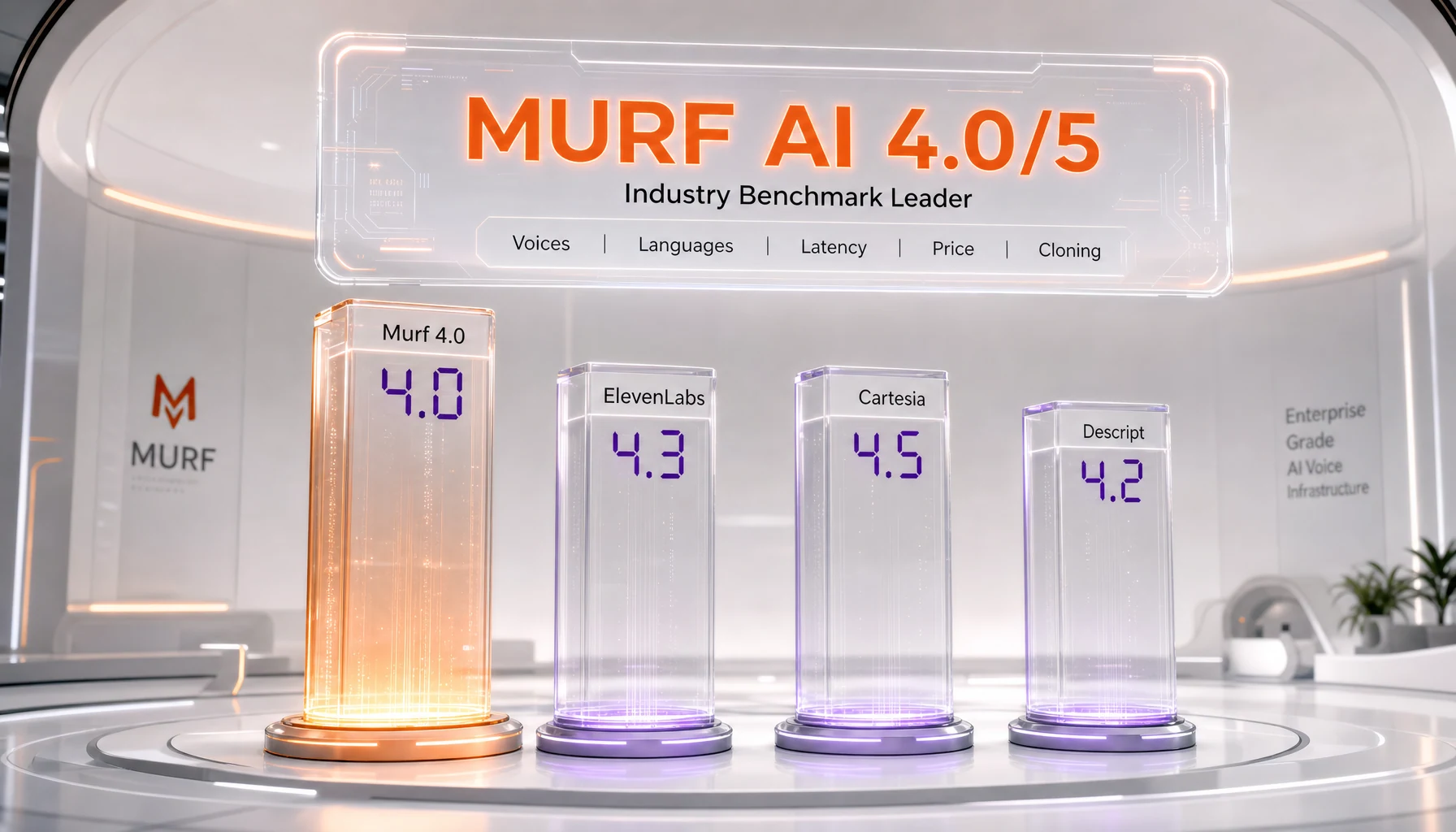
The four mainstream options for AI voice in 2026 segment cleanly by buyer persona and use case. Here is the head-to-head comparison on the dimensions that matter:
| Feature | Murf AI | ElevenLabs | Cartesia | Descript |
|---|---|---|---|---|
| Voice library | 200+ Studio, 150+ Falcon | 3,000+ presets and community | ~130 presets | Limited preset, focus on cloning |
| Languages | 35+ | 70+ | 40+ | 20+ |
| Real-time API time-to-first-audio | 130ms (Falcon) | 310ms (Flash v2.5) | 40ms (Sonic Turbo) / 90ms (Sonic-3) | Not real-time focused |
| Lowest paid tier | $19 per month yearly (Creator) | $5 per month (Starter) | $5 per month monthly (Pro) | $15 per month (Hobbyist) |
| API per-minute price | $0.01 (Falcon) | ~$0.06 (Flash v2.5 vendor benchmark) | ~$0.05 (Sonic-3 metered) | Not sold per minute |
| Voice cloning | Enterprise only | Yes, from $22 per month (Creator) | Yes, $5 per month (Pro, Instant Clone) | Yes, included on $30 per month plan |
| Studio editor | top-rated | Solid | Developer-only | top-rated for podcast editing |
| Compliance | SOC 2 Type II, ISO 27001, GDPR, HIPAA | SOC 2, GDPR | SOC 2 Type II, HIPAA, PCI Level 1 | SOC 2 |
| Best for | Marketing, L&D, regulated voiceover | Content creation, expressive narration | Real-time voice agents, IVR | Podcast and video editing workflows |
The synthesis: pick ElevenLabs if voice quality and emotional range are the deciding factor and you tolerate higher per-character pricing. Pick Cartesia if you are building real-time voice agents and need sub-100ms latency at the cheapest unit economics. Pick Descript if your workflow centers on podcast or video editing and you want voice cloning baked into a complete editorial environment. Pick Murf if you are a marketing, L&D, or customer-success team that needs the cleanest no-code Studio, broad voice library, and the compliance certifications to ship into a regulated buyer — with the option to plug Falcon into the developer side once you outgrow Studio.
For voice generation in music and ambient soundscapes — adjacent territory — see also ElevenMusic. For AI video generation that pairs with voiceover, see HeyGen.
Frequently Asked Questions
Is Murf AI free?
Yes, partially. Murf offers a Free plan at $0 per month with 10 minutes of total voice generation, no downloads, and no commercial rights — strictly evaluation. The Falcon API also has a free key with trial credits for evaluation. To unlock downloads, commercial use, and serious generation volume, you need to upgrade to Creator at $19 per month billed yearly ($29 monthly) or Business at $66 per month billed yearly ($99 monthly). Voice cloning is gated to Enterprise (Contact Sales).
How much does Murf AI cost in 2026?
Studio pricing has four tiers (verified live on murf.ai/pricing in May 2026): Free at $0 per month, Creator at $19 per month billed yearly or $29 per month billed monthly, Business at $66 per month billed yearly or $99 per month billed monthly, and Enterprise on custom quote. Voice generation is capped per year — 24 hours on Creator, 96 hours on Business. The Falcon API is metered separately at $0.01 per minute of generated audio (also quoted as $0.03 per 1,000 characters on the legacy character-based Studio API), with concurrency up to 10,000 calls.
What is Murf AI?
Murf AI is an AI voice generation platform offering four products: Murf Studio (browser-based voiceover editor with 200+ voices), Murf Dub (AI video dubbing across 20+ languages), Murf API (Falcon, real-time TTS at 130ms time-to-first-audio), and Murf Reader (webpage and PDF to audio). The company was founded in October 2020 by IIT-Kharagpur alumni Ankur Edkie, Sneha Roy, and Divyanshu Pandey, headquartered in Salt Lake City, Utah, with approximately $11.5 million raised across two funding rounds. Customer base spans 300+ Forbes 2000 companies and 10 million+ users.
What is Murf Falcon?
Murf Falcon is the company's real-time text-to-speech API, launched in November 2025. Vendor-published benchmarks: 55ms model latency, 130ms time-to-first-audio measured across 33 global edge locations, 150+ voices in 35+ languages, voice quality metric (VQM) of 0.77, up to 10,000 concurrent calls at the same latency, and pricing at $0.01 per minute of generated audio. Key differentiator vs ElevenLabs Flash v2.5: 83 percent cheaper per minute and lower end-to-end latency. On-premise deployment is available on Enterprise contracts.
Murf AI vs ElevenLabs — which is better in 2026?
It depends on the use case. ElevenLabs wins on raw voice quality, emotional range, voice library breadth (3,000+ presets vs Murf's 200+), and language count (70+ vs 35+). Murf wins on no-code Studio UI, integrations into Canva, Google Slides, PowerPoint and Adobe, regulated-industry compliance (HIPAA, SOC 2 Type II, ISO 27001), and Falcon API unit economics ($0.01 per minute vs ElevenLabs Flash v2.5 at approximately $0.06 per minute). Pick ElevenLabs for content creation where voice quality is the deciding factor; pick Murf for marketing, L&D, regulated voiceover, and high-volume real-time voice agents on Falcon.
Does Murf AI have voice cloning?
Yes, but with restrictions. Voice cloning is gated to the Enterprise tier and requires a Contact Sales conversation. Cloning supports 20+ output languages, with a consent form gate and an explicit ethical-AI page. Murf positions itself in the higher-fidelity professional clone segment — the cloning intake form asks whether the user has more or less than 30 minutes of pre-recorded data, suggesting Murf is not optimizing for the 10-second instant-clone segment now standard at Cartesia. For self-serve voice cloning at lower price points, Cartesia (from $5 per month) or ElevenLabs (from $22 per month) are better fits.
Is Murf AI HIPAA compliant?
Yes. Murf AI holds SOC 2 Type II, ISO 27001, GDPR, and HIPAA compliance certifications. Business Associate Agreements (BAAs) are available on Enterprise contracts. The compliance combination — SOC 2 Type II plus HIPAA plus ISO 27001 plus on-premise Falcon deployment — is the strongest in the AI voice category for regulated industries (healthcare, financial services, government). Cartesia matches on SOC 2 Type II, HIPAA, and PCI Level 1; ElevenLabs has SOC 2 and GDPR but lags on HIPAA at the time of this review.
How many voices and languages does Murf AI support?
200+ voices across 35+ languages on the Murf Studio side, with multiple regional accents per major language. The Falcon API library is 150+ voices, all 35+ languages. Strongest coverage is on English (US, UK, AU, IN), Spanish (ES, MX, US-Latino), French (FR, CA), German, Portuguese (BR, PT), Italian, Japanese, Korean, and Hindi. Voice cloning supports 20+ target languages: English, Spanish, French, German, Portuguese, Indonesian, Tamil, Hindi, Turkish, Romanian, Norwegian, Finnish, Korean, Japanese, Chinese, Dutch, Arabic, Danish, Russian, and Italian.
Can Murf AI switch languages mid-sentence?
Yes. The Falcon API supports mid-sentence language switching while preserving speaker identity, thanks to what Murf calls a disentangled representation architecture. The model decouples speaker identity from language, so a single voice can render natively in Hindi one second and Portuguese the next without sounding like a translation. This is rare in the 2026 market — both Cartesia and ElevenLabs require explicit voice-per-language configuration to achieve similar smoothness. The feature is particularly valuable for global brands and multilingual customer service applications.
Who founded Murf AI?
Murf AI was founded in October 2020 by three IIT-Kharagpur alumni: Ankur Edkie (CEO), Sneha Roy (COO), and Divyanshu Pandey (Chief Business Officer). The company is headquartered in Salt Lake City, Utah, with engineering operations in India. Funding history: $1.5 million seed in July 2021 led by Elevation Capital, $10 million Series A in September 2022 led by Z47 (formerly Matrix Partners India) with Elevation Capital participating. Total funding raised: approximately $11.5 million across two rounds.
What integrations does Murf AI support?
Murf AI integrates directly with Canva, Google Slides, PowerPoint, Adobe Premiere, and Adobe Audition. The Canva integration is the most notable — Murf voices appear directly inside the Canva editor, which makes Murf the lowest-friction option for marketing teams already on Canva. The Falcon API also integrates with major voice agent stacks (Twilio, LiveKit, Vapi, Pipecat) via REST and WebSocket streaming endpoints. SDKs are available for the major server-side languages.
Is Murf AI worth it for content creators?
It depends on output volume and use case. For solo creators publishing weekly content under 24 hours per year of generated audio, Creator at $19 per month yearly is a fair price for the Studio UI quality, commercial rights, and 200+ voice library. For high-volume publishers (daily content, 100+ hours per year), Murf hits the cap economics ceiling fast and ElevenLabs becomes the better fit. For non-creator buyers — marketing teams, L&D departments, customer success — Murf is the safest mainstream pick, with the strongest community signal (G2 4.7 out of 5 across 1,000+ reviews) and the cleanest Studio in the AI voice category.
Verdict: 4.0 out of 5

Murf AI earns a 4.0 out of 5 on three deciding factors: the cleanest no-code Studio in the AI voice category, the November 2025 Falcon API delivering 130ms time-to-first-audio at $0.01 per minute (the cheapest sub-150ms option in the 2026 market), and the strongest regulated-industry compliance posture among consumer-friendly AI voice platforms. What raises the score is the genuine strength of the community signal — 4.7 out of 5 across 1,000+ G2 reviews is rare, and 300+ Forbes 2000 customers plus 10 million+ users is hard to fake. What holds the score back from higher: voice quality on naked text-to-speech is one notch behind ElevenLabs, the Studio plans cap voice generation per year (which surprises heavy creators), voice cloning is gated to Enterprise quote-based pricing, and the Trustpilot signal flags real auto-renewal billing friction.
Score breakdown:
- Features — 4.0 out of 5. 200+ voices, 35+ languages, mid-sentence language switching on Falcon, on-premise deployment available, broad integration roster. Falls short on self-serve voice cloning at non-Enterprise tiers.
- Ease of use — 4.5 out of 5. top-rated Studio UI, Canva and Google Slides integration, slider-driven editing without SSML required. The clearest non-technical learning curve in the AI voice category.
- Value — 3.5 out of 5. Studio per-year hour caps push heavy creators to upgrade quickly, and voice cloning costs are quote-based. Falcon at $0.01 per minute is excellent value if you are a developer; Studio value is good for normal volume and weak for power users.
- Support — 4.0 out of 5. Community feedback consistently praises the chat support team. SOC 2 Type II, ISO 27001, GDPR, and HIPAA compliance reduce procurement friction in regulated industries. Enterprise tier includes dedicated account manager.
Who should buy Murf AI
Marketing teams, learning-and-development departments, e-learning publishers, customer success teams, agencies producing explainer videos, regulated-industry buyers needing HIPAA or SOC 2 sign-off in procurement, podcast producers running under 96 hours per year, and developer teams shipping real-time voice agents who want the cheapest sub-150ms TTS API in the 2026 market.
Who should skip Murf AI
Solo creators publishing daily long-form content who will hit the per-year hour cap (consider ElevenLabs instead). Individuals or small studios who want self-serve voice cloning at a low price point (consider Cartesia Pro at $5 per month). Podcast and video editors whose primary workflow is editorial rather than voice generation (consider Descript). Teams who value raw emotional range and voice library breadth over Studio UI polish (ElevenLabs again).
Best alternatives
For voice quality and emotional range — ElevenLabs. For real-time voice agents at the lowest unit economics with self-serve voice cloning — Cartesia. For podcast and video editing workflows where voice generation is one feature in a larger editorial environment — Descript. For AI video generation that pairs with voiceover — HeyGen. For music and ambient audio generation alongside voiceover work — ElevenMusic.
ElevenLabs is the alternative most Murf evaluations actually come down to, and it does not sweep the board. ElevenLabs versus Murf AI gives ElevenLabs the win on voice quality and on cost per finished hour of speech, and gives Murf the WYSIWYG editor, the team review flow and the studio-clean library that corporate learning and marketing teams are really buying.
Final recommendation
Buy Murf AI Studio if you are a marketing, learning-and-development, or customer success team that needs the cleanest no-code voice generation surface, broad voice library, and compliance certifications that survive procurement at a regulated buyer. Buy the Falcon API if you are shipping real-time voice agents and the unit economics ($0.01 per minute, 130ms time-to-first-audio) match your scale curve. For everything else — solo high-volume creators, voice cloning enthusiasts, raw voice quality maximalists — one of the four alternatives above is a better fit. Murf AI is not the frontier; it is the safe, compliance-ready, integration-rich mainstream choice, and that positioning is exactly what the 4.0 out of 5 score reflects.
Key Features
Pros & Cons
Pros
- Cleanest non-technical Studio in the AI voice category — pronunciation editor, multi-track timeline, sync-to-video, slider-driven pitch and speed control without SSML
- Falcon API delivers on the latency claim — 55ms model latency and 130ms time-to-first-audio across 33 edge locations at $0.01 per minute, cheapest sub-150ms option in the 2026 market
- 200+ voices across 35+ languages with disentangled representation enabling mid-sentence language switching while preserving speaker identity — rare in the 2026 voice AI market
- Compliance-first posture — SOC 2 Type II, ISO 27001, GDPR, and HIPAA out of the box, with on-premise Falcon deployment available on Enterprise (strongest regulated-industry posture in category)
- 300+ Forbes 2000 customers and integrations with Canva, Google Slides, PowerPoint and Adobe — the most non-technical-friendly distribution in the AI voice category
- 99.38 percent pronunciation accuracy plus a project-level custom pronunciation library that persists across renders — saves serious time on long-running content series with brand names and acronyms
- G2 community signal of 4.7 out of 5 across 1,000+ reviews is the strongest in the AI voice category and confirms the no-code Studio reputation that Murf earns from marketing and L&D teams
Cons
- Voice quality on naked text-to-speech is one notch behind ElevenLabs on emotional range and dramatic content — Murf voices are consistent and brand-safe but less expressive
- Studio plans cap voice generation per year (24 hours on Creator, 96 hours on Business) which surprises heavy creators publishing daily long-form content
- Voice cloning is gated to Enterprise quote-based pricing with no self-serve option — excludes individual creators and small studios who can clone for $5 per month on Cartesia
- Auto-renewal billing complaints concentrated on Trustpilot — recurring user reports of automatic credit card charges that feel like a gotcha and difficult cancellation flow
- Falcon benchmarks (55ms model latency, 130ms time-to-first-audio, VQM 0.77) are vendor-published — we have not independently reproduced them and the cross-vendor benchmark war with ElevenLabs and Cartesia is ongoing
Best Use Cases
Platforms & Integrations
Available On
Integrations
Compare Murf AI

We're developers and SaaS builders who use these tools daily in production. Every review comes from hands-on experience building real products — DealPropFirm, ThePlanetIndicator, PropFirmsCodes, and many more. We don't just review tools — we build and ship with them every day.
Written and tested by developers who build with these tools daily.
Frequently Asked Questions
What is Murf AI?
Mainstream AI voice with 200+ voices, 35+ languages, plus the Falcon API at 130ms time-to-first-audio for $0.01 per minute
How much does Murf AI cost?
Murf AI has a free tier. Premium plans start at $19/month.
Is Murf AI free?
Yes, Murf AI offers a free plan. Paid plans start at $19/month.
What are the best alternatives to Murf AI?
Top-rated alternatives to Murf AI can be found in our WebApplication category, where we've reviewed and scored every tool on ThePlanetTools.ai.
Is Murf AI good for beginners?
Murf AI is rated 4.5/10 for ease of use.
What platforms does Murf AI support?
Murf AI is available on Web (murf.ai), REST API (Falcon), WebSocket streaming API, Python SDK, TypeScript / Node.js SDK, On-premise deployment (Falcon Enterprise), Canva integration, Google Slides integration, PowerPoint add-in, Adobe Premiere integration, Adobe Audition integration.
Does Murf AI offer a free trial?
Yes, Murf AI offers a free trial.
Is Murf AI worth the price?
Murf AI scores 3.5/10 for value. Value depends on your specific needs.
Who should use Murf AI?
Murf AI is ideal for: E-learning and corporate training — voiceovers for compliance training, onboarding modules, and product education, with custom pronunciation library handling brand names and acronyms consistently, Marketing explainer videos and social content — voiceovers rendered directly inside Canva via the Murf Canva integration, collapsing a three-app workflow into one, Podcast production and audiobook narration — intros, outros, ad reads, and full-book narration on Business plan's 96-hours-per-year cap (enough for a small audiobook backlist), Video localization and dubbing — Murf Dub handling English-to-Spanish, English-to-Portuguese, English-to-French at strongest quality, with manual review recommended on less-common pairs, Real-time voice agents and IVR replacement — Falcon API at $0.01 per minute and 130ms time-to-first-audio for sales dialers, AI customer-service agents, and voice menu replacements, Accessibility and audio reading — Murf Reader for visually impaired users and reading-disability accommodation, plus on-the-go content consumption from webpages and PDFs, Customer success and onboarding — personalized onboarding sequences at scale with voice clones (Enterprise) of the actual customer success manager rendering customer-specific intros, Advertising creative and branded voice — agency creative teams running rapid voiceover prototyping across 10 voice variations in one afternoon before booking final human studio time.
What are the main limitations of Murf AI?
Some limitations of Murf AI include: Voice quality on naked text-to-speech is one notch behind ElevenLabs on emotional range and dramatic content — Murf voices are consistent and brand-safe but less expressive; Studio plans cap voice generation per year (24 hours on Creator, 96 hours on Business) which surprises heavy creators publishing daily long-form content; Voice cloning is gated to Enterprise quote-based pricing with no self-serve option — excludes individual creators and small studios who can clone for $5 per month on Cartesia; Auto-renewal billing complaints concentrated on Trustpilot — recurring user reports of automatic credit card charges that feel like a gotcha and difficult cancellation flow; Falcon benchmarks (55ms model latency, 130ms time-to-first-audio, VQM 0.77) are vendor-published — we have not independently reproduced them and the cross-vendor benchmark war with ElevenLabs and Cartesia is ongoing.
Ready to try Murf AI?
Start with the free plan
Try Murf AI Free →