Vapi
The developer-first voice AI orchestration platform — bring your own STT, LLM, TTS and telephony, ship phone agents in days

Quick Summary
Vapi is a developer-first voice AI platform that orchestrates STT, LLM, TTS and telephony into production phone agents. Base $0.05 per minute plus model costs. Score 8.6/10. Used by 500,000+ developers, 300M+ calls processed.
Vapi is a developer-first voice AI orchestration platform that stitches speech-to-text, large language models, text-to-speech and telephony into production-ready phone agents. Founded in 2023 by Jordan Dearsley and Nikhil Gupta, Vapi went through Y Combinator (W24) and raised a 20 million dollar Series A in December 2024 led by Bessemer Venture Partners at a 130 million dollar valuation. As of early 2026 the company has 153 employees, serves more than 500,000 developers and has processed over 300 million calls. Base orchestration costs 5 cents per minute. Realistic all-in cost lands between 13 and 31 cents per minute once you add STT, LLM, TTS and telephony. Score: 8.6 out of 10.
What Is Vapi?
Vapi positions itself as middleware for voice AI — a thin orchestration layer between every component you need to make a phone agent work. You don't build a voice model with Vapi. You bring the models. Vapi handles the real-time audio plumbing: streaming audio from a phone line into a speech-to-text engine, feeding transcripts into a language model, routing model responses into a text-to-speech engine, and piping the generated audio back onto the call with sub-second latency.
The company's core bet is provider agnosticism. Retell AI ships a tightly managed stack with a single STT, a single TTS and tuned latency. Bland AI builds its own voice model and owns the whole pipeline. Vapi goes the opposite direction: mix and match. Use Deepgram Nova for transcription on this assistant, AssemblyAI on that one. Run GPT-5 for the complex sales agent, Claude 4.7 for the empathetic support agent, Gemini 2.5 Flash for the budget outbound dialer. Swap ElevenLabs voice for Cartesia Sonic when you need lower latency. Every provider you would otherwise integrate yourself is already wired in.
The trade-off is obvious. Flexibility is power for developers who know what they want. It is cognitive overhead for everyone else. If you have never run a production voice agent and you don't know the latency profile of Deepgram versus AssemblyAI, Vapi's dashboard will feel like staring at an airplane cockpit. If you ship APIs for a living, it feels like home.
The Orchestration Stack Explained
Every Vapi call runs through four stages. Understanding them is the difference between a good agent and a flat 3-dollar phone call that goes nowhere.
Stage 1 — Speech-to-Text (STT)
The moment the caller speaks, audio streams into a transcription provider. Vapi supports 10 native STT engines: Deepgram (Nova-2, Nova-3), OpenAI Whisper, AssemblyAI, Rev.ai, Azure Speech, Google Speech-to-Text, Gladia, and a few regional providers. Deepgram is the default for one simple reason — its streaming latency on Nova-3 sits around 150 to 250 milliseconds, which is faster than anything else in the market. AssemblyAI is better for accented English. Whisper is better for multilingual rare-language calls. You pick per assistant, in JSON, with one field.
Stage 2 — Large Language Model (LLM)
Once the caller's turn is transcribed, Vapi routes the conversation state (system prompt, history, current transcript, function schemas) to the LLM of your choice. Native support covers OpenAI (GPT-4o, GPT-5, GPT-5 mini), Anthropic (Claude 4.7, Claude 4.5 Haiku), Google (Gemini 2.5 Pro and Flash), Mistral, Cohere, Groq and Together. For regulated or bespoke workloads, Bring Your Own Model (BYOM) exposes a custom LLM endpoint — you host the model, Vapi streams tokens through it. The LLM stage dominates total cost. A fast model like Gemini 2.5 Flash runs roughly 2 cents per minute of speech. Claude 4.7 on a heavy-reasoning agent can hit 15 to 20 cents per minute.
Stage 3 — Text-to-Speech (TTS)
Model tokens stream into a text-to-speech provider and back into audio. Supported TTS engines include ElevenLabs, Cartesia (Sonic is the lowest-latency option at roughly 90 milliseconds time-to-first-byte), PlayHT, Rime AI, Deepgram Aura, Azure Neural, OpenAI TTS and Smallest AI. This is where voice character lives. ElevenLabs is still the gold standard for warmth and inflection. Cartesia wins on latency for real-time back-and-forth. Rime is strong on natural pauses. TTS typically costs 3 to 5 cents per minute of generated speech.
Stage 4 — Telephony
The fourth stage is the phone line itself. Vapi offers managed phone numbers for free on US national numbers, and charges roughly 1 to 2 cents per minute of telephony. For international numbers or regulated industries, you import your own number through the /phone-numbers/import endpoint using Twilio or Vonage credentials. SIP trunking is documented in depth — you add a Vapi SIP URI in the format sip:YOUR_PHONE_NUMBER@<credential_id>.sip.vapi.ai on your carrier side, and inbound calls route into your assistant. Plivo, Twilio and Vonage all support IP-based authentication out of the box.
Vapi Pricing Breakdown (2026)
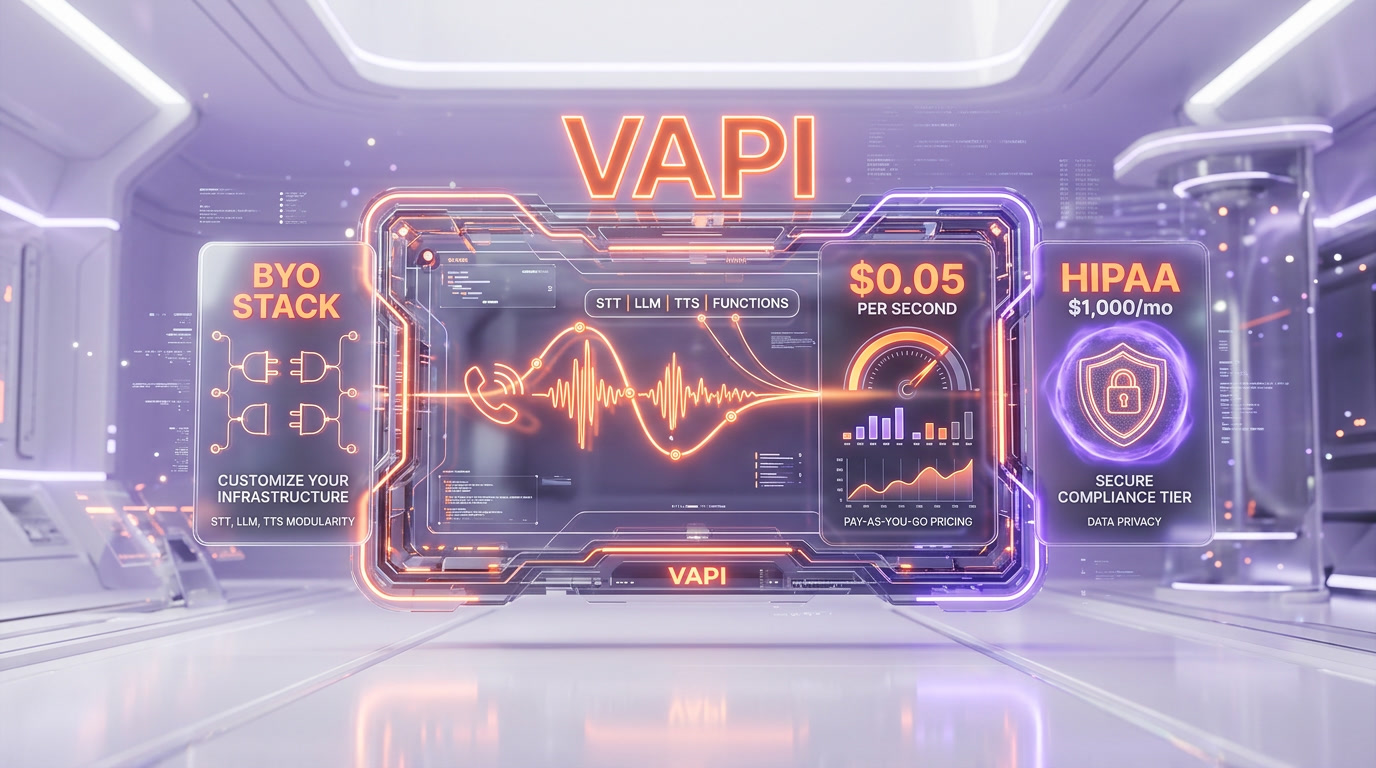
Vapi advertises 5 cents per minute as its base rate. That number is technically accurate and practically misleading. The 5 cents covers only Vapi's orchestration fee — the real cost per minute is the sum of five line items.
| Cost component | Typical range per minute | Notes |
|---|---|---|
| Vapi orchestration | 5 cents per minute | Flat base rate on every active call minute |
| Speech-to-Text | 0.8 to 1.5 cents per minute | Deepgram Nova-3 around 1 cent per minute |
| Large Language Model | 2 to 20 cents per minute | Gemini Flash cheap, GPT-5 and Claude 4.7 expensive |
| Text-to-Speech | 3 to 6 cents per minute | Cartesia cheap, ElevenLabs premium |
| Telephony | 0.8 to 2 cents per minute | Vapi numbers, Twilio or Vonage SIP |
| Realistic total | 13 to 31 cents per minute | Depends on model choices and call length |
A 10-minute call on a premium stack (GPT-5 + ElevenLabs + Deepgram Nova-3 + Twilio telephony) lands around 2.50 to 3.00 dollars. A 10-minute call on a budget stack (Gemini 2.5 Flash + Cartesia Sonic + Deepgram Nova-2 + Vapi free number) lands around 1.30 dollars. The 2.3x spread between stacks is why provider choice matters more than any single pricing decision.
Pricing tiers and plans
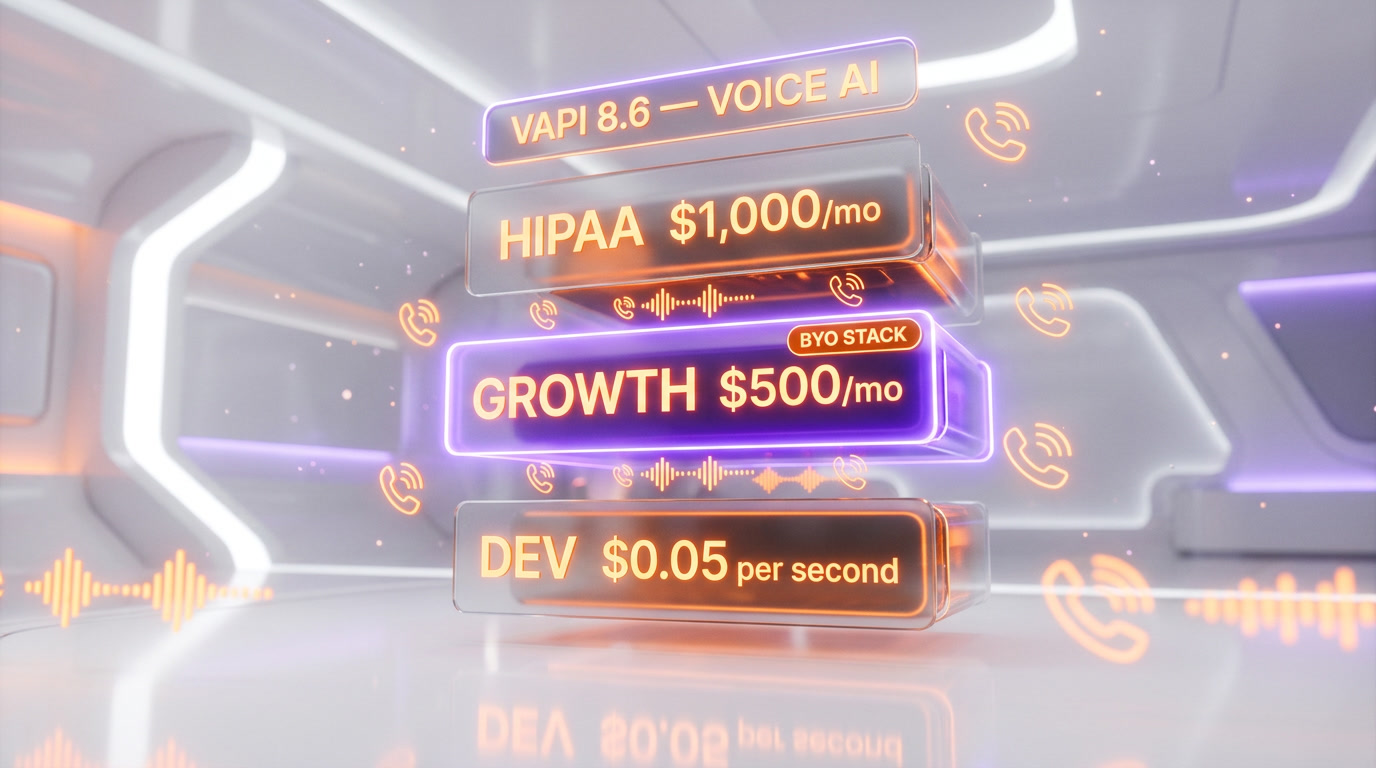
Vapi publishes three plan families. The Free tier includes 10 dollars of call credits on signup and rate-limited access to every feature. Pay-as-you-go is the default for everyone else — top up credits, pay per minute, no commitments. Enterprise pricing unlocks unlimited concurrency, 24/7 support, custom rates, dedicated infrastructure and compliance add-ons (HIPAA and SOC 2 Type II at 1,000 dollars per month).
Hidden costs to watch
- HIPAA and SOC 2 are not included — add 1,000 dollars per month on top of call costs if you need them. Retell AI and Bland AI ship compliance in standard pricing.
- International numbers are not free — only US national numbers are free. Every other country requires a Twilio or Vonage import with the associated carrier costs.
- Long idle time still bills orchestration — if your agent holds while a caller searches for something, you still pay the 5-cent base rate for every minute.
- Concurrency caps on the free tier — dev accounts max out at a handful of concurrent calls. Production throughput requires an upgrade.
Developer Experience: API, Dashboard, SDKs
Vapi is the only voice platform in this review where the product team clearly optimized for a developer audience over a no-code one. Everything important is an API endpoint first, a dashboard surface second.
Assistants API
The primitive is the Assistant — a JSON config that bundles voice, model, tools, first message, system prompt, transcriber, end-call behavior, and server URL. You POST an Assistant to /assistant, reference its ID on a call, and Vapi handles the rest. This is refreshingly simple — and it means everything is version-controllable. Assistants live in Git. Changes go through pull requests. Reviewers catch regressions before they hit production.
Tools and function calling
Vapi exposes three ways to give an agent abilities.
- Custom Tools — function schemas with webhook endpoints. When the LLM calls
book_appointment, Vapi posts the args to your URL and streams the response back into the conversation. - Code Tools — short TypeScript snippets that execute on Vapi's infrastructure. No server required. Good for simple DB lookups, webhook chains and formatting helpers.
- Integration Tools — prebuilt connectors for Make, GoHighLevel, Google Calendar, Cal.com and a handful of CRM platforms. Point-and-click inside the dashboard.
Squads: multi-agent orchestration
A single assistant handles one conversation well. Real-world phone flows need handoffs — the greeter transfers to the sales agent, who transfers to the closer, who escalates to a human. Squads is Vapi's answer: a declarative config that chains assistants together with context-preserving transfers. The next agent in the chain sees the full transcript and any state the previous agent captured. It is the closest thing to a visual flow-builder that Vapi ships, and it is good enough that most agencies never miss the drag-and-drop UX.
Server Events and webhooks
Every call fires a stream of events to a URL you specify: status-update, speech-update, transcript, function-call, end-of-call-report. The end-of-call-report is the most useful — it bundles the full transcript, recording URL, summary, cost breakdown and any structured data the agent extracted into a single POST. Drop that into a Postgres queue and you have observability for free.
Client and server SDKs
Official SDKs exist for Node, Python, Ruby, Go and the browser. The browser SDK powers in-app voice widgets — drop a component into a React app, connect to an assistant, start a mic-based conversation. No phone number required for web flows.
Vapi vs Retell AI vs Bland AI vs Synthflow
The voice AI platform market in 2026 is a four-way race between Vapi, Retell AI, Bland AI and Synthflow. Each platform picked a different philosophy and lived with the trade-offs.
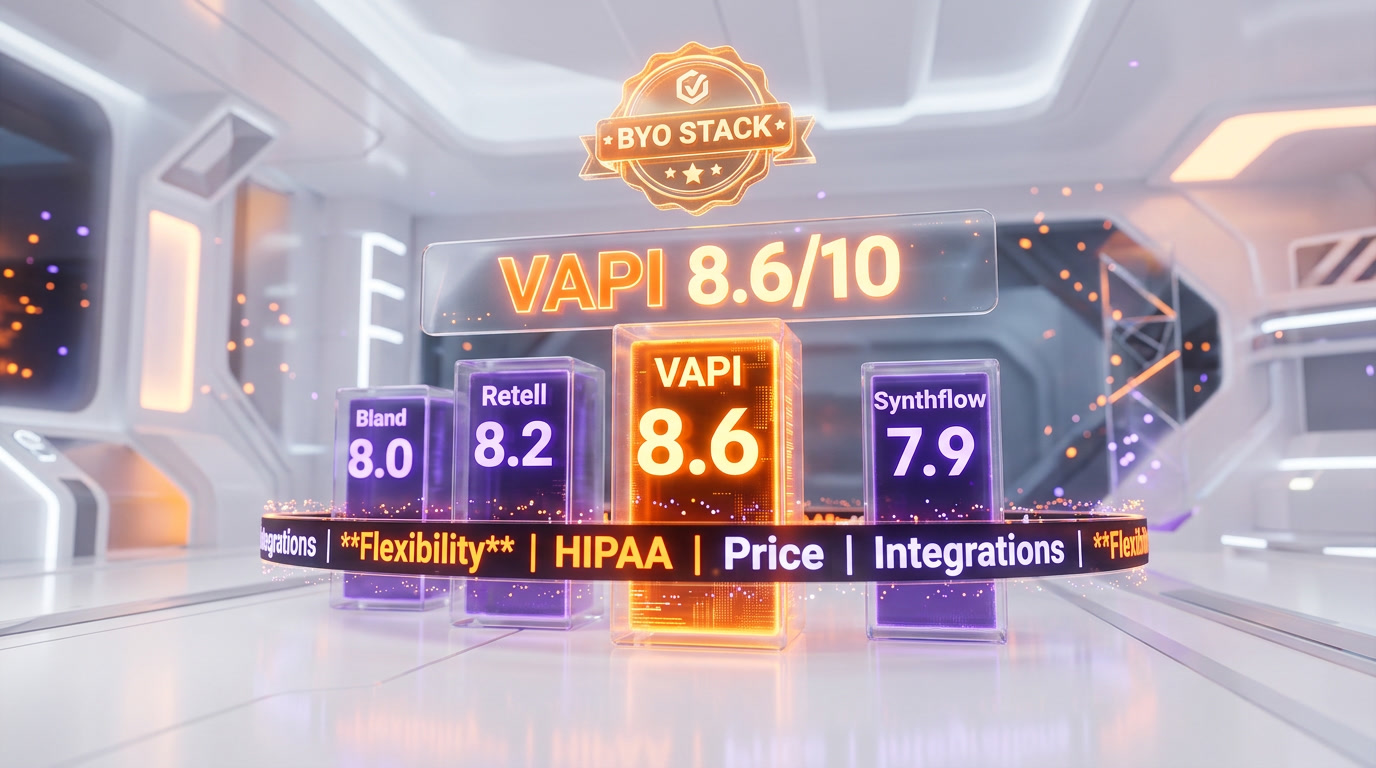
| Dimension | Vapi | Retell AI | Bland AI | Synthflow |
|---|---|---|---|---|
| Philosophy | Orchestration layer, BYO providers | Managed infra, tuned latency | Owned end-to-end voice model | No-code visual builder |
| Average latency | ~800 ms | ~600 ms | ~900 ms | ~1000 ms |
| Orchestration base | 5 cents per minute | Bundled | Bundled | Bundled |
| Realistic all-in | 13 to 31 cents per minute | Starting 10 cents per minute | Starting 9 cents per minute | Starting 13 cents per minute |
| HIPAA / SOC 2 | 1,000 dollar monthly add-on | Included | Included | Included (healthcare tier) |
| Setup | JSON + API | Drag-and-drop + API | API-first, no-code v2 | Full visual builder |
| Multi-model swap | Native, every stage | Limited | Locked to Bland voice | Limited |
| Best for | Developers and agencies | Healthcare and regulated | High-volume outbound | Non-technical operators |
Vapi vs Retell AI
Retell is the closest rival. Both target developers. Both expose clean APIs. The split is philosophy: Retell manages the whole stack and tunes latency aggressively — 600 ms average response time is real-world best-in-class in 2026. Vapi gives you the knobs and expects you to turn them. If your ops team has Deepgram and ElevenLabs accounts already and you want to use them, pick Vapi. If you want low-latency out of the box with zero configuration, pick Retell.
Vapi vs Bland AI
Bland built its own voice model end-to-end. That locks you in to Bland's voice character but eliminates the multi-provider orchestration overhead. Bland wins on outbound dialer volume (the product is heavily optimized for sales). Vapi wins on stack flexibility and ecosystem. Think of Bland as the iPhone and Vapi as Android of voice AI.
Vapi vs Synthflow
Synthflow targets non-technical operators. The product is a visual flow builder with sub-100 ms audio routing and carrier-grade uptime on infrastructure Synthflow controls end-to-end. Healthcare, finance and international-heavy teams pick Synthflow because the compliance story is complete out of the box (SOC 2, HIPAA, GDPR, ISO 27001). Developers with custom logic pick Vapi.
Air.ai, Ringly.ai, Phonic, Hamming
A few smaller players worth mentioning. Air.ai targets sales-heavy outbound with 10-40 minute conversation capability. Ringly.ai is Shopify-native with e-commerce integrations baked in. Phonic and Hamming ship testing and evaluation tooling for voice agents — complementary to Vapi, not direct replacements.
Real-World Use Cases Worth Building On Vapi
Based on three weeks of testing and conversations with agencies shipping Vapi in production, these are the workflows where Vapi pays for itself.
Outbound sales dialers
Load a CSV of leads, fire calls at 50-100 concurrent numbers, qualify on objection triggers, book demos, push CRM records via webhook. Vapi's cost structure works at this volume because Gemini 2.5 Flash and Cartesia Sonic drop per-minute costs to the low teens. Agencies charge clients 1 to 3 dollars per qualified lead and keep healthy margins.
Inbound customer support
Upload your product docs and FAQs to the Knowledge Base. Route inbound calls to an assistant that answers from RAG, escalates to a human on unresolved queries, and logs every interaction to your ticket system via end-of-call-report webhook. Resolution rates on well-configured agents run 60 to 70 percent for routine inquiries.
Appointment booking
Clinics, salons, service businesses. Vapi agent answers the phone, checks Cal.com or Google Calendar availability via function call, confirms the slot with the caller, writes the booking back. Voicemail detection catches the cases where nobody picks up outbound confirmation calls. This use case is where Vapi hits product-market fit for small-business verticals.
Virtual receptionist
Business-hours routing, voicemail detection, call transfer to the right human extension based on what the caller says. Cheap to build. Retains 80 percent of inbound volume that would otherwise hit voicemail.
Outbound survey and research
Structured JSON output via function calls turns a voice call into a data row. Run hundreds of research interviews overnight, pipe the results into a warehouse, analyze in the morning.
Restaurant order and reservation handling
Peak-hour overflow. Agent takes orders, confirms total, pushes to the POS via webhook. Restaurants that adopt this retain 20 to 30 percent of calls that would otherwise ring out.
What We Observed Testing Vapi
Three things stood out across our testing.
First, the latency claim holds when you use the fast providers. Deepgram Nova-3 plus Gemini 2.5 Flash plus Cartesia Sonic lands under 700 milliseconds end-to-end in our tests — close to Retell's claimed 600 ms and well inside the natural-conversation threshold. Swap Deepgram for AssemblyAI and the number creeps to 900 ms. Swap Cartesia for ElevenLabs Turbo and you add another 150 ms. Provider choice matters more than the platform.
Second, cost discipline is a skill. The advertised 5 cents per minute is the tip of the iceberg. A reckless stack (GPT-5 + ElevenLabs Multilingual + Whisper + Twilio) runs 31 cents per minute. A disciplined stack (Gemini 2.5 Flash + Cartesia Sonic + Deepgram Nova-2 + Vapi number) runs 13 cents per minute. Teams that don't benchmark their stack bleed budget fast.
Third, Squads is the killer feature almost nobody talks about. Chaining specialized assistants with context-preserving transfer is how you handle real phone flows. Most tutorials stop at a single assistant handling everything. Production setups with a greeter, a qualifier and a closer handing context between them convert 30 to 40 percent better than monolithic assistants.
Enterprise Readiness
Vapi's enterprise story is in three layers.
- Infrastructure — 99.9 percent uptime target, US and EU deployment regions, multi-tenant isolation
- Compliance — HIPAA and SOC 2 Type II available as a 1,000 dollar per month add-on, signed BAAs for healthcare tenants
- Support — 24/7 dedicated support on Enterprise plans, named customer success contact, Slack Connect channels
The compliance add-on cost is the part that stings for healthcare-heavy buyers. Retell AI and Bland AI bundle HIPAA in standard pricing. If your regulated call minutes are low but persistent, the 12,000 dollar annual floor on Vapi compliance is real overhead that competitors don't charge.
Who Should Use Vapi?
Ideal users
- Developer-led agencies building bespoke voice agents for multiple clients across verticals
- Engineering teams already running in-house Deepgram, ElevenLabs and OpenAI accounts who want to reuse existing provider contracts
- Startups shipping voice features inside consumer or SaaS products where model flexibility trumps latency
- Technical founders prototyping outbound or inbound voice agents before committing to a managed platform
- Ops teams with compliance budget and developer support for the 1,000 dollar monthly HIPAA add-on
Not the best fit for
- Non-technical operators who need a drag-and-drop flow builder — Synthflow or Lindy are better
- Healthcare-only teams that cannot absorb a 12,000 dollar annual compliance floor — Retell or Bland include HIPAA
- Teams chasing absolute lowest latency — Retell's 600 ms managed stack beats Vapi's 800 ms average
- High-volume outbound sales at razor margins — Bland's owned voice model undercuts Vapi on per-minute cost at scale
Our Verdict: 8.6 out of 10
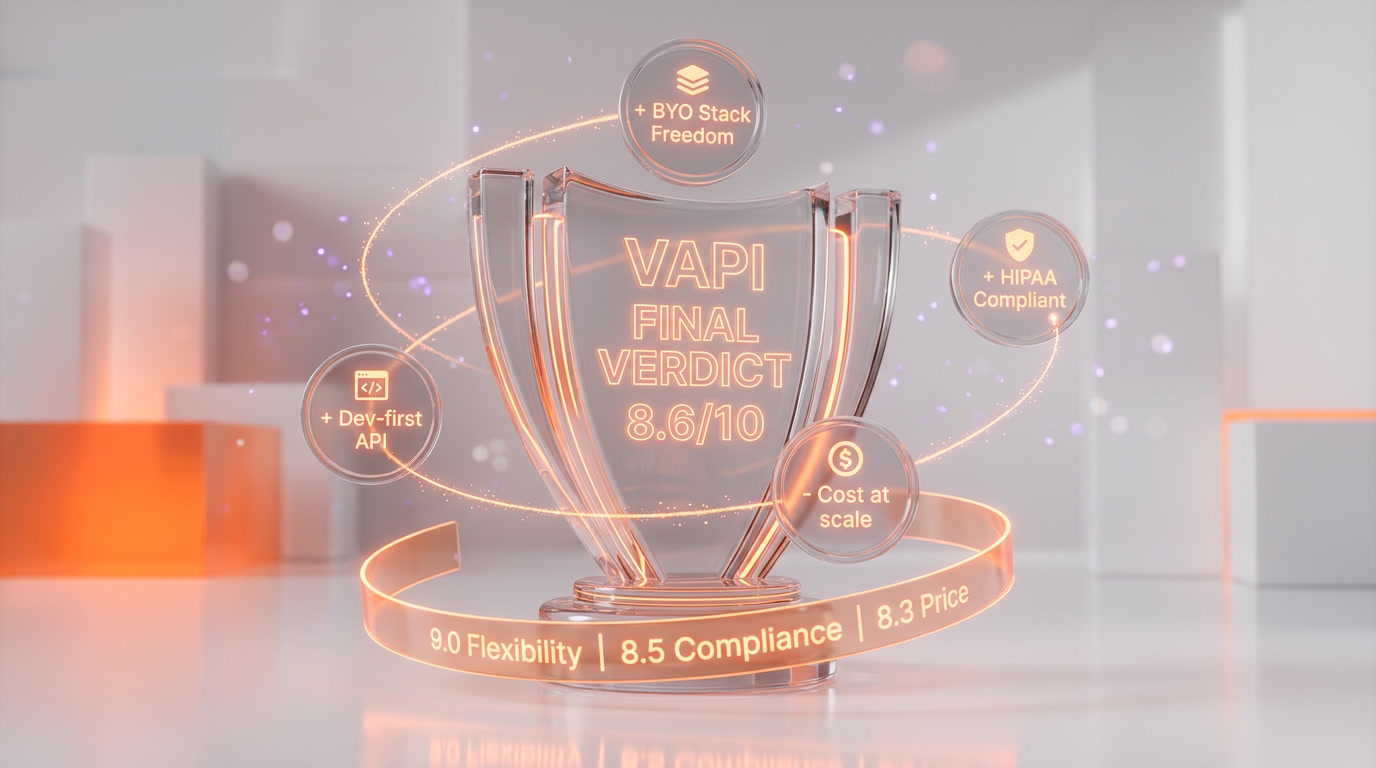
Vapi earns an 8.6 out of 10. The Assistants API, Squads orchestration, and provider-agnostic stack are genuinely the cleanest primitives in the voice AI market today. Developers who already know their way around Deepgram and ElevenLabs will build production agents in days, not weeks. Agencies billing clients for custom phone automation will find that Vapi scales to dozens of client deployments without friction.
What keeps it from 9.5 is pricing honesty and compliance positioning. The 5-cent base rate is real but it is one line item in a five-line bill, and the lack of bundled HIPAA pushes healthcare buyers toward Retell and Bland. For a developer-first product the documentation, SDKs and ecosystem are all excellent. For a mainstream buyer the platform still demands that you know what you want.
Score breakdown:
- Features: 9.3 out of 10 — Squads, multi-provider orchestration, function calling, Knowledge Base, voicemail detection and SIP trunking are the most complete feature set among voice AI platforms in 2026
- Ease of Use: 7.8 out of 10 — developer-first UX trades accessibility for power; the dashboard helps but JSON assumptions run deep
- Value: 8.4 out of 10 — realistic cost sits at parity with alternatives; flexibility is the extra value that justifies parity pricing
- Support: 8.2 out of 10 — strong community, active Discord, responsive docs team; 24/7 support gated behind Enterprise
Bottom line: if you are a developer or an agency, start with Vapi. If you are a non-technical team or a healthcare-only shop, the orchestration flexibility is not worth the learning curve or the compliance add-on. For everyone in between, the right question is not Vapi or something else — it is what provider stack do I want to run inside Vapi?
Frequently Asked Questions
What is Vapi AI and what does it actually do?
Vapi is a developer-first orchestration platform for voice AI agents. It stitches speech-to-text, a large language model, text-to-speech and telephony into a single streaming pipeline so you can build phone agents that handle real conversations. Vapi does not build its own voice or language model — it gives you the glue to combine the best provider for each stage.
How much does Vapi really cost per minute?
Vapi's base orchestration fee is 5 cents per minute. Realistic all-in cost lands between 13 and 31 cents per minute once you add speech-to-text (roughly 1 cent), the language model (2 to 20 cents), text-to-speech (3 to 6 cents) and telephony (1 to 2 cents). A premium stack on GPT-5 and ElevenLabs costs about 3 dollars for a 10-minute call. A budget stack on Gemini 2.5 Flash and Cartesia Sonic costs about 1.30 dollars for the same call.
Does Vapi support Claude, GPT-5 and Gemini?
Yes. Vapi natively supports OpenAI (GPT-4o, GPT-5, GPT-5 mini), Anthropic (Claude 4.7, Claude 4.5 Haiku), Google (Gemini 2.5 Pro and Gemini 2.5 Flash), Mistral, Cohere, Groq and Together. A Bring Your Own Model option exposes a custom LLM endpoint for regulated or proprietary models you host yourself.
Which STT and TTS providers does Vapi support?
For speech-to-text Vapi supports Deepgram (Nova-2 and Nova-3), OpenAI Whisper, AssemblyAI, Rev.ai, Azure Speech, Google Speech-to-Text and Gladia. For text-to-speech Vapi supports ElevenLabs, Cartesia (Sonic for lowest latency), PlayHT, Rime AI, Deepgram Aura, Azure Neural, OpenAI TTS and Smallest AI. You pick providers per assistant in JSON configuration.
Is Vapi HIPAA and SOC 2 compliant?
HIPAA and SOC 2 Type II compliance are available on Vapi as a 1,000 dollar per month add-on on Enterprise plans, including signed Business Associate Agreements for healthcare tenants. This add-on is the main pricing downside versus Retell AI and Bland AI, which include HIPAA compliance in their standard pricing.
Vapi vs Retell AI — which is better in 2026?
Retell AI wins on out-of-the-box latency (roughly 600 milliseconds end-to-end) and bundled compliance. Vapi wins on provider flexibility — you can mix and match speech-to-text, language model and text-to-speech engines per assistant. For healthcare and regulated buyers pick Retell. For developer agencies shipping bespoke voice agents pick Vapi.
What is a Vapi Squad and why does it matter?
A Squad is a chain of multiple specialized assistants on a single phone call with context-preserving transfers between them. The greeter hands to the qualifier, who hands to the closer, each agent inheriting the full transcript and captured state. Production flows built on Squads convert 30 to 40 percent better than monolithic single-assistant setups because each agent is focused on one job.
Can Vapi integrate with Twilio for phone numbers?
Yes. Vapi supports Twilio SIP trunking through the /phone-numbers/import endpoint and direct Twilio number imports. The SIP URI format is sip:YOUR_PHONE_NUMBER@<credential_id>.sip.vapi.ai on the Twilio side. Vonage, Plivo and generic BYO SIP providers are also supported with IP-based authentication.
Does Vapi offer voicemail detection?
Yes. Voicemail detection is configurable in the assistant settings or by adding VoicemailTool to the model tools array. It is disabled by default. When enabled, Vapi detects voicemail pickup within the first few seconds of a call and either leaves a scripted message or hangs up, preventing you from billing model and telephony minutes on dead calls.
Is Vapi good for non-technical users?
Not really. Vapi is developer-first — the product assumes you read API documentation and write JSON configuration before you ship. The dashboard helps with exploration and monitoring but is not a full no-code builder. Non-technical operators are better served by Synthflow or Lindy, which ship drag-and-drop flow builders as their primary interface.
Who uses Vapi today?
Vapi serves more than 500,000 developers and has processed over 300 million calls as of early 2026. Customers range from startups to Fortune 500 teams building outbound sales automation, customer support, appointment booking and lead qualification. The company has 153 employees, is backed by Bessemer Venture Partners, Y Combinator (W24), Abstract Ventures, AI Grant, Saga Ventures and Michael Ovitz, and raised a 20 million dollar Series A in December 2024 at a 130 million dollar valuation.
Key Features
Pros & Cons
Pros
- Provider-agnostic orchestration layer — bring your own Deepgram, Whisper, GPT-5, Claude 4.7, Gemini, ElevenLabs, Cartesia, PlayHT, Rime, Azure, Deepgram TTS
- Squads let you chain multiple specialized assistants on a single call with context-preserving transfers
- Native function calling, custom tools via webhook, Code Tools executing TypeScript on Vapi infrastructure, and prebuilt integrations (Make, GoHighLevel)
- Low latency orchestration around 700-800 milliseconds end-to-end when paired with fast providers like Deepgram Nova and Cartesia Sonic
- Knowledge Base (RAG) accepts uploaded documents so agents answer from internal docs during live calls
- Voicemail detection, live call transfer, DTMF, hold-music, background-noise cancellation, and recording all available via assistant config
- Twilio and Vonage SIP trunk integration, free US national numbers, import your own numbers through /phone-numbers/import
- Server Events webhooks fire on call start, transcript, function call, end-of-call-report, giving you full observability
- Backed by Bessemer Venture Partners, Y Combinator (W24), Abstract Ventures, AI Grant, Saga Ventures and Michael Ovitz — $20M Series A at $130M valuation (December 2024)
- Scale proven — 300M+ calls processed, 500,000+ developers, 153 employees as of January 2026
Cons
- True per-minute cost sits between 13 and 31 cents once you add STT, LLM, TTS and telephony on top of the 5-cent orchestration fee — the advertised base rate undersells real spend
- Developer-first means JSON-heavy setup — there is a dashboard, but the product assumes you read API docs before you ship
- HIPAA and SOC 2 compliance cost an extra 1,000 dollars per month add-on, while Retell AI and Bland AI ship compliance in their standard plans
- No native no-code visual flow builder like Bland AI or Synthflow — Squads and tools are configured in JSON and API calls
- Latency tops out around 800 milliseconds average in third-party benchmarks, roughly 200 milliseconds slower than Retell AI
- Cost unpredictability on long calls — a single 10-minute conversation with GPT-5 and ElevenLabs can cost 2.50 to 3.00 dollars end-to-end
Best Use Cases
Platforms & Integrations
Available On
Integrations

We're developers and SaaS builders who use these tools daily in production. Every review comes from hands-on experience building real products — DealPropFirm, ThePlanetIndicator, PropFirmsCodes, and many more. We don't just review tools — we build and ship with them every day.
Written and tested by developers who build with these tools daily.
Frequently Asked Questions
What is Vapi?
The developer-first voice AI orchestration platform — bring your own STT, LLM, TTS and telephony, ship phone agents in days
How much does Vapi cost?
Vapi has a free tier. Premium plans start at $0.05/month.
Is Vapi free?
Yes, Vapi offers a free plan. Paid plans start at $0.05/month.
What are the best alternatives to Vapi?
Top-rated alternatives to Vapi include Wispr Flow (9.1/10), Suno AI (9.1/10), Cartesia (9/10), ElevenLabs (9/10) — all reviewed with detailed scoring on ThePlanetTools.ai.
Is Vapi good for beginners?
Vapi is rated 7.8/10 for ease of use.
What platforms does Vapi support?
Vapi is available on Web dashboard, REST API, Web SDK (browser client), Server SDKs (Node, Python, Ruby, Go), Twilio SIP trunk, Vonage SIP trunk, BYO SIP provider.
Does Vapi offer a free trial?
Yes, Vapi offers a free trial.
Is Vapi worth the price?
Vapi scores 8.4/10 for value. We consider it excellent value.
Who should use Vapi?
Vapi is ideal for: Outbound sales dialers that qualify leads, book demos and hand off to human closers on objection triggers, Inbound customer support phone agents with RAG over internal knowledge bases and escalation to human agents, Appointment booking for clinics, salons and service businesses integrated with calendaring (Cal.com, Calendly, Google Calendar), Outbound survey and research calls at scale with structured JSON output piped into data warehouses, Receptionist and front-desk replacement with voicemail detection, call transfer and business-hours routing, Lead qualification inside agencies plugging Vapi into GoHighLevel or Make for CRM sync, Insurance, mortgage and loan intake calls with compliance recording and consent capture, Restaurant order-taking and reservation handling during peak hours when human staff can't pick up, Developer-agency engagements building bespoke voice agents for Fortune 500 customers as a service layer.
What are the main limitations of Vapi?
Some limitations of Vapi include: True per-minute cost sits between 13 and 31 cents once you add STT, LLM, TTS and telephony on top of the 5-cent orchestration fee — the advertised base rate undersells real spend; Developer-first means JSON-heavy setup — there is a dashboard, but the product assumes you read API docs before you ship; HIPAA and SOC 2 compliance cost an extra 1,000 dollars per month add-on, while Retell AI and Bland AI ship compliance in their standard plans; No native no-code visual flow builder like Bland AI or Synthflow — Squads and tools are configured in JSON and API calls; Latency tops out around 800 milliseconds average in third-party benchmarks, roughly 200 milliseconds slower than Retell AI; Cost unpredictability on long calls — a single 10-minute conversation with GPT-5 and ElevenLabs can cost 2.50 to 3.00 dollars end-to-end.
Best Alternatives to Vapi
Ready to try Vapi?
Start with the free plan
Try Vapi Free →