Whisper Large v3
OpenAI's flagship speech-to-text model — 2.7% WER on clean audio, 99 languages, $0.006 per minute via API.

Quick Summary
Whisper Large v3 is OpenAI's open-source speech-to-text model with 1.55B parameters. It hits 2.7% WER on clean audio across 99 languages. Self-host free (MIT license) or call the OpenAI API at $0.006 per minute. Score: 8.6/10.
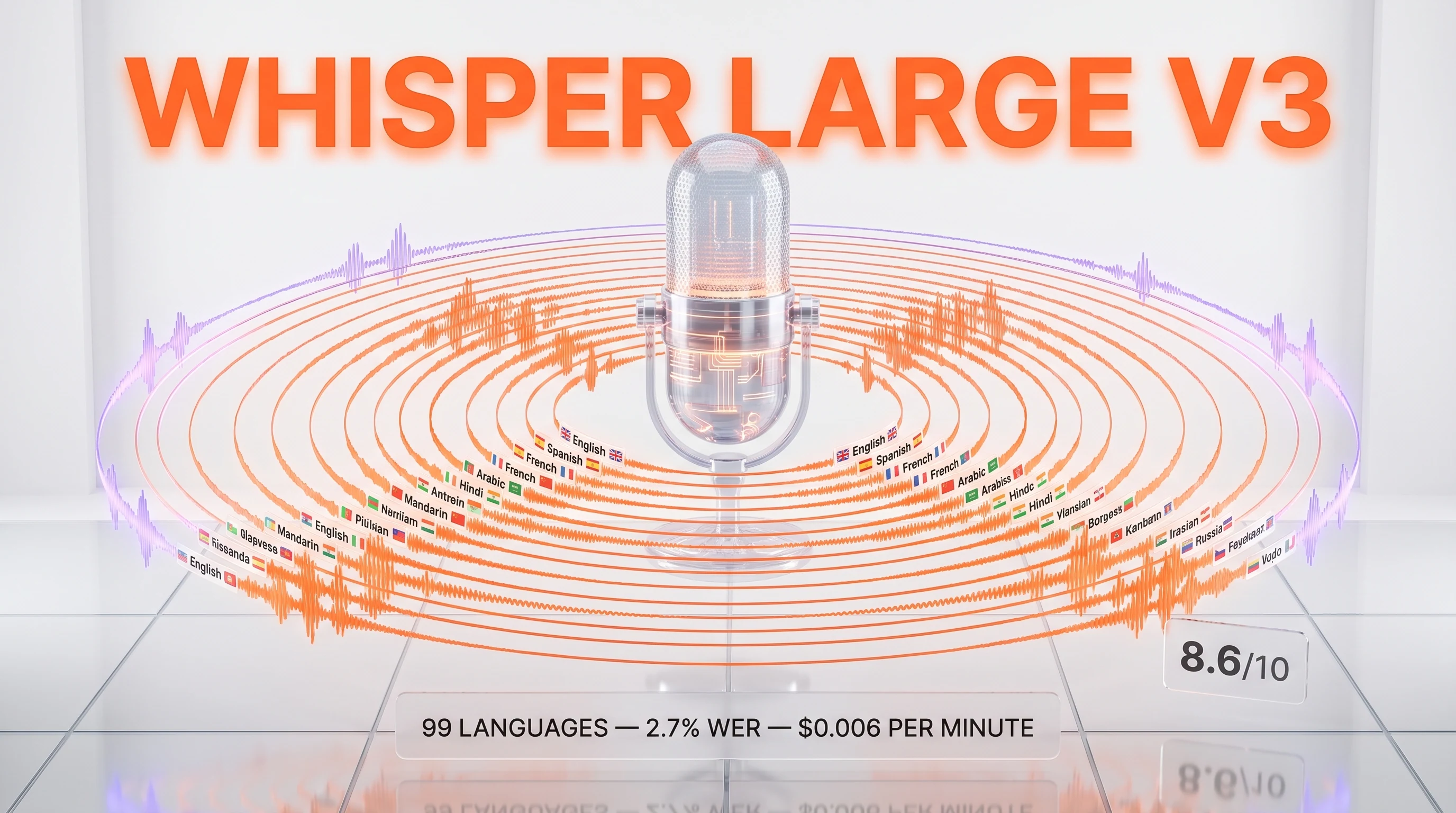
Whisper Large v3 is OpenAI's flagship speech-to-text model, released December 2022 with 1.55 billion parameters. It transcribes 99 languages with 2.7% word error rate on clean audio. Pricing: free self-hosted under MIT license, or $0.006 per minute via the OpenAI API. Score: 8.6 out of 10.
Our Methodology for This Review
We have not deployed Whisper Large v3 ourselves on a production transcription pipeline at ThePlanetTools. This review compiles OpenAI's official model card on Hugging Face (last checked April 2026), the open-source repository on GitHub (98.6k stars), the MLPerf Inference v5.1 ASR benchmark from MLCommons (September 2025), the Artificial Analysis Speech-to-Text Index leaderboard, the academic paper (arXiv 2212.04356), and community feedback aggregated from Hugging Face discussions (230 active threads), Reddit r/MachineLearning, and benchmark posts on Medium and SambaNova's engineering blog.
Our score reflects feature completeness, benchmark performance versus commercial alternatives (ElevenLabs Scribe v2, Deepgram Nova-3, AssemblyAI Universal-3 Pro, Google Chirp), pricing transparency, and ecosystem depth. We do not score real-time performance because Whisper Large v3 is not designed for streaming — for that use case we route readers to Deepgram or ElevenLabs in our Alternatives section.
TL;DR — Our Verdict
Score: 8.6 out of 10. Whisper Large v3 is the best-in-class open-source speech-to-text model in 2026, with 2.7% word error rate on clean audio across 99 languages — performance that matches or beats commercial STT APIs costing 6-10x more. Best for batch transcription pipelines, podcast indexing, subtitle generation, and any team that wants to self-host and cap costs. Skip it if you need sub-second streaming latency (use Deepgram Nova-3 instead) or if hallucination resistance is critical for high-stakes content like medical or legal dictation without a post-processing layer.
- Best open-source WER on the market — 2.7% on clean audio, 4.2% on real-world via fal.ai benchmark
- 99 languages with auto-detection, MIT license, $0.006 per minute via OpenAI API or free self-hosted
- Word-level timestamps work out of the box — perfect for subtitles and audio search
- Hallucination risk on long audio — community filters detect 5-10 hallucinations per 45-minute video
- Not real-time — designed for batch, not streaming voice agents
What Is Whisper Large v3?
Whisper is OpenAI's robust speech recognition system, first published in September 2022 by Alec Radford and team. The Large v3 variant launched December 6, 2022 as the third generation of the flagship multilingual model. Architecture is a transformer-based encoder-decoder (sequence-to-sequence) with 1.55 billion parameters. The big upgrade in v3: 128 mel frequency bins on the input spectrogram, up from 80 in v2, giving the model sharper acoustic features and roughly 10-20% error reduction across most languages. Cantonese support was also added.
Training corpus is massive — 5 million hours of audio total. One million hours are weakly labeled (audio paired with imperfect transcripts scraped from the web), and four million hours are pseudo-labeled by Whisper Large v2 itself. The team trained for 2.0 epochs over the mixture. The result is a model that handles 99 languages robustly, even noisy real-world audio with accents, background noise, and technical jargon.
Whisper is open-source under the MIT license — code, weights, and documentation are all on GitHub (98.6k stars, 12.1k forks) and Hugging Face (4.8 million downloads in the last month, 230 community discussions). The same weights also power OpenAI's hosted Audio API at audio.transcriptions with model name whisper-1, billed at $0.006 per minute of audio with no language or format premium.
Key Features
Multilingual transcription across 99 languages
Whisper Large v3 transcribes 99 languages with automatic language detection. On Common Voice 15, the most comprehensive multilingual STT benchmark, it averages around 10% WER across all supported languages. High-resource languages (English, Spanish, French) maintain 3-8% WER. Medium-resource languages (German, Portuguese, Italian) sit at 8-15%. Low-resource regional languages (64 variants) range 15-40%+ due to limited training data — accuracy drops on dialects and underrepresented speech patterns. v3 is the first version to support Cantonese, which v2 missed.
Word-level and segment timestamps
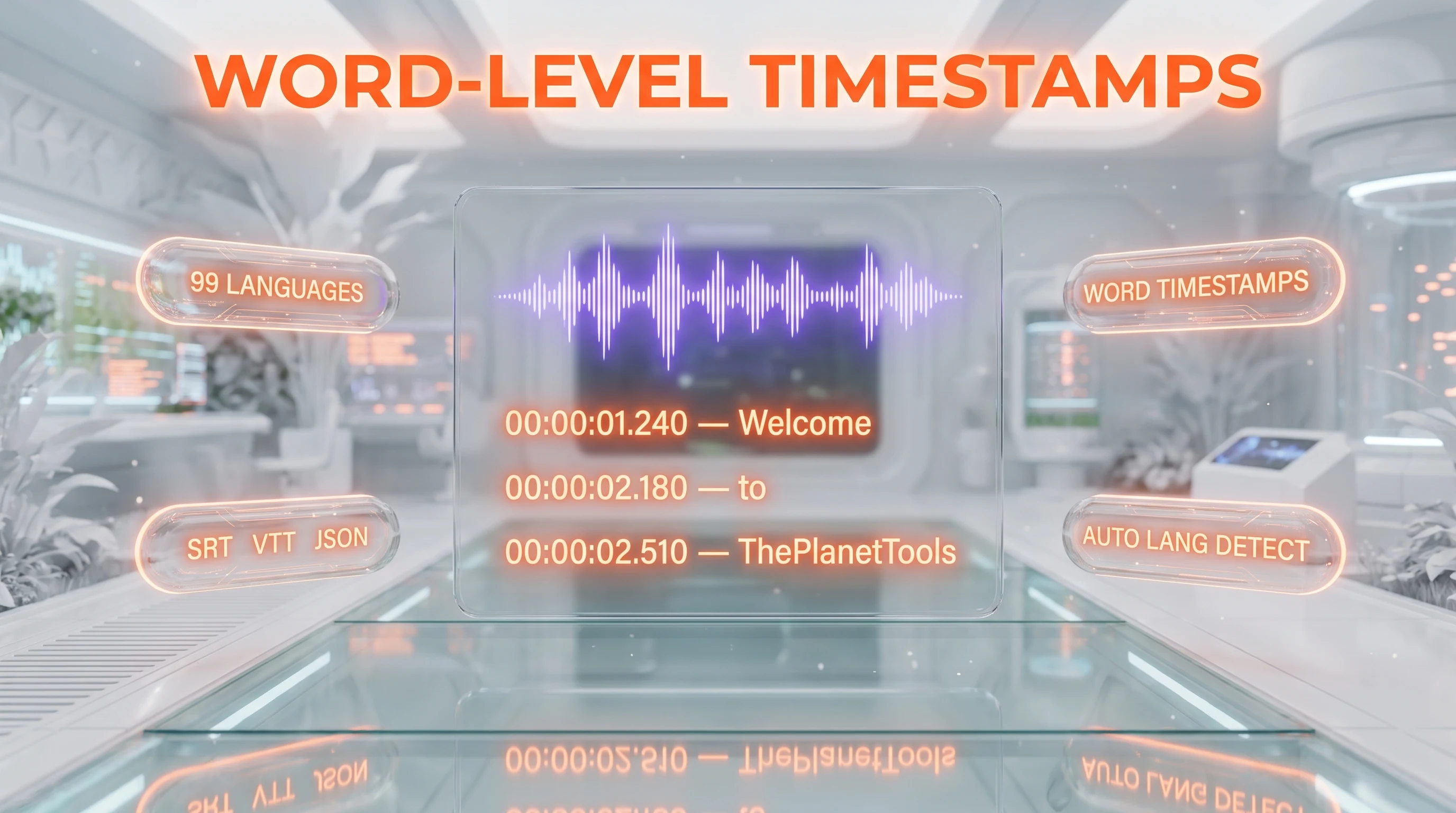
Pass return_timestamps="word" in Hugging Face Transformers, or response_format="verbose_json" with timestamp_granularities=["word"] in the OpenAI API, and Whisper returns each word with millisecond-precision start and end times. This is the killer feature for podcast indexing, subtitle generation (SRT/VTT export), audio search engines, and any workflow that needs to jump to a specific moment in long audio.
Built-in speech translation to English
Whisper can translate any of its 99 supported source languages directly to English in a single forward pass. Set the task parameter to translate and the output is English text regardless of input language. Saves a separate translation step in localization pipelines and avoids the compounding error of chained ASR + translation models.
Prompt parameter for domain vocabulary
Whisper supports a prompt parameter that biases the transcription toward a specific vocabulary. Useful for medical terminology, legal jargon, brand names, or proper nouns the model has not seen often. The prompt does not need to be a full transcript — a few sentences of representative vocabulary is enough to nudge the decoder.
Multiple response formats
Output as json, verbose_json (with timestamps and segment metadata), srt, vtt, or plain text. Subtitle formats are generated natively without a post-processing pass.
Open weights under MIT license
The model card on Hugging Face exposes safetensors and PyTorch weights at 2GB (F16). You can self-host on a single H100, A100, RTX 4090, or even consumer cards (4070+ for inference). C++ port whisper.cpp by Georgi Gerganov runs on CPU and CoreML on Apple Silicon. Faster-Whisper, a CTranslate2 reimplementation, achieves up to 4x speedup vs the reference PyTorch implementation. ONNX, MLX, and quantized variants (24 versions on HF) cover edge deployment.
Massive ecosystem of fine-tunes and ports
The Hugging Face hub lists 823 fine-tuned variants of Whisper Large v3, 199 adapter models, and 100+ Spaces. Domain-specific fine-tunes exist for medical, legal, customer support, telephony (8kHz), and underrepresented languages. Hosted inference is available on Replicate, Groq Cloud (216x real-time on LPU hardware), SambaNova Cloud, fal.ai, AWS SageMaker JumpStart, and Azure OpenAI Service.
Benchmark leadership
From the Hugging Face Open ASR Leaderboard (April 2026): Mean WER 7.44% across the multi-dataset evaluation, RTFx 145.51, Librispeech Clean 2.01% WER, Librispeech Other 3.91% WER. On Artificial Analysis Speech-to-Text Index (via fal.ai endpoint), Whisper Large v3 hits 4.2% WER at 46x real-time speed for $1.15 per 1,000 minutes. Best-in-class for open-source STT and competitive with closed commercial APIs.
Whisper Large v3 Pricing in 2026
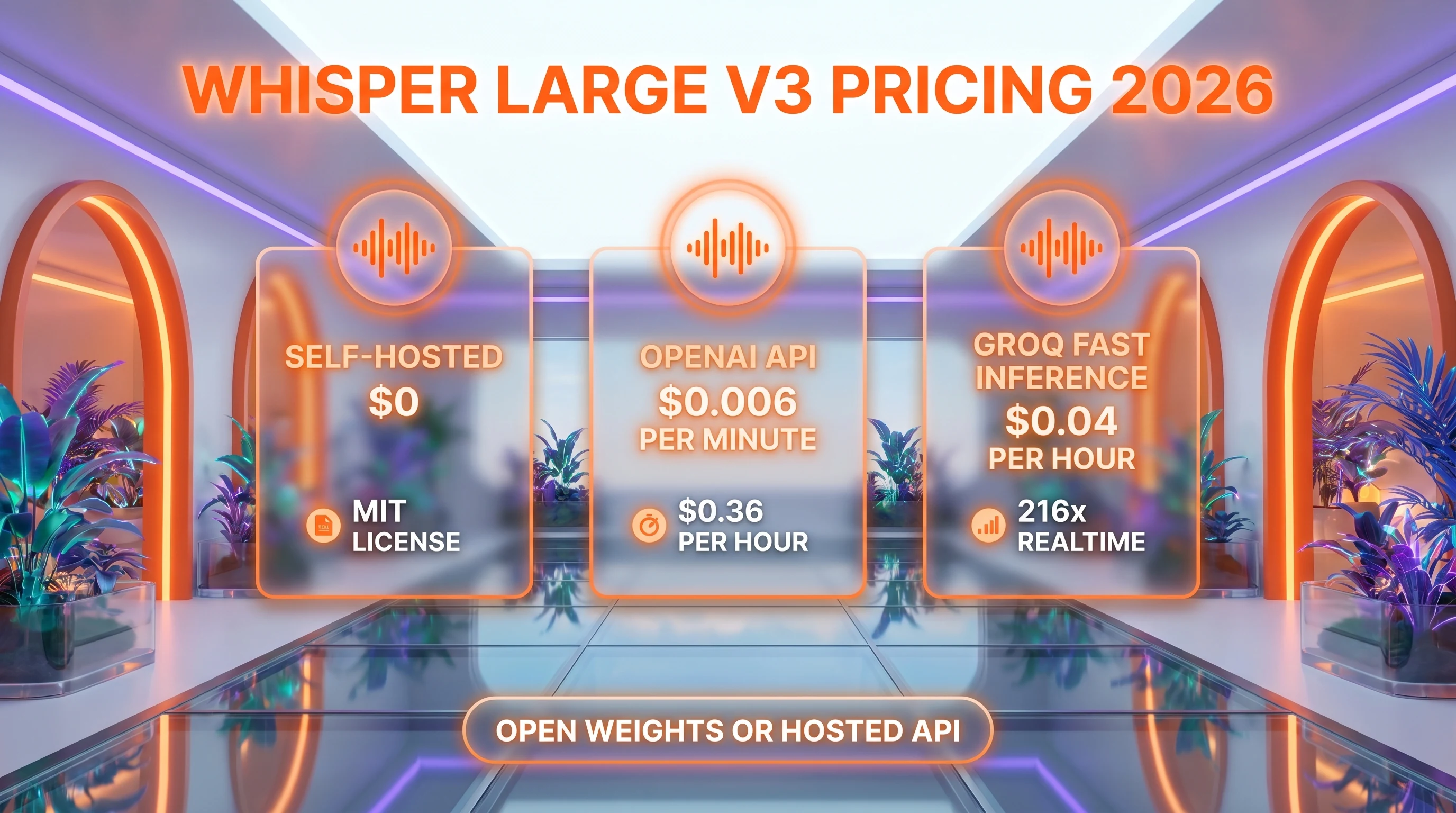
Whisper Large v3 has two pricing paths: free self-hosted (open weights) or $0.006 per minute via the OpenAI hosted API. There are also third-party hosted options at varying price points and speed/accuracy tradeoffs.
| Option | Price | Key Features |
|---|---|---|
| Self-hosted (open weights) | $0 (compute cost only) | MIT license, run on any GPU/CPU, full control over privacy and latency, no per-minute fee, requires DevOps skills |
| OpenAI Audio API | $0.006 per minute ($0.36 per hour) | Hosted at audio.transcriptions, model whisper-1, no language premium, 25MB max file size, response_format options, prompt parameter |
| Groq Cloud (whisper-large-v3) | ~$0.04 per audio hour (216x real-time on LPU) | Sub-second inference for short audio, hosted on custom LPU silicon, fastest production endpoint for Whisper |
| fal.ai (whisper-large-v3) | $1.15 per 1,000 minutes | Serverless GPU, 46x real-time, simple REST API, used by Artificial Analysis benchmark |
| Replicate, SambaNova, AWS, Azure | Varies (~$0.005-$0.030 per minute) | Hosted endpoints with regional availability, SLAs, enterprise compliance options |
Best for: Self-hosted is best for teams with DevOps skills processing massive archives (millions of hours) where per-minute fees become prohibitive. The OpenAI API at $0.006 per minute is the cheapest hosted option for sporadic or moderate volume — one hour of transcription costs $0.36, a 1,000-podcast batch averaging 45 minutes each costs $270. Groq is the speed champion when you need short audio transcribed in under a second.
Pricing source verified: OpenAI Audio API pricing $0.006 per minute confirmed via developers.openai.com pricing page and corroborated by TokenMix, Lemonfox, and CostGoat pricing trackers, all reporting the same rate as of April 2026. The rate has been stable since the API launched in March 2023.
Pros and Cons After Research
What stands out
- Best open-source WER on the market. 2.7% WER on clean audio matches commercial APIs that charge 6-10x more per minute. On the Artificial Analysis leaderboard, Whisper Large v3 sits at 4.2% WER, beaten only by ElevenLabs Scribe v2 (2.3%) and AssemblyAI Universal-3 Pro (3.2%) — both closed-source.
- MIT license unlocks zero-cost scale. Self-hosting on a single H100 or even consumer GPUs (RTX 4090, 4070+) gives you unlimited transcription with no per-minute charge. Faster-Whisper hits real-time on CPU with quantized models. For million-hour archives, self-hosting saves five or six figures per year vs hosted APIs.
- 99-language coverage with auto-detection. Unmatched at this price point. Deepgram and AssemblyAI lock multilingual behind premium tiers; Google Chirp covers more languages but at 31.3% average WER, vs Whisper's 4-15% on most. For multilingual products, Whisper is the cost-quality sweet spot.
- Word-level timestamps work out of the box. Subtitle generation, podcast indexing, audio search engines — all of these need word-level timing. Whisper exposes it natively in JSON, SRT, and VTT. No post-processing required.
- OpenAI API at $0.006 per minute is one of the cheapest hosted STT options. One hour costs $0.36, and pricing has not changed since 2023. Compare to Deepgram Nova-3 at $4.30 per 1,000 minutes ($0.258 per hour) or AssemblyAI at $3.50 per 1,000 minutes ($0.21 per hour) — Whisper API undercuts both significantly.
- Built-in speech translation to English. Set
task=translateand any of 99 source languages comes out as English in one pass. Saves a separate model in localization pipelines and avoids compounding error. - Massive ecosystem and community. 4.8 million Hugging Face downloads per month, 823 fine-tunes, 230 active community threads, ports to whisper.cpp (CPU, CoreML), Faster-Whisper (CTranslate2), MLX, ONNX. Whatever your deployment target, someone has shipped a port.
Where it falls short
- Hallucinations are real. Whisper sometimes generates text that is not in the audio, especially during long silences or background music. Community filters detect 5-10 hallucinations per 45-minute video on Large v3, slightly more than v2 in some cases. For high-stakes domains (medical, legal, accessibility) you need a post-processing layer that flags low-confidence segments.
- Not real-time out of the box. Whisper is designed for batch transcription. Latency on a single GPU is 1-3 seconds per 30-second chunk, which is fine for podcasts but not for live captioning or voice agents. For sub-second streaming use Deepgram Nova-3 (140x real-time, streaming-native) or ElevenLabs Scribe v2.
- Slower than newer commercial STT APIs. Whisper Large v3 hits 46x real-time on fal.ai and 216x on Groq. Deepgram Nova-3 reaches 140x real-time on standard infrastructure. For million-hour archives where throughput matters, the gap is meaningful.
- Documented demographic bias. Stanford research (2024) and Gladia analysis show disparate WER across speaker accents, genders, and ages. Lower accuracy on African American Vernacular English, non-Western accents, and elderly speakers. If your product serves diverse populations, evaluate WER on representative samples before deploying.
Real-World Use Cases
Podcast transcription and indexing
Word-level timestamps make Whisper the default choice for podcast platforms that need searchable transcripts and chapter markers. Run the entire back catalog through self-hosted Whisper Large v3 on a single H100 — 1,000 hours of podcasts transcribe in roughly 22 hours of compute time. Cost: a few dozen dollars in GPU rental.
Meeting notes automation
Zoom, Teams, and Google Meet recordings drop straight into Whisper. The OpenAI API handles 25MB files (about 25 minutes at 16kHz mono, longer with compressed formats). Pair with Claude or GPT-5.5 for summary, action items, and decisions extraction.
Multilingual subtitle generation
Native SRT and VTT output, 99-language coverage, and built-in translation to English make Whisper the most cost-efficient subtitle pipeline for international content. YouTube creators, e-learning platforms, and global media companies route through Whisper before publishing.
Voice agent transcription pipelines
For non-real-time voice agents (asynchronous voicemail, IVR replay, batch call analysis) Whisper is excellent. For real-time conversational agents, pair Deepgram Nova-3 or ElevenLabs Scribe with Whisper as a post-processing layer for higher accuracy on low-stakes turns.
Customer support call analysis
Transcribe support call recordings, then run sentiment analysis, topic clustering, and compliance checks downstream. Whisper handles telephony audio (8kHz) reasonably well, and there are domain-specific fine-tunes on Hugging Face that boost accuracy for call center workflows.
Legal and medical dictation
Use the prompt parameter to bias the model toward domain vocabulary (medications, procedures, statutes, case law). Critical: pair with a confidence threshold and human review for any high-stakes text. Whisper hallucinations have caused real-world incidents in healthcare transcription per ABC News reporting (2024).
Content moderation pipelines
Audio and video content moderation at scale routes through Whisper for transcription, then through LLMs for policy classification. The 99-language coverage matters here — TikTok, YouTube, and other UGC platforms moderate content in dozens of languages daily.
Accessibility — captions for video
YouTube, social media platforms, and corporate e-learning rely on automated captions for ADA and WCAG compliance. Whisper's word-level timestamps and SRT output ship directly into video editors and CMS workflows.
Whisper Large v3 vs ElevenLabs Scribe vs Deepgram vs AssemblyAI
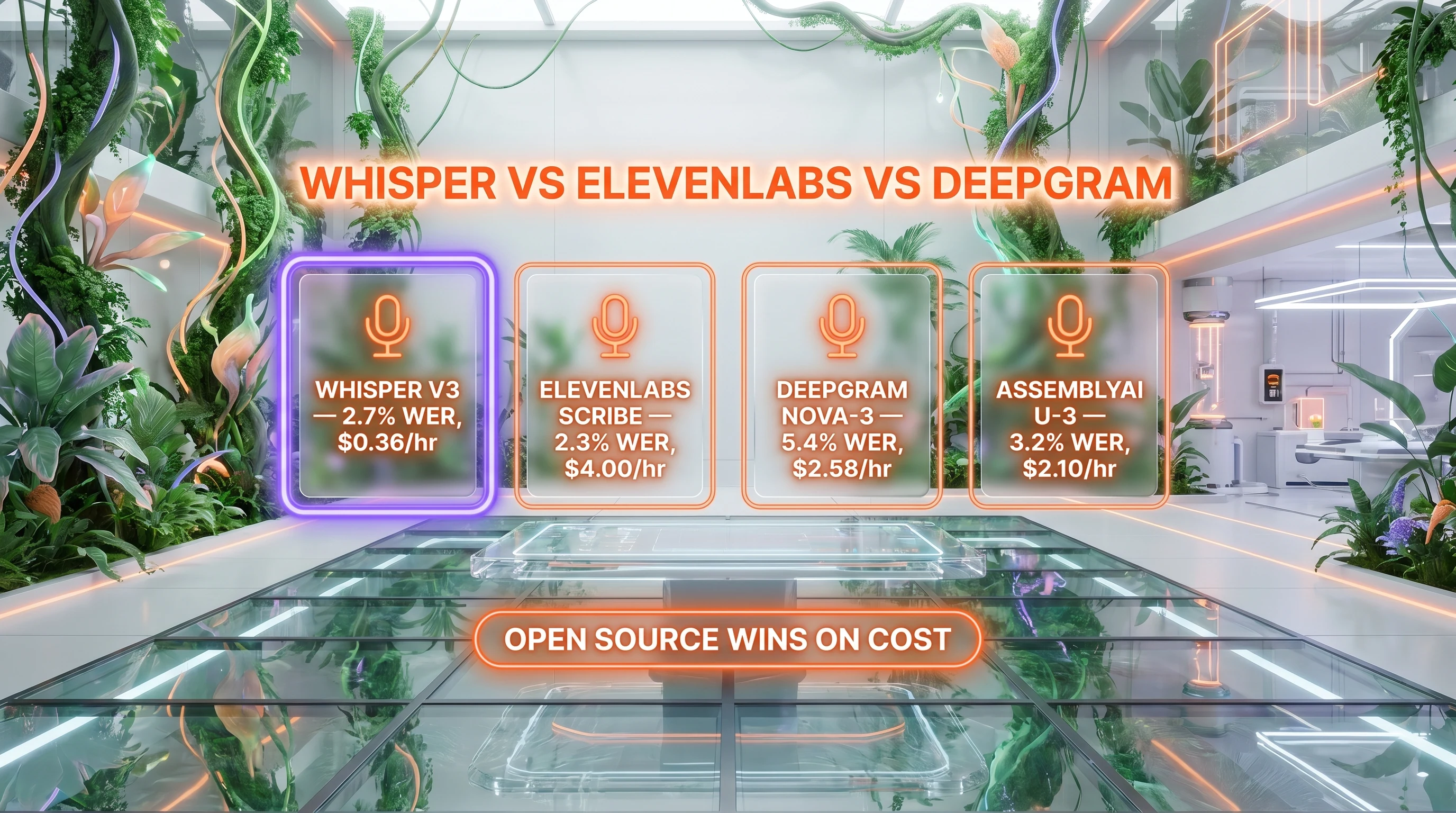
The 2026 STT landscape has four serious contenders for production transcription. Each wins a different lane.
| Feature | Whisper Large v3 | ElevenLabs Scribe v2 | Deepgram Nova-3 | AssemblyAI U-3 Pro |
|---|---|---|---|---|
| WER (Artificial Analysis) | 4.2% | 2.3% | 5.4% | 3.2% |
| Real-time speed (xRT) | 46x | 32x | 140x | 99x |
| Price per 1,000 min | $1.15 (fal.ai) / $6.00 (OpenAI) | $6.67 | $4.30 | $3.50 |
| Languages | 99 | 99+ | 36 (premium) | 50+ |
| Streaming | No (batch only) | Yes | Yes (best) | Yes |
| License | MIT (open weights) | Closed | Closed | Closed |
| Word timestamps | Yes | Yes | Yes | Yes |
| Speech translation | To English (built-in) | Limited | No | Limited |
Pick Whisper if you want to self-host, you process huge volumes (millions of hours), you need 99-language coverage at the lowest cost, or you have batch (non-streaming) workloads. Pick ElevenLabs Scribe if accuracy is everything and budget is not a constraint — 2.3% WER is the best in the industry. Pick Deepgram Nova-3 if you need streaming latency under 300ms for live captions or voice agents. Pick AssemblyAI Universal-3 Pro for the best balance of accuracy, speed, and developer experience with built-in features like speaker diarization, summarization, and PII redaction.
Frequently Asked Questions
Is Whisper Large v3 free?
Yes — the model weights are released under the MIT license and are free to download from Hugging Face and GitHub. You can run inference on your own hardware at zero per-minute cost. The OpenAI hosted API at audio.transcriptions charges $0.006 per minute as a managed alternative if you do not want to self-host.
How much does Whisper Large v3 cost via the OpenAI API in 2026?
$0.006 per minute of audio input, which works out to $0.36 per hour or $6.00 per 1,000 minutes. Pricing does not vary by language, audio format, or model variant. The rate has been stable since the audio API launched in March 2023 and was confirmed via developers.openai.com pricing page in April 2026.
What is Whisper Large v3's word error rate?
Whisper Large v3 hits 2.7% WER on clean audio (Librispeech Clean baseline 2.01%), 4.2% WER on the Artificial Analysis multi-dataset benchmark, and around 7.88% on mixed real-world audio. On low-quality call center recordings WER rises to about 17.7%. Average across all 99 supported languages is roughly 10%, with high-resource languages (English, Spanish, French) at 3-8% and low-resource regional dialects at 15-40%+.
How many languages does Whisper Large v3 support?
99 languages with automatic language detection. v3 added Cantonese, which was missing in Whisper Large v2. The complete list is in the tokenizer file in the GitHub repository. Coverage is uneven — English, Spanish, French, German, Portuguese, Italian, Japanese, Korean, and Mandarin perform best; underrepresented dialects and regional variants show 15-40% WER due to limited training data.
Is Whisper Large v3 better than v2?
Yes — Whisper Large v3 delivers a 10-20% error reduction across most languages compared to v2. The main architectural change is increasing the input mel spectrogram from 80 frequency bins to 128, which gives the model sharper acoustic features. v3 also added Cantonese support. Both versions have 1.55B parameters and the same training corpus size (5 million hours).
Can Whisper Large v3 do real-time transcription?
Not natively. Whisper is designed for batch transcription with 1-3 seconds of latency per 30-second chunk on a single GPU. For sub-second streaming latency use Deepgram Nova-3 (streaming-native, 140x real-time) or ElevenLabs Scribe v2. Hosted Whisper on Groq Cloud reaches 216x real-time on custom LPU hardware, which approaches usable streaming for some use cases.
How does Whisper Large v3 compare to ElevenLabs Scribe v2?
ElevenLabs Scribe v2 is more accurate (2.3% WER vs Whisper's 4.2% on the Artificial Analysis benchmark) but significantly more expensive ($6.67 per 1,000 minutes vs Whisper's $1.15 on fal.ai). Whisper wins on cost, language coverage, and the option to self-host. Scribe wins on raw accuracy and streaming support. Pick Scribe for high-stakes content where WER matters more than budget; pick Whisper for volume and multilingual coverage.
Does Whisper Large v3 have an API?
Yes — the OpenAI Audio API exposes Whisper Large v3 (under the model name whisper-1) at the audio.transcriptions endpoint. Maximum file size is 25MB. Supported input formats are mp3, mp4, mpeg, mpga, m4a, wav, and webm. Response formats include json, verbose_json (with timestamps), srt, vtt, and text. Third-party hosted endpoints exist on Replicate, Groq, fal.ai, SambaNova, AWS SageMaker, and Azure OpenAI Service.
What audio formats does Whisper Large v3 support?
The OpenAI Audio API accepts mp3, mp4, mpeg, mpga, m4a, wav, and webm with a 25MB file size limit (about 25 minutes at 16kHz mono, longer with compressed formats). Self-hosted Whisper accepts any format that ffmpeg can decode, which is essentially all common audio and video formats. Internally Whisper resamples to 16kHz mono mel spectrograms regardless of input format.
Does Whisper Large v3 hallucinate?
Yes, sometimes. Whisper occasionally generates text that is not present in the audio, especially during silences or background music. Community filters detect 5-10 hallucinations per 45-minute video on Large v3 — slightly more than v2 in some cases. For high-stakes domains (medical dictation, legal transcription, accessibility) implement a post-processing confidence threshold and human review for low-confidence segments. ABC News reported real-world incidents in healthcare in 2024.
What license does Whisper Large v3 use?
MIT License — one of the most permissive open-source licenses. You can use Whisper for commercial products, modify the weights, fine-tune for specific domains, and redistribute without paying royalties. Some Hugging Face mirrors of the model card cite Apache 2.0; the canonical license per the official GitHub repository (github.com/openai/whisper) is MIT.
Should I self-host Whisper Large v3 or use the OpenAI API?
Use the OpenAI API at $0.006 per minute if you process under roughly 50,000 minutes per month (about 833 hours) — the API cost is lower than maintaining your own infrastructure. Self-host if you process millions of minutes per year, you need data privacy guarantees, you want sub-second cold-start latency on dedicated hardware, or you require domain-specific fine-tuning. The break-even point depends on your team's DevOps maturity and GPU rental costs.
Verdict: 8.6 out of 10
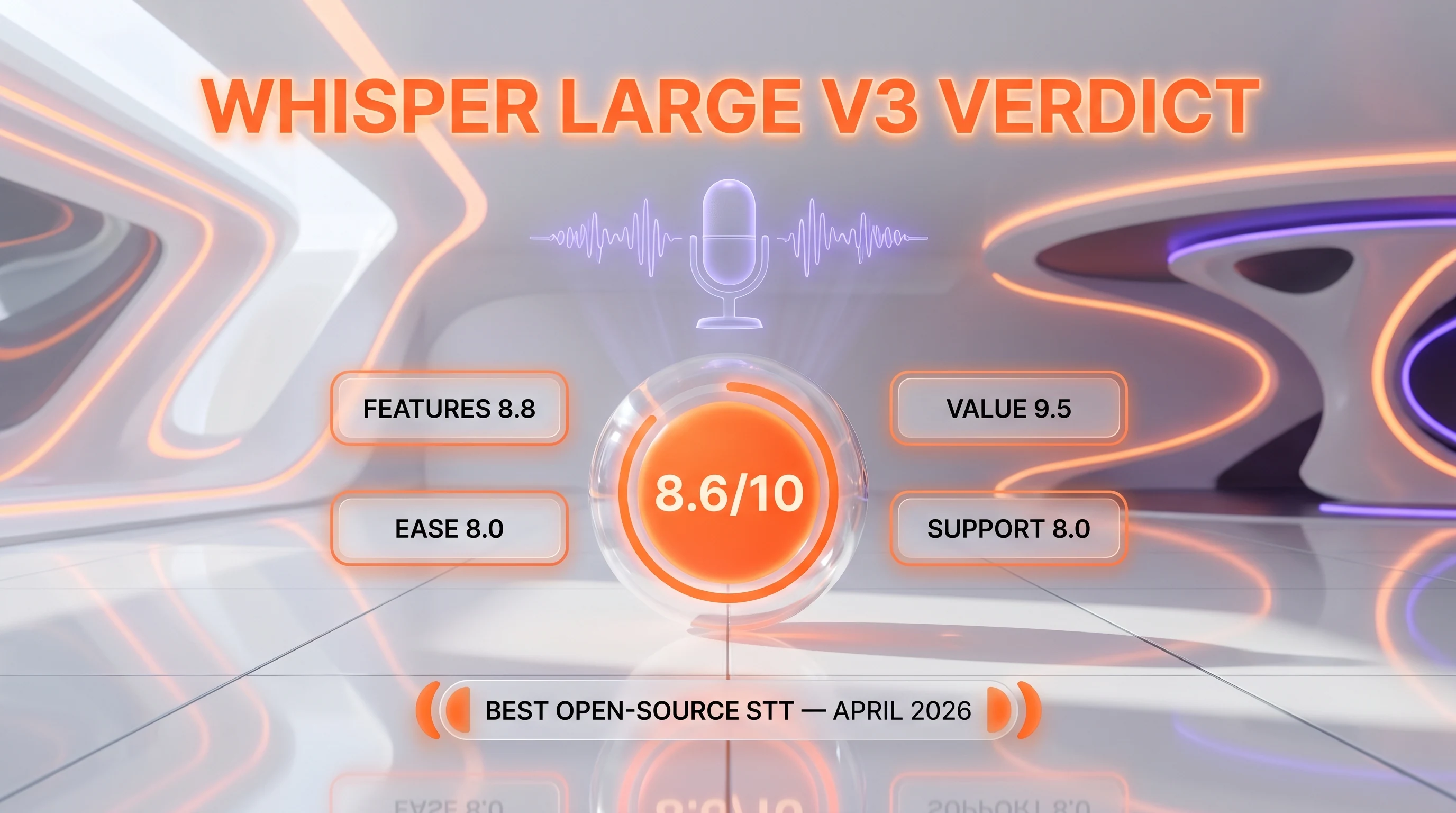
Whisper Large v3 earns an 8.6 out of 10 on best-in-class open-source word error rate, MIT license that unlocks zero-cost scale, and 99-language coverage that no commercial STT API matches at this price. What raises the score: the OpenAI hosted API at $0.006 per minute is one of the cheapest production STT options on the market, and the ecosystem (823 fine-tunes, ports to whisper.cpp, Faster-Whisper, MLX, ONNX) makes deployment simple on any target hardware. What holds it back from a 9+: hallucinations remain a real risk on long audio, real-time streaming requires a different tool, and demographic bias on accents and dialects requires careful evaluation before deploying to diverse user bases.
Score breakdown:
- Features: 8.8 out of 10 — 99 languages, word timestamps, speech translation, prompt parameter, multiple response formats. Lacks native streaming.
- Ease of Use: 8.0 out of 10 — OpenAI API is dead simple; self-hosting requires DevOps skills and GPU provisioning. Strong documentation and ecosystem softens the learning curve.
- Value: 9.5 out of 10 — Best WER per dollar in the open-source ecosystem. Self-hosted is free at scale; OpenAI API at $0.36 per hour undercuts most commercial STT.
- Support: 8.0 out of 10 — Active community (4.8M monthly downloads, 230 HF threads), comprehensive docs, but no official OpenAI Whisper SLA for self-hosted users.
Final word: Buy in if you process batch audio at scale, you need 99-language coverage, you want the option to self-host, or you are price-sensitive on STT. Pass if you need real-time streaming under 300ms latency (use Deepgram Nova-3), if absolute accuracy is non-negotiable for medical or legal transcription without a human review layer (use ElevenLabs Scribe v2 with confidence thresholds), or if you want a fully managed STT platform with built-in diarization, summarization, and PII redaction (use AssemblyAI Universal-3 Pro). For everyone else, Whisper Large v3 is the default choice for speech-to-text in 2026.
Key Features
Pros & Cons
Pros
- Best open-source WER on the market — 2.7% on clean audio matches commercial APIs that cost 6-10x more.
- MIT license means you can self-host on a single H100 or even consumer GPUs (4070+ for inference) with zero per-minute cost — Hugging Face Faster-Whisper hits real-time on CPU.
- 99-language coverage with automatic language detection is unmatched at this price point — Deepgram and AssemblyAI lock multilingual behind premium tiers.
- Word-level timestamps work out of the box — perfect for subtitle generation, podcast indexing, and audio search.
- OpenAI API at $0.006 per minute is one of the cheapest hosted STT options (1 hour = $0.36) and pricing has not changed since 2023.
- Built-in speech translation to English from any of the 99 languages — saves a separate translation step in localization pipelines.
- Massive ecosystem — 4.8M monthly downloads on Hugging Face, 823 fine-tuned variants, ports to C++ (whisper.cpp), CoreML, ONNX, MLX.
Cons
- Hallucinations are real — community filters detect 5-10 hallucinations per 45-minute video on Large v3, slightly more than v2 in some cases. Critical applications need post-processing.
- Not real-time out of the box — designed for batch transcription, latency is 1-3 seconds per chunk on a single GPU. For sub-second latency use Deepgram Nova-3 or ElevenLabs Scribe.
- Slower than newer commercial STT APIs — Deepgram Nova-3 hits 140x real-time vs Whisper's 46x on fal.ai. For million-hour archives, this matters.
- Documented demographic bias on accents, genders, and ages (Stanford study 2024 + Gladia analysis) — disparate WER across speaker groups.
Best Use Cases
Platforms & Integrations
Available On
Integrations

We're developers and SaaS builders who use these tools daily in production. Every review comes from hands-on experience building real products — DealPropFirm, ThePlanetIndicator, PropFirmsCodes, and many more. We don't just review tools — we build and ship with them every day.
Written and tested by developers who build with these tools daily.
Frequently Asked Questions
What is Whisper Large v3?
OpenAI's flagship speech-to-text model — 2.7% WER on clean audio, 99 languages, $0.006 per minute via API.
How much does Whisper Large v3 cost?
Whisper Large v3 has a free tier. All features are currently free.
Is Whisper Large v3 free?
Yes, Whisper Large v3 offers a free plan.
What are the best alternatives to Whisper Large v3?
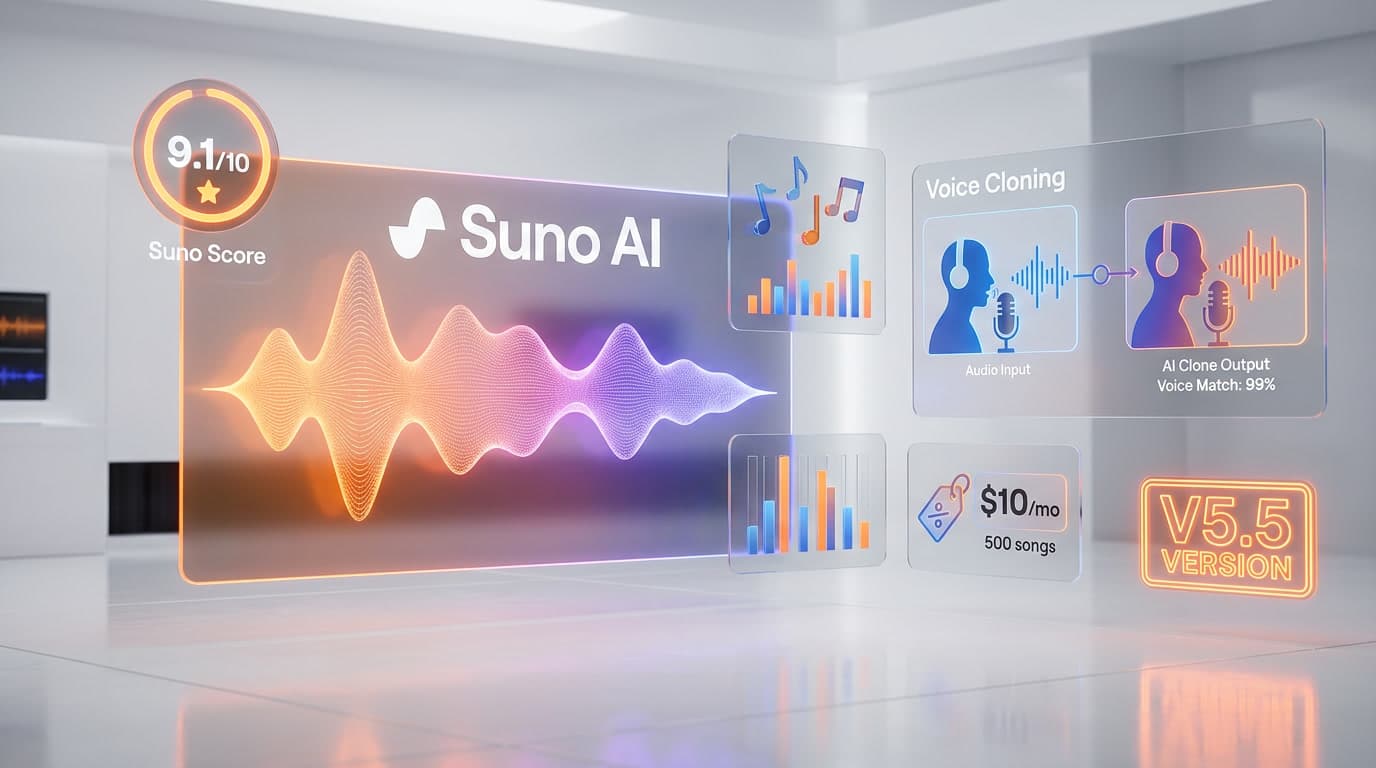
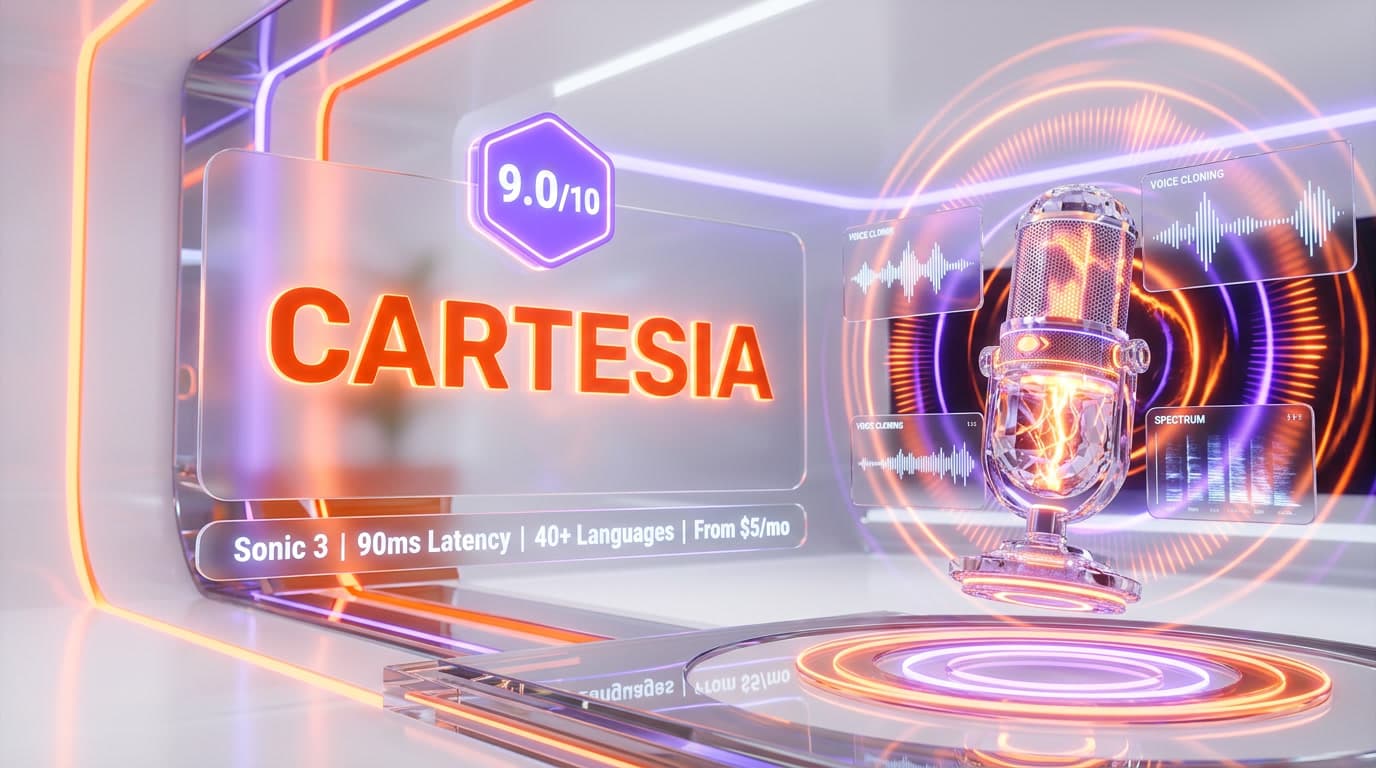
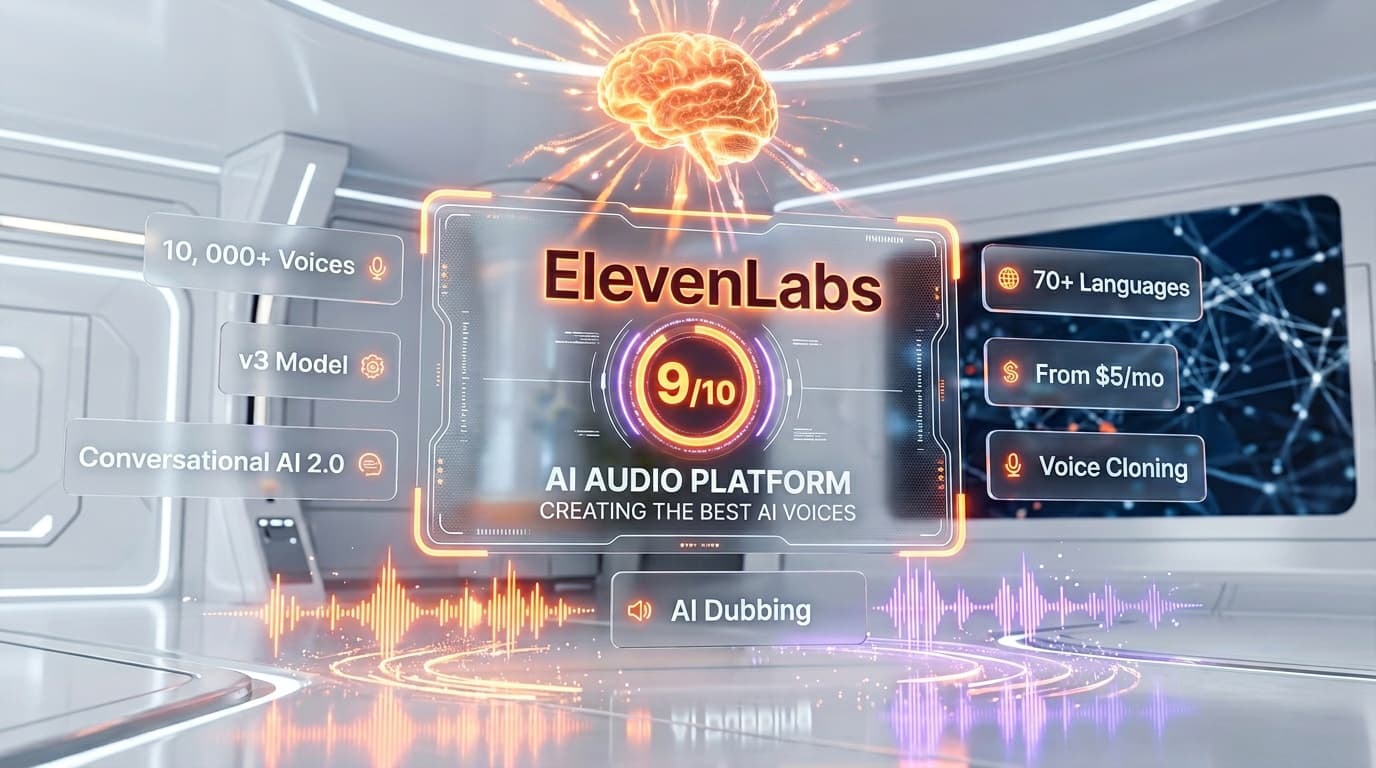
Top-rated alternatives to Whisper Large v3 include Suno AI (9.1/10), Cartesia (9/10), ElevenLabs (9/10), gpt-realtime (8.4/10) — all reviewed with detailed scoring on ThePlanetTools.ai.
Is Whisper Large v3 good for beginners?
Whisper Large v3 is rated 8/10 for ease of use.
What platforms does Whisper Large v3 support?
Whisper Large v3 is available on Web API, Self-hosted (Python), Hugging Face Transformers, Hugging Face Inference API, Replicate, Groq Cloud, SambaNova Cloud, fal.ai.
Does Whisper Large v3 offer a free trial?
Yes, Whisper Large v3 offers a free trial.
Is Whisper Large v3 worth the price?
Whisper Large v3 scores 9.5/10 for value. We consider it excellent value.
Who should use Whisper Large v3?
Whisper Large v3 is ideal for: Podcast transcription and indexing for SEO + searchable archives, Meeting notes automation (Zoom, Teams, Google Meet recordings), Multilingual subtitle generation (SRT, VTT export with timestamps), Video content accessibility — captions for YouTube, social media, e-learning, Voice agent transcription pipelines (paired with LLM + TTS for full voice loops), Customer support call analysis (sentiment, topics, compliance), Legal and medical dictation (with prompt parameter for domain vocabulary), Content moderation pipelines for audio and video at scale.
What are the main limitations of Whisper Large v3?
Some limitations of Whisper Large v3 include: Hallucinations are real — community filters detect 5-10 hallucinations per 45-minute video on Large v3, slightly more than v2 in some cases. Critical applications need post-processing.; Not real-time out of the box — designed for batch transcription, latency is 1-3 seconds per chunk on a single GPU. For sub-second latency use Deepgram Nova-3 or ElevenLabs Scribe.; Slower than newer commercial STT APIs — Deepgram Nova-3 hits 140x real-time vs Whisper's 46x on fal.ai. For million-hour archives, this matters.; Documented demographic bias on accents, genders, and ages (Stanford study 2024 + Gladia analysis) — disparate WER across speaker groups..
Best Alternatives to Whisper Large v3
Ready to try Whisper Large v3?
Start with the free plan
Try Whisper Large v3 Free →