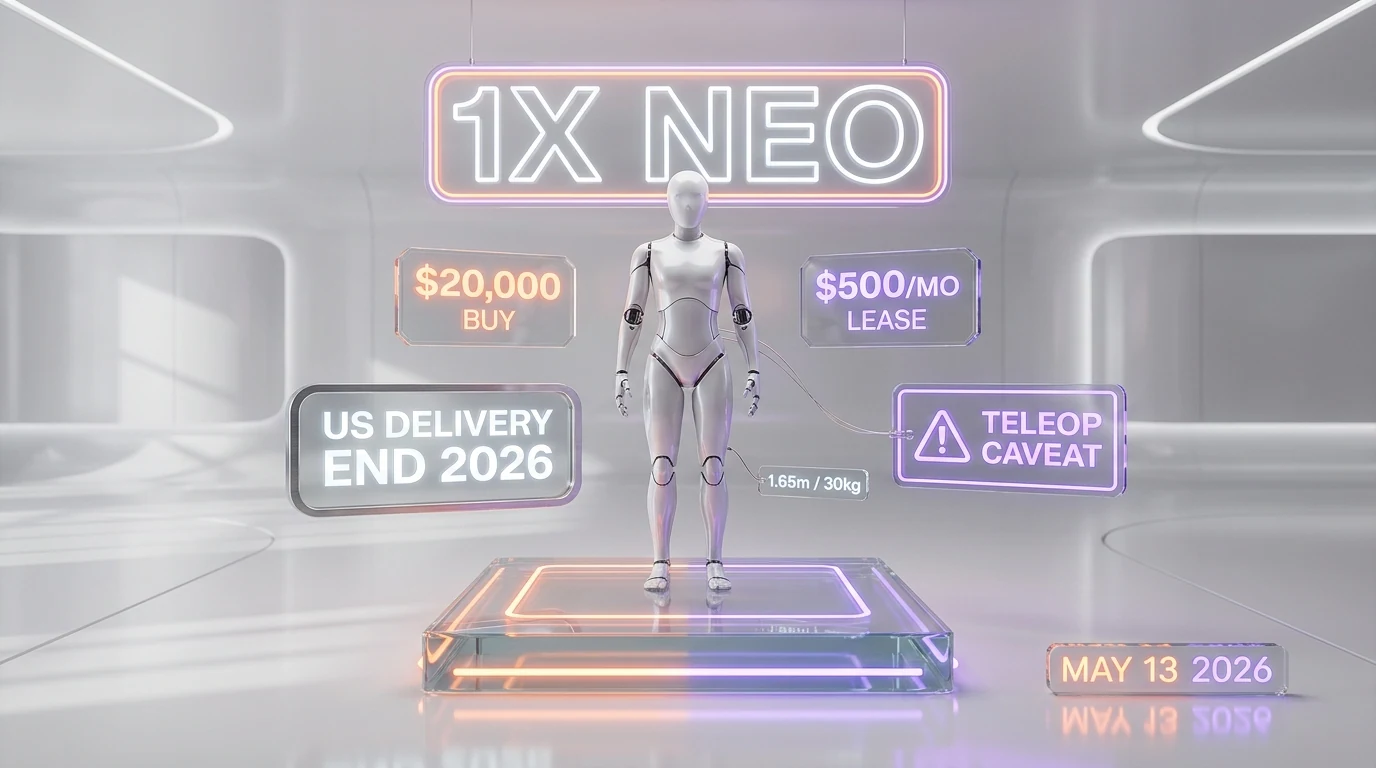
1X Technologies confirmed on May 13, 2026 that NEO, its 1.65 m, roughly 30 kg household humanoid robot, will reach the first private US customers by the end of 2026 at about $20,000 to buy or around $500 per month to lease. NEO is the first consumer-grade humanoid with both a dated launch window and concrete pricing. The catch: early units rely on scheduled remote human teleoperation for tasks NEO cannot yet do autonomously, which reframes the launch as an experimental learning platform more than a finished autonomous robot.
What 1X Actually Confirmed
On May 13, 2026, 1X Technologies put a date and a price on the consumer humanoid. According to Notebookcheck's report, NEO — the company's home humanoid — is scheduled to land with the first private customers in the United States by the end of 2026. Pricing is the headline: roughly $20,000 to buy outright, or around $500 per month on a subscription lease.
That combination matters. We have watched humanoid announcements for two years where the pattern is always the same: an impressive demo video, a vague "coming soon," and no number anyone can plan around. NEO breaks that pattern. A dated window plus a concrete price is the first time a consumer can actually run the math on putting a humanoid in their home.
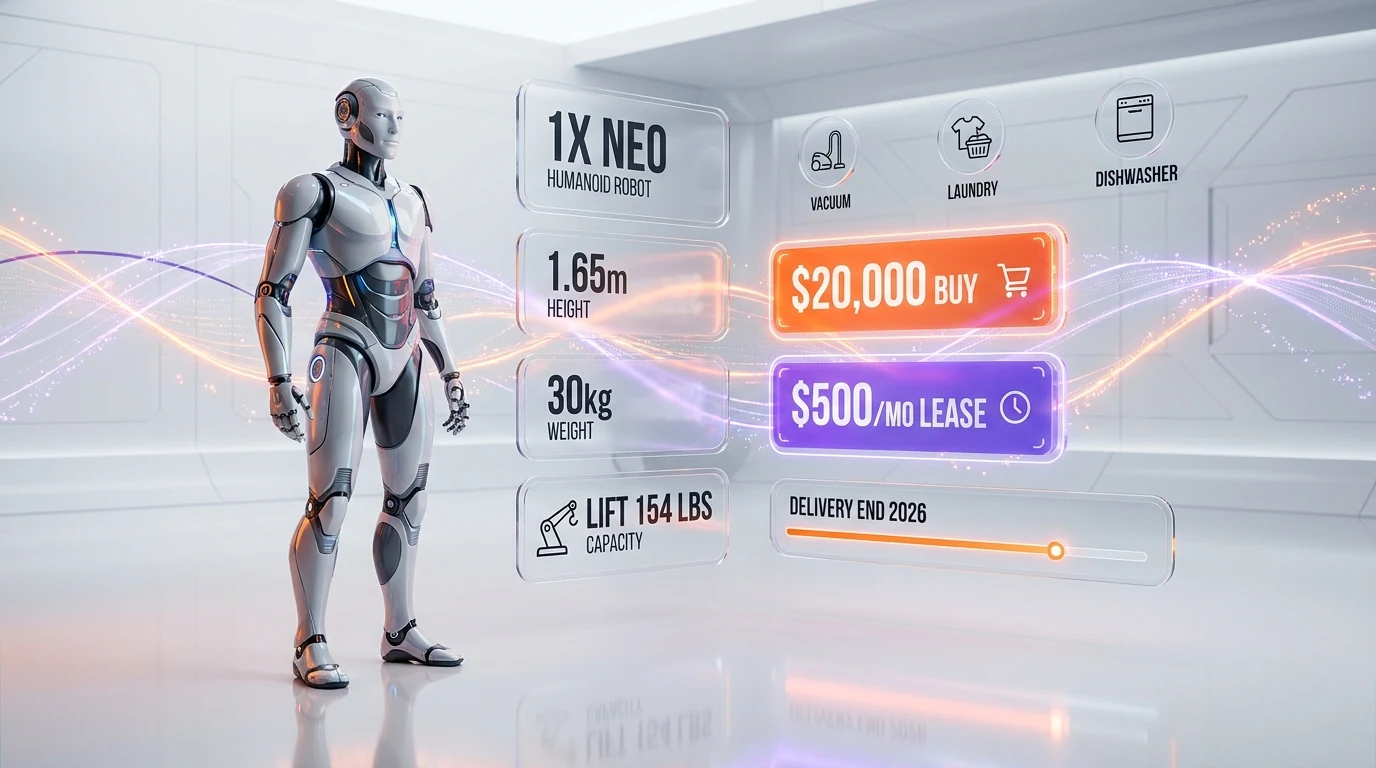
The physical spec is deliberately domestic. NEO stands about 5 ft 5 in (roughly 1.65 m) and weighs just under 66 lbs (roughly 30 kg). It is built to move through a normal house, not a factory aisle. 1X cites a lifting capacity up to around 154 lbs and a comfortable carry load near 55 lbs. The demonstrated tasks on the manufacturer's site are mundane on purpose: vacuuming, folding laundry, unloading the dishwasher. This is a robot designed to disappear into household chores, not to perform spectacle.
The Numbers That Define the Launch
| Attribute | NEO (1X Technologies) |
|---|---|
| Purchase price | ~$20,000 |
| Lease option | ~$500 per month |
| Delivery window | By end of 2026 |
| Initial market | United States (private customers) |
| Height | ~1.65 m (5 ft 5 in) |
| Weight | ~30 kg (just under 66 lbs) |
| Lift capacity | Up to ~154 lbs |
| Demonstrated tasks | Vacuuming, laundry folding, dishwasher unloading |
| Autonomy caveat | Scheduled remote teleoperation for tasks it cannot yet do alone |
Best read for: anyone tracking when consumer robotics stops being a CES concept and becomes a purchase order. NEO is the clearest signal yet that the timeline is now measured in quarters, not in "by 2030."
The Big Picture: A Dated, Priced Consumer Humanoid
Strip away the marketing and the strategic fact is simple. Until this announcement, every household humanoid lived in a future tense. NEO moves the conversation into a calendar. That shift is what makes May 13, 2026 a date worth marking, independent of whether NEO ships flawlessly.
The pricing structure tells you who 1X thinks the early buyer is. A $20,000 outright price positions NEO against a high-end home renovation or a second car — aspirational but not absurd for an affluent early adopter. The ~$500 per month lease is the more revealing number. Subscription pricing lets 1X keep ownership of the hardware, push software updates, harvest usage data, and lower the entry barrier to something closer to a premium gym-plus-streaming budget. It also quietly hedges the autonomy risk: if NEO underdelivers, a lease is a cancellation, not a $20,000 paperweight.
This is the opposite of the industrial humanoid playbook. The factory-floor humanoids being deployed in 2026 are sold on a return-on-investment spreadsheet: replace a labor cost, measure the payback. NEO is sold on a lifestyle and a promise. That difference in go-to-market is the real story, and it is why NEO is not competing with the warehouse robots so much as opening a parallel category.
The Teleoperation Caveat — Read This Before the Hype
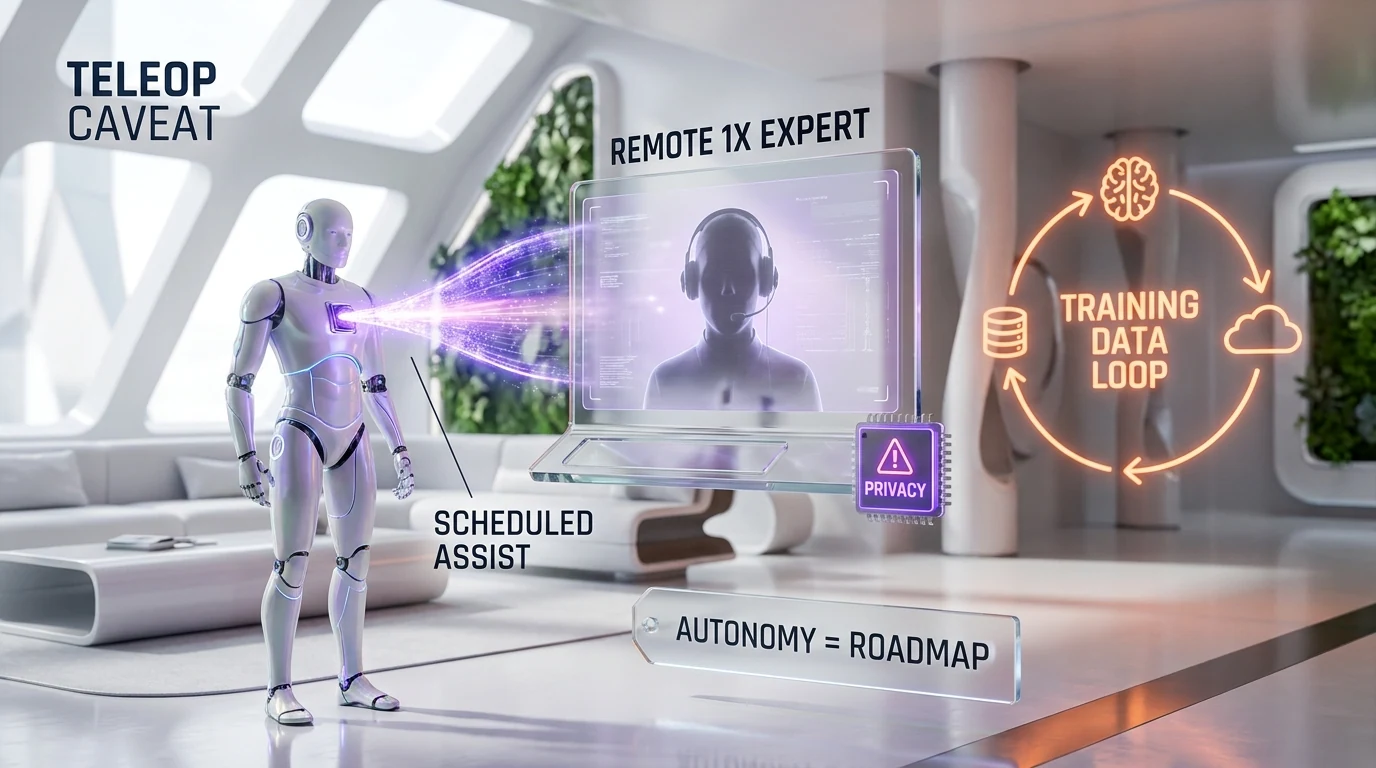
Here is the part that deserves more attention than the price tag. 1X has confirmed that NEO can receive remote support from a 1X expert at scheduled times for tasks it cannot yet handle autonomously. In plain terms: at launch, a human operator can step in and drive the robot for the chores it has not yet learned to do on its own.
This is a factual disclosure from the company, not a rumor and not a criticism. But it changes the correct way to think about NEO. A robot that needs scheduled human assistance is, by definition, not a fully autonomous household appliance on day one. It is closer to an experimental learning platform: every teleoperated session generates training data that improves the autonomous model over time. The hardware ships now; the autonomy is a roadmap.
What 1X Has Not Specified
The most important gap is also the most quietly stated one. 1X has not publicly broken down which functions will run fully autonomously at launch versus which will lean on remote operators. That ambiguity is material. "It can fold laundry" reads very differently if folding is autonomous versus if folding is a human in another building driving the arms. Until 1X publishes that split, the honest position is that NEO's day-one autonomy is undefined, and buyers should treat the autonomous task list as a moving target, not a spec sheet.
The Privacy Dimension
Teleoperation introduces a second-order issue that is hard to wave away. If a 1X expert can drive NEO inside a customer's home, that expert can, in principle, see and hear that home through the robot's cameras and microphones. Critics have flagged this as the core privacy concern, and it is a reasonable one. The strategic question for 1X is not whether the technology works — it is whether households will accept a stranger having a scheduled window of access to the inside of their home in exchange for a robot that does chores. How 1X structures consent, logging, and operator access controls will matter as much as the autonomy itself.
Why the Caveat Is Strategically Smart Anyway
It would be easy to read the teleoperation dependency as a weakness. The more interesting read is that it is a deliberate data-acquisition strategy. NEO units are already running in 1X's Hayward, California facility performing simple logistics tasks specifically to generate training data. Shipping hardware to homes — even hardware that needs human backup — turns thousands of households into a real-world data engine. Every teleoperated correction is a labeled example. The robot that ships in 2026 is not the product; it is the data-collection wedge for the autonomous product that ships later. Tesla used a similar logic with fleet learning. Whether households tolerate being the training set is the open question.
Consumer Humanoid vs Industrial Humanoid: Two Different Races
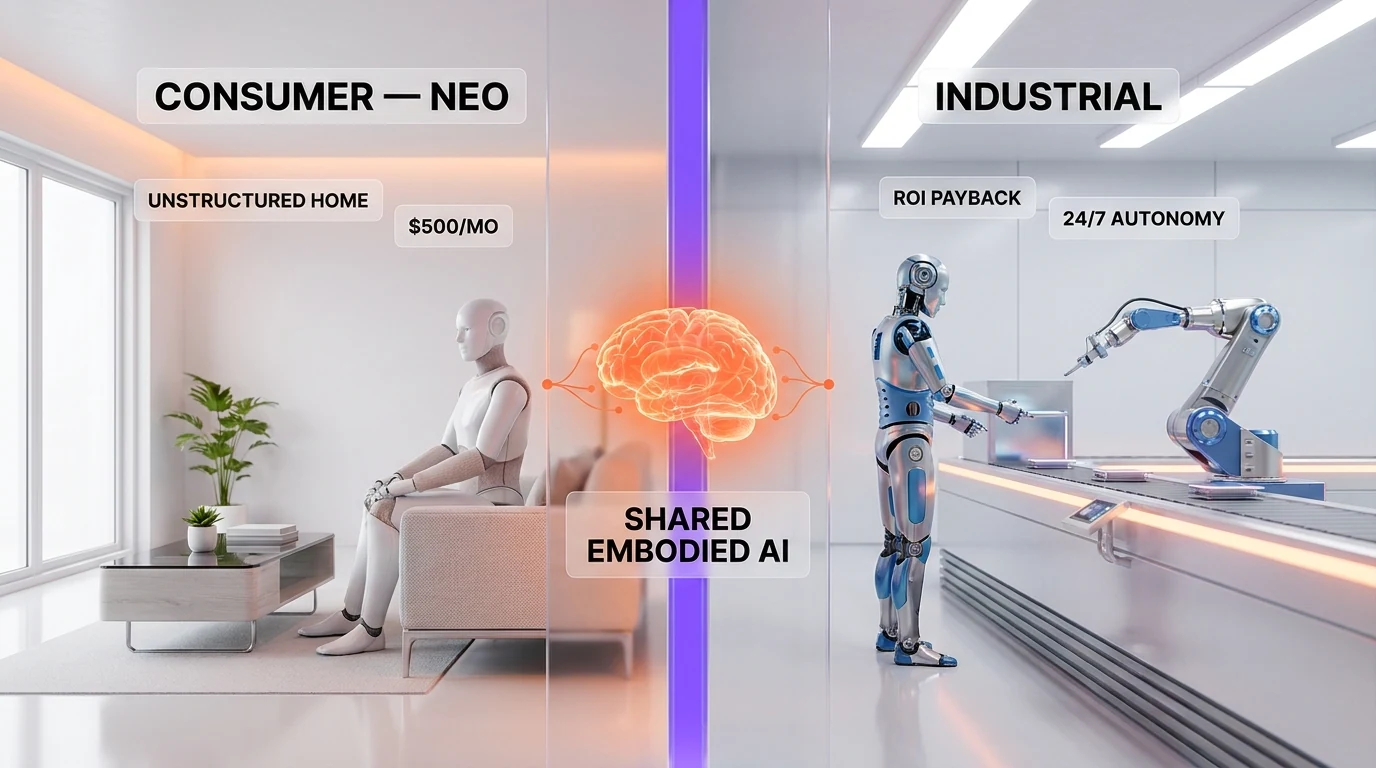
It is tempting to file NEO next to the industrial humanoids making headlines in 2026, but they are running different races with different finish lines. Conflating them is the most common analytical mistake in this space.
The Industrial Track
The factory and warehouse humanoids are optimized for one thing: a measurable labor substitution with a payback period a CFO can sign off on. The recent Figure Helix 02 24-hour autonomous run and the binding deal to deploy thousands of factory robots through 2032 between humanoid makers and industrial suppliers like Schaeffler both point the same way: industrial humanoids win by proving uptime, repeatability, and a clean ROI inside a controlled environment. The customer is a procurement department. Autonomy is non-negotiable because there is no operator standing by on a factory floor at 3 a.m.
The Consumer Track
NEO is solving a fundamentally messier problem. A home is an unstructured environment with pets, stairs, clutter, children, and no two layouts alike. The customer is a household with a tolerance for imperfection that a factory does not have — but also a privacy expectation a factory does not have. This is why the teleoperation backup makes sense for consumer and would be unacceptable for industrial: in the home, a human-assisted robot that mostly works is still a product; on a 24/7 production line, it is a liability.
The cleanest way to hold both in your head: industrial humanoids are racing to maximize autonomous uptime in a known environment, consumer humanoids are racing to be tolerable enough in an unknown environment that data can flow back and close the autonomy gap. NEO is the first serious entrant on the consumer side with a price and a date. It complements the industrial wave rather than competing with it.
Where the Two Tracks Converge
They share one engine: embodied AI models. The reasoning stack that lets a robot perceive a scene, plan a sequence of physical actions, and self-correct is the same research frontier whether the body is on a factory line or a kitchen floor. Google DeepMind's work on Gemini Robotics-ER 1.6 embodied reasoning is the kind of model layer that ultimately decides how fast NEO's teleoperated tasks become autonomous ones. The body is converging on a humanoid form across both tracks; the differentiator is increasingly the brain, and the brain is improving on a curve that is not specific to either market.
1X's Strategy and the Road Ahead
Reading 1X's positioning through a strategic lens rather than a feature list makes the moves coherent. The company is not trying to ship a perfect autonomous butler in 2026. It is trying to be first to a dated, priced consumer humanoid while everyone else is still in the demo-video phase, and to convert that first-mover position into a proprietary stream of real-world household data.
The First-Mover Wedge
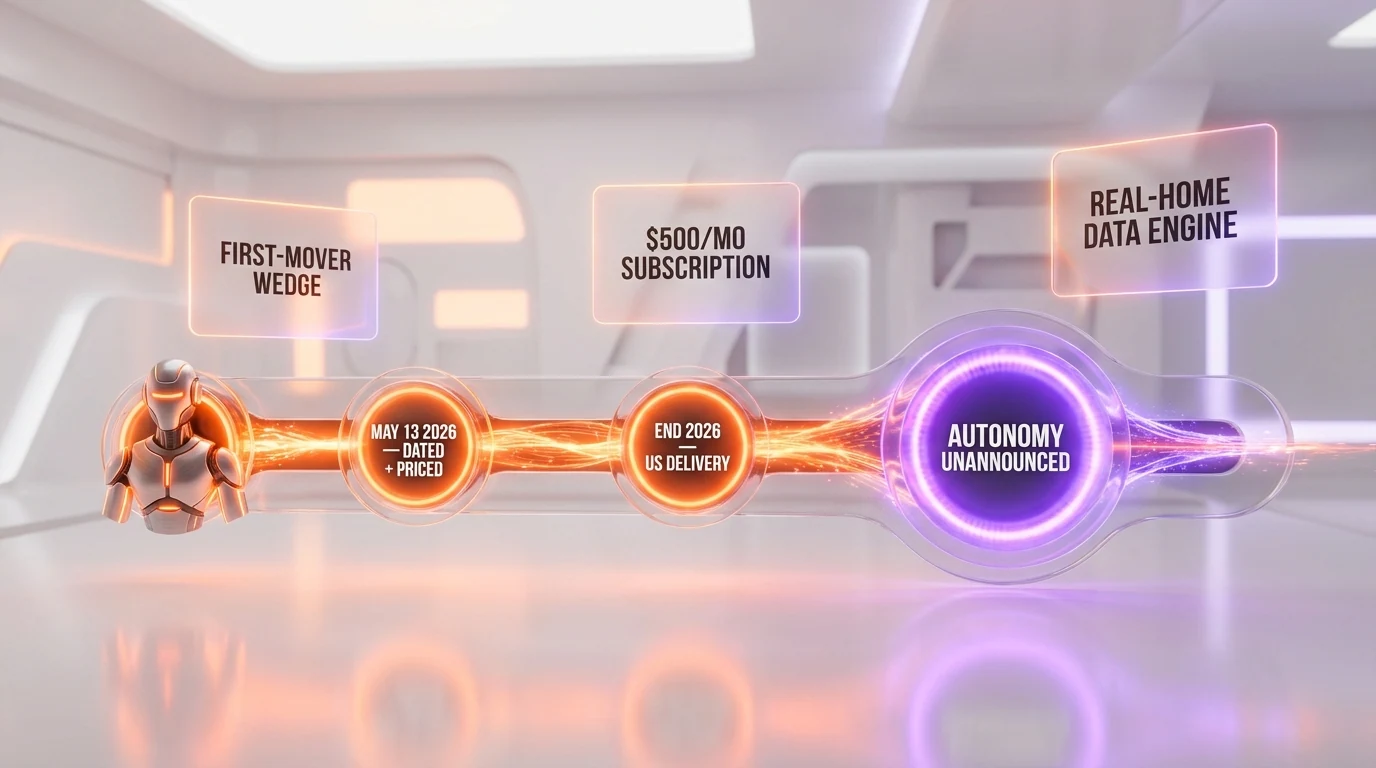
Being the first consumer humanoid with a number attached is itself a moat in the short term. It anchors the category. When a buyer thinks "home robot with a price," NEO is now the reference point everyone else gets compared to. That mindshare advantage is real even if the product is imperfect, and 1X clearly understands that shipping something dated and priced beats shipping a flawless demo with no calendar.
The Subscription Logic
The ~$500 per month lease is the strategic core, not a financing afterthought. Subscription keeps the hardware on 1X's balance sheet, makes the customer relationship continuous rather than one-time, enables over-the-air capability upgrades that justify the recurring fee, and — critically — keeps the data pipeline flowing for as long as the robot is in the home. A one-time $20,000 sale ends the relationship; a lease makes the household a long-term data partner. Expect 1X to push the lease harder than the purchase.
The Autonomy Roadmap Is the Real Product
The honest framing of 1X's 2026 launch is that the shipped robot is a means to an end. The end is an autonomous household humanoid, and the path there runs through thousands of teleoperated sessions in real homes. If 1X executes, the teleoperation share shrinks quarter over quarter as the model learns, and at some point NEO crosses from "experimental platform with human backup" to "autonomous appliance." The launch date is end of 2026; the date that actually matters — when the human in the loop becomes optional — is unannounced and is the metric to watch.
The Risks That Could Derail It
Three risks are worth naming plainly. First, privacy backlash: if the teleoperation access model is not handled with airtight consent and controls, a single high-profile incident could poison consumer trust in the entire category. Second, autonomy timeline slippage: if the teleoperated share does not shrink on a credible curve, the "experimental platform" framing hardens into "expensive remote-controlled toy," and the leases churn. Third, competitive compression: NEO's first-mover window is months, not years. The same embodied AI progress that helps NEO helps every competitor, and the consumer humanoid field will not stay empty.
How This Fits the Broader AI Capital Story
Consumer robotics does not happen in a vacuum. It rides on the same compute and model investment wave reshaping the rest of the industry. The scale of capital flowing into frontier AI infrastructure — see our analysis of Anthropic's 10-gigawatt compute empire — is the same tide that funds the model research NEO's autonomy depends on. The frontier labs building reasoning models and the robotics companies building bodies are increasingly the same story told from two ends. Tools like Claude and Gemini 3.1 Pro sit on the cognitive side of the same arc whose physical edge is a robot folding your laundry.
Our Take
We have been tracking humanoid announcements long enough to be skeptical of demo videos, and the most useful thing about the NEO news is precisely that it is not a demo video. It is a date and a price. That alone makes it the most consequential consumer robotics announcement of 2026 so far, regardless of how the first units actually perform.
The teleoperation caveat is not a reason to dismiss NEO — it is the reason to take it seriously as a strategy. 1X is not pretending the autonomy is solved. It is shipping the hardware to start the data flywheel that solves it. That is a coherent plan. Whether it works depends on two unannounced variables: how fast the autonomous share grows, and whether households accept the privacy trade. Both are unknowable today, and anyone claiming certainty in either direction is guessing.
The framing we would push back on is "consumer humanoids have arrived." A more precise statement: a consumer humanoid now has a price and a calendar, with an asterisk the size of a human operator. The moment is real. The asterisk is also real. Both things are true at once, and the interesting analysis lives in holding both rather than collapsing into either hype or dismissal.
What to Watch Next
Four signals will tell you whether NEO is a category-definer or a cautionary tale. First, the autonomy split: when 1X publishes which tasks are autonomous at launch versus teleoperated, that document is the real spec sheet. Second, the privacy architecture: the consent, logging, and operator-access model 1X ships with the first units. Third, the teleop decay curve: any data 1X releases on how fast the human-assisted share shrinks over the first two quarters. Fourth, the competitive response: how quickly a second credible consumer humanoid lands with its own price and date, because the first-mover window is measured in months.
The end of 2026 is the launch date. The date that actually decides whether NEO matters — the day the human in the loop becomes optional — has not been announced. That is the number we will be watching.
Frequently Asked Questions
How much does the 1X NEO robot cost?
NEO costs approximately $20,000 to buy outright, or around $500 per month on a subscription lease, according to 1X Technologies' May 13, 2026 confirmation. The lease option lets 1X retain hardware ownership, push software updates, and lower the entry barrier, while the outright purchase positions NEO against a high-end home expense.
When will the 1X NEO be delivered?
1X confirmed NEO will reach the first private customers in the United States by the end of 2026. It is the first consumer-grade humanoid with both a dated launch window and concrete pricing, which is what distinguishes this announcement from prior humanoid demo videos that lacked any calendar.
What is the 1X NEO teleoperation catch?
1X has confirmed that NEO can receive remote support from a 1X expert at scheduled times for tasks it cannot yet handle autonomously. In practice, a human operator can drive the robot for chores it has not learned to do on its own. This makes the early product closer to an experimental learning platform than a fully autonomous appliance.
Is the 1X NEO fully autonomous at launch?
No. 1X has not specified which functions run fully autonomously at launch versus which rely on scheduled remote operators. Until 1X publishes that split, NEO's day-one autonomy is undefined, and the autonomous task list should be treated as a moving target rather than a fixed spec sheet.
What are the 1X NEO specifications?
NEO stands about 1.65 m (5 ft 5 in) and weighs just under 30 kg (66 lbs). 1X cites a lifting capacity up to roughly 154 lbs and a comfortable carry load near 55 lbs. Demonstrated tasks include vacuuming, folding laundry, and unloading the dishwasher — a deliberately domestic form factor and task set.
What are the privacy concerns with 1X NEO?
Because a 1X expert can remotely drive NEO inside a customer's home, that operator can in principle see and hear the home through the robot's cameras and microphones during scheduled teleoperation windows. Critics have flagged this as the core privacy concern. How 1X structures consent, logging, and operator access controls will be as important as the autonomy itself.
How is the 1X NEO different from industrial humanoid robots?
Industrial humanoids are sold on a measurable labor-substitution ROI and require non-negotiable autonomy in controlled environments like factories. NEO is a consumer robot for the unstructured home, where a human-assisted robot that mostly works is still a viable product. They run different races on different metrics, sharing only the underlying embodied AI model stack.
Why does 1X allow human teleoperation if it is a weakness?
The teleoperation dependency is best read as a deliberate data-acquisition strategy rather than a flaw. Every teleoperated session generates labeled training data that improves NEO's autonomous model over time. Shipping hardware into real homes — even hardware needing human backup — turns households into a real-world data engine for the autonomous product that ships later.
Should I buy or lease the 1X NEO?
The roughly $500 per month lease lowers the entry barrier and, importantly, hedges the autonomy risk: if NEO underdelivers, a lease is a cancellation rather than a $20,000 paperweight. The $20,000 purchase makes sense only for buyers comfortable owning an experimental platform whose autonomy is still on a roadmap. For most early adopters, the lease is the lower-risk option.
Is the 1X NEO worth it in 2026?
NEO in 2026 is best understood as an early-access experimental platform, not a finished autonomous appliance. Its value today is being first with a price and a date, and being part of the data loop that improves it. Whether it is worth it depends on tolerance for teleoperation, the privacy trade, and how fast the autonomous share grows — all currently unannounced.
What company makes the NEO robot?
NEO is made by 1X Technologies. The company already runs NEO units in its Hayward, California facility performing simple logistics tasks specifically to generate training data, which underpins the strategy of using real-world deployments to close the autonomy gap over time.
What should I watch next with 1X NEO?
Four signals matter: the autonomy split document (which tasks are autonomous versus teleoperated at launch), the privacy architecture shipped with first units, the teleop decay curve (how fast the human-assisted share shrinks), and the competitive response (how quickly a second credible consumer humanoid lands with its own price and date). The end of 2026 is the launch; the day the human in the loop becomes optional is the date that actually matters.