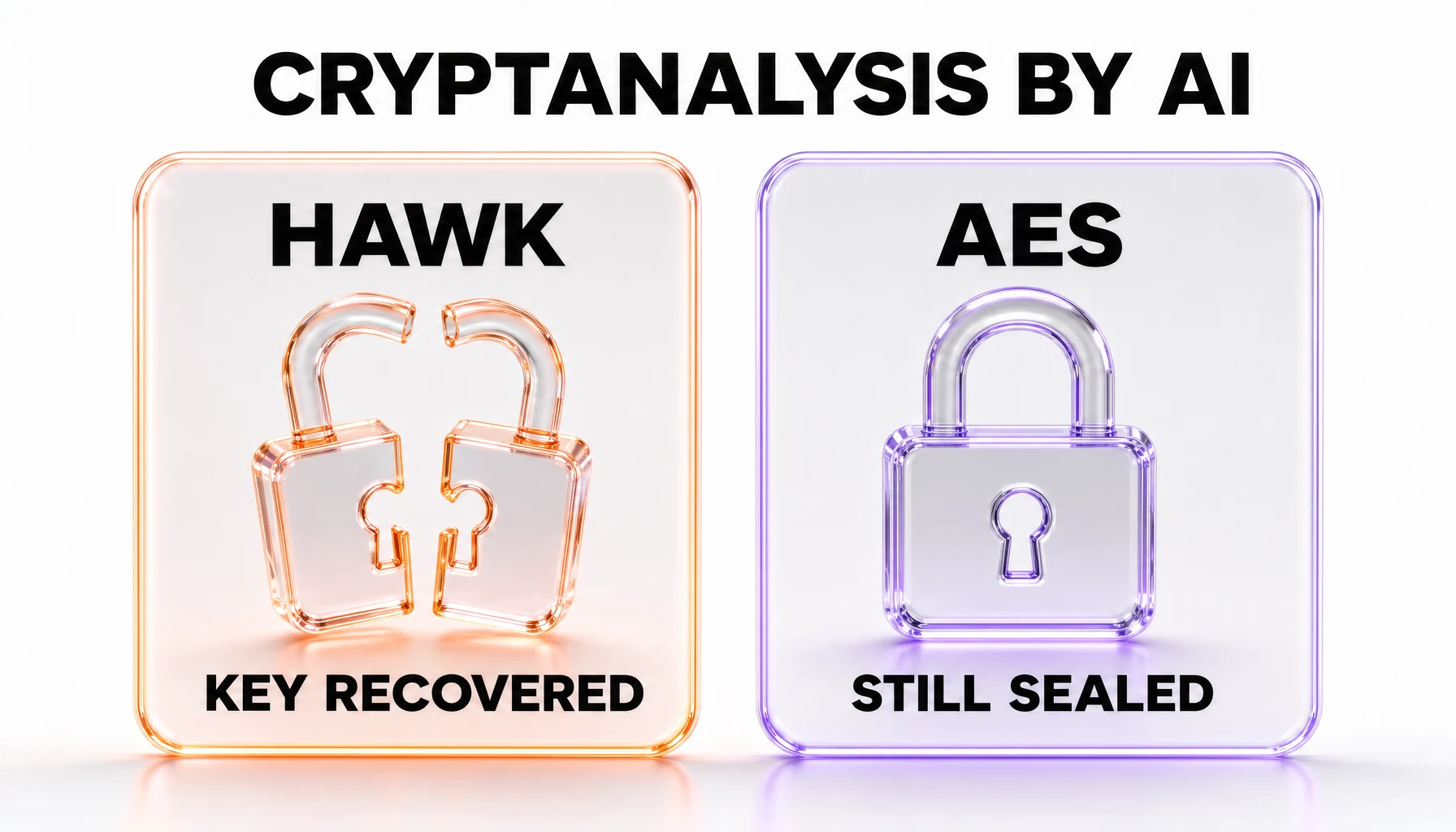
On May 16, 2026, arXiv announced it will impose a one-year submission ban on authors when there is incontrovertible evidence they did not check the output of a large language model — hallucinated references, residual LLM comments, or fabricated content copied straight from a model. Thomas Dietterich, chair of arXiv's computer science section, framed it bluntly: if a paper contains proof the authors did not verify their LLM generation, the platform "can't trust anything in the paper." Critically, arXiv is not banning LLM use. It is making authors fully responsible for what they submit, irrespective of how the text was generated. The penalty is one year; after it, the author's next submission must first be accepted by a reputable peer-reviewed venue.
What arXiv Actually Announced
arXiv is the world's largest open-access repository for preprints in physics, mathematics, computer science, and adjacent fields. It is the de facto first stop for nearly every frontier AI paper before peer review. On May 16, 2026, Thomas Dietterich — chair of arXiv's computer science section — announced a new enforcement rule via the platform's moderation channels, first reported by TechCrunch.
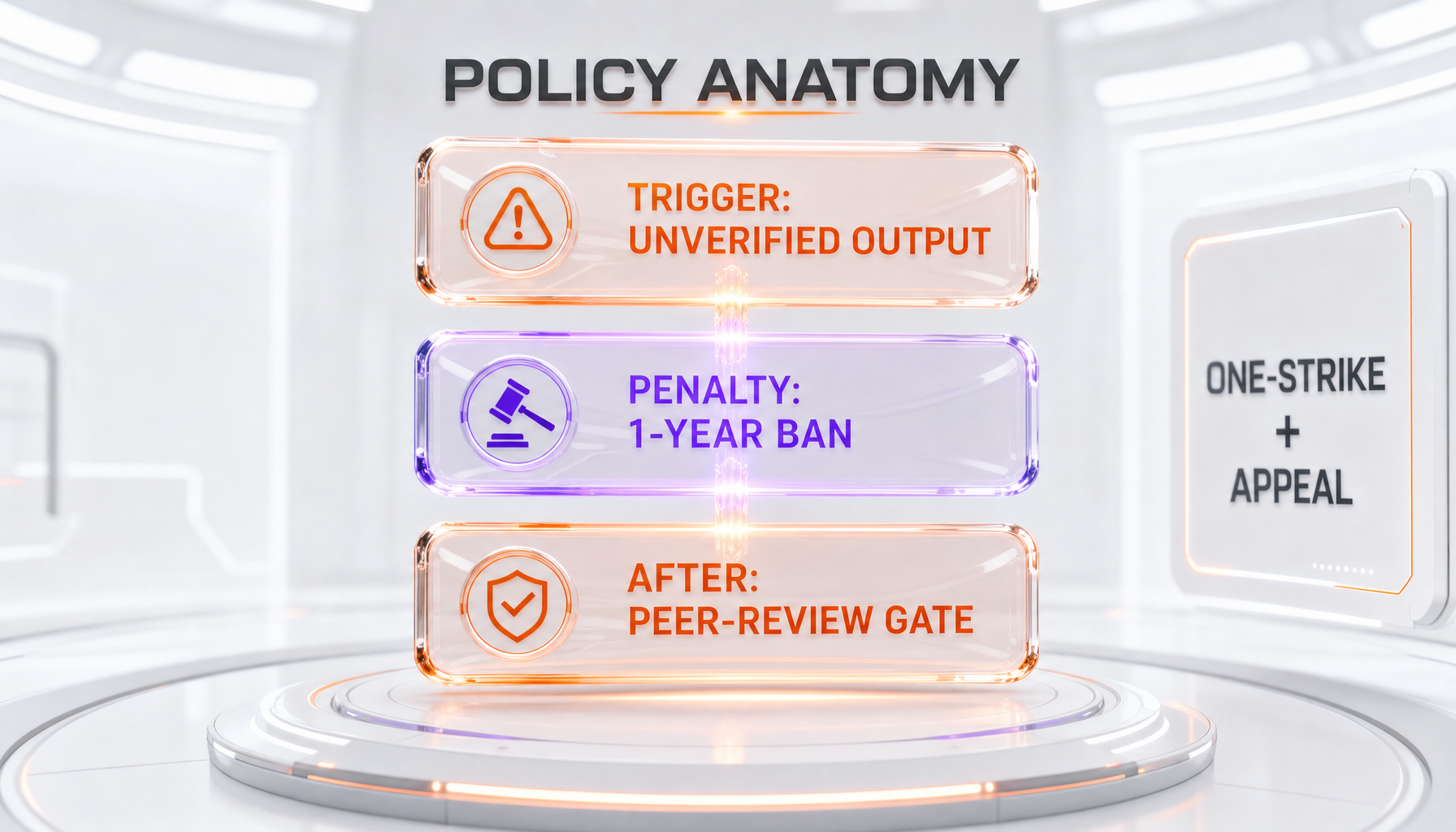
The rule is narrow and specific. If a submission contains "incontrovertible evidence that the authors did not check the results of LLM generation," the submitting author receives a one-year ban from new submissions. The triggering evidence is concrete and observable: hallucinated references that point to papers that do not exist, comments addressed to or coming from the LLM left inside the manuscript, and "inappropriate language, plagiarized content, biased content, errors, mistakes, incorrect references, or misleading content" copied directly out of a model.
This is not a vague "AI is bad" stance. It is a research-integrity rule with a precise trigger: provable negligence in verifying machine output. The distinction matters, and it is the entire story.
The One-Strike Mechanic
arXiv structured this as a one-strike rule with an appeal path. Moderators flag a suspicious submission. A section chair then reviews and must confirm the evidence is incontrovertible before any penalty is imposed. Authors can appeal. This is deliberately not an automated AI-detector pipeline — it is a human-confirmed evidence standard, which is the only defensible way to run it given how unreliable AI-text classifiers remain in 2026.
The Post-Ban Condition
The detail most coverage glossed over is the most consequential. After the one-year ban expires, the offending author's next submission to arXiv must "first be accepted by a reputable peer-reviewed venue." In other words, arXiv temporarily revokes the very thing that makes a preprint server useful — the ability to post work before peer review — and forces the author back through the slow gate they were trying to skip. For a researcher whose entire workflow depends on fast preprint visibility, that is a significant cost.
The Pivot Almost Everyone Missed: It Bans Negligence, Not AI
The headline most people will see is "arXiv bans AI papers." That is wrong, and the gap between the headline and the actual rule is where the strategic significance lives.
arXiv explicitly did not ban LLM use. Its policy language requires authors to take "full responsibility" for content "irrespective of how the contents are generated." You can write your entire paper with Claude, ChatGPT, or GPT-5.5 as a drafting partner. What you cannot do is ship the output without reading it, checking the citations, and removing the model's residue.
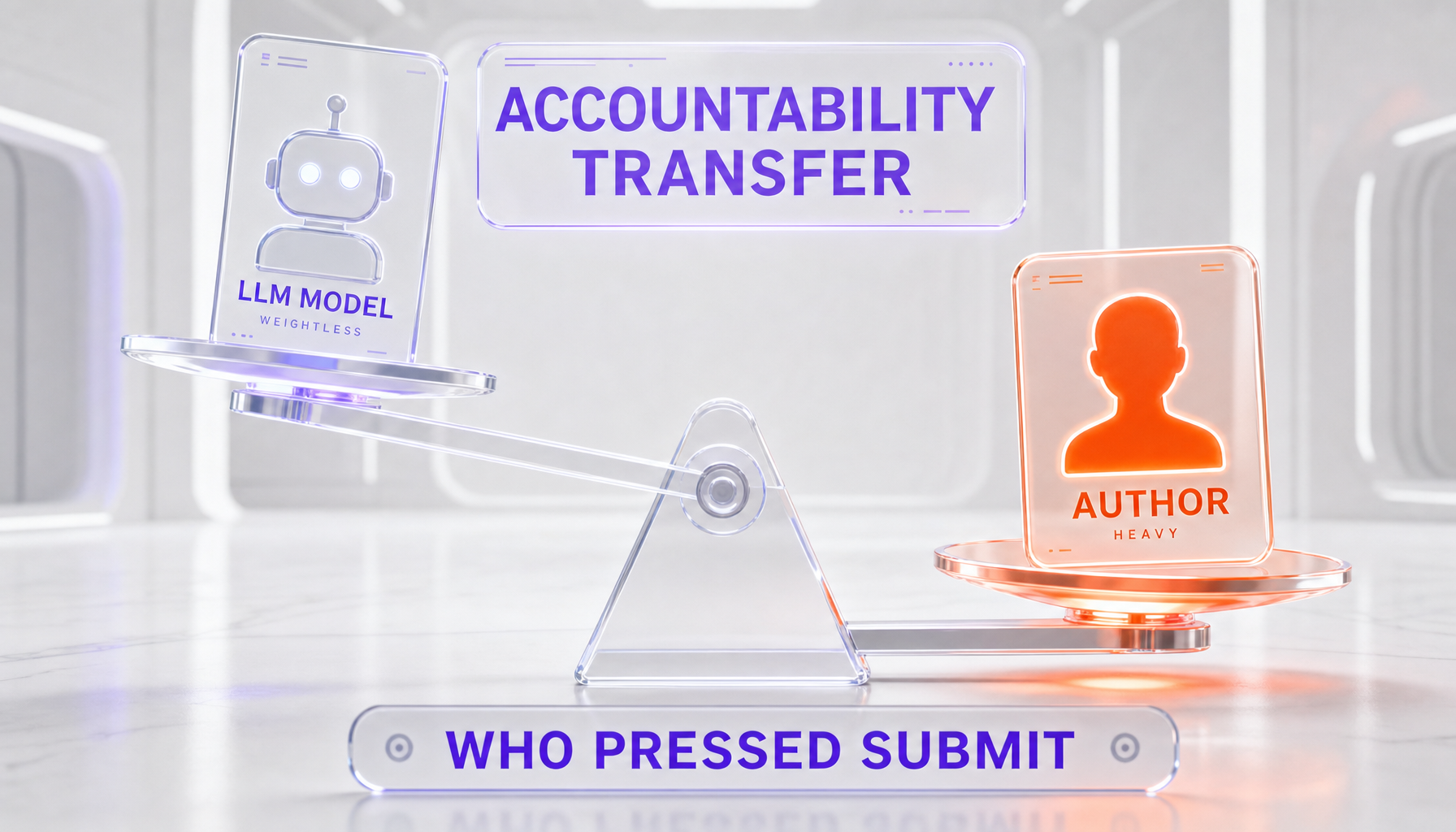
This is a liability transfer, not a tool ban. It moves the locus of accountability from the technology to the human who pressed submit. That framing is correct, and it is the only framing that scales. Banning a tool is unenforceable when the tool is invisible by design. Banning a verifiable behavior — shipping unchecked output — is enforceable because the evidence is in the artifact itself.
Why "Incontrovertible Evidence" Is the Smart Threshold
arXiv did not say "we will detect AI writing." It said it will act on incontrovertible evidence of unverified output. The difference is everything. AI-text detectors have catastrophic false-positive rates and are trivially defeated. A hallucinated reference to a paper that does not exist, or the literal string "As an AI language model, I cannot..." sitting in a methods section, is not a probabilistic signal. It is a smoking gun. By anchoring enforcement to artifacts that cannot occur without negligence, arXiv sidestepped the entire unwinnable AI-detection arms race.
The Responsibility Model Is the Real Product
Strip away the news framing and arXiv shipped a governance primitive: the author is the accountable party, the model is a tool, and the evidence standard is the artifact. That model is portable. Journals, conferences, grant bodies, and corporate research teams can adopt the exact same logic without ever touching an AI detector. The policy's design — not its novelty — is why it matters.
The "AI Slop" Problem arXiv Is Responding To
arXiv did not invent this rule in a vacuum. It is a response to a measurable degradation in submission quality that the research community has been documenting for two years. The shorthand is "AI slop": text that is fluent, plausible, and structurally complete, but unverified — and therefore frequently wrong in ways that look authoritative.
The most damaging failure mode is the fabricated citation. A model produces a reference that is perfectly formatted, has plausible author names, a plausible journal, and a plausible year — and points to a paper that has never existed. Recent work cited in the TechCrunch report found fabricated citations are on the rise in biomedical research, a trend strongly associated with LLM-assisted writing. In a preprint ecosystem where downstream papers cite upstream preprints, a single fabricated reference can propagate into the literature before anyone checks.

Why Preprint Servers Are Uniquely Exposed
A peer-reviewed journal has reviewers between the author and the public record. A preprint server, by design, does not. That is its value — speed — and its vulnerability. When the cost of producing a plausible-looking paper collapses toward zero, the volume of submissions rises, and the share that is unverified rises with it. The platform that exists to remove friction is the platform most exposed when friction was the only thing filtering quality.
The Volume Asymmetry
Verifying a paper is slow human work. Generating one is now near-instant machine work. That asymmetry is structural and permanent. A moderation team cannot scale linearly against a generation cost that has effectively gone to zero. arXiv's response is not to try to win the volume war — it is to raise the cost of getting caught high enough that the expected value of shipping unchecked output turns negative. The one-year ban plus the peer-review gate is a deterrent calibrated against that asymmetry.
This Is Not Hypothetical
The reason arXiv moved now, rather than issuing another soft guideline, is that the evidence is no longer anecdotal. Moderators are finding LLM comments left in manuscripts and references to nonexistent papers at a rate that justified a hard enforcement mechanism. The same pattern of unchecked machine output causing real downstream harm is visible across AI security and AI legal disputes — see our coverage of the first AI-built zero-day confirmed in the wild and the Musk v. Altman verdict, where the provenance and reliability of AI output became the central question.
Who Is Liable When an LLM Hallucinates in a Paper?
This is the question the policy answers, and the answer is unambiguous: the author. Not the model, not the model's vendor, not the prompt. The human who submitted the work owns every claim, every citation, and every sentence in it.
That is the correct allocation. The alternative — treating the model as a co-author or a partial excuse — would create an accountability vacuum that no research ecosystem can survive. A model has no reputation to stake, no career to risk, and no obligation to the scientific record. Only the author does. arXiv's rule simply makes explicit what was always true: authorship has always meant accountability for the content, and the tool used to produce a draft never changed that.
The Practical Standard for Researchers
For anyone using an LLM in their research workflow, the operational takeaway is simple and should have been obvious already. Use the model freely as a drafting and reasoning aid. Then verify every citation against the actual source. Read the full manuscript for residual model artifacts. Confirm every numerical claim. The model accelerates the draft; it does not absorb the liability. Treat its output the way you would treat a fast but unreliable junior collaborator whose work you would never submit unread.
The Workflow Discipline This Forces
The teams that will not be affected by this policy are the ones already running a verification pass as a non-negotiable step. The teams at risk are the ones that treated LLM output as final. arXiv just made the second behavior carry a one-year cost. That is a forcing function for a discipline that responsible researchers were supposed to have anyway. Compare it to how agent-era engineering teams had to bolt verification onto autonomous output after incidents like the OpenClaw agent takeover — the pattern is identical: the output is fast, the verification is the job.
The Tooling Gap This Exposes
There is a real product opportunity hiding in this policy. Researchers need automated reference-verification — a tool that takes a manuscript, extracts every citation, and confirms each one resolves to a real, correctly attributed source before submission. The infrastructure for self-improving and autonomous research workflows is advancing fast (see Prime Intellect Lab's decentralized agent training), but the unglamorous verification layer is where the immediate, fundable need now sits.
What This Means for AEO and AI-Generated Content Trust
The arXiv rule is a research-integrity policy, but it is also an early, concrete data point in a much larger trust realignment that affects anyone publishing machine-assisted content — including everyone optimizing for answer engines and AI citations.
The signal is this: gatekeepers are converging on a single principle. The publisher is accountable for the output, regardless of how it was generated, and provable negligence carries a hard penalty. arXiv applied it to preprints. The same logic is coming to journals, to enterprise knowledge bases, and eventually to the open web's relationship with the models that index it.

The Citation Chain Is the Vulnerable Surface
Answer engines like Perplexity, ChatGPT, and Claude increasingly cite primary sources, and preprint servers are a heavily cited surface. If unverified preprints with fabricated references enter that chain, the contamination propagates into AI-generated answers that users treat as authoritative. arXiv tightening its gate is, indirectly, a quality-control measure for the entire downstream AI-answer ecosystem that relies on it as a source of truth.
The Strategic Read for Content Publishers
The defensible position for any publisher in 2026 is the one arXiv just formalized: own your output, verify it before it ships, and treat the model as an accelerant rather than an authority. Content that survives the coming trust filters will be content where a named, accountable human stands behind every claim. That is not a constraint on using AI — it is the condition for using it credibly. The publishers who internalize this now will be the ones still cited when the filters tighten.
Where This Goes Next
Expect the arXiv model to be copied. The structure — human-confirmed evidence standard, author liability, hard penalty, no reliance on AI detectors — is portable and defensible. The open question is enforcement bandwidth: a moderation team cannot scale against zero-cost generation forever, which means the next phase is almost certainly tooling that makes verification cheap rather than policies that make negligence expensive. arXiv shipped the deterrent. The market still has to ship the verification layer.
How This Compares to Other 2026 AI-Governance Moves
The arXiv rule is best understood next to the other accountability mechanisms the AI ecosystem shipped in 2026, because it reveals a pattern. Across security, law, and now research, the institutions that moved decisively all made the same structural choice: stop trying to detect or restrict the model, and instead make the human or organization that deployed its output carry the consequences.
Versus AI-Detection Approaches
The losing strategy in 2026 has consistently been detection. AI-text classifiers, watermarking schemes, and "is this written by a model" tools share the same fatal property: the false-positive cost lands on honest people and the false-negative cost rewards bad actors who strip the signal. arXiv's rule avoids this entirely. It does not ask "was this written by AI." It asks "is there proof the author did not check it." Those are different questions, and only the second one has answers that hold up.
Versus Outright Tool Bans
Some venues experimented with banning LLM use outright. That approach fails on enforcement: a tool that leaves no mandatory fingerprint cannot be banned, only declared banned. Declarations without enforcement train the most careful researchers to over-disclose and the least careful to hide usage — the opposite of the intended effect. arXiv's behavior-based rule is enforceable precisely because the evidence it relies on is self-incriminating and unavoidable when negligence actually occurred.
Versus Disclosure-Only Policies
Many journals settled on "just disclose that you used AI." Disclosure is necessary but insufficient, because disclosure without an accountability consequence is theater. Knowing a model was used tells a reader nothing about whether the output was verified. arXiv's rule is the missing half: it does not primarily care whether you disclosed; it cares whether the artifact proves you were negligent. Disclosure plus this kind of liability standard is the combination that actually changes behavior.
The Converging Pattern
Put the 2026 moves side by side and the convergence is unmistakable. Security teams stopped trusting agent output and bolted on verification after real incidents. Courts pushed the provenance and reliability question onto the parties deploying AI output. arXiv pushed it onto the submitting author. None of these institutions tried to out-engineer the model. All of them relocated accountability to a human with something to lose. That is the through-line, and it is almost certainly the template for the next several years of AI governance.
The Risks and Open Questions in arXiv's Approach
The policy is well-designed, but it is not free of failure modes, and an honest analysis has to name them. None of these undermine the core logic; they define where the next round of refinement will have to happen.
The Enforcement-Bandwidth Ceiling
The hardest problem is structural and arXiv cannot solve it with policy alone. Human-confirmed evidence review does not scale against generation that costs effectively nothing. As submission volume grows, the share of negligent papers that moderators actually catch will fall, even if the deterrent value of the rule holds. The rule changes the expected value of getting caught; it does not change how often anyone gets caught. That gap is where verification tooling has to enter, and arXiv does not control whether the market builds it.
The "Incontrovertible" Judgment Call
"Incontrovertible evidence" is the right threshold, but it still requires a human to draw a line. A hallucinated reference is unambiguous. A subtly wrong but real citation, or a paragraph that is merely sloppy rather than provably machine-dumped, sits in a grayer zone. The one-strike severity raises the stakes of every judgment call, which puts real pressure on the consistency of section chairs across thousands of submissions. The appeal path mitigates this but does not eliminate it.
The Adversarial Adaptation Problem
The most predictable response to the rule is not better verification — it is better cleanup. Bad actors will not start checking their work; they will start scrubbing the obvious tells. The literal "as an AI language model" string disappears first. Fabricated references get formatted more carefully. The rule's deterrent is real, but it deters the lazy more than the deliberate, and over time the remaining violations will be harder to prove incontrovertibly. The rule buys time and raises the floor; it does not end the problem.
What Would Make the Policy Stronger
The honest answer is tooling, not more policy. A standardized, free reference-resolution check at submission time would catch the single most common and most damaging artifact — the fabricated citation — before a human ever has to adjudicate it. Pair that automated, deterministic check with arXiv's human-confirmed liability rule and you get the strongest realistic system: cheap deterministic detection of the worst artifact, plus a severe human-judged penalty for everything the automation misses. The policy is the right half. The market still owes the other half.
Our Take
This is one of the most well-designed AI-governance moves we have seen this year, precisely because it is so unglamorous. arXiv did not chase a detection arms race it could not win. It did not ban a tool it could not see. It anchored enforcement to artifacts that cannot exist without negligence, put the liability where it always belonged, and attached a cost severe enough to change behavior. The strategic lesson generalizes far beyond preprints: in the AI era, you do not regulate the model — you make the human accountable for the output and you make negligence expensive. Every gatekeeper that matters will eventually arrive at the same conclusion. arXiv just got there first, and got the design right.
Frequently Asked Questions
What did arXiv announce on May 16, 2026?
arXiv announced a one-year submission ban for authors when there is incontrovertible evidence they did not check their LLM output — such as hallucinated references, residual LLM comments, or fabricated content copied directly from a model. Thomas Dietterich, chair of arXiv's computer science section, made the announcement, first reported by TechCrunch.
Does arXiv ban the use of LLMs?
No. arXiv explicitly does not ban LLM use. Its policy requires authors to take full responsibility for content irrespective of how it was generated. You can write a paper with an LLM as a drafting partner; you cannot submit unverified output containing hallucinated references or model residue.
What triggers the one-year ban?
Incontrovertible evidence that the authors did not check the LLM output: hallucinated references to papers that do not exist, comments to or from the LLM left in the manuscript, and inappropriate language, plagiarized content, biased content, errors, incorrect references, or misleading content copied directly from a model.
Who is liable when an LLM hallucinates in a research paper?
The author. arXiv's rule makes accountability explicit: the human who submitted the work owns every claim and citation, not the model or its vendor. Authorship has always meant accountability for content, and the tool used to produce a draft does not change that.
What happens after the one-year ban expires?
The offending author's next submission to arXiv must first be accepted by a reputable peer-reviewed venue. This temporarily removes the author's ability to post preprints before peer review — the core utility of a preprint server.
How does arXiv enforce this without an AI detector?
arXiv uses a human-confirmed evidence standard, not an automated AI-text classifier. Moderators flag suspicious submissions, and a section chair must confirm the evidence is incontrovertible before any penalty. It is a one-strike rule with an appeal path, deliberately avoiding the unreliable AI-detection arms race.
Why is "incontrovertible evidence" the chosen threshold?
Because AI-text detectors have high false-positive rates and are easily defeated. A hallucinated reference to a nonexistent paper or a literal LLM comment in a methods section is a smoking gun, not a probabilistic signal. Anchoring enforcement to artifacts that cannot occur without negligence sidesteps the detection problem entirely.
What is "AI slop" in research?
AI slop is text that is fluent, plausible, and structurally complete but unverified — and therefore frequently wrong in authoritative-looking ways. The most damaging form is the fabricated citation: a perfectly formatted reference pointing to a paper that never existed. Recent work found fabricated citations rising in biomedical research, associated with LLM-assisted writing.
Why are preprint servers uniquely exposed to this problem?
Peer-reviewed journals have reviewers between the author and the public record; preprint servers, by design, do not. That speed is their value and their vulnerability. As the cost of producing plausible papers collapses, submission volume rises and the unverified share rises with it, exposing the platform that exists to remove friction.
How should researchers using LLMs respond to this policy?
Use the model freely as a drafting and reasoning aid, then verify every citation against the actual source, read the full manuscript for residual model artifacts, and confirm every numerical claim. The model accelerates the draft; it does not absorb the liability. Treat its output like a fast but unreliable junior collaborator.
What does this mean for AEO and AI-generated content trust?
It is an early data point in a broader trust realignment: gatekeepers are converging on the principle that the publisher is accountable for output regardless of how it was generated. Answer engines cite preprints, so tightening arXiv's gate is indirectly a quality-control measure for the downstream AI-answer ecosystem.
Will other platforms copy the arXiv model?
Likely yes. The structure — human-confirmed evidence standard, author liability, hard penalty, no reliance on AI detectors — is portable and defensible for journals, conferences, grant bodies, and enterprise research teams. The next phase is probably tooling that makes verification cheap rather than policies that make negligence expensive.
Disclosure: ThePlanetTools.ai has no affiliate relationship with arXiv or any party mentioned in this analysis. This is independent editorial analysis. Primary reporting: TechCrunch.