OpenAI announced on May 14, 2026 that Codex is coming to the ChatGPT mobile app on iOS and Android, with rollout starting May 15 as a preview available across all plans, including Free and Go. The phone is positioned as a control surface, not an execution device: you supervise, approve, redirect, and reassign Codex sessions that keep running on your laptop, Mac mini, or devbox. OpenAI says Codex now has more than 4 million weekly users, and the feature requires the latest ChatGPT mobile app plus the Codex macOS app.
What OpenAI Announced
On May 14, 2026, OpenAI confirmed that Codex, its agentic coding agent, is arriving inside the ChatGPT mobile app on both iOS and Android. The rollout began the next day, May 15, as a preview that OpenAI is extending to every plan tier, including the free ChatGPT plan and the ChatGPT Go plan. TechCrunch and MacRumors both reported the move within hours of the announcement.
The framing OpenAI chose matters more than the feature itself. In its own words, quoted by TechCrunch: "This is more than the ability to remotely control a single task or dispatch new tasks to your computer. From your phone, you can work across all of your threads, review outputs, approve commands, change models, or start something new." That sentence is the entire thesis. The phone is not where code runs. It is where decisions about code get made while the work happens elsewhere.
This is the strategic read we want to lead with: the mobile Codex client turns a phone into a thin supervisory layer over heavy compute that lives on a developer's own machine. The laptop, the always-on Mac mini in a closet, or a cloud devbox keeps doing the work. The phone becomes the place where a human says yes, no, not like that, or try the other model.
The Confirmed Facts, In One Place
Here is what is verified as of May 16, 2026. The announcement landed May 14, 2026. The rollout started May 15, 2026. Codex is available inside the ChatGPT app on iOS and Android. It is a preview, not a stable general-availability release. It is being extended to all plans, explicitly including Free and Go, which is unusual for an agentic feature this capable. OpenAI says Codex has surpassed 4 million weekly users. The mobile experience requires the latest version of the ChatGPT app and the Codex macOS app installed and running on the developer's machine.
What This Is Not
This is not Codex executing code on your phone. There is no model running locally on the handset doing repository edits. The phone does not become a build machine. It is also not a brand-new product line. Codex already ran in the cloud, in the terminal, in the IDE, and as a background process on desktop after the April 2026 update. The mobile client is the supervision endpoint for sessions that already existed. The novelty is the control surface, not a new execution venue.
The Phone As A Control Surface, Defined
A control surface, in this context, is an interface whose only job is to observe state and issue decisions, while the actual computation happens somewhere else. Pilots use the term for cockpit instruments. The phone-Codex relationship works the same way. The session is the aircraft. The phone is the cockpit. You do not lift the plane with the yoke; you steer something already in motion.
Concretely, what can a developer do from the ChatGPT mobile app? Based on OpenAI's own description, four actions stand out. You can work across all of your threads, meaning every Codex session you have open is visible and addressable, not just the one in front of you. You can review outputs, reading diffs, command results, and reasoning before anything lands. You can approve commands, which is the human-in-the-loop gate that keeps an agent from running something destructive unsupervised. And you can change models or start something new, redirecting a session mid-flight or kicking off fresh work.
Why The Phone Is The Right Form Factor For This
There is a reason this lands on mobile and not as another desktop panel. Supervision is bursty and ambient. A coding agent working a refactor does not need a human every second; it needs one at decision points that arrive unpredictably across minutes or hours. The phone is the device a developer always has, the one that already gets push notifications, the one that fits the shape of intermittent attention. A laptop demands a session. A phone fits a glance.
This is why we read the mobile move as more significant than its modest preview status suggests. The form factor matches the workflow. Async agent work produces a stream of approval moments. The phone is the natural surface for catching those moments without being chained to a desk.
The Latency Asymmetry That Makes It Work
Control surfaces work because the cost of a decision is tiny relative to the cost of the work being decided. Approving a command takes a developer two seconds. The command itself might be a ten-minute test suite or a multi-file migration. That asymmetry is the entire economic logic. The phone carries the cheap part, the decision, while the expensive part, the compute, stays on hardware built for it.

How Async Agent Supervision Actually Works
To understand why this is a strategic moment and not just a feature ship, it helps to walk the loop. An async supervision workflow has a predictable shape, and the mobile Codex client slots into a specific point in it.
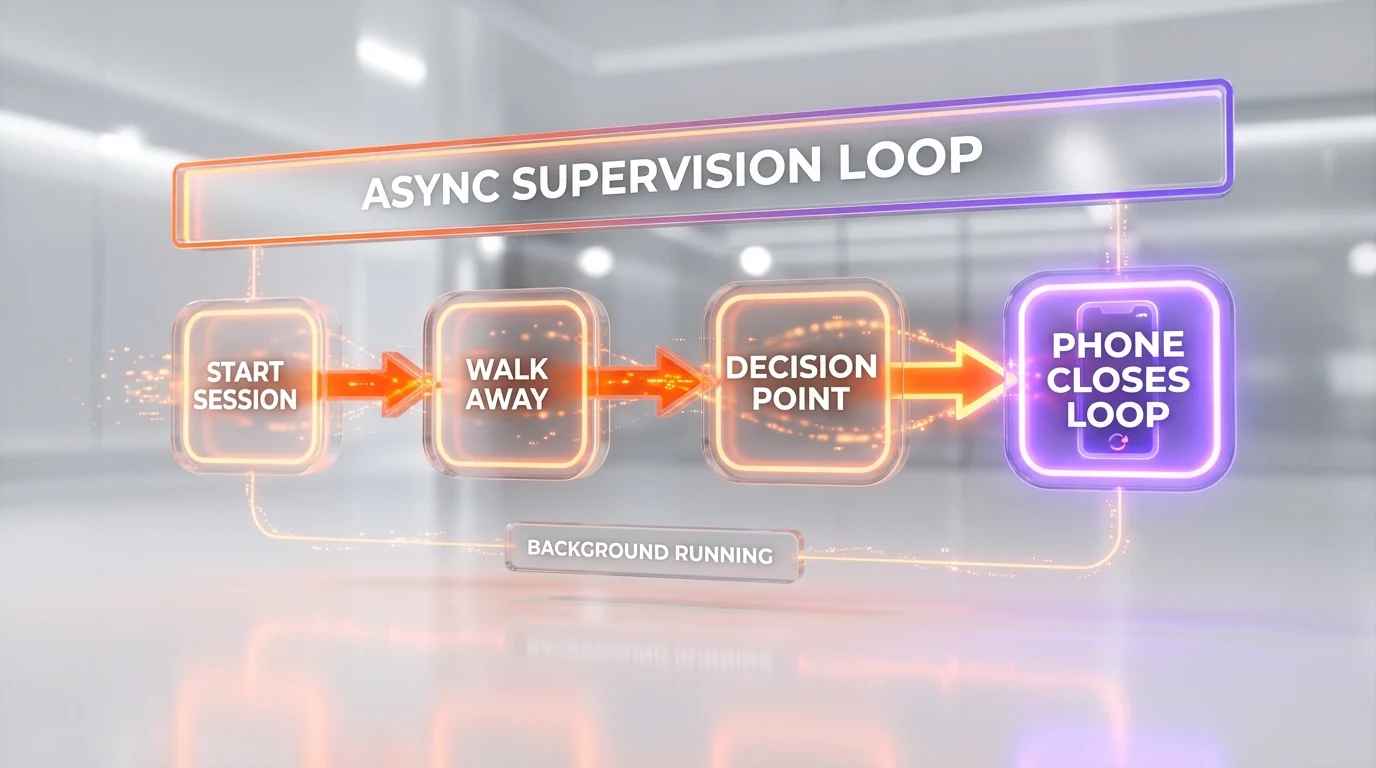
Step One: The Session Starts On Real Hardware
A developer kicks off a Codex task from their terminal, IDE, or the desktop app, on a machine with the Codex macOS app installed. This is where the agent has filesystem access, where it can run tests, where the repository lives. Nothing about that changes. The heavy lifting stays put.
Step Two: The Developer Walks Away
This is the part that makes async supervision valuable. After the April 2026 update gave Codex the ability to run in the background on desktop, the developer no longer has to babysit the terminal. The session continues. The human goes to a meeting, gets lunch, or starts a second task. The agent keeps working.
Step Three: A Decision Point Arrives
The agent hits something that needs a human: a command it wants to run, an ambiguous instruction, a choice between approaches, or a finished chunk of work that wants review. In a fully manual workflow, this is where everything stalls until the developer returns to the machine. The cost of being away is the cost of every decision point waiting in a queue.
Step Four: The Phone Closes The Loop
This is where the mobile Codex client earns its place. The decision point surfaces on the phone. The developer reviews the output, approves or rejects the command, swaps the model if the current one is struggling, or redirects the session entirely. The loop closes without the human walking back to the desk. The session resumes immediately. The cost of being away collapses toward zero.
That four-step loop is the actual product. The mobile app is step four. Steps one through three already existed. What OpenAI shipped is the piece that makes the gap between decision points survivable when the developer is not at the machine.
Where Multi-Thread Supervision Changes The Math
OpenAI's wording specifically says you can work across all of your threads. This is the part that scales. Supervising one agent from a phone is convenient. Supervising five concurrent sessions from a phone is a different category of leverage. A developer running parallel Codex sessions, one on a refactor, one on a test backfill, one on a dependency upgrade, becomes a coordinator of agents rather than a writer of code. The phone becomes the dispatch console for a small fleet.
We are careful not to overstate the maturity here. This is a preview, and multi-thread coordination at scale is exactly the kind of thing that gets rough edges in early releases. But the design intent is unambiguous. OpenAI is building the supervision layer for a world where a developer runs many agents at once, not one.
Why The Free And Go Rollout Is The Real Signal
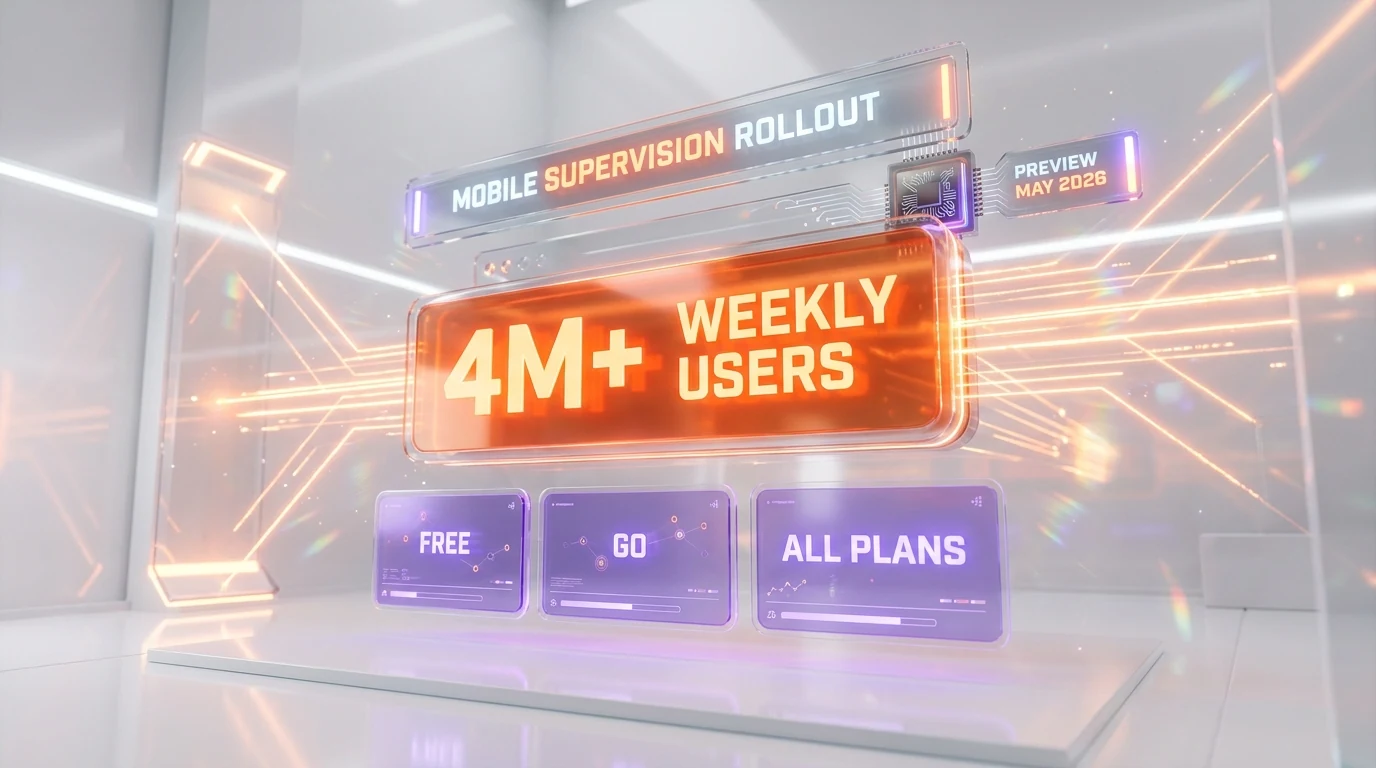
The detail that deserves the most strategic attention is the plan coverage. OpenAI is rolling this out to all plans, explicitly including Free and Go. Agentic coding features have historically been gated behind paid, often premium, tiers. Putting async session supervision in the free tier, even as a preview, is a positioning decision, not a generosity decision.
The 4 Million Weekly Users Context
OpenAI states Codex now has more than 4 million weekly users. That number is the backdrop for the free rollout. When a tool already has a user base at that scale, the strategic priority shifts from monetizing access to entrenching the workflow. You do not gate the habit-forming surface when your goal is to make the habit universal. Free and Go access turns the phone-as-control-surface pattern into something a developer can try with zero commitment, which is exactly how a default behavior gets established.
What OpenAI Is Actually Buying With Free Access
The trade is straightforward. By giving away the supervision surface, OpenAI buys reach for the supervision pattern itself. Every free-tier developer who learns to approve a Codex command from their phone is a developer whose mental model of coding now includes a remote agent and a pocket control surface. That mental model is the moat. Pricing tiers can change later. A workflow that millions of developers have internalized does not reverse easily.
This is the strategic read we want on record: the free and Go inclusion is an acquisition cost for the async supervision habit, paid in foregone short-term revenue, with the return being workflow lock-in at the ecosystem level. It is the same logic that made the ChatGPT free tier the on-ramp for everything that followed.
The Counter-Read We Should Acknowledge
There is a less strategic explanation worth naming for honesty. Previews are often broad precisely because they are previews; wide exposure surfaces bugs faster. It is possible the all-plans rollout is partly a testing decision rather than a pure positioning play. We think both can be true at once. A wide preview gathers signal and seeds the habit simultaneously. The strategic interpretation does not require the testing interpretation to be false.
The Industry Pattern: Cloud Handoff Is Becoming The Default
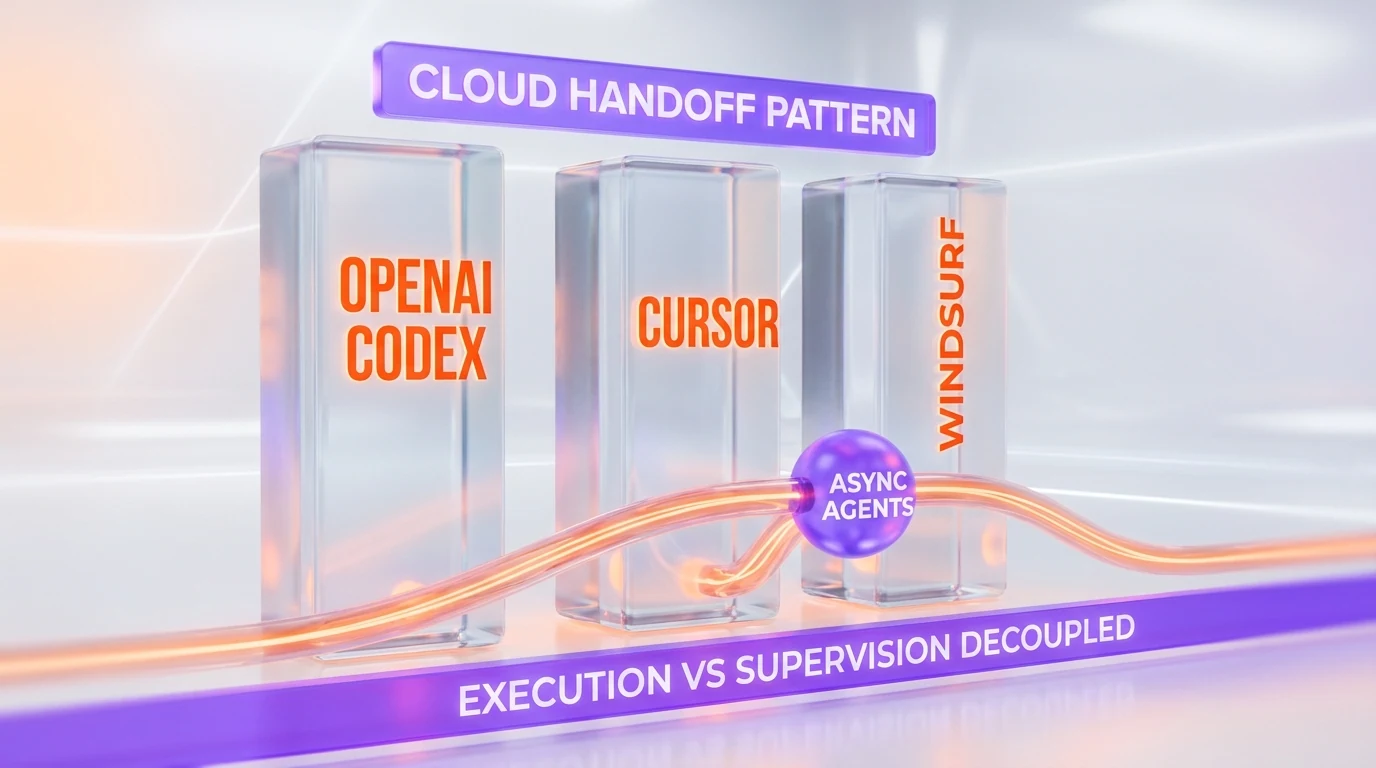
Codex on mobile does not exist in isolation. It is one move in a pattern that has been forming across the agentic coding category through early 2026. The pattern has a name worth using: cloud handoff, or more precisely, the separation of where an agent runs from where a human supervises it.
The Cursor And Windsurf Parallel
The same architectural idea shows up across competitors. Cursor's cloud agent environments let sessions run in managed, repository-aware environments while developers supervise from elsewhere, an approach we covered in our analysis of Cursor's cloud agent environments and multi-repo governance. The shared premise across these products is that the agent's execution context and the human's supervision context are decoupling. Where the agent runs and where the human watches are no longer the same place.
This is not coincidence. It is convergence. When multiple well-funded teams independently arrive at the same architecture, the architecture is usually responding to a real shift in how the work is done. The shift here is that coding is becoming a supervisory activity layered on top of agent execution, and supervision wants to be portable.
The Throughline With OpenAI's Own Recent Moves
The mobile client also fits OpenAI's own trajectory. The April 2026 background-running update on desktop was step one: decouple the agent from the developer's active attention. The May 2026 Chrome extension for live browser sessions was step two: extend the agent's reach. Mobile supervision is step three: make the human's control portable. Each step pushes in the same direction, which is the strategic point. This is a roadmap, not a series of unrelated features. It also rhymes with how OpenAI has been reshaping its model defaults, including the shift we documented in GPT-5.5 Instant becoming the ChatGPT default model, where the company keeps moving the center of gravity toward fast, always-available interaction surfaces.
What The Pattern Implies For The Next Twelve Months
If cloud handoff is the direction, a few things follow. Supervision surfaces will multiply across devices, not just phones. The unit of developer productivity will shift from lines written to sessions coordinated. And the competitive battleground will move from raw model capability toward the quality of the supervision experience, because once every major agent can run async, the differentiator is how well a human can steer many of them at once. xAI's recently announced coding agent push, which we have been tracking as a Claude Code rival, is another data point that the category is consolidating around agentic, supervisable workflows rather than single-shot completions.
What This Means For Developers Right Now
Strip away the strategy and there is a concrete change in how a developer's day can be structured. The practical implication is that the requirement to be physically at the machine to keep an agent productive is weakening. That has real workflow consequences worth being precise about.
The Workflow That Becomes Possible
A developer can start a substantial Codex task before stepping away, then handle the agent's decision points from the phone over the following hour without returning to the desk. A test backfill, a mechanical refactor, a dependency bump: these are exactly the kinds of tasks that produce occasional approval moments rather than continuous attention demands. Those tasks become things you supervise from a coffee line, not things you sit and watch.
The Workflow That Does Not Change
We should be equally precise about limits. Deep, novel architectural work, the kind that requires a developer's full context and judgment, does not move to the phone. The control surface is for steering work whose shape is already understood, not for the creative core. The phone makes supervision portable; it does not make hard thinking smaller. Anyone selling the mobile client as a way to architect systems from a handset is overselling it.
The Setup Requirement People Will Miss
One operational detail will trip people up: the mobile experience requires the Codex macOS app installed and running on the developer's machine, plus the latest ChatGPT mobile app. The phone is the control surface, but it controls something that has to exist and be reachable. There is a real machine in the loop. The phone does not replace it; it remotes into it. Developers expecting a fully cloud-hosted, machine-free experience will need to recalibrate.
How Codex Mobile Compares To The Field
It is worth situating this against the agentic coding landscape rather than treating it as a standalone. The category in mid-2026 has three reference points worth naming: OpenAI Codex itself, Claude Code, and Cursor. Each has taken a slightly different path toward the same async future.
Codex Versus Claude Code On Supervision Surface
Claude Code has built its identity around a powerful terminal-native agent with strong tool use. Codex's mobile push is a different bet: not deeper terminal capability, but broader supervision reach. The two are not strictly substitutable, which is exactly the nuance we drew out in our Claude Code versus OpenAI Codex comparison. Codex is leaning into being supervisable from anywhere; the strategic distinction is surface breadth, not model superiority.
Codex Versus Cursor On Where The Agent Lives
Cursor's cloud agent environments push the agent into managed cloud contexts. Codex's mobile model keeps the agent on the developer's own machine and makes the human portable instead. These are two different answers to the same question of how to decouple supervision from execution. One moves the agent to the cloud; the other moves the human to the phone. Both are valid; they imply different trust and data-residency tradeoffs that teams will weigh differently.
Why The Comparison Will Keep Shifting
The honest caveat is that this is a fast-moving category and a preview-stage feature. Any head-to-head read today is a snapshot. The durable observation is structural, not feature-level: every serious agent is building toward async, supervisable operation, and the competition is increasingly about the supervision experience rather than the underlying model. That is the lens worth keeping as the category evolves.
The Bigger Strategic Picture
Zoom out and the Codex mobile launch reads as a marker of where agentic development is heading. The strategic narrative has three layers, and it is worth stating each plainly.
Layer One: The Phone Is Now Infrastructure For Coding
For most of software history, the phone was where you read about code, not where you participated in producing it. The control surface model changes that. The phone becomes a legitimate node in the development loop, not as an editor but as a decision endpoint. That is a structural change in what a development environment includes.
Layer Two: Supervision Is The New Scarce Resource
When agents do the typing, the bottleneck moves to human judgment at decision points. The scarce resource is no longer keystrokes; it is timely supervision. Whoever makes supervision cheapest and most portable captures the workflow. OpenAI putting the supervision surface in the free tier is a direct play for that scarce resource.
Layer Three: The Default Behavior Is Being Set Now
Defaults are sticky. The developers forming habits around remote agent supervision in mid-2026 are establishing the muscle memory of the next several years. By rolling this out broadly and freely, OpenAI is competing to define what normal looks like before competitors lock it in their direction. That is the real game being played, and it is why a modest-sounding preview deserves a strategic read rather than a feature-note shrug.
Our Take
We have been tracking the async agent supervision pattern across the category, and Codex on mobile is the cleanest expression of it so far. The feature itself is straightforward. The positioning is the story. By framing the phone explicitly as more than remote control of a single task, and by extending it free across all plans against a 4-million-weekly-user backdrop, OpenAI is making a deliberate bid to own the supervision surface before the category settles.
The honest uncertainties remain. It is a preview. Multi-thread coordination at scale is unproven in the wild. The setup dependency on a running macOS Codex app is friction that will frustrate the cloud-native expectations many developers now hold. None of that undercuts the strategic read; it just sets the realistic ceiling on it for now.
Our position: this is a positioning move worth taking seriously, not because the feature is revolutionary in isolation, but because it is a coherent next step in a roadmap that is converging with the rest of the industry on the same architecture. The phone as control surface is not a gimmick. It is what supervision looks like when agents do the work and humans do the deciding.
Frequently Asked Questions
What did OpenAI announce about Codex on mobile?
On May 14, 2026, OpenAI announced that Codex, its agentic coding agent, is coming to the ChatGPT mobile app on iOS and Android, with rollout starting May 15, 2026 as a preview. OpenAI described it as more than remote control of a single task, stating that from your phone you can work across all of your threads, review outputs, approve commands, change models, or start something new.
Does Codex run code on my phone?
No. The phone is a control surface, not an execution device. Codex sessions continue to run on the developer's own machine, such as a laptop, Mac mini, or devbox, where the Codex macOS app is installed. The phone is used to supervise, review outputs, approve commands, change models, and redirect or start sessions. No code is executed locally on the handset.
Which ChatGPT plans get Codex on mobile?
OpenAI is rolling Codex mobile out to all plans as a preview, explicitly including the Free plan and the ChatGPT Go plan. Putting an agentic supervision feature in the free tier is unusual and is widely read as a positioning move to make the async supervision workflow a default behavior rather than a paid premium feature.
How many weekly users does Codex have?
OpenAI states that Codex now has more than 4 million weekly users as of May 2026. That installed base is the backdrop for the free and Go rollout: at that scale, the strategic priority shifts from monetizing access toward entrenching the supervision workflow across as many developers as possible.
What do I need to use Codex on the ChatGPT mobile app?
You need the latest version of the ChatGPT mobile app on iOS or Android, plus the Codex macOS app installed and running on the machine where your sessions execute. The phone is the supervision surface, but it remotes into a real machine that has to exist and be reachable. There is no fully cloud-hosted, machine-free mode.
What is an async agent supervision workflow?
It is a workflow where a coding agent runs in the background while a developer steps away, and the developer handles the agent's decision points, such as command approvals or ambiguous instructions, as they arrive rather than babysitting the session continuously. Codex on mobile closes that loop by letting the developer handle decision points from a phone instead of returning to the machine.
How does Codex on mobile compare to Claude Code?
Claude Code is built around a powerful terminal-native agent with strong tool use. Codex's mobile push is a different bet focused on broader supervision reach rather than deeper terminal capability. The two are not strictly substitutable; the distinction is supervision surface breadth versus terminal depth rather than raw model superiority.
How does Codex on mobile compare to Cursor's cloud agents?
Cursor's cloud agent environments push the agent into managed cloud contexts, moving execution to the cloud. Codex's mobile model keeps the agent on the developer's own machine and makes the human portable instead by moving supervision to the phone. Both decouple supervision from execution but with different trust and data-residency tradeoffs.
Why is the free rollout strategically significant?
Agentic coding features have historically been gated behind paid tiers. Extending Codex mobile free across all plans, including Go, is read as an acquisition cost for the async supervision habit, paid in foregone short-term revenue, with the return being workflow lock-in at the ecosystem level. The mental model of a remote agent plus a pocket control surface becomes the moat.
What is the cloud handoff industry pattern?
Cloud handoff is the separation of where an agent runs from where a human supervises it. The same architecture is appearing across OpenAI Codex, Cursor's cloud agent environments, and similar products. The convergence indicates a real shift: coding is becoming a supervisory activity layered on agent execution, and supervision wants to be portable across devices.
Can I supervise multiple Codex sessions from my phone?
OpenAI's description specifically says you can work across all of your threads, indicating multi-thread supervision is part of the design intent. Supervising several concurrent sessions from a phone turns the developer into a coordinator of agents rather than a writer of code. This is preview-stage, so multi-thread coordination at scale is not yet proven in the wild.
Does Codex on mobile replace working at a desk?
No. It makes supervision of well-understood tasks, such as test backfills, mechanical refactors, and dependency upgrades, portable. Deep, novel architectural work that requires full context and judgment does not move to the phone. The control surface steers work whose shape is already understood; it does not shrink hard thinking.
Sources: OpenAI announcement reporting via TechCrunch (May 14, 2026) and MacRumors. Analysis and strategic interpretation by ThePlanetTools.ai.