What Happened
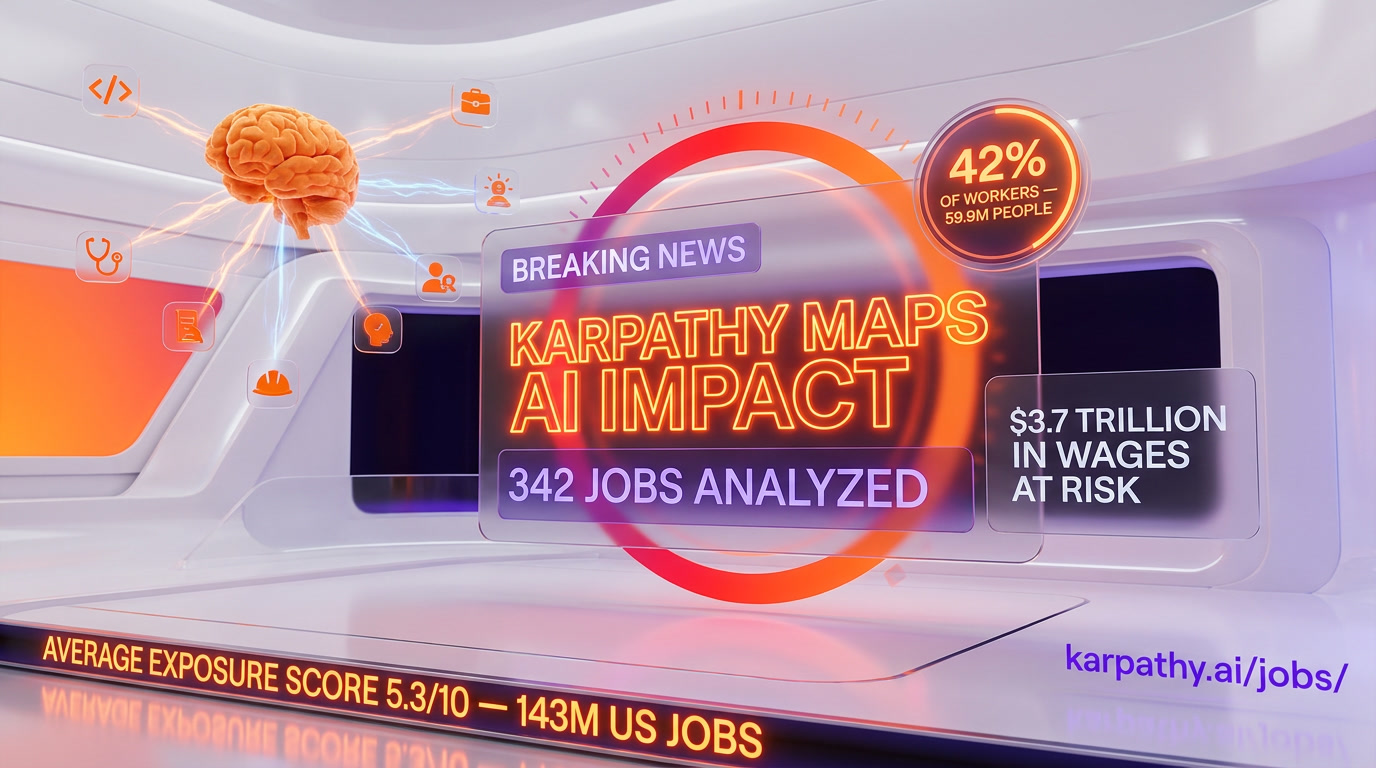
On March 15, 2026, Andrej Karpathy — former OpenAI researcher, former Tesla AI director, and one of the most influential voices in artificial intelligence — released an interactive visualization tool that maps AI's potential impact across 342 occupations from the Bureau of Labor Statistics. The tool, hosted at karpathy.ai/jobs/, covers 143 million jobs across the US economy and assigns each occupation an AI exposure score on a scale of 0 to 10.
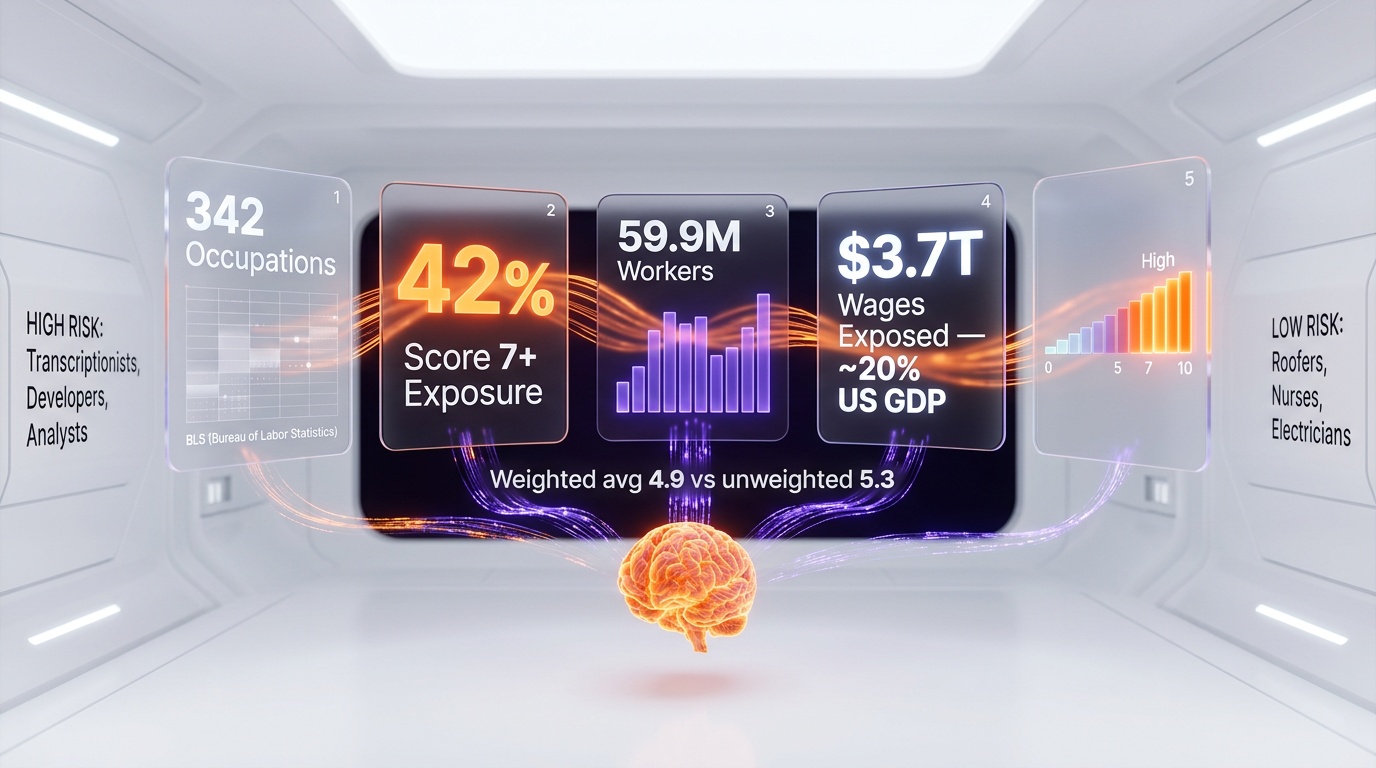
We've been following Karpathy's work closely since his departure from OpenAI, and this release immediately caught our attention. The headline numbers are sobering: the average AI exposure score across all occupations is 5.3 out of 10. When weighted by the number of workers in each occupation, that average drops slightly to 4.9 — but 42% of all jobs score 7 or higher, representing 59.9 million workers and approximately $3.7 trillion in annual wages.
What makes this release unusual is the context around it. Karpathy described the project as a "saturday morning 2 hour vibe coded project" — a casual weekend experiment, not a peer-reviewed study. The GitHub repository containing the source code was deleted within hours of publication, with no explanation provided. And Elon Musk weighed in on the findings, sending the project viral across social media.
The combination of a casual creation, explosive virality, and mysterious deletion has made this one of the most discussed AI releases of the year.
The Data: Who's Most Exposed
Karpathy's tool draws on Bureau of Labor Statistics occupation data and applies an AI exposure methodology to score each of the 342 occupations. While the exact scoring methodology was available in the (now-deleted) GitHub repo, the interactive tool at karpathy.ai/jobs/ still provides the full occupation-by-occupation breakdown.
The highest-exposure occupations — those scoring 8, 9, or 10 on the scale — are concentrated in knowledge work that involves pattern recognition, data analysis, and text production. Medical transcriptionists top the list, which isn't surprising given that AI transcription has already largely automated this role. Software developers and programmers score high, reflecting the rapid advancement of AI coding tools. Data analysts, statisticians, and actuaries score high due to AI's superior ability to process and interpret large datasets. Legal assistants and paralegals score high because much of their work involves document review and research that AI handles efficiently.
The pattern is clear: if your job primarily involves manipulating information — reading it, analyzing it, summarizing it, translating it, or producing it — AI exposure is high. The more your work can be reduced to tokens in and tokens out, the higher your score.
Who's Safe (For Now)
The lowest-scoring occupations are equally revealing. Roofers, plumbers, electricians, and construction workers all score low on the exposure scale. These are jobs that require physical presence, manual dexterity, spatial reasoning in unpredictable environments, and the ability to adapt to unique situations that don't repeat in standardized ways.
Nurses also score relatively low, despite the fact that healthcare is often cited as an AI target. The distinction is important: while AI can assist with diagnosis, documentation, and treatment planning, the core of nursing — physical patient care, emotional support, real-time assessment of complex human situations — remains beyond AI's current capabilities.
We've been analyzing AI capability curves across industries, and Karpathy's low-exposure list aligns with our assessment. The common thread among safe occupations is that they require embodied intelligence — the ability to navigate and manipulate the physical world in ways that current AI systems simply cannot do. Robotics will eventually close this gap, but at a much slower pace than the software-eating-software dynamic that threatens knowledge workers.
The Numbers That Matter
Let's drill into the specific figures because they tell a powerful story:
- 342 occupations analyzed, drawn from the Bureau of Labor Statistics Occupational Employment and Wage Statistics
- 143 million jobs covered, representing the vast majority of the US workforce
- Average exposure score: 5.3 out of 10 (unweighted across occupations)
- Weighted average: 4.9 out of 10 (weighted by number of workers per occupation, suggesting higher-employment occupations tend to be slightly less exposed)
- 42% of jobs score 7+: that's 59.9 million workers
- $3.7 trillion in annual wages at high exposure — roughly 20% of US GDP
The gap between the unweighted average (5.3) and the weighted average (4.9) is instructive. It means that occupations with fewer workers tend to have higher AI exposure scores. Think boutique knowledge work roles — translators, transcriptionists, research analysts — that employ relatively small numbers but are heavily exposed. The mass-employment occupations — retail, food service, transportation — tend to have moderate exposure, which pulls the weighted average down.
But the 42% figure is the one that stops you cold. Nearly half the US workforce is in occupations that Karpathy's model rates as highly exposed to AI disruption. Even if you discount the methodology as imprecise — which, as a two-hour weekend project, it certainly is — the direction and magnitude of the signal are hard to dismiss.
The "Saturday Morning Vibe Code" Factor
Karpathy's description of the project as a "saturday morning 2 hour vibe coded project" is both disarming and significant. On one hand, it contextualizes the work: this isn't a rigorous academic study with peer review and confidence intervals. It's one person's weekend experiment, built quickly and shared casually.
On the other hand, the fact that one of the world's foremost AI researchers can produce a data visualization covering 143 million jobs in two hours is itself a statement about AI's capabilities. Karpathy almost certainly used AI tools to help build the visualization, analyze the BLS data, and generate the exposure scores. The project is both a commentary on AI's impact and a demonstration of it.
We've been tracking the "vibe coding" phenomenon — using AI assistants to rapidly prototype applications and analyses — and Karpathy's project is perhaps the highest-profile example of what happens when a world-class researcher applies AI-assisted development to a question of enormous social significance. The speed of creation doesn't necessarily diminish the value of the output, especially when the creator has the domain expertise to validate the results.
The Mysterious Repo Deletion
Within hours of the project going viral, Karpathy deleted the GitHub repository containing the source code. No explanation was given. The interactive tool at karpathy.ai/jobs/ remains live, but the underlying methodology, scoring logic, and data processing pipeline are no longer publicly available.
We've been trying to understand why, and there are several plausible explanations. The most charitable: Karpathy may have felt that the methodology wasn't rigorous enough to withstand the scrutiny that viral attention brings, and preferred to remove the code rather than have it misinterpreted as a definitive study. The more concerning: the visualization touched on politically sensitive territory — job displacement, wage impacts, inequality — and the attention may have been unwelcome from an employer, investor, or policy perspective.
Whatever the reason, the deletion has had the predictable Streisand Effect. People are more interested in the project now than they would have been if the repo had stayed up. Cached copies are circulating, and the conversation about AI job displacement has been amplified rather than suppressed.

The Elon Musk Factor
When Elon Musk weighed in on Karpathy's job exposure data, the project went from viral to supernova. Musk's commentary — amplified to his massive following — introduced the findings to audiences far beyond the AI and tech communities.
We've seen this pattern before: a niche technical finding gets the Musk signal boost and becomes a mainstream talking point overnight. In this case, the impact was particularly significant because Musk's own companies (Tesla, xAI, Neuralink) are directly involved in building the AI systems that Karpathy's tool analyzes. There's an inherent tension in one of the world's largest AI investors amplifying research about AI-driven job displacement.
The Musk engagement also shifted the conversation from technical analysis to political territory. Questions about universal basic income, retraining programs, and the social contract between AI companies and displaced workers dominated the replies and quote-tweets. Karpathy's weekend project had become a political lightning rod.
How This Compares to Other Studies
Karpathy's visualization isn't the first attempt to map AI's impact on employment. The most cited prior work includes the 2023 OpenAI/University of Pennsylvania paper on GPT-4's exposure across occupations, Goldman Sachs' estimate that 300 million jobs globally could be affected by generative AI, and various McKinsey and World Economic Forum reports.
What sets Karpathy's tool apart is its accessibility and specificity. Previous studies published dense academic papers or gated consulting reports. Karpathy built an interactive tool that anyone can use to look up their own occupation and see exactly where it falls on the exposure scale. That democratization of the data is why it went viral — people could see their own jobs in the visualization and share the results.
The 5.3 out of 10 average exposure score is broadly consistent with prior research, which has generally placed 40-60% of job tasks as having some level of AI exposure. Karpathy's 42% figure for workers scoring 7+ also aligns with Goldman Sachs' estimates and the OpenAI paper's findings about highly exposed occupations.
The consistency across independent analyses, conducted with different methodologies by different researchers, strengthens the signal. Whether you look at this through Karpathy's lens, OpenAI's lens, or Goldman's lens, the picture is the same: a substantial portion of the workforce is performing tasks that AI can already do or will soon be able to do.
Our Take
We've been following AI's impact on the labor market closely, and Karpathy's tool — despite being a weekend project — is one of the most effective communication tools we've seen for making abstract AI impacts concrete and personal.
The data aligns with what we've observed in our own testing of AI tools across dozens of professional domains. Coding assistants are genuinely replacing junior development tasks. AI writing tools handle first-draft content at a level that was impossible two years ago. Data analysis tools can process and visualize datasets in seconds that would take an analyst hours. Legal research tools are cutting document review time by orders of magnitude.
But we want to add nuance that the exposure score alone doesn't capture. A high exposure score doesn't mean a job disappears — it means the job changes. Software developers scoring high on the exposure scale doesn't mean developers become unemployed. It means the skills, tools, and workflows that define development work are being fundamentally restructured. The developers who thrive will be those who use AI to amplify their capabilities. Those who don't adapt face genuine risk.
The $3.7 trillion wage figure is the number that should focus policymakers' attention. That's not theoretical — it's the real annual compensation of workers in occupations that Karpathy's model identifies as highly exposed. Whether those wages are displaced, restructured, or augmented depends entirely on how quickly institutions — companies, governments, educational systems — adapt to the AI transition.
Karpathy built this in two hours on a Saturday morning. That's the pace of AI development. The question is whether the rest of society can adapt at anything close to the same speed.
What's Next
The interactive tool remains live at karpathy.ai/jobs/, and we recommend everyone check their own occupation's exposure score. It's a useful starting point for thinking about how AI might affect your work, even if the methodology is imperfect.
We expect this type of analysis to become more common and more sophisticated. As AI capabilities continue to expand, the need for clear, accessible tools that help people understand their exposure will only grow. Karpathy may have deleted the repo, but he's opened a conversation that won't be going away.
We'll continue tracking AI's impact on employment across the industries we cover, and we'll update our analysis as new data becomes available. The 42% figure may be imprecise, but the direction is unmistakable: AI is reshaping work faster than most people realize, and the time to prepare is now — not when the disruption arrives at your desk.
Frequently Asked Questions
What is Karpathy's AI job exposure score?
Karpathy's tool assigns each of 342 occupations a score from 0 to 10 based on AI exposure. The average score across all occupations is 5.3 out of 10 unweighted, or 4.9 when weighted by employment numbers, covering 143 million US jobs.
Which jobs are most at risk from AI according to Karpathy?
The highest-scoring occupations include medical transcriptionists, software developers, data analysts, and legal assistants. These roles scored 7+ on the exposure scale, representing 42% of the US workforce — approximately 59.9 million workers earning $3.7 trillion in wages.
Which jobs are safest from AI according to Karpathy's data?
Physical and hands-on trades score the lowest on Karpathy's scale. Roofers, plumbers, nurses, construction workers, and electricians are among the least exposed occupations, largely because their work requires physical presence and manual dexterity that AI cannot replicate.
Why did Karpathy's AI jobs GitHub repo disappear?
Shortly after going viral on March 15, 2026, the GitHub repository backing the interactive tool was taken down. The exact reason remains unclear, though speculation ranges from legal concerns to Karpathy wanting to refine the methodology before broader release.
How does Karpathy's study differ from the OpenAI GPT-4 job impact paper?
OpenAI's 2023 study estimated 80% of workers would see at least 10% of their tasks affected by GPTs. Karpathy's 2026 tool is more granular — it assigns specific 0-10 scores per occupation rather than broad percentages, uses Bureau of Labor Statistics data for 342 occupations, and weights by actual employment numbers and wage data, making it more actionable for workforce planning.
What role did Elon Musk play in the Karpathy AI jobs tool going viral?
Elon Musk amplified Karpathy's tool on X (formerly Twitter), which drove massive traffic to the project. Hours later, the GitHub repository was deleted, triggering a Streisand Effect — the takedown made the project even more viral and discussed than it would have been otherwise, turning it into the most-cited AI labor study of 2026.
Who is Andrej Karpathy and why does his AI jobs analysis matter?
Andrej Karpathy is a founding member of OpenAI and former Senior Director of AI at Tesla, where he led the Autopilot team. His credibility in AI research makes his job exposure analysis carry significant weight — unlike most AI-jobs studies from consultancies, Karpathy's assessment comes from someone who has built production AI systems at two of the most influential AI companies in the world.