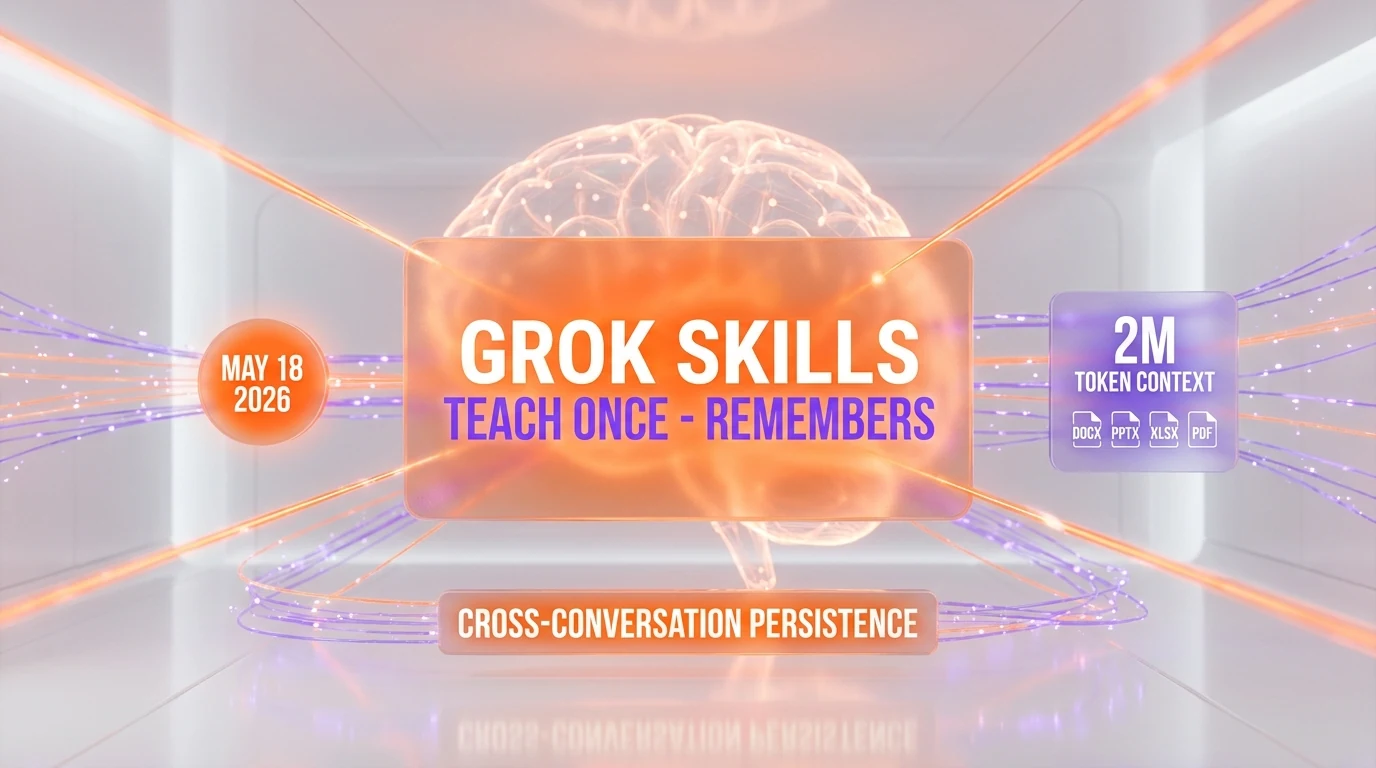
What is Grok Skills? Grok Skills is a feature xAI announced on May 18, 2026 that lets Grok learn a skill once and reuse it across every future conversation, plus generate production-ready Office documents. Skills are modular, reusable instruction sets stored with Name, Description, and Instruction fields, importable as .zip, .skill, or .md files, and they run inside Grok's 2 million token context window. The same release pushes Grok 4.3 document generation into Word (.docx), PowerPoint (.pptx), Excel (.xlsx), and PDF. The real strategic signal is not the documents — it is the cross-conversation persistence, which puts xAI directly on the agentic-productivity ground held by Anthropic Claude Skills, OpenAI, and Microsoft Copilot.
What Happened
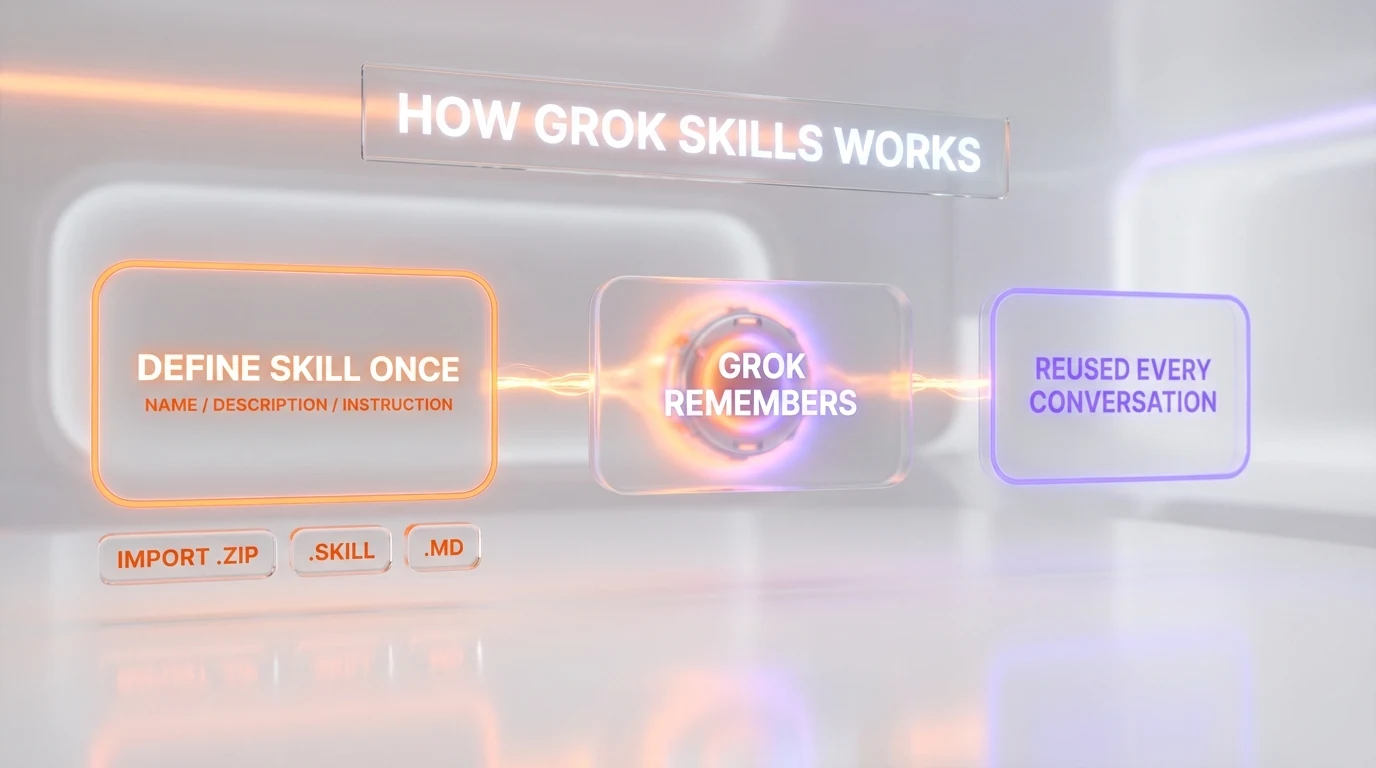
On May 18, 2026, xAI announced Grok Skills, a system that turns one-off prompting into persistent, reusable capability. Instead of re-explaining the same task every session, a user defines a Skill once — a structured instruction block with a Name, a Description, and an Instruction body — and Grok carries that capability into every future conversation. xAI also opened the door to importing Skills as .zip, .skill, or .md files, which means a Skill can be authored externally, version-controlled, and shared between users and teams.
The feature was first surfaced through a leaked screenshot and early demo dated March 27, 2026, credited to analyst Nima Owji, showing Grok automatically assembling a daily AI news briefing from a saved Skill. The May 18 announcement is the formal productization of that preview. xAI positions Skills as a more granular layer than its March 4, 2026 Custom Agents launch — designed for "smaller, shareable instruction blocks rather than full agent configurations" — and the blocks operate within Grok's 2 million token context window.
Bundled into the same release is a major document-generation upgrade tied to Grok 4.3. Grok now produces downloadable Microsoft Word documents (.docx), PowerPoint presentations (.pptx), Excel spreadsheets (.xlsx), and PDF files directly from a conversation. xAI describes these as production-ready: decks with visual hierarchy and speaker notes, invoices, contracts, proposals, and spreadsheets with working formulas and color-coded cells. Grok can also restructure and enrich files a user uploads. In an internal demo shown by xAI senior engineer Matthew Dabit, a dense neuroscience research paper was converted into a nine-slide, presentation-ready deck in under five minutes. We have not independently tested these document outputs; the capabilities described here are as announced by xAI and corroborated by early testers, not features we verified hands-on.
Why It Matters
The headline-grabbing part of this launch is the document generation. The strategically important part is the persistence. Generating a slide deck or a spreadsheet from a prompt is, in 2026, table stakes — Anthropic, OpenAI, Google, and Microsoft all do some version of it. What changes the competitive math is structured memory that survives the end of a conversation. A skill taught once and reused everywhere converts a chatbot from a stateless tool into something that accumulates a user-specific operating manual over time. That is the same bet Anthropic made with Claude Skills and the direction OpenAI and Microsoft Copilot have been moving.
For the operator or team, the implication is concrete. Today, the productivity ceiling of a general-purpose assistant is the prompt — every session starts from zero, and the quality of output depends on how well you re-specify context each time. Persistent Skills move that ceiling. The repeatable, high-value workflows — your invoice format, your proposal structure, your weekly reporting template, your brand voice rules — become assets the model holds rather than instructions you retype. The importable .skill and .md formats matter here too: a Skill becomes a shareable artifact, which is how this scales from one user to a team and how an ecosystem of pre-built Skills can form.
It also reframes the document-generation feature. Grok producing a contract or a color-coded spreadsheet is useful on its own. Grok producing your contract in your format because it learned that Skill once and retained it — that is the combination xAI is actually selling. The two announcements are deliberately coupled: persistence is the moat, documents are the demonstration.
How It Compares
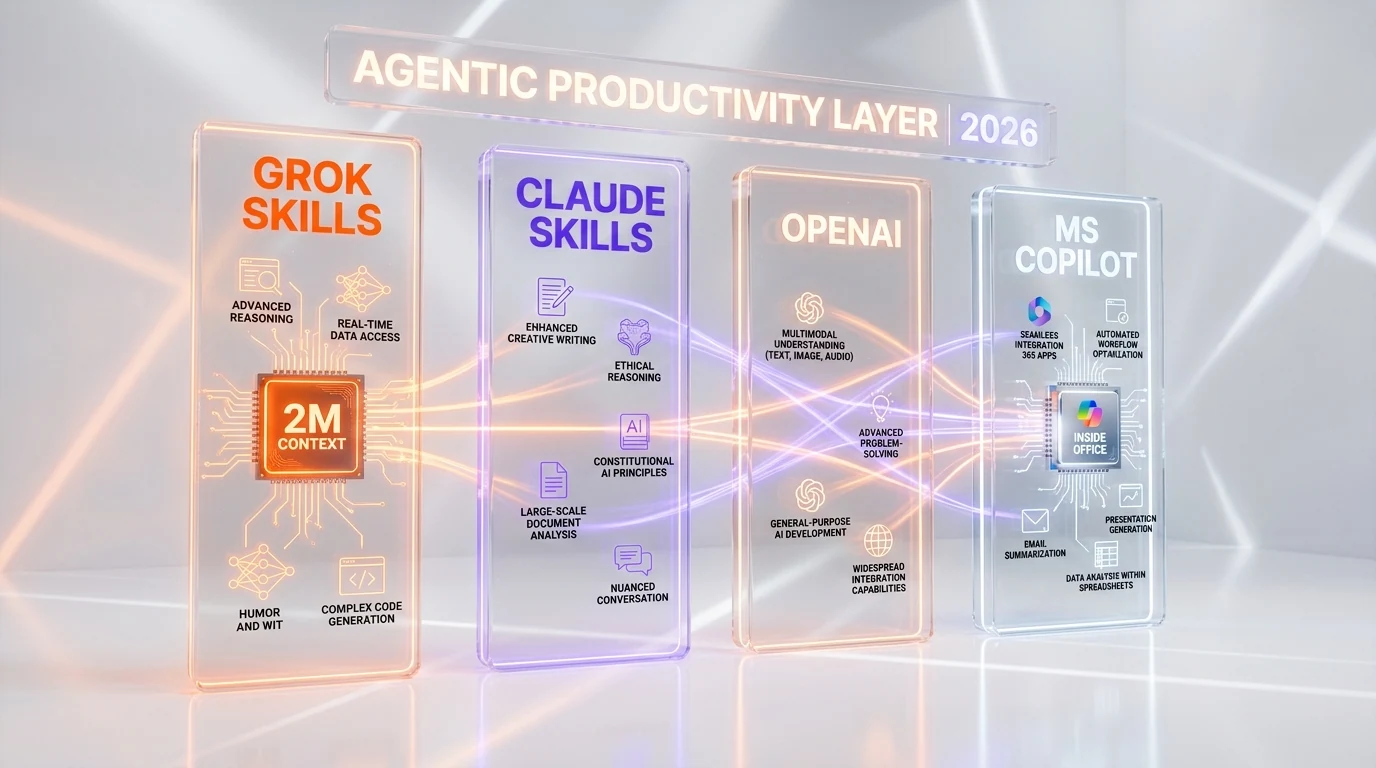
xAI is not pioneering this territory — it is contesting it. Anthropic shipped Claude Skills as reusable, packaged capabilities and has been threading native Skills into business surfaces. OpenAI has its own reusable-instruction direction, and Microsoft Copilot already sits inside Word, Excel, and PowerPoint with deep Office integration and an enterprise distribution advantage xAI does not have. Grok's differentiator is less about being first and more about bundling persistent Skills with native document output and Grok 4.3's 2 million token context window in a single consumer-facing package, on top of X's distribution.
The honest read on positioning: xAI is closing a feature gap, not opening one. Cross-conversation persistence is the right strategic target because it is where durable user lock-in lives — the more Skills a user accumulates, the higher the switching cost. But Microsoft's Office plugins are arriving "coming soon" with no firm date as of late April 2026, and the persistent-memory friction xAI is addressing has been a documented pain point even at the SuperGrok Heavy $300 per month tier. Whoever makes persistence reliable, shareable, and default — not gated behind the top tier — wins the agentic-productivity layer. This launch is xAI declaring it intends to be in that fight.
What Grok Skills Actually Does
The mechanics, as announced, are deliberately simple. A Skill is an instruction block with three fields:
- Name — a short identifier for the capability ("Weekly AI News Brief", "Standard Client Invoice").
- Description — what the Skill is for, used by Grok to decide when the Skill applies.
- Instruction — the full body: what to do, how to format the output, and what the deliverable should look like.
Skills are designed as small, composable units rather than full agent configurations — closer to a reusable template than a standalone autonomous agent. They can be imported from .zip, .skill, or .md files, which makes them authorable outside Grok and shareable as files. They run within Grok's 2 million token context window. The leaked daily-AI-news demo is the canonical example: a Skill that, once saved, lets Grok assemble a formatted briefing on request without the user re-specifying the format each time.
On the document side, the announced outputs go beyond plain text export. xAI describes decks with visual hierarchy and speaker notes, invoices, contracts, and proposals as finished deliverables, and spreadsheets with live formulas and color-coded cells rather than static tables. Grok can also take an uploaded file and restructure or enrich it — the neuroscience-paper-to-deck demo being the showcase example. Again, these are announced capabilities; we report them as described by xAI and early testers, not as outputs we independently confirmed.
Our Take
We have been tracking xAI's product cadence closely, and Grok Skills fits a clear pattern: after Grok Build moved xAI into the agentic-coding race, Skills moves it into agentic productivity. The strategic logic is sound. Persistence is the correct thing to compete on because it is where switching costs compound — every Skill a user builds is a reason not to leave. Bundling that with native Office-format generation and a 2 million token context window makes for a tidy consumer pitch, especially with X-scale distribution behind it.
What we would watch before calling this a category shift. First, availability: the document-generation upgrade has historically been gated behind expensive tiers, and persistent memory friction has been a documented complaint even at SuperGrok Heavy's $300 per month. Persistence only becomes a moat if it ships broadly, not locked to the top plan. Second, reliability: a Skill that mostly works is worse than no Skill, because users build workflows on top of it. Third, the ecosystem question — importable .skill and .md files hint at a shareable Skills ecosystem, and whether xAI cultivates that (the way Anthropic is building around Claude Skills) will decide if this is a feature or a platform.
Our honest position: this is xAI executing competently on the right target, not leapfrogging anyone. The persistence angle is the story, the documents are the demo, and the open question is distribution — who makes structured memory reliable, shareable, and default rather than premium-gated.
What's Next
The near-term signals to watch are concrete. Which plans get Skills and document generation, and at what price — broad availability versus a top-tier gate will tell us whether xAI is serious about the moat or just the headline. Whether xAI opens a shareable Skills directory or marketplace, which would turn Skills from a feature into a platform. How Anthropic, OpenAI, and Microsoft respond on persistence specifically, since that is now the contested layer. And whether the document outputs hold up at production quality outside curated demos — the gap between a five-minute demo deck and a deck you would actually send a client is exactly where these features usually break. We will revisit as availability and pricing details firm up.
Frequently Asked Questions
What is Grok Skills?
Grok Skills is a feature xAI announced on May 18, 2026 that lets Grok learn a skill once and reuse it across every future conversation. A Skill is a modular instruction block with Name, Description, and Instruction fields, importable as .zip, .skill, or .md files, running inside Grok's 2 million token context window. The same release also adds production-ready Word, PowerPoint, Excel, and PDF document generation.
How is Grok Skills different from Grok Build?
They are separate products. Grok Build, launched in May 2026, is a terminal-native coding agent that rivals Claude Code and OpenAI Codex. Grok Skills is about productivity and persistent document workflows — teaching Grok a reusable skill that survives across conversations and generating Office documents. Different surface, different use case.
What document formats can Grok generate?
As announced, Grok 4.3 generates Microsoft Word documents (.docx), PowerPoint presentations (.pptx), Excel spreadsheets (.xlsx), and PDF files directly from a conversation, including decks with speaker notes and visual hierarchy, invoices, contracts, proposals, and spreadsheets with working formulas and color-coded cells. It can also restructure files a user uploads.
What does cross-conversation persistence mean?
It means a Skill taught to Grok once is retained and reused automatically in every later conversation, instead of the user re-explaining the task each session. This converts Grok from a stateless assistant into one that accumulates user-specific, reusable capability over time — the core strategic signal of the launch.
How does Grok Skills compare to Anthropic Claude Skills?
Both are reusable, packaged capability systems aimed at the same agentic-productivity layer. Anthropic shipped Claude Skills earlier and has been threading native Skills into business surfaces. Grok Skills contests that ground rather than pioneering it; its differentiator is bundling persistent Skills with native Office document output and a 2 million token context window on top of X's distribution.
How does it compare to OpenAI and Microsoft Copilot?
OpenAI has its own reusable-instruction direction, and Microsoft Copilot already lives inside Word, Excel, and PowerPoint with deep Office integration and enterprise distribution xAI lacks. xAI is closing a feature gap, not opening one. Its bet is that reliable, shareable cross-conversation persistence is where durable user lock-in lives.
When was Grok Skills announced and when did it first leak?
xAI announced Grok Skills on May 18, 2026. The feature first surfaced via a leaked screenshot and early demo dated March 27, 2026, credited to analyst Nima Owji, showing Grok assembling a daily AI news briefing from a saved Skill.
Can Skills be shared between users?
The design supports it. Skills can be imported from .zip, .skill, or .md files, which makes a Skill an authorable, version-controllable, shareable artifact rather than an in-app-only setting. Whether xAI builds an official Skills directory or marketplace is an open question that will decide if Skills become a platform.
Do you need a paid plan for Grok Skills?
Plan and pricing details were not fully specified at announcement. Grok's document generation has historically been gated behind expensive tiers, and persistent-memory friction has been a documented pain point even at the SuperGrok Heavy $300 per month tier. Broad versus top-tier-only availability is one of the key signals to watch.
Did ThePlanetTools.ai test Grok Skills?
No. This article analyzes xAI's official May 18, 2026 announcement and corroborating reports. The persistence and document-generation capabilities described are as announced by xAI and reported by early testers, not features we independently verified hands-on. We report announced capabilities as announced, not as confirmed.
What is the real strategic significance of Grok Skills?
The persistence, not the documents. Document generation is table stakes in 2026 — Anthropic, OpenAI, Google, and Microsoft all do it. Structured memory that survives a conversation is where switching costs compound: every Skill a user builds raises the cost of leaving. That is the agentic-productivity layer xAI is contesting against Claude Skills, OpenAI, and Microsoft Copilot.