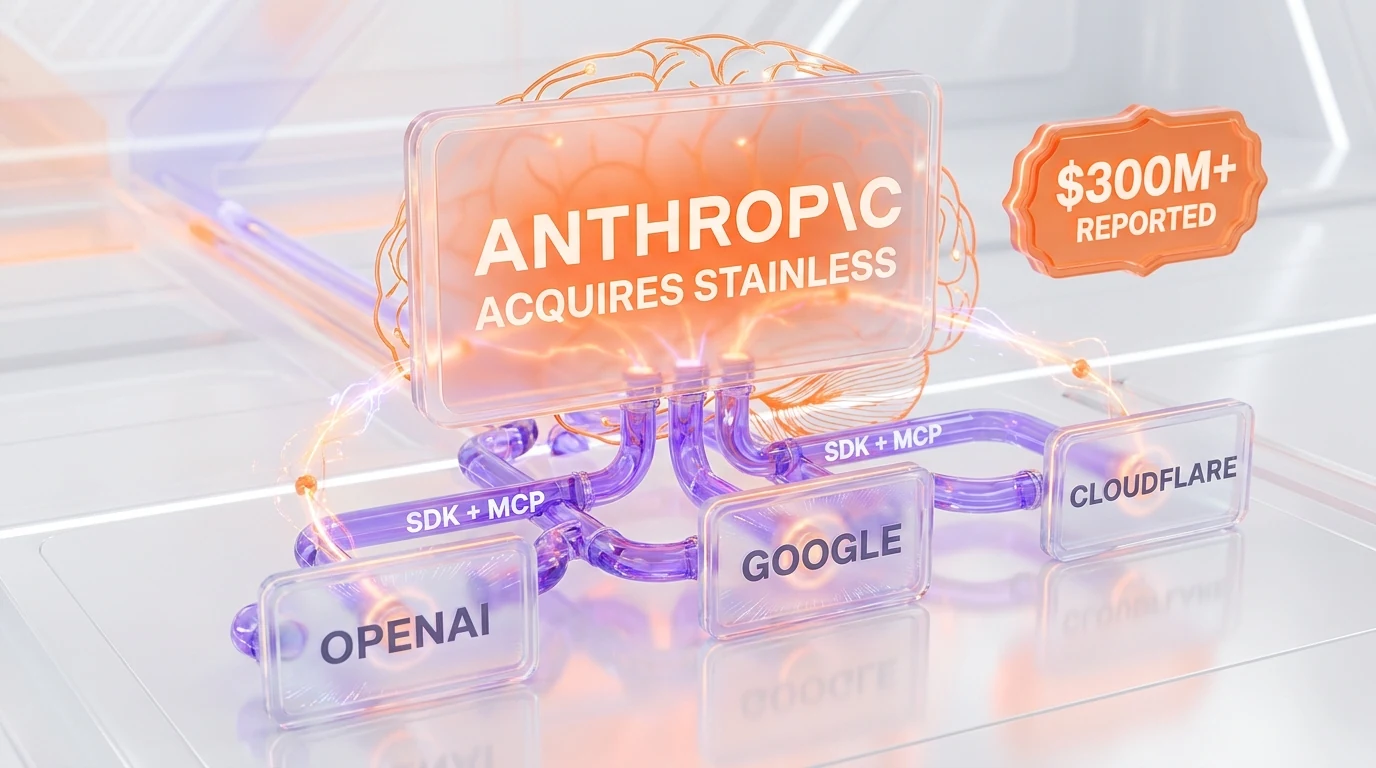
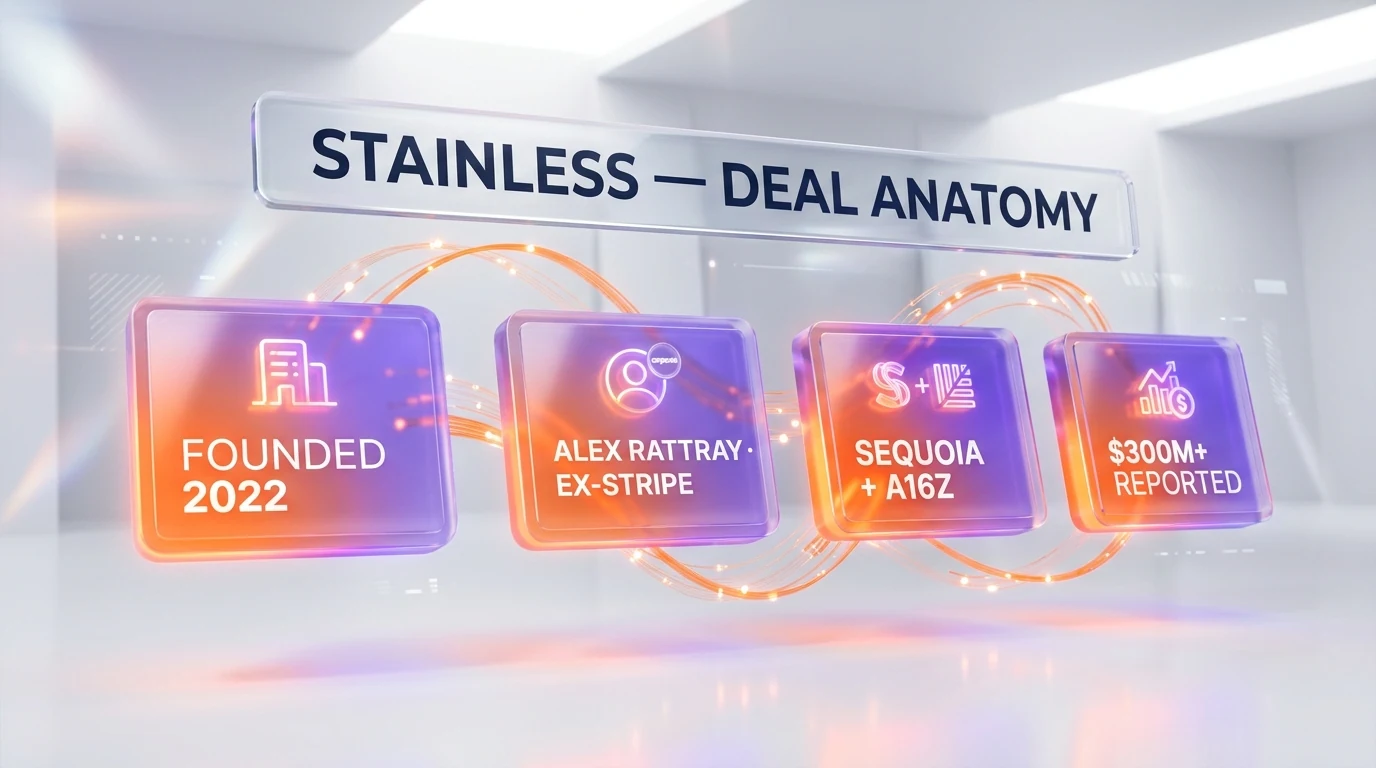
What did Anthropic acquire? Stainless, the SDK-generation company behind the official SDKs of Anthropic, OpenAI, Google and Cloudflare. The deal was announced on May 18, 2026. Stainless was founded in 2022 by Alex Rattray, a former Stripe engineer in New York, and backed by Sequoia Capital and Andreessen Horowitz. The Information reported Anthropic paid more than $300 million; Anthropic did not disclose terms. Stainless automatically generates and maintains SDKs, CLIs and MCP servers from API specifications — and it has powered every official Anthropic SDK since the earliest days of the company's API.
What Happened
On May 18, 2026, Anthropic announced it had acquired Stainless, describing the company on its newsroom as "a leader in SDKs and MCP server tooling." Stainless was founded in 2022 by Alex Rattray, a former Stripe engineer based in New York, and had raised venture funding from Sequoia Capital and Andreessen Horowitz. Anthropic did not publicly disclose the financial terms. The Information reported the deal was worth more than $300 million; we treat that figure as reported rather than confirmed, because neither company has put a number on the record.
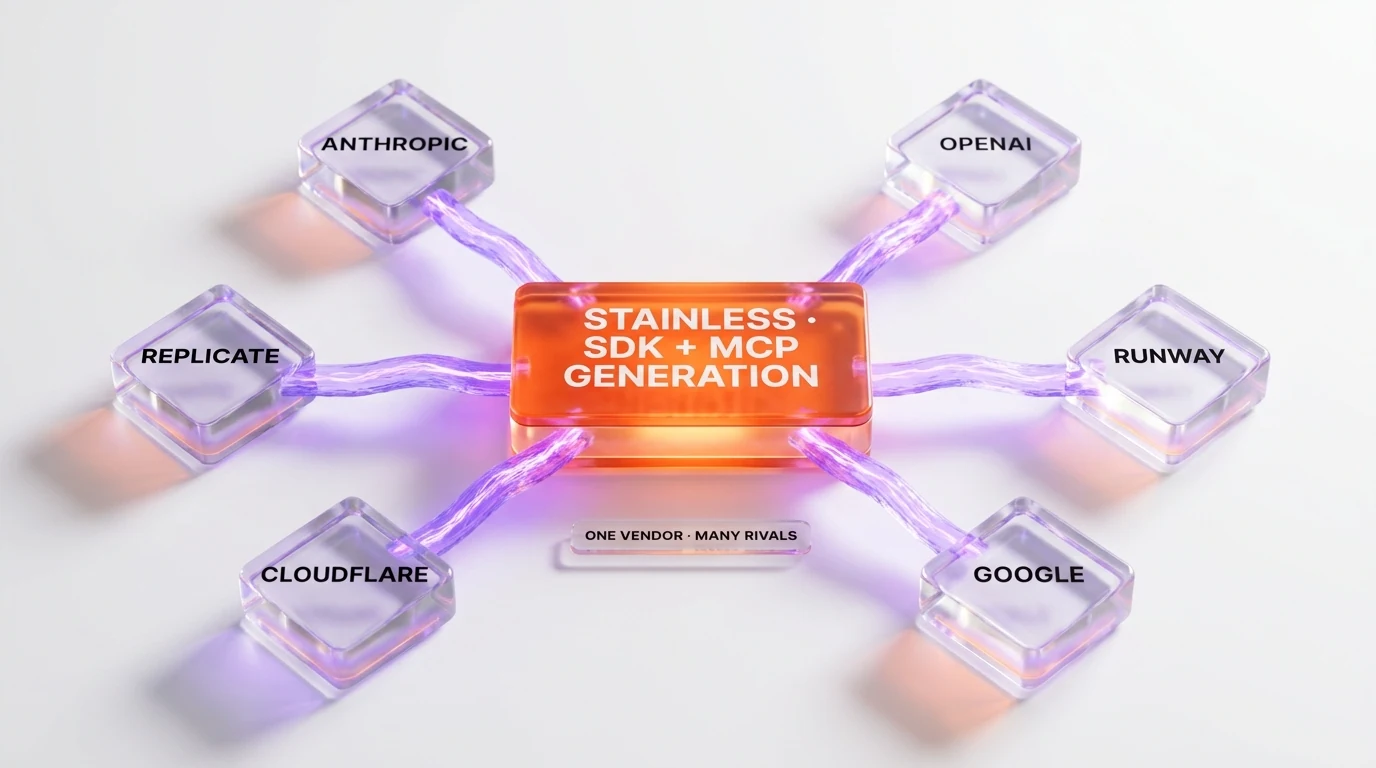
The strategic detail that makes this acquisition unusual is the customer list. Stainless does not just generate Anthropic's SDKs. It generates and maintains the official SDKs, command-line tools and Model Context Protocol (MCP) servers for OpenAI, Google, Cloudflare, Replicate and Runway. In plain terms: Anthropic just bought the company that builds the developer plumbing for several of its most direct competitors. According to Anthropic's announcement, Stainless "has powered the generation of every official Anthropic SDK since the earliest days of our API," and "hundreds of companies rely on Stainless to generate SDKs, CLIs, and MCP servers."
The official rationale was framed around agents, not rivalry. Katelyn Lesse, Head of Platform Engineering at Anthropic, said: "Agents are only as useful as what they can connect to. We're excited to bring the Stainless team into Anthropic to advance Claude's ability to connect to data and tools." Founder Alex Rattray framed it from the builder's side: "I started Stainless because SDKs deserve as much care as the APIs they wrap. Anthropic was one of the first teams to bet on this with us." Rattray also wrote that the team "gets to keep doing the work we love, on the platform where it matters most."
One claim circulating in coverage deserves a careful caveat. TechCrunch, citing The Information, reported that Anthropic plans to wind down the hosted Stainless products available to other AI labs, making the SDK generator exclusive to Anthropic. Anthropic's own announcement does not say this. The official post does not mention sunsetting hosted products, transition timelines, or commitments to existing Stainless customers like OpenAI or Google. We flag this as reported, not confirmed — the difference matters for any developer or company currently depending on Stainless infrastructure, and it is the single most consequential open question of this deal.
What Stainless Actually Does
SDKs are the layer that turns a raw API into something developers actually want to use. An API ships a specification — typically an OpenAPI document. Stainless ingests that specification and emits idiomatic, production-grade client libraries across languages: TypeScript, Python, Go, Java, Kotlin, and more. Crucially, it does this continuously. When the underlying API changes, Stainless regenerates the SDKs to match, so the libraries do not drift away from the service they wrap. It extends the same approach to command-line tools and, increasingly, to MCP servers — the standardized connectors that let AI agents call external tools and data sources.
This is unglamorous, high-leverage infrastructure. Every AI lab ships an API, and every API is only as adoptable as its SDKs. A clean, well-typed, always-current Python or TypeScript client is the difference between a developer shipping in an afternoon and a developer abandoning the integration. By 2026, the major model providers had largely converged on Stainless to solve this, which is precisely why a single acquisition can touch OpenAI's, Google's and Cloudflare's developer experience at the same time.
The MCP angle is the part that ties this directly to Anthropic's strategic narrative. Model Context Protocol — introduced by Anthropic in late 2024 — has become the de facto standard for connecting agents to tools. MCP servers are the executable connectors on the other end of that protocol. Stainless can generate MCP servers from API specifications the same way it generates SDKs. For a company whose entire 2026 thesis is "from models that answer to agents that act," owning the team that mass-produces the connectors agents depend on is not a side bet. It is the bet.
Why It Matters
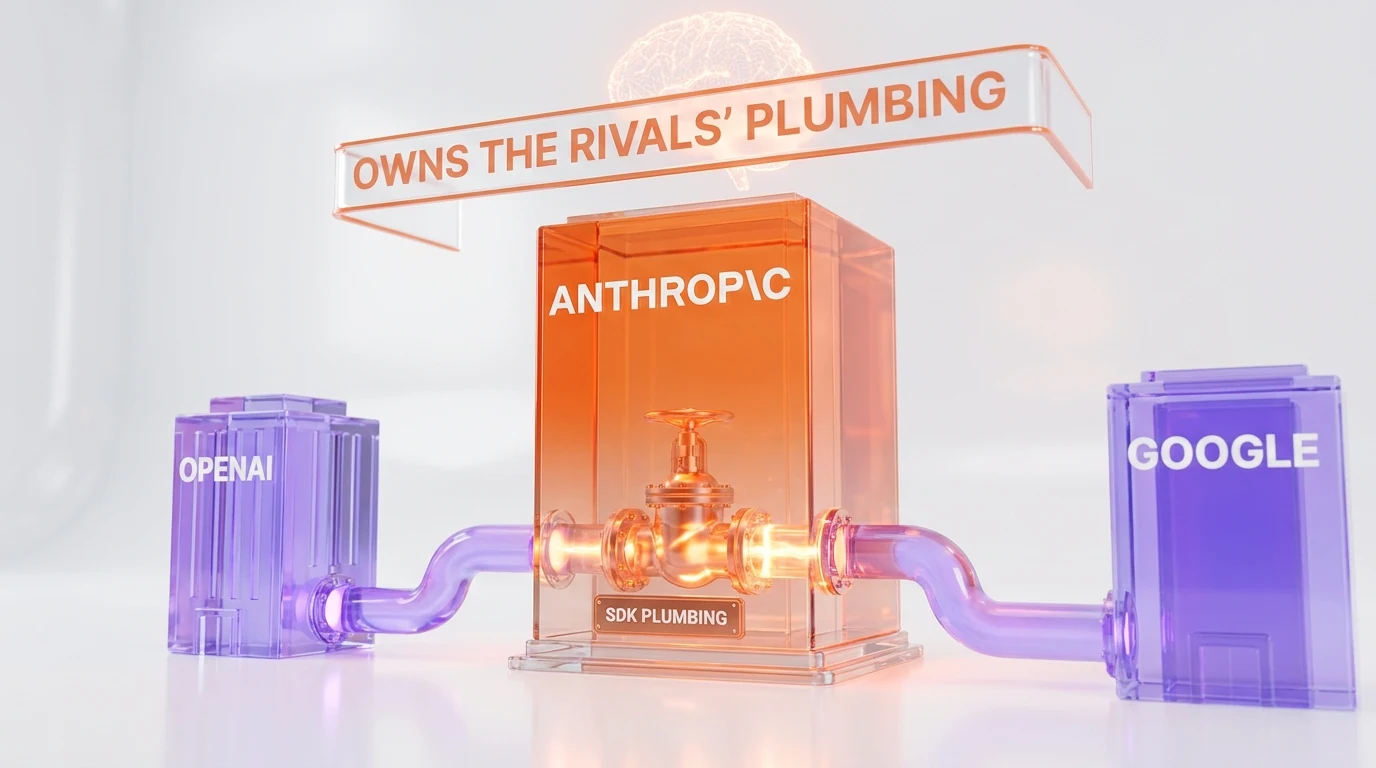
Read narrowly, this is a talent-and-tooling acquisition: Anthropic wants the best SDK-and-MCP-generation team in the industry working on Claude's connectivity, and it bought them. Read strategically, it is one of the more pointed competitive moves of the year. The plumbing that makes a rival's API pleasant to use is now owned by their competitor. Even if Anthropic never changes a single line of how Stainless serves other labs, the dependency itself has changed character — OpenAI and Google's developer experience now runs, in part, on infrastructure controlled by Anthropic.
That is the irony worth sitting with. Anthropic has spent 2026 reframing itself from a model company to an agent platform — the SAP reasoning-brain deal, the PwC certification push, the small-business skills rollout, the Claude Agent SDK metering changes landing June 15. The Stainless acquisition is the infrastructure-layer expression of the same pivot. Models are increasingly commoditized at the frontier; the durable moat is in distribution, integration, and the connective tissue that makes agents useful inside real software. Stainless is connective tissue, at industrial scale.
The competitive asymmetry is what gives the move its weight. There is no equivalent acquisition OpenAI or Google can make to neutralize it, because there is no second Stainless of comparable reach. Either rivals continue depending on a competitor-owned vendor, or they invest to rebuild SDK-generation pipelines internally — a multi-quarter effort that pulls engineering focus away from models and products. Neither option is free, and that is the point. Anthropic did not just buy capability; it bought a structural inconvenience for the labs it competes with.
How It Fits Anthropic's Agent Strategy
Anthropic's framing all year has been a single sentence repeated in different rooms: the company is moving "from models that answer to agents that act." An agent that acts must connect — to APIs, databases, internal tools, third-party services. Two technical layers govern that connectivity: the SDKs that let software call models, and the MCP servers that let models call tools back. Stainless industrializes both. That is why the Lesse quote — "agents are only as useful as what they can connect to" — is not boilerplate. It is the entire thesis of the acquisition compressed into one line.
Concretely, the surface this strengthens is the developer-facing one. Claude Code, Anthropic's terminal coding agent and the company's most strategically loaded developer product, lives or dies on integration breadth. The Claude Agent SDK — whose billing model changes on June 15, 2026 — is the programmatic backbone for teams building production agents on Claude. Faster, broader, always-current SDK and MCP generation feeds directly into both. A team that can auto-generate a clean MCP server for any API with an OpenAPI spec is a team that can widen Claude's connectable universe far faster than hand-built integrations ever could.
There is also a defensive read on the timing. Across 2026, the agent ecosystem has been consolidating fast — Cursor industrializing its agent stack, xAI shipping Grok Build as a Claude Code rival, OpenAI Codex maturing. In that environment, the differentiator is shifting away from raw model quality and toward how completely an agent can plug into the systems where work actually happens. Owning Stainless is Anthropic moving early on the integration layer before that layer becomes the contested ground everyone fights over.
The Open Questions
The biggest unknown is the one Anthropic's announcement pointedly does not address: what happens to Stainless's existing customers. If the hosted products are wound down for other labs — as reported by The Information and relayed by TechCrunch, but not stated by Anthropic — then OpenAI, Google, Cloudflare, Replicate and Runway face a migration question with real engineering cost. If they are not wound down, Anthropic ends up in the unusual position of operating critical developer infrastructure for its direct competitors, with all the trust and governance complexity that implies. Both outcomes are strategically interesting. Only one of them has been confirmed by anyone, and it has not been confirmed by Anthropic.
A second open question is regulatory texture. Acquisitions where a dominant player absorbs infrastructure its competitors depend on tend to attract scrutiny, particularly in a year when AI market structure is already under the antitrust microscope on both sides of the Atlantic. The reported sub-billion-dollar figure keeps this well below the thresholds that trigger automatic review in most jurisdictions, but the qualitative shape — competitor-critical tooling moving to a rival — is exactly the pattern regulators have signaled interest in. We would not over-read this; we would not ignore it either.
The third question is talent retention. Acqui-hires of infrastructure teams succeed or fail on whether the team stays and keeps shipping. Rattray's public framing — the team "gets to keep doing the work we love, on the platform where it matters most" — is the right signal, but signals at announcement time are cheap across the industry. The real test is whether the Stainless engineering culture survives integration into a much larger organization with its own platform priorities. On that, the next two quarters will tell us more than the press release does.
Our Take
We have been tracking Anthropic's platform moves all year, and this one is the cleanest expression yet of the company's actual strategy. The headline writes itself — "Anthropic buys the company powering its rivals' SDKs" — and the headline is accurate, but the more durable story is the layer it targets. Anthropic is not trying to win the model benchmark of the week. It is trying to own the parts of the stack that compound: protocols, connectors, developer experience, the boring infrastructure that determines which agent platform actually gets adopted inside companies. Stainless is a precise acquisition for that strategy, not an opportunistic one.
On the competitive irony, our read is that it is real but should not be overstated. Anthropic gains genuine leverage and optionality. But the more important asset is forward-looking, not adversarial: a world-class team that turns any API specification into clean SDKs and MCP servers, pointed at the problem of making Claude connectable to everything. In an agent era where integration breadth is the moat, that capability matters more than whatever discomfort it creates for OpenAI's release process. The competitor-tooling angle is the story that gets clicks. The MCP-generation-at-scale angle is the story that compounds.
What would change our read: if Anthropic confirms it is winding down hosted Stainless for other labs, the move tilts from "strategic infrastructure buy" toward "deliberate competitive denial," and the regulatory and trust questions get sharper. If it keeps the hosted products running neutrally, the story stays a connectivity play and the irony stays mostly rhetorical. Anthropic has not said which it is, and until it does, anyone telling you definitively how this plays for OpenAI and Google is reading a press release that does not contain that answer.
What's Next
Three things to watch. First, any official statement from Anthropic — or from OpenAI, Google or Cloudflare — about the continuity of Stainless's hosted products; that single data point resolves most of the strategic ambiguity. Second, how fast Stainless-generated MCP and SDK capability shows up inside Claude Code and the Claude Agent SDK, especially around the June 15, 2026 Agent SDK billing changes; that is where the acquisition either proves its thesis or stays a line item. Third, whether any Stainless customer publicly moves off the platform — the first migration announcement, if it comes, would tell us more about the deal's real terms than any of the public quotes have so far.
For builders, the practical advice is unchanged for now: if you depend on Stainless-generated SDKs through OpenAI, Google, Cloudflare, Replicate or Runway, nothing has been announced that requires action today — but this is a dependency worth monitoring rather than assuming. We will update this analysis as the picture clarifies.
Editorial disclosure: ThePlanetTools.ai has no commercial relationship with Anthropic, Stainless, OpenAI, Google or Cloudflare. This analysis is independent and based on Anthropic's official announcement and tier-1 reporting. Sources: Anthropic newsroom (primary), TechCrunch, and reporting by The Information on the deal value. Reported figures are attributed as reported and not stated as confirmed. Published May 18, 2026.
Frequently Asked Questions
What did Anthropic acquire on May 18, 2026?
Anthropic acquired Stainless, a company that automatically generates and maintains SDKs, command-line tools and MCP servers from API specifications. Anthropic described it as "a leader in SDKs and MCP server tooling." Stainless was founded in 2022 by Alex Rattray, a former Stripe engineer based in New York, and was backed by Sequoia Capital and Andreessen Horowitz. Financial terms were not disclosed by Anthropic.
How much did Anthropic pay for Stainless?
Anthropic did not publicly disclose the deal terms. The Information reported the acquisition was worth more than $300 million. We treat that figure as reported rather than confirmed, because neither Anthropic nor Stainless has put a number on the record.
Why does it matter that Stainless also powers OpenAI, Google and Cloudflare?
Stainless generates and maintains the official SDKs, CLIs and MCP servers not only for Anthropic but also for OpenAI, Google, Cloudflare, Replicate and Runway. That means Anthropic now owns the developer-experience plumbing several of its direct competitors depend on. Even with no operational changes, the nature of that dependency has shifted: rival labs' SDK infrastructure is now controlled by a competitor.
Is Anthropic shutting down Stainless for OpenAI and Google?
Not confirmed. TechCrunch, citing The Information, reported that Anthropic plans to wind down the hosted Stainless products for other AI labs and make the SDK generator exclusive to Anthropic. Anthropic's own announcement does not say this — it does not mention sunsetting hosted products or commitments to existing customers. This is the single most consequential open question of the deal, and it has not been confirmed by Anthropic.
What exactly does Stainless do?
Stainless ingests an API specification, typically an OpenAPI document, and generates idiomatic, production-grade client libraries across languages including TypeScript, Python, Go, Java and Kotlin. It regenerates those SDKs continuously as the underlying API changes, so the libraries stay in sync. It applies the same approach to command-line tools and to MCP servers, the standardized connectors that let AI agents call external tools and data.
What is MCP and why is it central to this acquisition?
Model Context Protocol (MCP) is the standard, introduced by Anthropic in late 2024, for connecting AI agents to external tools and data. MCP servers are the executable connectors on the tool side of that protocol. Stainless can generate MCP servers from API specifications the same way it generates SDKs. For a company whose 2026 thesis is moving "from models that answer to agents that act," owning the team that mass-produces those connectors is core to the strategy, not a side bet.
What was Anthropic's stated rationale for the deal?
Katelyn Lesse, Head of Platform Engineering at Anthropic, said: "Agents are only as useful as what they can connect to. We're excited to bring the Stainless team into Anthropic to advance Claude's ability to connect to data and tools." Founder Alex Rattray said: "I started Stainless because SDKs deserve as much care as the APIs they wrap. Anthropic was one of the first teams to bet on this with us."
Who is Alex Rattray and who backed Stainless?
Alex Rattray is the founder of Stainless and a former Stripe engineer based in New York. He founded Stainless in 2022. The company was backed by Sequoia Capital and Andreessen Horowitz. Stainless has powered the generation of every official Anthropic SDK since the earliest days of Anthropic's API.
How does this connect to Claude Code and the Claude Agent SDK?
Claude Code, Anthropic's terminal coding agent, depends on integration breadth, and the Claude Agent SDK is the programmatic backbone for teams building production agents on Claude. The Claude Agent SDK's billing model changes on June 15, 2026. Faster, broader, always-current SDK and MCP generation from Stainless feeds directly into both surfaces, widening the universe of systems Claude agents can connect to.
Could this acquisition attract regulatory scrutiny?
Possibly. Acquisitions where a dominant player absorbs infrastructure its competitors depend on tend to draw scrutiny, especially in a year when AI market structure is already under antitrust attention in the US and EU. The reported sub-billion-dollar figure keeps the deal below thresholds that trigger automatic review in most jurisdictions, but the qualitative shape — competitor-critical tooling moving to a rival — matches a pattern regulators have signaled interest in.
If I depend on Stainless-generated SDKs, do I need to act now?
Not based on what has been announced. If you depend on Stainless-generated SDKs through OpenAI, Google, Cloudflare, Replicate or Runway, nothing Anthropic has officially stated requires action today. However, because the continuity of Stainless's hosted products for other labs has not been confirmed by Anthropic, this is a dependency worth actively monitoring rather than assuming stable.