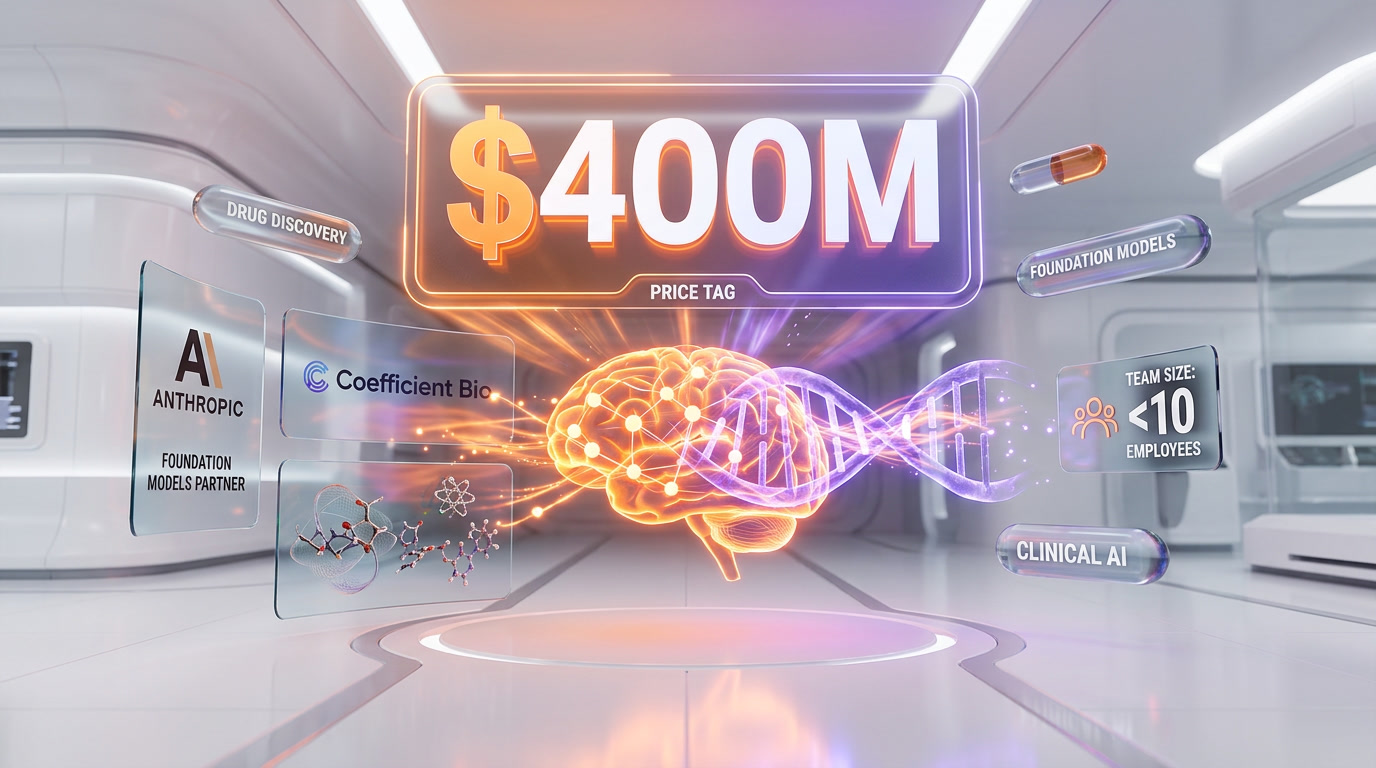
Anthropic acquired Coefficient Bio, a stealth biotech AI startup with fewer than 10 employees, in an all-stock deal worth approximately $400 million on April 3, 2026. Co-founded by former Genentech Prescient Design researchers Samuel Stanton and Nathan C. Frey, the team joins Anthropic's Healthcare and Life Sciences division led by Eric Kauderer-Abrams. The deal values each employee at roughly $40-50 million and represents about 0.1% dilution against Anthropic's $380 billion post-money valuation.
The Deal at a Glance
| Detail | Value |
|---|---|
| Acquisition Price | ~$400 million (all-stock) |
| Target | Coefficient Bio (stealth biotech AI startup) |
| Date Reported | April 3, 2026 |
| Team Size | Fewer than 10 employees |
| Per-Employee Valuation | ~$40-50 million |
| Anthropic Dilution | ~0.1% (against $380B valuation) |
| Investor | Dimension (~50% stake, 38,513% IRR) |
| Founders | Samuel Stanton & Nathan C. Frey (ex-Genentech) |
| Founded | ~Fall 2025 (8 months pre-acquisition) |
| Integration | Anthropic Healthcare & Life Sciences group |
We have been tracking Anthropic's healthcare ambitions since the launch of Claude for Life Sciences in October 2025. This acquisition is not a surprise in direction, but the price tag for a pre-revenue, 8-month-old startup with fewer than 10 people is a statement. Anthropic is buying talent and domain expertise, not revenue.
Who Is Coefficient Bio?
Coefficient Bio was a stealth-mode biotech AI startup founded in approximately Fall 2025. The company operated with minimal public visibility and was building a platform that used AI for three core pharmaceutical workflows:
- Drug R&D planning — AI-driven research and development strategy for new drug candidates
- Clinical regulatory strategy — managing the complex compliance and regulatory pathway from discovery to approval
- Drug opportunity identification — discovering and evaluating new drug candidates using computational methods
The startup was pre-revenue. It had not shipped a commercial product. What it had was a team of world-class computational biologists, nearly all from Genentech's Prescient Design unit, and a research-heavy operation focused on biological foundation models and biomolecule design.
The Founders: Genentech's Prescient Design Alumni
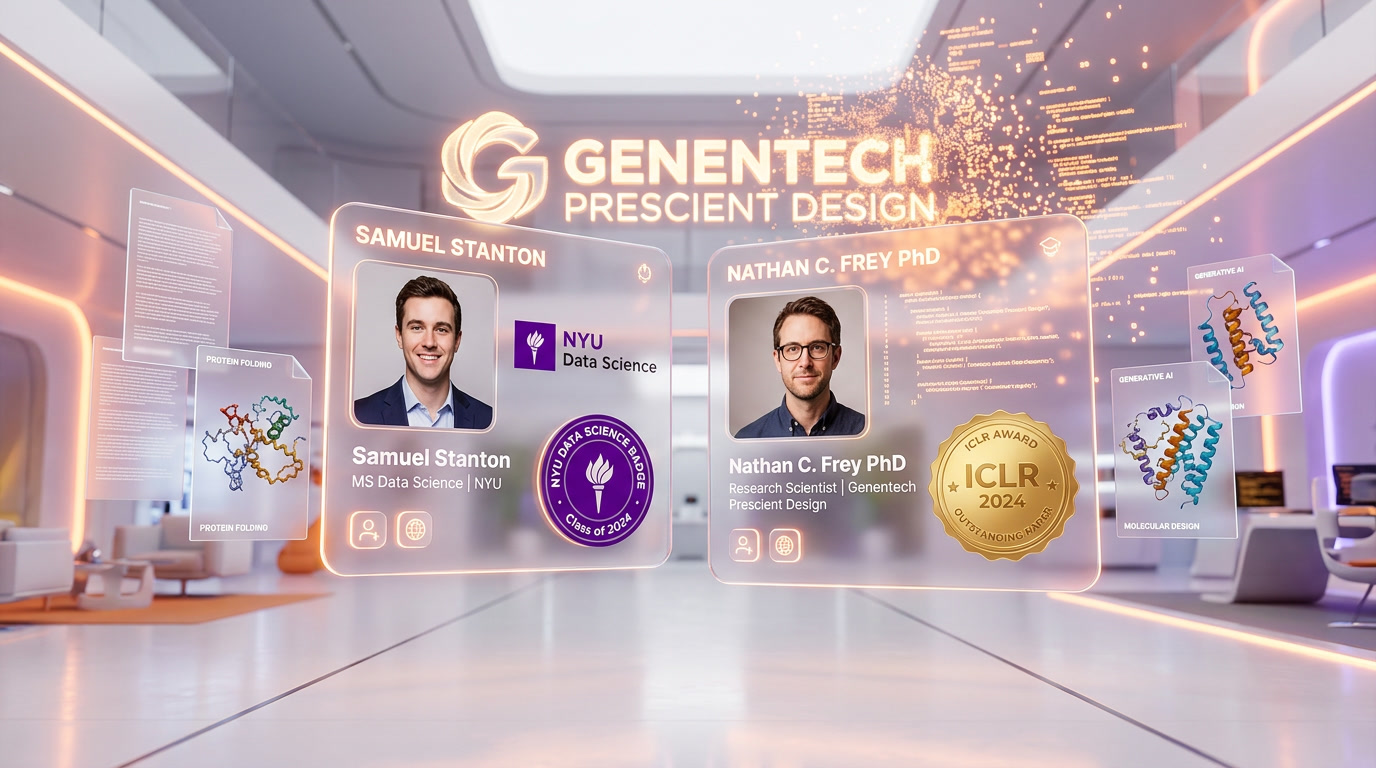
The acquisition's real value lies in the people. Both co-founders bring significant pedigrees in computational drug discovery.
Nathan C. Frey, PhD
Frey served as Group Leader and Principal Scientist at Prescient Design, Genentech's computational drug discovery unit. He led a multidisciplinary team of machine learning scientists, engineers, molecular biologists, and computational biologists. His research focused on biological foundation models and novel AI/ML approaches to biomolecule design.
His credentials are substantial. Frey has over 20 published papers in journals including Science Advances and Nature Machine Intelligence. In 2024, he won the ICLR Outstanding Paper Award (one of five selected from 7,300+ submissions) for "Protein Discovery with Discrete Walk-Jump Sampling" — a paper that introduced a new generative modeling approach for protein sequence design, validated with wet lab antibody binding experiments. He also sat on Genentech's Foundation Model and Large Molecule Drug Discovery Leadership Teams, where he set research direction, roadmaps, and long-term AI strategy for Roche and Genentech.
Samuel Stanton
Stanton joined Prescient Design at Genentech in June 2022 while completing his PhD at the NYU Center for Data Science. His doctoral work focused on fundamental Bayesian machine learning methods and their practical applications to drug design. At Genentech, he worked on computational approaches to drug discovery alongside Frey before co-founding Coefficient Bio.
Why $400 Million for a Pre-Revenue Startup?
The numbers look extreme on the surface. $400 million for fewer than 10 employees, no revenue, and just 8 months of existence. But this deal makes strategic sense when you examine the context.
1. This Is a Talent Acquisition at AI Valuations
At $40-50 million per employee, this is expensive even by acqui-hire standards. But the team is not interchangeable. These are researchers who have published in Nature Machine Intelligence, won ICLR awards, and spent years building the exact type of biological foundation models that Anthropic needs. Recruiting them individually through traditional hiring would likely be impossible — they had already chosen to start a company.
2. The Dilution Is Minimal
Against Anthropic's $380 billion post-money valuation (following its $30 billion Series G in February 2026), this $400 million all-stock deal represents approximately 0.1% dilution. For a company that raised $30 billion in a single round, this is a rounding error. Anthropic is using its inflated equity as currency to acquire domain expertise it cannot build internally.
3. Dimension's Return Tells the Story
Dimension, the New York-based venture firm that held roughly 50% of Coefficient Bio, reported a 38,513% internal rate of return on the investment. Founded in 2023 by former Lux Capital and Obvious Ventures partners Adam Goulburn, Zavain Dar, and Nan Li, Dimension is now raising a $700 million third fund to continue investing at the intersection of AI and life sciences. That IRR number says more about AI valuation dynamics than about Coefficient Bio's commercial viability.
Anthropic's Healthcare Playbook
The Coefficient Bio acquisition fits into a clear strategic sequence that Anthropic has been building over the past 18 months.
October 2025: Claude for Life Sciences
Anthropic launched Claude for Life Sciences, a platform designed to embed Claude into scientific research workflows. The system integrated with Benchling (experiment records), PubMed (biomedical literature), 10x Genomics (single-cell and spatial analysis), BioRender (scientific figures), and Wiley's Scholar Gateway (peer-reviewed content). It targeted researchers across literature synthesis, hypothesis generation, clinical trial planning, and regulatory documentation.
January 2026: Claude for Healthcare
At JPM26, Anthropic introduced Claude for Healthcare, adding connectors to CMS coverage databases, ICD-10 coding systems, the National Provider Identifier Registry, Medidata (clinical trial data), ClinicalTrials.gov, and ToolUniverse (600+ vetted scientific tools). This extended Claude from research into operational healthcare — prior authorization, claims appeals, and compliance workflows.
April 2026: Coefficient Bio Acquisition
Now Anthropic is not just providing tools for researchers — it is bringing the researchers in-house. The Coefficient Bio team joins Eric Kauderer-Abrams' Healthcare and Life Sciences group with a stated mandate: "We want a meaningful percentage of all of the life science work in the world to run on Claude, in the same way that that happens today with coding."
That quote from Kauderer-Abrams, reported by CNBC, reveals the ambition. Anthropic does not want to be a tool vendor for pharma. It wants Claude to be as embedded in drug discovery as it is becoming in software development.

The Genentech Exodus
Coefficient Bio did not emerge in a vacuum. It is part of a broader wave of computational biology talent leaving traditional pharma for AI-native startups.
Genentech cut at least 489 roles in 2025 as parent company Roche restructured toward roles that "embed digital, automation and AI capabilities across the organization." The layoffs came in three rounds at the South San Francisco headquarters: 143 in May, 87 in July, and 118 in November. Since April 2024, over 800 positions were eliminated, including the termination of a $2 billion TCR collaboration with Adaptive Biotechnologies and the shutdown of cancer immunology research programs.
The talent displacement created opportunities for AI startups. Xaira Therapeutics launched in April 2024 with $1 billion in funding, led by former Genentech Chief Scientific Officer Marc Tessier-Lavigne. Coefficient Bio drew from the ML research ranks at Prescient Design specifically, targeting the foundation model expertise that Genentech was restructuring around.
The irony is clear: Roche spent years building one of the best computational drug discovery teams in the industry, then restructured in ways that pushed that talent toward AI labs willing to pay $40-50 million per head to acquire it.
What This Means for the AI Industry
The Coefficient Bio deal is a signal, not an outlier. Several trends are converging.
AI Labs Are Going Vertical
Anthropic, OpenAI, and Google DeepMind are all moving from horizontal AI platforms toward vertical domain expertise. Building the best general-purpose model is necessary but not sufficient. The competitive advantage now comes from embedding domain knowledge — in this case, computational biology — into the model's application layer. Anthropic is betting that the team that built foundation models for Roche can build better biological AI inside Claude's ecosystem.
Acqui-Hires at AI Valuations Are the New Normal
The $400 million price for a pre-revenue, 8-month-old startup sets a benchmark. When AI labs have $380 billion valuations and stock to spend, the traditional startup economics invert. Coefficient Bio's 38,513% IRR for Dimension is not about the startup's business model — it is about the repricing of AI talent in the current market.
Drug Discovery Is Becoming an AI Race
The pharmaceutical industry is increasingly reshaping operations around AI. Companies like Recursion (which acquired Exscientia in late 2024), Xaira, and now Anthropic are embedding machine learning into every stage of the drug development pipeline — from target identification through clinical trials and regulatory submission. The traditional 10-15 year, $2.6 billion drug development cycle is the target for disruption.
Our Take
We see this acquisition as primarily strategic positioning rather than a technology play. Coefficient Bio was pre-revenue with no commercial product. What Anthropic bought is a team that understands drug discovery at the molecular level and can bridge that knowledge with large language model capabilities.
The risk is execution. Having world-class researchers does not automatically translate into a product that pharmaceutical companies will adopt at scale. Anthropic will need to demonstrate that Claude can do more than summarize papers and draft regulatory documents — it will need to show tangible impact on drug discovery timelines and success rates.
The opportunity, however, is enormous. Global pharmaceutical R&D spending exceeded $250 billion in 2025. If Claude can capture even a small percentage of that workflow, the $400 million investment becomes trivial. Kauderer-Abrams' ambition to make Claude as essential to life sciences as it is to coding is the right framing — but the proof will be in the pipelines, both computational and pharmaceutical.
Frequently Asked Questions
How much did Anthropic pay for Coefficient Bio?
Anthropic acquired Coefficient Bio in an all-stock deal worth approximately $400 million. The deal was reported on April 3, 2026, by The Information and subsequently confirmed by multiple outlets including TechCrunch.
What does Coefficient Bio do?
Coefficient Bio was a stealth biotech AI startup building a platform for AI-driven drug R&D planning, clinical regulatory strategy management, and drug candidate identification. The company was pre-revenue and founded approximately 8 months before the acquisition.
Who founded Coefficient Bio?
Coefficient Bio was co-founded by Samuel Stanton and Nathan C. Frey, PhD. Both were former researchers at Genentech's Prescient Design computational drug discovery unit. Frey won the ICLR 2024 Outstanding Paper Award for generative modeling in drug discovery.
How many employees did Coefficient Bio have?
Coefficient Bio had fewer than 10 employees at the time of acquisition. Nearly all were former Genentech computational biology researchers from the Prescient Design unit. This puts the per-employee acquisition cost at approximately $40-50 million.
Why did Anthropic acquire a biotech startup?
Anthropic has been building a healthcare and life sciences strategy since October 2025 with Claude for Life Sciences, followed by Claude for Healthcare in January 2026. The Coefficient Bio acquisition brings in-house domain expertise in computational drug discovery to accelerate this strategy under Eric Kauderer-Abrams' Healthcare and Life Sciences group.
Who invested in Coefficient Bio before the acquisition?
Dimension, a New York-based venture firm founded in 2023 by former Lux Capital and Obvious Ventures partners, held approximately 50% of Coefficient Bio. Dimension reported a 38,513% internal rate of return on the investment.
What is Anthropic's current valuation?
Anthropic's post-money valuation stands at $380 billion following its $30 billion Series G round in February 2026, led by GIC and Coatue. The $400 million Coefficient Bio acquisition represents approximately 0.1% dilution against this valuation.
Will the Coefficient Bio team continue working on drug discovery at Anthropic?
Yes. The Coefficient Bio team will join Anthropic's Healthcare and Life Sciences division, led by Eric Kauderer-Abrams, who has stated the goal is for "a meaningful percentage of all of the life science work in the world to run on Claude."
Frequently Asked Questions
How does Anthropic's AI drug discovery strategy compare to Google DeepMind's AlphaFold approach?
Google DeepMind's AlphaFold focuses on open-science protein structure prediction. Anthropic is pursuing a commercial talent-acquisition strategy: the $400M Coefficient Bio deal (fewer than 10 employees, ~$40-50M per head) targets biological foundation models and biomolecule design for pharmaceutical workflows. Anthropic's healthcare lead Eric Kauderer-Abrams has explicitly stated the goal is for Claude to run 'a meaningful percentage of all life science work in the world' — a revenue ambition DeepMind does not share with AlphaFold.
Is Anthropic's healthcare AI push ahead of OpenAI's in pharmaceutical drug discovery?
Anthropic has built a more structured pharma roadmap than OpenAI to date. Since October 2025 it deployed Claude for Life Sciences (Benchling, PubMed, 10x Genomics, BioRender), added Claude for Healthcare in January 2026 (Medidata, ClinicalTrials.gov, ICD-10, CMS connectors), and now acquired Coefficient Bio for ~$400M in April 2026. OpenAI has made general healthcare partnerships but has not disclosed a comparable acqui-hire or a dedicated drug discovery division backed by an in-house team at this scale.
What did Coefficient Bio do that Genentech's Prescient Design unit couldn't?
Coefficient Bio's co-founders Nathan C. Frey and Samuel Stanton both came from Genentech's Prescient Design unit before founding the startup in Fall 2025. As an independent startup they pursued novel generative approaches — Frey won the ICLR 2024 Outstanding Paper Award (1 of 5 from 7,300+ submissions) for discrete walk-jump sampling in protein sequence design — outside Roche's corporate constraints. Genentech cut 800+ roles between April 2024 and November 2025 as it restructured toward AI automation, accelerating the talent exodus.
Who should pay attention to Anthropic's Coefficient Bio acquisition?
Four audiences: (1) Pharma and biotech companies — Recursion Pharmaceuticals, Exscientia, BenevolentAI — assessing whether Claude will compete with or complement their platforms; (2) computational biologists weighing startup vs. Big Tech career paths, given the $40-50M per-employee benchmark this deal sets; (3) life science investors tracking AI valuation dynamics — Dimension reported a 38,513% IRR on its ~50% stake in Coefficient Bio; (4) AI founders in healthcare building acqui-hire targets for well-capitalized AI labs.
What are the limitations and risks of Anthropic's $400M Coefficient Bio bet?
Key risks: (1) Coefficient Bio was pre-revenue with no commercial product after 8 months of operation — there is no validated technology, only research pedigree; (2) at $40-50M per employee, the deal inflates future biotech acqui-hire expectations industry-wide; (3) integrating a sub-10-person research team into a large AI company creates retention and culture risk; (4) regulatory pathways for AI-designed drugs remain undefined globally; (5) Anthropic's stated goal of running 'a meaningful percentage of all life science work' on Claude has no disclosed revenue model or commercial timeline.
Does Claude for Life Sciences integrate with Benchling, PubMed, or Medidata?
Yes. Claude for Life Sciences (launched October 2025) connects to Benchling for experiment records, PubMed for biomedical literature, 10x Genomics for single-cell and spatial genomics analysis, BioRender for scientific figure creation, and Wiley's Scholar Gateway for peer-reviewed content. The January 2026 Claude for Healthcare expansion added Medidata for clinical trial data management, ClinicalTrials.gov, CMS coverage databases, ICD-10 coding systems, the National Provider Identifier Registry, and ToolUniverse (600+ vetted scientific tools).
How does Dimension's 38,513% IRR on Coefficient Bio compare to normal biotech VC returns?
A 38,513% IRR over approximately 8 months is unparalleled in any asset class. Top-quartile biotech venture funds typically target 3-5x cash-on-cash returns over a 10-year fund life — equivalent to IRRs in the 15-30% range. Dimension, founded in 2023 by ex-Lux Capital and Obvious Ventures partners Adam Goulburn, Zavain Dar, and Nan Li, held ~50% of Coefficient Bio. The return reflects AI-era valuation multiples being applied to biotech talent, not commercial traction. Dimension is now raising a $700M third fund to continue at the AI–life sciences intersection.
How does Anthropic's Coefficient Bio deal compare to Recursion Pharmaceuticals or Exscientia?
Recursion Pharmaceuticals and Exscientia are independent companies with hundreds of employees, active drug pipelines, and clinical-stage candidates. Coefficient Bio had fewer than 10 employees, no revenue, and no commercial product. Anthropic's acquisition is not about owning drug candidates — it is a talent and IP acquisition to deepen Claude's pharmaceutical workflow capabilities, positioning Anthropic to compete with Recursion's and Exscientia's software and platform businesses rather than their drug pipelines.