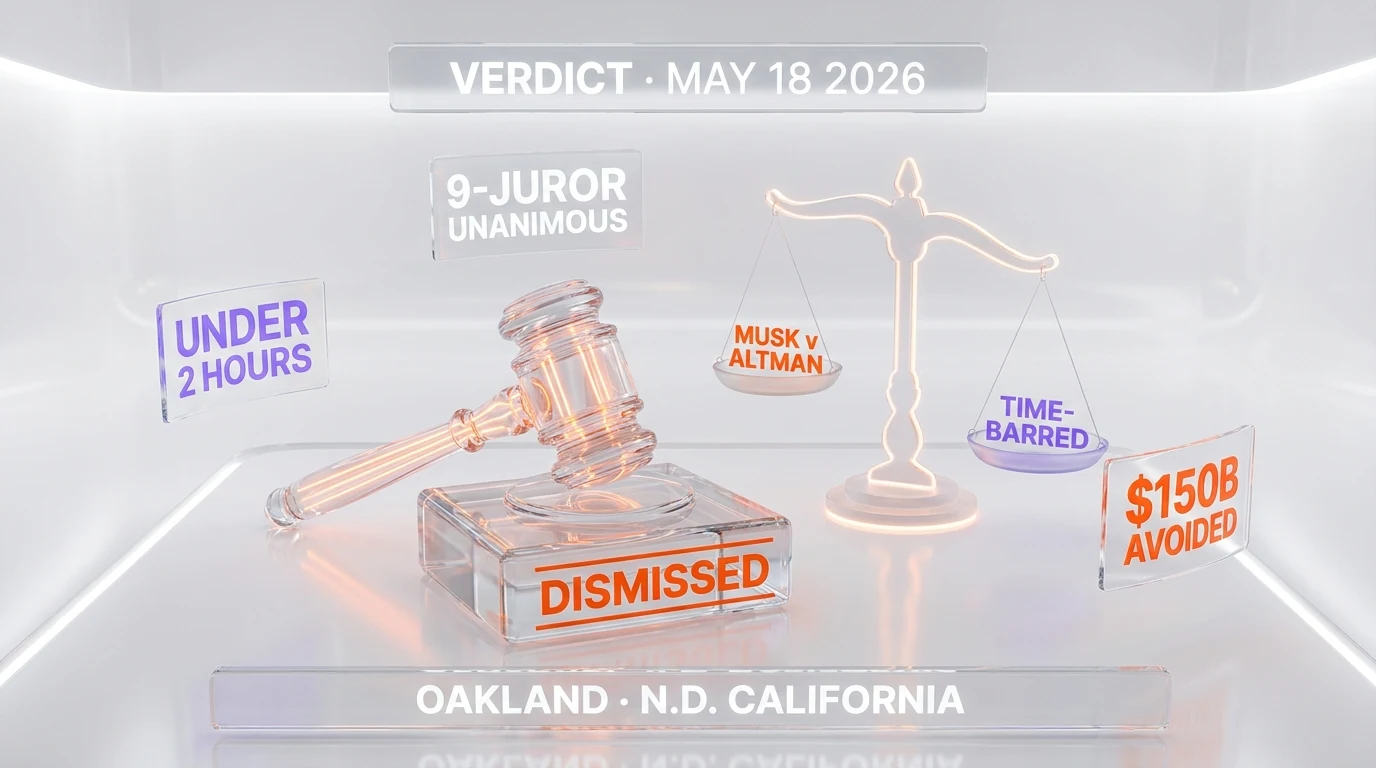
Did Musk win against OpenAI? No. On Monday, May 18, 2026, a nine-member federal advisory jury in Oakland, California unanimously rejected every claim Elon Musk brought against Sam Altman, OpenAI, Greg Brockman and Microsoft, finding the case time-barred after less than two hours of deliberation. Judge Yvonne Gonzalez Rogers of the U.S. District Court for the Northern District of California immediately adopted the verdict and dismissed the suit. The ruling closes the most consequential nonprofit-governance case in AI history on procedure, not on the merits — and as we covered when the verdict was imminent, the substance of how a charity becomes a for-profit was never decided.
What Happened
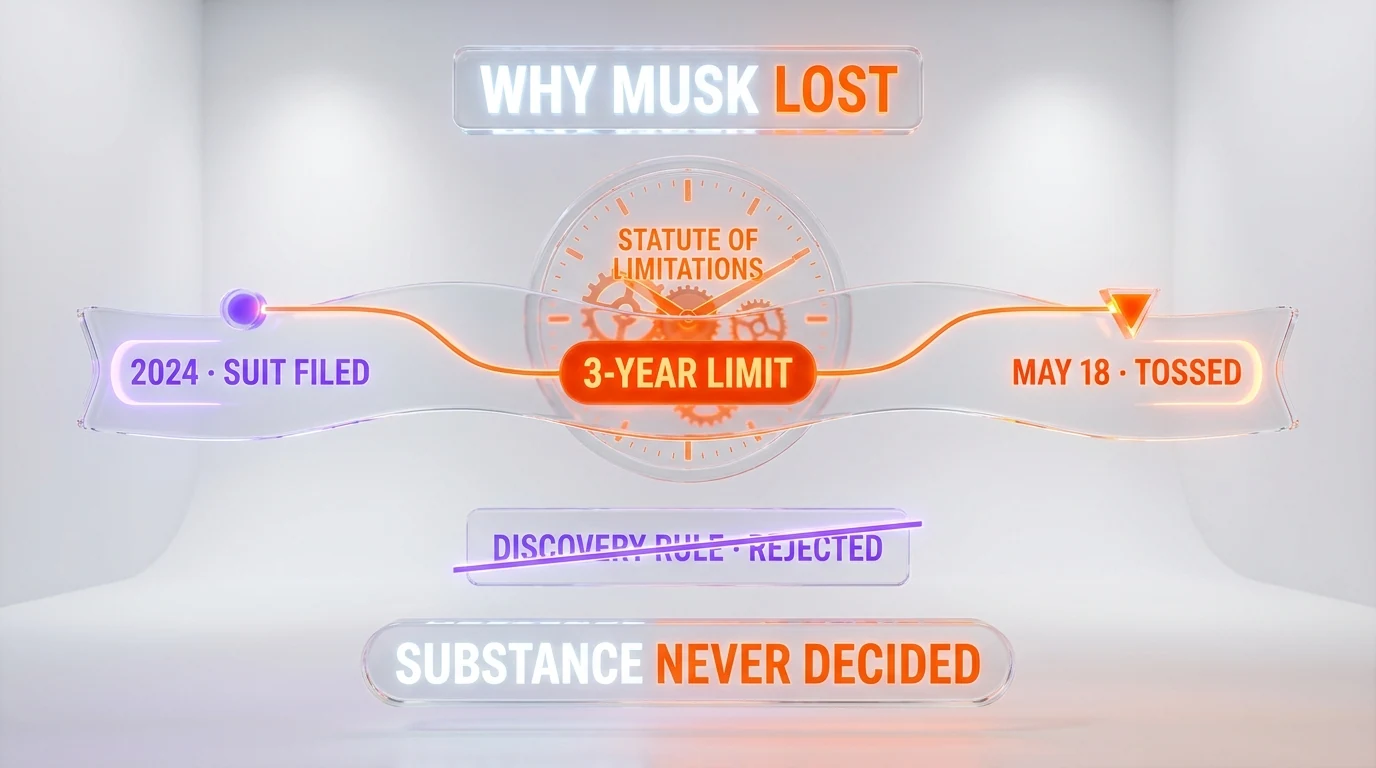
After roughly three weeks of trial and eleven days of testimony, the jury needed under two hours to land on a single conclusion: Musk waited too long. The panel found that the claims for breach of charitable trust and unjust enrichment fell outside California's three-year statute of limitations, because Musk filed his suit in 2024 over a corporate restructuring whose foundations trace back years earlier. The jury rejected Musk's argument that the limitations clock should only have started when he later discovered the scale of OpenAI's drift from its nonprofit mission — the so-called discovery rule.
Because the case was thrown out on the limitations question, the jury never reached the substance of the allegations. There was no finding on whether Altman and Brockman actually "stole a charity," no finding on whether OpenAI breached a charitable trust, and no finding on whether Microsoft aided and abetted anything. The claim that Microsoft enabled the alleged breach through investments totaling roughly $13 billion between 2019 and 2023 was dismissed alongside the rest. Judge Gonzalez Rogers, who had used an advisory jury precisely because the equitable claims sit with the bench, adopted the recommendation on the spot.
Musk co-founded OpenAI and put roughly $38 million into it in its early years before the 2018 falling-out with Altman. His 2024 complaint sought up to $150 billion in disgorgement into OpenAI's nonprofit foundation and asked the court to remove Altman and Brockman from leadership and unwind the for-profit entity. None of that will happen on the strength of this case. Within minutes of the verdict, Musk posted on X that the decision was a "calendar technicality." His lead attorney, Marc Toberoff, told reporters at a post-verdict press conference that the team will appeal to the Ninth Circuit U.S. Court of Appeals.
Why It Matters
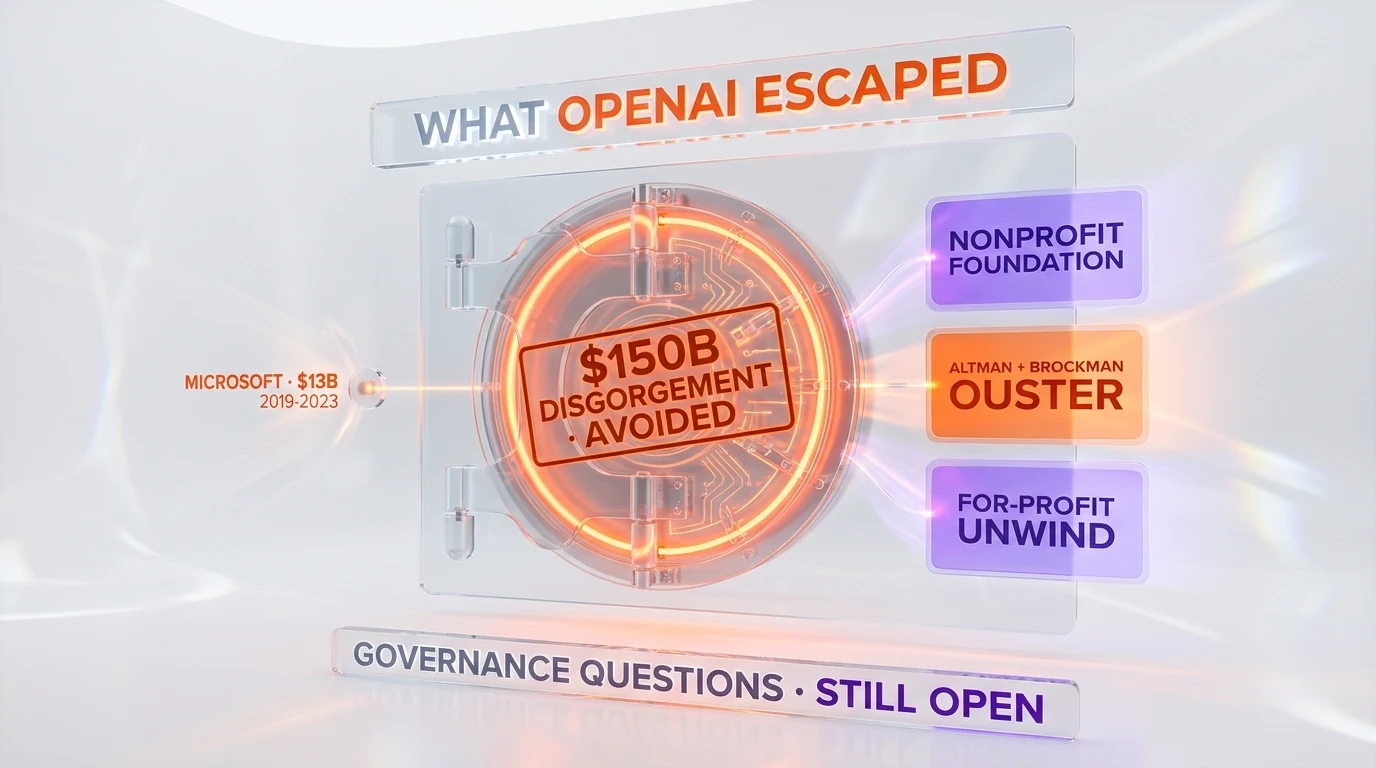
The number that did not get written into a judgment is the headline. Had the jury sided with Musk and the judge agreed, OpenAI and Microsoft could have been ordered to disgorge up to $150 billion into the nonprofit foundation, Altman and Brockman could have been pushed out, and the for-profit structure that anchors OpenAI's roughly $300 billion valuation could have been forced into an unwind. That tail risk — the one Microsoft's own internal "next IBM" anxiety circled during discovery — is now off the table for this lawsuit.
For OpenAI, the practical effect is freedom of movement. The company can continue executing its for-profit conversion, its capital raises, and its commercial roadmap without the immediate threat of a court forcing structural changes mid-flight. The OpenAI and Microsoft commercial relationship, already reworked through the multi-cloud and licensing amendment earlier in May, is no longer shadowed by a $150 billion contingent liability. For a company operating at OpenAI's burn rate and fundraising cadence, removing that overhang is materially valuable even though no money changed hands.
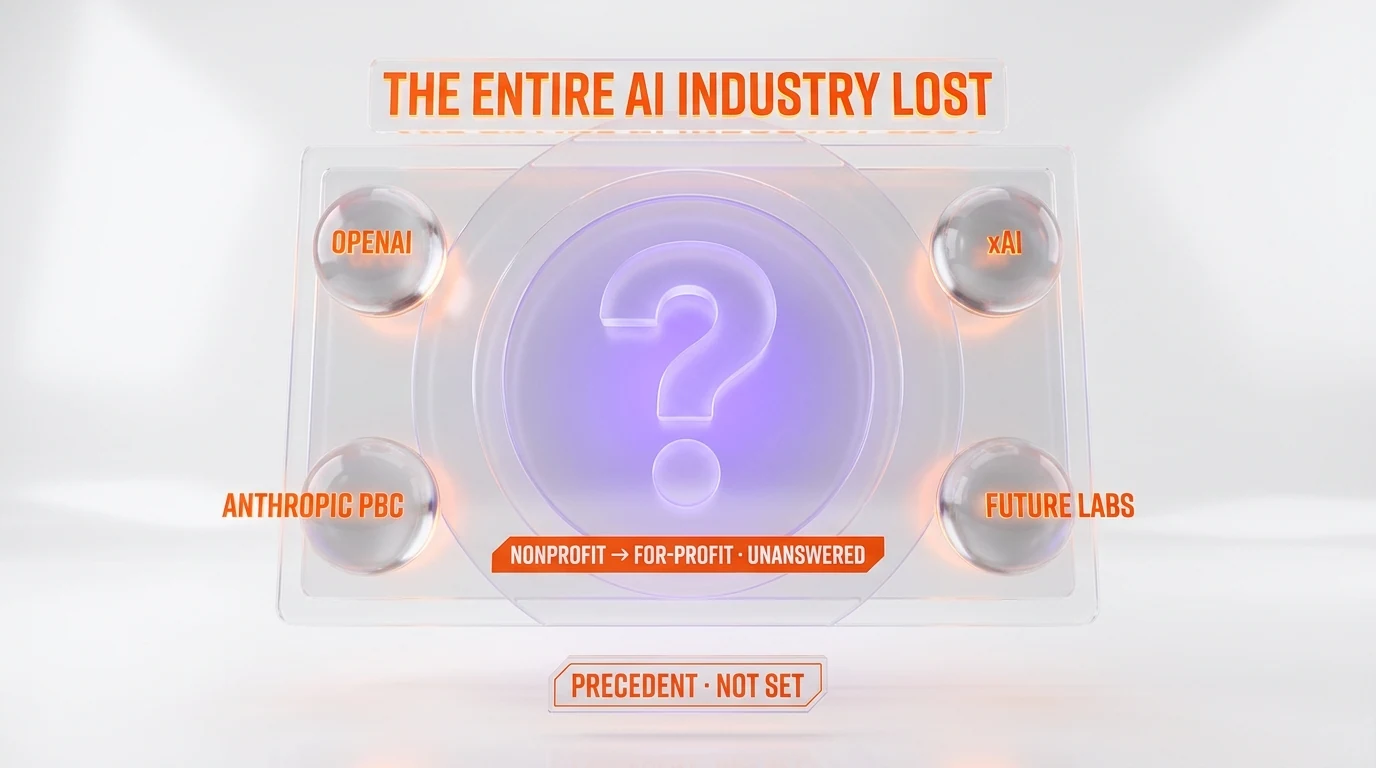
But the most important point is the one the Axios analysis sharpened the day after: the entire AI industry lost. The case that was supposed to test how much freedom a nonprofit has to restructure after making commitments to donors and the public ended on a limitations clock. The central governance question — can an organization founded to build AI "for the benefit of humanity" pivot into a capped-profit, then a for-profit, structure without legal consequence — was never answered. Every frontier lab that has flirted with a public-benefit or nonprofit-adjacent framing now operates with the same legal ambiguity it had before the trial started.
How It Compares
Set this against the broader pattern in AI corporate structure. OpenAI's nonprofit-to-for-profit arc, Anthropic's public-benefit corporation framing, and Musk's own xAI — folded into the SpaceX orbit earlier this month — all rest on the same unsettled foundation: there is still no controlling precedent in the United States on how a mission-locked AI entity may restructure once it has taken donor money and made public commitments. The Musk v. Altman verdict did not create that precedent. It declined to.
That is the difference between this case and most high-profile tech litigation. Antitrust cases against large platforms produce doctrine even when the defendant wins. Patent fights produce claim construction. This trial produced a date. The jury's unanimous finding was about when Musk sued, not about what OpenAI did. Legally, the most cited line from this case will be a statute-of-limitations holding, not a governance principle. For founders, donors, and boards designing the next generation of AI organizations, that is close to the least useful outcome a three-week trial could have produced.
It also resets the leverage map. Musk loses his strongest legal instrument for forcing OpenAI's hand and is reduced to an appeal on the timing question — a narrower fight than the sweeping charitable-trust theory he opened with. Altman and Brockman keep their seats. Microsoft keeps its position clean. And the regulators who were watching from the sidelines — state attorneys general in Delaware and California with charitable-trust oversight authority — inherit a question the courts just punted.
Our Take
We have followed this dispute closely, and our read is that the strategic verdict and the legal verdict point in opposite directions. Legally, OpenAI won decisively and quickly. Strategically, the win is narrower than the scoreboard suggests. A dismissal on limitations is not vindication of the conversion; it is a finding that the challenge arrived late. Every serious objection to the nonprofit-to-for-profit pivot that Musk raised in his complaint remains formally unadjudicated, which means it remains available — to a different plaintiff, to a state regulator, or to the same plaintiff on different facts.
The "calendar technicality" framing from Musk is, for once, not entirely spin. From a precedent standpoint, the case really did turn on the calendar. That cuts against OpenAI's longer-term interest more than the celebratory headlines imply, because the company would have been better served by a merits ruling that blessed the structure than by a procedural exit that leaves the structure legally untested. A win that resolves nothing is a win that can be relitigated, and OpenAI's structure is a target that is not going to get smaller.
What the trial did expose, in testimony from both men, is how far the industry's leading figures have drifted from the original "for humanity" rhetoric. That reputational cost is real, it is shared across the industry, and it does not appear anywhere in the judgment. Public trust in AI was already sliding before this trial; a courtroom month in which two of the field's most powerful people argued about who betrayed the mission did not help. This is the strategic critique that holds up regardless of who won the legal point.
What's Next
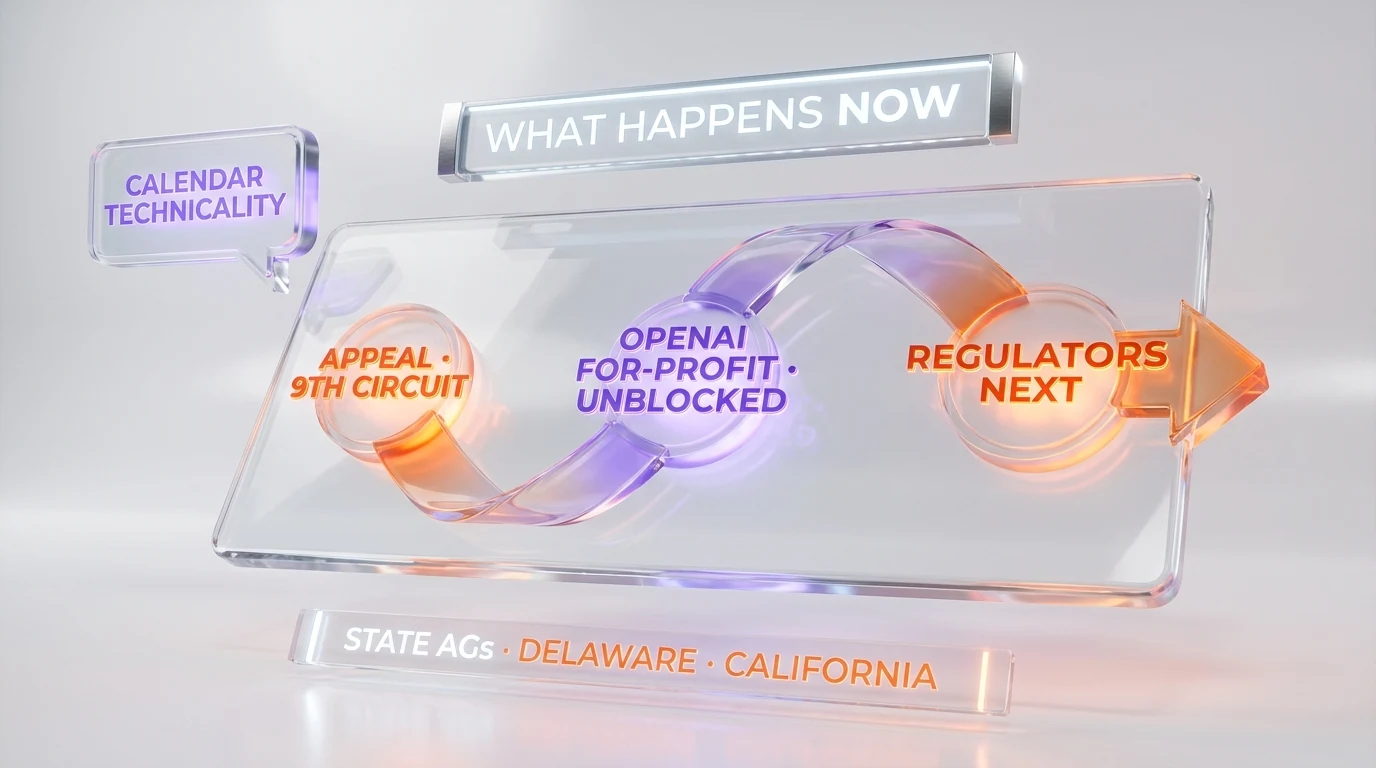
Three things to watch. First, the appeal. Toberoff's team will take the limitations ruling to the Ninth Circuit, and the entire fight narrows to one question: when did Musk's clock start. If an appellate panel revives the discovery-rule argument, the substance of the charitable-trust claim comes back to life and the $150 billion tail risk reopens. That is a multi-year process with a low base rate of reversal, but it is not zero, and OpenAI's structure will remain a contingent question until it resolves.
Second, the regulators. Charitable-trust enforcement does not depend on Musk. State attorneys general with jurisdiction over OpenAI's nonprofit parent retain independent authority to scrutinize the conversion, and the trial just generated a public evidentiary record they can mine. The governance question the jury declined to answer can still be asked by an office that does not have a statute-of-limitations problem.
Third, the rest of the field. Anthropic, the xAI-SpaceX entity, and every future lab designing a mission-locked structure now know that the courts will not quickly clarify the rules. That ambiguity is itself a strategic input: it rewards labs that lock structure early and cleanly, and it raises the litigation surface for any lab that converts later under pressure. The verdict closed a lawsuit. It did not close the question — and in AI governance, the open question is the story.
ThePlanetTools.ai has no financial relationship with OpenAI, Microsoft, xAI, or any party to this litigation. This is independent editorial analysis. Sources: NPR, CNBC, Axios, NBC News. For the pre-verdict analysis, see our earlier piece on the Musk v. Altman verdict when it was imminent.
Frequently Asked Questions
Did Elon Musk win his lawsuit against OpenAI and Sam Altman?
No. On May 18, 2026, a nine-member federal advisory jury in Oakland, California unanimously rejected all of Musk's claims, finding them time-barred under California's three-year statute of limitations. Judge Yvonne Gonzalez Rogers adopted the verdict and dismissed the case. The jury deliberated for less than two hours after roughly three weeks of trial. Because the case was dismissed on the limitations question, the substance of the allegations was never decided.
Why did the jury dismiss Musk's case?
The jury found that Musk's claims for breach of charitable trust and unjust enrichment fell outside California's three-year statute of limitations. Musk filed the suit in 2024 over a restructuring whose foundations predate that filing by more than three years. The jury rejected Musk's discovery-rule argument that the clock should only have started when he later learned the extent of OpenAI's departure from its nonprofit mission.
How much money was at stake in Musk v. Altman?
Musk sought up to $150 billion in disgorgement into OpenAI's nonprofit foundation, plus the removal of Sam Altman and Greg Brockman from leadership and an unwinding of the for-profit entity. He also sued Microsoft for aiding and abetting through roughly $13 billion in investments between 2019 and 2023. All of it was dismissed on the statute-of-limitations ruling, so none of the relief was granted.
Is Elon Musk appealing the verdict?
Yes. Musk called the decision a 'calendar technicality' on X, and his lead attorney Marc Toberoff said at a post-verdict press conference that they will appeal to the Ninth Circuit U.S. Court of Appeals. The appeal will center narrowly on the statute-of-limitations question — specifically whether the discovery rule should have started Musk's clock later.
What does the verdict mean for OpenAI's for-profit conversion?
OpenAI can continue its for-profit conversion, capital raises, and commercial roadmap without the immediate threat of a court forcing structural changes. The roughly $150 billion contingent liability and the risk of Altman and Brockman being removed are off the table for this lawsuit. However, the conversion itself was never blessed on the merits — it was simply not adjudicated.
Why does Axios say the entire AI industry lost?
Because the case that was supposed to test how much freedom a nonprofit has to restructure after making commitments to donors and the public ended on a procedural clock instead of a merits ruling. The central governance question — whether a mission-locked AI organization can pivot to for-profit without legal consequence — was never answered, leaving every frontier lab with the same legal ambiguity it had before the trial.
Did the jury decide whether OpenAI actually breached a charitable trust?
No. The jury never reached the substance of the allegations. There was no finding on whether Altman and Brockman stole a charity, no finding on whether OpenAI breached a charitable trust, and no finding on whether Microsoft aided and abetted. The dismissal was purely about timing, which means those questions remain formally unadjudicated.
What was Microsoft's role in the case and what happened to that claim?
Musk accused Microsoft of aiding and abetting OpenAI's alleged breach through investments totaling roughly $13 billion between 2019 and 2023. That claim was dismissed alongside the others on the statute-of-limitations ruling. Microsoft was not found liable and was not found not liable — the merits were never reached.
Can regulators still challenge OpenAI's nonprofit conversion after this verdict?
Yes. Charitable-trust enforcement does not depend on Musk. State attorneys general with oversight of OpenAI's nonprofit parent in Delaware and California retain independent authority to scrutinize the conversion, and the trial produced a public evidentiary record they can use. The governance question the jury declined to answer can still be asked by an office without a statute-of-limitations problem.
How does this compare to OpenAI's earlier legal exposure?
Unlike antitrust or patent litigation, which produce doctrine even when a defendant wins, this trial produced a date rather than a governance principle. The most-cited line from the case will be a statute-of-limitations holding. As we covered when the verdict was imminent, the structural question around nonprofit-to-for-profit conversion remains unsettled in U.S. law — the verdict declined to set precedent rather than creating it.