On April 4, 2026 at 12pm PT, Anthropic ended subscription-based access to Claude for all third-party agent frameworks, starting with OpenClaw. Claude Pro ($20 per month) and Max ($100-$200 per month) subscribers can no longer route usage through OpenClaw or similar tools. Over 135,000 active OpenClaw instances are affected. Users must now switch to pay-as-you-go "extra usage" billing or use a Claude API key. Heavy users report cost increases of 10x to 50x. Anthropic is offering a one-time credit equal to one month's subscription cost, redeemable until April 17, 2026, and up to 30% off pre-purchased extra usage bundles.
What Happened: The Policy Change Explained
At 12pm Pacific Time on April 4, 2026, Anthropic flipped the switch. Claude Pro and Claude Max subscribers lost the ability to use their flat-rate plans with OpenClaw and every other third-party agentic framework. The change is immediate and server-side enforced — there is no workaround.
Boris Cherny, Head of Claude Code at Anthropic, delivered the reasoning in a statement we obtained: "Anthropic's subscriptions weren't built for the usage patterns of these third-party tools. Capacity is a resource we manage thoughtfully and we are prioritising our customers using our products and API."
The practical translation: if you want to keep using Claude with OpenClaw, you have two options. Pay per token through the "extra usage" billing system, or switch to a full Claude API key at standard rates ($3/$15 per million input/output tokens for Sonnet 4.6, or $15/$75 for Opus 4.6).
Cost Impact at a Glance
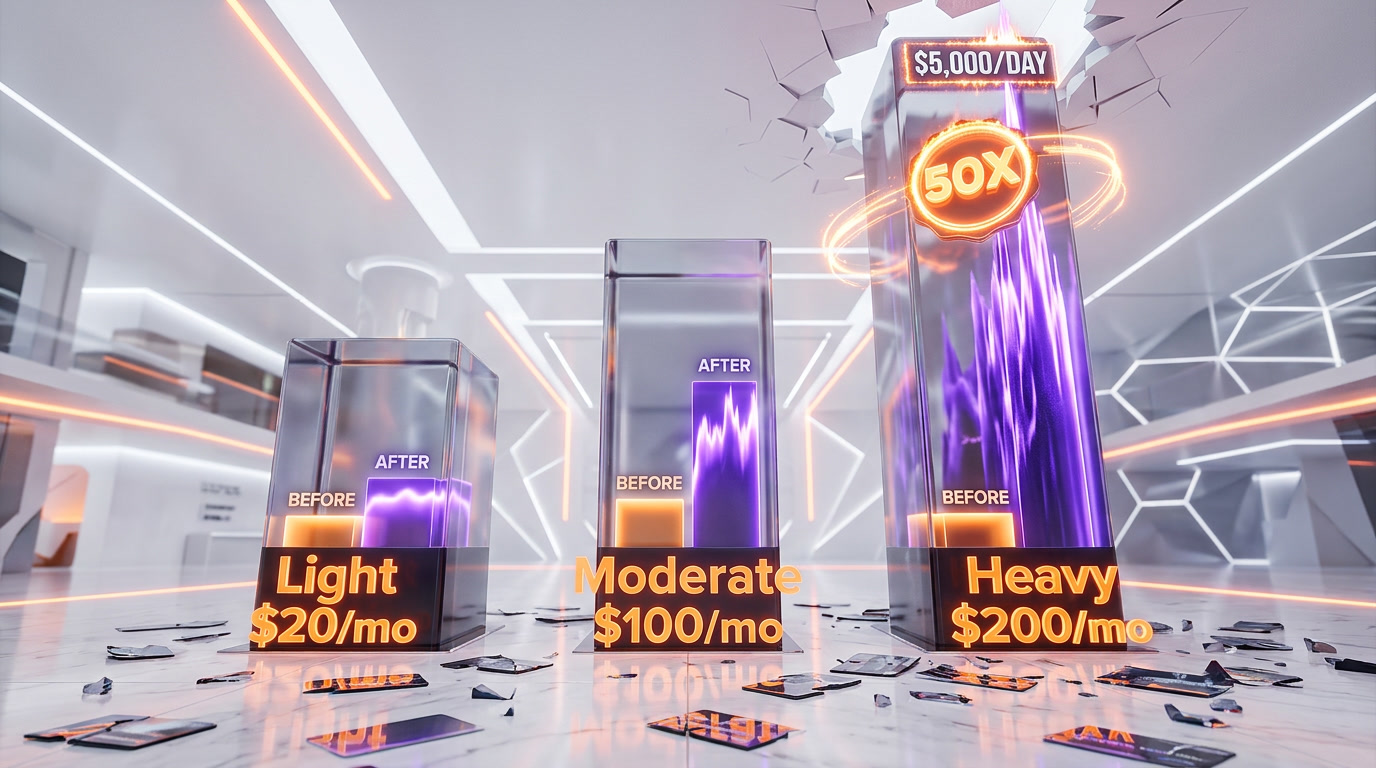
| Scenario | Before (Subscription) | After (API / Extra Usage) | Cost Increase |
|---|---|---|---|
| Light user (few tasks/day) | $20 per month (Pro) | $50-$150 per month | 2.5x - 7.5x |
| Moderate user (OpenClaw daily) | $100 per month (Max 5x) | $500-$1,500 per month | 5x - 15x |
| Heavy user (autonomous agent 24/7) | $200 per month (Max 20x) | $1,000-$5,000 per day | Up to 50x+ |
The math is brutal for power users. A single OpenClaw instance running autonomously for a full day — browsing the web, managing calendars, responding to messages, executing code — can consume the equivalent of $1,000 to $5,000 in API costs. Under a $200 per month Max subscription, that is a gap Anthropic was absorbing at a loss.
Who Is Affected
The immediate blast radius covers anyone using Claude through third-party agent harnesses. OpenClaw is the biggest name with 135,000+ active instances and 247,000 GitHub stars, but the policy applies equally to every non-Anthropic framework. Claude Code, Anthropic's own first-party coding agent, remains fully covered under Pro and Max subscriptions.
Hobbyist developers and solo practitioners are the most exposed demographic. Enterprise users with existing API contracts are unaffected. The mid-tier — indie developers and small teams who relied on Max subscriptions to power always-on agents — face the sharpest adjustment.
Why Anthropic Made This Move
The Cache Efficiency Gap
The technical justification is straightforward and, we should note, legitimate. Anthropic's first-party tools like Claude Code are engineered to maximize prompt cache hit rates. When Claude Code sends a request, it structures prompts so that repeated context (system prompts, project files, conversation history) gets cached and reused efficiently. This dramatically reduces the actual compute cost per interaction.
Third-party harnesses like OpenClaw largely bypass these efficiencies. They construct their own prompt chains, manage their own context windows, and route requests in ways that generate far more unique compute operations per token. The result: an OpenClaw interaction can cost Anthropic several multiples more in raw GPU time than the equivalent Claude Code interaction, even at identical token counts.
The Subscription Math Never Worked
Industry analysts had flagged the problem for months. A $200 per month Max subscription was powering daily workloads worth $1,000 to $5,000 in API-equivalent compute. At scale — 135,000+ OpenClaw instances — the aggregate subsidy was unsustainable. One estimate put the price gap at more than 5x between what heavy agentic users paid under flat subscriptions and what equivalent usage would cost at API rates.
Cherny also clarified something that caught many users off guard: "Using OpenClaw on a Claude subscription plan wasn't allowed in the first place" under Anthropic's existing Terms of Service. The company had simply not enforced the restriction until now.
Strategic Timing: The Claude Partner Network
The timing is impossible to ignore. In March 2026, Anthropic committed $100 million to the Claude Partner Network and launched a marketplace for Claude-powered software with controlled distribution channels. The implicit message: build within Anthropic's ecosystem, or pay full API rates. Third-party tools that operate outside this framework are being nudged toward the API tier.
OpenClaw: From Viral Hit to Caught in the Crossfire
A Rapid Rise
OpenClaw's trajectory has been one of the most dramatic in recent AI history. Here is the condensed timeline:
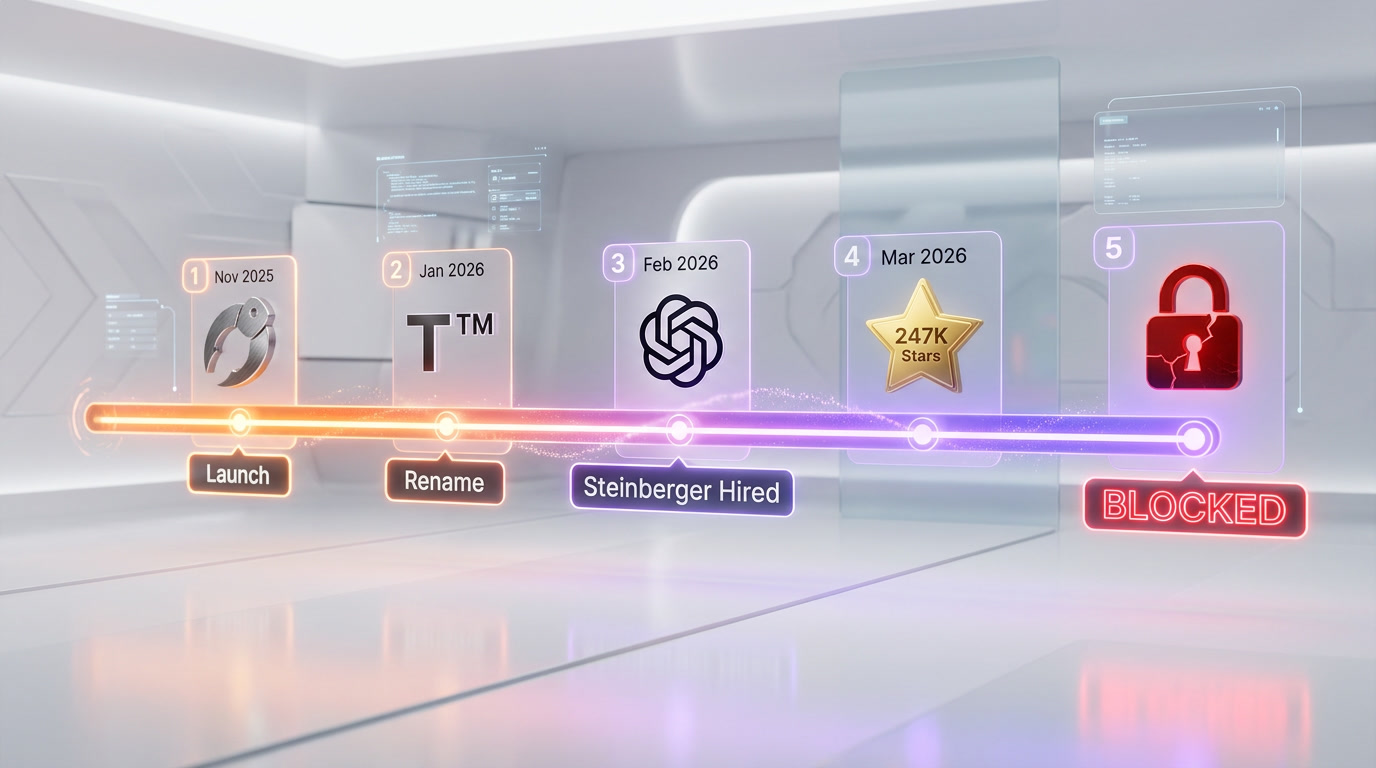
- November 2025: Austrian developer Peter Steinberger releases "Clawdbot," an open-source AI agent that "actually does things" — managing calendars, booking flights, browsing the web autonomously.
- Late January 2026: Renamed to "Moltbot" after Anthropic raises trademark concerns over the similarity to "Claude." Three days later, renamed again to "OpenClaw" (Steinberger said he simply preferred it).
- February 15, 2026: Steinberger announces he is leaving to join OpenAI. Sam Altman personally announced the hire, calling Steinberger "a genius with a lot of amazing ideas about the future of very smart agents."
- March 2, 2026: OpenClaw reaches 247,000 GitHub stars and 47,700 forks.
- April 4, 2026: Anthropic cuts off subscription access.
The framework supports 50+ integrations and works with Claude, GPT-4o, Gemini, and DeepSeek — but Claude was the preferred backend for the majority of users due to model quality.
Peter Steinberger's Response
Steinberger did not hold back. In a post following the announcement, the OpenClaw creator stated: "First they copy some popular features into their closed harness, then they lock out open source."
According to reporting from TNW, Steinberger and investor Dave Morin attempted to negotiate a softer landing with Anthropic directly. By their account, they managed to delay enforcement by only a single week. Steinberger has since acknowledged Boris Cherny's efforts to mitigate the impact, and announced that he is working on cache efficiency improvements to reduce costs for users who switch to API billing.
As for OpenClaw's future, Sam Altman confirmed the project will "live in a foundation as an open source project that OpenAI will continue to support."
What Users Should Do Now
Immediate Steps
- Claim your one-time credit: Anthropic is offering every affected subscriber a credit equal to their monthly plan cost (e.g., $200 for Max 20x users). This credit must be redeemed by April 17, 2026. Do not let this expire.
- Evaluate pre-purchased bundles: Anthropic is offering up to 30% off pre-purchased extra usage packages. For moderate users, this can meaningfully reduce the sting.
- Request a refund if needed: Full refunds are available via email request for current billing cycle subscribers who no longer see value in their plan.
- Switch to API billing: For developers already comfortable with API keys, this is the cleanest path. You pay exactly for what you use with no intermediary billing layer.
Alternative Paths Forward
If the cost increase makes Claude impractical for your use case, the AI agent ecosystem offers several alternatives:
- Multi-model approach: OpenClaw supports GPT-4o, Gemini, DeepSeek, and local models. Routing lower-priority tasks to cheaper models while reserving Claude for high-stakes work can cut costs 60-80%.
- OpenCode: An MIT-licensed AI coding agent written in Go with 11,100+ GitHub stars. Fully open source, supports multiple LLM providers.
- ZeroClaw: Written in Rust, compiles to a single binary, 99% smaller footprint than OpenClaw but with a mature feature set.
- NanoClaw: Self-hosted with a web interface. Plugs into OpenAI, Anthropic, and local models.
- Qwen 3.5: If cost is the primary concern, Qwen offers native agentic capabilities at $0.40/$2.40 per million tokens — a fraction of Claude's $5.00/$25.00 API pricing.
What This Means for the AI Industry
The End of Flat-Rate AI Agents
We believe this is a watershed moment. The fundamental tension exposed by Anthropic's decision is structural: flat-rate subscription models cannot sustain agent-driven, continuous usage patterns. When an AI agent runs autonomously for hours or days, it generates token consumption that no monthly fee was designed to cover.
This is not unique to Anthropic. Every major AI provider faces the same math. OpenAI, Google, and others will eventually confront the reality that agentic workloads cost orders of magnitude more than conversational ones. Anthropic simply got there first because Claude became the de facto backend for the most popular agent framework.
Platform Lock-In vs. Open Ecosystem
The subtext of this decision is unmistakable. Anthropic's own Claude Code — which operates within the company's controlled environment and benefits from prompt caching optimizations — remains fully subsidized under subscriptions. Third-party tools that cannot be optimized from Anthropic's side get pushed to API pricing.
The Claude Partner Network's $100 million war chest, announced weeks before this restriction, draws the line even more clearly. Anthropic is building a walled garden. Partners who operate inside the walls get favorable economics. Those outside pay market rates.
Whether this is a smart business decision or a trust-breaking move depends on your perspective. From a unit economics standpoint, Anthropic's reasoning is sound. From a developer ecosystem standpoint, cutting off the most popular open-source agent framework — weeks after its creator joined a competitor — reads as competitive calculus.
2025 Was Growth. 2026 Is Monetization.
The broader pattern is clear. Throughout 2025, AI companies competed on generosity — free tiers, flat-rate subscriptions, unlimited API credits for startups. In 2026, the industry is shifting to monetization. Anthropic's move is the most visible example, but it will not be the last. We expect similar announcements from other providers as agentic usage patterns grow and the gap between subscription revenue and compute cost widens.
Our Take: Understandable but Poorly Executed
We track the AI tools space daily at ThePlanetTools, and we have to be honest: Anthropic's reasoning is defensible. No company can sustain $5,000 per day in compute costs on a $200 per month subscription. The math was always going to break.
But the execution leaves much to be desired. A one-week delay after negotiations is not a transition period — it is a scramble. The one-time credit equal to a single month's subscription is a gesture, not a solution. And the timing — weeks after Steinberger joined OpenAI — invites the interpretation that this is competitive retaliation, whether or not that is true.
For users, our practical advice is simple: claim the credit by April 17, evaluate the pre-purchased bundles with the 30% discount, and start planning a multi-model strategy. Single-provider dependency was always risky. Today it became expensive.
Frequently Asked Questions
When exactly does the Anthropic OpenClaw block take effect?
The block took effect on April 4, 2026 at 12pm PT (3pm ET / 8pm BST). It is server-side enforced — no action is required from users for the restriction to apply. If you are reading this after that time, your OpenClaw instances using Claude subscriptions have already stopped working.
Can I still use Claude with OpenClaw after the block?
Yes, but not through your subscription. You must either switch to Anthropic's pay-as-you-go "extra usage" billing system or use a Claude API key at standard rates ($3/$15 per million input/output tokens for Sonnet 4.6, $15/$75 for Opus 4.6). Claude Code, Anthropic's first-party tool, remains fully covered under Pro and Max subscriptions.
How much more will Claude cost through API billing vs. my subscription?
It depends on usage intensity. Light users may see 2.5x-7.5x increases. Moderate daily OpenClaw users face 5x-15x increases. Heavy users running autonomous agents 24/7 could see costs jump up to 50x or more — from $200 per month to $1,000-$5,000 per day in API-equivalent compute.
What is the one-time credit and how do I claim it?
Anthropic is providing every affected subscriber a one-time credit equal to their monthly plan cost (e.g., $20 for Pro, $100 for Max 5x, $200 for Max 20x). This credit must be redeemed by April 17, 2026. It can be applied toward extra usage charges. Additionally, pre-purchased extra usage bundles come with up to 30% discount.
Does this affect Claude Code users?
No. Claude Code is Anthropic's first-party coding agent and remains fully covered under Pro and Max subscription plans. The restriction only applies to third-party agent frameworks like OpenClaw, ZeroClaw, NanoClaw, and others that route requests through Claude subscriptions.
Why did Anthropic block OpenClaw specifically?
Anthropic did not single out OpenClaw specifically — the block applies to all third-party agent harnesses. OpenClaw is the most prominent because it is the most popular with 135,000+ active instances and 247,000 GitHub stars. The core issue is that third-party tools bypass Anthropic's prompt caching optimizations, generating compute costs several multiples higher than equivalent Claude Code usage.
Can I use OpenClaw with other AI models instead of Claude?
Yes. OpenClaw supports 50+ integrations including GPT-4o, Google Gemini, DeepSeek, Qwen 3.5, and local models. Switching to alternative backends or adopting a multi-model strategy is one of the most practical responses to this change. Qwen 3.5 offers agentic capabilities at $0.40/$2.40 per million tokens — significantly cheaper than Claude's API rates.
Is Peter Steinberger still involved with OpenClaw?
Steinberger joined OpenAI in February 2026 but OpenClaw continues as an open-source project. Sam Altman confirmed it will "live in a foundation as an open source project that OpenAI will continue to support." Steinberger has announced he is working on cache efficiency improvements to help reduce costs for users who switch to API billing.
Frequently Asked Questions
Is OpenClaw still better than Claude Code after Anthropic's April 4 ban?
Claude Code remains fully covered under Claude Pro ($20 per month) and Max ($100–$200 per month) subscriptions, while OpenClaw now requires pay-as-you-go API billing at $3/$15 per million input/output tokens for Claude Sonnet 4.6. For users who need flat-rate pricing, Claude Code is now the cost-superior choice. OpenClaw still supports 50+ integrations and multi-model backends including GPT-4o, Google Gemini, and DeepSeek — but running OpenClaw with Claude now costs up to 50x more than a former Max subscription.
Who should switch to the Claude API instead of keeping a Pro or Max subscription?
Any developer or team routing Claude requests through OpenClaw or another third-party agent framework must now use Claude API keys or extra usage billing. Claude Pro ($20 per month) and Max ($100–$200 per month) subscriptions no longer cover third-party tools as of April 4, 2026. Light users with a few tasks per day may absorb the cost; heavy autonomous-agent users can face $1,000–$5,000 per day in API costs versus the previous $200 per month Max subscription. Enterprise users with existing direct API contracts are unaffected.
What are OpenClaw's main limitations after the Anthropic subscription ban?
After April 4, 2026, OpenClaw can no longer leverage Claude's flat-rate Pro or Max subscription pricing. The framework also bypasses Anthropic's prompt caching efficiencies, making each Claude interaction more expensive in raw compute compared to Claude Code. Heavy 24/7 autonomous agent users face cost increases of up to 50x. With 135,000+ active instances previously running on Claude subscriptions, the majority of OpenClaw's user base is directly impacted. GPT-4o and Gemini remain viable no-cost-spike alternatives via OpenClaw's multi-model support.
Does OpenClaw still integrate with GPT-4o and Google Gemini after the Claude subscription cut-off?
Yes. OpenClaw is model-agnostic and supports 50+ integrations, including GPT-4o, Google Gemini, and DeepSeek. Only Claude subscription-based access was terminated on April 4, 2026. Users can continue pairing OpenClaw with Claude by switching to a Claude API key at standard pay-as-you-go rates ($3/$15 per million tokens for Sonnet 4.6), or reroute workloads to GPT-4o or Gemini to sidestep the cost increase entirely. Sam Altman confirmed OpenAI will continue supporting OpenClaw as an open-source foundation project.
How does Anthropic's extra usage billing compare to DeepSeek's API pricing for OpenClaw power users?
Anthropic's Sonnet 4.6 API is priced at $3 per million input tokens and $15 per million output tokens; Opus 4.6 is $15/$75. DeepSeek offers significantly lower rates, making it a compelling alternative for cost-sensitive OpenClaw users who do not require Claude-level model quality. For heavy agents previously running on a $200 per month Max subscription and now facing $1,000–$5,000 per day in Claude API costs, switching to DeepSeek via OpenClaw's multi-model backend can reduce operating costs by an order of magnitude.
Will OpenAI's backing change how OpenClaw competes with Anthropic's Claude Code?
Potentially, yes. Sam Altman confirmed OpenClaw will live in a foundation as an open-source project that OpenAI will continue to support. Its creator Peter Steinberger — who grew OpenClaw to 247,000 GitHub stars and 47,700 forks — has joined OpenAI. This positions OpenClaw as a direct open-source counterweight to Anthropic's closed Claude Code ecosystem. Claude Code stays covered under Pro and Max subscriptions, but OpenAI's backing could accelerate GPT-4o optimization within OpenClaw and further erode Claude's dominance as its preferred backend.
What is Anthropic's one-time credit offer, and when does it expire?
Anthropic is offering every affected subscriber a one-time credit equal to their current monthly plan cost — $20 for Pro users, $100 for Max 5x users, and $200 for Max 20x users. This credit must be redeemed by April 17, 2026 — no extensions have been announced. In addition, Anthropic is offering up to 30% off pre-purchased extra usage bundles. Full refunds for the current billing cycle are available via email request. Users should act immediately given the firm April 17 deadline.
Why did Anthropic block OpenClaw but keep Claude Code on flat-rate subscription plans?
Boris Cherny, Head of Claude Code at Anthropic, explained that subscriptions were never designed for third-party tool usage patterns. Claude Code is engineered to maximize prompt cache hit rates, dramatically reducing compute cost per interaction. OpenClaw bypasses these efficiencies, generating far more unique compute operations per token — costing Anthropic several multiples more in GPU time at identical token counts. Industry analysts estimated the gap at over 5x between what heavy OpenClaw users paid ($200 per month) versus actual API-equivalent compute ($1,000–$5,000 per day). Anthropic also noted that using OpenClaw on subscription plans already violated its Terms of Service.