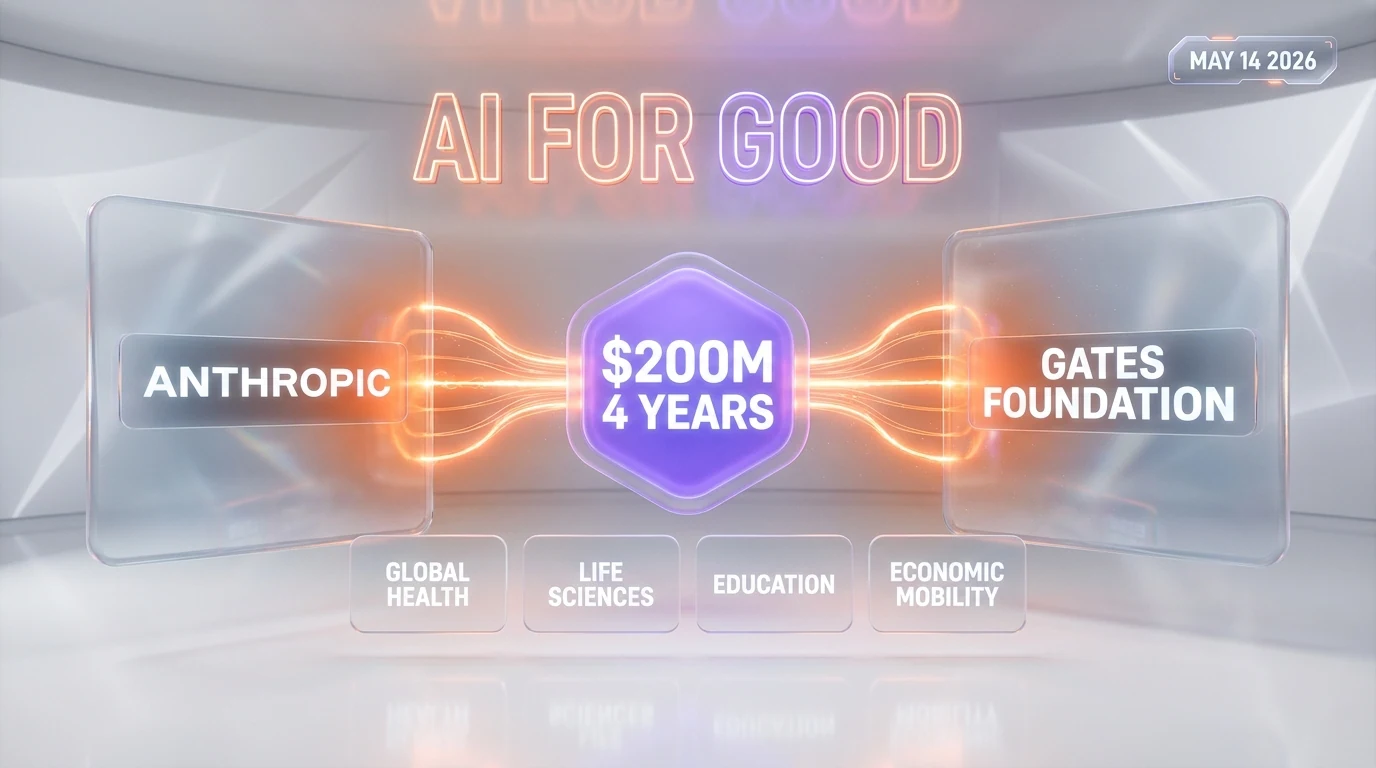
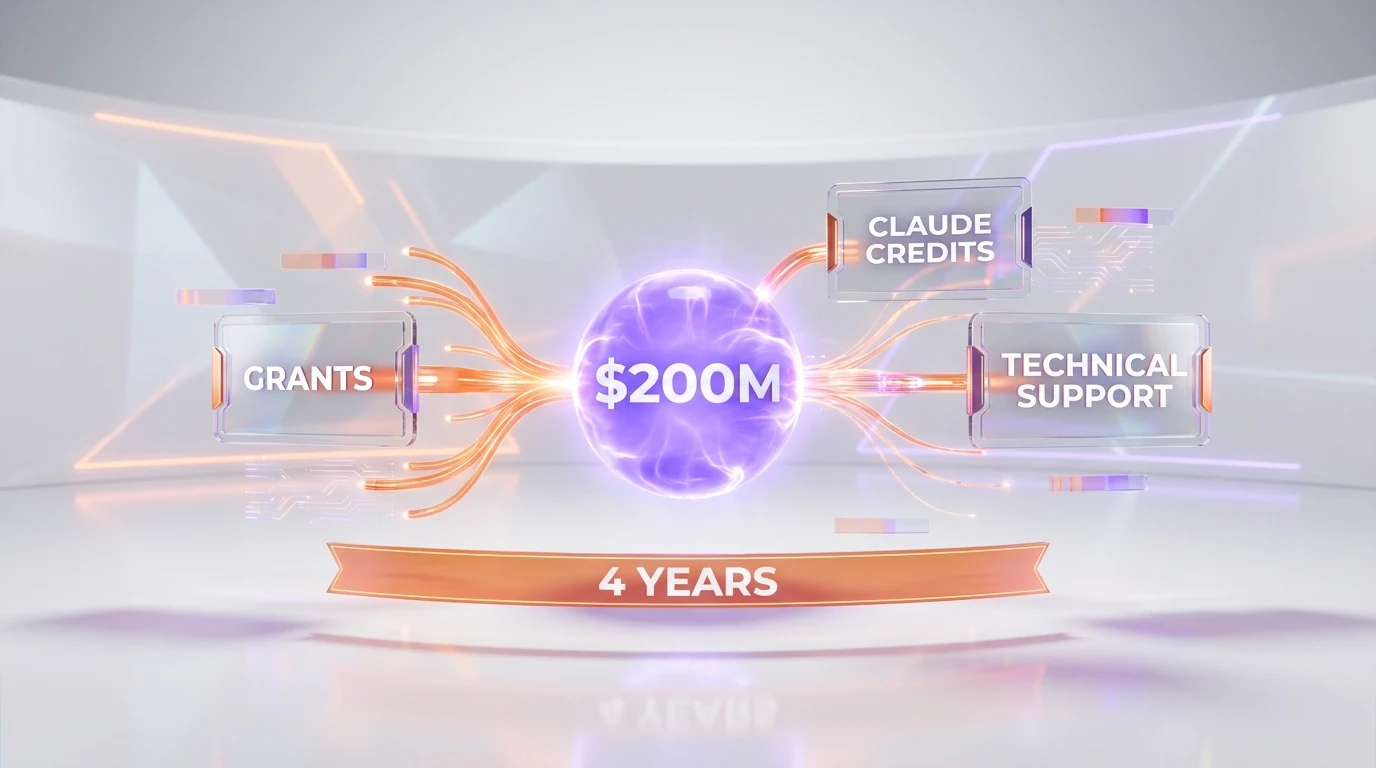
On May 14, 2026, Anthropic and the Gates Foundation announced a $200 million partnership over four years, combining grant funding, Claude usage credits, and technical support. The money targets four domains: global health and life sciences, education, and economic mobility, with named programs spanning polio and HPV research, K-12 tutoring, and smallholder agriculture. It is the largest philanthropic AI commitment Anthropic has disclosed to date, and it stakes out distinct strategic ground against OpenAI and Google on the AI-for-good front.
The Big Picture: Why a $200M Philanthropic Deal Is a Strategic Signal
Philanthropy and frontier AI economics do not usually share a press release. The Gates Foundation deal forces them together, and that is precisely why it matters beyond the headline number. Anthropic spent the spring of 2026 locking compute (a roughly 10-gigawatt war chest across Google, Amazon, Microsoft, and SpaceX, detailed in our analysis of Anthropic's 10-gigawatt compute empire) and converting that infrastructure into enterprise revenue. The Gates Foundation partnership is a different lever entirely: it is positioning, not monetization.
The structure tells the story. Of the $200 million, the components are grant funding, Claude usage credits, and technical support. Only one of those three is cash that leaves Anthropic's balance sheet in the conventional sense. Credits and engineering hours are capacity Anthropic already controls, deployed toward problems that generate research artifacts, public benchmarks, and a track record in regulated, high-stakes domains. Read strategically, this is Anthropic buying credibility and a development moat in healthcare and education AI at a fraction of the headline cost.
That framing is not a criticism. It is the rational design of a frontier lab that wants to be the trusted AI vendor when governments, NGOs, and health ministries write procurement specs in 2027 and beyond. The question for the rest of this analysis is whether the program design backs that positioning, and how it stacks against what OpenAI and Google are doing on the same terrain.
What Was Actually Announced
The confirmed facts, per Anthropic's official announcement: a $200 million commitment over four years, structured as grants plus Claude credits plus technical support, covering global health and life sciences, education, and economic mobility. The announcement names specific initiatives rather than vague intentions, which is the detail that separates this from a typical AI-for-good press cycle.
The Number In Context
$200 million over four years is $50 million per year of blended value. Against Anthropic's reported $350 billion private valuation and the scale of its compute commitments, this is a small line item. Against the philanthropic AI field, it is one of the larger single commitments announced by a frontier lab. Both things are true, and holding them together is the correct way to read the deal.
How This Fits Anthropic's Spring 2026 Trajectory
The Gates Foundation deal does not land in isolation. It is the latest move in a dense sequence of Anthropic announcements through April and May 2026, and the sequence is the story.
The Compute-Then-Distribution-Then-Credibility Arc
The pattern across the spring is legible: first secure compute at scale, then convert that compute into enterprise distribution, then convert distribution momentum into institutional credibility. The compute war chest came first. Enterprise traction followed, with Anthropic posting business adoption gains against OpenAI. The Gates Foundation partnership is the credibility layer stacked on top. Each move makes the next one cheaper to execute, which is what a coherent strategy looks like from the outside.
Why Philanthropy Comes After Revenue, Not Before
The ordering matters. A frontier lab that announces a $200 million philanthropic program before it has secured compute and revenue is signaling something different from one that announces it after. Anthropic is doing this from a position of strength: the philanthropic commitment reads as the deployment of a credibility asset by a company that has already solved its near-term existential constraints, not as a distraction from them. That is the correct time to spend reputational capital on field-building.
Breaking Down the $200M / 4 Years Structure
The partnership splits into three instruments, each with different strategic weight.
Grant Funding
Direct grants are the most conventional component and the one closest to traditional philanthropy. Grant money flows to organizations and research programs working in the four target domains. This is the part that looks most like the Gates Foundation's existing playbook, where the Foundation has historically channeled funding into global health and development. The novelty is not the grant mechanism; it is that the grants are explicitly tied to AI capability deployment rather than standalone research.
Claude Usage Credits
Credits are the most strategically interesting instrument. When Anthropic provides Claude credits to health researchers, education nonprofits, and agricultural data programs, it is doing three things at once: subsidizing access, generating real-world usage data in domains where it currently has thin coverage, and building switching costs. An organization that builds a disease-forecasting pipeline on Claude does not casually migrate to a competitor model. Credits are the cheapest durable distribution Anthropic can buy. We use Claude daily in our own production workflows (see our coverage of Claude and Claude Code), and the lock-in effect of building agentic pipelines on a single model family is real and underappreciated.
Technical Support
Engineering hours are the third lever. Anthropic deploying its own staff to help build connectors, benchmarks, and evaluation frameworks for healthcare tasks means Anthropic's engineers are learning the domain alongside the partners. That knowledge transfer runs both directions, and it is arguably the most valuable thing Anthropic gets out of the deal: domain expertise in regulated verticals it cannot easily acquire any other way.
How the Three Instruments Compound
The three instruments are not additive; they compound. Grants fund the organizations, credits power the workloads those organizations run, and technical support ensures the workloads actually ship. A grant without credits stalls at the proof-of-concept stage. Credits without technical support produce brittle prototypes. The bundled structure is designed so that each instrument unlocks the value of the others, which is a more sophisticated philanthropic design than a pure grant program.
Global Health and Life Sciences: The Anchor Domain
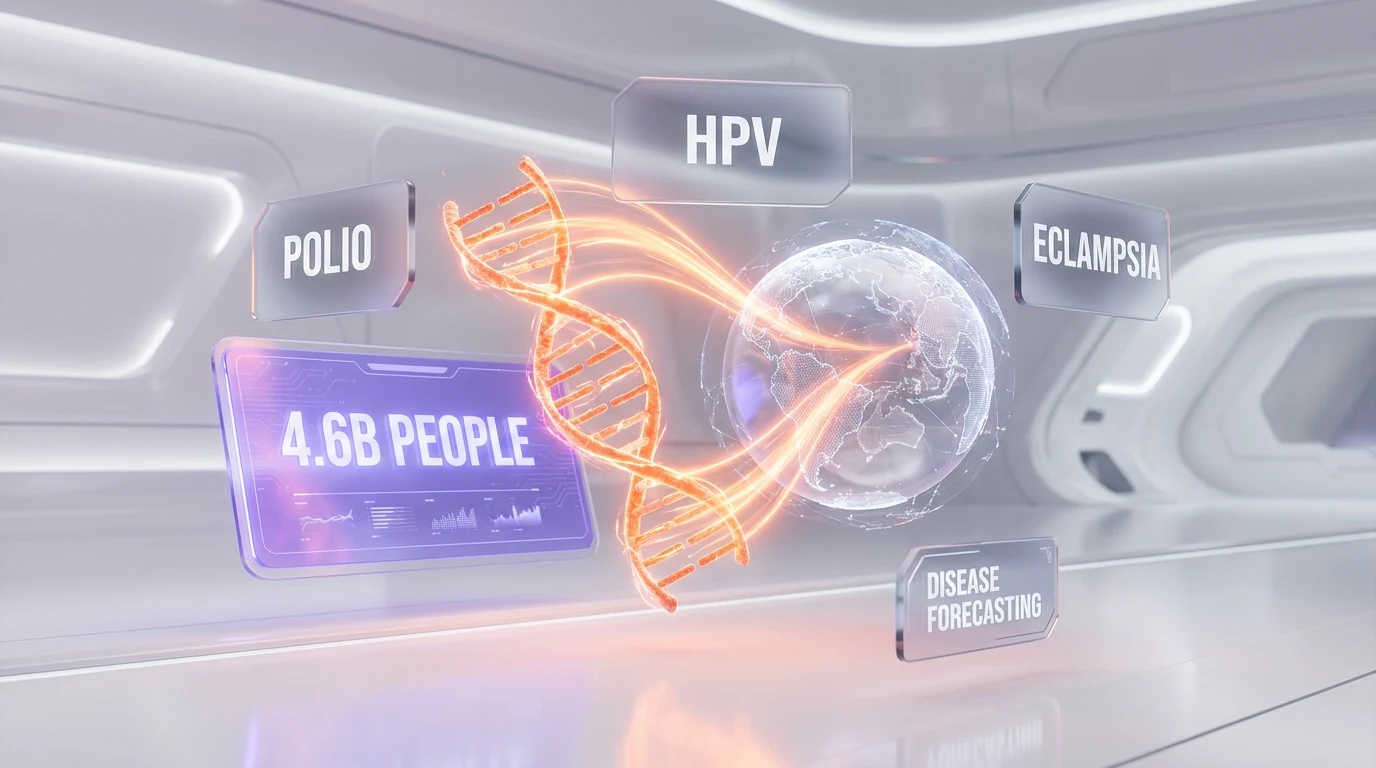
Global health and life sciences is where the partnership has the most concrete program detail, and it is the domain where the Gates Foundation's institutional knowledge is deepest. The announced work includes creating connectors, benchmarks, and evaluation frameworks for healthcare AI tasks, advancing research on polio, HPV, and eclampsia and preeclampsia, and a partnership with the Institute for Disease Modeling to improve disease forecasting.
The 4.6 Billion People Framing
The announcement frames the target population as the 4.6 billion people in low- and middle-income countries who lack access to essential health services. That number is the strategic anchor of the entire health track. It defines the addressable problem space and signals that the work is aimed at systemic capacity gaps, not incremental tooling for well-resourced health systems. Whether AI moves that number is a multi-year question, but the framing tells you how Anthropic and the Foundation want the program judged.
Connectors, Benchmarks, and Evaluation Frameworks
The least glamorous item on the list is the most important for Anthropic's long game. Building healthcare-specific benchmarks and evaluation frameworks means Anthropic helps define how AI performance in health gets measured. Whoever shapes the evaluation standards in a regulated domain holds durable influence over that domain. This is the same dynamic that played out in coding benchmarks, and it is a deliberate move into a vertical where standards are still forming.
Polio, HPV, and Eclampsia Research
The three named disease areas are not random. Polio eradication is a flagship Gates Foundation program with decades of institutional investment. HPV vaccination is a major global cervical cancer prevention lever. Eclampsia and preeclampsia are leading causes of maternal mortality in low-resource settings. Each represents a domain with large existing datasets, clear outcome metrics, and a defined population, which makes them tractable targets for AI-assisted research rather than open-ended moonshots.
The Institute for Disease Modeling Partnership
Disease forecasting is where AI has a credible near-term contribution. The Institute for Disease Modeling brings established epidemiological modeling expertise; Claude brings the ability to synthesize heterogeneous data sources and accelerate model iteration. This is the kind of partnership where the AI component is a multiplier on existing scientific capability rather than a replacement for it, which is the realistic frame for AI in life sciences right now.
How This Compares to OpenAI's Pharma Strategy
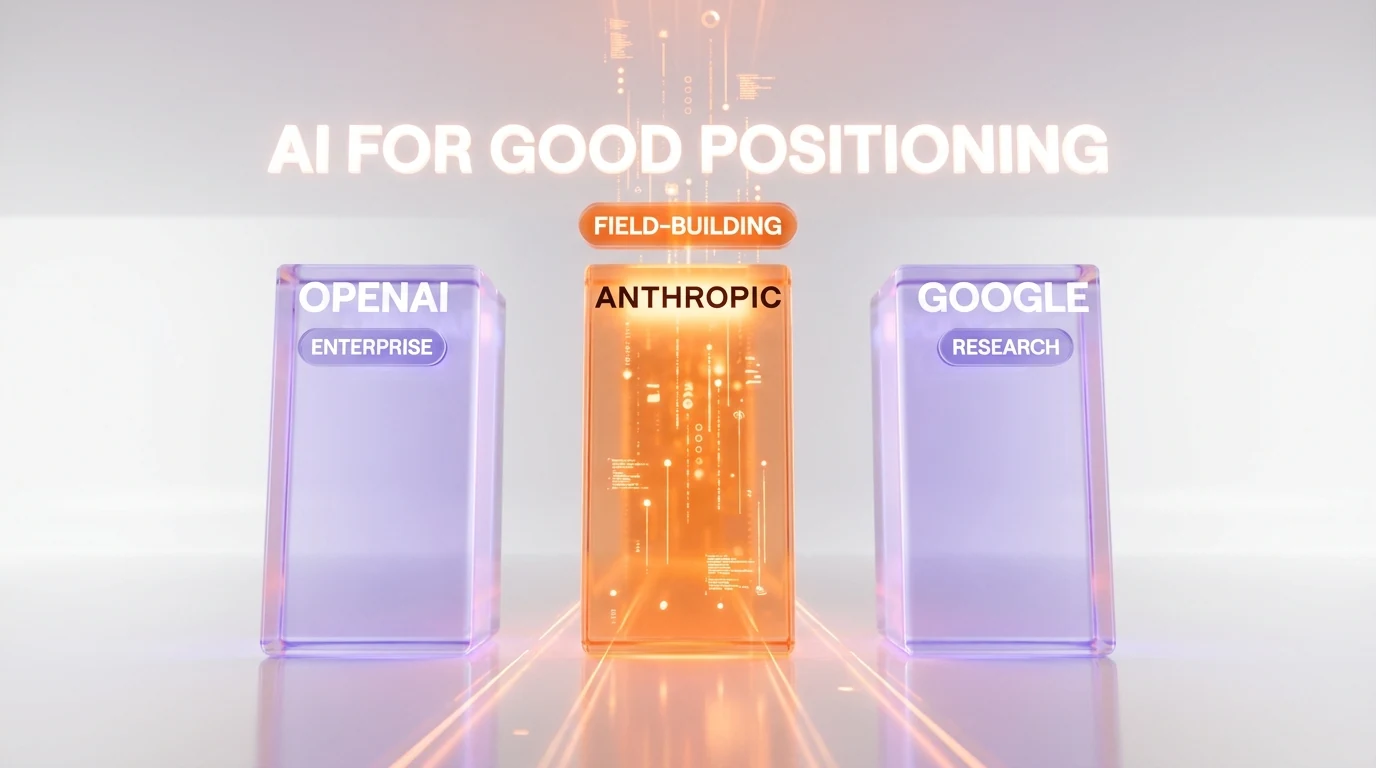
The contrast with OpenAI is instructive. OpenAI's most visible life sciences move was the enterprise deal with Novo Nordisk, which we analyzed in our breakdown of the Novo Nordisk and OpenAI pharma partnership. That arrangement is a commercial integration with a single large pharmaceutical company aimed at drug discovery and operational efficiency. Anthropic's Gates Foundation health track is structurally different: it targets population-scale public health in low-resource settings through a philanthropic foundation rather than a corporate customer. One is enterprise revenue; the other is field-building. Both are legitimate strategies, and they reveal how the two labs are choosing different beachheads in healthcare AI.
Education and Economic Mobility: The Reach Domains
If global health is the anchor, education and economic mobility are the reach domains, broader in scope and harder to measure, but central to the AI-for-good narrative Anthropic is constructing.
Education: Public Goods Over Products
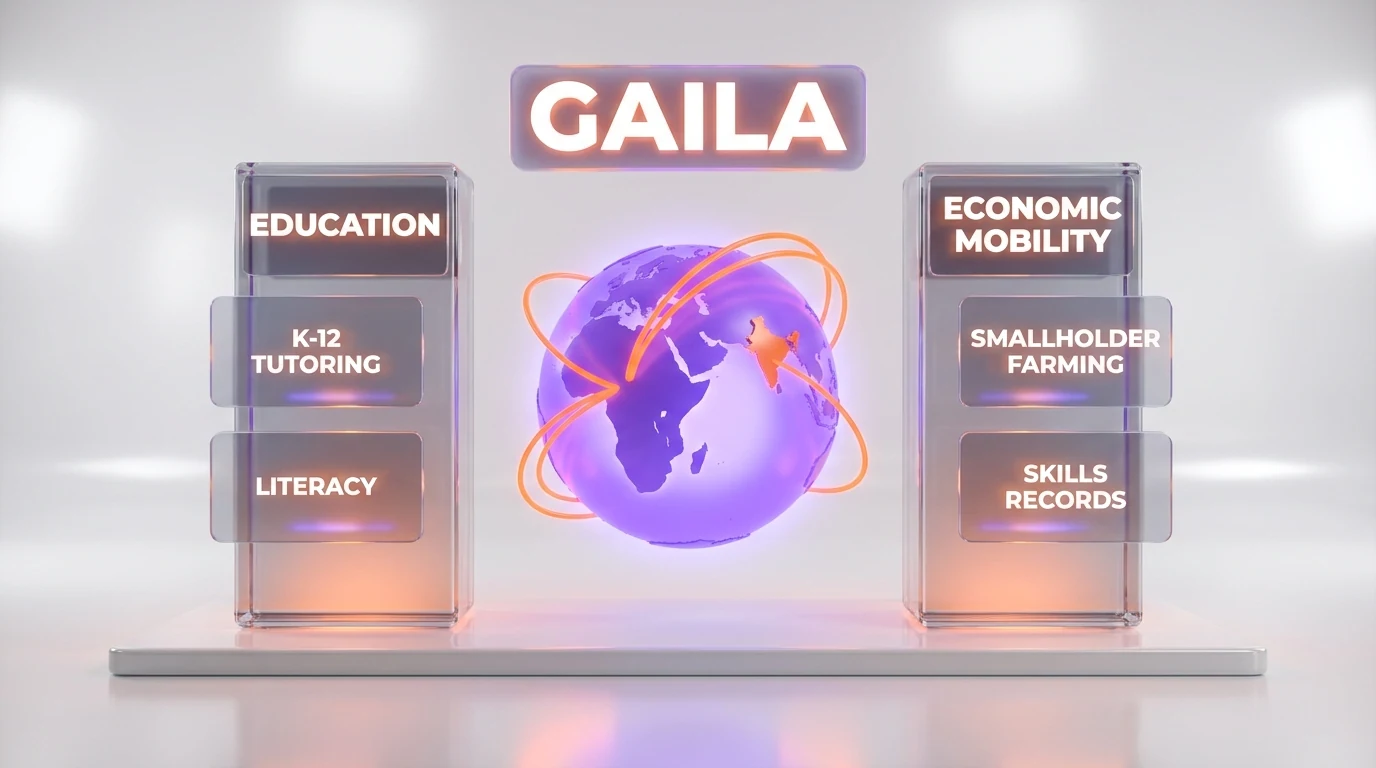
The education track emphasizes public goods such as benchmarks, datasets, and knowledge graphs, alongside K-12 tutoring tools and career guidance in the US, and foundational literacy and numeracy programs in sub-Saharan Africa and India. The phrase "public goods" is doing strategic work here. By framing the education deliverables as shared infrastructure rather than proprietary products, Anthropic positions itself as a steward of the field rather than a vendor extracting from it, while still being the entity whose model the public goods are built and evaluated against.
The GAILA Collaboration
The collaboration with the Global AI for Learning Alliance signals that Anthropic wants the education work to operate through a coalition rather than as a solo program. Coalitions distribute credibility and reduce the perception of a single vendor capturing public education infrastructure. Strategically, working through GAILA is a hedge against the criticism that frontier labs are colonizing classrooms, while still keeping Claude central to the technical stack.
Economic Mobility: Agriculture and Skills
The economic mobility track is the most operationally concrete of the two reach domains. It includes agriculture-specific Claude improvements and datasets for smallholder farming, portable skills records systems in the US, career guidance tools for job market entrants and retraining programs, and employment outcome measurement tools. The smallholder farming component is notable because it implies model-level work, not just credits. Building agriculture-specific datasets and tuning Claude for that domain means the partnership produces capability improvements that flow back into the core product, not just deployment subsidies.
Portable Skills Records and Employment Measurement
The US-focused skills and employment work is the part most exposed to measurement scrutiny. Portable skills records and employment outcome measurement tools are areas where claims are easy to make and hard to verify. This is also the domain where the gap between announced intention and demonstrated impact will be widest, and where independent evaluation will matter most. We will be watching whether concrete outcome data emerges over the four-year window or whether this track stays at the pilot stage.
Anthropic's AI-for-Good Positioning vs OpenAI and Google
The strategic core of this deal is positioning. All three frontier labs talk about beneficial AI; the question is what each is actually building toward, and the Gates Foundation partnership sharpens the contrast.
Anthropic's Play: Safety Brand Plus Field-Building
Anthropic has spent its corporate existence cultivating a safety-first brand. The Gates Foundation partnership operationalizes that brand in domains where trust is the binding constraint: health ministries, education systems, and development organizations do not buy from the most capable vendor, they buy from the most trusted one. By embedding into these domains through a foundation with five decades of institutional credibility, Anthropic is converting a reputational asset into a procurement advantage that compounds over the four-year window and beyond.
OpenAI's Play: Consumer Scale and Enterprise Deals
OpenAI's strategy has trended toward consumer scale and large enterprise integrations. Its life sciences footprint runs through commercial deals like Novo Nordisk rather than philanthropic field-building. This is consistent with OpenAI's broader pivot, also visible in how Anthropic overtook OpenAI in US business adoption on Ramp data, where the two labs are diverging on which markets they prioritize. OpenAI is not absent from beneficial-AI messaging, but its revealed strategy is monetization first, with social impact as a narrative layer rather than a structured program.
Google's Play: Research Infrastructure and DeepMind
Google's beneficial-AI work runs primarily through DeepMind's scientific research, where protein structure prediction and related programs delivered genuine scientific milestones. Google's strength is fundamental research published as scientific output. It is less focused on the deployment-and-capacity-building model that the Gates Foundation partnership represents. Google does science; Anthropic, with this deal, is doing field deployment. These are different theories of impact, and the market will reward them differently depending on which domain you look at.
Why the Gates Foundation Chose Anthropic
From the Foundation's side, the choice of Anthropic is rational. Anthropic's safety positioning aligns with a philanthropic funder's risk tolerance in sensitive domains like health and education. A foundation deploying AI in maternal mortality research or children's literacy cannot afford a reputational incident from an under-aligned model. Choosing the vendor that has most publicly invested in safety is the conservative, defensible institutional decision, regardless of marginal capability differences between frontier models.
The Enterprise Halo Effect
There is a commercial second-order effect worth naming. Anthropic's enterprise momentum, visible in deals like the PwC partnership certifying 30,000 professionals on Claude, is reinforced by philanthropic credibility. Enterprise procurement committees increasingly weigh vendor responsibility narratives. A frontier lab partnered with the Gates Foundation on global health carries a trust signal into unrelated enterprise sales conversations. The philanthropic deal is not only philanthropy; it is also a brand asset that travels into commercial contexts.
The Credibility Economics of Philanthropic AI
Strip the deal to its economic logic and a clear mechanism appears. Anthropic is spending a mix of low-marginal-cost capacity (credits, engineering time) and a smaller amount of hard cash (grants) to acquire an asset that does not appear on any balance sheet but compounds: trusted-vendor status in domains where trust gates procurement.
Why Credits Are Cheaper Than They Look
A dollar of Claude credits does not cost Anthropic a dollar. It costs Anthropic the marginal inference expense of serving those tokens, which is a fraction of the headline credit value, plus the opportunity cost of capacity that might otherwise serve paying customers. In a period where Anthropic has just locked multi-gigawatt compute, marginal capacity is the resource it is least short of. Denominating philanthropic value in credits is the most capital-efficient way to fund a $200 million-labeled program.
The Standards Moat
The most durable return is not goodwill; it is influence over evaluation standards. Helping build the benchmarks and evaluation frameworks for healthcare AI tasks means Anthropic's engineers are in the room when the field decides how AI performance in health gets measured. Standards, once adopted by institutional buyers, are extremely sticky. This is the same playbook that shaped coding benchmarks, redeployed into a regulated vertical where the standards are still wet cement.
What the Deal Does Not Tell Us
Responsible analysis names the gaps. The announcement is strong on program structure and weak on accountability mechanics.
No Disclosed Milestones or Outcome Metrics
The announcement does not specify measurable milestones, target outcomes, or independent evaluation commitments. Four years is long enough that the absence of public checkpoints is a real gap. The named programs are concrete; the success criteria are not. This is common in philanthropic AI announcements and is exactly the place where independent observers should apply pressure over the four-year window.
The Allocation Across Domains Is Unspecified
$200 million spread across four domains could mean anything from an even split to a heavily health-weighted allocation with token education and mobility components. The program detail is densest in global health, which suggests that is where the weight sits, but the announcement does not commit to a breakdown. That ambiguity preserves Anthropic's flexibility and limits external accountability.
No Executive Quotes
The announcement carried no executive quotes from either Anthropic or the Gates Foundation. For a partnership of this scale, the absence of named leadership statements is a stylistic choice that keeps the messaging program-focused rather than personality-driven. It is a minor signal, but it is consistent with a deliberately understated rollout.
Our Verdict: A Calculated, Well-Designed Strategic Move
The Anthropic and Gates Foundation partnership is a well-constructed strategic instrument that serves Anthropic's positioning at least as much as it serves the stated beneficiaries, and there is nothing wrong with that. The most effective philanthropy from a frontier lab is the kind that is also strategically rational, because that alignment is what makes it durable rather than a one-cycle PR exercise.
The program design is genuinely strong where it counts: the bundled instrument structure compounds, the global health track has concrete named programs with measurable disease targets, and the coalition framing in education distributes credibility intelligently. The weaknesses are equally clear: no disclosed milestones, no public allocation breakdown, and the economic mobility track is the most exposed to the gap between announcement and demonstrated impact.
Strategically, this is Anthropic planting a flag on terrain OpenAI and Google have chosen not to contest in the same way. OpenAI runs enterprise pharma deals; Google publishes scientific research; Anthropic is building field presence and evaluation standards in regulated public-interest domains through the most credible philanthropic institution available. If the goal is to be the default trusted AI vendor for governments and NGOs by 2028, this is exactly the move you make in 2026. We will be tracking whether the outcome data over the next four years matches the quality of the design.
Frequently Asked Questions
How much is the Anthropic and Gates Foundation partnership worth?
The partnership is $200 million committed over four years, announced on May 14, 2026. It is structured as three instruments: grant funding, Claude usage credits, and technical support. That works out to roughly $50 million of blended value per year across the four target domains.
What domains does the Anthropic Gates Foundation deal cover?
Four domains: global health and life sciences, education, and economic mobility. Global health has the most concrete program detail, including polio, HPV, and eclampsia research plus disease forecasting with the Institute for Disease Modeling. Education covers K-12 tutoring and literacy programs; economic mobility covers smallholder agriculture and skills records.
When was the Anthropic Gates Foundation partnership announced?
It was announced on May 14, 2026, via Anthropic's official news channel. It is the largest philanthropic AI commitment Anthropic has publicly disclosed to date.
How is the $200 million actually structured?
Not as a single cash transfer. It combines direct grant funding, Claude usage credits provided to partner organizations, and technical support from Anthropic engineers. Only the grant component is conventional cash; credits and engineering hours are capacity Anthropic already controls, which makes the effective cost to Anthropic lower than the headline figure.
How does this compare to OpenAI's Novo Nordisk partnership?
They are structurally different. OpenAI's Novo Nordisk deal is a commercial enterprise integration with a single pharmaceutical company focused on drug discovery and operations. Anthropic's Gates Foundation health track targets population-scale public health in low- and middle-income countries through a philanthropic foundation. One is enterprise revenue; the other is field-building and standards-setting.
What is the Institute for Disease Modeling partnership about?
It is the disease-forecasting component of the global health track. The Institute for Disease Modeling provides established epidemiological modeling expertise, and Claude provides data synthesis and faster model iteration. The AI acts as a multiplier on existing scientific capability rather than a replacement for it.
What is the 4.6 billion people figure in the announcement?
It is the framing target for the global health track: the roughly 4.6 billion people in low- and middle-income countries who lack access to essential health services. It defines the addressable problem the health work is aimed at, signaling systemic capacity-building rather than incremental tooling for well-resourced systems.
Does this partnership improve Claude itself?
In part, yes. The economic mobility track includes agriculture-specific Claude improvements and datasets for smallholder farming, which implies model-level work that flows back into the core product. Most of the deal is deployment and access, but the agriculture component produces capability improvements rather than only subsidized usage.
What are the weaknesses in the announcement?
Three main gaps: no disclosed measurable milestones or independent evaluation commitments, no public breakdown of how the $200 million is allocated across the four domains, and no executive quotes. The economic mobility track in particular is the most exposed to the gap between stated intention and demonstrated outcomes over the four-year window.
Why did the Gates Foundation choose Anthropic over OpenAI or Google?
Anthropic's long-standing safety-first positioning aligns with a philanthropic funder's risk tolerance in sensitive domains like maternal mortality research and children's literacy. A foundation deploying AI in high-stakes public-interest areas chooses the vendor that has most publicly invested in alignment and safety, which is the conservative institutional decision regardless of marginal capability differences.
Is this partnership mainly philanthropy or strategy for Anthropic?
Both, by design. It delivers genuine philanthropic programs while also buying Anthropic credibility, distribution, switching costs, and influence over evaluation standards in regulated domains. The most durable philanthropy from a frontier lab is the kind that is also strategically rational, because that alignment is what keeps it funded beyond a single news cycle.
What should observers watch over the next four years?
Whether independent outcome data emerges for each domain, whether the allocation across health, education, and economic mobility becomes public, whether the smallholder agriculture model improvements ship, and whether the healthcare benchmarks Anthropic helps build become field standards. The program design is strong; the open question is execution and transparency over the full term.