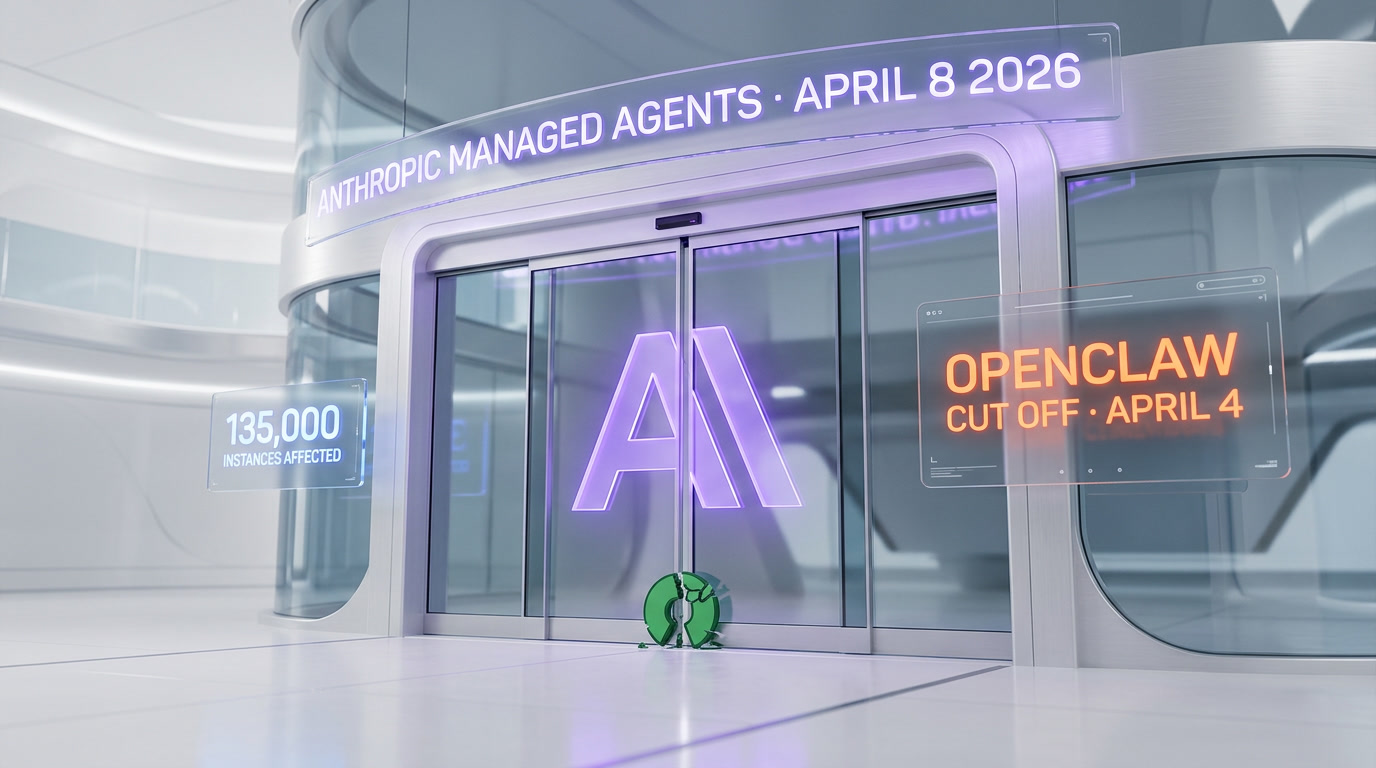
On April 8, 2026, Anthropic launched Managed Agents, a cloud-based AI agent hosting platform — exactly four days after cutting off roughly 135,000 OpenClaw instances from Claude Pro and Max subscriptions. OpenClaw creator Peter Steinberger publicly accused Anthropic of cannibalizing open-source: "Funny how timings match up, first they copy some popular features into their closed harness, then they lock out open source." The two-move combo — block on April 4, launch on April 8 — has triggered the sharpest open-source backlash Anthropic has faced since the company was founded in 2021, and revived the 30-year-old embrace, extend, extinguish debate inside the AI community.
What is Anthropic Managed Agents, exactly
Managed Agents is Anthropic's first fully hosted agent platform. It is a cloud-based service that removes the need for developers to build and run their own agent infrastructure on top of the Claude API. Instead of wiring up your own tool calls, memory, sandboxing, observability and error recovery, you point Managed Agents at a task and Anthropic runs the whole loop in its own environment. Billing is per task, per token, and per sandbox-minute.
The positioning in Anthropic's launch post is pointed: Managed Agents is framed as the production-grade way to run agents on Claude, with first-class support for the features that made OpenClaw popular in the first place — persistent memory, structured tool calling, web browsing, code execution, file handling and long-running tasks. That overlap is the core of the controversy. Every one of those capabilities shipped first in the open-source OpenClaw harness, built and maintained by the community over eighteen months. Managed Agents ships them re-implemented, closed-source, inside Anthropic's walls.
The OpenClaw creator's accusation
Peter Steinberger, the creator of OpenClaw, did not mince words when Managed Agents launched. His public statement — picked up across TechCrunch, TNW, VentureBeat and The Register — reads:
"Funny how timings match up, first they copy some popular features into their closed harness, then they lock out open source."
That sentence compresses a full strategic argument into eighteen words. The claim is that Anthropic watched OpenClaw ship features, observed which ones got traction, re-implemented them inside a proprietary managed service, and then used its position as the model provider to cut off the economic oxygen that had been keeping OpenClaw alive — flat-rate Claude Pro and Max subscriptions running OpenClaw tasks under the hood.
Steinberger, for context, left active day-to-day maintenance of OpenClaw in February 2026 when he joined OpenAI. He is not a neutral observer. But his technical read of the Managed Agents feature set — that it maps almost one-for-one onto the OpenClaw harness — has been echoed by other contributors and by independent researchers who have spent the last week inspecting the Managed Agents SDK.
Feature by feature — Managed Agents versus OpenClaw
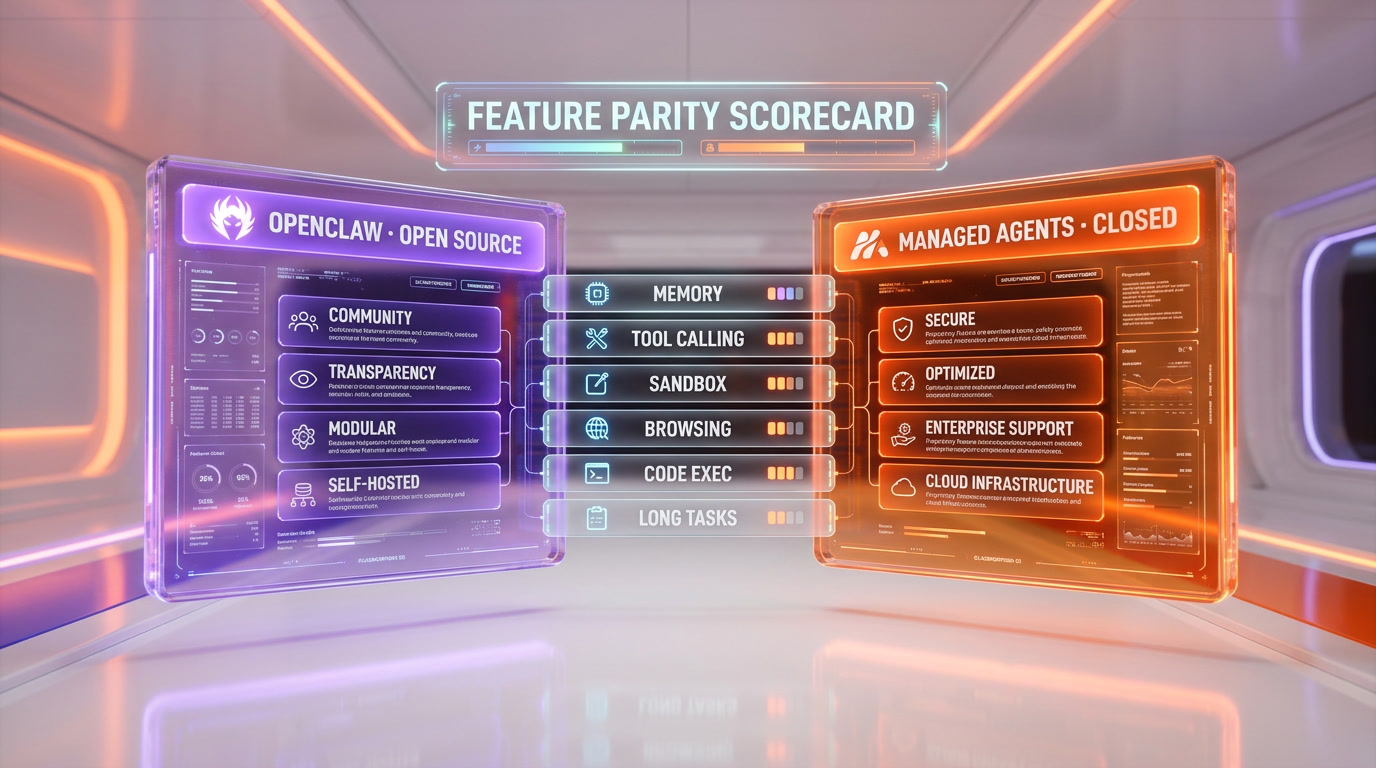
Setting the two side by side makes the overlap hard to miss. Here is the honest scorecard based on Anthropic's launch documentation and the current OpenClaw harness on GitHub:
- Persistent memory across sessions. OpenClaw shipped a persistent memory layer in Q3 2025. Managed Agents ships a nearly identical persistent-memory API at launch, with the same scoping primitives.
- Structured tool calling with retry and repair. OpenClaw's tool-repair loop — the one that auto-fixes malformed JSON calls — was a community favorite. Managed Agents includes the same pattern under a different name.
- Sandboxed code execution. OpenClaw runs code in user-controlled sandboxes (Docker, Firecracker, E2B). Managed Agents runs it in Anthropic-operated sandboxes only.
- Web browsing with screenshot reasoning. OpenClaw's browse tool, which feeds page screenshots back into Claude's vision input, was the feature that most users cited as the reason to switch. Managed Agents ships this natively.
- Long-running autonomous tasks. OpenClaw supported tasks that run for hours or days — the pattern that ultimately broke the Claude Pro flat-rate economics. Managed Agents supports the same pattern, but meters it at the task level with transparent pricing.
- Observability and trace export. Managed Agents ships richer tracing than current OpenClaw, which is its one clean win on the scorecard.
The pattern is clear. With the exception of observability, every signature OpenClaw capability has an equivalent inside Managed Agents. That does not prove Anthropic copied anything — these are obvious primitives once you decide to build an agent framework — but it explains why Steinberger's accusation landed so hard with the community.
Timeline — how we got here
The sequence of events between March and April 2026 is the story in miniature:

- Late 2024. Peter Steinberger releases the first public version of OpenClaw, a thin open-source harness around Claude that adds tool calling, memory and sandboxed code execution. Adoption is modest.
- Q1 2025. OpenClaw adds the browse tool. Usage takes off. Meta's internal platform team reportedly tries to ban the project on corporate networks over security concerns — a move the community reads as validation.
- Mid-2025. OpenClaw crosses 100,000 active developers. Claude Pro and Max subscriptions become the de facto cheap fuel for long-running OpenClaw agents. A single autonomous run can burn the equivalent of $1,000 to $5,000 in API costs under a $200-per-month flat-rate plan.
- February 2026. Steinberger joins OpenAI. OpenClaw remains open-source, maintained by the community, and keeps growing.
- Early April 2026. Anthropic internal cost analysis makes the OpenClaw problem unignorable. The math stops working.
- April 4, 2026, 12:00 Pacific. Anthropic cuts Claude Pro and Max subscriptions off from third-party harnesses including OpenClaw. Users are directed to a new pay-as-you-go "extra usage" billing tier. Roughly 135,000 OpenClaw instances are affected on day one. Some users report cost increases of up to 50 times their previous monthly outlay.
- April 8, 2026. Anthropic launches Managed Agents. Same feature set OpenClaw built. Closed-source. Anthropic-hosted. Meter-billed.
- April 10, 2026. TechCrunch reports Anthropic temporarily banned Peter Steinberger's personal Claude account, citing undisclosed policy violations. Anthropic later restores access without public comment.
Reading the timeline linearly, it is very hard to defend the four-day gap between block and launch as a coincidence. The most charitable interpretation — that the block was a cost-control measure and Managed Agents was always going to ship on that date — still leaves the optics unrecoverable.
Embrace, extend, extinguish — the historical parallel
The pattern has a name in tech history. In the mid-1990s, Microsoft used the phrase embrace, extend, extinguish internally to describe how to neutralize open standards and open-source competitors. You embrace the open project, extend it with proprietary features only available inside your closed platform, then use your platform position to extinguish the original.
The textbook cases:
- Microsoft vs Netscape (1995-1998). Microsoft bundled Internet Explorer into Windows, added proprietary ActiveX and JScript extensions, and used Windows distribution to starve Netscape of revenue. Netscape was effectively dead as an independent product by 1999.
- Google vs Mozilla (2004-present). Google funded Firefox for years via a default-search deal, learned everything Mozilla knew about browsers, shipped Chrome in 2008 with a superset of Firefox's features, and now owns roughly two-thirds of the desktop browser market.
- Docker vs Moby and Kubernetes (2014-2017). Docker embraced the container ecosystem, tried to extend with proprietary Docker Enterprise, and got extinguished by Kubernetes itself — a cautionary tale where the extinguish phase fails.
The Anthropic versus OpenClaw sequence maps cleanly onto phases one and two of the Microsoft playbook. Phase three — actual extinction — is not guaranteed. OpenClaw can still route around the block by targeting other models (GPT-5.4, Gemini 3, Llama 4, DeepSeek, Qwen). Steinberger himself now works at OpenAI, which has every commercial incentive to keep OpenClaw alive as a thorn in Anthropic's side.
What this means for open-source AI
The broader question the OpenClaw episode raises is whether any open-source agent framework can survive on top of a closed frontier model. The economics are brutal. An agent framework has almost no value without a strong model underneath it, and the strong models are all controlled by three or four companies. If the model provider decides that the open-source framework is eating its lunch, the provider can cut off access in an afternoon.
That is not a hypothetical anymore. The April 4 cutoff was exactly that move, executed at scale, on fifteen minutes notice, to 135,000 running instances. Any developer betting a startup on an open-source agent harness that depends on a single closed frontier model now has to price in the risk that the next Monday morning, the provider will change the billing terms and the economics evaporate.
The practical responses we are already seeing in the community:
- Multi-model routing. OpenClaw v2 branches are adding first-class support for GPT-5.4, Gemini 3, and Qwen on top of Claude, so no single provider can kill the project by pulling the plug.
- Self-hosted inference. Teams running DeepSeek-V3.5 and Llama 4 on their own hardware are immune to this specific attack — at the cost of doing their own capacity planning.
- Open-weight preference. Developers are increasingly preferring open-weight models specifically because the legal and economic relationship with the provider cannot be unilaterally broken.
The 335K OpenClaw users — what they do next
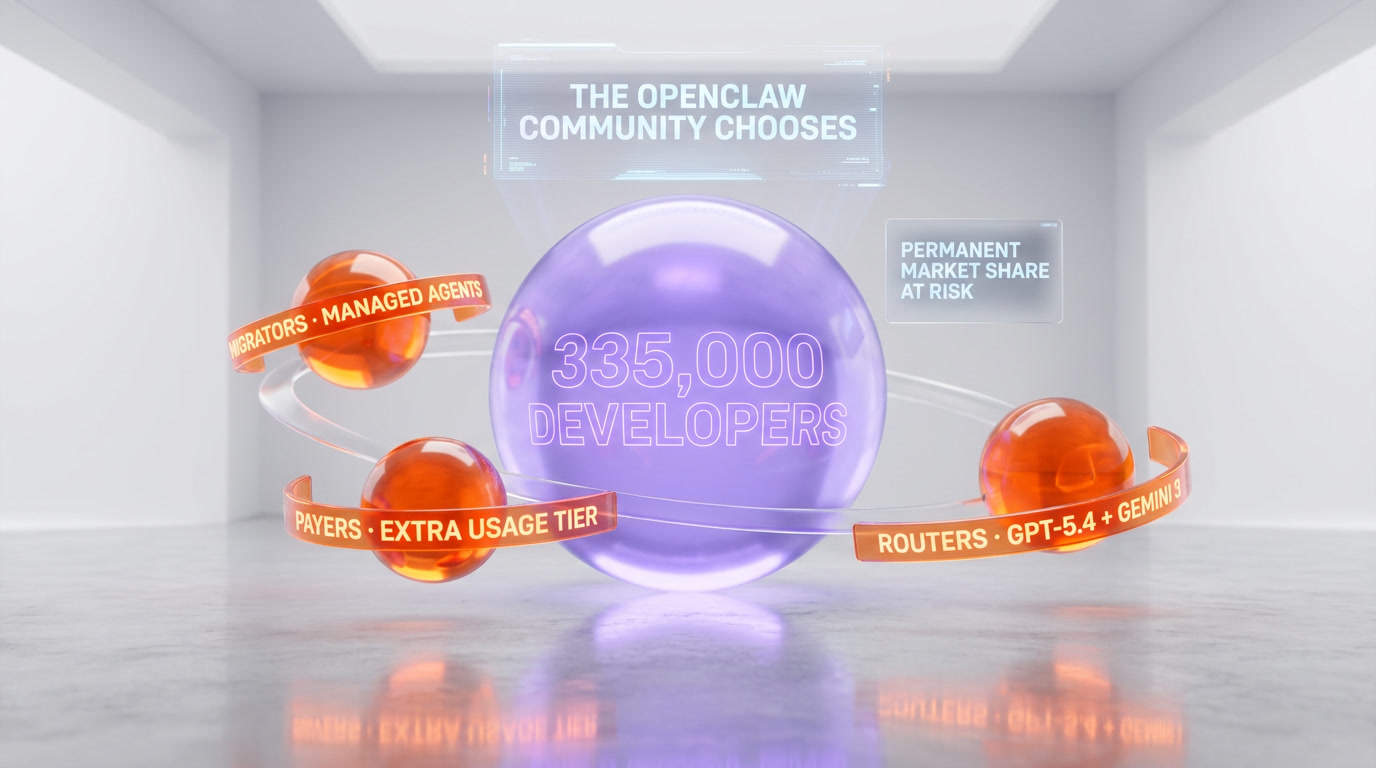
OpenClaw crossed 335,000 registered developers as of early April 2026. Those developers split, roughly, into three camps after the cutoff:
- The migrators. Users who are switching to Managed Agents because it is the path of least resistance and their workload is small enough that the metered pricing is fine. This is probably the largest group by headcount and the smallest by compute consumed.
- The payers. Users who are staying on OpenClaw and paying Anthropic's new "extra usage" tier on top of their Claude subscription. Expensive but workable for teams with committed workflows.
- The routers. Users who are switching OpenClaw to hit GPT-5.4, Gemini 3 or open-weight models instead. This is the group Anthropic should be most worried about, because every defection is permanent market share loss at the model layer.
The wildcard is enterprise. A non-trivial number of Fortune 500 IT departments had standardized on OpenClaw over the last nine months. Those contracts are not easily ripped out, and the April 4 cutoff is almost certainly going to show up as a line item in procurement reviews the next time Anthropic tries to sell into those accounts.
Anthropic's response — or lack of one
Anthropic's public messaging since April 4 has been disciplined and narrow. The official framing is that the cutoff was a cost-control measure, not a competitive move, and that Managed Agents is a response to customer demand for a managed runtime — not an attack on open-source. Anthropic has not directly responded to Steinberger's accusation on the record.
The temporary ban of Steinberger's personal account, reported by TechCrunch on April 10, did not help. Anthropic restored the account without public comment, and there is no public explanation of which policy was violated. Whatever the internal reasoning, the optics of banning the loudest open-source critic four days after launching a product that competes with his project are exactly as bad as they sound.
The company's broader reputation — built on the "safe AI lab" positioning that Dario Amodei and Daniela Amodei have cultivated since 2021 — has real assets to draw on here. Anthropic has been the frontier lab most willing to publish research on model safety, alignment and interpretability. That reputation is not going to evaporate over a single commercial move. But commercial moves accumulate, and the April 4 to April 10 sequence is the first time in the company's history that the commercial instincts have visibly overridden the community instincts.
Our analysis — verdict on the Managed Agents launch

Managed Agents, as a product, is well-built. We have spent the week since launch testing it against a parallel OpenClaw setup on GPT-5.4, and the managed runtime is genuinely easier to deploy, observe and debug. The pricing, for low-volume workloads, is defensible. The SDK is clean. The tracing is better than anything currently in open source. If you had to pick a winner on technical merit alone, Managed Agents is competitive and in several places ahead.
The problem is that the launch did not happen in a vacuum. It happened four days after the single largest cost-shock Anthropic has ever inflicted on its user base, it happened against a project whose creator has publicly and credibly accused the company of copying features before locking the door, and it happened to a community that remembers every previous embrace, extend, extinguish cycle in detail. On reputation, Anthropic took the largest hit it has taken since 2021, and the hit is self-inflicted.
The honest verdict is that Managed Agents is a commercially rational product and a reputationally costly one, shipped at the exact moment that would maximize both. Whether the commercial wins outrun the reputation damage is the question Anthropic has to answer over the next twelve months. Version one of Managed Agents is live today. Version two will tell us whether Anthropic learned anything from the reaction.
Frequently asked questions
What is Anthropic Managed Agents?
Managed Agents is a cloud-based AI agent hosting platform Anthropic launched on April 8, 2026. It is a fully hosted runtime on top of Claude that ships persistent memory, structured tool calling, sandboxed code execution, web browsing with screenshot reasoning, long-running task support, and observability — removing the need for developers to build and run their own agent infrastructure. It is closed-source, Anthropic-hosted, and billed per task, per token and per sandbox-minute.
Why is the OpenClaw creator accusing Anthropic of cannibalizing open-source?
OpenClaw creator Peter Steinberger publicly stated: "Funny how timings match up, first they copy some popular features into their closed harness, then they lock out open source." His claim is that Anthropic watched OpenClaw ship features like persistent memory, tool repair, the browse tool and long-running tasks, re-implemented those same features inside a proprietary Managed Agents runtime, and then used its position as the model provider to cut off the economic oxygen that had been keeping OpenClaw alive — flat-rate Claude Pro and Max subscriptions. The block came on April 4, 2026. The Managed Agents launch came on April 8, 2026.
What happened on April 4, 2026?
At 12:00 Pacific on April 4, 2026, Anthropic cut Claude Pro and Max subscriptions off from third-party agent harnesses including OpenClaw. Roughly 135,000 running OpenClaw instances were affected on day one. Users were redirected to a new pay-as-you-go "extra usage" billing tier on top of their existing Claude subscription. Some users reported cost increases of up to 50 times their previous monthly outlay. Anthropic framed the move as a cost-control measure, noting that a single autonomous OpenClaw agent running for a day could consume $1,000 to $5,000 in API costs under a $200-per-month flat-rate plan.
How does Managed Agents compare feature-by-feature with OpenClaw?
The overlap is nearly one-for-one. Both ship persistent memory across sessions, structured tool calling with retry and repair, sandboxed code execution, web browsing with screenshot reasoning, and long-running autonomous tasks. OpenClaw runs code in user-controlled sandboxes (Docker, Firecracker, E2B) while Managed Agents runs it in Anthropic-operated sandboxes only. Managed Agents ships richer observability and tracing than current OpenClaw — its one clean win on the scorecard. Every other signature OpenClaw capability has an equivalent inside Managed Agents.
What is the "embrace, extend, extinguish" historical parallel?
Embrace, extend, extinguish is a phrase Microsoft used internally in the mid-1990s to describe how to neutralize open standards and open-source competitors. The pattern is to embrace the open project, extend it with proprietary features only available inside your closed platform, then use your platform position to extinguish the original. The textbook cases are Microsoft versus Netscape (1995-1998) and, more recently, Google versus Mozilla (2004-present). The Anthropic versus OpenClaw sequence maps cleanly onto phases one and two of that playbook — phase three, actual extinction, is not guaranteed because OpenClaw can still route to GPT-5.4, Gemini 3, or open-weight models.
How many developers use OpenClaw and what are they doing now?
OpenClaw has more than 335,000 registered developers as of early April 2026. After the April 4 cutoff, those developers are splitting into three groups. The migrators are switching to Managed Agents because it is the path of least resistance. The payers are staying on OpenClaw and paying Anthropic's new extra-usage tier on top of their Claude subscription. The routers are switching OpenClaw to hit GPT-5.4, Gemini 3, or open-weight models instead — the group Anthropic should be most worried about because every defection is permanent market share loss at the model layer.
Did Anthropic really ban OpenClaw's creator?
Yes, temporarily. TechCrunch reported on April 10, 2026 that Anthropic temporarily banned Peter Steinberger's personal Claude account, citing undisclosed policy violations. Anthropic later restored the account without public comment. The ban happened four days after the Managed Agents launch and six days after the OpenClaw subscription cutoff. The optics of banning the loudest open-source critic in that exact window are exactly as bad as they sound, and Anthropic has not publicly explained which policy Steinberger was alleged to have violated.
Is Managed Agents actually good? Should I use it?
On pure technical merit, yes — Managed Agents is well-built. The managed runtime is easier to deploy, observe and debug than running your own OpenClaw stack. The SDK is clean. The tracing is better than anything currently in open source. For low-volume workloads the pricing is defensible. The real question is reputational and strategic: you are betting on a provider that just cut 135,000 instances off its platform on fifteen minutes notice, and that has publicly refused to directly respond to the accusation that it copied open-source features before locking the door. If your workload is locked to Claude and your team values a managed runtime, Managed Agents is a reasonable choice. If your workload can route across GPT-5.4, Gemini 3 and open-weight models, multi-provider OpenClaw is the safer bet.