Update, mid-June 2026: our Bing Web and Microsoft Copilot citations came back on their own. About three weeks after they collapsed to near zero on May 27 and 28, 2026 — with no action from us and no change to the site — they climbed back. Our Bing Webmaster Tools "AI Performance" dashboard now reads 11.5K total citations and 13 average cited pages over the trailing three months, with a clear recovery at the right edge. The recovery is consistent with what we argued in our original report: this was a grounding-index transition on Microsoft's side, not a penalty against our site. Microsoft has still published no incident notice and given no reason. If this happens to you, check your technical fundamentals first, then monitor and wait — but understand that is what worked for us, not a guarantee.
Editorial Disclosure: This is a first-party follow-up written by Anthony Martinez (CEO & Founder, ThePlanetTools.ai). The site discussed is our own. We have no affiliate relationship with Microsoft, Bing, OpenAI, or Google, and we receive no compensation from any of them. The chart below is a real screenshot read straight from our own Bing Webmaster Tools dashboard. We have attributed every third-party claim to its source and flagged clearly where something is observed data versus a hypothesis we cannot prove.The short version
Three weeks ago we published a detailed account of a strange, alarming event: between May 27 and May 28, 2026, ThePlanetTools.ai lost effectively all of its Bing Web search and Microsoft Copilot citation visibility in under 48 hours, while Google kept growing. Nothing had changed on our side since our May 17 deploy, there was no penalty notice, and a full technical audit came back clean. We argued the most likely explanation was not a quality penalty but a serving-side change tied to Microsoft's shift to a "grounding index" — a transition Microsoft itself described in a May 6, 2026 blog post. The full data, sourcing, and reasoning are in that original article.
This is the update we promised. The citations are back. They returned on their own, with nothing changed on our end, roughly three weeks after they vanished. That is the observable fact, and it is the strongest evidence yet for the transition reading we put forward. It is not, by itself, proof of the cause — and we are going to be just as careful about what we still cannot claim as we are about what the data now shows.
The recovery: what our dashboard shows now
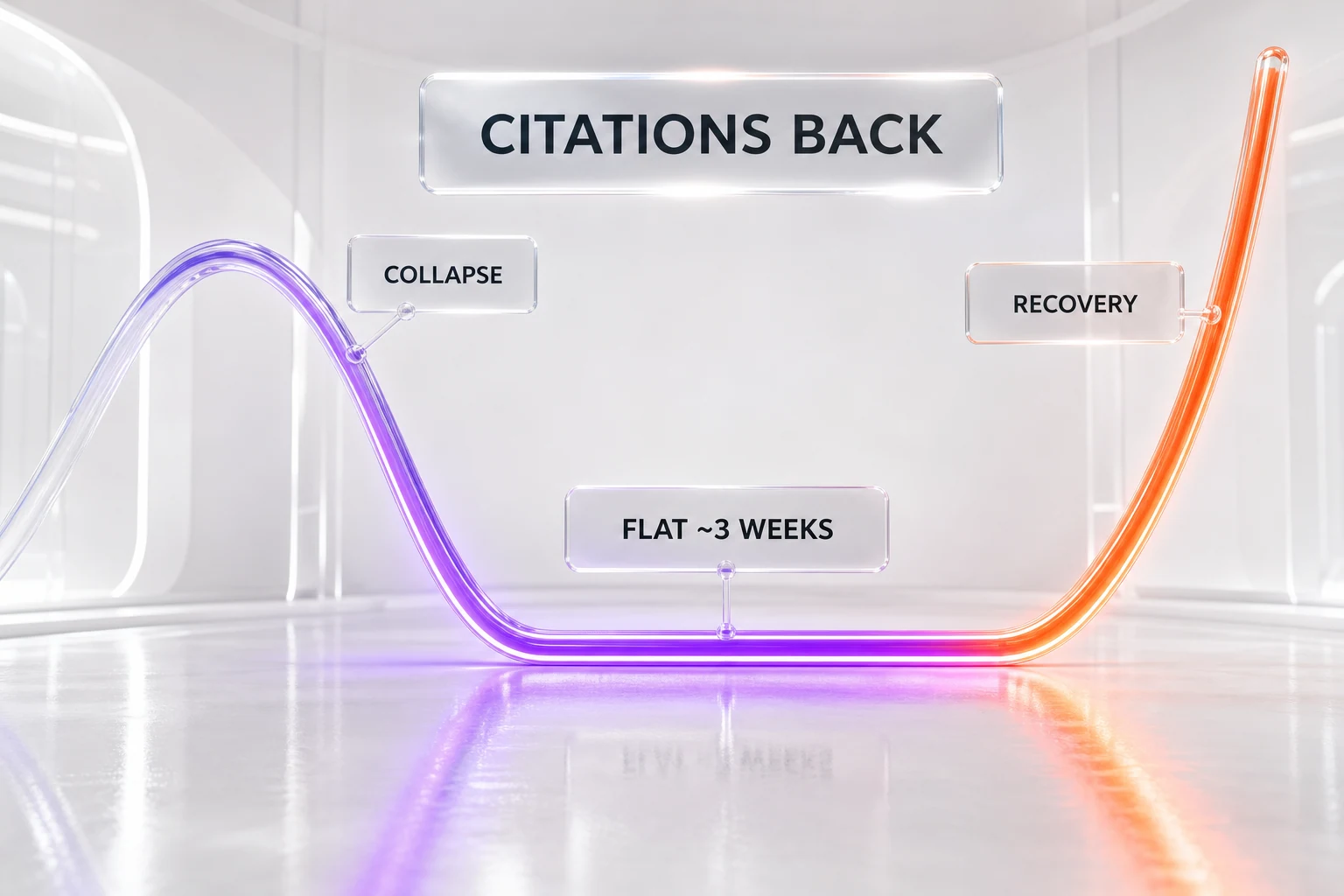
Here is the same Bing Webmaster Tools surface we screenshotted in the original article — the "AI Performance" report, which counts how often Microsoft Copilot and its partners grounded an answer on one of our pages — except now viewed across the full three months that contain the entire episode. The shape tells the whole story in one frame: a gradual climb through April and early May, a peak around May 24 to 26, the cliff in the last days of May, about three weeks flat against the floor, and then a sharp climb back up at the right edge in mid-June. The citation source is labeled "Microsoft Copilots and Partners," and the three-month totals now read 11.5K total citations and 13 average cited pages.
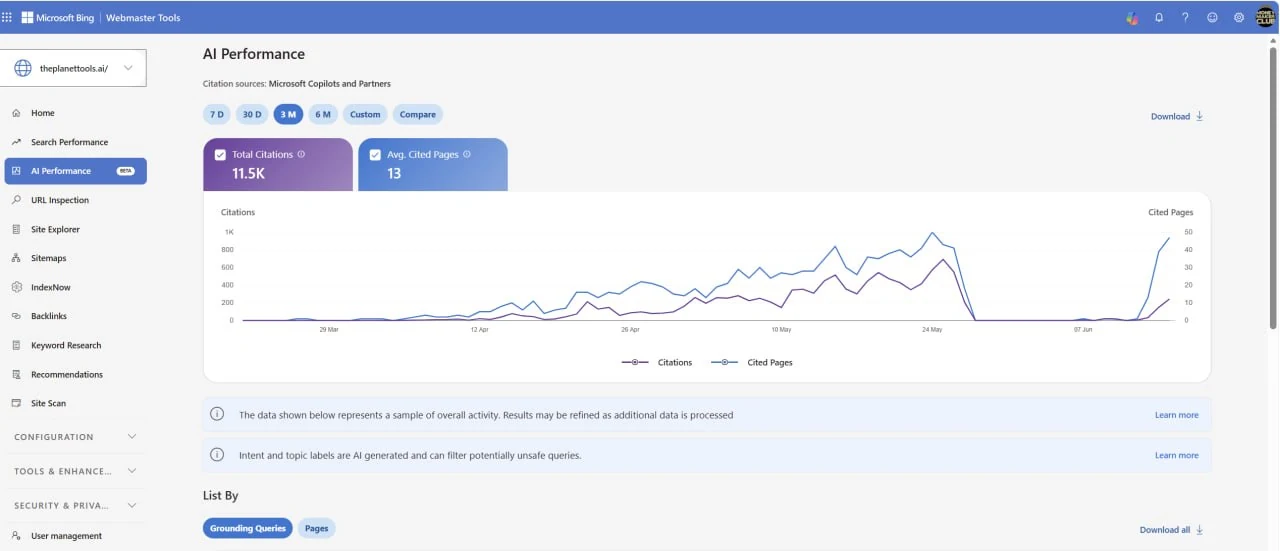
A few honest caveats about reading this chart, because we hold ourselves to the same standard we asked of Microsoft. First, Bing Webmaster Tools states plainly on this very screen that the AI Performance data "represents a sample of overall activity" and that "results may be refined as additional data is processed" — so the precise daily values are estimates that can move. Second, Search Engine Land noted when Microsoft launched this report that the metric only reflects citation frequency and does not indicate ranking, prominence, or how a page contributed to a specific answer (searchengineland.com). So we are not over-reading the absolute numbers. What we are reading is the shape, and the shape is unambiguous: near-total collapse, an extended flat stretch, and a real recovery — not noise, not a refinement artifact, not a seasonal wobble.
To anchor it against the original article: in late May our trailing three-month total sat around 10,850 citations with a Share of Authority near 16%, and then both Bing Web search and Copilot citations dropped to approximately zero across May 27 and 28. The total now reading 11.5K is consistent with three quiet weeks adding almost nothing, followed by a mid-June rebound that resumed the accumulation. The line did not creep back; it snapped back, in the same abrupt way it fell.
Why this supports the grounding-index reading
In the original piece we resisted the easy conclusion that we had been penalized, and we laid out a different reading: that this was a serving-side change during Microsoft's rollout of grounding indexing, not a judgment that our content was bad. A spontaneous recovery, with no intervention from us, is exactly the behavior that reading predicts — and it is hard to square with a quality penalty.
Walk through the logic. A genuine quality or trust penalty does not typically lift itself three weeks later for free; it gets lifted when the underlying issue is fixed or when a human review reverses it. We fixed nothing, because our audit never found anything to fix — robots.txt still allowed Bingbot, pages still returned HTTP 200, there was no stray noindex, canonicals were correct, and the sitemap returned 200 throughout. Google, our control, kept serving and growing our content the entire time, exactly as it did during the crash. So the most economical explanation for a drop and an unprompted recovery on one engine, with the content provably healthy on another, is that the change lived in Bing's serving and grounding layer, not in our pages. That is precisely what Microsoft's own framing allows for: in the May 6 post, the company described keeping "the same crawlers, the same quality signals" while changing the optimization objective, and explicitly introduced "abstention" — the system choosing not to use a source — as "a valid outcome when support is missing, stale, or conflicting." A source toggled out of grounding and later toggled back in fits that model cleanly.
We want to be exact about the strength of this claim, because this is where it is easiest to overreach. The recovery is consistent with, and supports, the grounding-index-transition hypothesis. It does not prove it. We did not get a message from Microsoft saying "the transition completed and your serving resumed," and we never will unless they choose to send one. The honest framing is that the timing of the recovery lines up with our reading better than it lines up with the penalty reading — which raises our confidence without closing the question.
This kind of volatility is documented — we are not unique
One thing that makes our episode easier to interpret is that severe, unexplained swings in Bing and Copilot citations are not unique to us. They are a documented phenomenon, and the clearest public account predates our own crash.
In February 2026, Search Influence published a detailed breakdown of its own Bing AI Performance data titled "Inside Bing's New AI Performance Report: What 20,000 Copilot Citations Taught Us." Their finding was stark: their Copilot citations fell from an average of about 1,520 per day in early December 2025 to roughly 34 per day by February 2026 — what they described as a 97% drop in two months (searchinfluence.com). They could not attribute it to any single cause either, floating possibilities like content aging out of a freshness window, new competing pages entering the index, or Microsoft reweighting how Copilot retrieves sources — all offered as hypotheses, none confirmed by Microsoft. The parallels to our case are obvious: large, abrupt citation movements on Microsoft's AI surface, no clear announced cause, and an operator left to reverse-engineer it from a dashboard.
The point of citing this is not to claim our episodes share a mechanism — Search Influence documented a sustained decline, while we documented a collapse followed by a recovery, and those may be different things entirely. The point is narrower and well-sourced: the Bing and Copilot citation surface is volatile, those swings can be enormous, and they routinely arrive without explanation. Against that backdrop, a healthy site losing and then regaining its citations is a variation on a known pattern, not an anomaly that demands an exotic cause.
What to do if your Copilot citations disappear
Our case ended well, but we are not going to turn "we waited and it came back" into a universal prescription — that would be exactly the kind of unearned advice we criticized in the original article. The defensible version has an order to it, and the order matters because the early days of an incident are when people make their worst, most panicked changes.
First, rule yourself out. Before you assume this is happening to you and not because of you, verify the fundamentals, because a self-inflicted cause needs a different fix entirely. Check that your robots.txt has not started blocking Bingbot or other AI crawlers such as PerplexityBot. Confirm your pages return HTTP 200 and that no noindex directive slipped in during a recent deploy. Confirm your canonical tags are correct and your sitemap still returns 200. Check that a web application firewall or bot-mitigation rule has not begun challenging or blocking Bingbot. If any of these is broken, that is your problem and your fix — and no amount of waiting will solve it.
Second, if the fundamentals are clean, monitor and wait — but monitor actively. If your site is technically healthy and, like ours, still performing on an independent engine such as Google, then the evidence points away from a self-inflicted cause and toward a serving-side change you cannot directly control. In that situation patience is rational, but it should be instrumented patience: watch your Bing Webmaster Tools AI Performance and Search Performance reports, and keep an eye on whether other engines are affected. For us, the recovery took about three weeks. We are reporting that as our timeline, not as a rule — there is no guaranteed window, and a different incident could resolve faster, slower, or not on its own at all.
Third, you can still escalate in parallel. Waiting and opening a Bing Webmaster Support ticket are not mutually exclusive. As we documented originally, a human, domain-level review is the one channel that has demonstrably lifted serving suppressions in other cases, and there is no downside to requesting one early while you also monitor. What we cannot tell you is whether a ticket helps — which brings us to the part we are least certain about.
What we still do not know
The recovery did not come with an explanation, and we are not going to manufacture one. Here, precisely, is the edge of what our data can support.
We do not know what caused the recovery. We did open a Bing Webmaster Support ticket during the outage, as we said we would. But we cannot claim Microsoft restored our citations because of that ticket, or that anyone reviewed our domain and reversed a decision on our behalf — we received no such confirmation. Whether the recovery was the natural end of the grounding-index transition settling down, a backend fix unrelated to us, the resolution of our support request, or some combination, we cannot attribute with certainty. The recovery coincided with mid-June; that is all the data licenses us to say. To assert that "Microsoft acted on our ticket and restored us" would be exactly the kind of unsupported causal claim we have been careful to avoid.
We also do not know whether it will hold, or whether it could happen again. A surface that can drop a healthy site to zero without notice can presumably do it again, and the recovery does not immunize us. And Microsoft has still published no public incident report, no acknowledgment of a May 2026 wave of citation losses, and no guidance for affected site owners. The transparency gap we described in the original article is exactly as wide today as it was three weeks ago — the only thing that changed is that, for us, the lights came back on. Other operators in the same situation still have no documented, official path and no stated reason, and that is the part of this story that is genuinely unresolved.
What would change our read
We hold this update as loosely as we held the original analysis. If Microsoft published an incident report or guidance attributing May 2026 citation losses to a specific cause, we would adopt that cause over our hypothesis, whatever it turned out to be. If our citations collapsed again on the same site without any change from us, that would strengthen the "volatile serving layer" reading and weaken any notion that the first drop was a one-time transition artifact. If a Bing Webmaster Support response had explicitly identified a reason and a remediation, we would have published that reason here instead of this section — we did not get one. What we are confident about is narrow and evidence-backed: the citations fell, they stayed down for about three weeks, and they returned on their own, with our site healthy and growing on Google throughout. The why is still open, and we would rather say that clearly than fill the gap with a tidy story we cannot defend.
Did this happen to you — and did it come back? Email us at contact@theplanettools.ai. We are still pooling cases, and recovery stories are the most useful of all: tell us how long your citations stayed down, whether you opened a support ticket, and what, if anything, you changed. The more drop-and-recovery timelines we collect, the clearer the real picture gets for everyone watching this surface.
Frequently asked questions
Why did our Bing and Copilot citations drop?
We cannot state the cause with certainty, and Microsoft never gave one. Over May 27 and 28, 2026, our Bing Web search and Microsoft Copilot citations fell to near zero in under 48 hours, while Google kept growing and our technical audit was clean. Our best-supported reading, laid out in our original report, is that this was a serving-side change tied to Microsoft's shift to a "grounding index" rather than a penalty against our content. That remains a hypothesis consistent with the data, not a confirmed cause.
Did the citations come back on their own?
Yes. About three weeks after the collapse, in mid-June 2026, our Bing and Copilot citations recovered with no change on our side. Our Bing Webmaster Tools AI Performance dashboard, viewed over three months, shows the late-May cliff, roughly three weeks flat near zero, and a sharp climb back at the right edge, with three-month totals of 11.5K citations and 13 average cited pages. The recovery is observable in the data; the cause of it is not something we can attribute with certainty.
Was it a penalty?
The evidence argues against a quality penalty. There was no manual action notice and no stated reason, our full technical audit was clean, Google grew its impressions through the same window, and the citations recovered on their own without us fixing anything — which is not how a genuine quality penalty typically resolves. We read it as a serving-side change during Microsoft's grounding-index transition, not a judgment that our content was bad. We cannot prove that, but a spontaneous recovery fits it far better than it fits a penalty.
What should I do if my Copilot citations disappear?
Check your fundamentals first: confirm robots.txt is not blocking Bingbot or PerplexityBot, that pages return HTTP 200, that no accidental noindex slipped in, that canonicals are correct, that your sitemap returns 200, and that a firewall or bot rule is not blocking Bingbot. If all of that is clean and you are still healthy on an independent engine like Google, monitor your Bing Webmaster Tools reports and wait — for us it took about three weeks — while optionally opening a Bing Webmaster Support ticket requesting a human, domain-level review. Waiting worked for us; it is not a guaranteed fix for everyone.
Did Microsoft restore your citations because of your support ticket?
We cannot claim that. We did open a Bing Webmaster Support ticket during the outage, but we received no confirmation that anyone reviewed our domain or reversed a decision for us. Whether the recovery was the grounding-index transition settling, an unrelated backend fix, the resolution of our ticket, or a combination, we cannot attribute with certainty. The recovery coincided with mid-June; that is the limit of what our data supports.
Is this volatility unique to our site?
No. Large, unexplained swings in Bing and Copilot citations are documented. Search Influence reported its own Copilot citations falling from about 1,520 per day in early December 2025 to roughly 34 per day by February 2026, which it described as a 97% drop in two months, with no cause confirmed by Microsoft. Our episode — a collapse followed by a recovery — is a variation on a known pattern of abrupt, unexplained movement on this surface, not a one-off anomaly.
Has Microsoft explained the May 2026 citation losses?
No. As of this update, Microsoft has published no incident report, no acknowledgment of a May 2026 wave of citation losses, and no guidance for affected site owners. The only official context is the May 6, 2026 blog post describing the move to a grounding index, which does not mention domain age or site authority as criteria. The transparency gap we flagged originally is unchanged; the only thing that changed for us is that the citations returned.
Should I trust the exact numbers in the AI Performance report?
Treat them as estimates of shape, not precise counts. Bing Webmaster Tools states on the AI Performance screen that the data represents a sample of overall activity and that results may be refined as additional data is processed, and Search Engine Land noted at launch that the metric reflects citation frequency only — not ranking, prominence, or how a page contributed to an answer. We rely on the unmistakable shape of our curve — collapse, flat, recovery — rather than on any single day's value.