Update — June 19, 2026: Resolution to this story. About three weeks after the collapse, our Bing & Copilot citations recovered on their own — nothing changed on our side, exactly what the grounding-index reading below predicted. Full data and the recovery dashboard: Our Bing & Copilot citations came back on their own — what the recovery proves.
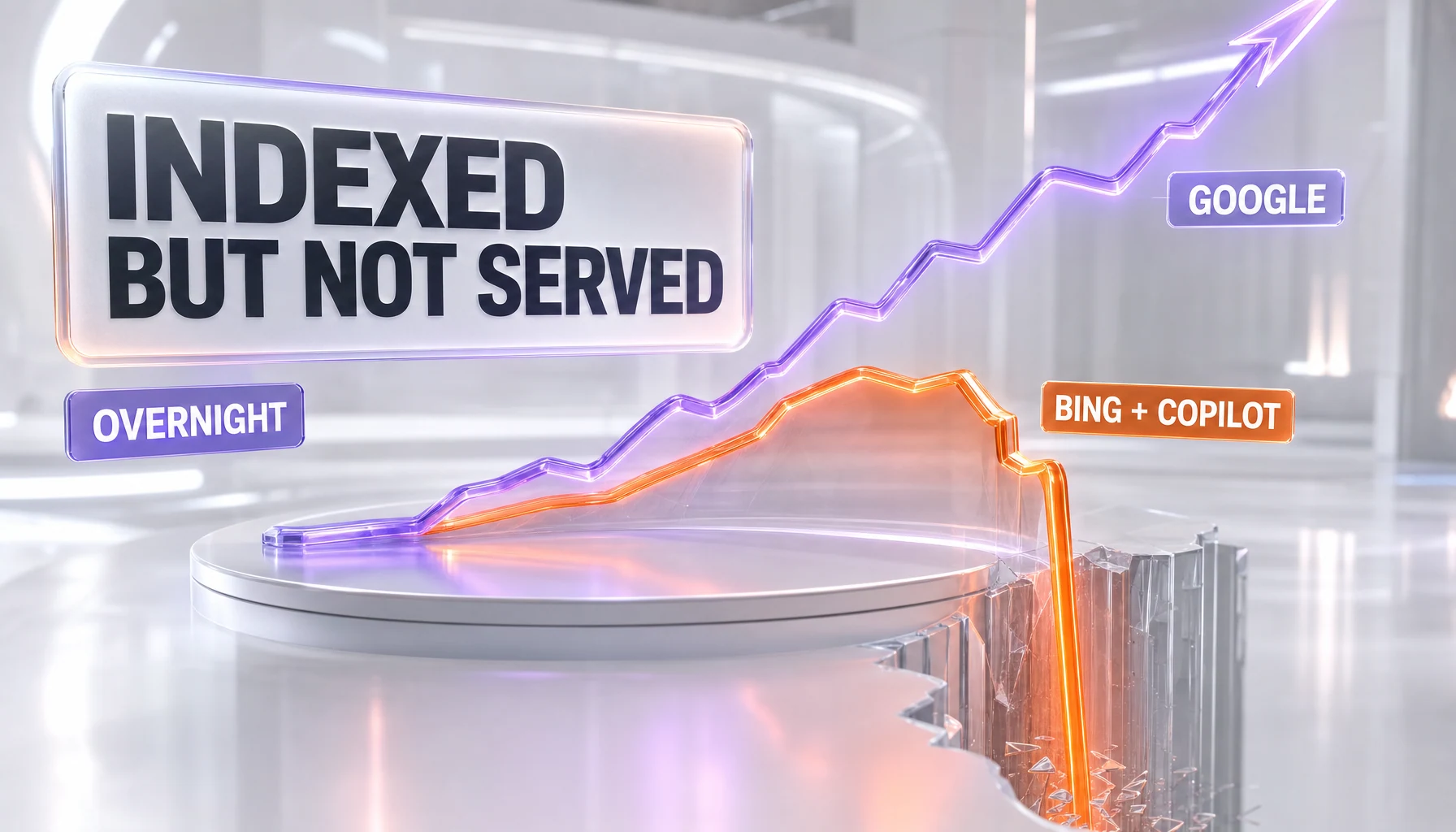
Full disclosure: this is our own site. Between May 27 and May 28, 2026, ThePlanetTools.ai lost effectively all of its Bing Web search and Microsoft Copilot citation visibility in under 48 hours — Bing Web impressions fell from a peak near 847 per day to 13, and Copilot AI citations dropped from roughly 700 per day to about zero. Over the same window, our Google Search Console traffic kept growing. Nothing changed on our side between our last deploy on May 17 and the crash, and a full technical audit came back clean. This is what the data shows, what Microsoft has officially changed about its index, and what — based on documented cases — actually helps you recover.
Editorial Disclosure: This is a first-party analysis written by Anthony Martinez (CEO & Founder, ThePlanetTools.ai). The site discussed is our own. We have no affiliate relationship with Microsoft, Bing, OpenAI, or Google, and we receive no compensation from any of them. The numbers below are read directly from our own Bing Webmaster Tools and Google Search Console dashboards. We have attributed every third-party claim to its source and flagged clearly where something is a hypothesis rather than a fact.What happened, in one paragraph
ThePlanetTools.ai is a young site — first indexed on March 19, 2026, roughly two and a half months old at the time of the event. Through late May it was performing well across Microsoft's surfaces: real Bing Web search clicks, and thousands of Copilot AI citations. Then, over May 27 and 28, both collapsed to near zero. Google, which we use here as a control, did not flinch — it kept growing through the same period. We did not change anything between our last deploy on May 17 and the drop. There was no manual penalty notification, no message in Bing Webmaster Tools, no reason given. The pattern matches a documented behavior that Microsoft staff and other site owners call "indexed but not served": the pages stay crawlable and still show as indexed, but they stop being served.
The cliff: what our dashboards show
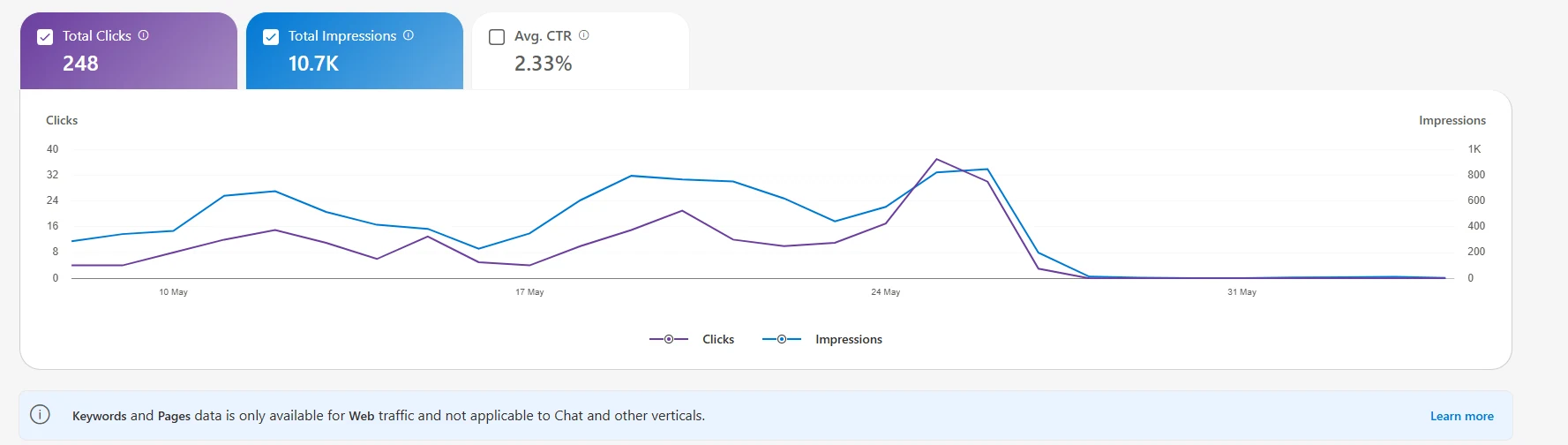
Here is the Bing Web search side first. Our Bing Web impressions peaked near 847 per day on May 25–26. On May 27 they fell to 199. On May 28 they hit 13 impressions and zero clicks, and then flatlined at 1 to 12 per day for the rest of the period. Across the full window, Bing Web search delivered 248 clicks and 10,700 impressions, a 2.33% click-through rate. That is not the curve of a slow decline or a seasonal dip. It is a cliff.
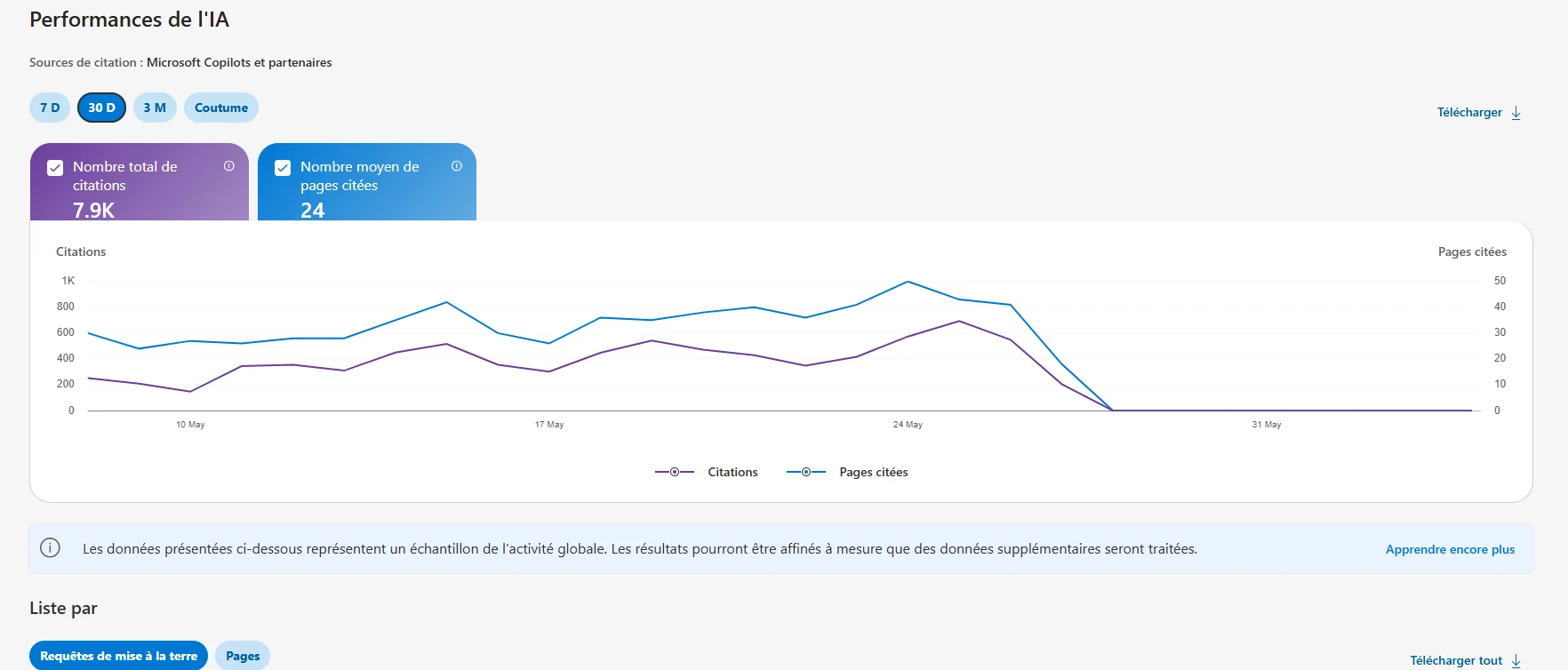
The AI side tells the same story. Our Microsoft Copilot citations — the count of times Copilot grounded an answer on one of our pages — ran near a peak of roughly 700 per day, totaling about 7,900 over the trailing 30 days and 10,850 across three months. Those citations dropped to approximately zero on May 27. Both surfaces, Web search and AI grounding, went dark within the same 48-hour window. That simultaneity matters: it is consistent with a single domain-level change on Microsoft's side, not two unrelated problems.
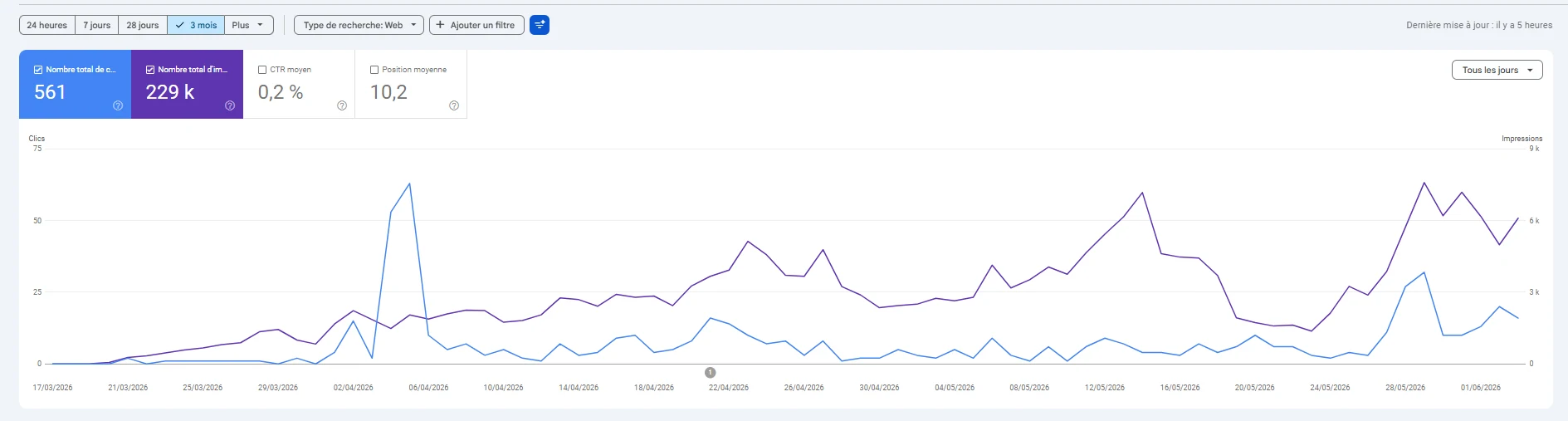
Now the control. On Google, the same site pulled 561 clicks and 229,000 impressions over three months, and it was growing, not shrinking, through the exact window of the Bing crash. Google impressions ran 3,867 on May 27, rose to 7,597 on May 29, and held near 6,000 per day into early June, at an average position of 10.2. If our content had suddenly become low quality, spammy, or technically broken, Google would not have rewarded it with rising impressions at the same moment Bing zeroed us out. The divergence is the whole point.
We also ran a full technical audit, because the obvious first suspicion is always self-inflicted. The audit came back clean. Our robots.txt allows Bingbot with Allow: /. Pages return HTTP 200. There is no noindex directive anywhere it should not be. Canonical tags are correct. The sitemap returns 200. The last deploy was May 17, ten days before the crash, and we changed nothing between that deploy and the drop. So we are left with a site that Google likes more by the day, that is technically healthy, and that Bing and Copilot stopped serving overnight without explanation.
We were dominant on Bing first — this matters
If the loss were the correction of a thin, low-trust site that never belonged in the index, the story would be different. It is not. Before the crash, our content was not just present on Microsoft's AI surfaces — it was winning specific topics outright. Across three months our pages accumulated roughly 10,850 Copilot citations and held a Share of Authority between 16.11% and 16.18%. For a two-and-a-half-month-old site, on Microsoft's own AI grounding surface, that is a strong position, not a marginal one.
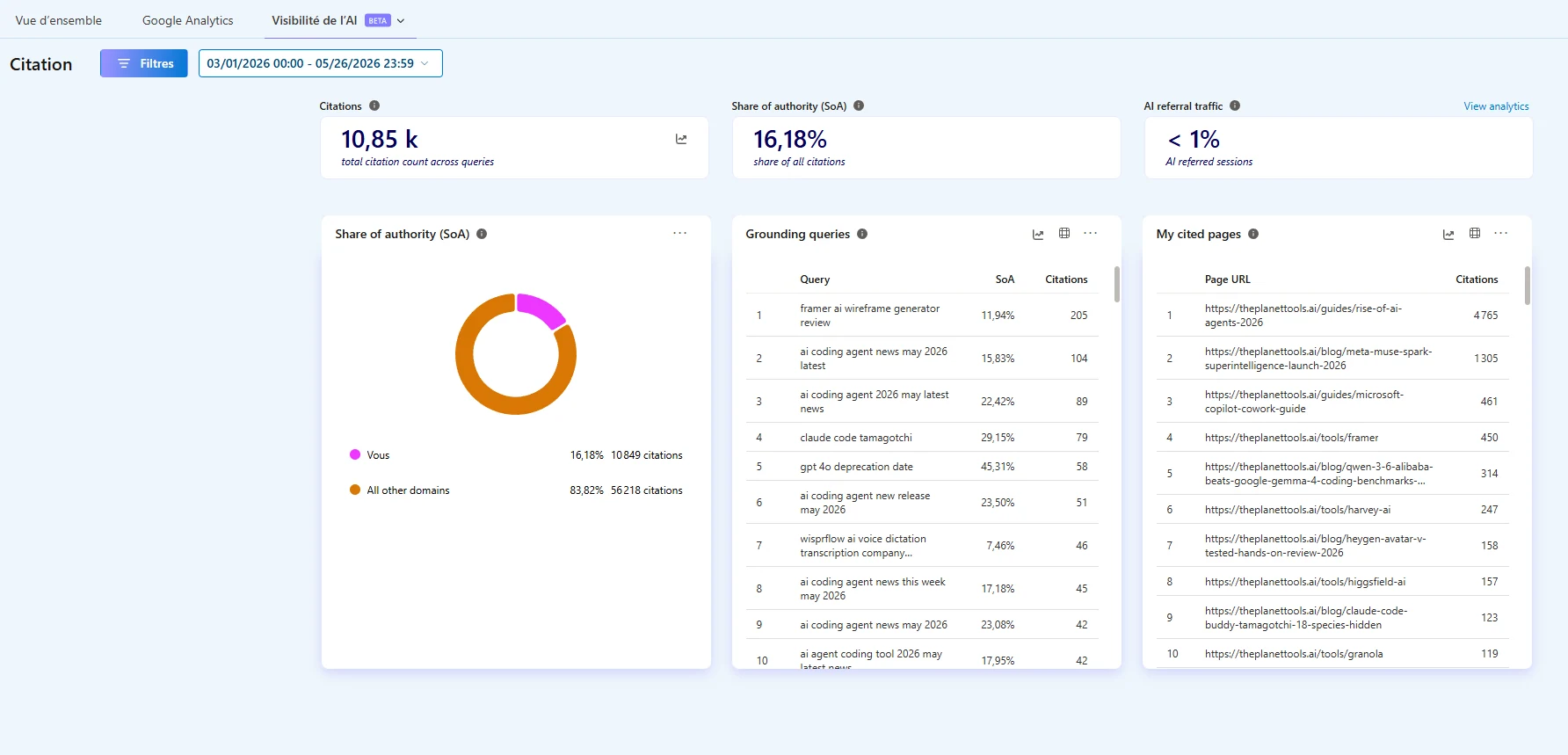
Drilling into the query-level detail makes it concrete. We held a 45.31% Share of Authority on "gpt 4o deprecation date" — meaning that on that grounding query, Copilot leaned on our page nearly half the time. We sat around 12% on "framer ai wireframe generator review" and between 15% and 23% on "ai coding agent news may 2026." Our single most-cited page, our guide on the rise of AI agents in 2026, drew roughly 4,400 citations on its own. Our AI referral share ran 6.72% across three months before the crash and fell below 1% in the post-crash portion of May. These are the metrics of a site Microsoft's own systems had judged worth grounding on — repeatedly, across many distinct queries — right up until it stopped.
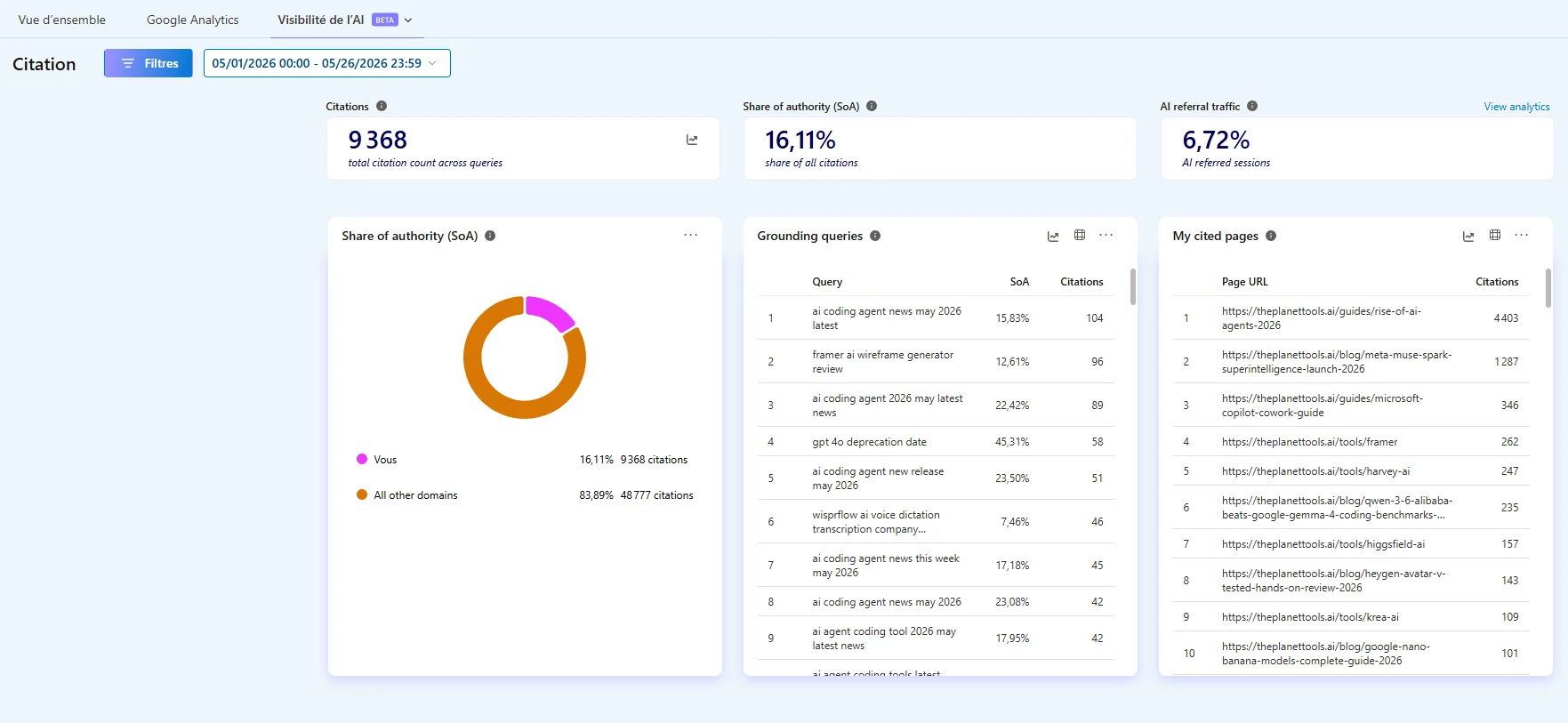
We are laying this out not to brag about the numbers — they are modest in absolute terms — but to rule out the simplest explanation. A site that was earning a double-digit Share of Authority on Microsoft's AI surface, across diverse queries, days before going dark is not a quality problem that quietly resolved itself. Something changed on the serving side, not on the content side.
You are not alone: a pattern of sudden Bing losses
What kept us from concluding "this is just us, we did something wrong" was finding that we are part of a documented pattern. Several other site owners have reported the same shape of event — sudden, Bing-only, with Google unaffected, and with no explanation.
In mid-May 2026, the operators of wow.gg reported losing more than 95% of their Bing visibility in a single night. It was Bing-only; their Google traffic was fine. They described it with the same phrase that fits our case — "indexed but not served" — and reported that Microsoft declined to open a case for them. Their thread is on Microsoft's own Q&A platform (learn.microsoft.com/en-in/answers/questions/5907704).
This is not new to 2026 either. In late January 2026, Neocities — the indie web host — saw roughly 1.5 million of its hosted sites delisted from Bing. Founder Kyle Drake documented it, and the episode was picked up by Windows Central and Ars Technica. Earlier still, in March 2026, the operators of HealthCore.org.uk reported a similar situation; in that thread, a Microsoft adviser characterized the behavior as "algorithmic suppression: indexed but not visible... withheld from public results when quality, trust, or other policy signals are insufficient" (learn.microsoft.com/en-au/answers/questions/5817236).
The most precise description we found of the mechanism came from a Microsoft staff member, posting as Alex-L on the Q&A platform, who described "a domain-level serving suppression (often called soft deindexing)... pages can remain crawlable and even appear 'indexed' in Bing Webmaster Tools, but are algorithmically excluded from being served... can be triggered by Bing-side quality or trust re-evaluations, even if nothing changed on your site... Only an internal Bing review can lift it." That last sentence is the operationally important one, and we will come back to it. There is also a community-maintained GitHub tracker, "not-awesome-bing-bans-and-deindexing," cataloging 14 legitimate sites banned between 2019 and 2026 — small, but a useful record that this is a recurring class of event, not a one-off.
A note on what we are deliberately not repeating. Some SEO blogs have circulated a "Low-Trust Cluster" narrative with a specific "23% lift" figure attached. We could not source that to Microsoft or to any verifiable data, so we are not adopting it. We are also not conflating our case with a routine "ranking update" or with ordinary Google ranking volatility; those are different phenomena. What we can say, sourced, is that the "indexed but not served" / soft-deindexing pattern is real, recurring, and described in those exact terms by Microsoft staff and other affected operators.
What Bing officially changed
On May 6, 2026 — three weeks before our crash — Microsoft published a post on the Bing blog titled "Evolving role of the index: From ranking pages to supporting answers," authored by Krishna Madhavan, Knut Risvik, and Meenaz Merchant (blogs.bing.com). It is the clearest statement we have of how Microsoft now thinks about its index, and it reframes the entire purpose of indexing.
The core reframing, in Microsoft's words: "Traditional search asks: which pages should a user visit? Grounding asks: what information can an AI system responsibly use to construct a response?" And: "search indexing was built to help humans decide what to read. Grounding indexing is being built to help AI systems decide what to say." The consequence Microsoft draws is blunt — "the unit of value shifts from documents to groundable information."
Crucially, Microsoft says the crawling layer is unchanged while the selection layer is not: "the same crawlers, the same quality signals... the optimization problem is not." In other words, your pages get fetched the same way, but what the system decides to do with them — whether to serve or ground on them — runs on a different objective. The post lists the criteria a grounding index optimizes for: Factual Fidelity, Source Attribution, Freshness (with the warning that "Stale facts can directly produce wrong answers"), Contradiction Detection, and High-Value Coverage. And it introduces a behavior that did not exist in classic search: "Abstention is a valid outcome when support is missing, stale, or conflicting." The system can now choose to say nothing rather than serve a weak source.
One omission is important enough that we will state it explicitly: the blog post does not mention domain age, and it does not mention site authority as a grounding criterion. That absence has been noted independently by Search Engine Land in its coverage of Microsoft's grounding index (searchengineland.com). We flag it because it is central to the contradiction we are about to describe.
The contradiction
Here is where the policy and our reality diverge. Read Microsoft's stated grounding criteria against our content. Factual Fidelity — our pages are factual, sourced, and we correct them. Source Attribution — we attribute. Freshness — we publish frequently; our content is current, which is precisely why Google's impressions were rising. Contradiction Detection — we are not publishing content that conflicts with itself. High-Value Coverage — Microsoft's own systems had ranked us at a 16% Share of Authority days earlier, which is the system telling us our coverage was high-value. On the published criteria, we appear to check every box. And yet the serving stopped.
That leaves an uncomfortable gap, and the honest thing is to name what we know and what we do not. What we know: Bing stopped serving and grounding our healthy, freshly indexed, Google-approved site without notification or stated reason, during the rollout window of a major index transition. What we do not know: why.
The leading explanation among analysts is that authority — site-level reputation, the kind of signal classic SEO has always optimized — has become a gatekeeper for grounding. Niara frames it this way: traditional ranking signals "act as a 'gatekeeper'... If your site doesn't have the authority to get into the traditional index, it's highly unlikely it will be used for grounding." SEOwithSiva puts the practical version more bluntly: "You cannot opt out of traditional SEO and only do GEO." We find this hypothesis plausible and worth taking seriously. But it is a hypothesis from analysts, not a criterion Microsoft has announced — and it is the analysts' read, not Microsoft's policy.
And we want to be very precise about one thing, because it is the easiest place to overreach. The idea that a young, fast-rising domain is being punished specifically for its age is documented by no one — not by Microsoft, and not by the analysts. Microsoft does not document any domain-age criterion for grounding. Whether young or rapidly-growing domains are disproportionately affected is an open question raised by analysts, not an announced policy and not a demonstrated fact. We are a young site that got hit; that is a data point, not a mechanism. We will not assert the age theory as if it were established, and neither should anyone citing this article.
The real lesson: concentration risk
Set aside the question of cause for a moment, because there is a structural lesson here that holds regardless of why this happened. A surprising amount of AI answer visibility runs through one index, and that index is Bing's.
Microsoft Copilot is the most direct case: it depends on Bing, and our own Copilot citation data confirms it crashed in lockstep with our Bing Web search. There is no ambiguity there — when Bing stopped serving us, Copilot stopped citing us.
The Azure side is more nuanced but points the same direction. In a June 2026 post, Microsoft described its Web IQ product as built on Bing's foundation: "Web IQ starts from the foundation... the Bing global index and ecosystem" (blogs.bing.com). Microsoft's own announcement does not name ChatGPT or OpenAI. The broader claim — that Web IQ powers both Copilot and ChatGPT — comes from press coverage by TechTimes and PPC Land, not from a Microsoft or OpenAI confirmation, so we attribute it as exactly that: according to TechTimes and PPC Land, while Microsoft does not name OpenAI in its announcement.
ChatGPT's relationship to Bing is real but partial. OpenAI confirmed in October 2024 that ChatGPT's web browsing was historically built on Bing. But OpenAI now operates its own crawler, OAI-SearchBot, and its dependence on Bing has been declining. So the honest framing is: losing Bing is a genuine risk to ChatGPT web visibility, but it is not a guarantee of losing it. We will not write "dropped from Bing equals dead on ChatGPT" as a fact, because it is a risk, not a certainty.
The defensible conclusion is about diversification, not doom. The surfaces that do not depend on Bing's index are the ones that kept working for us: Google AI Overviews and Gemini run on Google's index, which stayed healthy; Perplexity runs its own crawl; and Claude runs its own crawl. If your AI visibility strategy routes entirely through Bing-dependent surfaces, a single domain-level serving change can take all of it at once. Spreading across independent indexes is the structural hedge.
How hard we looked — and what we audited
Before we wrote a word of this, we tried to fix it, exhaustively. This is an AI tools publication, so we did what we do: we launched our full agent stack — 72 parallel research agents — at the open web, to find a documented, repeatable fix for a Bing "indexed but not served" collapse, and to find anyone who had recovered from one. They combed forum threads, Microsoft Q&A pages, SEO post-mortems, GitHub trackers, and vendor documentation across every phrasing of the problem we could build.

In parallel, we audited ourselves harder than any outside reviewer would. We ran our full technical and GEO audit stack against the site — checking structure, indexability, canonical and robots configuration, content-quality signals, and ranking health from every angle. The result was the same everywhere: nothing. No broken structure, no penalty signal, no quality cliff, no misconfiguration.
That is the unsettling part. The agents surfaced no official Microsoft remediation guide, no self-serve button, no automated trick that lifts a serving suppression — only a scatter of other operators in the same situation, and one documented recovery path: a human, domain-level review through Bing Webmaster Support. Our own audit came back clean. We looked everywhere, with everything we have, and the problem is precisely that there is no problem we can find. A healthy site simply stopped being served.
What to do if this happens to you
We separate this into what is documented to work, what does not work on its own, and what is merely speculative for this specific problem — because conflating them wastes the precious early days of an incident.
What is documented to work: open a ticket with Bing Webmaster Support and explicitly request a human, domain-level review, citing the phrase "indexed but not served." This is the channel that has actually lifted suppressions. The clearest documented case is the bitdoze / wpdoze incident: the operator submitted a support ticket on July 25, got a response on August 9 — roughly two weeks — and Microsoft acknowledged "a bug on their end" and reindexed the site (bitdoze.com). The Alex-L description above lines up with this: "Only an internal Bing review can lift it." The lever is a human review request, not an automated re-submission.
What does not work on its own: IndexNow, re-submitting your sitemap, and forcing a recrawl through URL Inspection. These are the reflexive first moves, and for this specific class of problem they do not lift a serving suppression — confirmed both by Microsoft staff and in the wpdoze account. The pages were never the issue; the serving decision was. Pinging the crawler does not change a serving decision.
What is speculative for this problem: "build authority and backlinks" and "wait for the rollout to settle." Both might help over a longer horizon if the authority-gatekeeper hypothesis is correct, but neither is documented to resolve an active suppression, and we are not going to present them as a fix. One more caution: do not go looking for a "Report a Concern" button to escalate this — we could not confirm such a path exists for this issue. The confirmed channel is a Bing Webmaster Support ticket.
And while you wait on a review, lean on the indexes that did not break. For us, Google (and therefore Google AI Overviews and Gemini), Perplexity, and Claude kept serving our content throughout. They are the independent refuges when one index goes dark.
What would change our read
We hold this analysis loosely, and we will say plainly what would move us off it. If Microsoft published guidance documenting a domain-age or site-maturity factor in grounding selection, we would update — right now no such criterion is documented, and we have been careful not to invent one. If a Bing Webmaster Support review restored our serving and the response identified a specific cause, we would publish that cause here, whatever it is, including if it turns out we did something wrong after all. If the pattern reversed and our Bing visibility returned on its own during the rollout, that would point toward transition turbulence rather than a deliberate suppression, and we would say so. And if a credible, sourced explanation emerged that contradicts the soft-deindexing read — from Microsoft or from rigorous third-party analysis — we would revise. What we are confident about is narrow and evidence-backed: the loss was real, it was Bing-only, our site was healthy and growing on Google, and no reason was given. The why is still open.
The frustration here is real, but it is aimed at one thing specifically: the absence of notification, the absence of a stated reason, and the absence of a clear self-serve recourse during a major index transition. We are not questioning Microsoft's right to evolve its index — the move from ranking pages to grounding answers is a legitimate and arguably necessary shift. What we are asking for is transparency: tell site owners when serving is suppressed, tell them why, and give them a documented path back that does not require finding a staff member in a community forum to learn the magic phrase. That is a reasonable ask, and it would cost Microsoft very little.
This happened to you? Email us at contact@theplanettools.ai — we are pooling what works, and we will keep this article updated as we (and you) find solutions. If you got a serving suppression lifted, tell us how long it took and what you said in the ticket. The more cases we collect, the clearer the recovery path gets for everyone.
Frequently asked questions
Was the site penalized by Bing?
There was no manual penalty notification and no stated reason. The site stayed crawlable and still showed as indexed in Bing Webmaster Tools, but stopped being served — a pattern Microsoft staff describe as "soft deindexing." Two signals argue against a real quality penalty: Google grew its impressions through the same window (3,867 on May 27 to 7,597 on May 29), and our full technical audit was clean (robots.txt allows Bingbot, HTTP 200, no noindex, correct canonicals, sitemap 200).
Did Bing give a reason for the drop?
No. There was no message in Bing Webmaster Tools, no manual action notice, and no explanation. The drop happened over May 27–28, 2026, with no change on our side since the May 17 deploy. The absence of any stated reason is one of our central criticisms.
Is it just our site, or are others affected?
Others are affected. wow.gg reported losing more than 95% of its Bing visibility in one night in mid-May 2026 (Bing-only, Google fine, "indexed but not served," and Microsoft declined to open a case). Neocities had roughly 1.5 million sites delisted in late January 2026. HealthCore.org.uk reported a similar event in March 2026. A GitHub tracker, "not-awesome-bing-bans-and-deindexing," lists 14 legitimate sites banned between 2019 and 2026.
Does this also hit ChatGPT?
Partially. Microsoft Copilot depends directly on Bing, and our Copilot citations crashed in lockstep with Bing Web search, dropping to near zero around May 27. ChatGPT's web browsing was historically built on Bing (OpenAI confirmed this in October 2024), but OpenAI now runs its own OAI-SearchBot crawler and its Bing dependence is declining — so losing Bing is a real risk to ChatGPT visibility, not a guarantee of losing it.
How do you recover from "indexed but not served"?
The documented path is to open a Bing Webmaster Support ticket and explicitly request a human, domain-level review, citing the phrase "indexed but not served." In the documented bitdoze/wpdoze case, the operator submitted a ticket on July 25, got a response around August 9 (about two weeks), and Microsoft acknowledged a bug on its end and reindexed the site. A Microsoft staff member (Alex-L) put it directly: "Only an internal Bing review can lift it."
Does IndexNow fix it?
No. IndexNow, re-submitting your sitemap, and forcing a recrawl through URL Inspection do not lift a serving suppression on their own — confirmed by Microsoft staff and in the wpdoze account. The pages were never the problem; the serving decision was, and pinging the crawler does not change a serving decision.
Is this because the site is young?
That is not documented. Microsoft does not document any domain-age criterion for grounding, and the May 6, 2026 grounding-index blog post does not mention domain age or authority. Whether young or fast-rising domains are disproportionately affected is an open question raised by analysts — not an announced policy and not a demonstrated fact. Our site being young and getting hit is a data point, not a proven mechanism.
What does "indexed but not served" mean?
It describes a domain-level serving suppression — sometimes called soft deindexing. Per a Microsoft staff description: pages "can remain crawlable and even appear 'indexed' in Bing Webmaster Tools, but are algorithmically excluded from being served," and this "can be triggered by Bing-side quality or trust re-evaluations, even if nothing changed on your site." The page exists in the index; the system simply stops serving it.
Is Google affected?
No. Google is our control, and it kept growing through the Bing crash. Over three months Google delivered 561 clicks and 229,000 impressions at an average position of 10.2, with impressions rising from 3,867 on May 27 to 7,597 on May 29 and holding near 6,000 per day into early June. This is the strongest evidence that the content itself is healthy.
What is Bing's grounding index?
On May 6, 2026, Microsoft described a shift from a search index (which "asks: which pages should a user visit?") to a grounding index (which "asks: what information can an AI system responsibly use to construct a response?"). It uses "the same crawlers, the same quality signals," but the goal changes — it optimizes for Factual Fidelity, Source Attribution, Freshness, Contradiction Detection, and High-Value Coverage, and it can choose Abstention "when support is missing, stale, or conflicting."
How long does recovery take?
If it is a bug on Microsoft's end, the one well-documented case (bitdoze/wpdoze) took about two weeks from support ticket to reindexing. There is no guaranteed timeline, and Microsoft has not officially acknowledged a wave of suppressions in May 2026 — only the January 2026 Neocities episode received a near-acknowledgment in the press. Your best move is a Bing Webmaster Support ticket requesting a human domain-level review, as early as possible.
What can you do while you wait for a review?
Lean on the indexes that do not depend on Bing. For us, Google (and therefore Google AI Overviews and Gemini) kept serving our content, as did Perplexity and Claude, which both run their own crawlers. Diversifying AI visibility across independent indexes is the structural hedge against a single domain-level serving change taking everything at once.