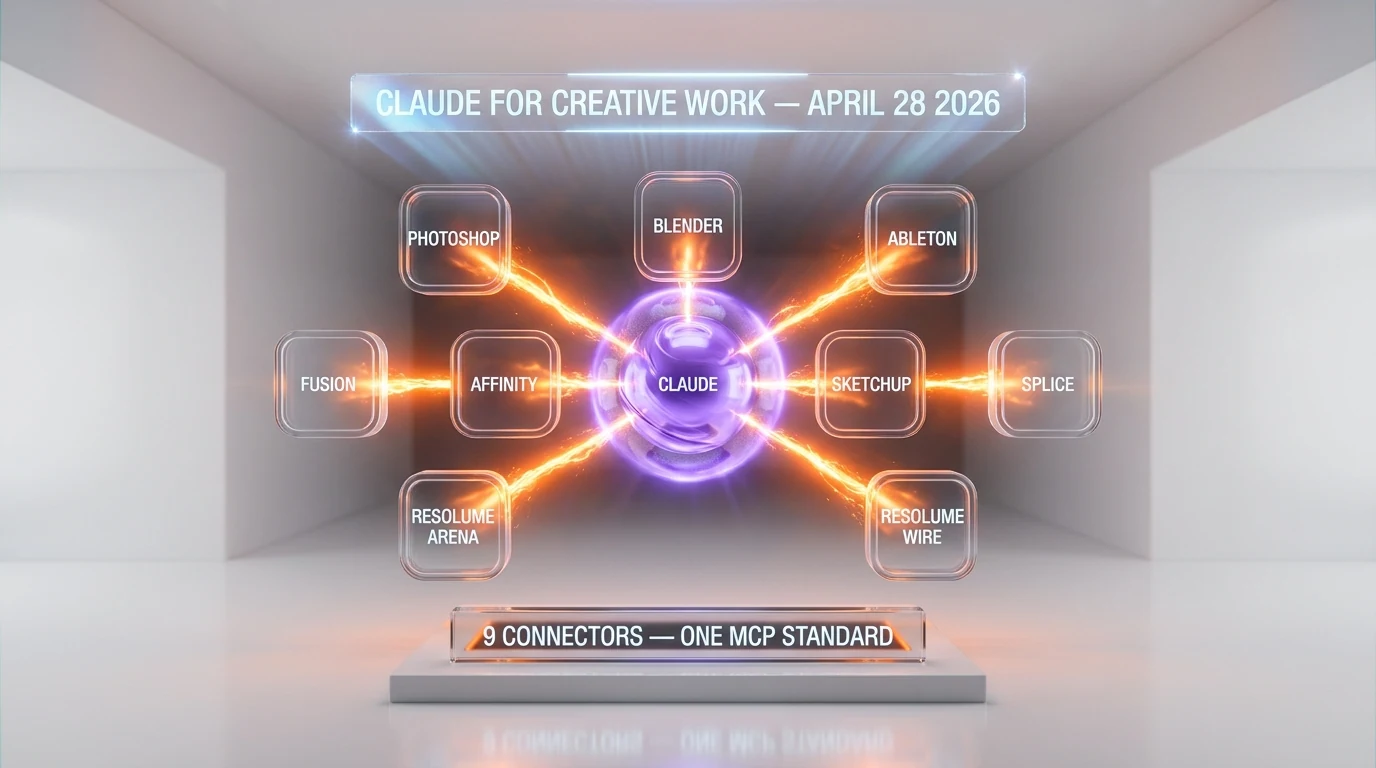
Anthropic launched Claude for Creative Work on April 28, 2026, releasing nine connectors that let Claude operate inside professional creative software. The connectors cover Adobe Creative Cloud and its 50-plus apps including Photoshop, Premiere and Express, plus Blender, Autodesk Fusion, Ableton Live and Push, Splice, Affinity by Canva, SketchUp, Resolume Arena and Resolume Wire. The connectors are built on the Model Context Protocol, making them usable with Claude and other MCP-compatible large language models. Anthropic also joined the Blender Development Fund as a patron and partnered with three art schools — Rhode Island School of Design, Ringling College of Art and Design, and Goldsmiths, University of London — on AI-for-creatives education programs.
TL;DR — what shipped on April 28, 2026
- Nine connectors for creative pro software, all built on Model Context Protocol (MCP).
- Adobe Creative Cloud — 50+ apps including Photoshop, Premiere, Express.
- Blender — natural-language interface to Blender's Python API; Anthropic joins the Blender Development Fund as a patron.
- Ableton — Live and Push documentation surfaces grounded inside Claude.
- Autodesk Fusion — conversational 3D modeling for Fusion subscribers.
- Affinity by Canva, SketchUp, Splice, Resolume Arena, and Resolume Wire.
- Education partnerships with Rhode Island School of Design (Art and Computation), Ringling College of Art and Design (Fundamentals of AI for Creatives), and Goldsmiths, University of London (MA/MFA Computational Arts).
- MCP-first design — connectors work with Claude but are accessible to any MCP-compatible LLM.
What happened: nine creative tools, one connector layer
On April 28, 2026, Anthropic published "Claude for Creative Work" on the company newsroom and rolled out a coordinated coalition of partner integrations. The launch covers nine pieces of professional creative software at once — an unusually broad single-day shipping moment for a connector ecosystem.
The core claim from Anthropic's announcement: "Claude can't replace taste or imagination, but it can open up new ways of working — faster and more ambitious ideation." The deliverable underneath that claim is concrete. Each connector exposes a specific subset of the creative tool's API surface, document corpus, or scripting layer to Claude through the Model Context Protocol — the open spec Anthropic shipped in late 2024 and that has since become the connector standard across LLM products from Claude Code to Cursor to Antigravity.
The full list of nine connectors, drawn directly from Anthropic's announcement and verified through coverage in 9to5Mac and MacRumors:
- Adobe Creative Cloud — Anthropic's announcement says the integration draws "from 50+ tools across Creative Cloud apps including Photoshop, Premiere, Express, and more."
- Blender — natural-language interface to Blender's Python API for exploring complex setups and accessing Blender documentation.
- Autodesk Fusion — conversational creation and modification of 3D models for Fusion subscribers.
- Ableton — grounding Claude's responses in official Ableton Live and Push documentation.
- Splice — connector to Splice's royalty-free sample catalog.
- Affinity by Canva — connector for the Affinity creative suite under its new Canva ownership.
- SketchUp — 3D modeling integration.
- Resolume Arena — VJ and live visuals software.
- Resolume Wire — Resolume's node-based visual programming environment.
Why it matters: Anthropic moves from coding into creative pro
The strategic story here is sequencing. Anthropic spent 2024 and 2025 making Claude the default model for software developers — Claude Code, the SDK, the integrations into Cursor, Antigravity, and the agent IDE wave. By Q1 2026 the developer tooling moat was real and measurable: Claude Opus and Sonnet reliably topped SWE-Bench and the developer-preference surveys.
Creative pro is the next vertical. It is also the next one where the workflow is software-deep, the user is technical-but-not-an-engineer, and the willingness to pay for tooling is established. Photoshop users do not balk at $25 per month software bills. Blender is free, but the Blender community is sophisticated and skews professional. Ableton Live runs in nearly every commercial music studio in the world. Fusion is the standard for product design and small-shop manufacturing.
The April 28 launch is Anthropic doing for creative pros what Cursor, Claude Code, and the agent IDE wave did for developers: meeting them inside the tool they already use, with a native conversational layer, instead of asking them to copy-paste between a chat window and the application.
Adobe Creative Cloud: 50+ apps, one connector
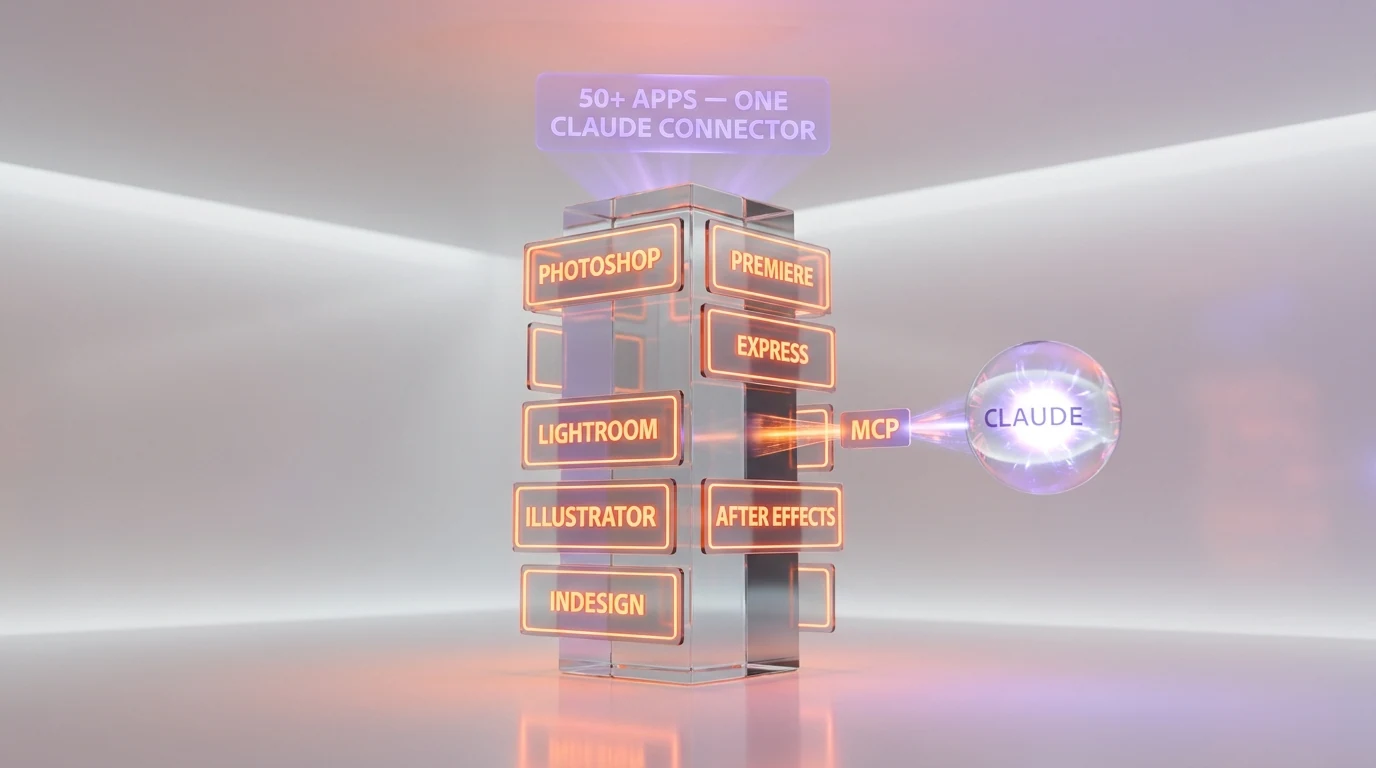
The Adobe integration is the heaviest piece of the launch by surface area. Anthropic's announcement specifies "50+ tools across Creative Cloud apps including Photoshop, Premiere, Express, and more." That number is consistent with the public Adobe Creative Cloud catalog, which includes — alongside the three apps Anthropic names directly — Lightroom, Illustrator, InDesign, After Effects, Audition, Animate, Acrobat, Substance 3D, Fresco, and the rest of the Creative Cloud lineup.
What the connector practically enables, per the announcement language, is "bringing images, videos, and designs to life" through conversation with Claude. The interpretation of that phrase across early coverage in Unite.AI, RedShark News, and Digit is consistent: this is conversational control over Adobe app features, file context retrieval, and asset generation/manipulation — not a separate "AI image generator" surface. The Claude conversation becomes the command and reasoning layer for the Adobe app the user is already in.
This is significant because Adobe has been shipping its own Firefly AI generation features inside Creative Cloud for two years. The new connector is not a competitive product against Firefly — it is a meta-layer sitting above Firefly and the rest of the Adobe app surface, controllable through Claude conversations.
Blender: natural language for the Python API, plus a Development Fund seat
The Blender integration is the most technically interesting of the nine. Blender's automation surface is its Python API — a deep, well-documented scripting layer that long-time Blender users wield through the built-in scripting console. Anthropic's connector turns that Python API into a conversational interface: users describe what they want, Claude reasons about the right Python calls, and the result lands as scripted operations inside Blender.
From the official announcement: the connector "offers a natural-language interface to its Python API, allowing users to explore and understand complex setups and making it easier to access Blender's documentation."
The strategic gesture alongside the connector is that Anthropic joined the Blender Development Fund as a patron. The Blender Development Fund is the financial backbone of the open-source Blender Foundation. Patron-level funding is a multi-year commitment to the foundation's core development work. This is the second time in 18 months an AI lab has materially backed an open-source creative tool's foundation work — a notable pattern that contrasts with the more extractive integration model some other AI products have taken with open-source projects.
Audio stack: Ableton, Splice, Resolume
The audio and live-visuals side of the launch is denser than it looks. Three of the nine connectors target this stack:
- Ableton — Live and Push documentation surfaced inside Claude, per MusicTech. Ableton Live is the dominant DAW in electronic music production; Push is its hardware controller. Grounding Claude responses in official Ableton documentation means producers can ask about device parameters, MIDI routing, and Push-specific workflows and get answers backed by the canonical reference instead of hallucinated guidance.
- Splice — the world's largest royalty-free sample catalog, with roughly 2 million sounds. The connector lets Claude search and surface samples from the Splice library inside a conversation, which is a meaningful workflow upgrade for producers who currently context-switch into the Splice app to dig for sounds.
- Resolume Arena and Resolume Wire — the live-visuals stack used by VJs and stage designers. Arena is the playback environment; Wire is Resolume's node-based visual programming language, comparable to TouchDesigner or Notch. Including Wire specifically signals that Anthropic is taking node-graph creative tools seriously, not just GUI-driven apps.
The pattern across the audio stack is the same pattern as in Adobe and Blender: Claude is not generating audio. It is operating the tools that already generate audio, using each tool's native capabilities through a conversational layer.
3D and design: Autodesk Fusion, SketchUp, Affinity
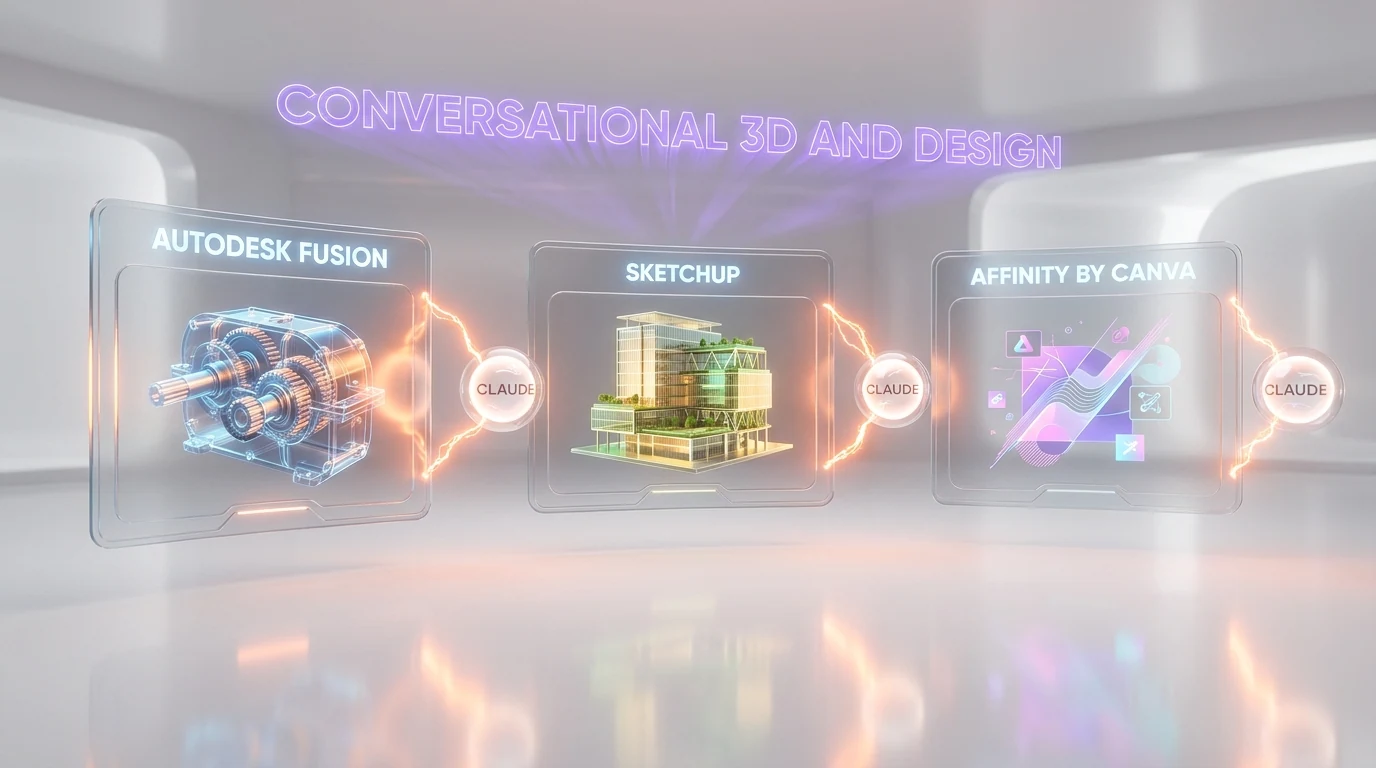
The 3D and design portion of the stack covers three more tools.
Autodesk Fusion. Fusion is the standard cloud-collaborative CAD product for product designers, hardware startups, and small manufacturers. Per Anthropic's announcement, the connector "allows designers and engineers with a Fusion subscription to create and modify 3D models through conversations with Claude." This is conversational CAD — a category that has been promised for years and shipped only in narrow form (Zoo's text-to-CAD, ShapeShift, and a handful of plugins). Bringing it natively to Fusion through Claude is a significant credibility moment for the category.
SketchUp. SketchUp is the entry-level architectural and product 3D tool — widely used in education, residential architecture, and small-firm interior design. The connector targets the same conversational-3D pattern as the Fusion integration but at SketchUp's lower-floor price and complexity.
Affinity by Canva. The Affinity suite (Designer, Photo, Publisher) was acquired by Canva in 2024 and rebranded "Affinity by Canva." It is a one-time-purchase alternative to Adobe Creative Cloud popular with cost-conscious independent designers. Including Affinity in the launch is notable because it puts Claude alongside the only credible non-Adobe alternative in the professional design suite category.
Education partnerships: RISD, Ringling, Goldsmiths
The third pillar of the launch is education. Anthropic's announcement names three art-school partnerships:
- Rhode Island School of Design — Art and Computation program. RISD is the most prominent fine-arts and industrial-design school in the United States.
- Ringling College of Art and Design — Fundamentals of AI for Creatives course. Ringling is best known for its computer animation and game art programs.
- Goldsmiths, University of London — MA/MFA Computational Arts program. Goldsmiths' computational arts MA is one of the longest-running graduate programs at the intersection of art and code in the world.
Anthropic did not detail the financial structure of these partnerships. Based on the announcement language, the partnerships involve Claude access for students, curriculum collaboration, and likely some level of foundation-style support to the programs. The selection of these three schools — one US art-and-design generalist, one US animation specialist, one UK computational-arts pioneer — covers a reasonable spread across the professional creative education map.
MCP-first architecture: connectors usable beyond Claude
One of the more underplayed lines in the announcement: the connectors are built on the Model Context Protocol, making them "accessible to other LLMs beyond Claude," per coverage in Unite.AI.
This is the same pattern Anthropic has been running since the original MCP launch: ship an open spec, ship Anthropic-built reference connectors against the spec, and let the rest of the ecosystem (Cursor, Antigravity, Cline, GitHub Copilot, others) interoperate. Practically, that means a Photoshop-MCP-server or a Blender-MCP-server that ships in this launch is reusable inside other LLM products. It also means the partnerships Anthropic struck with Adobe, Autodesk, Canva, Ableton, Resolume, and SketchUp are not exclusive in the typical sense — the connectors live in the open ecosystem.
This is a deliberate trade-off. It dilutes Anthropic's exclusive claim to the integration but expands the gravitational pull of the MCP standard. For an Anthropic that is trying to make MCP the default tool-use protocol across the LLM industry, the network-effect bet outweighs the exclusivity it gives up.
Market impact: where the pressure lands
The April 28 launch puts new pressure on three different market segments.
OpenAI and ChatGPT. ChatGPT has been pushing into creative use cases through Sora video, ChatGPT Images 2.0, and Custom GPTs. But ChatGPT does not have a comparable "live inside the creative pro tool" connector ecosystem at the depth Anthropic just shipped. OpenAI will need a credible response in the Photoshop / Blender / Ableton surface area to avoid ceding the creative-pro vertical.
Adobe Firefly and Sensei. Adobe has been the dominant AI-in-creative-tools narrative for two years. With Anthropic now sitting inside Creative Cloud as a meta-conversational layer, Adobe's Firefly value proposition shifts — Firefly stays the Adobe-native generation engine, but Claude becomes the reasoning layer above it. That is a more interesting position for Adobe than a pure competitive collision; it is also a more dependent one.
Canva. Canva owns Affinity now and has its own AI Magic features. Including Affinity in the Anthropic launch is a tell that Canva is willing to play in the Claude-powered ecosystem rather than wall its tools off into a Canva-AI-only experience. That is a notable strategic signal.
What to watch next
Three threads will determine how big this lands.
First, the connector quality bar. "Live inside Photoshop" is a great headline. The actual user experience depends on whether Claude's reasoning over Photoshop's enormous API surface is reliable enough to trust on real client work, or whether it is impressive in demos and brittle in production. The first 60 days of community demos and tutorials will tell.
Second, the model behind the connectors. Anthropic's announcement does not specify which Claude model powers the creative work integrations. Based on Anthropic's product cadence and the vision-and-reasoning load these connectors require, the smart bet is Claude Opus 4.7 with vision — the company's most capable current model. Confirmation of which models are wired into which connectors will firm up in the technical documentation over the next few weeks.
Third, OpenAI's response. Whether OpenAI ships a comparable creative-pro connector layer for ChatGPT in the next 60 to 90 days is the cleanest signal of whether April 28 was a one-off Anthropic move or a category landgrab. If OpenAI responds with a parallel Adobe/Blender/Ableton stack, the creative-pro AI tooling space is now a real two-horse race. If OpenAI does not respond within that window, Anthropic may have just claimed the vertical for the next 12 months.
Our take
The April 28 launch is the most strategically sharp Anthropic move we have tracked since Claude Code's growth phase. The shape of the play — ship nine simultaneous deep integrations into the canonical professional creative tools, layer it on top of an open MCP standard, fund the open-source Blender Foundation, partner with three respected art schools, and roll it all out in a single coordinated news moment — is the kind of multi-pronged execution most AI labs reach for and few actually deliver.
The risk is that "connector" is doing a lot of work in this launch. A connector to Photoshop's full feature surface is a different beast from a connector to Ableton's documentation. The shipped product reality probably includes a wide range of integration depth across the nine tools, and the marketing collapses that range into a single coherent story. Over the next 30 to 60 days, the honest test will be whether each individual connector holds up to a creative pro's actual workflow needs — not whether the launch announcement reads well.
If those individual integrations hold, Anthropic just took the creative-pro AI tooling vertical the same way it took the developer tooling vertical: by meeting professionals inside the software they already use, instead of asking them to switch into a Claude window.
Frequently asked questions
What is Claude for Creative Work and when did it launch?
Claude for Creative Work is Anthropic's coordinated launch of nine connectors that let Claude operate inside professional creative software. It was announced on April 28, 2026 via a post on the Anthropic newsroom titled "Claude for Creative Work." The connectors target Adobe Creative Cloud, Blender, Autodesk Fusion, Ableton, Splice, Affinity by Canva, SketchUp, Resolume Arena, and Resolume Wire.
Which Adobe apps does the Claude connector support?
Anthropic's announcement specifies that the Adobe Creative Cloud connector covers "50+ tools across Creative Cloud apps including Photoshop, Premiere, Express, and more." That number is consistent with the full Adobe Creative Cloud catalog, which alongside the three apps named directly includes Lightroom, Illustrator, InDesign, After Effects, Audition, Animate, Acrobat, Substance 3D, Fresco, and the remainder of the suite.
What does the Blender connector actually do?
The Blender connector exposes Blender's Python API as a natural-language interface inside Claude. Per the official announcement, it "allows users to explore and understand complex setups and makes it easier to access Blender's documentation." Practically, this means users can describe what they want in conversation and Claude reasons about the right Blender Python calls, with results applied through Blender's scripting layer. Anthropic also joined the Blender Development Fund as a patron alongside the connector launch.
Are the connectors exclusive to Claude?
No. The connectors are built on the Model Context Protocol (MCP), the open spec Anthropic shipped in late 2024 and that has since been adopted across the LLM tooling industry. Per the launch coverage in Unite.AI and other outlets, the connectors are accessible to other MCP-compatible LLMs beyond Claude. This dilutes exclusivity but expands the network effect for the MCP standard.
Which Claude model powers the creative connectors?
Anthropic's launch announcement does not specify which Claude model powers the integrations. Based on Anthropic's product cadence in early 2026 and the vision-plus-reasoning load these connectors require — controlling Photoshop and Premiere through conversation, generating Blender Python from natural language, parsing Ableton and Resolume documentation — the most likely model is Claude Opus 4.7, Anthropic's current most-capable model with multimodal vision support. Confirmation will firm up in the technical documentation in the weeks following launch.
What education programs partnered with Anthropic for this launch?
Three art schools were named in the announcement: Rhode Island School of Design (Art and Computation program), Ringling College of Art and Design (Fundamentals of AI for Creatives), and Goldsmiths, University of London (MA/MFA Computational Arts). The partnerships involve Claude access for students and curriculum collaboration. Anthropic did not detail the financial structure of the partnerships.
Does the Claude Ableton connector control Ableton Live directly?
Per the official announcement and coverage in MusicTech, the Ableton connector grounds Claude's responses in official Ableton Live and Push documentation. The current scope of the integration is documentation-and-knowledge-grounding rather than direct device parameter control inside Live. Producers can ask about Live device behavior, MIDI routing, and Push workflows and get authoritative answers, but the connector at launch is not a substitute for hands-on Live operation.
How does this affect Adobe Firefly's positioning?
Adobe Firefly remains the Adobe-native generation engine inside Creative Cloud. The Claude connector sits as a meta-conversational reasoning layer above the broader Adobe app surface, including Firefly features. The two products are not directly competitive — Firefly generates pixels and assets, Claude orchestrates Adobe app workflows including Firefly invocations. The strategic effect is that Adobe's AI value proposition becomes more entangled with Anthropic's connector ecosystem.
What is the Resolume Wire connector for?
Resolume Wire is Resolume's node-based visual programming environment, comparable to TouchDesigner or Notch. The connector exposes Wire's node-graph creative programming surface to Claude through MCP. This is significant because it signals that Anthropic is targeting node-graph creative tools as a first-class category alongside GUI-driven apps — important for VJs, stage designers, and live-visuals professionals who work primarily in node-based tooling.
Is Claude for Creative Work free or paid?
Anthropic's launch announcement does not detail standalone pricing for Claude for Creative Work. The connectors operate inside Anthropic's existing Claude product surface — Claude.ai consumer access, Claude Pro, Claude for Teams and Enterprise, plus the API and Claude Code. Underlying creative tool subscriptions (Adobe Creative Cloud, Autodesk Fusion, Ableton Live, Splice, Resolume, SketchUp, Affinity by Canva) remain separately licensed and billed by their respective vendors.