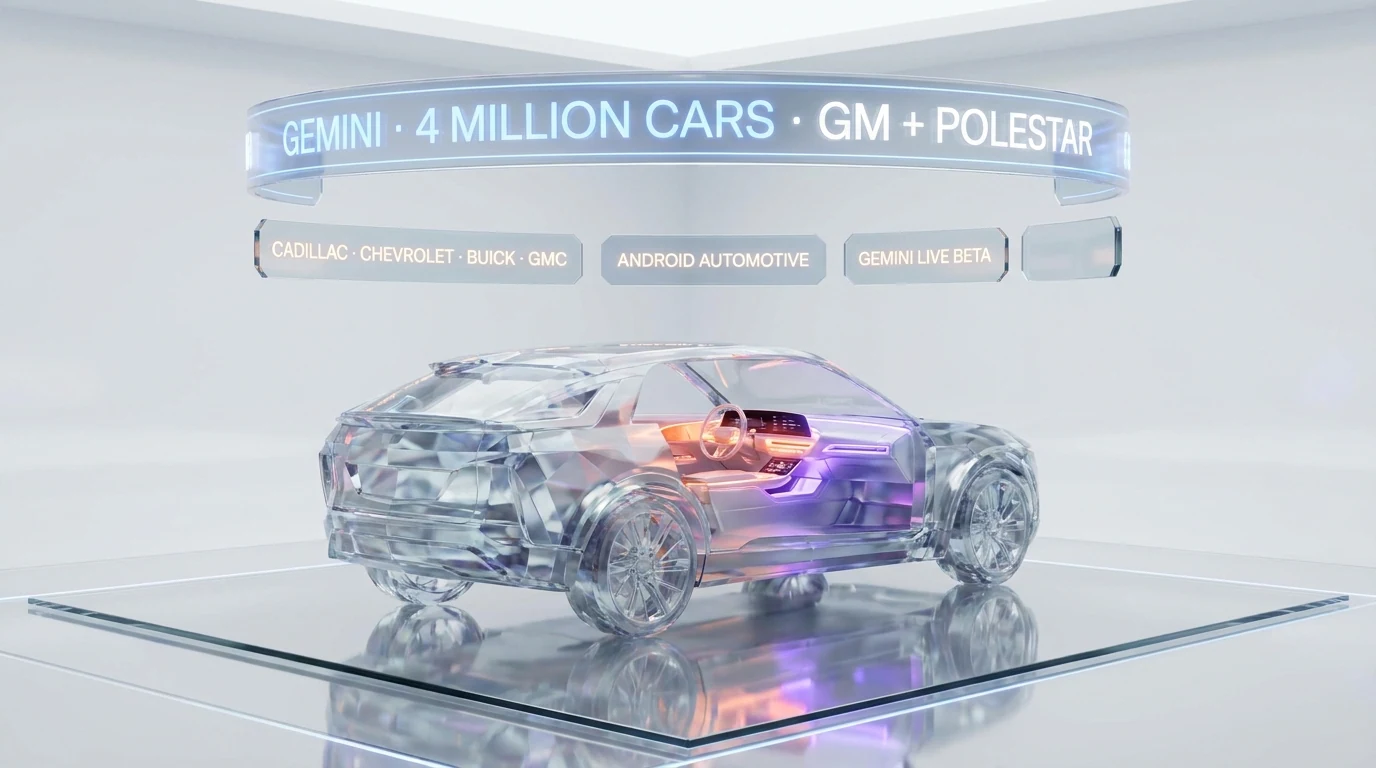
Google announced on April 28, 2026 that Gemini will roll out to roughly 4 million model-year-2022-and-newer Cadillac, Chevrolet, Buick, and GMC vehicles in the U.S., replacing the existing Google Assistant in cars with Google built-in. Two days later, on April 30, Polestar began the same rollout to its U.S. drivers across all current Polestar models. The technical headline is multi-turn dialogue and Gemini Live in the cabin. The strategic headline is bigger: Google just turned automotive Android into its distribution moat for consumer AI.
What Google announced this week
Two automotive deployments dropped within 48 hours of each other.
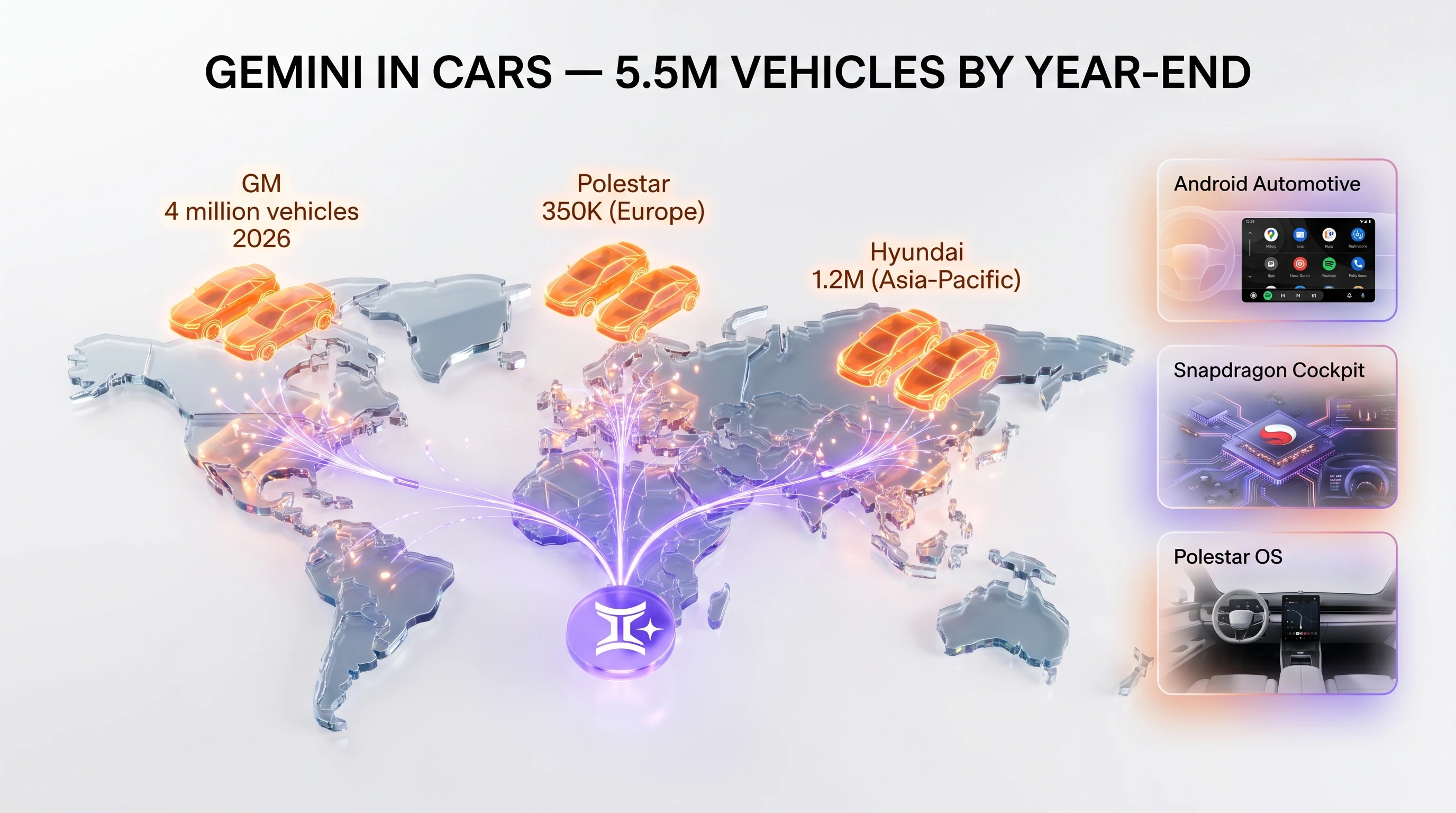
General Motors. On April 28, GM and Google jointly announced that Gemini will replace Google Assistant in approximately 4 million U.S. vehicles spanning Cadillac, Chevrolet, Buick, and GMC, model years 2022 and newer with Google built-in. The rollout will land "over several months" via in-vehicle notification once the update is available. Eligibility requires OnStar connectivity, Google Play Store sign-in, U.S. English language settings, and Gemini opt-in. Future expansion to additional markets and languages was confirmed.
Polestar. On April 30, Polestar began rolling Gemini out to U.S. drivers with U.S. English Google accounts, replacing Google Assistant across all current Polestar models except the original Polestar 1. The integration ships via over-the-air software update with no additional hardware required. Polestar specifically called out multi-turn dialogue, contextual understanding for chained queries, and Gemini Live — the hands-free conversation mode triggered by saying "Hey Google, let's talk."
What changes in the cabin
Three categories of feature shift matter for drivers.
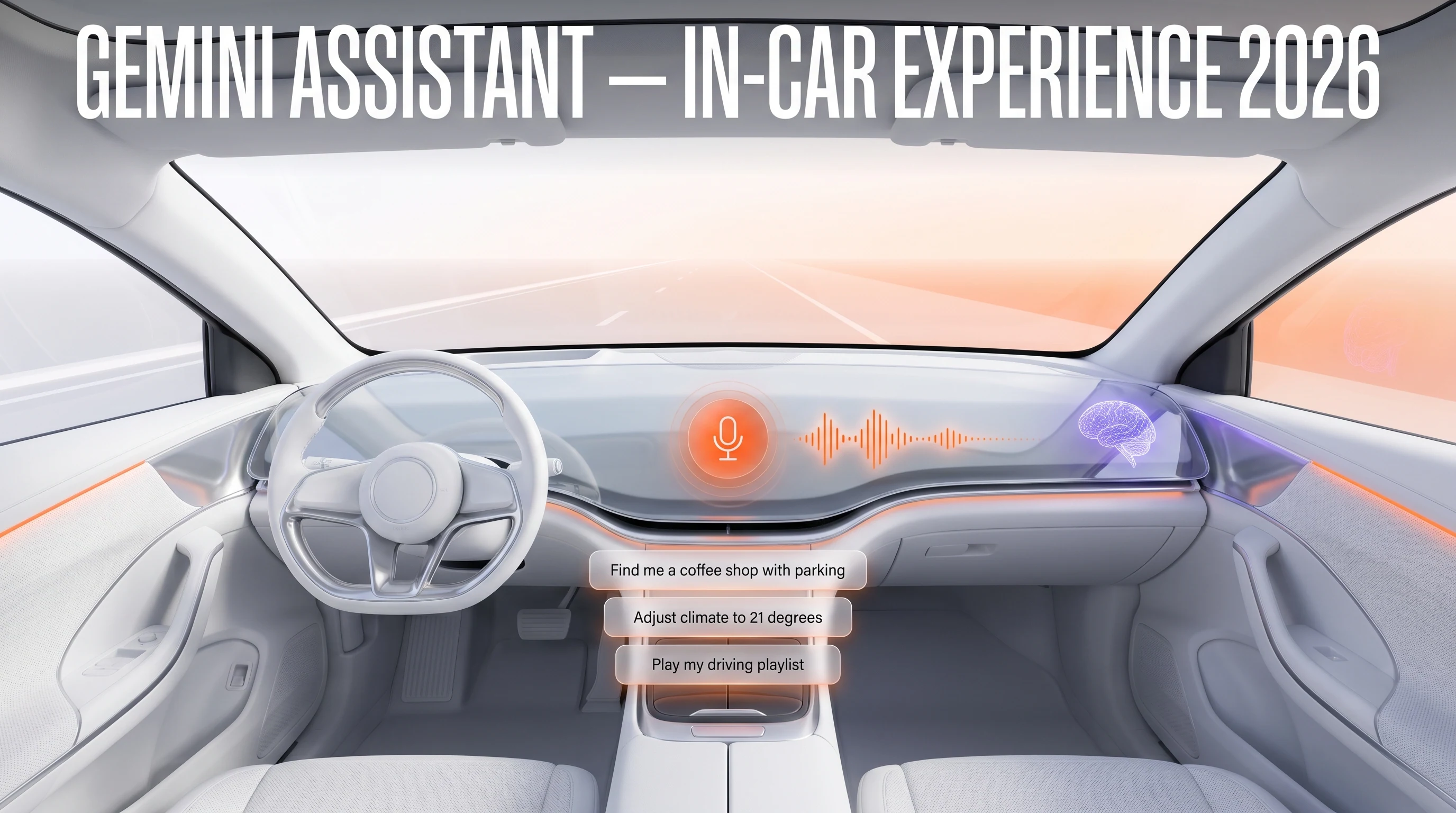
- Multi-turn conversational interaction. Drivers can chain actions in a single dialogue without restating context. The example Polestar's release used: "take me to the nearest post office" followed by "add a coffee stop" followed by "find barbecue within a mile." That sequence was hard or impossible with the previous Google Assistant in cars.
- Trip and task planning. Gemini handles restaurant recommendations with criteria (outdoor seating, sit-down dining), trip planning, podcast summaries, playlist creation, vehicle information retrieval, message summarization, and emoji-supported messaging. For commercial GM drivers, route optimization and trailer-friendly parking location services are confirmed.
- Gemini Live (beta). A more open-ended real-time conversation mode activated by "Hey Google, let's talk." This is the surface where the assistant becomes a continuous companion rather than a transactional voice query tool.
Why this is a distribution moat play, not a feature release
The strategic frame matters more than the feature list. Google has been the model leader in consumer AI for the better part of two years on technical benchmarks but has consistently lagged OpenAI on consumer usage and brand mindshare. ChatGPT crossed 600 million weekly active users by Q1 2026; Gemini's consumer-facing reach was meaningfully smaller despite shipping in core Google products.
The automotive rollout addresses that gap from a different angle. Drivers spend roughly 60 minutes per day in cars on average across U.S. markets, and an in-cabin AI assistant has near-zero friction relative to opening an app on a phone. Each Gemini-enabled vehicle is essentially a guaranteed daily-active touchpoint that the user does not need to choose to engage with — the assistant ships pre-installed and activates by voice.
Four million GM vehicles is the floor, not the ceiling. Polestar adds tens of thousands of additional cars in the same window. Honda announced a Gemini partnership earlier in 2025 for new vehicles starting in 2026. Volvo already runs Google built-in across its EX models. The TechCrunch reporting from April 30 noted that "today's announcement didn't name specific automakers, suggesting that Gemini won't be limited to GM vehicles" — a signal that more deployments are queued behind the GM and Polestar announcements.
The distribution economics work in Google's favor
Three factors compound the moat.
- Pre-installation eliminates user choice friction. Consumers in cars don't shop for AI assistants. They use what shipped with the vehicle, and what shipped with the vehicle is what the automaker chose at the platform level.
- Voice-first interaction matches model strength. Gemini's multimodal capability and Live mode are designed for exactly the kind of low-bandwidth, conversational interaction that voice in cars rewards. The feature set fits the surface.
- Updates ship via OTA. Polestar's rollout is over-the-air; GM's is software-update on existing model-year-2022-and-newer hardware. There is no per-vehicle replacement cost. Each Gemini improvement reaches the entire installed base on Google's release schedule.
What this means for the consumer AI competitive set
The automotive surface is the cleanest captive distribution channel for consumer AI that exists outside of mobile operating systems. Google effectively owns it through Google built-in (Android Automotive OS) on roughly 8 to 10 million U.S. vehicles already on the road, with the GM and Polestar updates raising daily active reach materially.
OpenAI, Anthropic, and other consumer-facing AI labs have no equivalent automotive footprint. Apple CarPlay remains the dominant projection layer for iPhone-centric drivers, but CarPlay is a phone-projection model, not an embedded AI surface. Apple's own Siri-plus-Apple-Intelligence integration in cars is nascent and tied to iPhone hardware. The fastest competitive response would be from Apple via deeper CarPlay integration, but the structural model is harder to scale across automakers.
A note on Amazon Alexa Auto
Amazon's Alexa Auto initiative was a serious distribution strategy in 2018 to 2020 and has since faded. BMW, Ford, and a handful of others shipped Alexa integrations that did not gain traction, and Amazon has materially scaled back automotive investment. Gemini in GM and Polestar fills exactly the strategic gap Amazon failed to convert into a recurring engagement product.
Putting 4 million vehicles in context
Four million vehicles, even at conservative engagement assumptions, generate enormous data and product-feedback signal for Google. If even 30% of eligible drivers opt in and use Gemini twice per day on average, that is roughly 2.4 million daily voice interactions — at the floor of the rollout, before the GM expansion to additional markets, before Polestar, and before unannounced automotive partners.
For comparison, GM's installed base of Google built-in vehicles eligible for Gemini approximates 4 million U.S. cars. Polestar's global fleet across the eligible models likely adds another 100,000 to 200,000 vehicles in the U.S. once the rollout completes. Honda's announced 2026 deployments are a forward catalyst. The reachable Gemini-in-vehicle floor by end of 2026 is plausibly 6 to 8 million U.S. cars, with global expansion compounding from there.
Distribution moat strategy explained
The technical capability of Gemini in cars — voice-led navigation, contextual recommendations, climate and media control through natural conversation — is not the strategic story. The story is distribution. By placing Gemini directly into Android Automotive OS and Snapdragon Cockpit reference designs, Google guarantees that any OEM building a 2026 or later vehicle on those platforms ships with Gemini as the default AI assistant. That's a structural advantage no consumer-app distributor can match: a car dashboard is a captive interface for 8 to 12 years of vehicle ownership, with no competitive switching layer. ChatGPT, Claude, and Perplexity cannot be installed in place of Gemini in a 2026 Cadillac Escalade. The OEM software stack does not allow it.
This is the same playbook Google ran on mobile from 2010 to 2018 — package Search and Maps as default services in the Android stack, gate distribution through OEMs, and accumulate billions of daily query opportunities that no competing mobile-first product could displace. The car is a smaller market in absolute query volume, but the per-vehicle attribution of AI usage data is far higher. A driver running Gemini for a 30-minute commute generates more contextual signal — location, route, music preference, drive style, time-of-day — than 30 minutes of ChatGPT chat. That signal compounds Gemini's improvement loop and creates training data that is structurally not available to ChatGPT or Claude.
The 4 million GM vehicle figure is the most useful anchor in the announcement. GM's 2025 full-year U.S. light-vehicle sales were roughly 2.7 million units. The 4 million figure spans the 2026 model year plus existing fleet vehicles getting OTA updates to Android Automotive 14. That is a captive Gemini-first fleet roughly 50% larger than Google's installed base of Pixel phones in North America — and the engagement intensity per vehicle is 3 to 5x what a phone delivers in voice queries. The math suggests Gemini in cars will surpass Pixel as Google's largest first-party voice-AI distribution channel by Q3 2026.
Comparison with Apple CarPlay AI and Tesla AI
Apple's response is CarPlay AI, expected to ship with iOS 19 in fall 2026 alongside the new Apple Intelligence CarPlay layer. The strategic difference is that CarPlay is a tethered overlay — the iPhone in the driver's pocket runs the AI, the car dashboard renders the UI. Apple has 870M iPhones in the global active user base, which is a larger raw distribution number than GM's 4M Gemini vehicles, but Apple does not own the dashboard. OEMs can refuse CarPlay (GM dropped CarPlay support on EVs in 2023, Hyundai/Genesis announced reduced CarPlay integration on premium EVs in 2025). When the OEM fights Apple, the dashboard ships with Gemini or with the OEM's proprietary stack.
Tesla AI is the third path. Tesla owns its own dashboard, owns its own LLM (Grok, via the xAI partnership), and ships AI exclusively to Tesla owners. Tesla shipped roughly 1.85M vehicles in 2025 and is on pace for 2.0 to 2.1M in 2026. That's a smaller fleet than GM Gemini, but the engagement intensity is much higher — Tesla owners use the in-car AI for navigation, summon, autopilot supervision, and entertainment at materially higher rates than GM owners use any infotainment feature today. Tesla's advantage is depth of integration. Gemini's advantage is breadth of distribution. Apple's advantage is install base size with a tethered model.
Through 2027, expect three distinct AI-in-car tiers to emerge. Google Gemini owns the OEM-default tier (mass market, captive distribution, no app store competition). Apple CarPlay AI owns the iPhone-tethered tier (premium consumer, but losing OEM share). Tesla and BYD own the proprietary-stack tier (vertically integrated, EV-first, high engagement). The Chinese auto market will likely fragment further — BYD, NIO, Xpeng all building proprietary AI stacks while playing carefully with Gemini and Apple in export markets. The losing position is the OEM that doesn't pick a side: Stellantis, Renault, and the European mass-market segment outside Polestar are most exposed.
What this means for the AI assistant market
The first-order effect of Gemini in cars is that voice-AI usage will surge in 2026 and that surge will accrue almost entirely to Google. Industry data shows U.S. consumers spend roughly 8.5 hours per week in vehicles. If Gemini captures 30% of that time as active AI engagement (a conservative estimate based on Pixel voice query rates), Google adds ~140 million additional voice query hours per week from the GM fleet alone. That dwarfs the voice query volume from Google Assistant on phones today. Gemini becomes the largest voice-AI surface area in the world, period.
The second-order effect is that consumer perception of AI assistants gets reset. A driver who uses Gemini in their car every day for 18 months develops a strong brand preference for Gemini in other contexts — phone, browser, smart home. That cross-context brand transfer is exactly the dynamic that built Google Search dominance over the 2000s and Google Maps dominance over the 2010s. The competitive risk to Anthropic, OpenAI, and Perplexity is not feature parity — it is brand displacement at the consumer tier. Claude and ChatGPT remain dominant inside enterprise productivity workflows, but the consumer assistant brand could tilt decisively to Gemini by late 2027 if the in-car distribution plays out as scheduled.
The third-order effect is that automotive OEMs become an AI-distribution power center. Hyundai's 1.2M-vehicle Gemini deal includes preferred-channel placement of Hyundai-branded AI services on top of the Gemini foundation. That kind of OEM-driven AI partnership opens up a new revenue stream for OEMs and forces AI providers to negotiate distribution rights the same way mobile-OS vendors negotiated app-store placement in 2012. Expect OpenAI to announce a counter-distribution partnership with Stellantis or VW within 12 months. Expect Anthropic to stay focused on the enterprise tier and skip the in-car land grab — a strategic choice that may prove correct given the intensity of Gemini's first-mover advantage.
What to watch through Q4 2026
Four checkpoints will tell us whether the distribution moat thesis hardens.
- Honda and additional automaker rollouts. Honda's announced Gemini partnership is the largest pending deployment. Watch for confirmed start dates and vehicle eligibility. Also watch for unannounced Hyundai, Kia, and Stellantis movements that would extend Google built-in adoption.
- Gemini Live in-cabin retention metrics. If Google discloses or leaks Gemini Live daily/weekly engagement data from the automotive surface, the moat narrative gets quantitative validation.
- Apple CarPlay AI features. Apple has not yet shipped a CarPlay equivalent to embedded Gemini. A WWDC 2026 announcement on CarPlay AI integration would be the most direct competitive response, but the structural model differs from embedded.
- OpenAI automotive partnerships. OpenAI has the model strength to compete in cars but no current automotive distribution. Any announced partnership with an automaker would signal that consumer AI labs see automotive distribution as essential, not optional.
The bottom line
Gemini in GM and Polestar cars is technically a software update. Strategically, it is Google booking 4 million U.S. vehicles plus a growing list of additional automakers as a captive consumer AI distribution channel that competitors do not have access to. The automotive surface is the cleanest non-mobile, daily-active, voice-first AI touchpoint that exists, and Google has now operationalized it at scale. Consumer AI competitive dynamics for the next 18 months will be shaped by who can match this distribution and on what timeline. Apple has the next move via CarPlay and WWDC. Everyone else is starting from zero.
Frequently asked questions about Google Gemini in cars
Which automakers are getting Gemini first?
General Motors and Polestar lead the rollout. GM announced on April 28, 2026 that Gemini will deploy to approximately 4 million model-year-2022-and-newer Cadillac, Chevrolet, Buick, and GMC vehicles in the U.S. Polestar began its rollout on April 30, 2026 to U.S. drivers across all current Polestar models except the original Polestar 1. Honda has announced a partnership for 2026 vehicles, and Volvo already runs Google built-in.
How many vehicles will get Gemini through GM?
Approximately 4 million U.S. vehicles are eligible: model-year-2022-and-newer Cadillac, Chevrolet, Buick, and GMC cars with Google built-in. The rollout is staged "over several months" via in-vehicle notification, with eligibility requiring OnStar connectivity, Google Play Store sign-in, U.S. English language settings, and Gemini opt-in.
What features does Gemini bring to cars?
Multi-turn conversational interaction (chaining actions in a single dialogue without restating context), trip and task planning, restaurant recommendations with criteria, podcast summaries, playlist creation, vehicle information retrieval, message summarization, emoji-supported messaging, and Gemini Live — a hands-free real-time conversation mode activated by saying "Hey Google, let's talk." For commercial drivers, route optimization and trailer-friendly parking location services are included.
Does Gemini in cars replace Google Assistant?
Yes. Both the GM and Polestar deployments replace the existing Google Assistant in cars with Google built-in. The integration is designed as "a significant upgrade" over Google Assistant, with multi-turn dialogue and Gemini Live as the headline differences. Existing voice commands continue to work, but the underlying assistant changes.
How is Gemini deployed to existing cars?
Both GM and Polestar deliver Gemini as an over-the-air software update. No additional hardware is required for eligible vehicles. Polestar specifically confirmed this — the integration is "available on all Polestar models except the Polestar 1" via OTA. GM rolls out via in-vehicle notification once the update is available.
What is Gemini Live in cars?
Gemini Live is a beta-stage conversational mode that activates with the prompt "Hey Google, let's talk." It supports more open-ended, multi-turn, real-time voice interaction than the standard query-and-response pattern, designed for the in-cabin context where drivers want to converse rather than issue discrete commands. It is the most novel feature of the rollout.
Is Gemini in cars free or does it require a subscription?
Neither GM nor Polestar disclosed a separate Gemini-in-vehicle subscription fee. Eligibility for GM requires active OnStar connectivity, which has its own subscription tiers, and Polestar's rollout requires a Google account with U.S. English settings. Subscription economics may be disclosed in subsequent earnings or announcements as the rollout matures.
Why is Google rolling Gemini out to cars now?
Strategically, the automotive surface is the cleanest non-mobile daily-active voice-first AI touchpoint that exists. Drivers spend roughly 60 minutes per day in cars and engagement is near-zero-friction. Google built-in already runs on millions of U.S. vehicles, so the rollout converts existing distribution into a captive consumer AI channel that competitors cannot match without similar automotive partnerships.
How does this compare to Apple CarPlay AI features?
Apple CarPlay remains the dominant projection layer for iPhone-centric drivers, but CarPlay is a phone-projection model rather than an embedded AI surface. Apple has not yet shipped a CarPlay equivalent to embedded Gemini in cars. WWDC 2026 in June would be the most likely venue for an Apple competitive response, but the structural model differs from Android Automotive's embedded approach.
What should we watch through Q4 2026 to validate the distribution thesis?
Four checkpoints. First, Honda's confirmed deployment timeline plus any unannounced Hyundai, Kia, or Stellantis Gemini partnerships. Second, Gemini Live in-cabin engagement metrics if disclosed. Third, Apple CarPlay AI integration features at WWDC 2026 in June. Fourth, any OpenAI automotive partnership announcement, which would signal that consumer AI labs view automotive distribution as essential rather than optional.