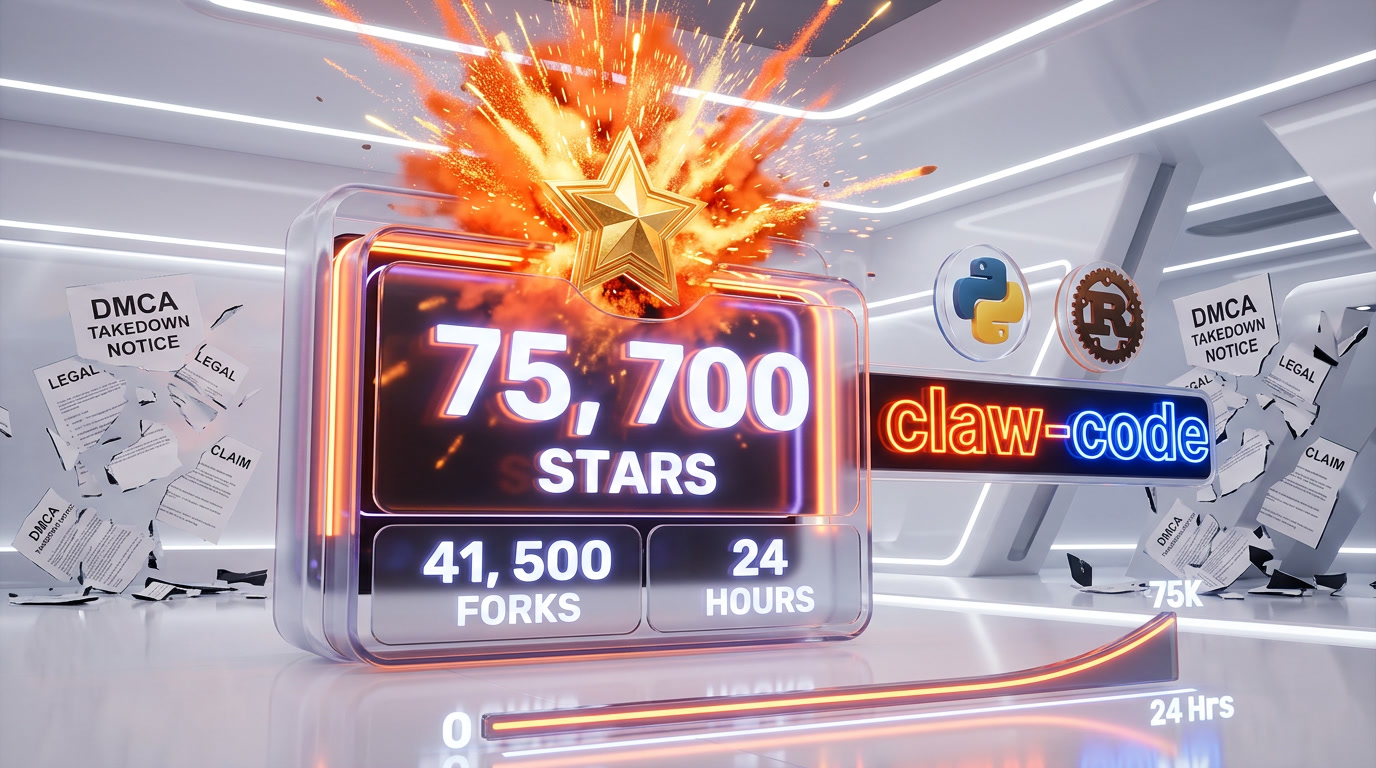
It took Sigrid Jin less than a day to rewrite Claude Code in Python. After the March 31, 2026 source map leak exposed 512,000 lines of TypeScript, Jin published claw-code — a Python/Rust port of the architecture. It hit 75,700 GitHub stars in 24 hours (a platform record) and 41,500 forks. Anthropic's DMCA takedowns failed as mirrors proliferated across GitHub, GitLab, Codeberg, and IPFS. The original leak post by intern Chaofan Shou generated 16 million views on X.
The Leak That Started It All
On March 31, 2026, security researcher Chaofan Shou discovered that the npm package @anthropic-ai/claude-code v2.1.88 included a source map file (cli.js.map) weighing 59.8 MB. This single file reconstructed the entire TypeScript source code of Claude Code — approximately 1,900 files and 512,000 lines of non-obfuscated code.
Within hours, the discovery was public. Within a day, someone had already done something nobody at Anthropic expected: port the entire thing to a different language and release it as open source.
| Timeline | Event |
|---|---|
| March 31, morning | Chaofan Shou discovers source map in npm package |
| March 31, afternoon | Discovery posted publicly, source code begins circulating |
| March 31, evening | Sigrid Jin begins Python/Rust port |
| April 1, 00:00 | claw-code repository goes live on GitHub |
| April 1, 24:00 | 75,700 stars reached — GitHub record broken |
| April 1-2 | Anthropic files DMCA takedown |
| April 2+ | Mirrors proliferate, DMCA becomes ineffective |
Sigrid Jin: The Developer Behind claw-code
Sigrid Jin, known on GitHub as @instructkr, is a Korean developer and AI researcher. When the Claude Code source map leaked, Jin did not just download the code. They analyzed the entire 512,000-line TypeScript codebase, mapped its architecture, and then rewrote it as a functional Python/Rust implementation.
The claw-code repository is not a direct copy of the TypeScript source. It is a clean-room port that preserves the metadata and structure — file names, command snapshots, tool definitions — while reimplementing the logic in Python with a Rust runtime. This distinction matters legally: it is a derivative work based on leaked information, not a verbatim copy of copyrighted code.
The repository includes:
- A functional Rust CLI with API client and runtime
- Reference data preserving original file names from the TypeScript source
- Command and tool snapshots documenting the original architecture
- Detailed analysis documents covering feature flags, model codenames, and system architecture
75,700 Stars in 24 Hours: Breaking GitHub Records
The numbers behind claw-code are unprecedented in GitHub history:
| Metric | Value | Context |
|---|---|---|
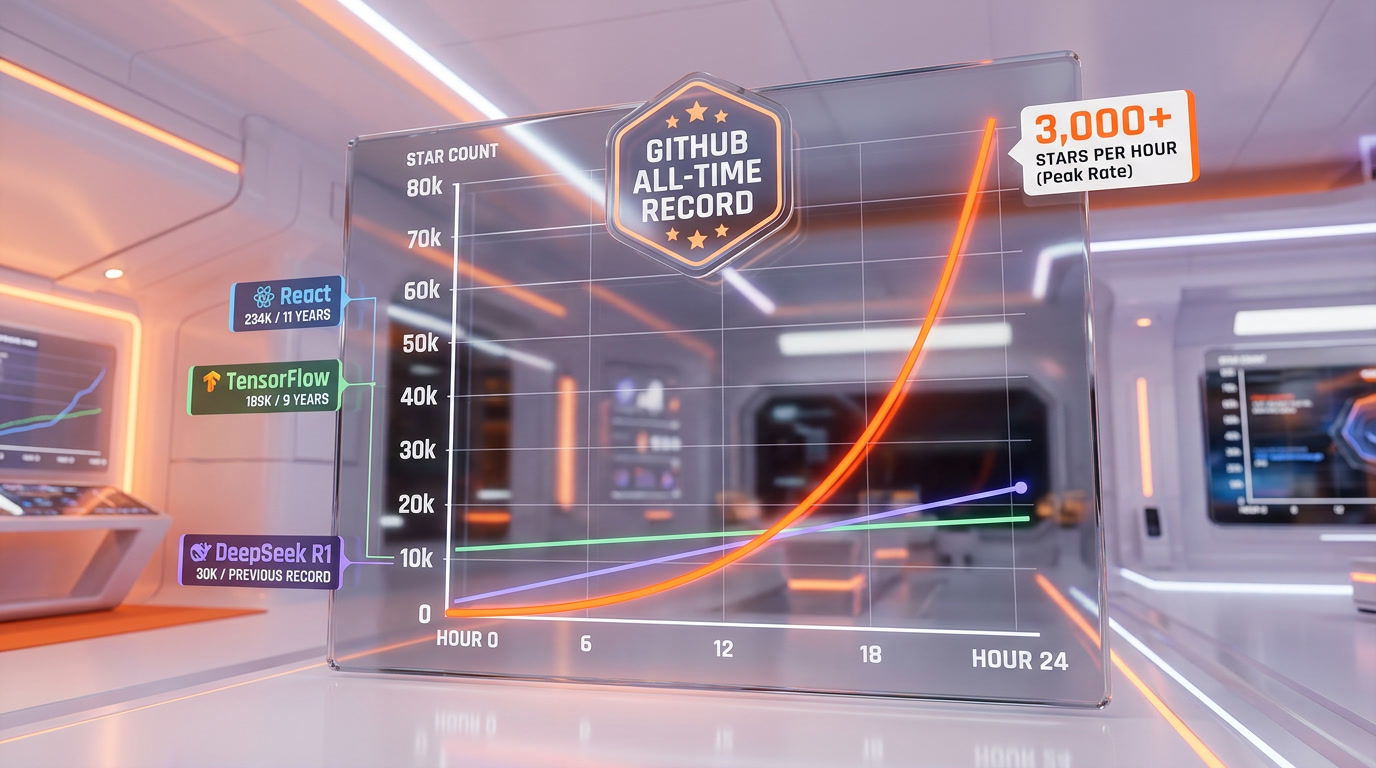
| Stars in 24 hours | 75,700 | Previous record: ~30,000 (DeepSeek R1) |
| Forks | 41,500 | Each fork is a complete copy of the codebase |
| Views on X (Twitter) | 16 million+ | Across all related posts and threads |
| Time to #1 trending | <6 hours | Fastest ascent to GitHub trending #1 |
| Mirror repositories | Hundreds | Across GitHub, GitLab, Codeberg, Bitbucket, IPFS |
To put 75,700 stars in 24 hours in perspective: most successful open-source projects take months or years to reach that number. React has 234,000 stars accumulated over 11 years. TensorFlow has 189,000 over 9 years. claw-code hit 75,700 in a single rotation of the Earth.
The fork count of 41,500 is equally significant. Each fork creates an independent copy of the repository under a different GitHub account. Even if the original repository is deleted, 41,500 copies persist. This is what made the DMCA takedown effectively impossible.
Anthropic's Failed DMCA Takedown
Anthropic responded within approximately 24-48 hours by filing a DMCA takedown request with GitHub. The original claw-code repository was temporarily restricted. But the damage — from Anthropic's perspective — was already done.
The problem with DMCA takedowns in the age of distributed version control:
- 41,500 forks: GitHub's DMCA process can target the original repo, but each fork requires a separate takedown notice
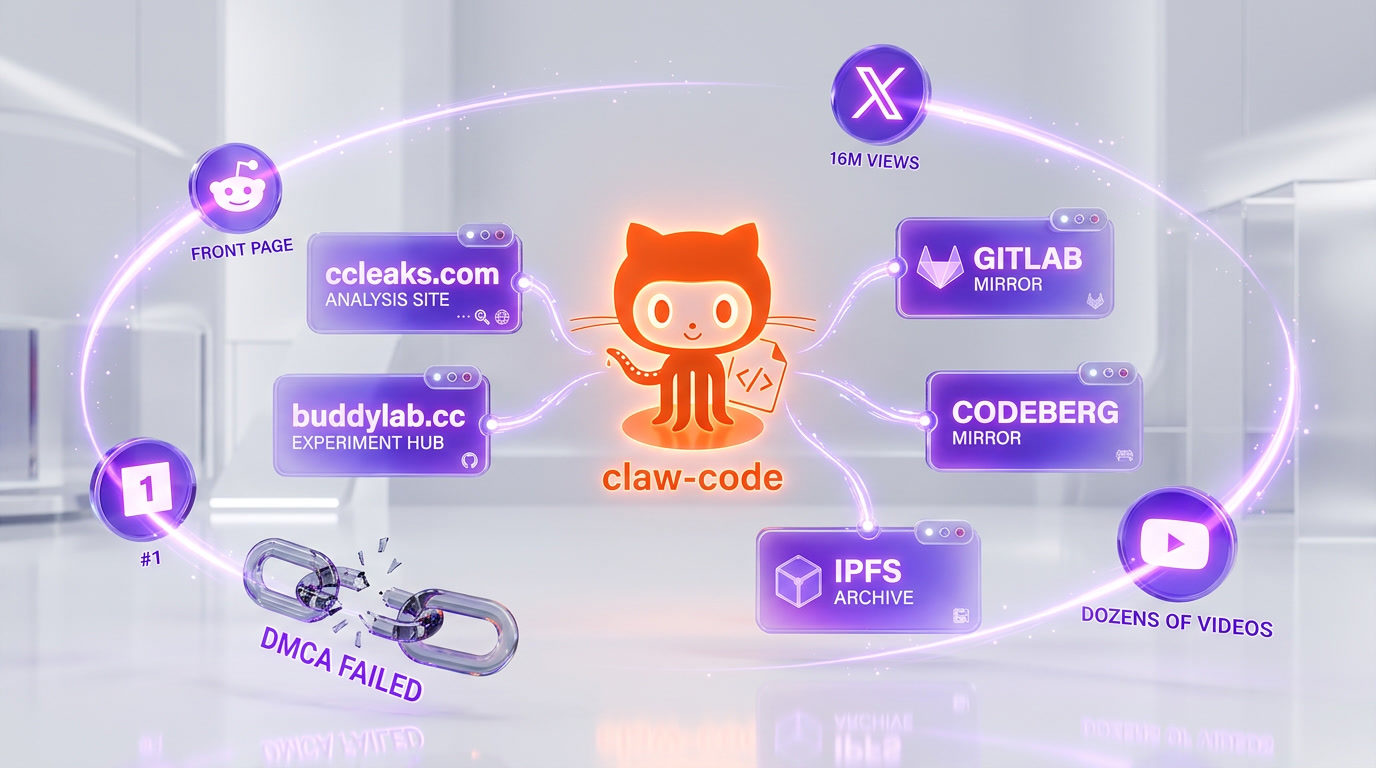
- Cross-platform mirrors: within hours of the DMCA filing, mirrors appeared on GitLab, Codeberg, Bitbucket, self-hosted Gitea instances, and IPFS (which cannot be taken down at all)
- Archive sites: The code was captured by multiple web archiving services
- Local clones: Tens of thousands of developers had already cloned the repository to their local machines
This is the textbook definition of the Streisand Effect: the attempt to suppress information draws more attention to it than the original disclosure would have. Anthropic's DMCA filing became a news story itself, driving even more traffic to the mirrors.
The Community Response: ccleaks.com and buddylab.cc
The leak did not just produce a GitHub repository. It spawned an entire community ecosystem:
ccleaks.com
A community site dedicated to analyzing and documenting everything discovered in the Claude Code source leak. The site catalogs feature flags, environment variables, hidden commands, model codenames, and architecture details. It serves as a centralized reference for researchers and developers studying the leaked codebase.
buddylab.cc
Named after the BUDDY feature flag discovered in the leak (the Tamagotchi companion system with 18 species and 5 stats), buddylab.cc became a community hub for experimenting with the leaked code. The name is a direct reference to one of the most unexpected discoveries: Anthropic built a complete virtual pet system inside their AI coding tool.
Social Media Explosion
The leak generated massive engagement across social platforms:
- X (Twitter): 16 million+ views across related posts. Every major AI influencer, developer advocate, and tech journalist covered it.
- Reddit: Multiple front-page posts on r/programming, r/MachineLearning, r/artificial, and r/technology
- Hacker News: Multiple #1 posts with thousands of comments
- YouTube: Dozens of analysis videos within the first week
- Discord/Telegram: Dedicated channels in major AI communities for real-time analysis
The Streisand Effect in Action
The claw-code saga is a case study in the Streisand Effect — the phenomenon where trying to suppress information makes it spread faster.
Consider the sequence of events:
- Source map ships in npm: Anthropic accidentally includes
cli.js.mapin the published package. At this point, anyone runningnpm install @anthropic-ai/claude-codedownloads the entire source code. - Researcher discovers it: Chaofan Shou finds the file and publishes the discovery. This is a security disclosure — standard practice in the tech industry.
- Community ports it: Sigrid Jin creates claw-code, making the code accessible in Python/Rust. Stars accumulate at 3,000+ per hour.
- Anthropic files DMCA: The takedown attempt generates headlines. "Anthropic tries to suppress leaked code" becomes a bigger story than "Anthropic accidentally shipped source map."
- Mirrors explode: The DMCA drives a rush to fork, mirror, and archive. Every developer who was not paying attention is now downloading the code.
By the time Anthropic's DMCA was processed, the code existed in so many locations that suppression was mathematically impossible. The 41,500 forks on GitHub alone represent 41,500 independent copies that would each need a separate legal action.
What the Leak Revealed
The reason claw-code attracted 75,700 stars was not mere curiosity — the leaked code contained genuinely newsworthy information about Anthropic's plans:
- 32 compile-time feature flags for unshipped features including voice mode, plugin marketplace, Chrome extension, multi-agent orchestration, and a Tamagotchi companion
- 22+ GrowthBook runtime gates that Anthropic can toggle remotely without user updates
- Model codenames: Capybara (Opus 5/Mythos), Fennec (early name for Opus 4.6), Tengu (Claude Code project name), Numbat (unknown), and references to Opus 4.7 and Sonnet 4.8
- Anti-distillation defenses: fake tool injection to poison competitor training data
- 330+ environment variables covering authentication, model configuration, cloud providers, telemetry, and remote control capabilities
- KAIROS: a persistent always-on AI assistant with proactive capabilities, referenced 150+ times in the codebase
This was not just source code — it was a roadmap for the next generation of AI coding tools.
The Legal Gray Zone
The claw-code situation exists in a legal gray area that has no clear precedent:
| Legal Question | Complexity |
|---|---|
| Is shipping a source map in an npm package a "publication"? | Arguably yes — npm packages are publicly downloadable |
| Is a Python port of leaked TypeScript a derivative work? | Yes, but the leak itself was Anthropic's error |
| Can DMCA apply to accidentally published code? | Copyright still applies, but remedies are limited |
| Are forks of a DMCA-targeted repo also infringing? | Technically yes, but enforcement at scale is impractical |
| Does the Rust rewrite qualify as clean-room? | Debatable — the reference data preserves original metadata |
The practical reality: once code is distributed to millions of developers via npm, the legal mechanisms for recalling it are insufficient. DMCA was designed for a world where content exists in one place. In a world of distributed version control and content-addressable storage (IPFS), it fails.
Impact on Anthropic
The leak had several immediate consequences for Anthropic:
- Competitive intelligence exposed: Every competitor (OpenAI, Google, Meta, xAI) now knows exactly what Anthropic is building, how far along each feature is, and what internal codenames to watch for.
- Security measures undermined: The anti-distillation system, Undercover Mode, and remote kill-switches are all less effective now that their existence and mechanisms are public.
- Model codenames burned: Capybara, Fennec, Tengu, Numbat, Mythos — all codenames must be considered compromised. The Undercover Mode system that was supposed to prevent this is now public knowledge.
- Trust and perception: Shipping a 59.8 MB source map in a production npm package raises questions about Anthropic's build and release processes.
What Happens Next
The claw-code phenomenon is not over. The community continues to analyze the leaked code, discover new details, and build tools based on the architecture. Key developments to watch:
- Feature flag monitoring: now that the flag names are known, the community can detect when Anthropic activates them
- Model codename tracking: Capybara/Mythos, Numbat, Opus 4.7, and Sonnet 4.8 are all on the watchlist
- Plugin ecosystem: community developers may build compatible plugins before Anthropic officially launches the marketplace
- Alternative implementations: claw-code proves that a functional Claude Code harness can exist outside Anthropic's control
Frequently Asked Questions
What is claw-code?
claw-code is a Python/Rust port of Anthropic's Claude Code, created by developer Sigrid Jin (@instructkr) after the March 31, 2026 source code leak. It reimplements the Claude Code harness architecture — CLI, API client, runtime, and tool system — based on the leaked TypeScript source. It is not a direct copy but a functional rewrite.
How did claw-code get 75,700 stars in 24 hours?
The combination of the most significant AI source code leak ever, a functional reimplementation, massive social media attention (16M+ views on X), coverage by every major tech news outlet, and the Streisand Effect from Anthropic's DMCA takedown drove unprecedented GitHub engagement. Stars accumulated at over 3,000 per hour at peak.
Did the DMCA takedown work?
No. By the time Anthropic filed the DMCA, the repository had 41,500 forks on GitHub alone, plus mirrors on GitLab, Codeberg, Bitbucket, IPFS, and personal Gitea instances. Each fork or mirror would require a separate takedown. The DMCA actually accelerated distribution by generating news coverage that drew more people to download the code.
Is it legal to use claw-code?
The legal situation is complex and unprecedented. The source code is protected by copyright regardless of how it was published. However, it was distributed publicly via npm — a platform designed for public code distribution. The Python/Rust port adds a layer of legal ambiguity as a derivative work. There is no clear precedent for this specific scenario. Users should consult legal counsel before using leaked code in commercial projects.
What did the leaked code actually reveal?
The leak exposed 32 compile-time feature flags for unshipped features (voice mode, plugin marketplace, Tamagotchi companion, multi-agent orchestration), 22+ runtime gates controllable remotely by Anthropic, model codenames (Capybara/Mythos for Opus 5, Fennec for Opus 4.6, Tengu for the project itself), anti-distillation defenses, 330+ environment variables, and references to upcoming models including Opus 4.7 and Sonnet 4.8.