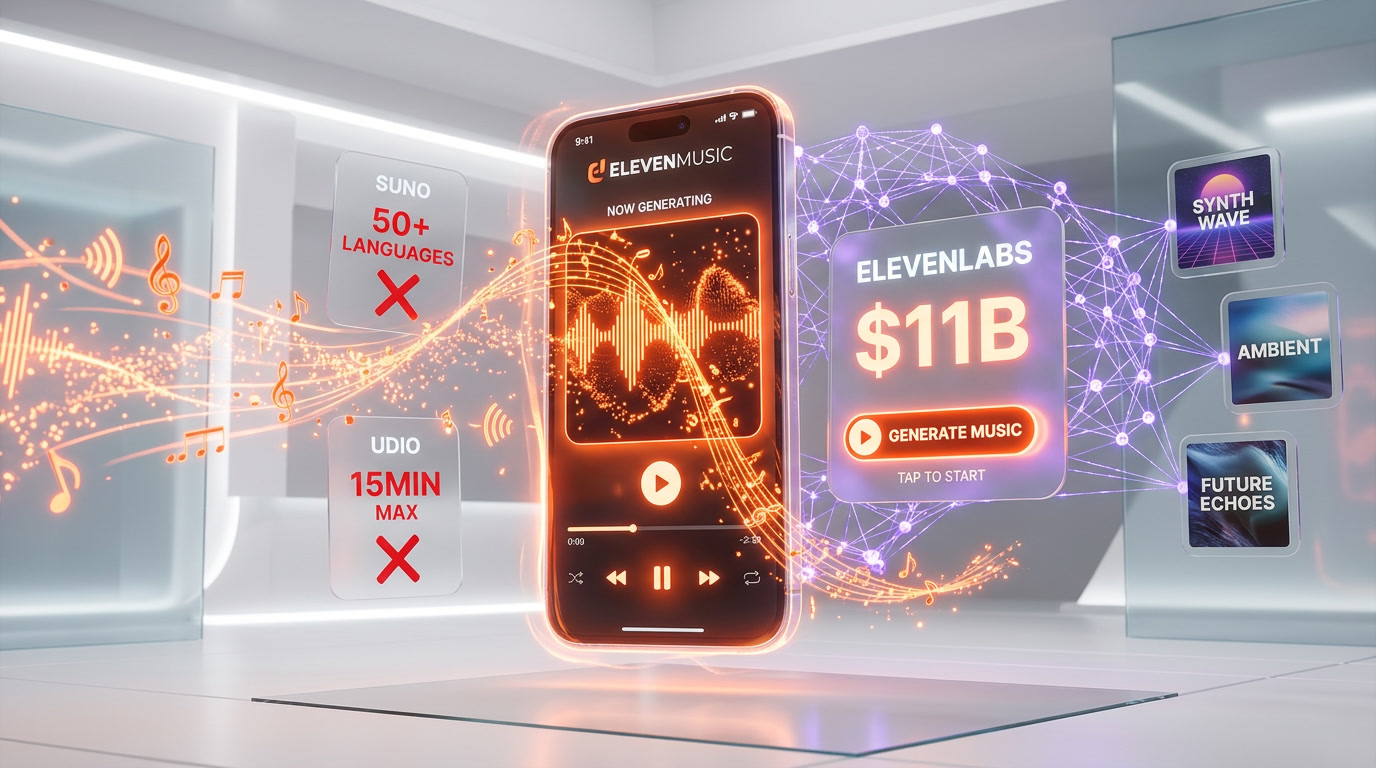
ElevenMusic is an iOS app by ElevenLabs that generates full songs from text prompts. Launched April 1, 2026. Free tier allows 7 songs per day. Pro subscription costs $9.99 per month for 500 tracks, 500+ GB storage, and expanded styles. ElevenLabs, valued at $11 billion after a $500M Series D in February 2026, is now competing directly with Suno and Udio in the AI music generation market.
What Is ElevenMusic and Why It Matters
ElevenLabs, the company best known for its industry-leading text-to-speech and voice cloning technology, has officially entered the AI music generation market. ElevenMusic launched on the App Store on April 1, 2026, after quietly appearing in listings for several weeks prior. The app allows anyone to generate complete songs — vocals, instrumentals, lyrics — from natural language prompts.
This is not a minor product extension. We use ElevenLabs daily for voice generation across multiple projects, and this move signals something larger: the company is building toward becoming the dominant force in all AI-generated audio, not just speech. With $330 million in annual recurring revenue and an $11 billion valuation, ElevenLabs has the resources and the technology to make a serious run at Suno and Udio — the two incumbents that have defined the AI music generation category since 2024.
ElevenMusic Pricing vs. Suno vs. Udio
Price is often the first question when a new AI music tool enters the market. Here is how ElevenMusic stacks up against its direct competitors as of April 2026.
| Feature | ElevenMusic (Free) | ElevenMusic (Pro) | Suno (Free) | Suno (Pro) | Udio (Free) | Udio (Standard) |
|---|---|---|---|---|---|---|
| Price | $0 | $9.99 per month ($95.90 per year) | $0 | $10 per month ($8 per month annual) | $0 | ~$10 per month |
| Daily/Monthly Songs | 7 songs per day | 500 tracks per month | ~10 songs per day (50 credits) | ~500 songs per month (2,500 credits) | Limited credits | ~1,200 songs per month (2,400 credits) |
| Max Song Duration | 5 min | 5 min | Up to 8 min | Up to 8 min | Up to 15 min | Up to 15 min |
| Commercial Use | Limited | Yes (broad) | No | Yes | No | Yes |
| Stems/Vocal Separation | No | Yes | No | Yes (Pro+) | No | Yes |
| Vocal Languages | 4 (EN, ES, DE, JA) | 4 (EN, ES, DE, JA) | 50+ | 50+ | Multiple | Multiple |
| Platform | iOS / Web | iOS / Web | Web / Mobile | Web / Mobile | Web | Web |
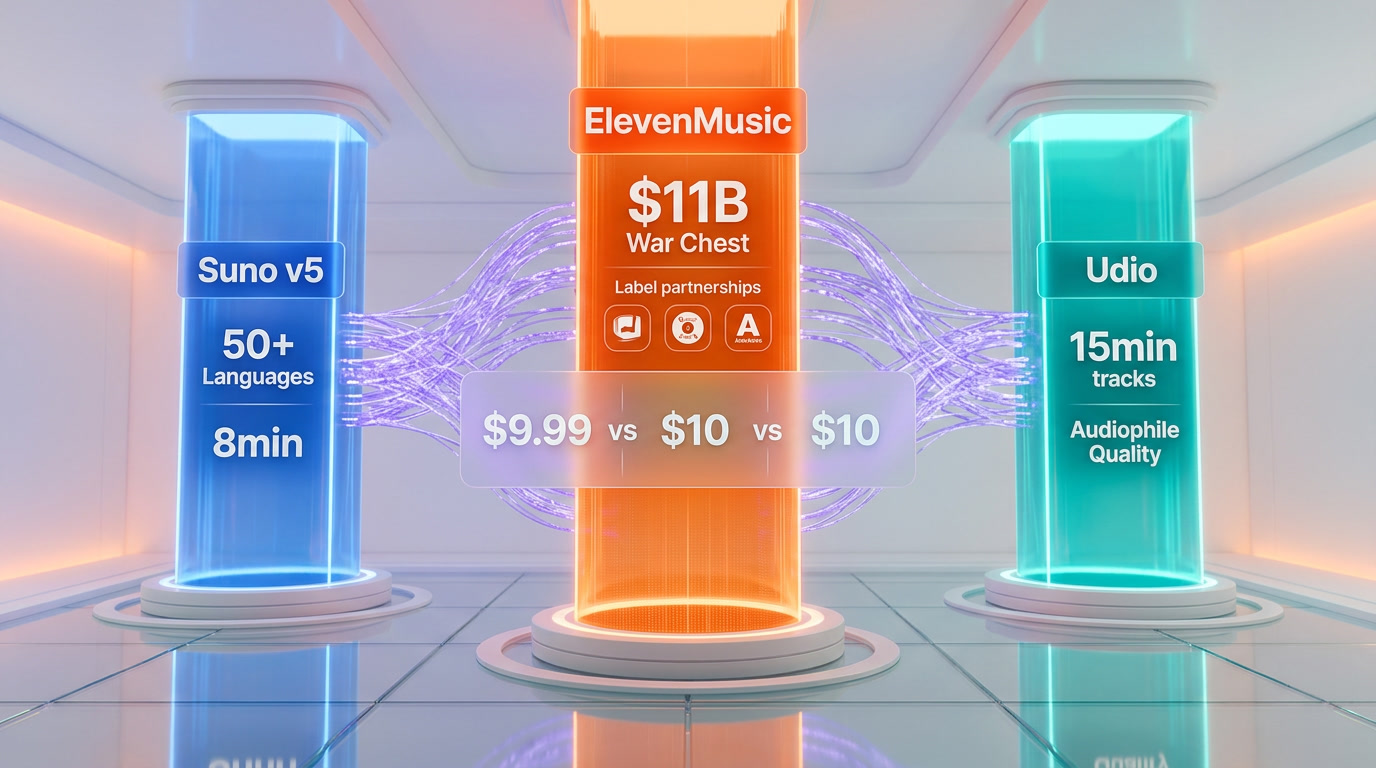
The pricing is competitive. At $9.99 per month, ElevenMusic Pro matches Suno Pro almost dollar-for-dollar. The annual plan at $95.90 (effectively $7.99 per month) undercuts both competitors. However, the free tier is more restrictive — 7 songs per day versus Suno's ~10 — and the maximum song duration of 5 minutes trails Suno's 8 minutes and Udio's 15 minutes.
Core Features We Identified
Text-to-Music Generation
The core functionality works exactly as you would expect from a 2026 AI music tool: type a natural language prompt describing what you want, and the model generates a complete track. Users can specify genre, mood, tempo, instrumentation, and lyrical themes. The model understands nuanced prompts and can generate songs across virtually any style — from lo-fi hip-hop to orchestral film scores.
We found the generation quality to be strong. The audio output is delivered at 44.1kHz sample rate with 128-192kbps bitrate in MP3 format. Pro, Scale, Business, and Enterprise plans offer studio-grade exports. The sound is clean, well-mixed, and demonstrates the audio engineering expertise ElevenLabs has built through years of voice synthesis research.
Section-by-Section Editing
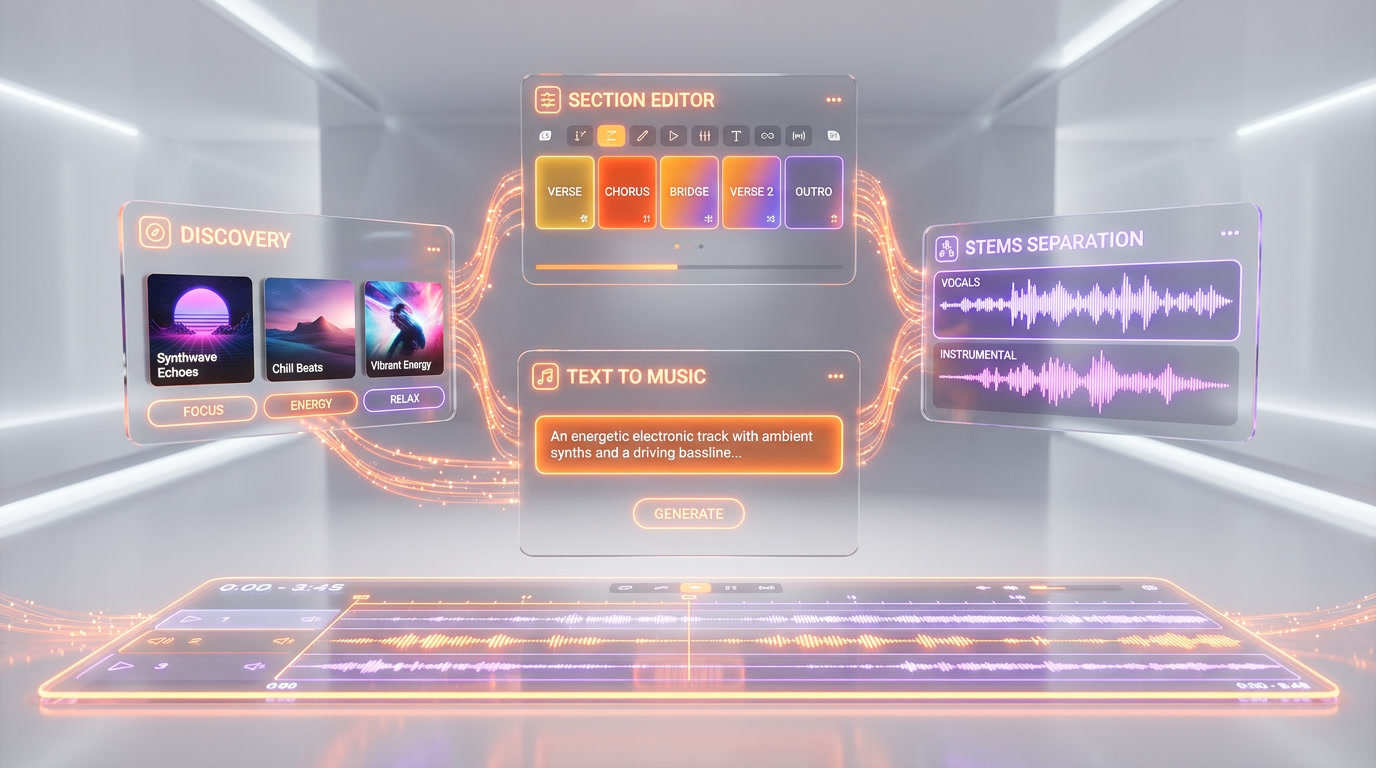
This is where ElevenMusic differentiates itself from Suno and Udio. The app features a modular editing system that lets you regenerate individual sections of a song — verse, chorus, bridge, breakdown, intro, outro — without rebuilding the entire track. You can modify lyrics for a specific verse, change the instrumental arrangement of a chorus, or extend a section, all while keeping the rest of the composition intact.
For anyone who has used Suno or Udio and been frustrated by the all-or-nothing approach to regeneration, this is a meaningful workflow improvement. It brings AI music generation closer to how actual producers think about song construction.
Stems and Vocal Separation
Pro subscribers can download not just the full song but also separated vocals, instrumentals, and individual stems. This makes ElevenMusic immediately useful for video producers, podcast creators, and game developers who need specific audio components rather than complete songs.
Discovery and Remix Platform
ElevenMusic is not just a generation tool — it is also a discovery platform. The app includes live stations, pre-created albums, and daily mixes organized by mood categories: Focus, Energy, Relax, Late Night, Cosmic, and Chill. There are also top charts, trending sections, and new releases — features borrowed directly from the Spotify and Apple Music playbook.
Any song on the platform can be remixed by other users using text prompts. Remixes count toward the daily generation limit. This social-generative hybrid approach is interesting: it creates a content flywheel where every song generated becomes potential source material for the community.
Music Finetunes
One of the more advanced features documented in ElevenLabs' technical docs is Music Finetunes — the ability to fine-tune the music model using your own original audio. This lets you create a personalized generation model that reflects your unique sonic identity. For independent artists and producers, this could be a significant differentiator, allowing them to use AI as an extension of their existing creative voice rather than a generic replacement.
Commercial Licensing: The Label-Backed Advantage
Here is where ElevenMusic has a structural advantage that neither Suno nor Udio can currently match. ElevenLabs has proactively partnered with major music industry players. The company has announced deals with Kobalt Music and Merlin, allowing artists and songwriters they represent to participate in model development and share in AI music revenue streams.
In January 2026, ElevenLabs released "The Eleven Album" — a collaborative project featuring AI-generated songs with contributions from Liza Minnelli, Art Garfunkel, and other established artists. The album was distributed on Spotify with artists retaining full ownership, streaming revenue, and commercial rights. This is not just a PR stunt; it demonstrates a licensing framework that treats artists as partners rather than training data.
For commercial users, this matters enormously. Music generated with ElevenMusic Pro is cleared for broad commercial use — film, television, podcasts, social media, advertisements, gaming. While Suno and Udio have settled their respective lawsuits with major labels (Warner with Suno, UMG with Udio), ElevenLabs built its relationships from day one. That proactive approach creates a cleaner legal foundation for commercial users.
Why ElevenLabs Is Doing This Now
The timing is strategic. ElevenLabs closed a $500 million Series D round in February 2026 at an $11 billion valuation, led by Sequoia Capital with participation from Andreessen Horowitz, Iconiq, Lightspeed Venture Partners, and others. The company ended 2025 with $330 million ARR, driven by enterprise adoption from companies like Deutsche Telekom and Revolut.
But the voice AI market faces inevitable commoditization. OpenAI, Google, and Meta all have competitive text-to-speech offerings. ElevenLabs' CEO has been clear: expanding into music generation is a way to "grow and protect itself from the eventual commoditization of AI audio models." By owning the full audio generation stack — speech, sound effects, and now music — ElevenLabs creates a moat that pure voice companies cannot match.
The iOS-first launch is also telling. While the service is available on the web at elevenlabs.io/music, the dedicated mobile app signals consumer ambitions beyond the professional/enterprise market. ElevenLabs is betting that music generation will become a mainstream mobile activity, not just a niche creator tool.
Current Limitations
We need to be honest about what ElevenMusic cannot do yet.
- Language support is limited. Vocals currently work in English, Spanish, German, and Japanese — only 4 languages versus Suno's 50+. For creators targeting non-Western markets, this is a significant gap.
- Song duration caps at 5 minutes. Suno supports up to 8 minutes, and Udio up to 15. For extended compositions, ambient tracks, or live-style recordings, ElevenMusic falls short.
- Generation speed is slower. Based on reports and our early testing, ElevenMusic takes noticeably longer to generate tracks compared to Suno, which can produce a 90-second song in under 60 seconds.
- App Store rating is 2.7/5. With only 3 ratings at launch, it is too early to draw conclusions, but one reviewer noted issues with downloading generated songs. Version 1.0.3 has been released with performance improvements.
- iOS-first creates a gap. There is no dedicated Android app yet. Web access exists, but the mobile-first strategy leaves Android users without the full experience.
- Free tier is more restrictive. 7 songs per day versus Suno's ~10 (50 credits) means casual users get less to experiment with before hitting the paywall.
Who Should Pay Attention
Video producers and content creators who need royalty-free, commercially cleared music for their projects. ElevenMusic's label partnerships provide stronger legal protection than competitors.
Independent musicians interested in using AI as a creative collaborator rather than a replacement. The Music Finetunes feature and section-by-section editing cater to this audience.
Existing ElevenLabs users who already pay for voice generation. If ElevenLabs integrates music generation into its existing subscription tiers (currently separate), the value proposition becomes extremely compelling.
Enterprise media companies that need scalable audio production with clear commercial licensing. The Kobalt and Merlin partnerships make ElevenMusic the safest option from a rights perspective.
What This Means for the AI Music Market
The AI music generation space just got its most well-funded competitor. Suno has been the dominant player through 2024-2025 with its fast generation and massive language support. Udio has carved out a niche for audiophiles who prioritize sound quality. ElevenMusic enters with a different thesis: that the future of AI music is not just generation but an integrated ecosystem of creation, editing, discovery, and commercial licensing.
We expect the competitive dynamics to intensify through 2026. Suno recently shipped v5 with improvements to generation quality. Udio continues to refine its audio fidelity. Google has its own music generation models in development. And now ElevenLabs brings its $11 billion war chest and deep audio expertise to the fight.
For users, more competition means better tools, lower prices, and faster innovation. For the music industry, the label partnerships ElevenLabs has pioneered could become the template for how AI music companies coexist with traditional rights holders.
Our Early Take
We have been testing ElevenMusic since its launch. The audio quality reflects the same engineering excellence we have come to expect from ElevenLabs' voice products. The section-by-section editing is genuinely useful and something we wish Suno had. The commercial licensing story is the strongest in the industry.
But the limited language support, slower generation speed, and 5-minute cap hold it back from being a Suno replacement today. It is a strong 1.0 product from a company that has the talent, funding, and strategic vision to iterate rapidly.
We will be publishing a full ElevenMusic review with detailed testing results, audio quality comparisons, and scoring in the coming weeks. For now, if you are an iPhone user curious about AI music generation, the free tier gives you 7 songs per day to explore — enough to form your own opinion.
Frequently Asked Questions
Is ElevenMusic free to use?
Yes. ElevenMusic offers a free tier that allows up to 7 songs per day generated from text prompts. Remixes count toward this daily limit. The Pro subscription at $9.99 per month unlocks 500 tracks monthly, 500+ GB storage, and access to additional styles and moods.
How does ElevenMusic compare to Suno?
ElevenMusic Pro costs $9.99 per month versus Suno Pro at $10 per month, making them price-comparable. Suno offers more languages (50+ vs 4), longer songs (8 min vs 5 min), and faster generation. ElevenMusic offers better section editing, stems separation, and stronger commercial licensing through label partnerships with Kobalt Music and Merlin.
Can I use ElevenMusic songs commercially?
Free tier songs have limited commercial use. Pro subscribers get broad commercial rights cleared for film, television, podcasts, social media, advertisements, and gaming. ElevenLabs' partnerships with Kobalt Music and Merlin provide a stronger licensing foundation than most AI music competitors.
Is ElevenMusic available on Android?
As of April 2026, ElevenMusic is iOS-only (requires iOS 18.0 or later). A web version is accessible at elevenlabs.io/music. There is no dedicated Android app yet, though it is expected to follow.
What languages does ElevenMusic support for vocals?
ElevenMusic currently supports vocals in English, Spanish, German, and Japanese. This is significantly fewer than Suno's 50+ languages. ElevenLabs is expected to expand language support given their existing multilingual capabilities in voice synthesis.
Can I edit individual sections of a generated song?
Yes. ElevenMusic features modular section editing that lets you regenerate specific parts — verse, chorus, bridge, intro, outro — without rebuilding the entire track. You can modify lyrics, change instrumental arrangements, and adjust durations for individual sections.
What is the maximum song length on ElevenMusic?
ElevenMusic supports songs between 3 seconds and 5 minutes. You can set fixed durations (30 seconds, 1 minute, etc.) or use Auto mode for dynamically determined length. Suno allows up to 8 minutes and Udio up to 15 minutes by comparison.
How is ElevenLabs different from other AI music companies?
ElevenLabs is primarily an AI voice and audio company valued at $11 billion, with $330 million ARR. Unlike Suno and Udio which are music-first companies, ElevenLabs brings deep audio engineering expertise from voice synthesis, existing enterprise relationships, and proactive label partnerships that differentiate its commercial licensing model.
Frequently Asked Questions
Is ElevenMusic better than Suno for AI music generation?
ElevenMusic and Suno are closely matched at the Pro tier ($9.99 per month vs $10 per month). ElevenMusic's key advantage is section-by-section editing — you can regenerate individual verses or choruses without rebuilding the entire track, which Suno does not offer. However, Suno supports songs up to 8 minutes vs ElevenMusic's 5-minute cap, and Suno covers 50+ vocal languages vs ElevenMusic's 4 (EN, ES, DE, JA). On commercial licensing, ElevenMusic has proactive label deals with Kobalt Music and Merlin, providing a cleaner legal foundation than Suno, which settled its Warner lawsuit after the fact.
How does ElevenMusic compare to Udio in pricing and features?
ElevenMusic Pro costs $9.99 per month (or $95.90 per year, ~$7.99 per month) for 500 tracks per month, while Udio Standard is ~$10 per month for approximately 1,200 songs per month (2,400 credits). Udio allows songs up to 15 minutes — three times ElevenMusic's 5-minute limit. However, ElevenMusic's section-by-section editing, Music Finetunes (custom model training on your own audio), and integrated discovery platform are not available in Udio, making it a stronger option for producers who want granular creative control over their AI-generated tracks.
Who should use ElevenMusic?
ElevenMusic is best suited for video producers, podcast creators, game developers, and independent artists who need commercially licensed AI music without legal risk. The Pro tier ($9.99 per month) includes stems and vocal separation, making it directly useful in media production workflows. Music Finetunes appeals to artists who want to train a personalized generation model on their own sonic identity. The free tier (7 songs per day) is ideal for casual creators testing AI music for the first time before committing to a subscription.
What are ElevenMusic's limitations compared to Suno and Udio?
ElevenMusic has three significant limitations vs. its competitors: (1) Maximum song duration is 5 minutes, compared to Suno's 8 minutes and Udio's 15 minutes. (2) Vocal language support is limited to just 4 languages — English, Spanish, German, and Japanese — while Suno and Udio support 50+ languages. (3) The free tier allows only 7 songs per day, slightly less than Suno's ~10. Additionally, ElevenMusic launched iOS-first with no dedicated Android app announced, limiting reach vs. Suno and Udio's full web and mobile coverage.
Does ElevenMusic integrate with Spotify or other music distribution platforms?
ElevenMusic does not currently offer direct integration with Spotify or Apple Music for export. However, ElevenLabs demonstrated distribution capability in January 2026 through 'The Eleven Album' — distributed on Spotify featuring Liza Minnelli and Art Garfunkel, with artists retaining full streaming revenue and commercial rights. Pro subscribers export full tracks and stems as MP3 (44.1kHz, 128–192kbps), which can be uploaded to any standard distributor such as DistroKid or TuneCore.
Can I use ElevenMusic for commercial projects like ads, films, or games?
Yes. ElevenMusic Pro ($9.99 per month) includes broad commercial use rights covering film, television, podcasts, social media, advertisements, and gaming. ElevenLabs proactively established licensing partnerships with Kobalt Music and Merlin before launch, giving commercial users a cleaner legal foundation than Suno (which settled with Warner Music) or Udio (which settled with UMG). The free tier has limited commercial rights and is not recommended for monetized projects.
What is ElevenMusic's Music Finetunes feature and how does it compare to Suno and Udio?
Music Finetunes is an advanced ElevenMusic feature that lets you fine-tune the music generation model on your own original audio recordings, producing a personalized model that reflects your unique sonic identity. Neither Suno nor Udio currently offer an equivalent capability. This makes ElevenMusic particularly relevant for independent artists and producers who want AI generation to complement and extend their established creative voice rather than produce generic, style-agnostic output.
Why did ElevenLabs launch ElevenMusic in April 2026 after years of focusing on voice AI?
ElevenLabs launched ElevenMusic strategically following a $500 million Series D in February 2026 at an $11 billion valuation led by Sequoia Capital with participation from Andreessen Horowitz, Iconiq, and Lightspeed. With $330 million in ARR from voice AI, the company faces commoditization pressure from OpenAI, Google, and Meta. By entering music generation, ElevenLabs is building toward owning the full AI audio stack — speech, sound effects, and music — creating a competitive moat that pure voice companies cannot replicate.