What Happened
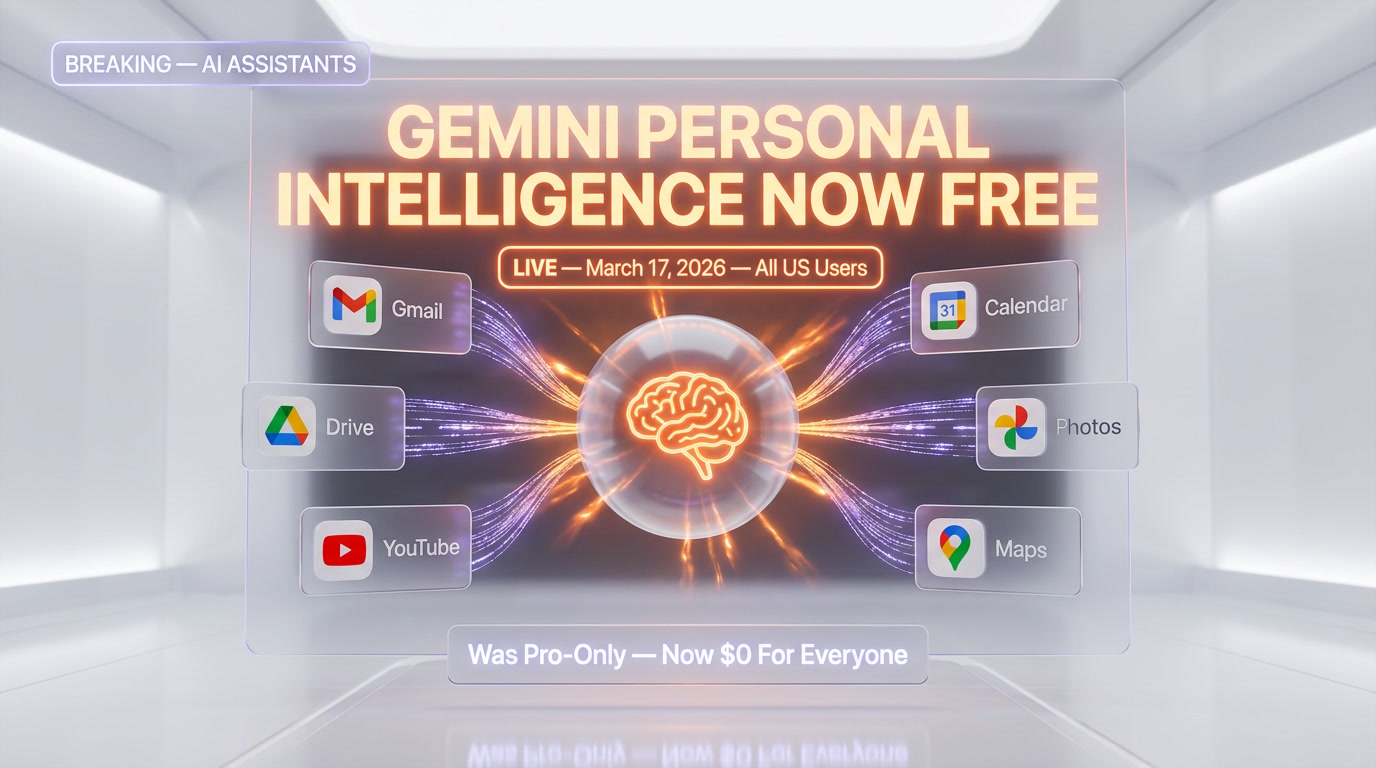
Google began rolling out Gemini Personal Intelligence to all US users on March 17, 2026. This is a major shift — the feature was previously locked behind the Gemini Pro subscription, and now it is available at no cost to anyone with a personal Google account in the United States.
According to Google's official announcement on blog.google, Personal Intelligence allows Gemini to tap into your Gmail, Google Calendar, Google Drive, Google Photos, YouTube, and Google Maps to provide personalized, context-aware responses. Instead of giving you generic answers, Gemini can now reference your actual emails, upcoming meetings, stored documents, photos, watch history, and location data to deliver responses tailored specifically to you.
We have been following Google's Gemini development closely, and this move represents the most significant expansion of Gemini's capabilities for free-tier users since the platform launched. The feature is available across the Gemini app, Chrome browser, and Google's AI Mode in Search.
Critically, Personal Intelligence is off by default. Users must explicitly opt in to enable the feature, and it is only available for personal Google accounts — not Google Workspace accounts. Google has stated that the feature does not directly train on your Gmail or Photos data, though it does use that data to generate personalized responses in real time.
Why It Matters
This is Google playing its strongest card: the fact that it already has more personal data about most users than any other company on Earth. By connecting Gemini to Gmail, Calendar, Drive, Photos, YouTube, and Maps, Google is creating the most deeply personalized AI assistant available — and making it free undercuts every competitor charging for similar capabilities.
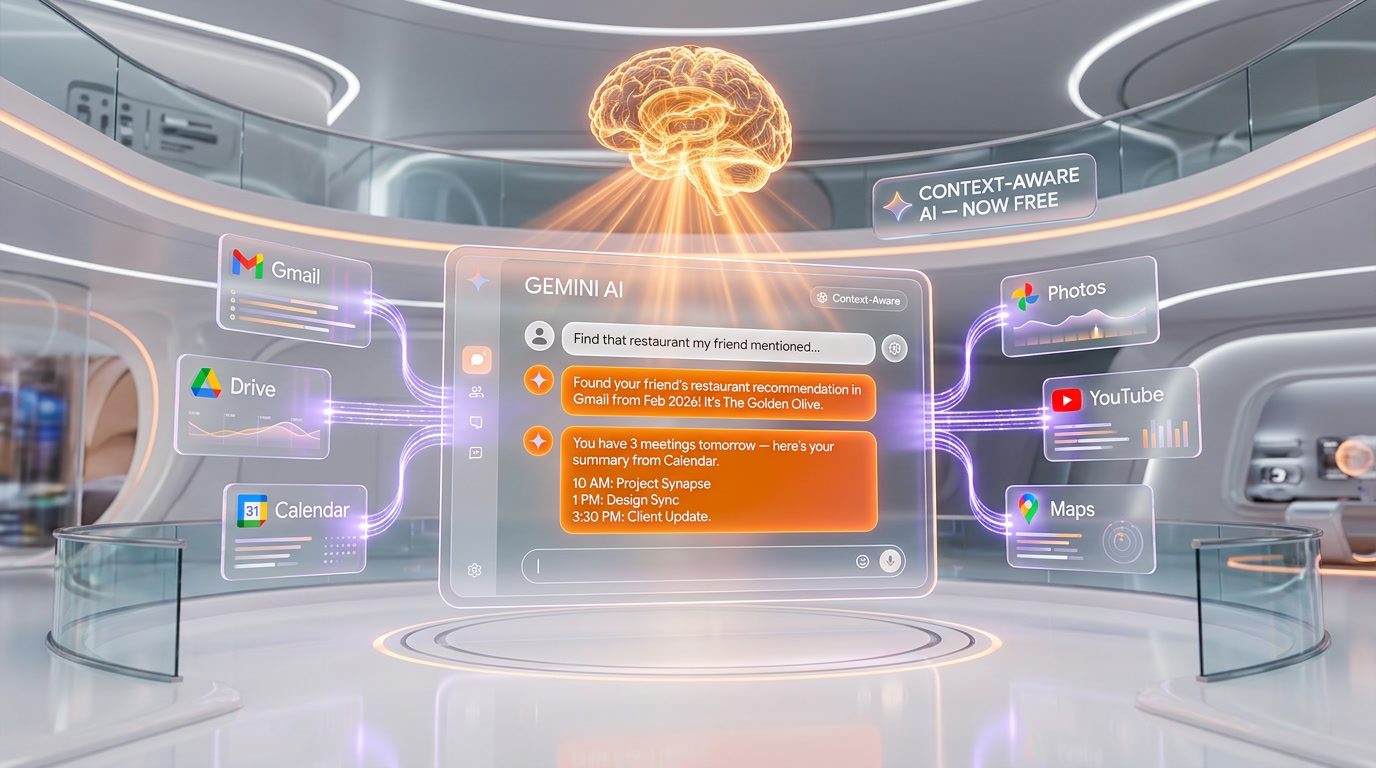
Think about what this means in practice. You can ask Gemini "What was that restaurant my friend recommended last month?" and it can search your Gmail for the relevant message. You can say "Summarize my meetings for tomorrow" and it pulls directly from your Calendar. You can ask "Find the presentation I worked on about Q4 results" and it searches your Drive. This is not theoretical — this is the kind of context-aware AI interaction that makes a genuine difference in daily productivity.
The strategic implications are significant. By making Personal Intelligence free, Google is accomplishing several things simultaneously. First, it dramatically increases the value proposition of the free Gemini tier, making it harder for users to justify paying for competing AI assistants. Second, it deepens user engagement with the Google ecosystem — the more you use Gemini with your personal data, the more valuable Google's platform becomes to you. Third, it creates a powerful incentive for users on other platforms to consolidate around Google's services.
For the AI assistant market, this is a competitive earthquake. ChatGPT, Claude, and other AI assistants simply do not have access to the breadth of personal data that Google can offer through its ecosystem. While competitors can integrate with some services through APIs, none can match the native, seamless integration that Google has with its own products.
The privacy dimension is equally important. Google is clearly aware of the sensitivity here — Personal Intelligence is opt-in by default, and the company has emphasized that it does not use Gmail or Photos data for model training. Whether users trust these assurances will be a key factor in adoption. We have seen enough data privacy controversies to know that trust, once lost, is difficult to rebuild.
How It Compares
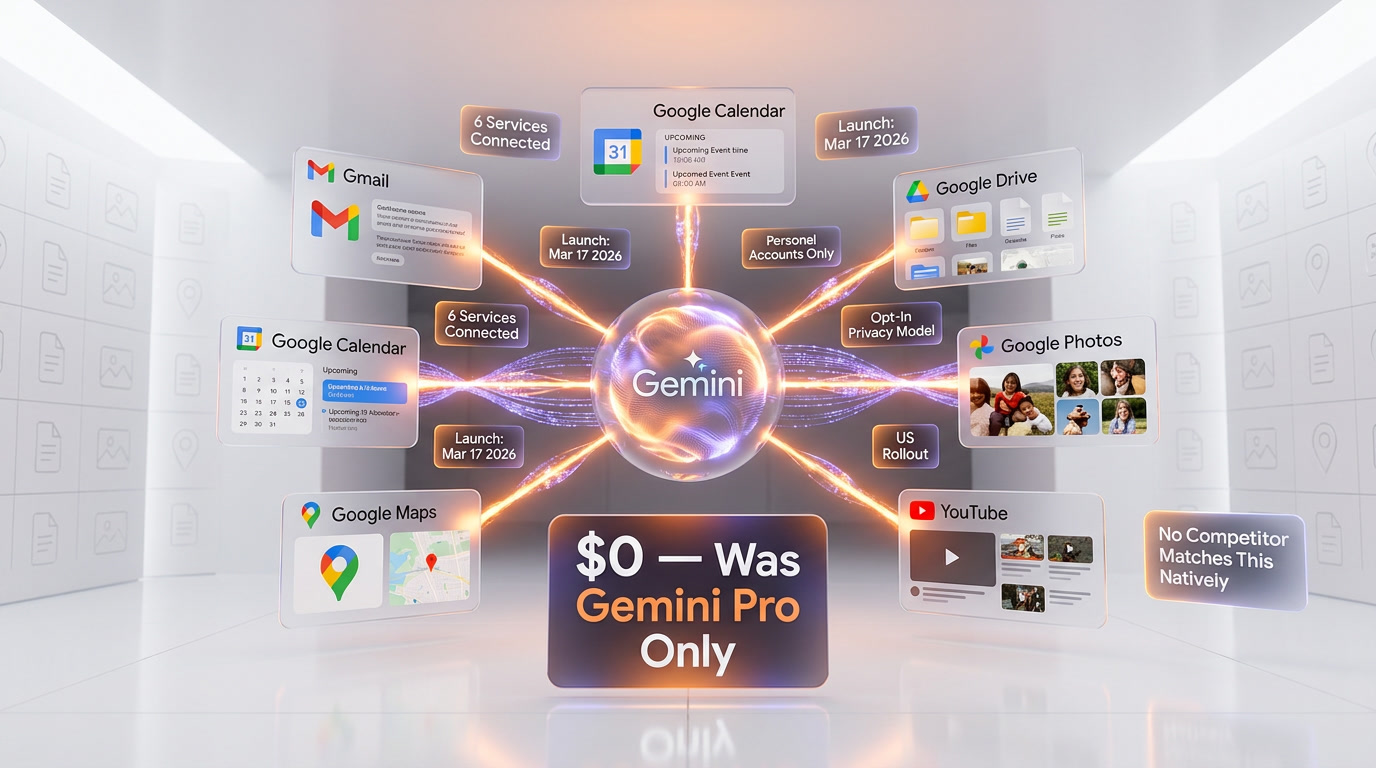
No other AI assistant currently offers this level of integrated personal context for free. ChatGPT Plus offers some integration capabilities through plugins and memory features, but accessing your Gmail, Calendar, and Drive requires third-party connections that are less seamless and less comprehensive than what Google is offering natively.
Apple's Siri with Apple Intelligence provides deep device-level integration, but it is limited to the Apple ecosystem and does not have the same breadth of cloud service data that Google can access. Microsoft's Copilot integrates well with Microsoft 365, but primarily for business users through paid subscriptions.
The free pricing is the real differentiator. Previously, accessing Gemini's personal context features required a Gemini Pro subscription. By removing that barrier, Google is making a clear statement: personal AI assistance should be a default feature, not a premium upsell. This puts pressure on every competitor to either match the offering or clearly articulate why their paid alternatives are worth the premium.
The breadth of connected services is also unmatched. Six major Google services — each with deep data about different aspects of your life — create a composite picture of your needs, preferences, and context that no single competing service can replicate. Gmail knows your communications, Calendar knows your schedule, Drive knows your work, Photos knows your memories, YouTube knows your interests, and Maps knows your locations.
Our Take
We have been following Gemini's evolution closely, and Personal Intelligence going free is exactly the kind of move we expected Google to make — but the timing is aggressive. By offering this for free before competitors have matching capabilities at any price, Google is establishing a significant lead in the personalized AI assistant space.
Here is what excites us: the practical utility. An AI assistant that knows your email history, your schedule, your documents, your photos, and your interests can provide responses that are genuinely useful in ways that generic AI interactions simply cannot match. The gap between a personalized response and a generic one is enormous, and Google just made that gap free to cross.
Here is what concerns us: the privacy trade-off. Opting into Personal Intelligence means giving Gemini real-time access to some of the most sensitive data in your digital life. Google says it is not using this data for training, and the opt-in design shows they are taking consent seriously. But the concentration of this much personal data access in a single AI system is unprecedented, and users should make informed decisions about whether the convenience is worth the access they are granting.
We are also watching the competitive response. This move puts ChatGPT, Claude, and every other AI assistant on notice. Google has a structural advantage that is extremely difficult to replicate — years of accumulated personal data across multiple services, combined with native platform integration. Competing on features or model quality is one thing. Competing on the depth of personal context is a different game entirely.
The limitation to personal Google accounts (not Workspace) is interesting. It suggests Google is keeping enterprise and consumer strategies separate, which makes sense given the different privacy and compliance requirements. We expect a Workspace version to follow, likely as a paid feature integrated with existing Workspace subscriptions.
What's Next
The rollout is currently US-only, but we fully expect Google to expand Personal Intelligence to other markets in the coming months. International availability, additional language support, and potential Workspace integration are all likely on the roadmap.
We also expect Google to deepen the integrations over time. Today it connects to six services — tomorrow it could include Google Contacts, Google Tasks, Google Keep, and Google Finance. Each additional connection makes the personalized experience more comprehensive and more valuable.
For users, the decision is straightforward: if you are comfortable with the privacy trade-off, Personal Intelligence is worth enabling. The practical benefits of having an AI assistant that understands your personal context are real and immediate. If privacy is a higher priority, the opt-in design means you lose nothing by waiting.
For the industry, this is a watershed moment. Google has demonstrated that it is willing to give away capabilities that competitors charge for, leveraging its ecosystem advantage to reshape the market. How ChatGPT, Claude, and others respond will define the competitive landscape for AI assistants in 2026 and beyond. We will be tracking every development and keeping you informed.
Frequently Asked Questions
Is Gemini Personal Intelligence free?
Yes, Gemini Personal Intelligence is rolling out free to all US users starting March 17, 2026. The feature is being gradually enabled across accounts, so not all users will see it immediately, but there is no paid tier required.
What data does Gemini Personal Intelligence access?
Gemini Personal Intelligence can connect to Gmail, Google Calendar, Google Drive, Google Photos, YouTube, and Google Maps. This cross-service integration allows it to provide contextual responses based on your emails, schedules, files, photos, and location history.
Is my data safe with Gemini Personal Intelligence?
The feature is off by default and requires explicit user opt-in. Google states that Gemini does not directly train its AI models on Gmail or Photos data. Users maintain granular control over which services are connected and can revoke access at any time.
How does Gemini Personal Intelligence differ from regular Gemini?
Regular Gemini operates as a general-purpose AI assistant without access to your personal data. Personal Intelligence connects across your Google ecosystem — emails, calendar, files, photos — to deliver responses that are contextually aware of your specific life and schedule.