What Happened
Google Stitch just received what the company is calling its biggest update yet — and after spending time with the new features, we agree. What started as a text-to-UI generator has evolved into a full AI-native design platform, and the implications for the design tool market are significant.
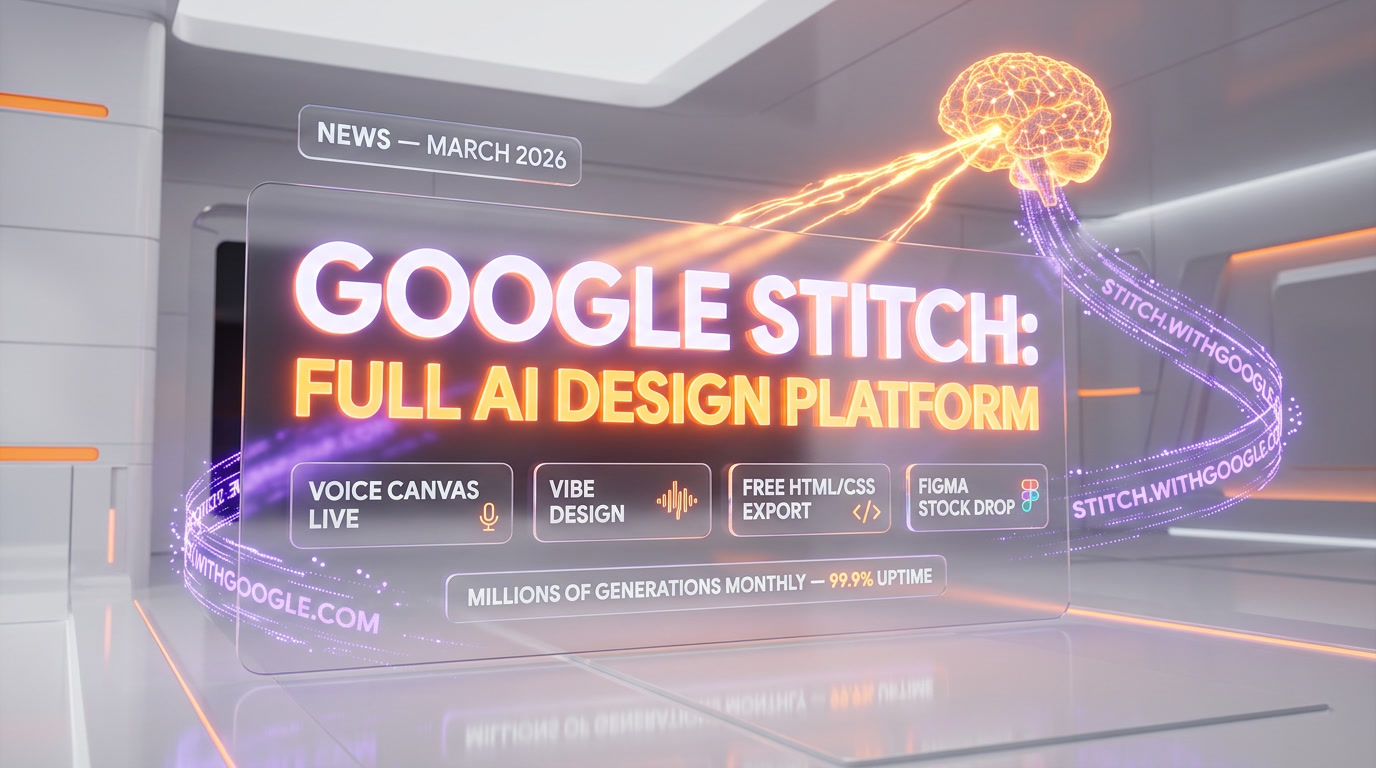
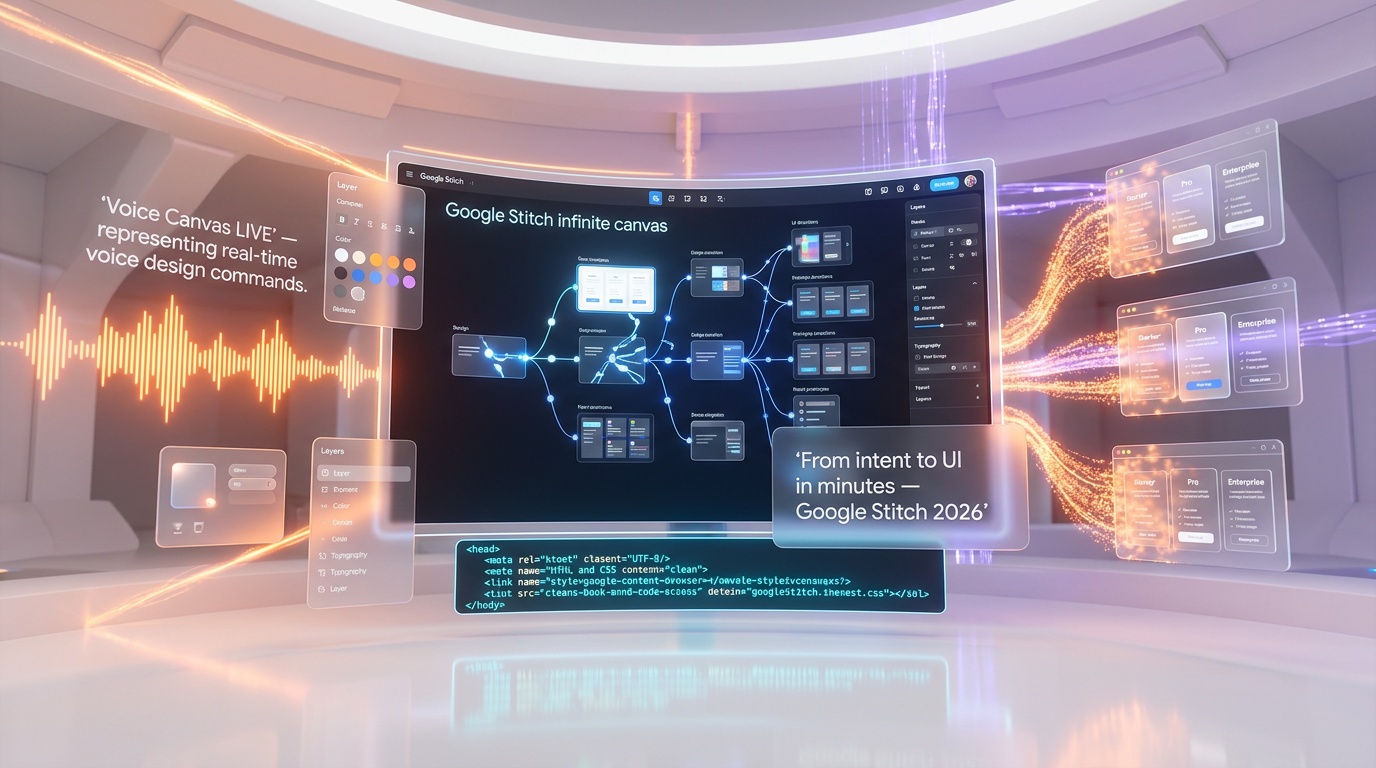
The March 2026 update, detailed at stitch.withgoogle.com, introduces several major capabilities. The headline feature is Voice Canvas — you can now speak directly to your canvas, and the AI makes live updates in real time as you describe what you want. Say "make the header larger and change the primary color to blue," and it happens instantly. Say "add a pricing section with three tiers below the hero," and the UI appears. This is not voice-to-text-to-action with a delay — it is genuinely live, responsive design through natural language.
Then there is what Google is calling "vibe design." Instead of starting with wireframes or mockups, you start with business objectives. Tell Stitch what your product does, who your target audience is, and what action you want users to take, and it generates complete UI designs optimized for those goals. This is a fundamental rethinking of the design process — starting from intent rather than implementation.
The platform now features an AI-native infinite canvas that lets you explore multiple design directions simultaneously. You can branch, compare, and iterate across different versions without losing any work. And when you are ready to ship, Stitch generates clean HTML and CSS code that you can export directly.
The most disruptive detail? It is completely free. No subscription tiers, no premium features behind a paywall. Everything at stitch.withgoogle.com is available to everyone at no cost.
Why It Matters
The design tool market has been dominated by Figma for years, with Sketch and Adobe XD as secondary players. Google Stitch is not trying to be a better Figma — it is trying to make the entire paradigm of manual UI design feel outdated. And the market noticed: Figma stock fell following the announcement.
Here is why this matters beyond the obvious competitive dynamics. Voice Canvas represents a genuinely new interaction model for design. Every existing design tool — Figma included — is fundamentally built around the same paradigm: manual placement of elements on a canvas using mouse and keyboard. Voice Canvas does not replace that paradigm entirely, but it adds a layer of AI-assisted creation that dramatically accelerates the design process.
The "vibe design" concept is equally significant. Starting from business objectives rather than wireframes inverts the traditional design workflow. Instead of a designer interpreting a brief and manually creating layouts, the AI handles the translation from intent to implementation. The designer's role shifts from production to curation and refinement — which is arguably a more valuable use of their expertise.
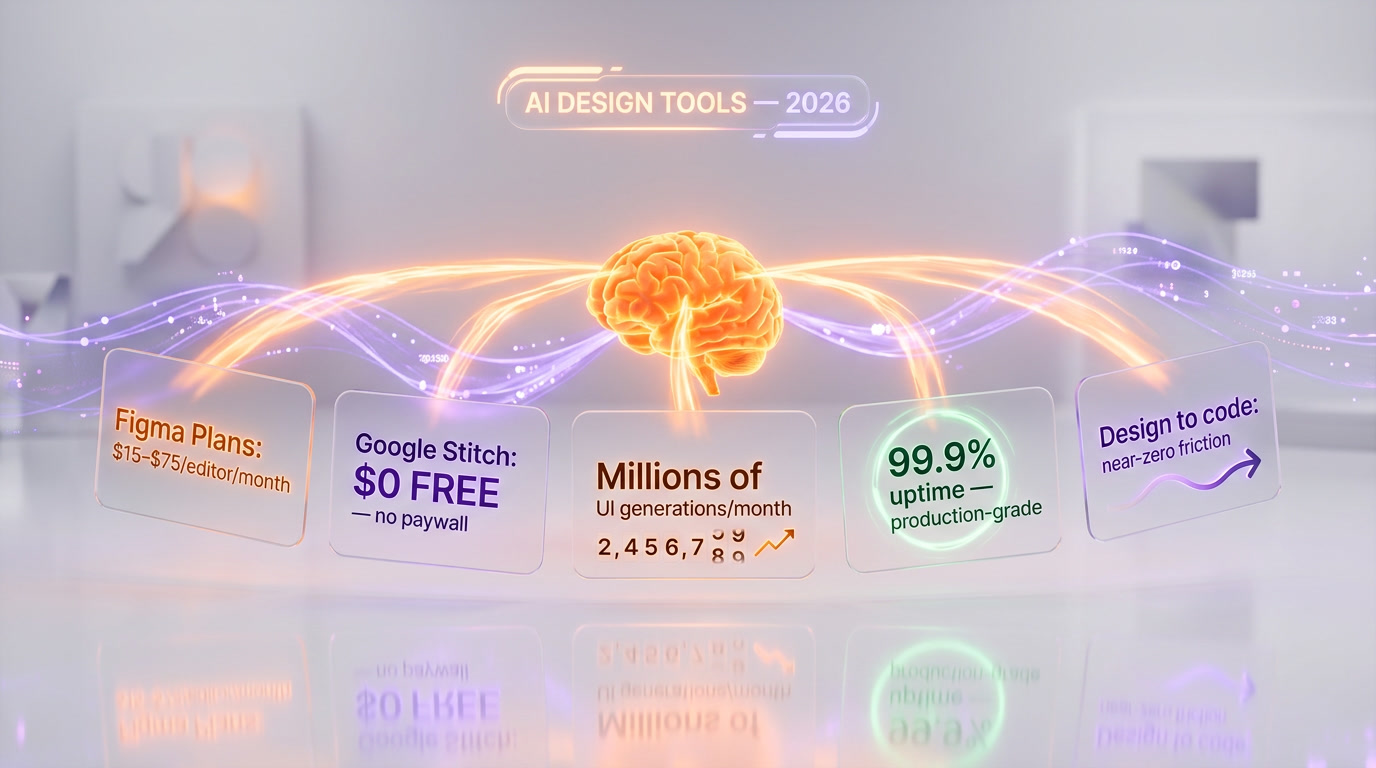
The free pricing is the nuclear option. Figma charges $15-75 per editor per month for its professional plans. Adobe XD requires a Creative Cloud subscription. By offering Stitch for free, Google is making an explicit bet that the value of the platform lies not in subscription revenue but in ecosystem engagement and the data insights that come from millions of designers using their tools.
The scale numbers back this up. According to Google, Stitch is already processing millions of generations monthly with 99.9% uptime. This is not a beta experiment — it is a production-grade platform running at scale, backed by Google's infrastructure.
For developers, the HTML and CSS code generation is a practical game-changer. Instead of a design handoff process that requires developers to interpret Figma mockups and recreate them in code, Stitch generates the code directly. The gap between design and implementation — historically one of the most friction-filled parts of product development — is being compressed to near zero.
How It Compares
Figma remains the gold standard for collaborative design workflows, component libraries, and design systems at scale. Nothing in Stitch's current feature set replaces Figma's depth in these areas. Enterprise design teams with established Figma workflows, extensive component libraries, and design system governance will not be switching overnight.
Where Stitch excels is in the early stages of the design process — ideation, rapid prototyping, and initial concept development. The combination of Voice Canvas, vibe design, and AI-powered generation means you can go from a business objective to a functional prototype in minutes rather than hours or days. For startups, solo founders, and small teams without dedicated designers, this is transformative.
The code export capability also sets Stitch apart. While Figma offers developer handoff tools and plugins for code generation, the output quality has always been inconsistent. Stitch generating clean HTML and CSS natively is a meaningful advantage for teams that need to move quickly from concept to code.
The free pricing creates an interesting dynamic. For individual designers and small teams evaluating tools, the cost barrier to trying Stitch is zero. For enterprise teams, the question becomes whether Stitch's AI-first approach can complement or eventually replace parts of their Figma workflow. We expect many teams to use both — Stitch for rapid ideation and prototyping, Figma for detailed design and production-ready assets.
Our Take
We have been following Stitch since its initial launch as a text-to-UI experiment, and this update is a genuine leap. Voice Canvas is not a gimmick — speaking design changes into existence feels like a fundamentally different way of working, and once you experience it, going back to manual drag-and-drop feels slow.
The vibe design approach resonates with how we think about design. Too often, the design process gets bogged down in pixel-level decisions before the strategic questions are answered. Starting from business objectives and letting AI handle the initial implementation frees designers to focus on what matters most: does this design achieve the goal?
Here is what we think Google is really doing: they are using Stitch to redefine what a design tool is. Traditional tools are about production — placing elements, adjusting spacing, choosing colors. Stitch is about intent — describing what you want and letting AI handle the production. This is the same paradigm shift we have seen in coding with AI assistants, and it is coming to design.
That said, we want to be realistic about limitations. Voice Canvas is impressive but not perfect — complex, nuanced design requests sometimes produce results that need manual refinement. The code export is clean but basic — complex interactions, animations, and responsive behaviors still require developer work. And the AI-generated designs, while good, can feel somewhat formulaic compared to the creativity of a skilled human designer working with full creative freedom.
The impact on Figma is real but nuanced. Figma is not going to disappear — it serves a different part of the design workflow and has massive enterprise adoption. But Google Stitch is capturing the "zero to prototype" phase of design, and for many teams, that is where the most time and friction exists. If Stitch can own that phase, it captures the beginning of every design workflow — and that is a powerful position to be in.
The free pricing is the most aggressive move. Google is essentially subsidizing an entire design platform to gain market position and ecosystem engagement. For users, this is unambiguously good — a powerful design tool at zero cost. For competitors, it is a serious competitive threat that is difficult to counter without matching the price, which few can afford to do.
What's Next
We expect Google to continue investing heavily in Stitch. The platform is clearly a strategic priority — the free pricing, the scale infrastructure, and the pace of feature development all point to a long-term commitment. We anticipate deeper integration with other Google products (Workspace, Firebase, Cloud) and potentially a collaborative multiplayer mode that would more directly compete with Figma's core strength.
For designers, our recommendation is simple: try it. Stitch is free, it takes minutes to start generating designs, and Voice Canvas is something you need to experience firsthand to understand. It will not replace your Figma workflow today, but it will almost certainly change how you approach the early stages of design.
For the design tool industry, the message is clear: AI-native design is not coming — it is here. The question is no longer whether AI will transform the design process, but how quickly. Google just accelerated that timeline significantly, and everyone in the space needs to respond. We will be watching closely and reporting on every major development.
Frequently Asked Questions
Is Google Stitch free to use?
Yes, Google Stitch is completely free and accessible at stitch.withgoogle.com. There are no subscription tiers or premium features — all capabilities including Voice Canvas and AI-powered design generation are available to every user at no cost.
What is Google Stitch Voice Canvas?
Voice Canvas is Google Stitch's signature feature that lets you speak directly to your design canvas. You describe what you want in natural language, and the AI makes live design updates in real time — no manual dragging, clicking, or layer management required.
Will Google Stitch replace Figma?
They serve different purposes. Google Stitch is an AI-native tool optimized for rapid prototyping and quick design iteration through natural language and voice commands. Figma remains the industry standard for detailed, pixel-perfect design work with advanced collaboration features.
What can you build with Google Stitch?
Google Stitch can generate full UI designs, landing pages, app mockups, and interactive prototypes from text or voice descriptions. It supports iterative refinement, so you can continuously adjust layouts, colors, and components through conversation with the AI.