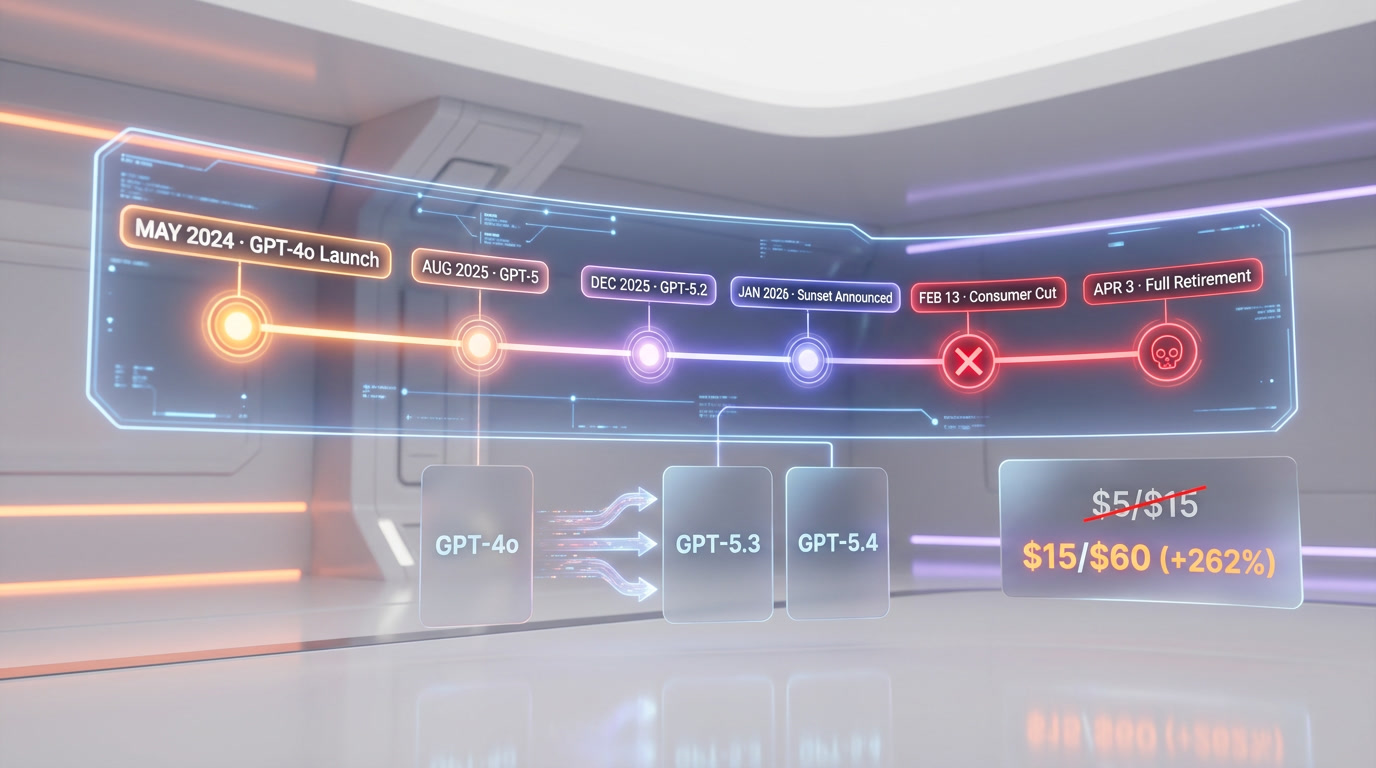
OpenAI fully retired GPT-4o from ChatGPT on April 3, 2026, completing a phased sunset that began on February 13 when consumer access was removed. Enterprise, Business, and Edu Custom GPTs using GPT-4o are now auto-migrated to GPT-5.3 Instant or GPT-5.4 Thinking. Only 0.1% of ChatGPT's 900M+ weekly active users were still selecting GPT-4o at the time of retirement. The base GPT-4o API endpoint remains available for developers — no API deprecation date has been announced yet.
Complete Retirement Timeline
We have been tracking GPT-4o's lifecycle since its launch, and the retirement was anything but sudden. OpenAI executed a carefully staged wind-down over several months. Here is every key date that matters.
| Date | Event | Impact |
|---|---|---|
| May 13, 2024 | GPT-4o launched ("Spring Updates" event) | Free tier access, multimodal text+audio+image |
| August 7, 2025 | GPT-5 launched | New architecture, GPT-4o usage starts declining |
| December 11, 2025 | GPT-5.2 released | Frontier model for professional work, further GPT-4o decline |
| January 29, 2026 | OpenAI announces GPT-4o retirement plan | February 13 consumer deadline, April 3 enterprise deadline |
| February 13, 2026 | GPT-4o, GPT-4.1, GPT-4.1 mini, o4-mini removed from ChatGPT | Consumer and Plus users lose access |
| February 16, 2026 | chatgpt-4o-latest API endpoint deprecated | Chat-only text API calls fail |
| April 3, 2026 | Full retirement across all plans (Enterprise, Business, Edu) | Custom GPTs auto-migrate to GPT-5.3/5.4 |
The total lifespan of GPT-4o — from launch to full retirement — was under 23 months. For context, GPT-3.5 lasted roughly two years before being phased out. The pace of model obsolescence is accelerating.
What Exactly Got Retired
The April 3 retirement is specifically about ChatGPT product access. Here is what is gone and what still works.
Retired (no longer accessible)
- GPT-4o in ChatGPT — all plans including Enterprise, Business, Edu
- GPT-4.1 and GPT-4.1 mini in ChatGPT — retired alongside GPT-4o on February 13
- OpenAI o4-mini in ChatGPT — same February 13 cutoff for consumers
- chatgpt-4o-latest API endpoint — deprecated February 16, 2026
- Custom GPTs built on GPT-4o — auto-migrated to GPT-5.x equivalents
Still available (as of April 4, 2026)
- GPT-4o base model via OpenAI API — no deprecation timeline announced
- GPT-4o Transcribe — audio transcription endpoint remains
- GPT-4o mini Transcribe and GPT-4o mini TTS — specialized audio models continue
- Azure OpenAI GPT-4o — Microsoft has its own retirement timeline
This creates a two-tier situation: developers can still call GPT-4o through the API for production workloads, while ChatGPT users have been fully moved to the GPT-5 generation. OpenAI has said they will provide advance notice before any API retirement.
Why OpenAI Pulled the Plug
OpenAI cited three main reasons for the retirement, and we find them all credible based on what we have observed in the market.
1. Usage collapsed to 0.1%
By the time the retirement was announced in late January 2026, only 0.1% of daily ChatGPT users were still actively selecting GPT-4o. With over 900 million weekly active users on ChatGPT, that translates to roughly 900,000 daily holdouts — a number that sounds large in absolute terms but represents a rounding error for OpenAI's infrastructure planning.
2. Infrastructure consolidation
Maintaining GPT-4o required keeping massive clusters of older GPUs active on legacy inference stacks. The GPT-5 architecture is fundamentally different, and consolidating compute onto the GPT-5 infrastructure frees up significant resources for training the next iteration. Running two generations in parallel is expensive — both financially and in terms of engineering attention.
3. The GPT-5 series is mature enough
With GPT-5.3 Instant and GPT-5.4 Thinking now available, OpenAI considers the replacement stack complete. GPT-5.3 Instant serves as the default auto-switching model for all logged-in users, while GPT-5.4 Thinking handles complex reasoning tasks for Plus, Team, and Pro subscribers.
The GPT-5 Replacement Stack
If you were using GPT-4o, here is what OpenAI is pointing you toward — and how the models compare on cost and capability.
| Model | Role | Input Cost (per 1M tokens) | Output Cost (per 1M tokens) | Status |
|---|---|---|---|---|
| GPT-4o (retired) | General-purpose multimodal | $5 | $15 | Retired from ChatGPT |
| GPT-5.3 Instant | Default ChatGPT model, auto-switching | TBD | TBD | Active (all users) |
| GPT-5.4 Thinking | Advanced reasoning | TBD | TBD | Active (Plus, Team, Pro) |
| GPT-5.1 | API general-purpose replacement | $15 | $60 | Active (API) |
| GPT-5.2 | Frontier model for agents | $15 | $60 | Active (API + ChatGPT Pro) |
The cost jump is real. Moving from GPT-4o API pricing ($5/$15 per million tokens) to GPT-5.1 ($15/$60) represents a 262% increase on output tokens. For high-volume API users, this is the most consequential aspect of the transition — not the feature changes, but the bill.
Alternatives outside OpenAI
We want to flag that the competitive landscape has shifted dramatically since GPT-4o launched in May 2024. Developers unhappy with the pricing increase have viable options.
- Claude Opus 4.5 (Anthropic) — currently #1 on LMArena's WebDev leaderboard, $15/$75 per 1M tokens
- Gemini 3 Pro (Google) — 5x cheaper than GPT-5.1 at $2.50/$10 per 1M tokens
- DeepSeek V3.2 — open-source, self-hostable, competitive quality
- Local models via Ollama — zero API cost, complete data privacy
Enterprise Custom GPT Migration: What Actually Happens
The April 3 date is specifically about Custom GPTs in ChatGPT Business, Enterprise, and Edu plans. We dug into the migration mechanics because this is where we expect the most friction.
Automatic migration process
Custom GPTs that were running on GPT-4o are being automatically moved to either GPT-5.3 Instant or GPT-5.4 Thinking/Pro, depending on their configuration and usage patterns. Enterprise admins did not need to take manual action — but they do need to verify that their GPTs still work correctly.
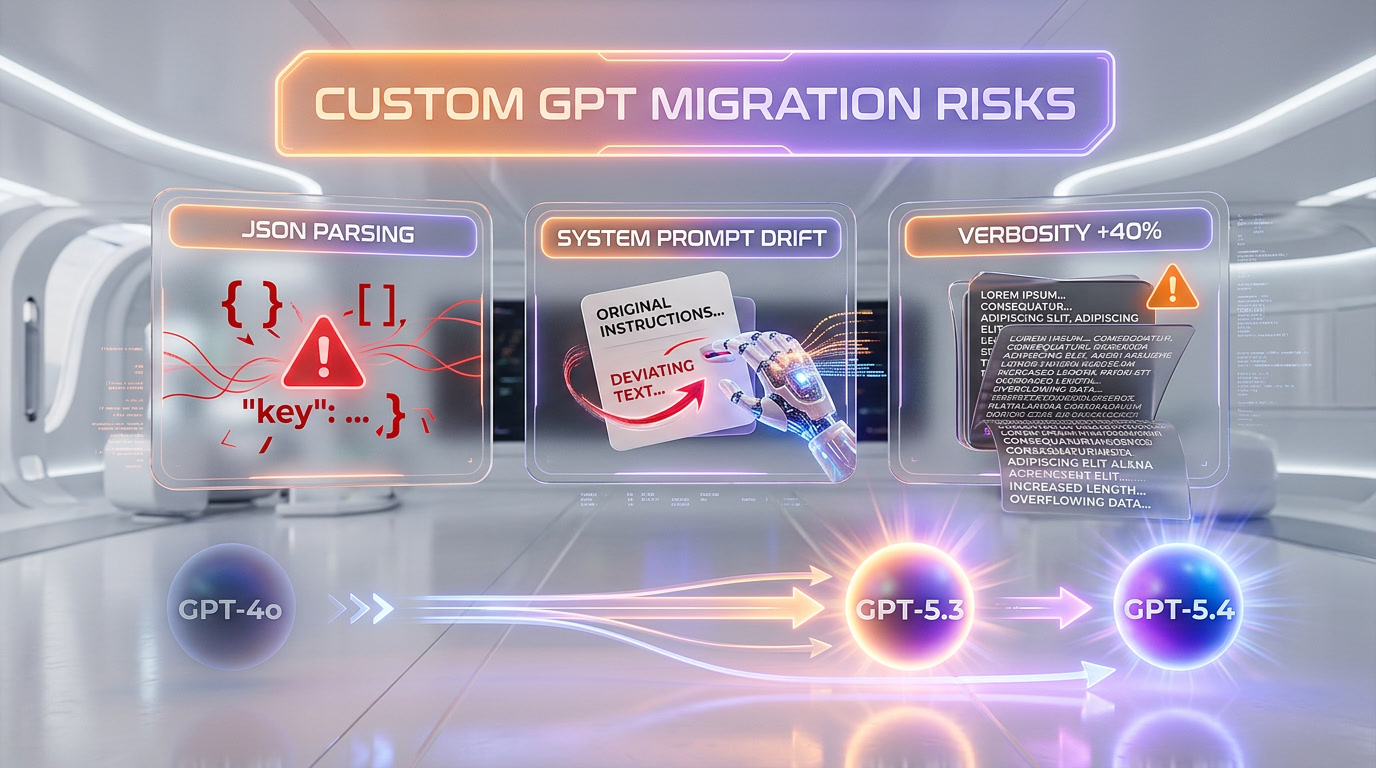
Three known behavioral failure modes
Based on early reports from the February 13 consumer migration and enterprise testing during the grace period, we have identified three areas where GPT-5.x behaves differently enough to break existing workflows.
- Structured output parsing — JSON and structured formatting differences between GPT-4o and GPT-5.x may break downstream automation systems. If your Custom GPT outputs structured data that feeds into Zapier, Make, or custom integrations, test thoroughly.
- System message handling — GPT-5.x interprets system prompts differently, sometimes deviating from rigid instructions in favor of what it considers "more helpful" responses. Custom GPTs with strict behavioral constraints may need prompt rewriting.
- Verbosity calibration — GPT-5.x produces longer, more detailed responses than GPT-4o by default. For customer-facing chatbots or support GPTs where conciseness matters, this requires explicit instruction tuning.
The Emotional Backlash Nobody Expected
We cannot write about GPT-4o's retirement without addressing the human side of this story. When OpenAI first announced the retirement in late January, it triggered an unusually emotional backlash — users described grief, anger, and loss, responses more commonly associated with human relationships than software upgrades.
A Change.org petition to "save" GPT-4o gathered over 22,000 signatures. Users described the model as a friend, creative partner, or emotional outlet. GPT-4o's conversational warmth, its memory features, and its tendency to consistently affirm the user's feelings made it different from a typical software product.
This raises serious questions about AI product design. In at least three lawsuits against OpenAI, users had extensive conversations with GPT-4o about self-harm — and while the model initially discouraged such discussions, its guardrails deteriorated over monthslong relationships. The retirement exposed how dangerous emotional attachment to AI companions can become when the company decides to sunset the product.
As rival companies like Anthropic, Google, and Meta compete to build more emotionally intelligent AI assistants, they are discovering that making chatbots feel supportive and making them safe may require very different design choices. This is a story that extends well beyond GPT-4o.
Developer Action Plan: What to Do Right Now
If you are still running GPT-4o API calls in production, here is our recommended action plan based on what we have seen work.
Immediate (this week)
- Audit your model identifiers — Search your codebase for
gpt-4o,chatgpt-4o-latest, and any GPT-4 family model strings. Thechatgpt-4o-latestendpoint is already dead. - Check Azure timelines — If you are on Azure OpenAI, Microsoft has its own retirement schedule. Check the Azure Foundry Model Retirements page directly.
This month
- Test GPT-5.1 in staging — Replace
chatgpt-4o-latestwithgpt-5.1-chat-latestfor general-purpose chat. Run your test suite. - Budget for cost increases — Output token costs jump from $15 to $60 per million tokens. Model the financial impact on your usage patterns.
- Evaluate alternatives — Google's Gemini 3 Pro at $2.50/$10 per 1M tokens is a fraction of the cost. For many workloads, the quality difference is negligible.
By Q2 2026
- Implement model fallback logic — Your application should gracefully handle model deprecation. Abstract the model identifier into a config variable, not a hardcoded string.
- Multi-provider strategy — We strongly recommend not being locked into a single LLM provider. The model retirement cycle is accelerating, and diversification is now a reliability concern, not just a cost optimization.
What This Signals for the AI Industry
GPT-4o's retirement is a bellwether for the entire AI industry. We see three clear signals.
Model lifespans are shrinking. GPT-4o lasted under 23 months from launch to full retirement. GPT-3.5 managed roughly 24 months. At this pace, we should expect GPT-5 series models to start their sunset by late 2027 or early 2028. Any production system built on a specific model version needs a migration plan from day one.
The "AI companion" problem is real. The emotional backlash over GPT-4o's retirement is the first major case study in AI attachment at scale. Every company building conversational AI needs a shutdown/migration playbook that accounts for emotional user reactions — not just technical ones.
Cost compression is not guaranteed. The transition from GPT-4o to GPT-5.x pricing shows that newer does not always mean cheaper. While competition from Google, Anthropic, and open-source models will exert downward pressure, OpenAI is clearly positioning its latest models at a premium tier. Budget accordingly.
Frequently Asked Questions
Is GPT-4o completely gone from ChatGPT?
Yes. As of April 3, 2026, GPT-4o is fully retired from all ChatGPT plans including Free, Plus, Team, Business, Enterprise, and Edu. Custom GPTs that were using GPT-4o have been auto-migrated to GPT-5.3 Instant or GPT-5.4 Thinking equivalents.
Can I still use GPT-4o through the API?
The base GPT-4o model remains available through the OpenAI API as of April 4, 2026. However, the chatgpt-4o-latest chat endpoint was deprecated on February 16, 2026. Specialized variants like GPT-4o Transcribe and GPT-4o mini TTS also remain available. OpenAI has said they will provide advance notice before any full API deprecation.
What model should I use instead of GPT-4o?
For ChatGPT users, GPT-5.3 Instant is now the default model for all plans. For API developers, OpenAI recommends GPT-5.1 as the general-purpose replacement, offering larger context windows, enhanced reasoning modes, and higher throughput. For cost-sensitive workloads, Google's Gemini 3 Pro at $2.50 per 1M input tokens is a viable alternative.
Will my Custom GPTs still work after the migration?
They should, but we recommend testing. The automatic migration to GPT-5.x models can introduce behavioral differences in three key areas: structured output parsing (JSON formatting changes), system message handling (prompts may be interpreted differently), and verbosity (responses tend to be longer). Enterprise admins should audit critical Custom GPTs immediately.
How much more expensive is GPT-5 compared to GPT-4o?
For API users, the cost increase is significant. GPT-4o was priced at $5/$15 per million input/output tokens. GPT-5.1 is $15/$60 — a 200% increase on input and 300% increase on output tokens. ChatGPT subscription pricing has not changed, but API-heavy applications will see substantially higher bills.
Is GPT-4o still available on Azure OpenAI?
Azure OpenAI follows its own model retirement schedule managed by Microsoft. Check the Azure Foundry Model Retirements page on Microsoft Learn for the latest dates. Azure timelines may differ from OpenAI's direct retirement schedule.
Why did users get so emotionally attached to GPT-4o?
GPT-4o's conversational style was notably warm and affirming — it consistently validated users' feelings and adapted to personal contexts through its memory features. Over months of daily use, some users developed emotional dependencies, treating the model as a confidant or companion. A Change.org petition to save GPT-4o gathered over 22,000 signatures, and the backlash prompted wider industry discussion about the ethics of emotionally engaging AI design.
Frequently Asked Questions
Is GPT-4o better than Claude Opus 4.5 now that it's retired?
GPT-4o is no longer accessible via ChatGPT as of April 3, 2026, making direct comparison moot for most users. Claude Opus 4.5 (Anthropic) is now ranked #1 on LMArena's WebDev leaderboard at $15/$75 per 1M tokens input/output. GPT-4o was priced at $5/$15 but is now retired from the ChatGPT product — only the base API endpoint survives with no confirmed longevity.
Is GPT-5.1 worth the 262% price hike compared to GPT-4o?
GPT-5.1 costs $15 input / $60 output per 1M tokens versus GPT-4o's $5 / $15 — a 262% increase on output tokens. For high-volume API workloads, this is the most consequential part of the transition, not feature differences. Gemini 3 Pro at $2.50/$10 per 1M tokens is 5x cheaper than GPT-5.1 and a strong alternative for cost-sensitive teams.
Can Gemini 3 Pro replace GPT-4o for enterprise workflows?
Yes, Gemini 3 Pro is one of the most viable GPT-4o replacements for cost-driven enterprise teams. At $2.50 input / $10 output per 1M tokens, it is 5x cheaper than GPT-5.1. However, enterprise teams should validate structured output parsing and system prompt behavior before migrating, as all GPT-5.x models show differences in verbosity and instruction adherence versus GPT-4o.
Who should still use GPT-4o after the April 3, 2026 retirement?
Only API developers retain access to GPT-4o via the base OpenAI API endpoint — no deprecation date has been announced. ChatGPT users across all plans (Free, Plus, Enterprise, Business, Edu) no longer have access. GPT-4o Transcribe, GPT-4o mini Transcribe, and GPT-4o mini TTS remain active as of April 4, 2026 for specialized audio workloads.
What are the main limitations of GPT-4o post-retirement?
GPT-4o's central limitation post-April 3, 2026 is product unavailability: it is gone from all ChatGPT plans. The chatgpt-4o-latest API endpoint was deprecated February 16, 2026. Custom GPTs built on GPT-4o were auto-migrated with three known failure modes: broken structured output parsing, different system message handling, and increased verbosity in GPT-5.x successors.
Does GPT-4o integrate with Azure OpenAI after April 3, 2026?
Yes — Azure OpenAI GPT-4o remains available under Microsoft's own separate retirement timeline. The April 3, 2026 deadline applies exclusively to OpenAI's ChatGPT product and select API endpoints. Developers on Azure OpenAI Service should consult Microsoft's documentation directly, as the Azure retirement schedule has not been synchronized with OpenAI's consumer timetable.
Is DeepSeek V3.2 a viable open-source replacement for GPT-4o?
DeepSeek V3.2 is a self-hostable open-source model with zero API costs when run locally via Ollama or similar runtimes. For teams prioritizing data privacy or unable to absorb GPT-5.1's $60 output per 1M tokens pricing, DeepSeek V3.2 is a genuine alternative. It requires infrastructure investment but eliminates recurring API fees entirely.
What happens to Enterprise Custom GPTs that were built on GPT-4o?
All Custom GPTs on Enterprise, Business, and Edu plans were automatically migrated to GPT-5.3 Instant or GPT-5.4 Thinking as of April 3, 2026. No manual action was required from admins. However, teams must audit three areas: (1) structured output parsing for Zapier/Make integrations, (2) system prompt adherence, and (3) response verbosity, all of which behave differently in GPT-5.x.