John Jumper, the Google DeepMind scientist who led the AlphaFold team and shared the 2024 Nobel Prize in Chemistry, is leaving Google DeepMind after nearly nine years to join Anthropic, the maker of Claude. Jumper announced the move on X on Thursday, June 19, 2026, saying he would take some time to recharge before starting. Neither Jumper nor Anthropic has disclosed what role he will take. The hire matters because it is the second landmark departure from Google's AI operation in 48 hours — Gemini co-lead Noam Shazeer announced he was leaving for OpenAI a day earlier — and because it pulls one of the world's most decorated AI-for-science researchers toward Anthropic's fast-growing push into biology and medicine. In short: a Nobel-winning protein-folding pioneer just picked Anthropic over the lab where he made his name, and that choice is a signal about where the AI-for-science talent war is heading.
To understand why this lands harder than a routine executive shuffle, you have to understand who Jumper is. He is not a generalist manager who happened to run an AI team. He is the researcher who led AlphaFold, the system that effectively solved one of biology's hardest open problems, and he has a Nobel Prize to show for it. Losing that person to a direct competitor is the kind of event a frontier lab notices for years, not weeks.
What Actually Happened
On Thursday, June 19, 2026, John Jumper announced on X that he is leaving Google DeepMind to join Anthropic. According to reporting from outlets including TechCrunch and The Next Web, Jumper said he would take some time to recharge before starting at the Claude maker. He had been at DeepMind for nearly nine years.
What he will actually do at Anthropic has not been disclosed. As of his announcement, neither Jumper nor Anthropic had said what title or mandate he would hold. That detail matters, and we will come back to why the silence is itself interesting. For now, the confirmed facts are narrow and clean: a senior DeepMind scientist who led AlphaFold is moving to Anthropic, the timing puts him among the company's most high-profile science hires, and the specifics of his role remain open.
In his announcement, Jumper reflected on how his career at DeepMind began, writing that "Demis Hassabis took a real chance letting me lead the AlphaFold team just six months after finishing my PhD." That line is worth pausing on, because the person who gave him that chance — DeepMind chief executive Demis Hassabis — is also the person he shared the Nobel Prize with. Jumper is not leaving after a falling out narrative; he is leaving on a note of gratitude. The departure is about where he wants to work next, not about burning a bridge.
Who John Jumper Is, and Why AlphaFold Was a Watershed
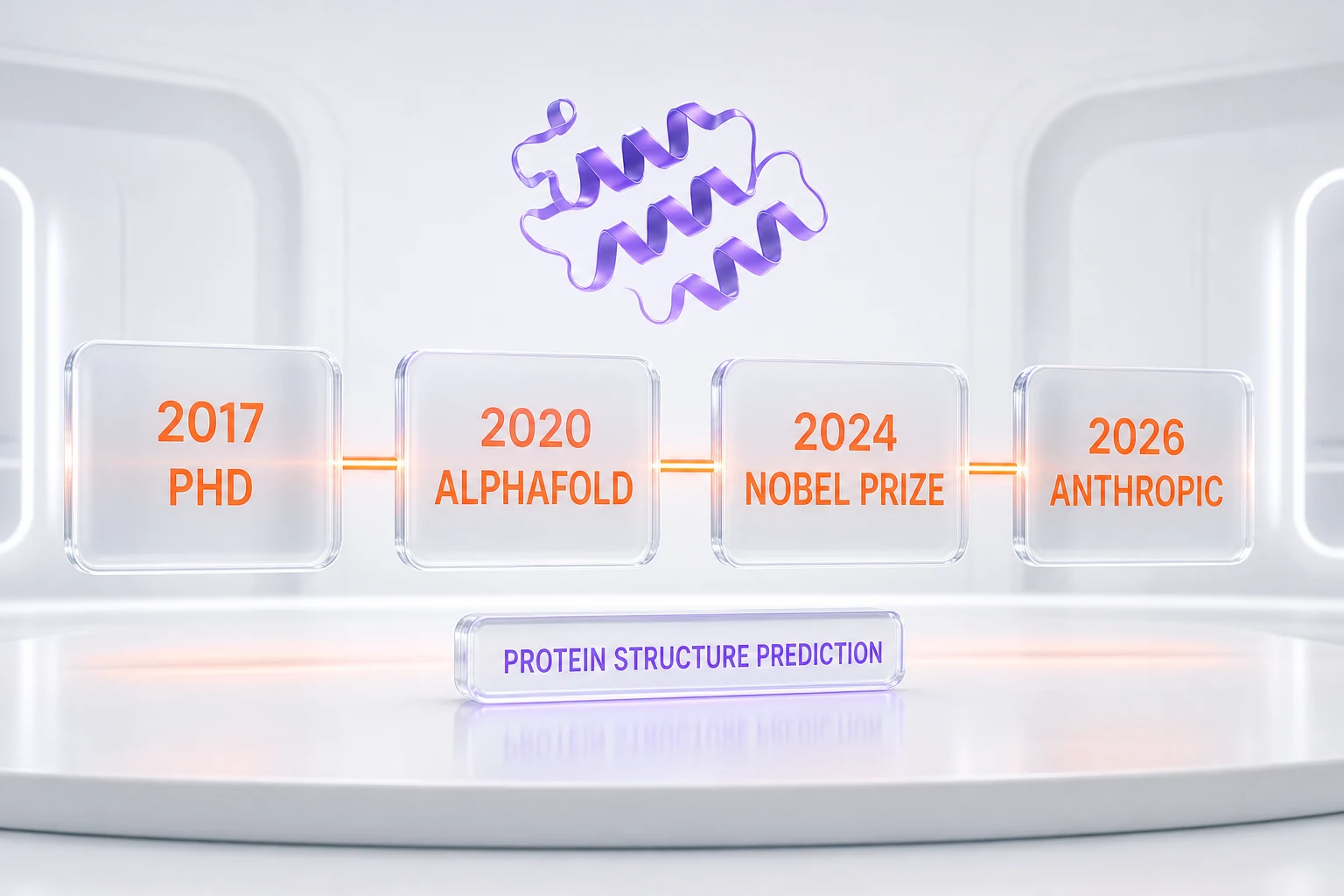
Jumper earned a PhD in theoretical chemistry from the University of Chicago in 2017. Within months of finishing it, he was leading the AlphaFold effort at DeepMind. AlphaFold is an artificial intelligence system that predicts the three-dimensional structure of a protein from its amino acid sequence — a task that had resisted decades of effort in molecular biology.
The breakthrough is not abstract. Knowing a protein's shape is the gateway to understanding what it does, how diseases hijack it, and how a drug might bind to it. AlphaFold2 won the CASP structure-prediction competition in November 2020, with the landmark paper published in July 2021. The team then released the AlphaFold Protein Structure Database, which had made available more than 200 million predicted protein structures by early 2024 — effectively handing the global research community a structural map of much of known biology.
That work earned Jumper and Demis Hassabis the 2024 Nobel Prize in Chemistry for protein structure prediction; the other half of that year's prize went to David Baker for computational protein design. It is one of the clearest examples to date of an AI system producing a result the broader scientific establishment recognized as foundational. When a researcher with that resume changes employers, the move reads as a statement about the field, not just a personal career decision.
Why Anthropic, and Why Now
Anthropic has spent the past year building out a life-sciences and healthcare practice with unusual speed. It launched Claude for Life Sciences in October 2025 and Claude for Healthcare in January 2026. In April 2026 it acquired Coefficient Bio, a stealth computational-biology startup of fewer than ten people — most of them former Genentech Prescient Design researchers — in a deal reported at roughly $400 million in stock. Company leadership has framed the ambition bluntly: it wants a meaningful percentage of the world's life-science work to run on Claude.
Seen against that backdrop, hiring the person who led AlphaFold is less a surprise than a logical next step. Anthropic is assembling the components of an AI-for-science platform — domain models, a healthcare and life-sciences division, and now, potentially, one of the field's most credible scientific minds. Whether Jumper ends up running a research group, advising on a biology-focused model, or shaping strategy, his presence alone strengthens Anthropic's claim to be serious about science rather than dabbling in it.
The undisclosed role is the open question. It could mean the mandate is still being defined, or that Anthropic is keeping its powder dry until Jumper has formally started after his break. Either way, a company does not land a Nobel laureate by accident, and Anthropic's recent acquisitions suggest a team that knows exactly what it is building toward. We would not read too much into the silence beyond noting that the hire fits a pattern that has been visible for months.
The Bigger Picture: Google's Brain-Drain Week
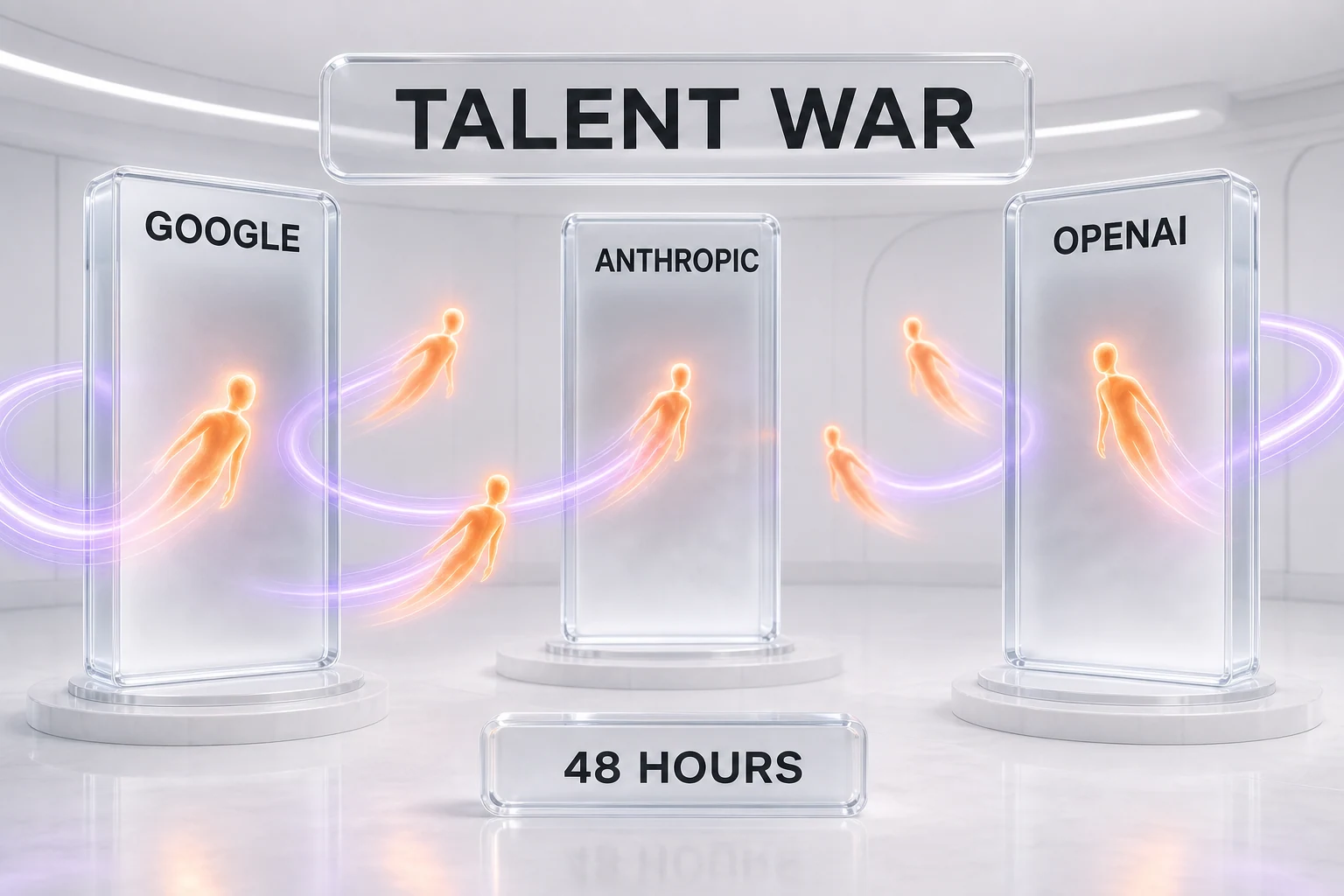
Jumper's exit did not happen in isolation. A day earlier, on June 18, 2026, Gemini co-lead Noam Shazeer — a co-author of the 2017 Transformer paper "Attention Is All You Need" — announced he was leaving Google for OpenAI. Two of the most consequential figures in Google's AI orbit announced departures to two of Google's biggest rivals within roughly 48 hours. (We covered the Shazeer move and why it lands harder than a normal executive exit in our analysis of Noam Shazeer leaving Google for OpenAI.)
It is worth being precise about what this is and is not. Two high-profile exits in a short window is a striking pattern, and it is reasonable to read it as a sign that the most sought-after AI talent has more leverage and more attractive alternatives than ever. It is not, on the available evidence, proof of an exodus or of internal collapse at Google. Researchers move for many reasons — new problems, new equity, a fresh mandate — and a 48-hour cluster can be partly coincidence. The honest framing is that the talent market for elite AI researchers is now so competitive that even Nobel laureates and Transformer co-authors are in play, and Google is currently on the losing side of two very visible trades.
What the AI-for-Science Talent War Signals
Step back from the personalities and a clearer pattern emerges. The frontier AI race is no longer only about who has the biggest model or the most compute. It is increasingly about who can apply that intelligence to high-value scientific domains — drug discovery, protein engineering, materials, diagnostics — where the payoff is measured in breakthroughs and, eventually, in markets worth far more than chatbots.
That shift changes what kind of talent matters most. A general-purpose research star is valuable, but a researcher who has already turned AI into a Nobel-grade scientific result is rarer still. Jumper sits in that second category. His move toward Anthropic signals that the company believes its future advantage lies partly in science, and that it is willing to compete at the very top of the market to get there.
For OpenAI, the Shazeer hire reinforces depth at the architecture and modeling core. For Anthropic, the Jumper hire points outward, toward applying frontier models to biology. The two moves, taken together, sketch a competitive map: the leading labs are no longer just racing on raw capability, they are staking out the domains where that capability will pay off. AI for science is one of the most contested of those domains, and the people who can credibly lead it are now among the most fought-over hires in technology.
There is also a practical lesson for anyone building on these platforms. When a lab recruits a scientist of Jumper's stature, it is a leading indicator of where that lab intends to invest. If you build products, research workflows, or tools on top of Claude, Anthropic's deepening commitment to life sciences is a signal worth tracking — the capabilities that follow a hire like this tend to show up in the product over the following year, not the following week.
What Would Change Our Read
A few developments would sharpen this picture. If Anthropic announces a specific, senior science mandate for Jumper — say, leading a biology-focused research effort or a dedicated AI-for-science lab — that would confirm the strategic reading and raise the stakes. If, on the other hand, the role turns out to be advisory or loosely defined, the hire would still matter for prestige and recruiting, but less so for near-term product direction.
The other variable is Google's response. Losing two marquee names in 48 hours invites scrutiny of retention, compensation, and research culture. If more senior departures follow in the coming weeks, the "brain-drain week" framing hardens into something more structural. If the exits stop here, this looks more like two unusually high-profile trades than a trend. For now, we are treating it as a strong signal in an intensifying talent war — not a verdict on any single lab's health.
Either way, the throughline is hard to miss. The most valuable currency in frontier AI is increasingly the small number of people who can turn models into scientific results, and in the span of two days, two of the most recognizable of them changed sides. That is the real story behind a Nobel laureate leaving DeepMind for Anthropic.
Frequently Asked Questions
Who is John Jumper?
John Jumper is a research scientist who led the AlphaFold team at Google DeepMind and shared the 2024 Nobel Prize in Chemistry with DeepMind chief executive Demis Hassabis for protein structure prediction. He earned a PhD in theoretical chemistry from the University of Chicago in 2017 and began leading AlphaFold within months of finishing it. On June 19, 2026, he announced he is leaving Google DeepMind, after nearly nine years, to join Anthropic, the maker of Claude.
What is AlphaFold and why does it matter?
AlphaFold is an artificial intelligence system, developed at DeepMind, that predicts the three-dimensional structure of a protein from its amino acid sequence — a problem that had resisted decades of effort in biology. AlphaFold2 won the CASP structure-prediction competition in November 2020, and the landmark paper was published in July 2021. The team later released a database of more than 200 million predicted protein structures, giving researchers worldwide a structural map of much of known biology and accelerating work in areas such as drug discovery and disease research.
Why is John Jumper joining Anthropic?
Neither Jumper nor Anthropic has disclosed his specific role. The hire aligns with Anthropic's rapid expansion into life sciences and computational biology: the company launched Claude for Life Sciences in October 2025 and Claude for Healthcare in January 2026, and in April 2026 it acquired the computational-biology startup Coefficient Bio in a deal reported at roughly $400 million in stock. Anthropic's leadership has said it wants a meaningful percentage of the world's life-science work to run on Claude, so recruiting the person who led AlphaFold fits a clear strategic pattern.
Is this connected to Noam Shazeer leaving Google for OpenAI?
The two events are not formally linked, but they happened within roughly 48 hours and form a striking pattern. On June 18, 2026, Gemini co-lead and Transformer co-author Noam Shazeer announced he was leaving Google for OpenAI; the next day, Jumper announced his move to Anthropic. Together they represent the second landmark departure from Google's AI operation in two days, which is why some observers have described it as a "brain-drain week" for Google's AI talent.
What does this mean for the AI race?
It signals that the frontier AI competition is increasingly about applying models to high-value scientific domains — biology, drug discovery, materials — and not only about raw model capability. Anthropic landing a Nobel laureate who led AlphaFold strengthens its claim to be a serious player in AI for science, while OpenAI adding a Transformer co-author reinforces its modeling core. The deeper takeaway is that elite AI-for-science researchers are now among the most contested hires in technology, with leading labs willing to compete at the very top of the talent market to secure them.
Did John Jumper say why he is leaving DeepMind?
He did not frame it as a dispute. In his announcement, Jumper reflected warmly on his time at DeepMind, writing that "Demis Hassabis took a real chance letting me lead the AlphaFold team just six months after finishing my PhD." He said he would take some time to recharge before starting at Anthropic. On the available evidence, the move reads as a choice about where he wants to work next rather than a reaction to anything at Google DeepMind.